Welcome to the Weekend Gene Pool. You know the drill. We give you a topic, you spill your guts, we betray you by publishing it next week with snarky comments.
We’ll get to that in a minute. But first, a brief nod to what seems to be a burgeoning scandal in the Trump regime, one that was almost totally ignored yesterday, drowned out by more salacious semi-details in The Epstein Chronicles. I’d considered waiting a bit to address this new scandal-in-progress but I came up with the perfect name for it, and I wanted to stake that claim, which I have done with the headline above.
Here is the story.
Until Watergate, the existing American scandal standard was “The Teapot Dome Affair,” though “-dome” never entered the lexicon as “-gate” did for required scandal suffixery. (Tragically, the 1959 steel scandal never became “Chromedome.”)
Teapot Dome was a rather simple affair. Warren Harding’s Secretary of the Interior, Albert Fall, a man who looked like an angry and constipated Mark Twain,
… took bribes from oilmen amounting to hundreds of thousand of dollars’ worth of cash and cows — he was also a rancher — in return for leasing them government oil reserves in the West that included the Teapot Dome field in Wyoming, which was no beaut of a butte; it was said to look something like a teapot, with its spout, but only as designed by those architects of Herman Goering’s priapic tables.
Teapot DomePriapic Table
Eventually, Fall, the fall guy, fell. He did a year of hard labor in the teapot can.
—
Kristi Noem — former governor of South Dakota — is also a Westerner, and also a rancher, and also a member of the president’s Cabinet and as such also controls huge domestic budgets, and also is connected by photographs to large mountains.
The beginnings of the Teapot Noem® Affair were revealed yesterday by ProPublica. Here are the headlines:
Firm Tied to Kristi Noem Secretly Got Money From $220 Million DHS Ad Contracts
The company is run by the husband of Noem’s chief DHS spokesperson and has personal and business ties to Noem and her aides. DHS invoked the “emergency” at the border to skirt competitive bidding rules for the taxpayer-funded campaign.
…
The majority of the money — $143 million — has gone to a mysterious LLC in Delaware. The company was created just days before it was awarded the deal.
—
Honestly, you don’t need to know more than that. Or maybe you do. I myself didn’t read any further because the Epstein news of the day seemed to imply the possibility that Donald Trump once gave Bill Clinton a blow job. That story seems pretty, um, inflated, but you know. Eyeballs.
More on Kristi “Twisti” Noem later in the week, I am guessing.
—
Today’s Gene Pool challenge is based on something that happened to me last evening. I was in my car, traveling west on Massachusetts Avenue, a bustling two way thoroughfare in D.C. I turned right onto 15th Street SE, a one-lane, one-way street going my way. This street had a bike lane, which was, of course, also one-way in the same direction as the street. I checked to my left for bikers. There were none. So I turned right. This turn was legal and prudent. And that is when I almost killed a young woman and a girl I presumed to be her daughter, who looked to be about seven. They were on an electric scooter. The girl was standing in front of her mom, between mom and the handlebars.
The scooter was going the wrong way in the bike lane at twilight. It was rolling to a stop for the light, but moving faster than I was.
I had to jam on my brakes and veer to the left to avoid them. Then I did something I almost never do. I butted in to something that was Clearly Not My Business. I pulled to the curb and got out of my car. They were still at the light.
I said, “Ma’am, this is not my business, but I think you’re risking both of your lives by driving the wrong way in a bike lane on a one-way street at night. I almost hit you. I don’t think you should do this.”
She stared at me, blandly. She did not seem offended.
“Okay,” she said.
The light changed.
She roared off, at maybe 20 miles an hour, down the bike lane, the wrong way on a one-way street, into the darkening, menacing night.
—
So, that is your challenge for the day. What is some advice — buttinsky or otherwise — that you once gave with the best of intentions that either backfired orwas ignored to someone’s detriment, or yours?
Send ’em as always, here. (snip-a bit MORE and a little poll on the page)
Restore the White House, and send the bill to Trump
Suppose I bulldozed somebody’s house, without his or her permission.
Hopefully I would be given due process, but if found guilty, part of my punishment would be to make restitution to the owner of the house. The atrocity that Donald Trump has perpetuated on the White House, which is “the people’s house,” not his, should not stand.
Any continuation of this project should cease immediately. This proposed vulgar, grandiose ballroom overwhelms the elegant but intentionally modest structure of the original building, and is an inappropriate symbol of a monarch, rather than a democracy, which this country hopes to remain. The only correct solution is to abandon this outlandish project and restore the White House to its previous condition.
This task should be taken on by those experts responsible for the preservation, renovation and restoration of historic government buildings. To those who believe that such a restoration would be impossible, I cite the restored Notre Dame Cathedral. Restitution for this crime should be borne by the perpetrator, Donald Trump. Returning the White House to its previous condition would symbolize our recommitment to the preservation of our nation as a democracy.
November 14, 1910 Eugene Ely performed the first airplane takeoff from a ship. His Curtiss pusher flew from the deck of the U.S.S. Birmingham in Hampton Roads, Virginia.By January he would execute the first (takeoff and) landing on a warship, the U.S.S. Pennsylvania. Captain Washington I. Chambers of the Navy Department had been interested in the military uses for the seven-year-old invention. Naval flight training started shortly thereafter. More of the whole story.
November 14, 1954 “Ten Million Americans Mobilized for Justice” began a campaign to collect 10 million signatures on a petition urging the Senate not to censure Senator Joseph McCarthy (R-Wisconsin). The motion of censure against Senator McCarthy was for obstructing a Senate committee and for acting inexcusably and reprehensibly toward a U.S. soldier appearing before his own committee. McCarthy had used his Senate Permanent Investigations Subcommittee to publicly denounce thousands as subversive, especially within the federal government, many without any justification. The political views of most were painted as treasonable and conspiratorial, rather than differing political views. The petition effort fell about nine million signatures short. More on Joe McCarthy
November 14, 2000 Florida Secretary of State Katherine Harris, simultaneously co-chair of George W. Bush’s Florida presidential campaign organization and the public official responsible for the conduct of the election itself, certified Governor Bush’s fragile 300-vote lead over Vice President Al Gore in the 2000 presidential election. Katherine Harris Florida Judge Terry Lewis gave Harris the authority to accept or reject a follow-up manual recount from some counties where the count was open to question. Harris rejected the manual recounts.
Leading up to the 2024 presidential election, U.S. Army veteran Sae Joon Park kept in mind a warning from an immigration officer: If Donald Trump were elected, Park would likely be at risk for deportation.
Park was 7 when he came to the U.S. from Seoul, South Korea. He joined the Army at 19 and received a Purple Heart after being shot in Panama. After leaving the military, he lived with PTSD, leading to addiction issues.
After a 2009 arrest on a drug charge, Park was eventually ordered deported. But because he was a veteran, he was granted deferred action, allowing him to remain in the U.S. while he checked in with immigration officials annually.
For 14 years he did just that, while raising children and building a new life in Honolulu. Then in June, when Park went in for his appointment, he learned he had a removal order against him. Instead of facing extended time in detention, he chose to self-deport.
“They allowed me to join, serve the country — front line, taking bullets for this country. That should mean something,” he said.
Instead, “This is how veterans are being treated.”
During his first term in office, Trump enacted immigration policies aimed at a group normally safe from scrutiny: noncitizens who serve in the U.S. military. His administration sought to restrict avenues for immigrant service members to obtain citizenship and make it harder for green card holders to enlist — actions that were unsuccessful.
Now, military experts and veterans say service members are once again targets of the president’s immigration policies.
“President Trump campaigned on a promise of mass deportations, and he didn’t exempt military members, veterans and their families,” said retired Lt. Col. Margaret Stock, a lawyer who helps veterans facing deportation. “It harms military recruiting, military readiness and the national security of our country.”
Both policies barred enforcement actions against active-duty service members, absent aggravating factors. Under the new policy, noncitizen relatives of service members are not addressed.
Some service members, like Park, are choosing to self-deport. In other instances, immigrant family members of soldiers or veterans have been detained — including Narciso Barranco, a father of three U.S. Marines who was detained earlier this year in Santa Ana, California.
“The people being ripped from our communities are hardworking, honest, patriotic people who are raising America’s teachers, nurses and Marines,” Barranco’s son, veteran Alejandro Barranco, testified in July to a U.S. Senate subcommittee. “Deporting them doesn’t just hurt my family. It hurts all of us.”
This image provided by News21 shows Michael Evans, a veteran who has been deported, hugging Diane Vega, a veteran and volunteer, at the Deported Veterans Support House on Saturday, June 28, 2025, in Ciudad Juárez, Mexico. (Sydney Lovan/News21 via AP)
There is no publicly available data on how many veterans are being affected, though ICE is supposed to track service member removals and the Department of Homeland Security is typically required to share that information with Congress.
A 2019 federal report found 250 veterans had been placed in removal proceedings between 2013 and 2018. News21 could find only two DHS reports tracking removals of veterans. One, covering the first half of 2022, said five veterans had been deported; another, for calendar year 2019, said three veterans had been deported.
In June, U.S. Rep. Yassamin Ansari, an Arizona Democrat, and nine members of Congress wrote to federal officials seeking the number of veterans currently facing deportation — noting “some estimates” put the overall number of deported veterans at 10,000.
Her office did not return messages. DHS and ICE also did not respond to questions.
Federal lawmakers have proposed several bills to protect immigrant service members and their relatives. One measure, introduced in May, would give green cards to parents of service members and allow those already deported to apply for a visa.
U.S. Sen. Tammy Duckworth, an Illinois Democrat and Army veteran, has sponsored some of that legislation. She told News21: “This is about the men and women who wore the uniform of our great nation, many of whom were promised a chance at citizenship by our government in exchange for their service. It’s about doing the right thing.”
As of February 2024, more than 40,000 foreign nationals were serving in active and reserve components of the Armed Forces, according to the Congressional Research Service. Another 115,000 were veterans living in the U.S.
Serving in the military has long been a pathway to citizenship, with provisions providing expedited naturalization dating back to the Civil War.
During designated periods of hostility, noncitizens who serve honorably for even one day are eligible to apply for naturalization if they meet all criteria. The U.S. has been in a period of hostility since 2001.
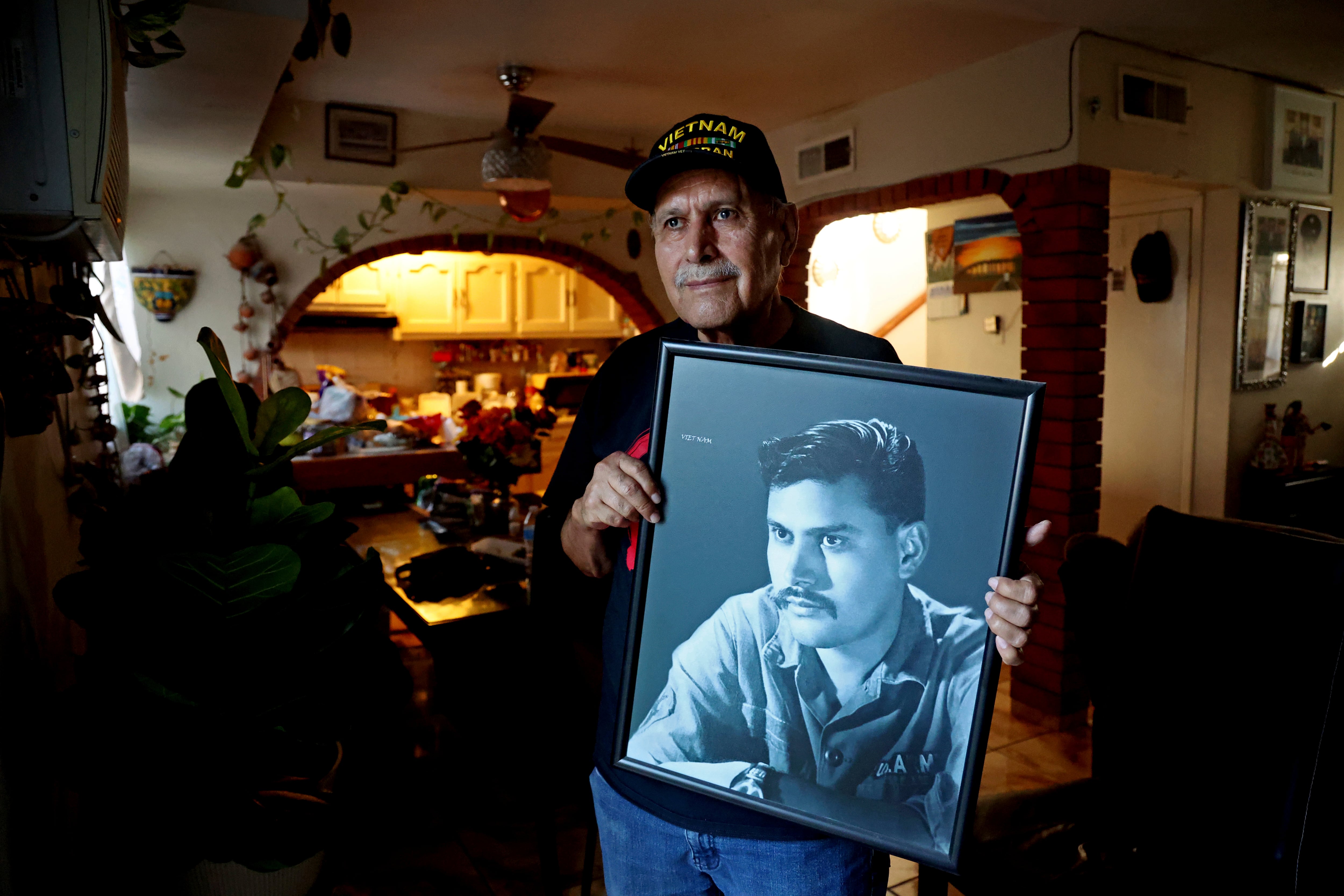
This image provided by News21 shows Army veteran Jose Francisco Lopez holding a portrait from his time in service on June 28, 2025, at the Deported Veterans Support House in Ciudad Juárez, Mexico. (Sydney Lovan/News21 via AP)
Despite that longstanding policy, the Department of Defense, during Trump’s first term, required service members to complete six months before obtaining military documents required to apply for citizenship.
The American Civil Liberties Union sued, and in 2020, a federal judge struck down the change. The Biden administration wound up rescinding the six-month policy.
Nevertheless, ACLU attorney Scarlet Kim said: “If you don’t get your citizenship while you’re serving and then you’re discharged … you can potentially become vulnerable to deportation.”
That’s the situation facing Army veteran Marlon Parris.
Parris, born in Trinidad, has been in the U.S. with a green card since the 1990s. He served in the Army for six years and received the Army Commendation Medal three times, according to court records.
Before his discharge in 2007, he was diagnosed with PTSD — which was cited when Parris pleaded guilty in 2011 to conspiracy to distribute cocaine and sentenced to federal prison.
Upon his release in 2016, the government assured him he would not be deported, according to the group Black Deported Veterans of America. But on Jan. 22, agents detained Parris near his home in Laveen, Arizona. In May, a judge ruled he was eligible for deportation.
His wife, Tanisha Hartwell-Parris, told News21 the couple plan to self-deport and bring along some of the seven children, ranging in age from 8 to 26, who are part of their blended family.
“I’m not going to put my husband in a situation to where he’s going to be a constant target, especially in the country that he fought for,” she said.
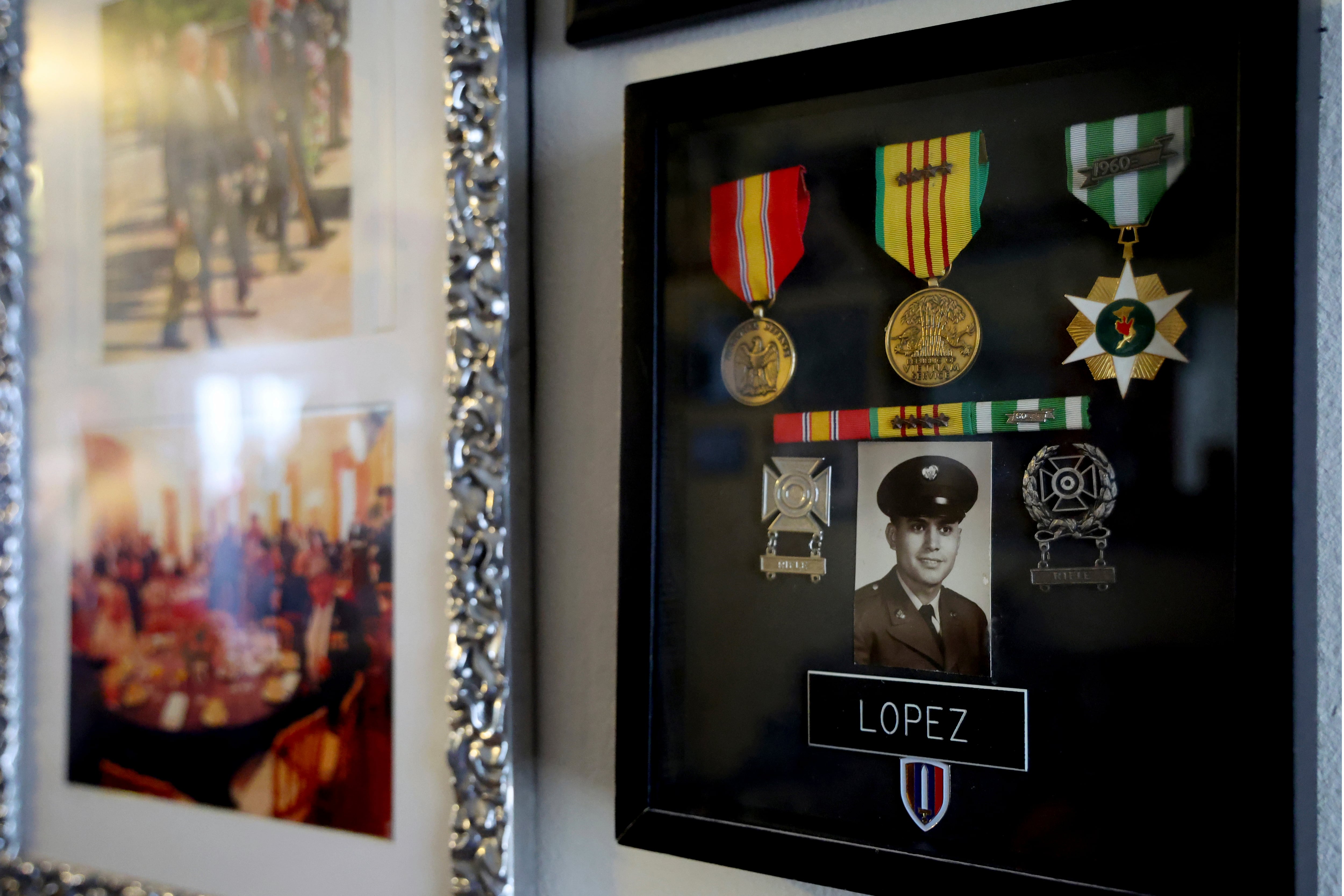
This image provided by News21 shows memorabilia from Jose Francisco Lopez’s service during the Vietnam War displayed inside the Deported Veterans Support House on Saturday, June 28, 2025, in Ciudad Juárez, Mexico. (Sydney Lovan/News21 via AP)
A report published last year by the Veterans Law Practicum at the University of California, Berkeley, School of Law noted that more than 20% of veterans with PTSD also have a substance use disorder, and that can result in more exposure to the criminal justice system.
That situation is “the most common scenario in terms of how deportation is triggered,” said Rose Carmen Goldberg, who oversaw completion of the report and now teaches in the Veterans Legal Services Clinic at Yale Law School.
The report stressed that even though deportation does not disqualify veterans from benefits earned through service, “Geographic and bureaucratic barriers may … stand in the way.”
In 2021, the Biden administration launched the Immigrant Military Members and Veterans Initiative (IMMVI) to ensure deported veterans could access Veterans Affairs benefits. The program offered parole to those needing to return to the U.S. for legal services or health care.
Jennie Pasquarella, a lawyer with the Seattle Clemency Project, said the biggest flaw of the program is that parole into the U.S. is temporary — a “dead end” if a veteran doesn’t have a legal claim to restore legal residency or to naturalize.
“We had asked the Biden administration to do more to ensure that there was a further path towards restoring people’s lawful status beyond parole,” she said. “Basically, we didn’t succeed.”
In the absence of aid in the U.S., more veterans are turning to help elsewhere.
José Francisco Lopez, a native of Torreón, Mexico, and Vietnam War veteran, experienced PTSD and addiction. He eventually went to prison for a drug-related crime and in 2003 was deported.
“I almost gave my life in Vietnam, and now they just throw me away like garbage,” he said.
For years, Lopez thought he was the only deported veteran in Mexico — until he met Hector Barajas, a deported Army veteran who in 2013 founded the Deported Veterans Support House in Tijuana.
Inspired, Lopez opened his own Support House in Ciudad Juárez.
Lopez, 80, is now a legal resident of the U.S. but splits his time between El Paso and Juárez, providing deported veterans housing, food and advice about how to apply for benefits. Since opening the support house in 2017, he’s helped about 20 people.
Back in Seoul, Park, 56, is adjusting to life in a country he hadn’t visited in 30 years. When he first arrived, he cried every morning for hours.
“It’s a whole new world,” he said. “I’m trying to really relearn everything.”
Park’s attorney started a petition to urge prosecutors to dismiss his criminal convictions, to help cancel his deportation order. More than 10,000 people have signed.
Park said he’s grateful for the support but has little faith he will ever be allowed to return to the U.S. He said: “This is not the country that I volunteered and fought for.”
News21 reporters Tristan E.M. Leach, Sydney Lovan and Gracyn Thatcher contributed to this story. This report is part of “Upheaval Across America,” an examination of immigration enforcement under the second Trump administration produced by Carnegie-Knight News21.
Abby Martin joins the program to discuss her new film, Earth’s Greatest Enemy which exposes the U.S. military as the world’s largest polluter. Live-streamed on November 6, 2025.
Apparently, Sunday night is the new big news night. To keep us up to date on today’s developments, it’s a rare Monday morning update.
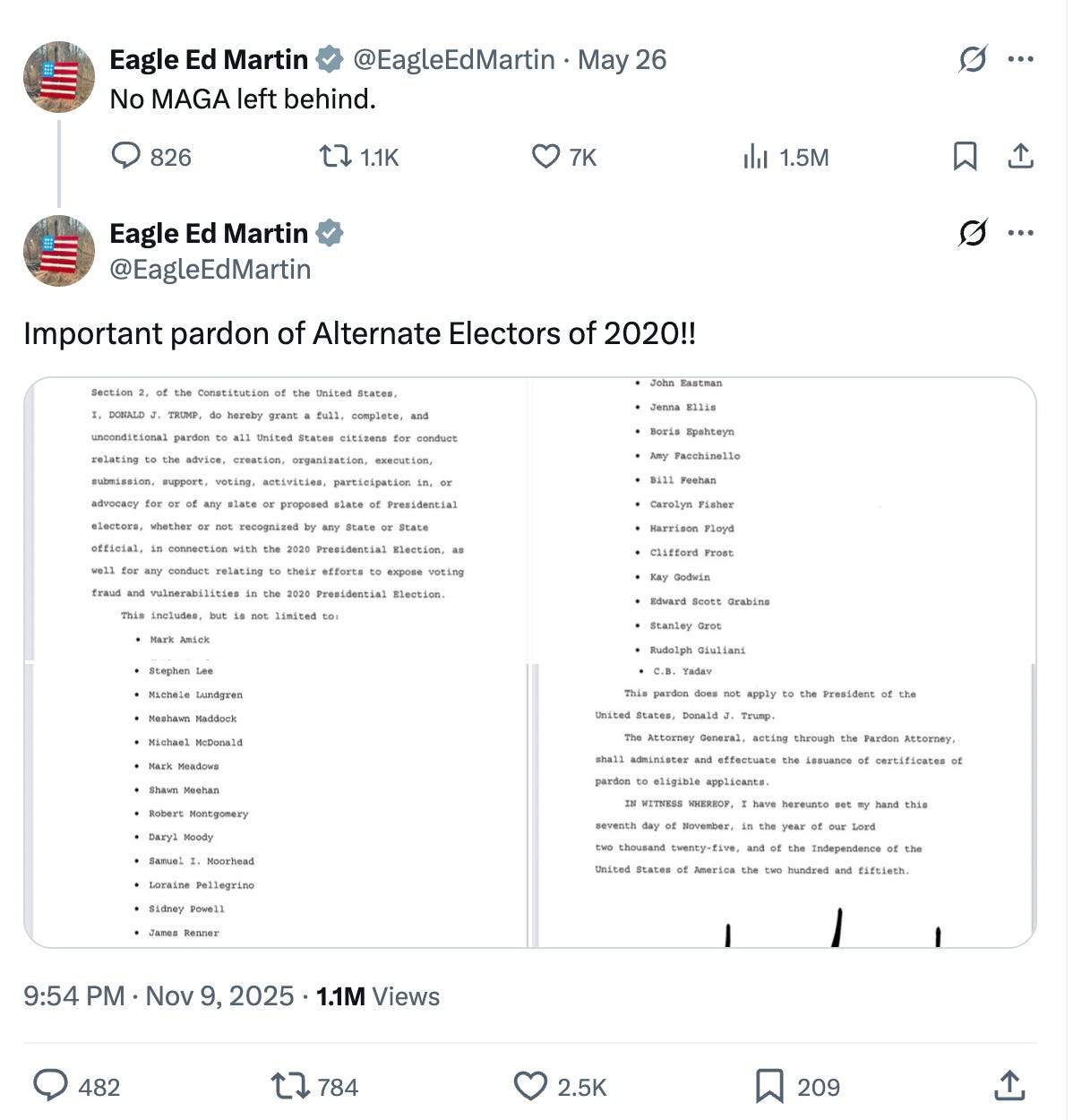
Late last night, Trump issued pardons. However, it’s an unusual list that leaves us reading tea leaves, because these aren’t individuals being prosecuted by the federal government or even people who are at risk of being prosecuted, given the current administration—those are the people who usually want and need a pardon. These pardons don’t apply to ongoing state prosecutions of fake slates of electors in places like Arizona and Nevada.
These names still don’t appear on the White House’s official pardon list. News of the pardons came from a tweet made by Trump’s man at DOJ, Ed Martin. And it wasn’t subtle: “No MAGA left behind.”
The list names a cast of familiar characters, including Rudy Giuliani, Boris Epshteyn, John Eastman, Mark Meadows, Sidney Powell, Ken Chesebro, Michael Roman, Christina Bobb, Kelli Ward, and Jenna Ellis. They are all people who advanced Trump’s effort to claim victory after losing the 2020 election. But that’s not the full extent of it. The document Martin posted purports to be a broad pardon, akin to those following the Civil War that pardons everyone involved (although here, there is no requirement to take a loyalty oath to the United States as there was following the war). It’s part of Trump’s ongoing effort to rewrite the history of January 6 and the insurrection and a signal that anyone who serves him will be protected and rewarded.
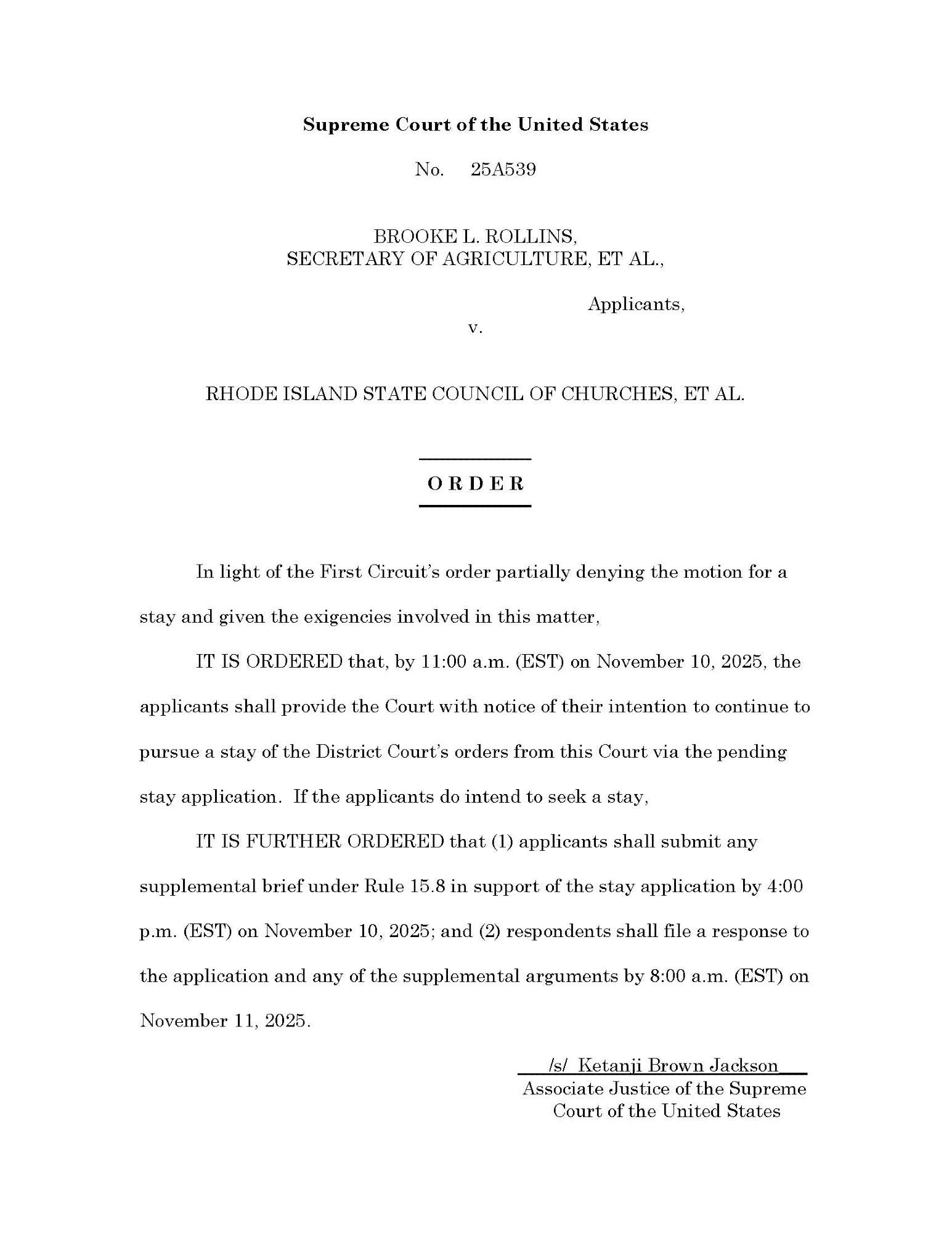
Late last night, the First Circuit rejected the administration’s request for a stay of a lower court order requiring it to make SNAP payments from emergency funds. That left the ball in the Supreme Court’s hands. Justice Jackson promptly issued a briefing schedule that requires both sides, as well as any amici, to file their briefs on the matter today. This proceeding is limited to the question of whether the district court’s order that the administration must proceed with November SNAP payments should be stayed (paused) while the lawsuit proceeds.
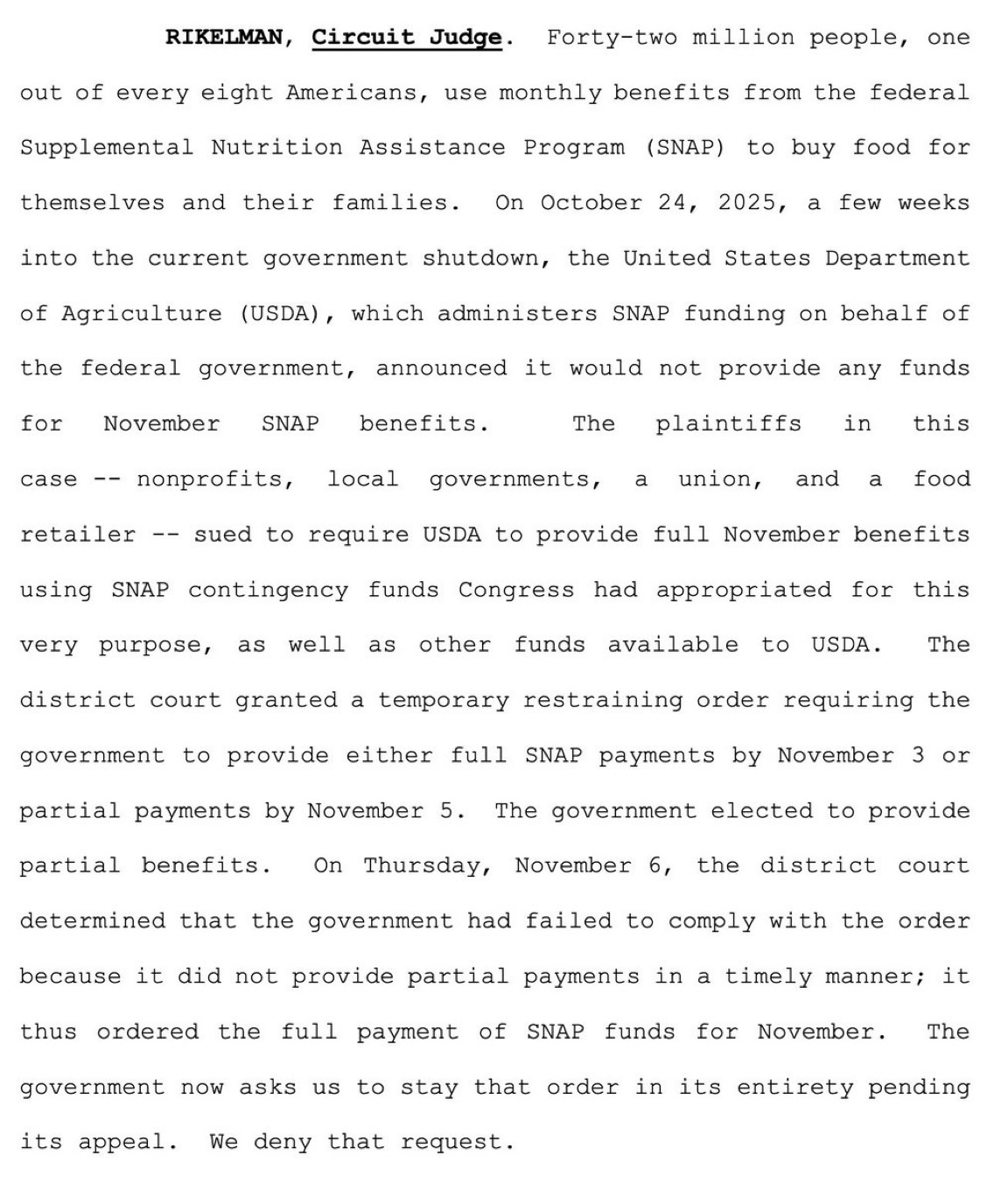
The First Circuit panel made the stakes plain in its opinion: 42 million people, or one in every eight Americans, rely on these benefits to keep hunger at bay.
From the First Circuit’s decision
First thing Monday morning, Justice Jackson issued a briefing order requiring the DOJ to file its response to the First Circuit’s decision by 4:00 p.m. and giving the plaintiffs until 8:00 a.m. Tuesday morning to respond. The government is “the applicant” at this stage of the case.
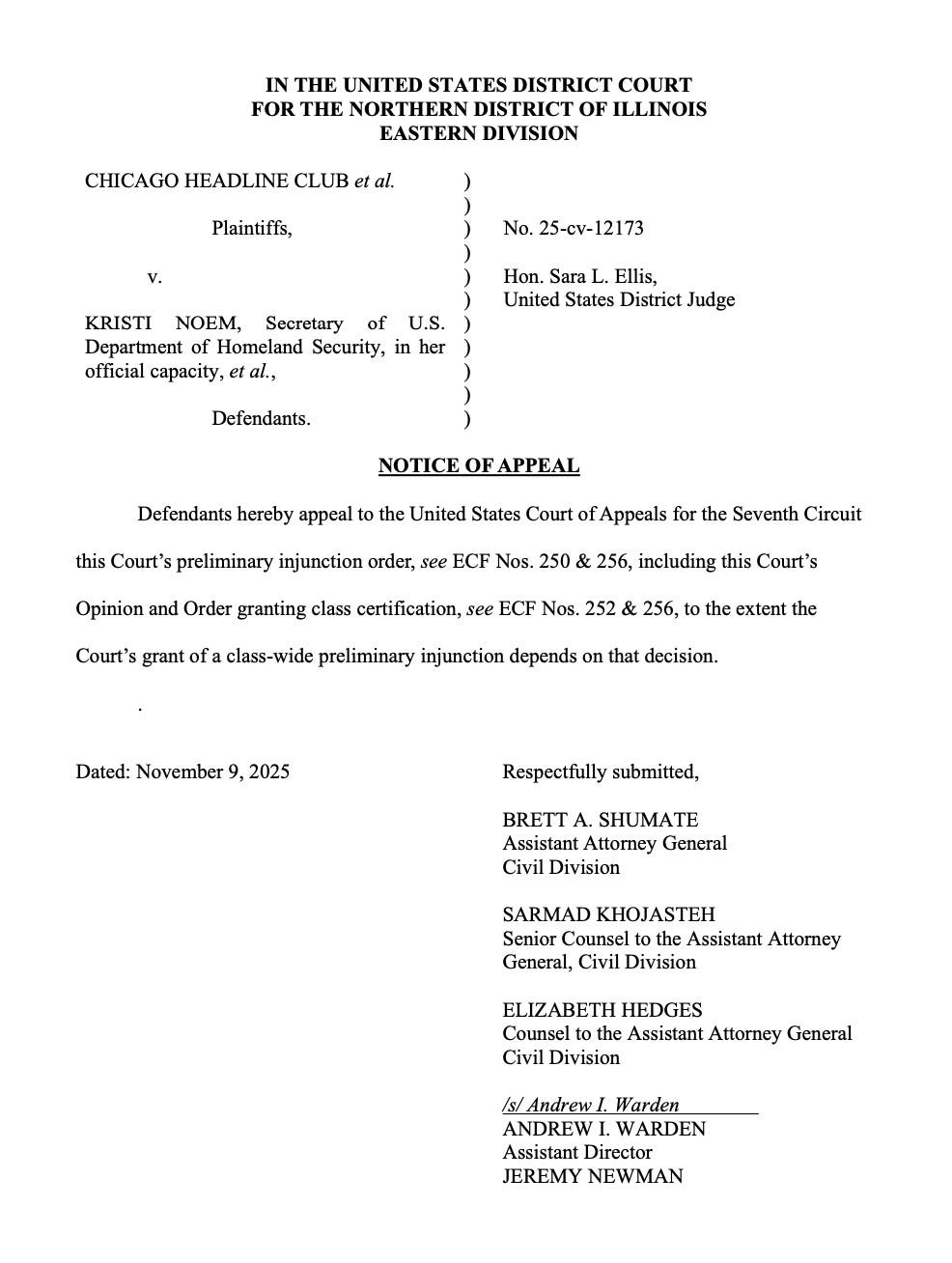
Federal Law enforcement abuses in Chicago. The Justice Department filed a notice of appeal over Chicago federal Judge Sara Ellis’ preliminary injunction restricting the use of force against protesters and journalists. If you stop for just a moment and zoom out, the utter lunacy here comes into focus. The government is fighting for the right to use excessive force against peaceful protesters. Why not take the obvious position that while it disagrees with the Judge’s assessment of the facts, it intends to fully comply with the law regarding treatment of people exercising their First Amendment rights? But that is not the government’s view of the matter.
Finally, marriage equality is safe, at least for now. The Supreme Court issued its list of grants and denials on cases from Friday’s conference this morning. The case I wrote to you about last night, involving Kentucky court clerk Kim Davis, who objected to issuing marriage licenses to same sex couples, was on the denial list, so the Court will not hear Davis’ appeal. That means there were not four Justices who wanted to hear the case, which, as I mentioned, doesn’t have particularly attractive facts for undoing longstanding precedent. This denial doesn’t tell us anything about whether the Court might be interested in undoing gay Americans’ rights if the “right” case comes along.
Last night, I started the newsletter by writing, “It’s going to be another blockbuster, high-stakes legal week. If you feel a bit overwhelmed, like I did Friday night at dinner when legal opinions were breaking out everywhere while I tried to have a meal with friends, remember that I’ll be here for you all week to try and keep things organized and understandable.” I didn’t expect it to be this soon, but the courts, for a change, are moving at lightning speed. Thank you for being here with me and reading Civil Discourse.
Photo Illustration by Victoria Sunday/The Daily Beast/Getty Images
Homeland Security Secretary Kristi Noem and her alleged lover Corey Lewandowski ordered 10 Spirit Airlines jets before realizing the planes had no engines.
Officials warned the pair that purchasing the jets—which they said would be used to increase deportations and for their own travel—was impractical, and that simply hiring additional flight contractors would be far less costly, The Wall Street Journal reported
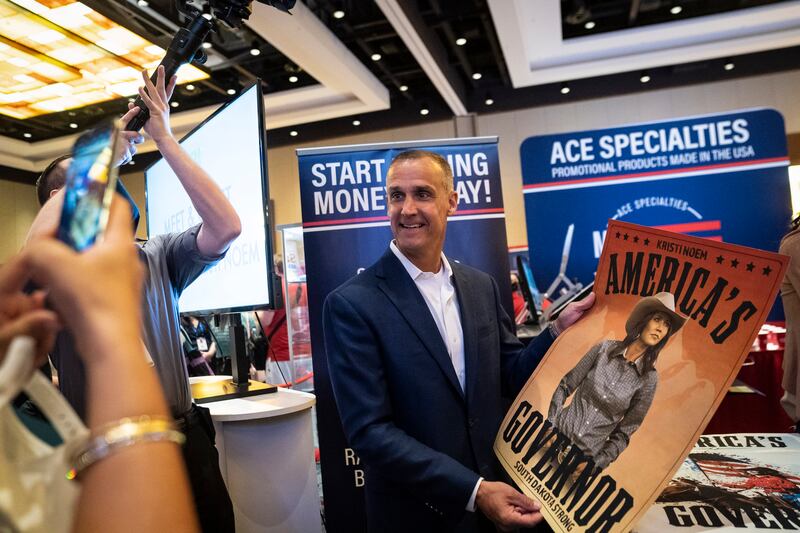
Corey Lewandowski and Kristi Noem, who are both married, deny reports that they are having an affair.Jabin Botsford/The Washington Post via Getty Images
But Noem and Lewandowski went ahead and blew through the funds allocated by Congress. Officials realized the pair’s blunder when they looked deeper into their spending spree and realized that Spirit—which has filed for bankruptcy twice—didn’t own the planes in the first place, and that the engines would have to be purchased separately, according to the Journal.
Noem and her shopping partner then purchased two Gulfstream jets for $200 million. However, shortly after, DHS notified the Democrats on the House Appropriations Committee that the project to increase deportation flights had been paused.
Noem looks pensive after a press conference held to discuss the “Midway Blitz” immigration enforcement operation in Chicago.Jamie Kelter Davis/Getty Images
Lewandowski—whose alleged relationship with Noem has been described as D.C.’s “worst-kept secret”—has been referred to as Noem’s “gatekeeper,” operating as a special government employee who travels with her, weighs in on personnel, and shapes enforcement.
He has also spearheaded efforts to replace ICE leaders across the country with Border Patrol veterans to impose a more heavy-handed, military-style approach to Trump’s immigration crackdown, such as the hostile situation dubbed “Midway Blitz,” unfolding in Chicago.
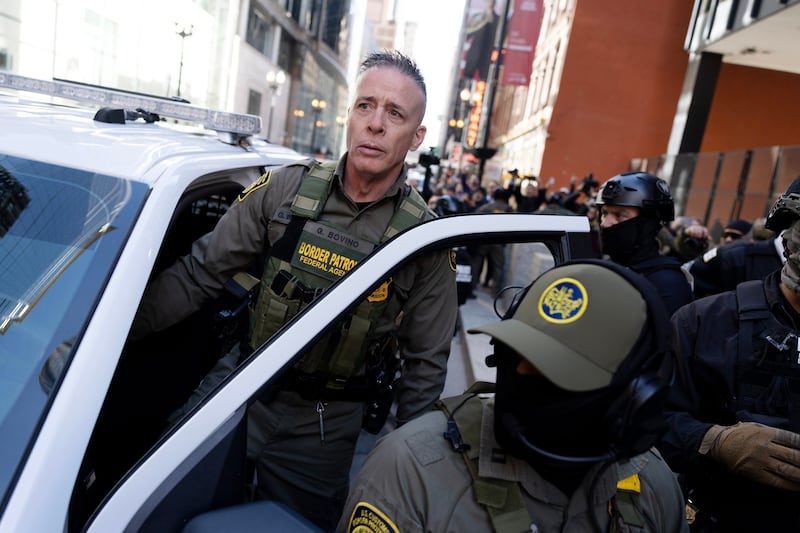
Gregory Bovino has a background in chasing migrants and drug smugglers through border terrain.Chicago Tribune/Brian Cassella/Chicago Tribune/Tribune News Service via Getty Images
Led by Border Patrol Chief Gregory Bovino, the operation’s militarized enforcement tactics and aggressive approaches have sparked public outcry. Footage and testimony have shown federal officers firing pepper-ball rounds and tear gas—even near children—while clashing with protesters. ICE agents have also been spotted roaming quiet neighborhoods, questioning landscapers and decorators.
Still, the militant approach hasn’t appeased the White House or met its steep daily deportation quotas.
ICE and Border Protection agents had made 3,000 arrests in Chicago over two months as of late October—the same number the White House has demanded they make in a single day, the Journal reported.
Noem’s methods—and the mounting pressure from the White House—have sparked infighting among DHS officials as they grapple with Lewandowski’s informal authority.
Kristi Noem and Greg Bovino visit the ICE facility in Chicago in October.DHS photo by Tia Dufour
Border czar Tom Homan and ICE Director Todd Lyons favor an old-school, less hostile approach, including using police research to develop target lists and focusing on those with criminal histories, sources told the Journal. But while Homan is influential in the White House, Noem has the final say.
Trump, however, is on the side of aggression, saying in a 60 Minutes interview last week that ICE officials “haven’t gone far enough” in Chicago.
The Daily Beast has reached out to DHS and ICE for comment. A spokesperson for DHS denied there were divisions in the department in a statement to the Journal, adding that Trump’s administration is on pace to “shatter records and deport 600,000 people by the end of Trump’s first year.”
Noem’s shake-up comes even as a federal judge on Thursday accused Bovino, 55, of lying to her in court as she imposed sweeping limits on a hardline anti-migrant crackdown in Illinois.
Bovino previously claimed he was hit in the head with a rock before he lobbed gas at anti-ICE protesters in Chicago—a claim he later admitted was false after DHS could not produce evidence to support it.
In an oral ruling, U.S. District Judge Sara Ellis said, “I find the government’s evidence to be simply not credible,” after weeks of tear-gassings, pepper-ball strikes, and hard takedowns against journalists, clergy, and residents during “Operation Midway Blitz,” with excessive violence that, she said, “shocks the conscience.”











 Scottie's Playtime