Another sitting congress person who is bought and owned by Israel to the point where he is adamant that Israel was not breaking the Leahy law on the use of military weapons. How did we the people let so many of our congress people be owned by foreign governments? Oh yes it was citizens united. That was one of the SCOTUS rulings that made bribery legal because the majority of right wing justices on the courts were taking bribes from wealthy people. Hugs
A Republican wearing an IDF pin is defending Israel’s genocide and invasion of Lebanon. He believes anything Israel does is OK, including attacking another country, killing its people, all to steal that country’s land. Same thing Russia is doing to Ukraine that the US tried to stop. Yet some members of our government / congress are bought and owned by Israel’s government. Hugs
Fired journalist accuses CBS News chief of interfering with report because it did not echo Trump’s view of the shooting
Scott Pelley was fired from CBS 60 Minutes last week. Photograph: Charles Sykes/AP
The fired 60 Minutes anchor Scott Pelley has accused editorial management at CBS of interfering with a broadcast segment on the killing of the Minneapolis protester Renee Good by an immigration officer in January.
The veteran broadcaster, who was recently dismissed from the show, said CBS News’s editor-in-chief, Bari Weiss, had sent an email to his supervisor requesting changes shortly before the airing of the segment in question.
Pelley told the outlet: “Two of the things in the email include, ‘Can we make the protesters look more violent?’ Now, I’m paraphrasing. I don’t have the quote, but that’s what was communicated to me. And the other thing, Renee Good’s car. You need to describe her as driving toward the officer.”
Pelley maintained that was the direction contained in the email even though video of Good’s shooting did not support such a conclusion.
A CBS News spokesperson told the Times in response to Pelley’s statements that Weiss had made four points in an email exchange on the segment that had “no political motivation and were proposed solely to make the piece as strong, fair, and accurate as possible”.
“Not everything she raised made it into the final piece,” the statement added.
Pelley’s accusation comes amid turbulence at the flagship TV news show that has seen the 60 Minutes executive producer Tanya Simon replaced and several correspondents and producers leave over questions of editorial independence. Three of the show’s veterans – Lesley Stahl, Bill Whitaker and Jon Wertheim – are staying on.
The newly installed executive producer, Nick Bilton, a former Vanity Fair journalist and film-maker, told staff in a memo that “the foundation of 60 Minutes is journalistic independence.
“We will always pursue stories without fear or favor.”
Pelley’s accusations to the Times followed a heated exchange at a meeting on Monday in which he accused Weiss of “murdering” the show. He was fired soon after.
In his latest salvo, Pelley said he was concerned that Weiss “had zero television experience and had never managed a large global operation like CBS News”. He also called her lack of TV news experience “red flags to me”.
Pelley also said that Bilton’s mission to modernize the 58-year-old show ignored changes that were already in play.
“Of course we have to reach out to a younger and younger audience, but their argument about joining the internet age is just disingenuous,” Pelley said. “It’s almost as if Bari Weiss and Nick Bilton were sealed in a time capsule in 1990, and it just cracked open. They’ve just discovered the internet, and they’re running around telling everybody how important it is.”
Pelley’s accusations over the Minneapolis segment in part centered on what took place in the seconds before Good was shot by an immigration enforcement officer.
“On the video, you see the officer standing slightly off the front of the car,” Pelley told the Times. “You clearly see Ms Good’s wheels turned completely as far as they will go, away from the officer. But he shoots her in the head [and] kills her.”
Pelley also alluded to cellphone video from the officer’s vantage point that was publicly released and captured him calling Good a “fucking bitch”.
As Pelley put it, the officer said “something about her that I can’t repeat in polite company”.
Pelley said that 60 Minutes had “gone out of our way in our plan from the very beginning to show the protesters for the responsibility that they had … somehow that wasn’t enough for Ms Weiss”.
He added that video of the shooting showed that the officer wasn’t standing in front of the car and she wasn’t “driving toward him”. He argued that Weiss “wanted it described that way” because it echoed what Donald Trump said of the shooting in his capacity as president.
Asked to respond to Pelley’s claim that Weiss “was putting a thumb on the scale on behalf of the [Trump] administration”, CBS News said there was “no credible argument” to suggest she was doing that.
This clip was with a reporter detailing the abuses in ICE detention facilities and the illegal actions of ICE agents and for profit prison staff. Profit over people as these ICE and prison staff do not see the detainees as humans like themselves. What is concerning is ICE is learning how to use existing laws to make the local law enforcement work against the will of the people. This young man wont admit he was attacked by ICE agents instead saying he thinks he hit a tree limb in the confusion but I showed Ron the video and he said the guy looks to him like he was hit repeatedly and hard in the head and possibly the body as well. When will we as a people see that these abuses are so very similar to the abuses suffered by the minorities in 1930s Geermany. Hugs
When approaching recent historical events, where the scope of destruction and loss can be unfathomable in scale, oral history can bring both connection and immediacy through individual stories of loss, grief, rescue, or triumph that would otherwise disappear in the grand sweep of “Great Men and their Deeds.”
[T]he method enables the documentation of certain aspects of historical experience that are often missing from other kinds of historical sources. Oral historians not only interview and engage in conversation with living sources, they also find themselves challenged in a unique way—the historian is transformed into a protagonist in the dialogue. Oral history is perhaps the only field where the sources talk back to the historian, confronting, disputing, disrupting, and sometimes resisting the historian’s understanding of the past (Frisch 1990; Shopes 2012). Oral history works with the interviewee as a partner in dialogue and the verbal form historical truth can take is always co-constructed (Cook and Goodall 2013; Goodall and Cadzow 2009; Portelli 1991).
Some of the most effective (and affecting) projects using this approach concern communities that may be far outside of the audience’s experience, whether due to time, geography, or identity. Works like Shoah by Claude Lanzmann, Hard Times by Studs Terkel, and Boots of Leather, Slippers of Gold by Elizabeth Lapovsky Kennedy document their subjects through the voices of those who lived through specific moments and events that can be overwhelming or remain unknown without a more interpersonal method.
“Many of the best works about this disease have been produced by people at various stages of HIV infection.”
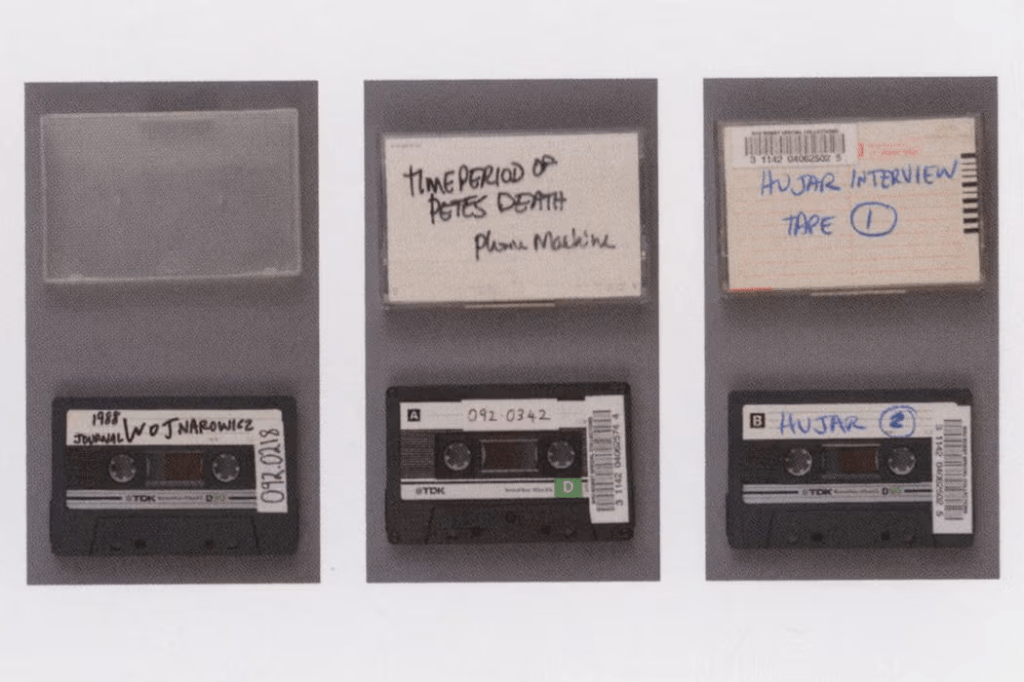
The history of the HIV/AIDS epidemic has recently become the subject of numerous oral history projects, where the stories of survivors, caregivers, activists, and health care professionals have been collected and made available online, traditionally published, and edited into documentaries.
One such collection, Visual Arts and the AIDS Epidemic, was begun in 2015 by the Smithsonian Archives of American Art after receiving a grant from The Keith Haring Foundation. Haring founded the foundation in 1989, a year before his death from HIV-related illness, to maintain his artistic and philanthropic legacy. The project interviewed forty artists about their lives, their work, and how the AIDS crisis intersected and permeated both.
The interviews in the Visual Arts and the AIDS Epidemic collection cover wide ranges of personal and creative history, ranging from insider gossip and “name-dropping” to theoretical discussions of method and art history. They benefit from interviewers who bring their own experience as artists, art scholars, and historians to the conversation, with questions and insights that make this collection a rich multifaceted history of AIDS, the arts, and activism.
as if the artist were immersed in dealing with the epidemic—as so many are. Many of the best works about this disease have been produced by people at various stages of HIV infection. Perhaps they have lost a lover, nursed a dear friend, or attended a dozen funerals at a young age, and feel themselves to be, in every sense, set apart by the experience. They are implicated. Their art signifies a collective trauma—mass death in the midst of life.
Reveal Digital, an initiative “to amplify important, long-overlooked voices of the twentieth century,” has made these histories, and more, available in their developing open access collection HIV, AIDS and the Arts.
Artists in The Early Years of the Epidemic
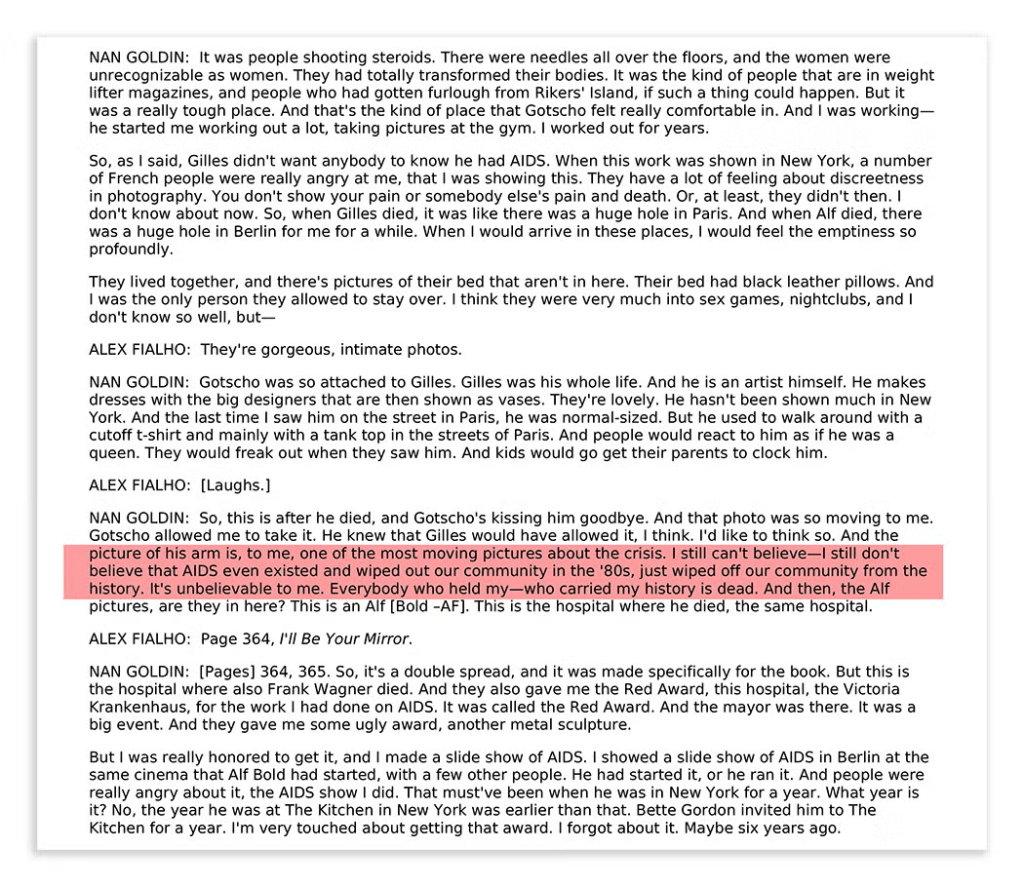
“I still can’t believe—I still don’t believe that AIDS even existed and wiped out our community in the ’80s, just wiped off our community from the history. It’s unbelievable to me. Everybody who held my—who carried my history is dead.” —Nan Goldin
One year later, William F. Buckley published a New York Times op-ed calling for HIV-positive people to be tattooed on the upper arm and buttocks to protect others (assuming that would protect both future sexual partners and intravenous drug users who might share needles). News reports about the disease largely focused on fear of contagion, the promiscuity and danger of gay men, and the threat of HIV to “normal” Americans.
In the interviews gathered in the Visual Arts and the AIDS Epidemic collection, artists describe how they first became aware of AIDS: from a loved one diagnosed after an illness; from hearing of a friend’s passing after not seeing them for a while; from a doctor telling them to stay with a partner because “there’s something going around”; or by learning of their own diagnosis. Friends were lost to the disease, and surviving family members denied the illness or sometimes actively excluded partners from funerals.
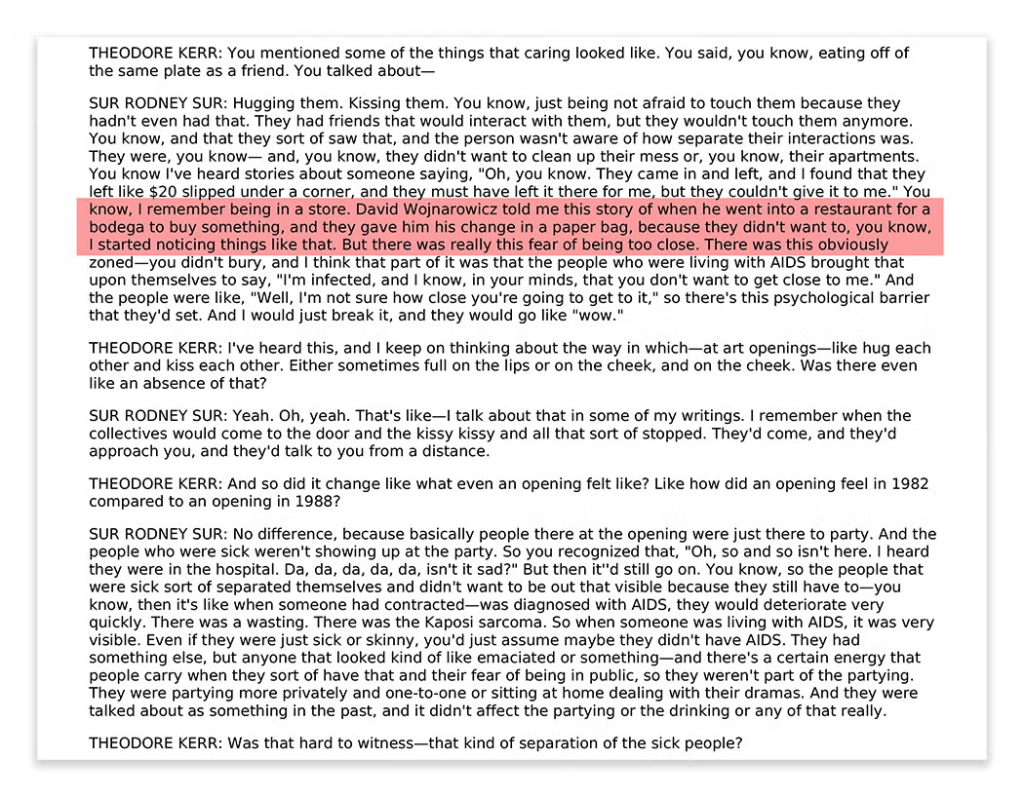
Sur Rodney (Sur), a New York City-based writer, gallery co-director, and archivist, relates that the late artist David Wojnarowicz would go to his local bodega in New York City where the clerks returned his change in a paper bag, out of fear. He describes his own anxieties when stepping in after a friend’s death to help save and archive their artworks and collections so they wouldn’t be destroyed (before there were nonprofit organizations to do so).
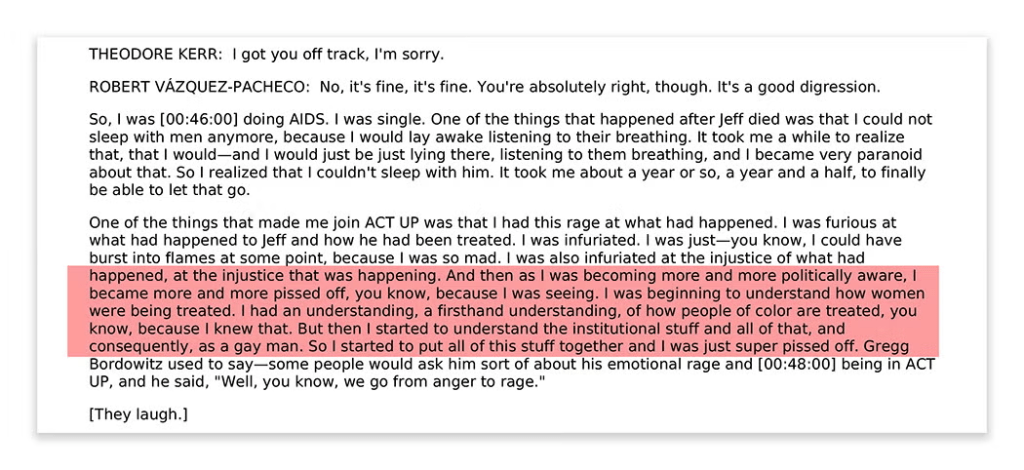
These personal experiences unfolded within the larger context of governmental indifference, active discrimination against people with the disease (or belonging to groups that were deemed “at risk”), and a growing consciousness of the political landscape of the epidemic. Robert Vasquez-Pacheco, a member of ACT UP and Gran Fury, recounts,
as I was becoming more and more politically aware, I became more and more pissed off, you know, because I was seeing. I was beginning to understand how women were being treated. I had an understanding, a firsthand understanding, of how people of color are treated, you know, because I knew that. But then I started to understand the institutional stuff and all of that, and consequently, as a gay man. So I started to put all of this stuff together and I was just super pissed off.
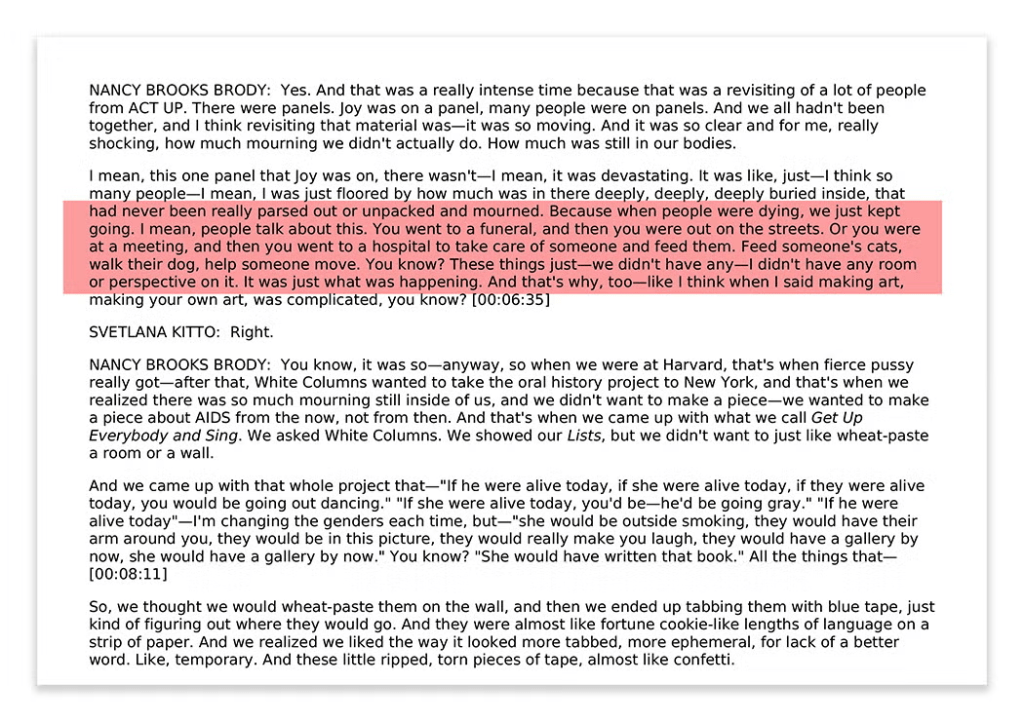
Some version of this process, repeated for many of the subjects, led people to activism, whether through art, volunteer work, protest, or sometimes all three. Nancy Brooks Brody (1962-2023), a visual artist and member of the fierce pussy collective, describes the progression in her interview.“Because when people were dying,” she explains,
we just kept going. […] You went to a funeral, and then you were out on the streets. Or you were at a meeting, and then you went to a hospital to take care of someone and feed them. Feed someone’s cats, walk their dog, help someone move. You know? These things just—we didn’t have any—I didn’t have any room or perspective on it. It was just what was happening.
The meetings she, and others, refer to were those of ACT UP New York (The AIDS Coalition to Unleash Power), which began in 1987 at a community meeting where Larry Kramer asked, “How long does it take before you get angry and fight back?” Kramer, a playwright and essayist who had been covering AIDS since the beginning through journalism, had co-founded the non-profit Gay Men’s Health Crisis in 1982. His play The Normal Heart, an impassioned call to action, spurred members of the audience to meet and subsequently take part in one of the most significant and effective activist movements of the twentieth century.
Creating Art in an Epidemic
The artistic works of those interviewed are diverse, both in media and approach: photographing people living with AIDS, using détournement to turn existing works into calls to action via graphic design, or using their body to confront audiences with the existence of the disease through performance. In some cases, their illness became an essential component of their art: John Dugdale, a former commercial photographer, began using nineteenth-century methods to capture and produce his work after HIV-related retinitis and a stroke left his sight significantly impaired. Ron Athey, one of the NEA Four, used his own HIV-positive body to create work exploring sex, trauma, and desire. The place of the artist within (or outside) a community could become a contentious issue, especially at a time when representation of people with AIDS was so fraught.
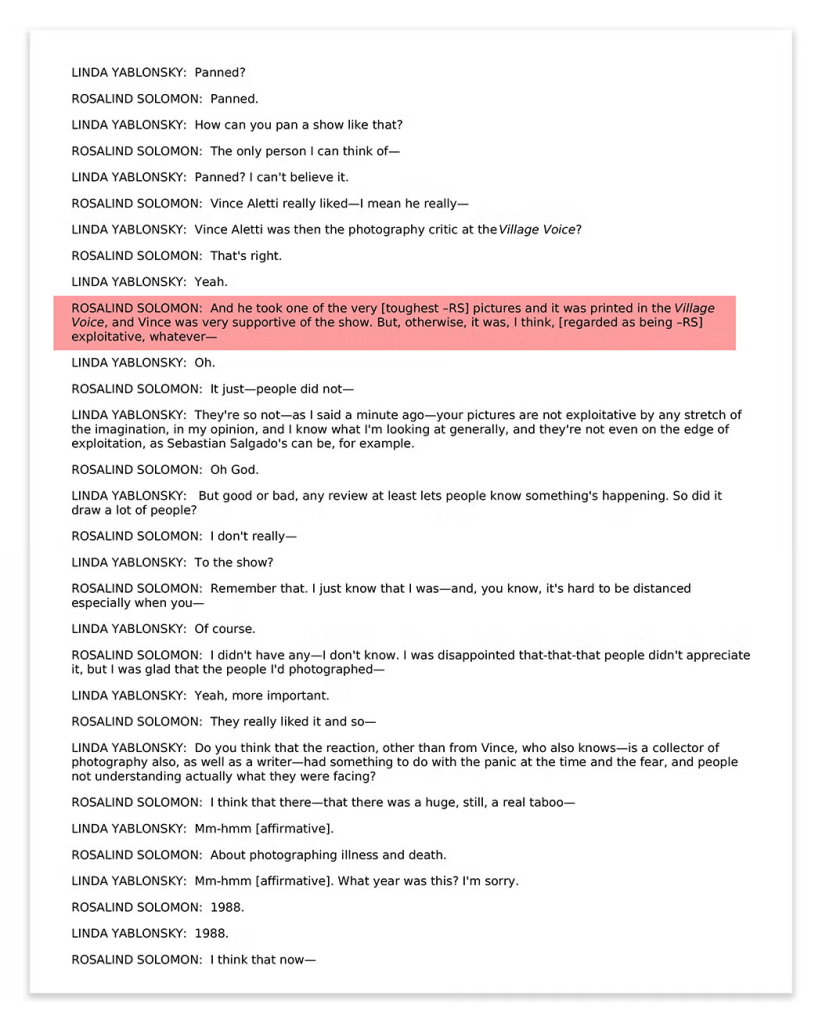
Rosalind Fox Solomon, whose 1988 show Portraits in the Time of AIDS featured photographs of the subject alone or with loved ones, some with visible lesions or in the hospital, relates that her project was critically panned and called “exploitative” at the time.
Some of the most vibrant, and now iconic, images of AIDS were created as (and for) protest: Silence = Death, the work of the Silence = Death Collective (and not ACT UP, as Avram Finkelstein relates in his interview) became the primary pictorial representation of ACT UP and a rallying slogan for the fight against the disease. Keith Haring did his own take on it for a poster, adding “Ignorance = Fear” to a “See No Evil, Hear No Evil, Speak No Evil” scene.
Collectives like Gran Fury and fierce pussy, which organized inside the ACT UP activist group, created posters for wheat-pasting that served as art, education, and calls to action around AIDS, homophobia, health care, and visibility. Whether newsprint works of text, guerrilla-installed bus station “ads,” or rolls of stickers of bloody hands announcing “One AIDS Death Every 10 Minutes,” the art of AIDS activism used any means available to communicate the urgency of the crisis.
The Visual Arts and the AIDS Epidemic collection demonstrates the power of oral history to preserve not just historical events, but what it felt like to live in the moment and survive it when so many people did not. Together with Reveal Digital’s HIV, AIDS, and the Arts archive, the collection ensures that these voices, experiences, and creative histories continue to be available to inform and educate future generations.
This is pure racism and entitlement. The boy put the bottles of water back. But even if he had not does stealing bottles of water rate or equate to a death penalty performed by a civilian? This is clearly an extra juditiacal killing. No judge or jury just a store owner and his son angry thinking a kid stole from them deciding to end his life. This automatic killing of Black people with no evidence has to stop. Black Lives Matter. Hugs
Gas station owner charged in shooting death of 14-year-oldRick Chow, 58, has been charged with murder after allegedly killing Cyrus Carmack-Belton in Columbia, South Carolina, on Sunday, police said.
The family of Cyrus Carmack-Belton expressed their indignation towards a South Carolina jury’s decision on Tuesday to acquit Chikei Rick Chow in the 2023 fatal shooting of the Black 14-year-old.
“Yesterday a jury watched our 14-year-old boy run away from two grown men on video. They knew one of them shot him in the back and they still said no one is to blame,” the family said in a statement first released to ABC News. “We are heartbroken. We do not accept it. Cyrus stole nothing. He was a child, and he was running for his life. Our son mattered.”
Chow, a 61-year-old store owner, shot the 14-year-old in the back outside of his Columbia, South Carolina, store in May 2023. He and his son were seen chasing Carmack-Belton outside of the store in video leading to the incident. Chow was charged with murder and denied bond multiple times before his acquittal.
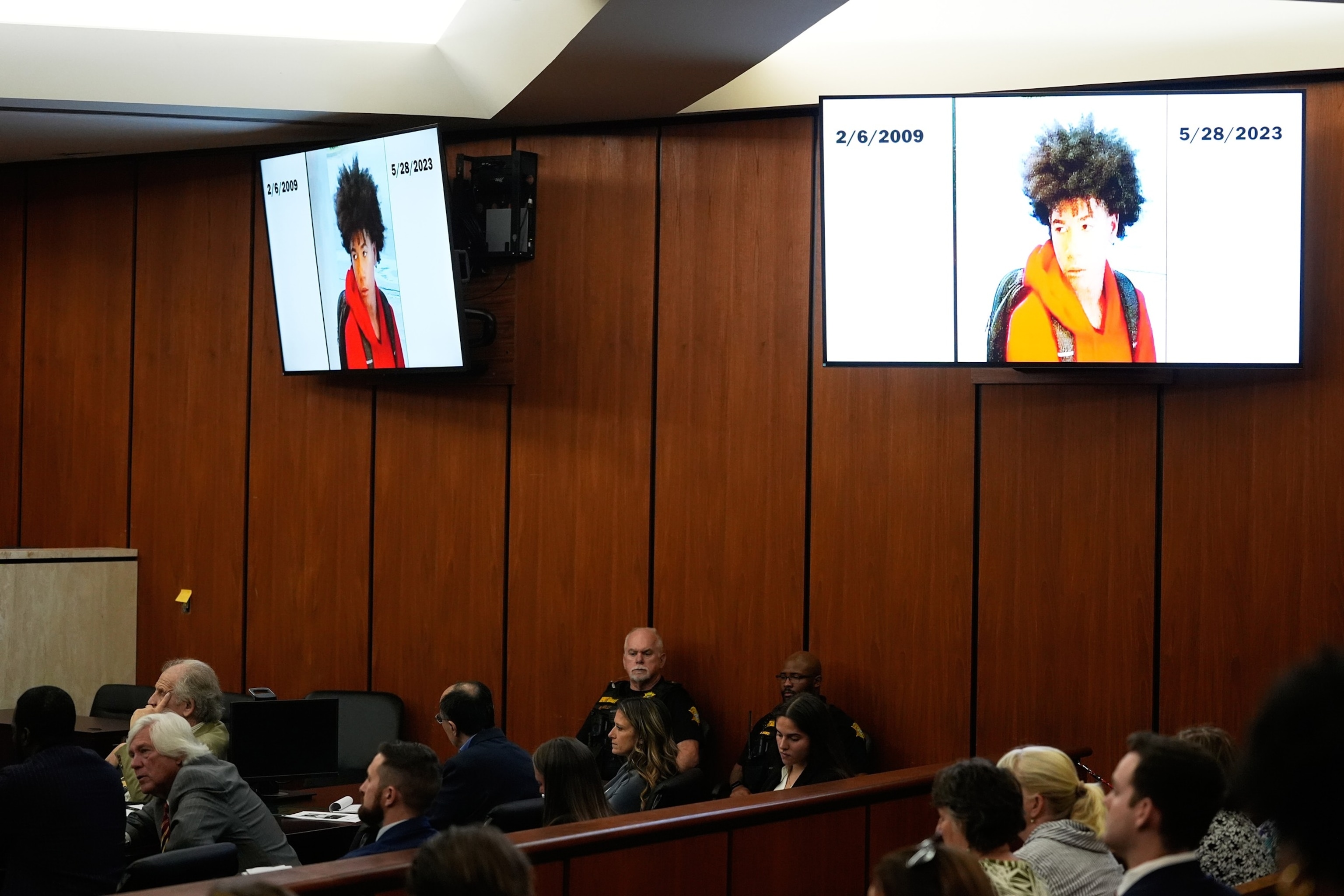
An image of Cyrus Carmack-Belton is displayed in court during closing arguments in the murder trial against his shooter, Chikei Rick Chow, a convenience store owner accused in the 2023 fatal shooting of the 14-year-old, on June 1, 2026, in Columbia, S.C.
Erik Verduzco/AP Photo
Prosecutors alleged that Chow acted out of a false belief that Carmack-Belton had shoplifted four bottles of water from his store. The defense claimed that Chow acted to protect his son, after allegedly seeing Carmack-Belton point a gun at him.
“On behalf of the Chows, we’re very pleased at the jury’s deliberations and their verdict,” attorney Jack Swerling said in a statement to ABC News. “We think it was the appropriate verdict in this case, although it was a difficult decision to come to, because you have two different stories, two extreme differences.”
Video obtained by ABC News shows that Carmack-Belton returned the bottles of water in question and did not steal anything from the store. A 9mm pistol was found next to Carmack-Belton, with prosecutors saying it was in his possession during the chase, and it had fallen to the ground at some point.
In this June 1, 2023, file photo, mourners stop by a memorial to Cyrus Carmack-Belton, in Columbia, S.C.
Jeffrey Collins/AP, FILE
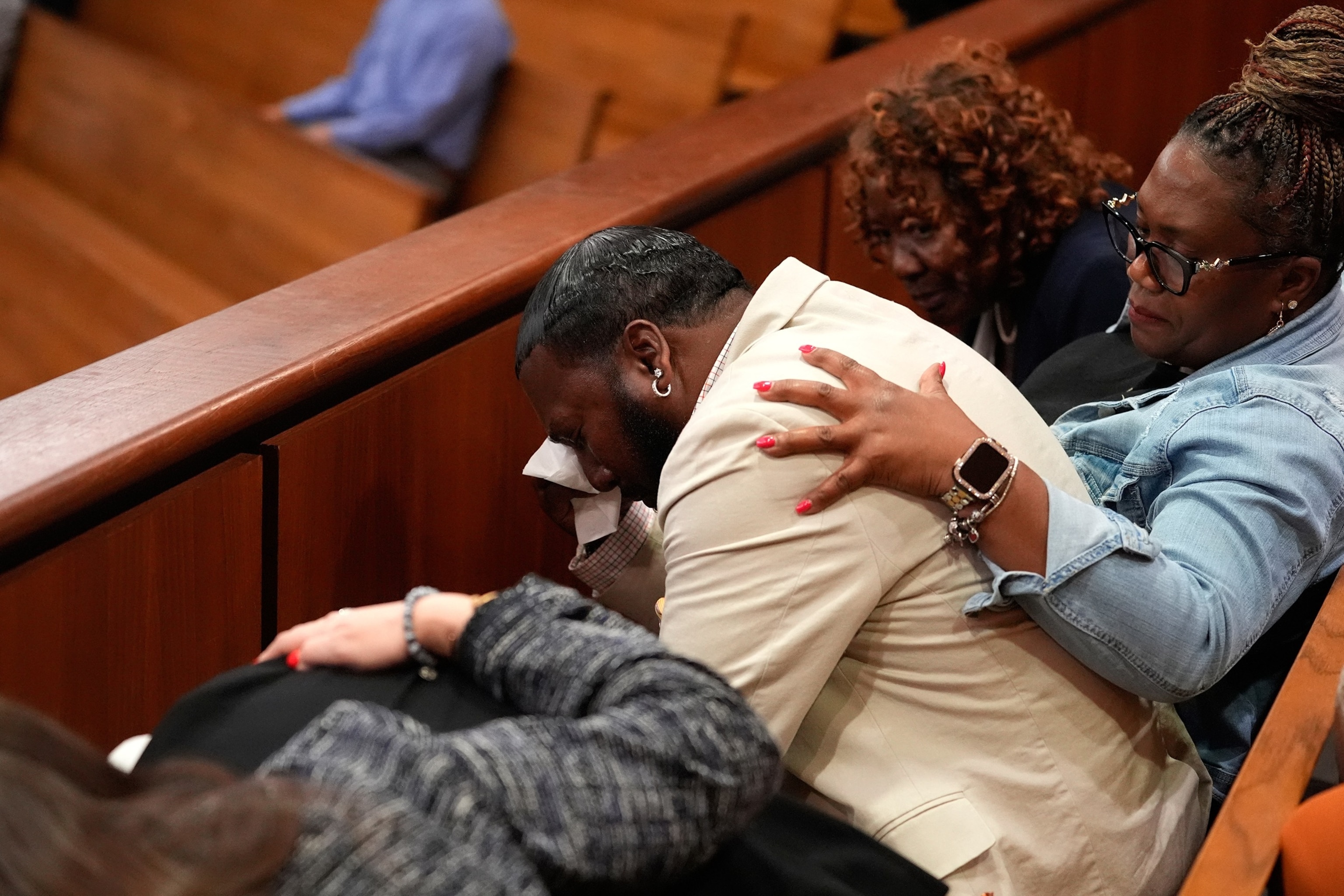
As the verdict was read in the courtroom, members of the Carmack-Belton family and the audience were seen breaking into sobs.
In their statement Tuesday, Carmack-Belton’s family drew a connection between their case and a larger history of violence against the Black community. “Black families have stood right here too many times — burying our children and then being told the law sees nothing. We feel every bit of that today,” the family said.
Troy Belton, center, father of Cyrus Carmack-Belton, reacts after a not guilty verdict against Chikei Rick Chow, a convenience store owner accused in the 2023 fatal shooting of his 14-year-old son, during a murder trial, on June 1, 2026, in Columbia, S.C.
Erik Verduzco/AP Photo
“To everyone hurting with us: honor Cyrus in peace. We will not stop. We’re taking this fight to civil court, and we will not rest until our son’s life is given the dignity this verdict denied him,” the family added.
According to family attorney Todd Rutherford, the family filed a civil lawsuit against Rick Chow in Richland County, which was put on hold until the conclusion of the criminal case.
The video below is hilarious. Right wing trump loving maga Dave Rubin gets destroyed with facts and figures from podcaster Parkergetajob. While Rubin tries to spout maga talking points and fox news misinformation. Hugs
I really enjoy this creator and how he has done this entire series on the Christian god and the inconsistancies of the bible and the figures in it. In this series the god is a self centered older teenager who only thinks of themselves and their needs/ wants. The full series starts out with a future highly technological civilization having graduates from school take a psychological test as them an omnipotent being and their assistant is actually their teacher in real life. But in this case “god” is so narcissistic it causes problems in the simulator they are all connected with. But the series does show how narcissistic and only thinking of their feelings, wants, and needs this Christian god is. Sadly the creator has moved on from making the series and the spin-offs from them as his main YouTube product but he still produces these videos which I am grateful for. But try to remember that God is a student and Jefferies is in reality his teacher still trying to teach him how to be a good person. Reverse the roles of the characters and you get the joke. Hugs.

Scott Pelley was fired from CBS 60 Minutes last week. Photograph: Charles Sykes/AP