I really enjoy this creator and how he has done this entire series on the Christian god and the inconsistancies of the bible and the figures in it. In this series the god is a self centered older teenager who only thinks of themselves and their needs/ wants. The full series starts out with a future highly technological civilization having graduates from school take a psychological test as them an omnipotent being and their assistant is actually their teacher in real life. But in this case “god” is so narcissistic it causes problems in the simulator they are all connected with. But the series does show how narcissistic and only thinking of their feelings, wants, and needs this Christian god is. Sadly the creator has moved on from making the series and the spin-offs from them as his main YouTube product but he still produces these videos which I am grateful for. But try to remember that God is a student and Jefferies is in reality his teacher still trying to teach him how to be a good person. Reverse the roles of the characters and you get the joke. Hugs.
WASHINGTON (AP) — Barney Frank, the longtime Democratic congressman and leading liberal who brought new visibility to gay rights and crafted the most significant reforms to the financial system in a generation, has died. He was 86.
Frank died late Tuesday, according to Jim Segel, Frank’s former campaign manager and close friend.
After representing broad swaths of Boston’s suburbs in Congress for 32 years, Frank and his husband moved to Ogunquit, Maine. He entered hospice there in April with congestive heart failure and is survived by his husband, Jim Ready, and sisters, the longtime Democratic strategist Ann Lewis and Doris Breay, along with brother David Frank.
A self-described “left-handed gay Jew,” Frank was known for his acerbic wit, combative style and focus on marginalized communities. He represented the party’s left wing while keeping close with Democratic leaders who sometimes frustrated progressives.
He is best known as a pioneer for LGBT rights. After decades of grappling with his sexuality, he publicly came out as gay in 1987, the first member of Congress to do so voluntarily. With his 2012 marriage to Ready, he became the first incumbent lawmaker on Capitol Hill to marry someone of the same sex.
It’s horrifying that these Jewish settlers who want to eradicate entirely the Muslim population. One woman described Islam as a cancer and wants the Islamists killed or reeducated. Muslims who own businesses can’t even open their shops. But there is a small minority trying to protect the arabs. Hugs
Yet the tRump administration trashed the government’s stance of fighting right wing violence or right wing extremist violent groups. It started with the republicans forcing Obama to remove a government study on right wing extremists. Now the current DOJ and FBI have removed all mention of right wing violence or violent actions instead claiming the violence is all being done and caused by Antifa. The government wants to make the public believe that the people who are against fascism are the real extremist threat to the public. Antifa is antifascism / antifascist. It has no headquarts or central organization it is just people who since the 1930s have pushed back against fascism and fascists. The tRump white supremacists want the public to believe violent groups like the Proud Boys, the Oath Keepers, Nazi groups, the 3 percenters, and other militia groups that joined in the insurrection riot on Jan 6th and are extreme white supremacists. The current people in charge love the way they can steal the money from the treasury and take away people’s rights, so they want to keep the hate groups that support them to be the good guys and anyone who tries to stop the destruction of democracy they hope to make the bad people. Hugs
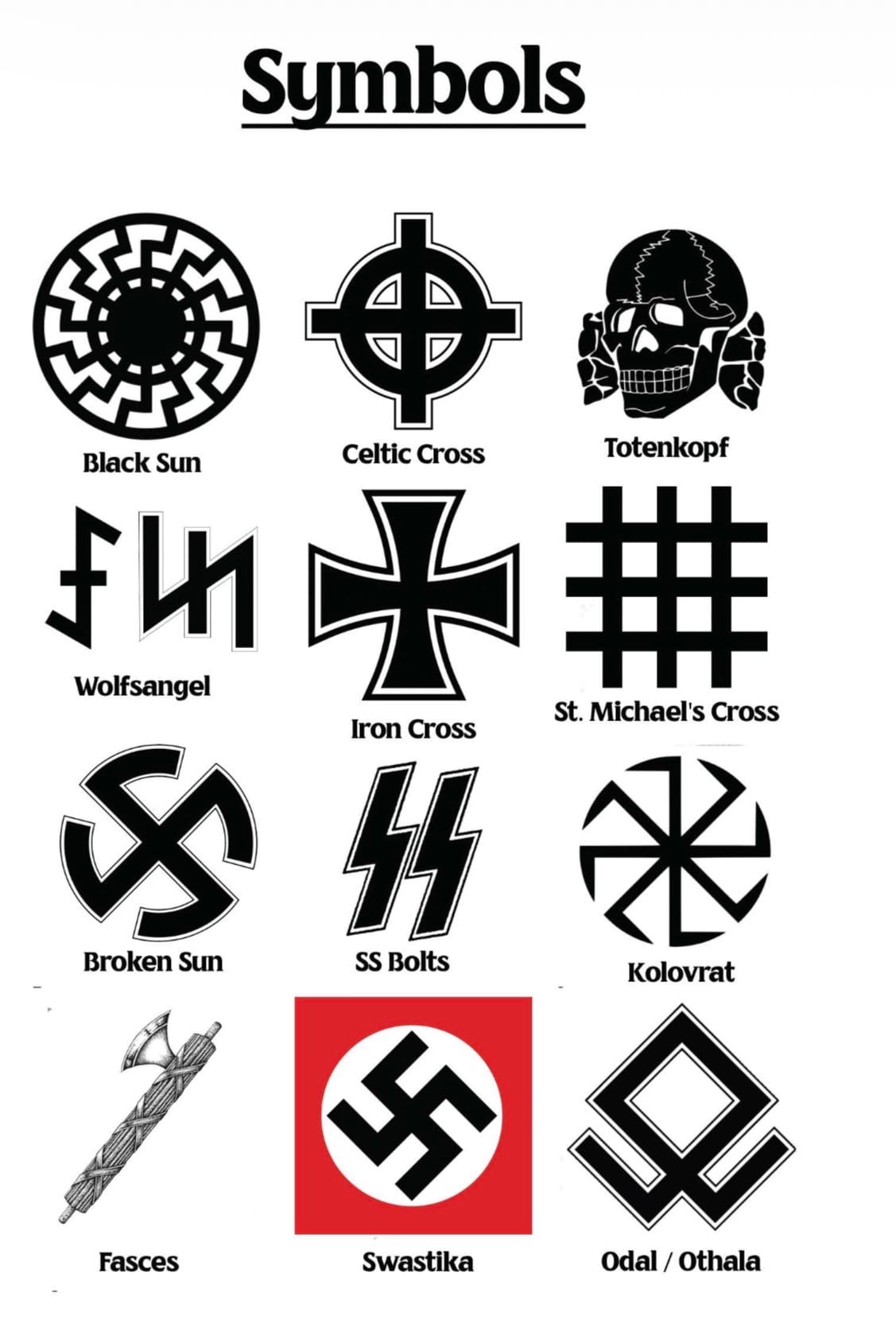
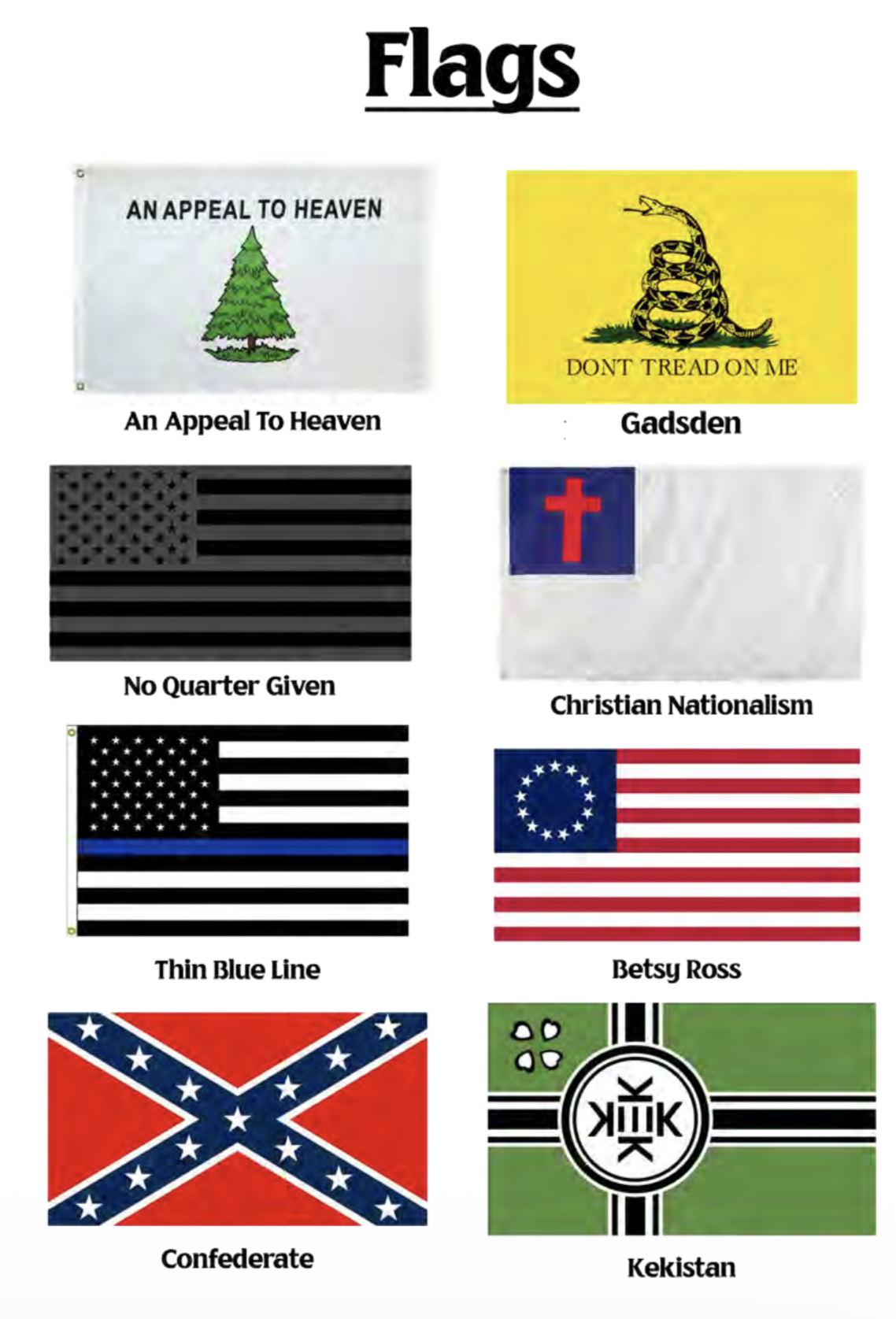
Disclaimer: WWFU typically redacts the imagery seen in this zine with an iron front or an X, and encourages others to do the same. This zine also contains slurs that we typically redact. For the sake of eduction and proper recognition, the following content is un-redacted.
A Reference Guide For Recognizing Far Right Groups, Symbols and Dog Whistles
Introduction
As of spring 2026, this zine serves as a reference guide to far-right symbols, dogwhistles, and groups, helping you recognize and understand them. The list focuses on the most active groups and the most commonly used phrases and symbols at this time.
Not all neo-Nazi and white supremacist groups openly brand themselves with swastikas or SS bolts. Recognizing their dogwhistles is essential to accurately identifying them as the community threats they are. Some groups and individuals deliberately project a public facing image of “patriotism” or opposition to “foreign wars” to appear more mainstream, while privately holding the same beliefs as more openly neo-Nazi organizations. Because some symbols are not exclusive to neo-Nazis, fascists, or white supremacists, it’s important to look for additional context clues and patterns of use.
Dogwhistles are coded messages communicated through words or phrases understood by a specific in-group, but not by outside observers. Neo-Nazis and white supremacists use dogwhistles to signal to one another while maintaining plausible deniability.
Phrases / Numbers
131: Anti Communist Action (ACA), the numbers referring to the letters of the alphabet.
Blue Lives Matter/All Lives Matter: These phrases are nothing more than a response to people saying “Black Live Matter” and as way to silence Black voices. Cops can always choose to take off their uniform, while Black people cannot take off their skin or escape the discrimination that comes with it. No one would go to an event to save the rainforests and say that all forests matter. If all lives matter, as racists love to say, then Black lives have to matter. All lives can’t matter until Black lives matter because they are the ones being targeted by police, racist attacks, and everyday discrimination.
TDOTR: The Day of the Rope, a fictional day from the book The Turner Diaries in which race traitors (women who marry non-white men, the press, politicians, LGBTQ people and more) are hanged from lampposts.
6MWE: “Six Million Wasn’t Enough” referring to the number of Jewish people murdered during the holocaust.
The Great Replacement Theory: White supremacist conspiracy theory that argues democratic and government officials are intentionally facilitating non-white immigration to replace the white population for political purposes. Similar phrases include “white genocide.”
It’s okay to be white: While no one is saying it’s not okay to be white, this phrase creates perceived victimhood and is a stepping stone to great replacement.
WPWW: White Pride World Wide
GTKRWN: Gas the Kikes, Race War Now
RAHOWA: Racial Holy War
RWDS: Right Wing Death Squad
Blood and Soil: A reference to race and nationality from Nazi Germany
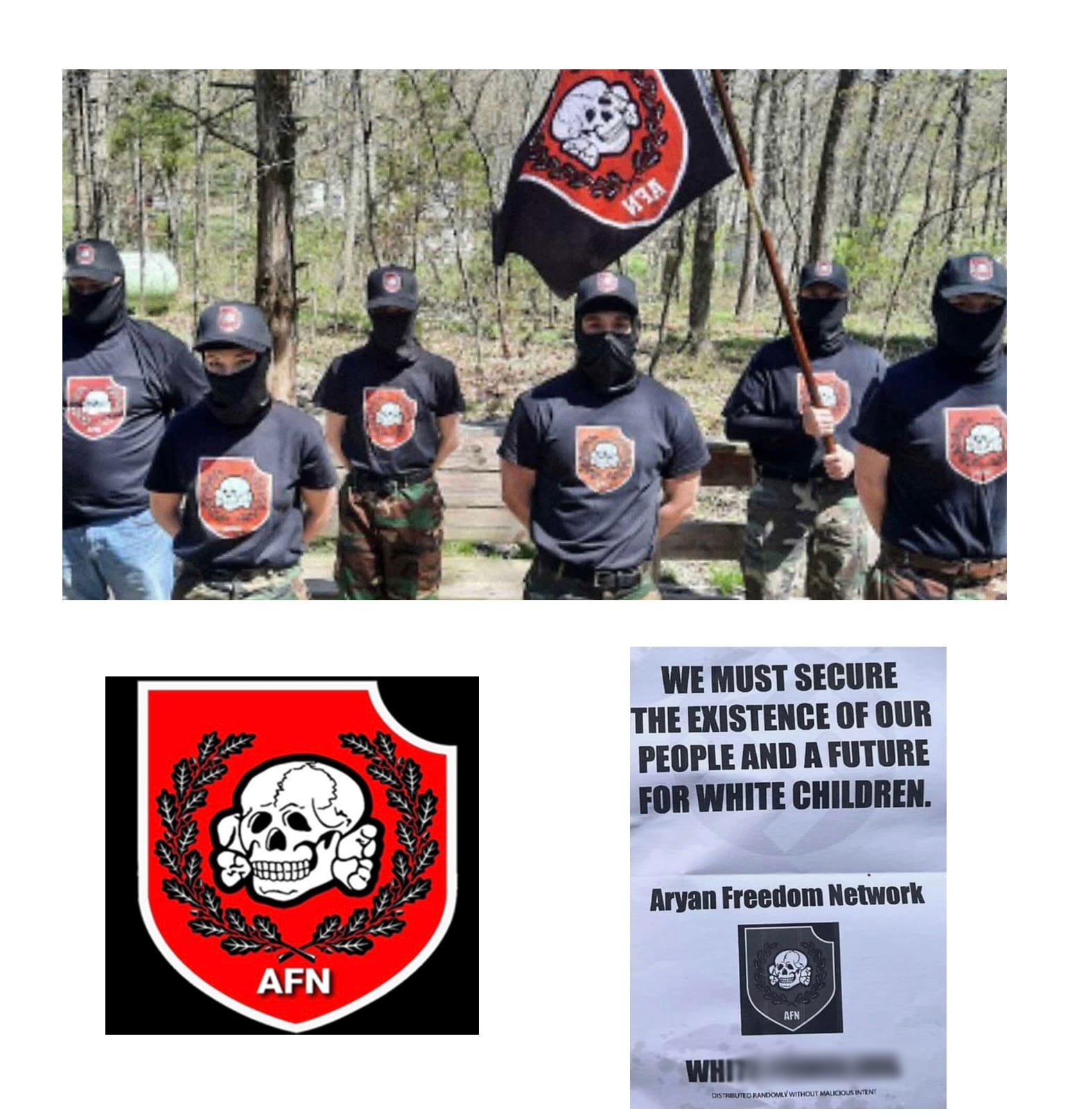
14: A reference to the 14 words “we must secure the existence of our people and a future for white children” coined by David Lane.
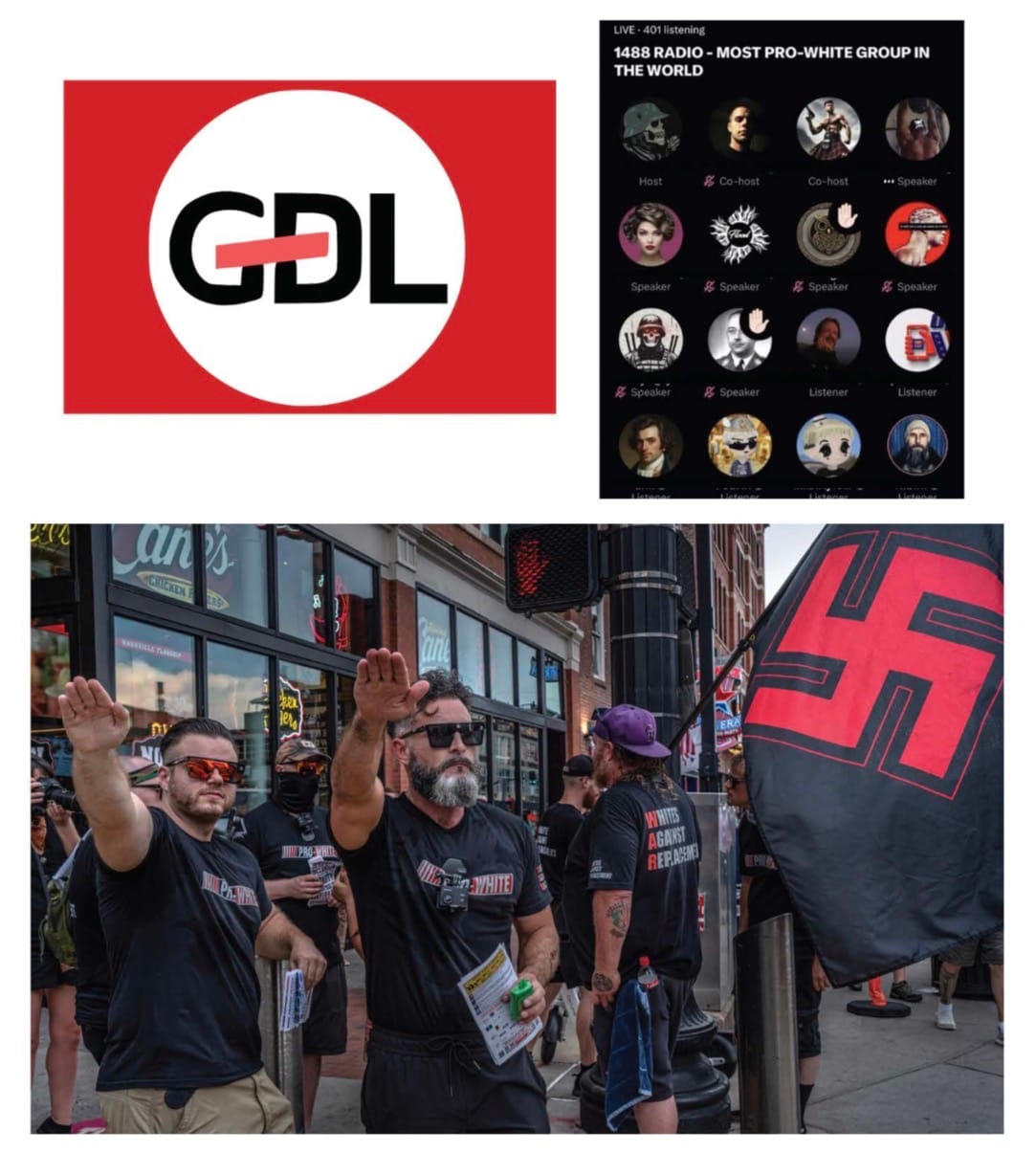
88: 8 Represents the 8th letter of the alphabet, HH or “Heil Hitler.” Variations include H8 and 83 “Heil Christ.” You will often see the numbers 14 and 88 together (1488 or 14/88).
WP: White Power. Also sometimes signified by an “okay” hand gesture.
Reclaim America: White supremacist slogan advocating for the “reclaiming” of America from immigrants (referencing the racist Great Replacement conspiracy theory).
We’ll Have Our Home Again: Popular phrase used by neo-nazis and white supremacists based on a song of the same title and similar to “reclaim America.”
Groups / Orgs
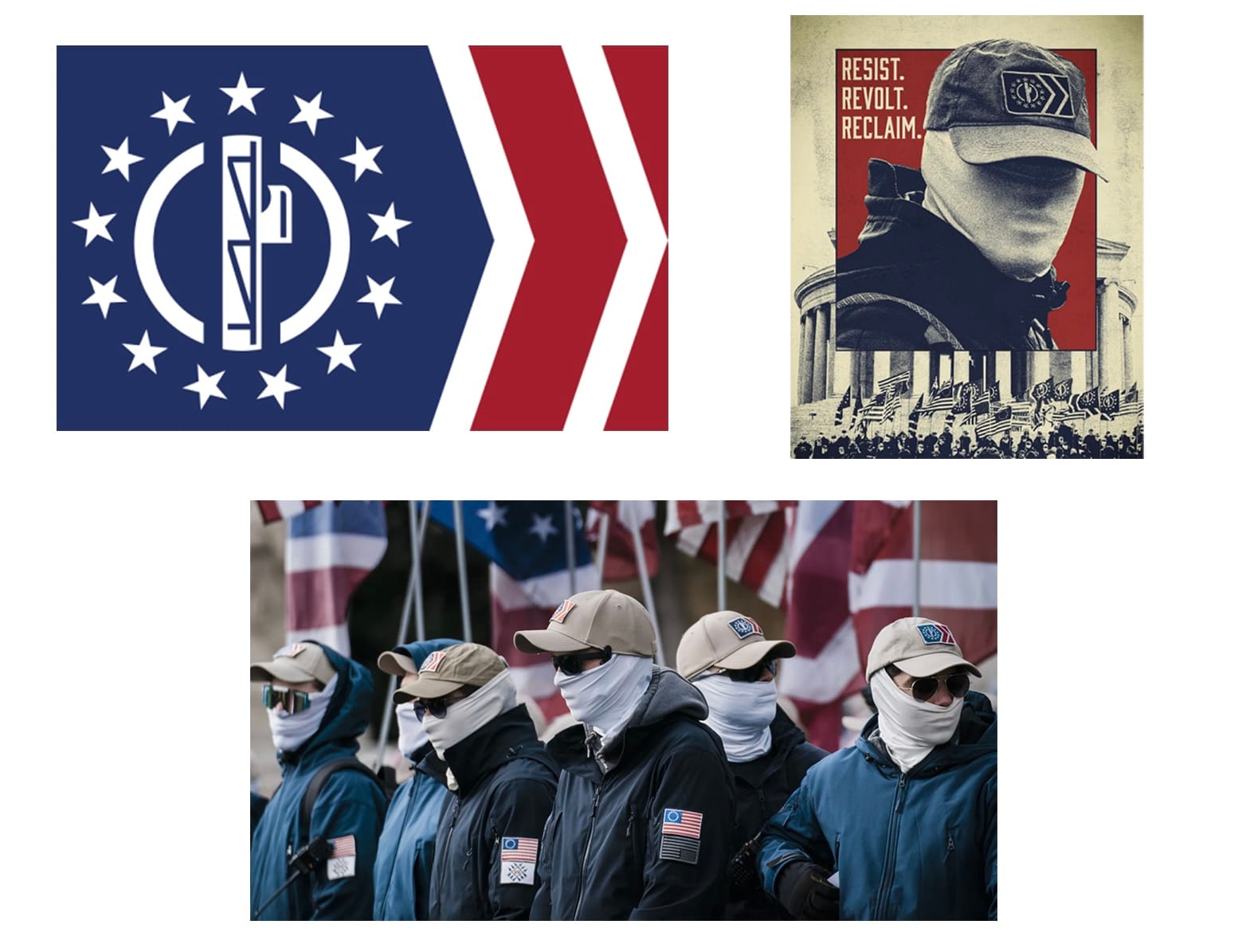
Patriot Front: A white nationalist group mostly focused on using patriotic imagery and rhetoric to spread propaganda and recruit. Founded by Thomas Rousseau, the group broke off from Vanguard America in 2017 after the deadly Charlottesville rally in Virginia. They care primarily about public image. Their style involves patriotic designs including red white and blue, fasces, khaki pants, and white masks with matching shirts, shields, the Confederate flag, the Betsy Ross flag, and the US flag. Despite their efforts to be palatable to a wider audience, outside of public view they espouse anti-semetic, pro-white and pro-nazi views. Patriot Front is currently one of the largest white nationalist groups in the US.
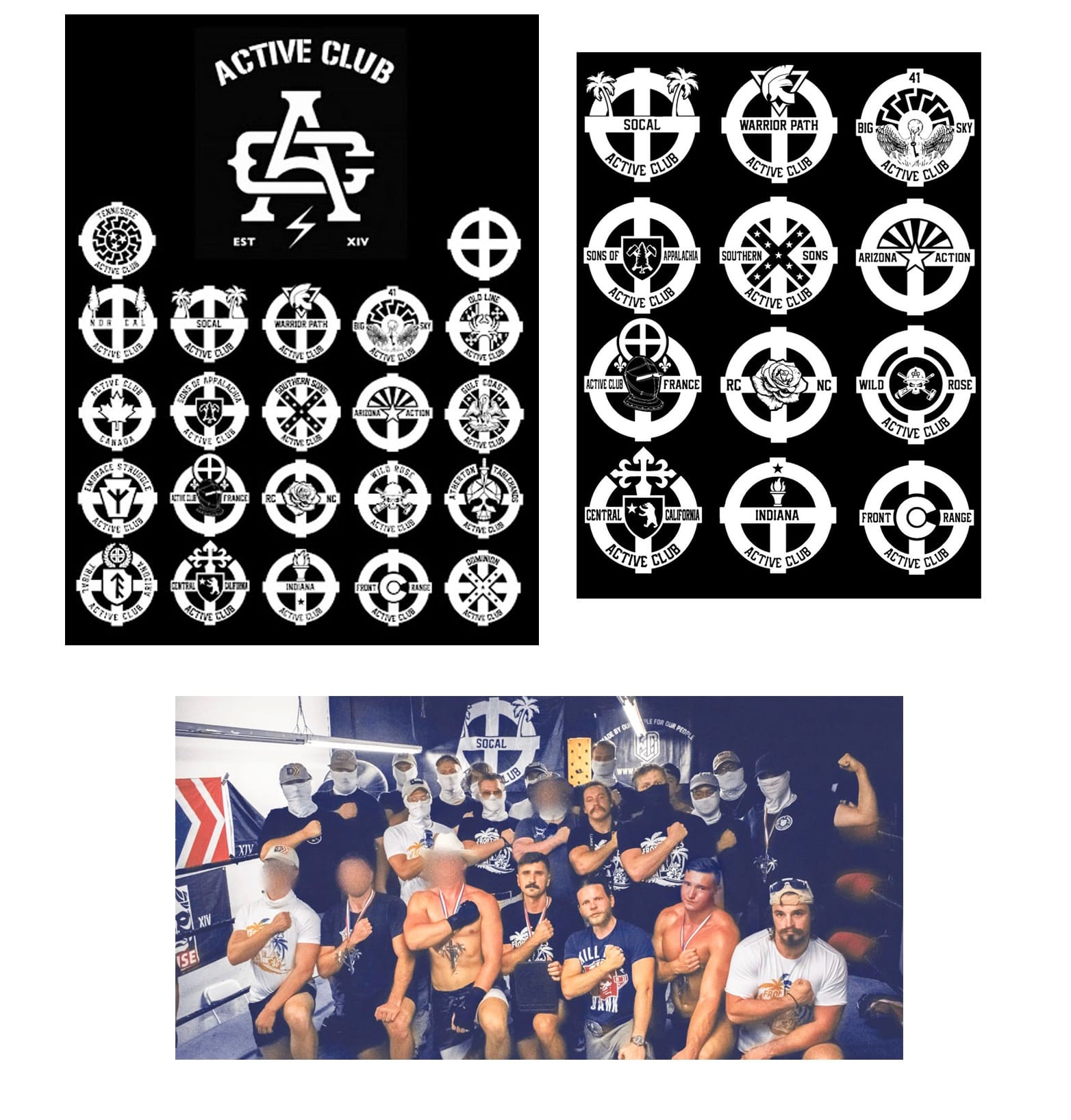
Active Clubs: Active Clubs are white supremacist fight clubs widespread across the US and throughout parts of Europe. They use the guise of fitness and training to try recruiting mostly younger white men into their clubs. Often members will march with other larger neo-nazi / white supremacist groups, and all chapters share the same logo of a Celtic Cross with text representative of their region. Many Active Clubs in the US are directly tied to Thomas Rousseau and Patriot Front.
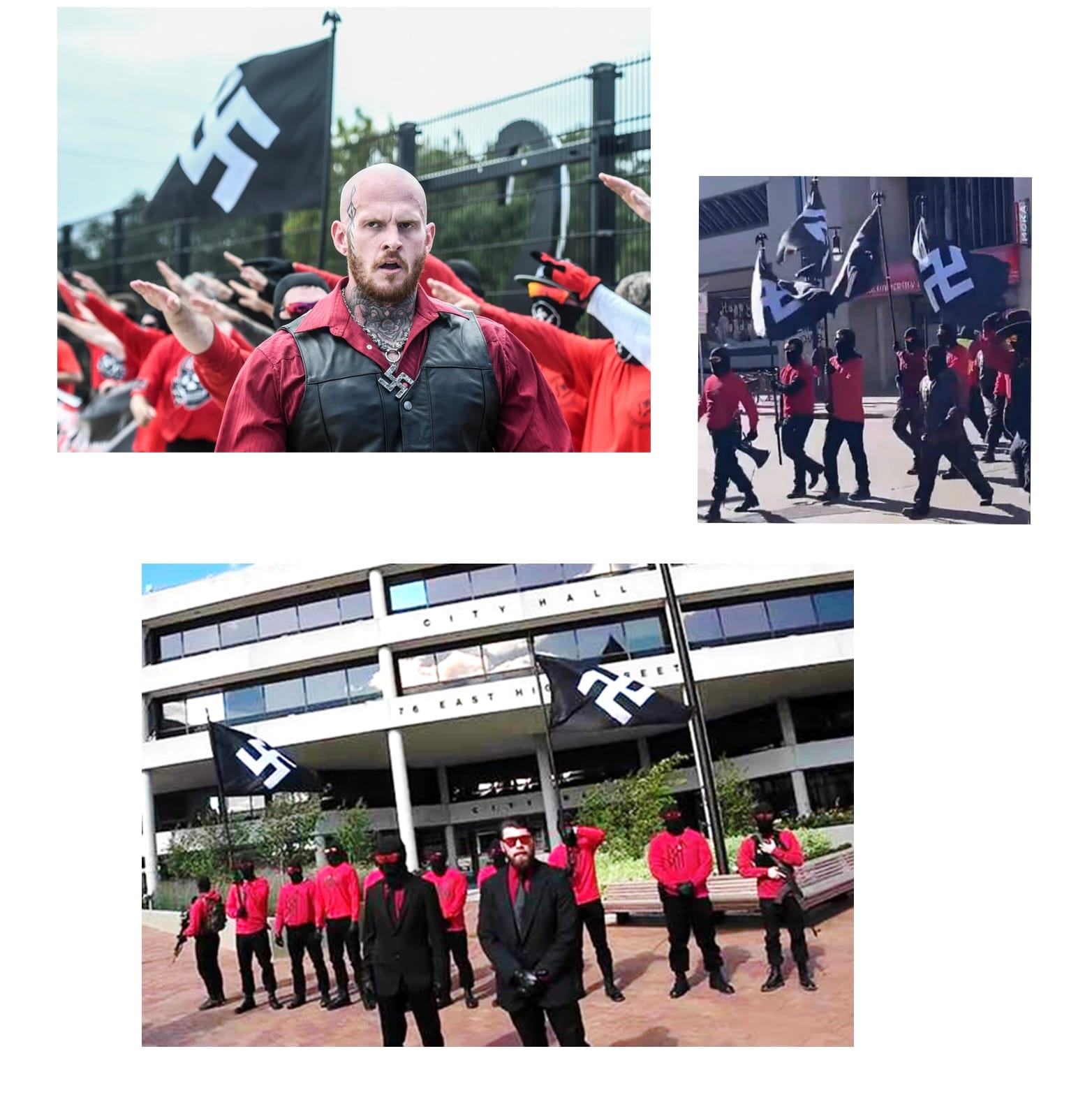
Blood Tribe: Blood Tribe is a neo-nazi group started by former marine Christopher Pohlhaus. They are known for being one of the most outward facing Nazi groups, holding semi-regular marches in cities across the US. They wear matching red and black outfits with black face coverings, and march with matching black and white swastika flags, and will loudly chant white supremacist and nazi slogans. Their goal is to instill a Fourth Reich in the US.
AFN: “Aryan Freedom Network” is a neo-nazi group present widespread across the US. The group has begun functioning as an umbrella organization, bringing in members from other groups like the Ku Klux Klan and outlaw bikers to function under their name. Outside of flyering neighborhoods with nazi propaganda, they operate mostly out of public view. They train often with firearms and make efforts to organize nationally across as many regions as possible.
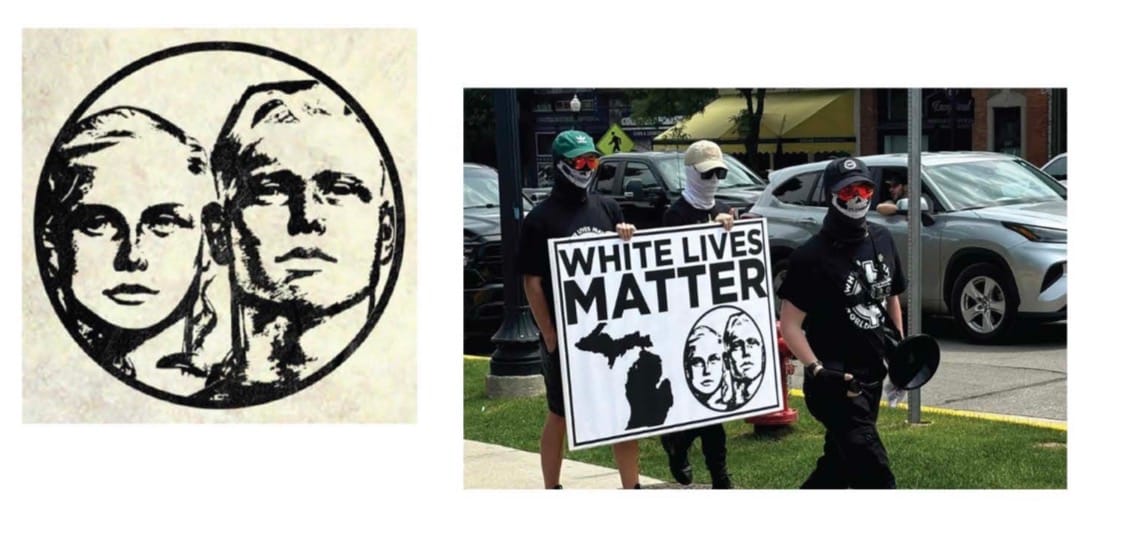
WLM: “White Lives Matter” is a white supremacist movement with chapters all around America and the globe, who focus their activism on low-risk tactics like stickers, flyers, and banners.
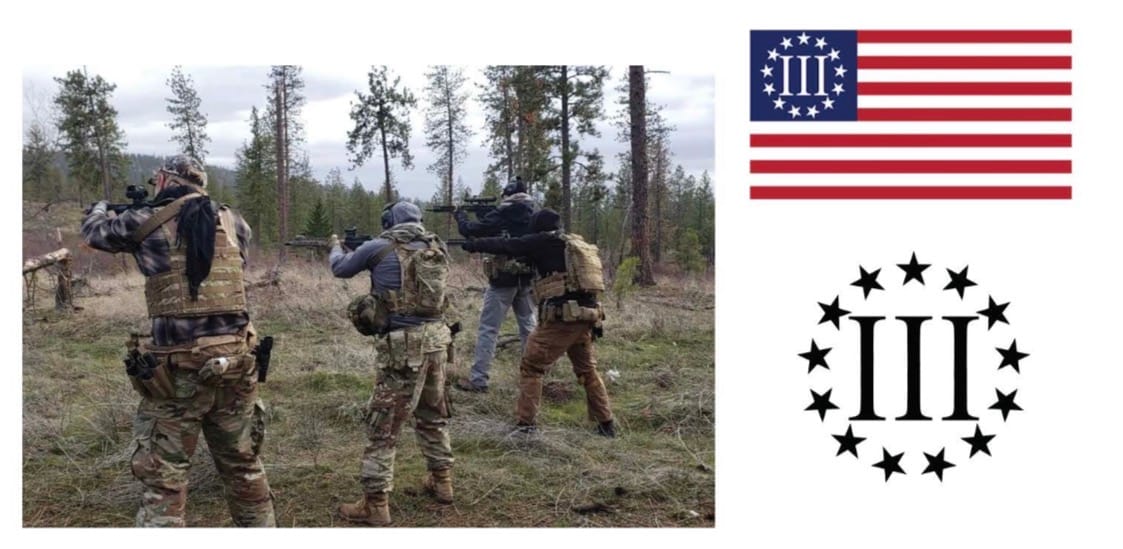
Three Percenters: This movement was created in 2008 with the false claim that only 3% of American forces fought the British in the revolutionary war, and therefore it would take only 3% of the population to overthrow the current US government. They are a far-right militia movement of anti-government extremists focused on gun ownership.
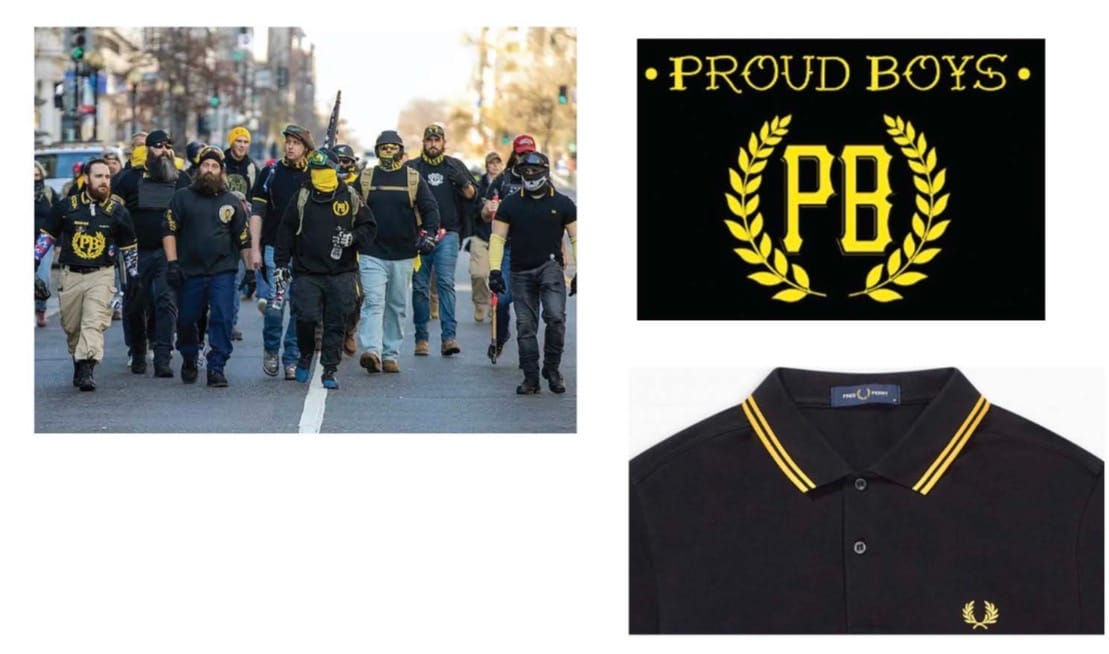
Proud Boys: A group of western chauvinists founded by Gavin McInnes in 2016. Although the Proud Boys aren’t explicitly white supremacist, their emphasis on the “western” values and culture is a thinly veiled substitute for “White” values and culture and is used to deflect accusations of racism. Their ideology can be considered a form of proto-fascism as it contains elements of ultra-nationalism, traditionalism, misogyny, and social Darwinism. Their membership has different levels and members are encouraged to participate in street brawls. Level 1 is to exclaim “I am a proud western chauvinist and I refuse to apologize for creating the modern world.” Level two is to recite 5 cereal brands while other members perform a “beat in.” Level 3 is to get a tattoo of “PROUD BOY,” and level 4 is to engage in violence for their cause, usually against LGBTQ or antifascists. They use the acronyms POYB (Proud of Your Boy) and FAFO (Fuck Around and Find Out) and can be spotted in black and yellow Fred Perry polo shirts, or other clothes with the black/yellow color combination. They also use the “okay” hand sign on a regular basis.
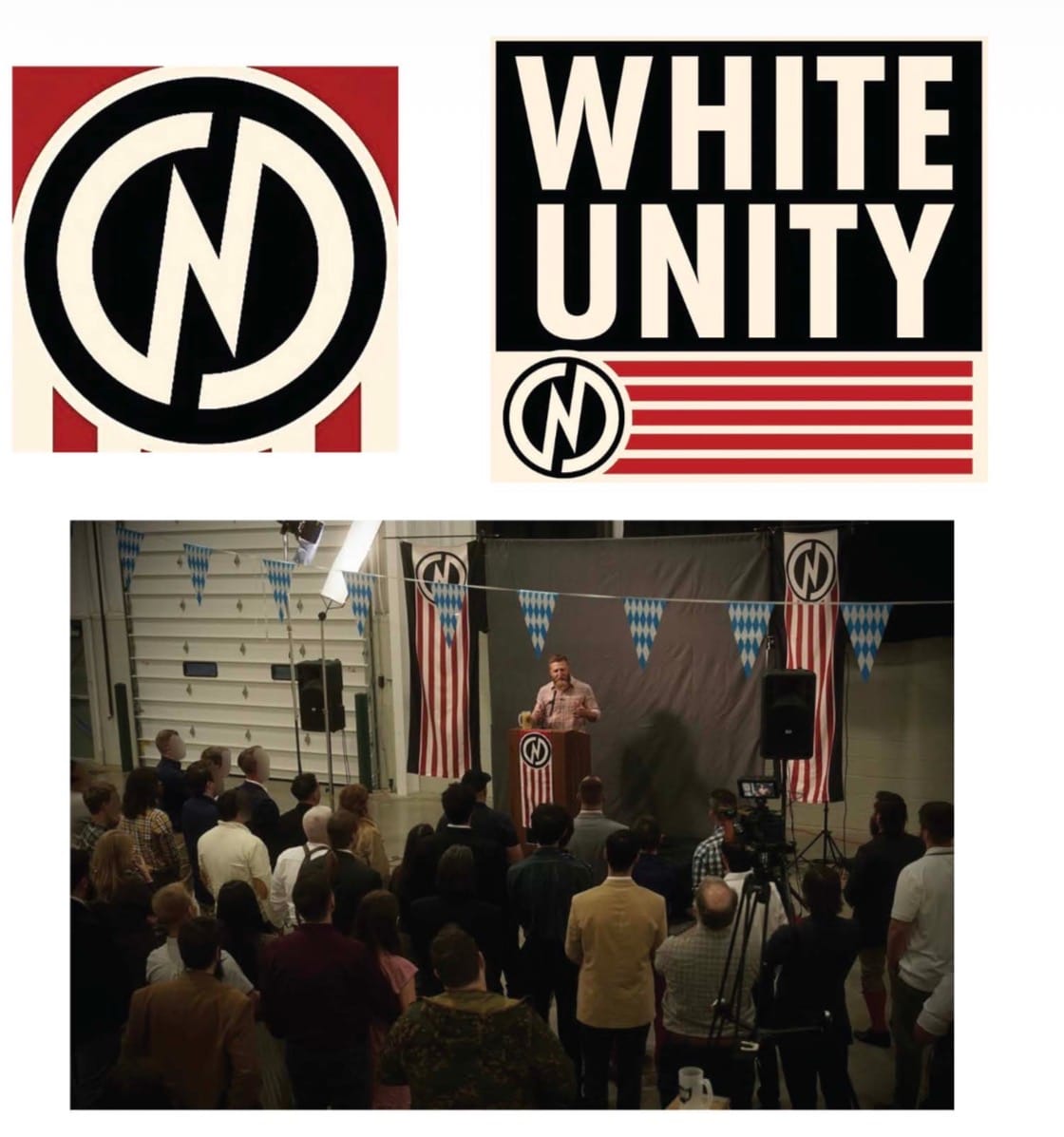
NOVA: “National Organization for Vital Action” is a white-supremacist organization with the goal of building a “nation within a nation” for whites only. They aim to connect as many neo-nazi and white-supremacist groups and individuals as possible in order to create a broad network of racists in America. Their public actions mostly consist of banner drops and stickers. In private, the group has expressed their willingness to use violence to achieve their end goals of a whites only nation.
GDL: “Goyim Defense League”, founded by Jon Minadeo II, is a network of anti-semetic content creators who focus almost exclusively on anti-Jewish conspiracy theories and hatred. They primarily focus their efforts on online videos and live -streams, but are also active in-person, often flyering neighborhoods doing banner drops, harassing synagogues, and holding marches with swastika flags.
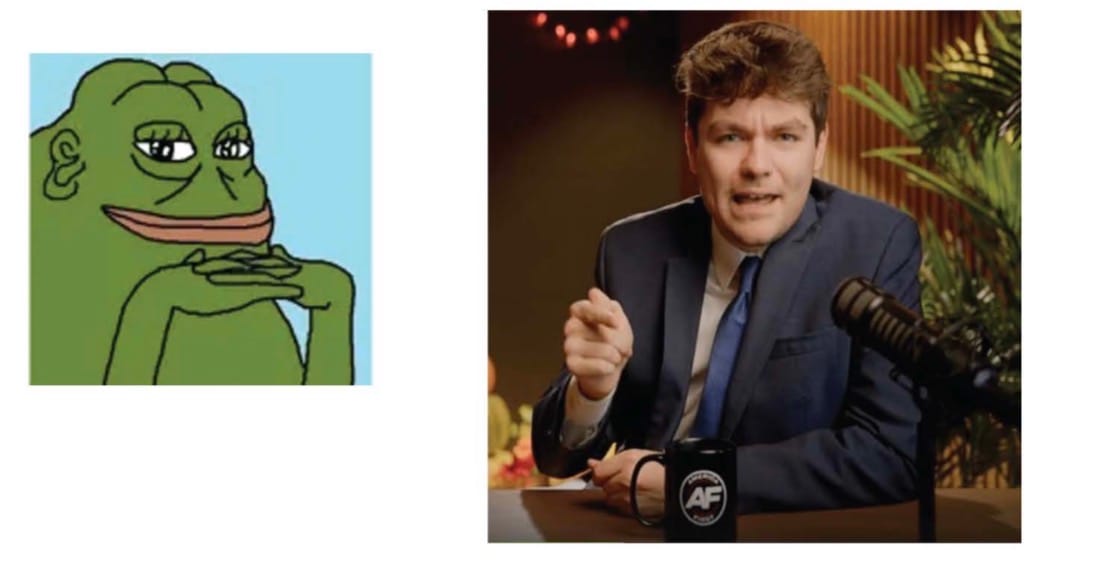
Groypers: “Groypers” are a term for followers of far-right, nazi influencer Nick Fuentes. Less of an organized group, it is a term given to adherents of the anti-immigrant, anti-semetic, and pro-white positions held by Nick Fuentes and pushed into the public. The primary function of Groypers is to push more “traditional conservatives” into a more radical, white supremacist sphere.
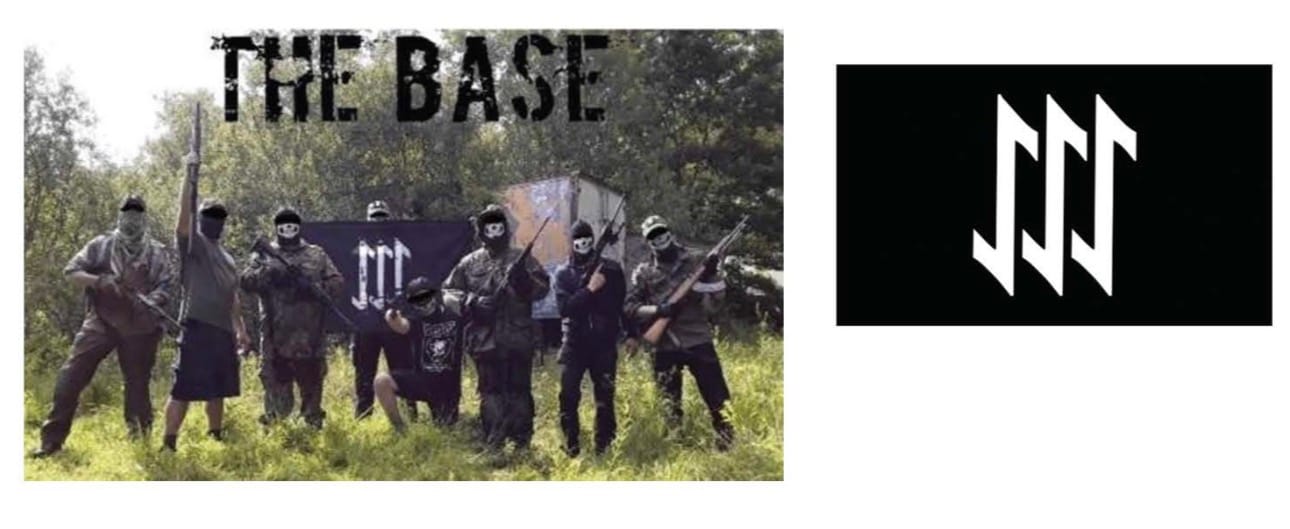
The Base: An accelerationist paramilitary nazi group formed by Rinaldo Nazzaro in 2018. They have similar aesthetics to Atomwaffen, but a different logo.
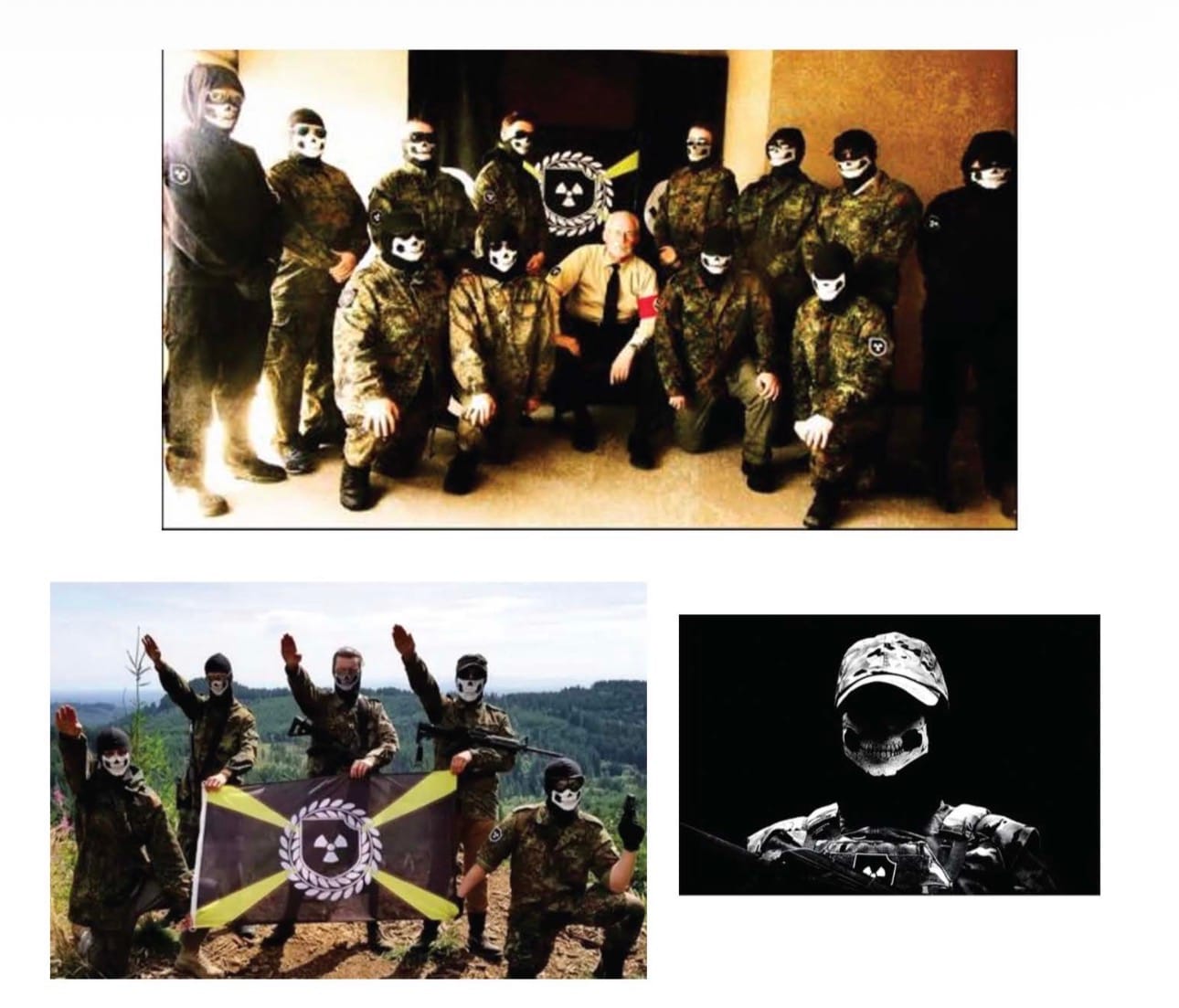
Atomwaffen Division: Also known as the National Socialist Order, Atomwaffen is an accelerationist (accelerating towards a race war in which they hope to overthrow the current government and society and replace it with a fascist order) nazi group responsible for several murders. After numerous arrests and infighting. the group dissolved, only recently attempting to reform in 2025, though failing to gain support. Responsible for popularizing the skull mask within neo-nazi groups, other symbols include the radioactive symbol and flecktarn (a German camo pattern similar to the “peas” pattern from WW2). Although now defunct, their influence remains significant.
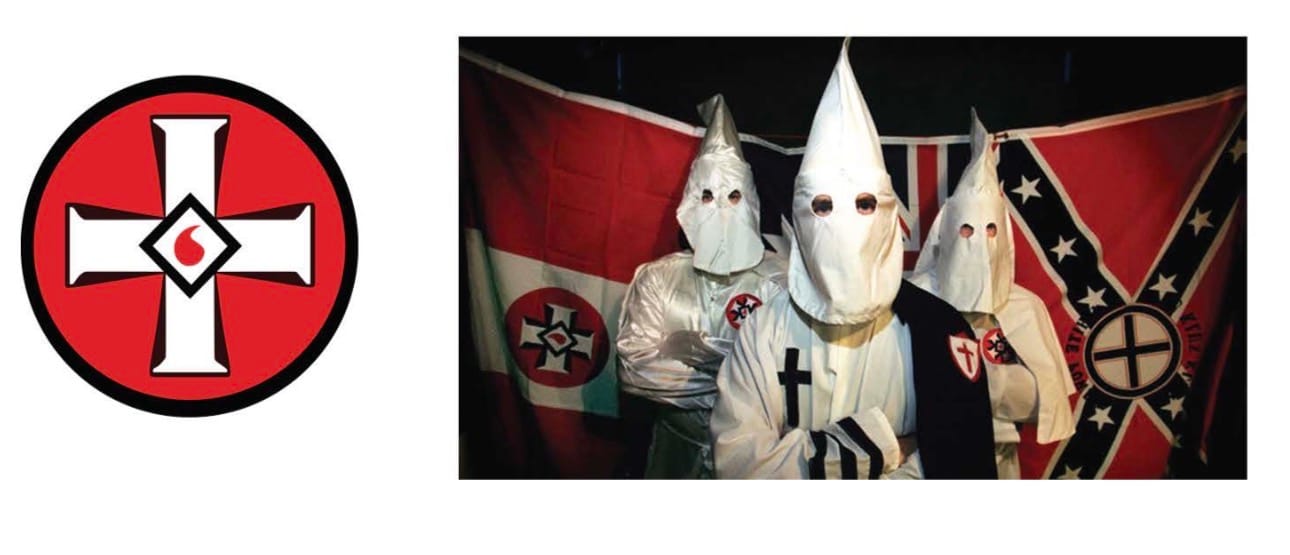
Ku Klux Klan: One of the longst running white supremacist organizations. They use the number 311 to represent 3 Ks, which is the 11th letter of the alphabet. Their iconic robes have become so recognizable they may no longer count as a dog whistle. They also use the blood drop cross and variations on the blood drop cross including just the blood drop, and the confederate flag.
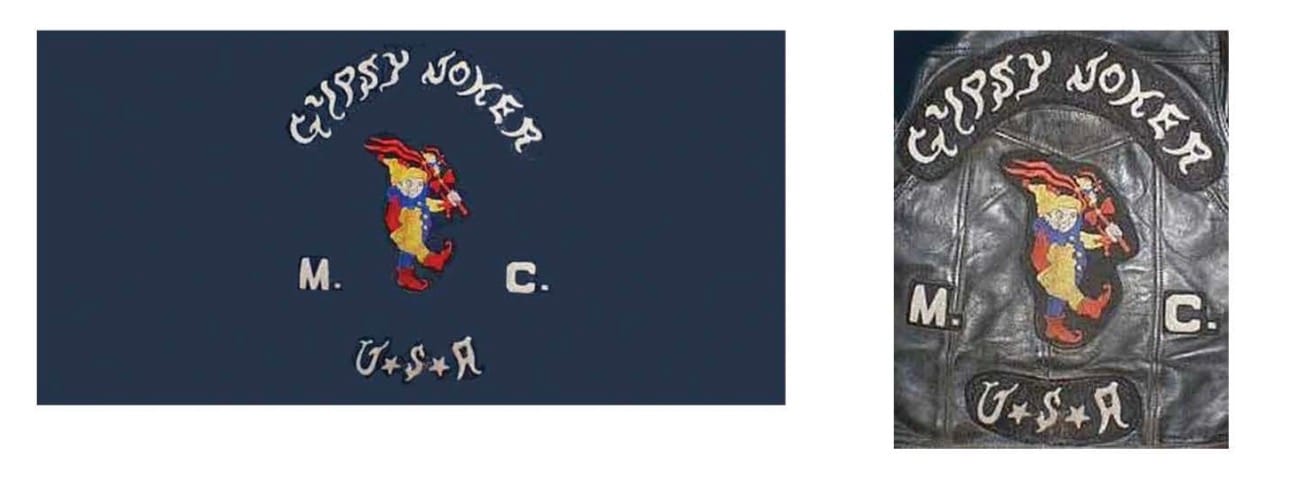
Gypsy Jokers: A one percenter motorcycle club with white supremacist sympathies who are known to traffic drugs and engage in low level organized crime and violence. They wear motorcycle gear adorned with nazi symbols and a back patch that says “Gypsy Jokers.” In recent years they have been known to associate with the Proud Boys.
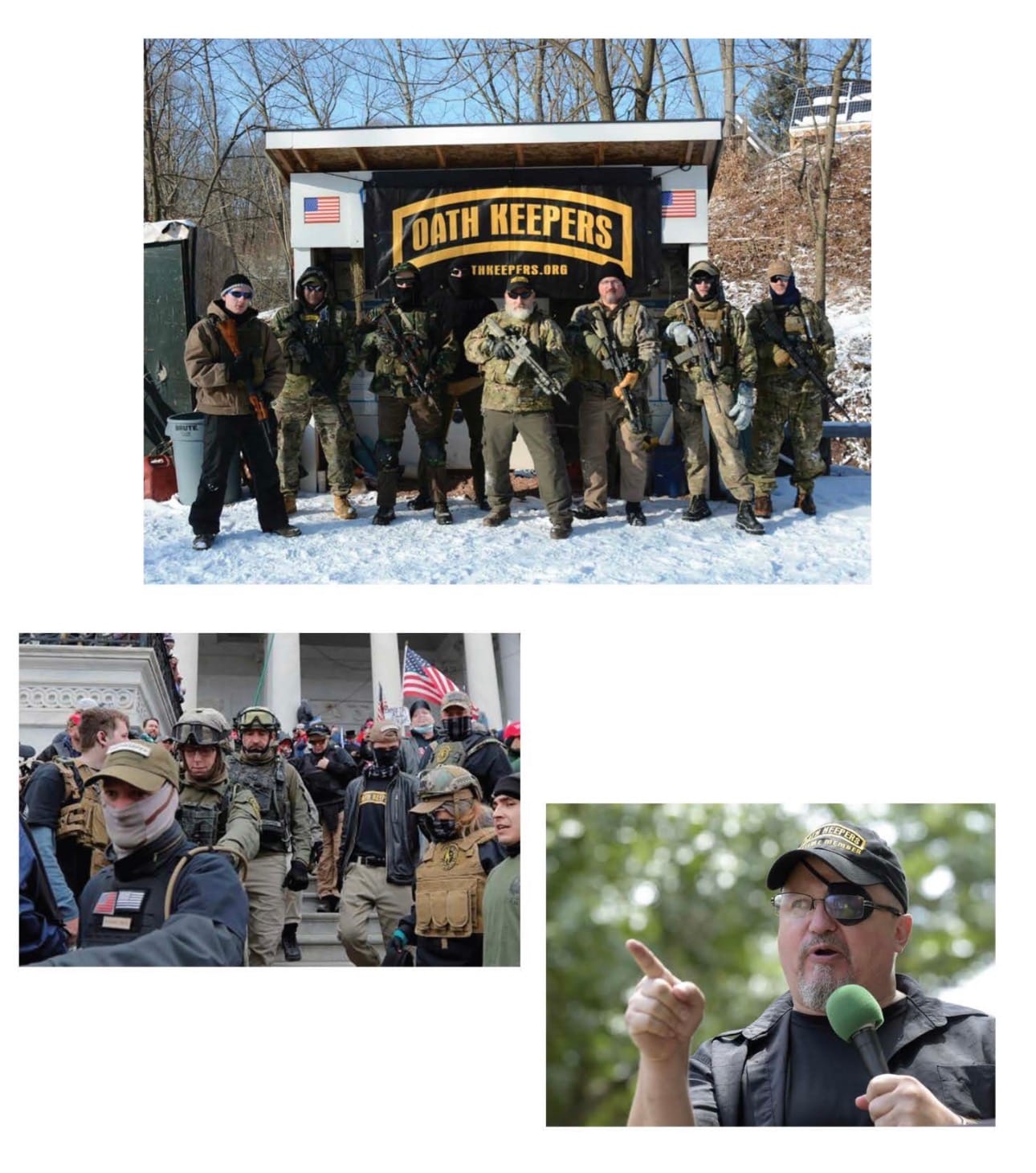
Oathkeepers: Far-right anti-government militia founded in 2009 by Stewart Rhodes. Oathkeepers played a key role in the January 6 insurrection at the US Capitol. Oathkeepers appeal directly to military and law enforcement personnel, encouraging them to keep their “oath” to defend the public from what they perceive as the new world order, by means of discipline and violence. They’re also associated with three percenters.
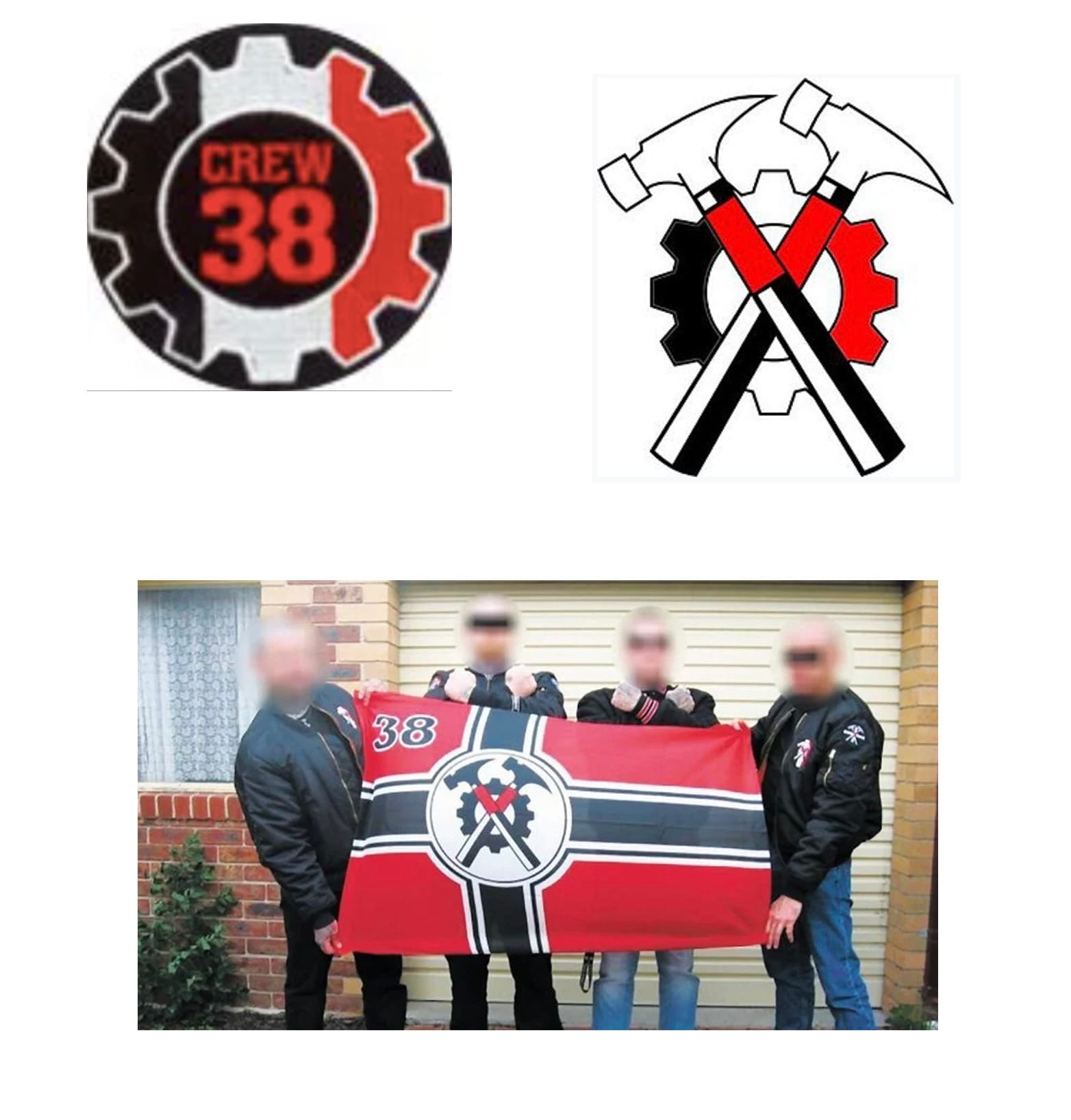
Hammerskins: A racist skinhead group, aka boneheads. The feeder group is known as Crew 38 (38 for “Crossed Hammers”). Hammerskins focus mostly on spreading racist music, but they also engage in street fighting and targeted attacks. Hammerskin Nation is considered one of the most violent racist skinhead groups in the US. They use a hand sign of crossed arms with fists to represent the crossed hammers.
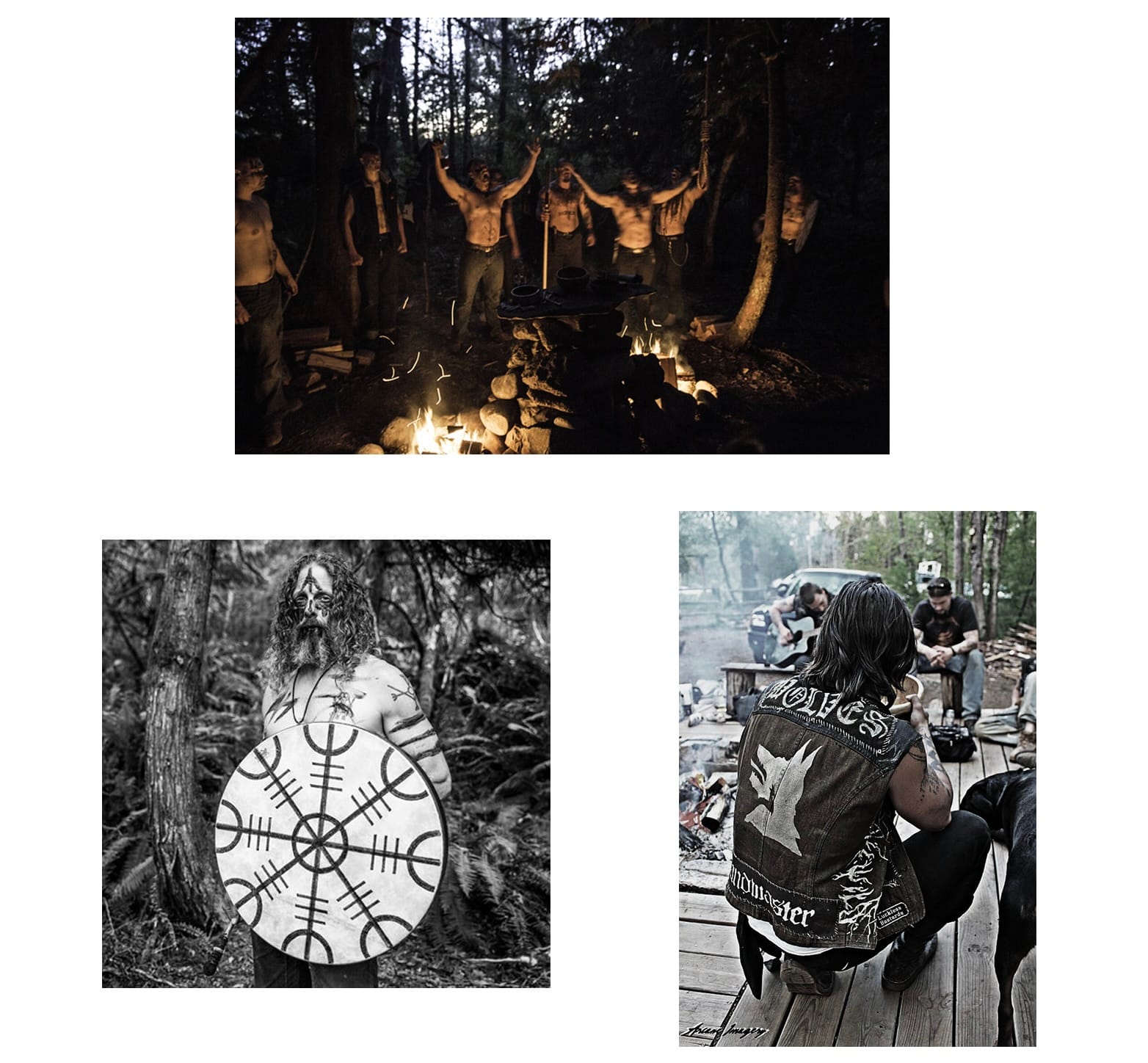
WoV: “Wolves of Vinland” is a group with heavy folkish influences that promotes white supremacy and misogyny, stressing Asatru or Paganism, including animal sacrifices and blood rituals in the woods. They have recently been partnering with Patriot Front and Active Clubs to hold fascist combat events. Their headquarters is in VA, but membership is not limited to that area. “Operation Werewolf” has been used as a recruiting tool and feeder group for WoV. They can be spotted with Celtic and Nordic imagery, runes, and wolf pack patches..
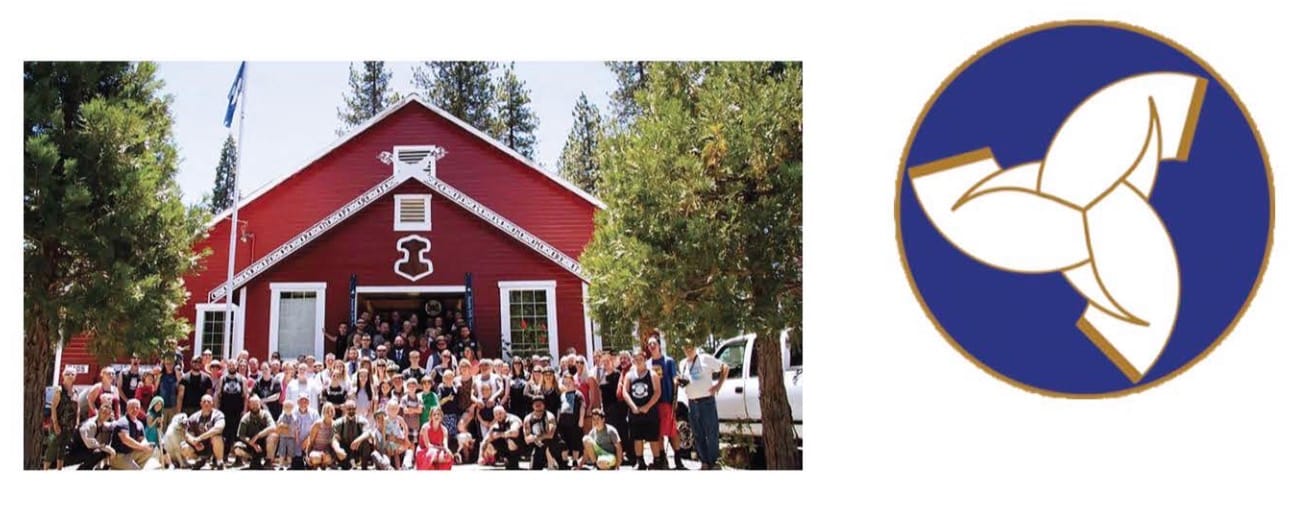
Asatru Folk Assembly: A norse pagan organization which advocates for pre-Christian European rituals and beliefs. The organization discourages “race-mixing” and promotes a whites-only vision of America, falsely claiming that white people were in North America first and were wiped out. Members of other neo-nazi groups such as Blood Tribe associate often with them.
764 / No Lives Matter: 764 is an international, predatory network that espouses neo-nazi, satanic, nihilistic, and accelerationist beliefs. It targets and exploits children / young people and encourages them to commit mass acts of violence. Adherents have been responsible for acts such as murder, firebombings, and school shootings.
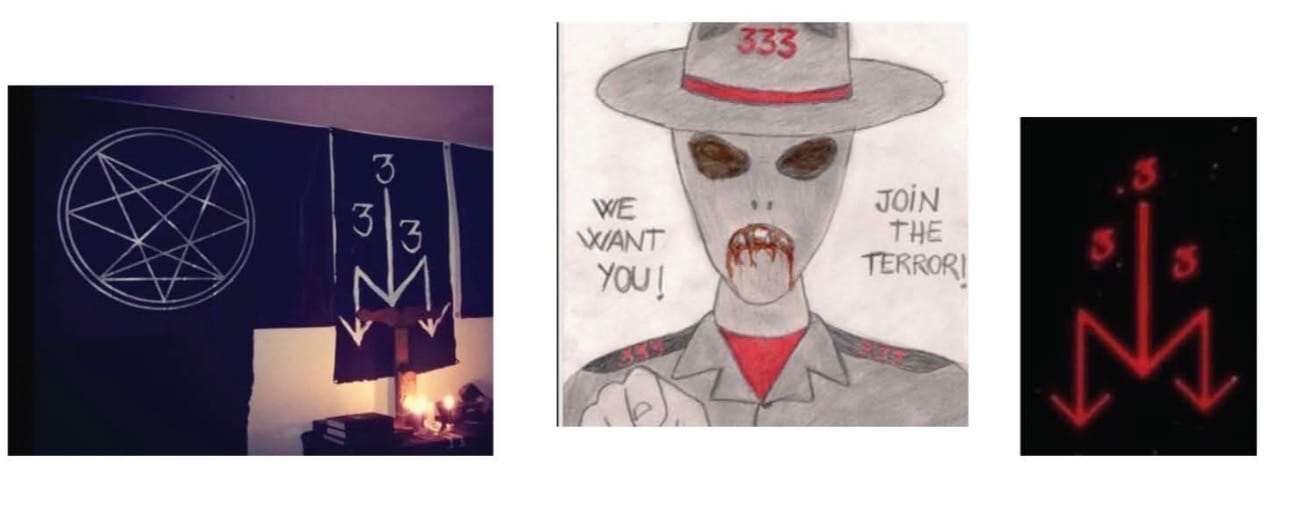
Tempel ov Blood / 09A: The Order of Nine Angles (09A), and it’s most violent chapter, The Tempel ov Blood (ToB), are satanic neo-Nazi cults that have had a significant influence on far-right accelerationist projects, like the now-defunct Atomwaffen. Suffice to say, 09A and ToB glorify nazism and violence, and are adept at radicalizing (and abusing) teenagers. Symbols include the seven-pt star inside a circle, a downward sort of pitchfork with 333 above it, and “Drill Sgt Grey” – a sinister space alien in a military outfit.
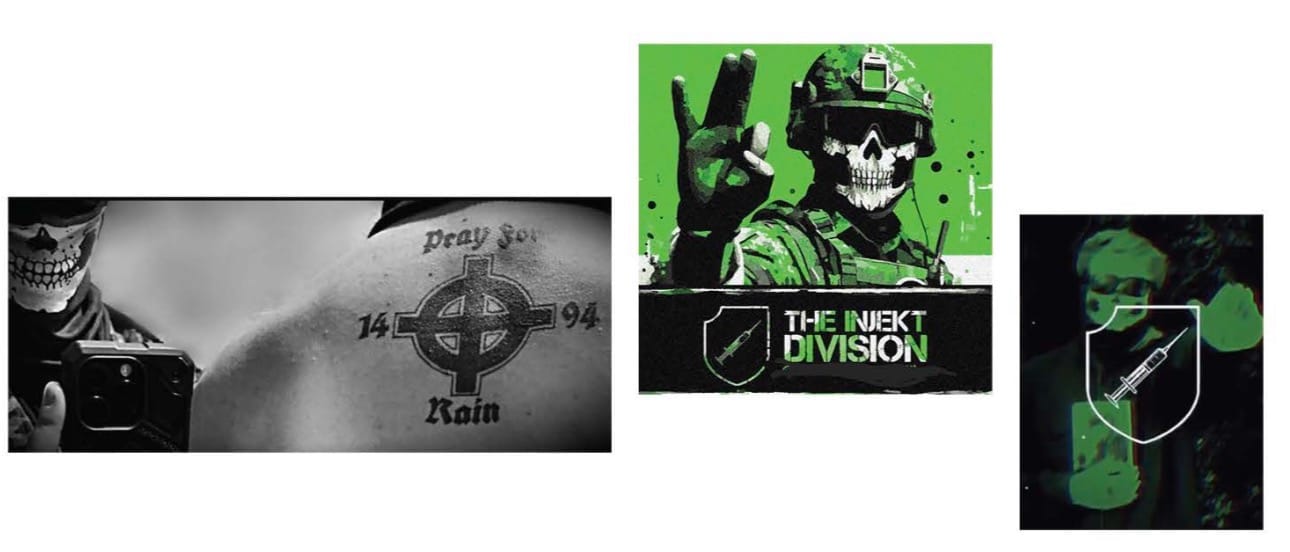
Injekt Division: An accelerationist nazi group that was formed by Coleman Blevins (aka Korb) in 2021. They are organized in decentralized cells, embracing a terror guerrilla ideology that looks to collapse the “System”. Their symbols include a syringe, 1494 and “Pray For Rain”.
NWTI: “The Northwest Territorial Imperative” is a vision of a whites-only homeland in the Pacific NW. Proposed in the ’80s by Richard Butler of the Aryan Nations, it is an idea embraced by a wide variety of white supremacists, including secretive militant nazi groups dedicated to implementing the vision, such as Northwest Front (NF) or the Northwest Pioneer Association (NPA). NWTI is represented by an inverted Cascadian tri-color flag – having vertical stripes, rather than horizontal. Their flag sometimes includes a rune or swastika. Common associated phrases: “Come Home, White Man” and “Ex Gladio Libertas”.
Vinlanders Social Club: Vinlanders Social Club (VSC / Firm 22) is a violent neo-Nazi bonehead gang formed in 2003. It uses Firm 22 as a support crew of men and women; the men being prospects for full VSC membership. VSC / Firm 22 went into decline in the 2010s, but has been attempting to build itself back up through proximity to the active club movement, much like the Hammerskins. Its symbols include a black cross on a green flag, 22, 1422, an eagle holding brass knuckles, a red, white & blue shield patch with a laurel, or just a laurel.
TPUSA: “Turning Point USA” is an organization which targets high schoolers and college students with far-right propaganda, talking points, and literature. Founded by Charlie Kirk, and now led by his widowed wife Erika Kirk, the organization has chapters in schools across the US, and regularly sets up tents on college campuses in order to recruit and create content by means of filming bad-faith political “debates.” With a roster of speakers and frequent events, TPUSA regularly promotes popular anti-trans white nationalist talking points, white Christianity, and racial divisions. Using the public image of more traditional conservatism, they function as a pipeline to more fascist far-right ideologies.
References and Further Reading
For current / past antifascist articles, contact info for sharing tips, and other resources, you can visit:
We were eight, nine, ten-years-old, and we called it “Smear the Queer.”
The game went like this: there were a group of kids—nearly always all boys—and a football. The pigskin got tossed up, a boy would grab it, the rest of us would chase and tackle him, and either he would surrender the ball or one of us would take it, and the chasing and tackling would start all over again.
That was the whole game. It was basically freeform rugby with no points, but this was Central Texas in the mid-90s and none of us were aware of rugby, so we thought of it as reverse tag with violence.
We called it “Smear the Queer” because that’s what the older boys called it. They called it that because the boys older than them called it that. Or that’s what their older brothers called it. Or that’s what their fathers and uncles called it.
At that age, I don’t think there was any discussion on the etymology of the word “queer” or why the ball carrier was called “the queer.” That was just the name of the game, and if you had a group of young boys and a football and enough interest, a kid might say “Smear the Queer?” and the game would start.
We were conditioned to think of being gay as a bad thing before we knew what it meant to be gay. By the time we got to middle school, it was made crystal clear to us that there were two things it was absolutely wrong for a boy to be: either gay or a girl.
If another boy called you gay or a girl, it was either because they were being “friendly” (or what passed for “friendly” among boys then) and playfully teasing you with the easiest insult — or they really didn’t like you and were going for the jugular with the worst insult. The intent was based on context, but at the end of the day, being gay or being a girl were not good things.
By that age, homophobic and sexist language had seeped into casual conversations among most of our peers. “That’s gay” was the most common way of saying a situation sucked.
“Wanna come over and play video games after school?”
“Can’t. Got detention.”
“That’s gay.”
“Yeah.”
At the close of the ‘90s, the words “faggot” and “pussy” were at the center of teenage boy lexicon. And a lot of the teenage girls used them, too. These terms flew freely in the hallways of middle school and sometimes in the classroom. Some teachers and parents might put a stop to it, and some teachers and parents willfully ignored it.
I got called “faggot” so many times in those years that I was pretty much resigned to it long before high school.
I was called a faggot for being in choir. I was called a faggot for getting good grades. I was called a faggot for reading. I was called a faggot for listening to Mariah Carey. I was called a faggot for my girlish laugh. I was called a faggot for my mannerisms. I was called a faggot if I did something nice. I was called a faggot for being smaller than the other boys. I was called a faggot for not wearing the right clothing. I was called a faggot for the way I walked. I was called a faggot for the way I talked. I was called a faggot if I followed the rules. I was called a faggot because a boy just didn’t like me. I was called a faggot because a boy in my grade might just feel like saying “faggot” and I was conveniently there.
I never said “faggot” or “that’s gay” myself because it felt wrong. I had a gay uncle. He had a boyfriend. They would come over and hang out and drink and smoke with my mother and stepfather. They were always welcome. The four of them would have a grand ole time.
This did not stop my mother and stepfather from asking my uncle and his boyfriend to sit me down when I was nine or so and make it clear that I needed to act like a boy and never act like a girl because everyone could see the writing on the wall and they wanted to prevent me from getting my ass kicked by other boys.
I didn’t understand their intent at the time. I felt very confused. I thought I had been acting like a boy. Apparently not enough. I needed to try harder. I had no idea what “try harder” meant.
What I remember most is my uncle’s boyfriend giving me a serious look and saying the following: “Don’t be a faggot, kid.”
The world that was supposedly the opposite of “being gay” was professional sports. Football, basketball, baseball. Emmitt Smith, Troy Aikman, Michael Jordan, Kobe Bryant, Allen Iverson, Barry Bonds, Mark McGwire, etc.
These men were considered the opposite of gay. They were big and strong and famous and talented and handsome and all the girls loved them and all the boys wanted to be them.
At least where I grew up, the thought of gay men in professional sports was so far removed from rationality that it never came up in conversation. Male celebrities in music, film, and television? All fair game for speculation. But not sports. There was no way a man could be gay if he were a pro athlete. Impossible.
When Jason Collins came out 13 years ago this spring, you could have knocked me over with a feather. My peers and I had grown up, and the world had rapidly changed in such a short time. And yet, it was still a jarring, welcome surprise.
By then, homophobic language was largely frowned upon, even by many conservatives who opposed LGBTQ rights. It felt like everyone personally knew someone in their lives who were openly gay. And the vast majority of folks, regardless of politics, were then enjoying entertainment made by openly-gay celebs.
“Don’t Ask, Don’t Tell” had recently been repealed, which meant gay, lesbian, and bisexual folks could serve openly in the military. Tammy Baldwin had recently become the first openly-LGBTQ person elected to the U.S. Senate in Wisconsin, and she had seven openly-LGBTQ colleagues in the House, not including Barney Frank, who had retired from Congress on the same day she was sworn-in.
It felt at the time like same-sex marriage could possibly be legalized nationwide within the decade but maybe not. It wasn’t anywhere near certain. Possible, yes, but no guarantee. Yet, just that it was possible felt incredible.
But male sports? Many years away, it was assumed. Americans could accept gay and bisexual male soldiers dying on their behalf but openly-gay men in the NFL, NBA, MLB, and NHL? Not for a long time to come.
It wasn’t that most of us thought there weren’t closeted gay men in the leagues. We assumed there were. Statistically, how could there not be closeted gay men playing pro sports?
But they weren’t going to come out while still playing. Nope, not for a long time. Pro sports were (and remain) the last cultural bastion of American masculinity, the sole extracurricular distraction of tens of millions of American men who don’t want anything uncomfortable messing up their entertainment.
Make music. Make movies. Serve in the military. Run for office. Get married. Go be gay and live your life. Just stay away from male sports.
It mattered little to them that Sue Wicks and Sheryl Swoopes and other women had come out in the WNBA by then. It mattered little to them that lesbian and bisexual women were, by 2013, out in every major pro women’s sports league. All were courageous, all were leaders, all faced discrimination, and yet, a strange misogyny permitted Americans—particularly men—to have an uneasy, conditional acceptance of openly-gay women in major pro sports but not openly-gay men.
This was the environment in which Jason Collins came out. Everything about it astonished me. The cover of Sports Illustrated? Doing so while a free agent after the season had ended and making a huge gamble on his career? Doing so as a Black man in a country with a long history of diminishing and dehumanizing Black masculinity?
I was in awe of him. I remain in awe of him.
No teams signed him in the offseason. Maybe it was his production on the court. Maybe there were no teams who thought he’d be a good fit for their needs. Maybe—just maybe—even with the general support he received, it was because he was now an openly-gay man and no teams wanted that controversy.
Even with NBA superstars like LeBron James, Kobe Bryant, Dwayne Wade, Steve Nash, and many others praising his courage and saying all that mattered was the game itself and meeting the standard of excellence, he still got passed over.
It was ten months later when, finally, the Brooklyn Nets signed Mr. Collins to a ten-day contract. February 23rd, 2014. Jason Kidd—the coach of the Nets and a former teammate and good friend of Mr. Collins—pushed for the contract. He played that night for 11 minutes against the Lakers. The first openly-gay man to compete in any of the four major male pro sports leagues in North America.
He would eventually be signed for the remainder of the season with the Nets and retired from pro basketball that November.
But here’s what really gets me about Jason Collins: he never rested on his laurels, nor did he decide coming out while an active gay male pro athlete was enough, even though, I would argue, he’d have been well within his right to do so.
Jason Collins had that quality inherent in all great leaders: a heart for service. He always thought about others. He always wanted to lift up others.
It was only revealed after he came out that he had worn No. 98 on his jersey while with the Celtics and Wizards—when he was still closeted—in honor of Matthew Shepard, the 21-year-old, openly-gay man who was beaten, tortured, and murdered in Laramie, Wyoming in 1998.
He returned to No. 98 after coming out and signing with the Nets. It became the highest-selling jersey in the NBA for a time. He had that level of impact with his courage.
He consistently supported others in the broader LGBTQ community, even when he had no personal connection to us.
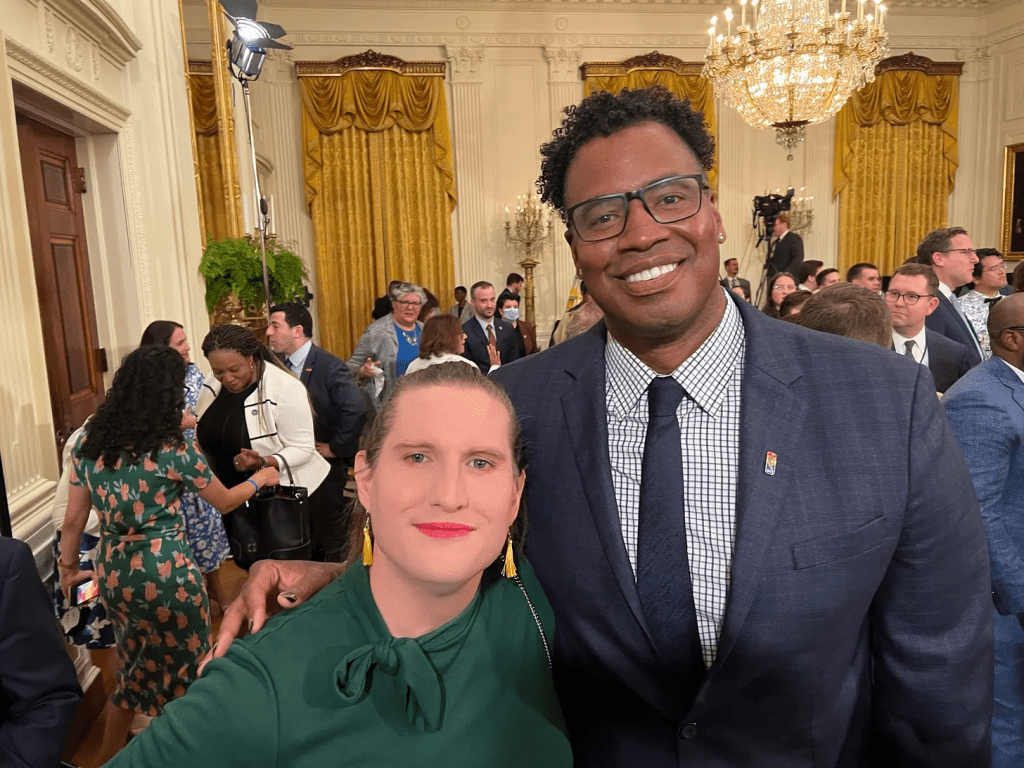
Several times over the years, Jason Collins—the retired NBA pro—reached out to me—a little-known trans woman political writer— over social media just to offer words of encouragement and make sure I felt supported and loved — because he saw the vile hatred trans folks were experiencing.
He would tell me he was proud of me. He would remind me that I should keep my chin up and be proud of myself. I remember one random occasion in 2020, as tired and stressed as I was during the presidential campaign, when I opened a DM from Jason that simply read: “Sending you a big hug today.”
Jason Collins went out of his way to be a big brother to queer folks he didn’t know just because he wanted to ensure we didn’t feel alone in tough moments. He felt protective of us because he knew, more than just about anyone, that sharp pang of loneliness in the public arena.
Many of us received an email this past Monday evening from Jason’s husband, Brunson Green, informing us that Jason was headed to hospice care and requesting we record a video offering words of love and what he means to us.
I cried after the reading the email and got to writing. It didn’t feel like enough. How do I tell this man how much he’s meant to me, meant to all of us? I decided to rewrite it (yet again) and film it and send it by the following evening. I wanted to do it right. He deserved at least that. He deserved way more than what I could offer.
Jason passed the next day before I could send it. I will forever regret not telling him all this, even though he likely wouldn’t have seen it in the mountain of videos his family received from countless people who loved and admired him.
What gives me comfort is knowing he was surrounded by those who loved him most, supported by millions who have thought about him this week, said a prayer for him, acknowledged his greatness and his humanity, given thanks for his selflessness and public service.
I receive a couple of weekly emails from Friends Committee on National Legislation. I began working with them back when the US invaded Afghanistan. I’m copy-pasting today’s letter, which includes links for more info, and some even for taking a little action if someone cares to do it.Either way, it’s good to be informed.
After a months-long political standoff over immigration enforcement funding, congressional Republicans continue to push forward a $72 billion proposal, without measures to hold these rogue agencies accountable.
A ruling by the Senate parliamentarian Thursday set back the proposal for now. But we must continue the struggle against a blank check for more lawless, cruel enforcement.
One of the most impactful ways we can push back is by lifting up stories of the toll of these policies on our communities.
On Wednesday, a group of senators held a hearing spotlighting how immigrants brought to the U.S. as children are facing detention and deportation after being promised protections.
Stephanie Villarreal shared a story about her husband Juan, a DACA recipient who has lived in the U.S. for more than 25 years. On Feb. 18, Juan was driving to deliver breast milk to their newborn baby in the neonatal intensive care unit. He never arrived. On his way, Juan was seized by ICE agents as Stephanie listened on the phone helplessly. He has been in detention ever since, separated from his wife, his baby, and his other children.
“He did everything he was asked to,” Stephanie said. “But that didn’t matter.”
We were also moved by the story of Deiver Henao, a nine-year-old boy held in ICE detention.
“I don’t wanna be here anymore,” he said. “I want to be [in school] to be happy … I wish I could leave before the spelling bee.”
Thankfully, Deiver and his family were released after his case received media attention. But many other children like him remain detained.
These stories are not are exceptional: they are far too common. How we treat people like Juan and Deiver is a test of who are as a nation. We all deserve to be treated with dignity, love, and respect. It is up to us, as people of faith and conscience, to speak out against these heartbreaking injustices and demand better from our government.
“Congressional action depends on local, personal stories from the communities they represent,” FCNL’s Anika Forrest explained.“Let’s make sure that Congress can’t look away.”
Elsewhere
War Powers Resolution on Iran barely falls short Public pressure to end war on Iran is moving Congress. Just this week, we saw resolutions to end the war almost pass – falling only one vote short in the House and two votes short in the Senate.
Public opposition to the war is bipartisan and fierce, and growing in Congress. Let’s keep up the momentum and get this over the finish line!
As Trump visits China, cries for cooperation multiply President Trump visited China this week, meeting with Chinese President Xi Jinping, talking about trade, Taiwan, and other issues. FCNL joined a broad coalition of organizations in calling for a peaceful, cooperative relationship between China and the U.S.As our letter to Congress puts it,
“At a time when so many domestic needs are going unmet, a confrontational posture toward China is costing untold billions.” Every dollar spent on war or preparing for war takes away from the desperate needs we have at home and abroad to build the world we seek.
Members of Congress call on U.S. to stop Ecuador operations The U.S. military is supporting Ecuadorian forces to violently crack down on accused drug traffickers. Twenty members of Congress sent a letter to Secretary of Defense Pete Hegseth demanding that the U.S. stop and investigate serious accusations of human rights abuses: “The United States cannot continue to be complicit in abuses abroad. There must be accountability.”
The path to abolishing the Selective Service Plans for automatic draft registration were announced about a month ago, fulfilling the mandate from 2025’s defense bill. Just yesterday, a bipartisan group of senators introduced legislation which would end the Selective Service entirely.
FCNL’s Priya Moran explained what’s going on and what the future might hold, calling on Congress to “focus on preventing war, instead of maintaining a system designed to force young people to engage in it.” Call for Congress to act!
In peace, Bryan Bowman Social Media and Communications Strategist
An Essential Shot: Vitamin K shots, which help the blood to clot, are one of three key interventions for newborns, along with an antibiotic eye ointment and the hepatitis B vaccine.
Increasing Rejections: The government doesn’t track vitamin K rejections, but hospitals have seen a rise in parents opting out of the shots for their newborns, often driven by unfounded fears.
Troubling Data: Hundreds of children die each year from spontaneous bleeding in the brain, a common result of vitamin K deficiency, suggesting that many related deaths go unreported.
These highlights were written by the reporters and editors who worked on this story.
They entered the world the way babies should, with piercing cries announcing their arrival. They passed their newborn screening tests. Some made it to their 2-week wellness visits without concern.
Then, without warning, their systems began to shut down. A 7-week-old boy in Maryland developed sudden seizures. An 11-pound girl in Alabama stopped breathing for 20 seconds at a time. A baby boy in Kentucky vomited before becoming lethargic. A brown-haired girl in Texas, not yet 2 weeks old, bled around her belly button.
Desperate to save them, records show, doctors inserted tubes into their airways and hooked them up to IVs. They ordered blood transfusions. They spent half an hour trying to resuscitate one boy until his parents told them they could stop. They shaved another boy’s soft locks to embed a needle directly into his skull to reduce the pressure in his brain.
None of it was enough.
At the morgue, the babies were brought in with their diapers and blankets and with their hospital ID bracelets still wrapped around their tiny ankles. The pathologists’ findings were like those you would typically see in ailing adults, not newborns — the kind of bleeding seen during strokes or brain tissue loss similar to what happens when radiation is administered to treat cancer.
Their autopsies, which took place over the last several years, all came to the same conclusion: The deaths were caused, in whole or in part, by a rare but potentially fatal condition known as vitamin K deficiency bleeding.
In almost every case, the babies’ deaths could have been prevented with a long-standard vitamin K shot. But across the country, families — first in smatterings, now in droves — are declining the single, inexpensive injection given at birth to newborns to help their blood clot.
Many of them are doing so out of a well-meaning but ill-informed abundance of caution. In the hopes of safeguarding their newborns from what they see as unnecessary medical intervention, they have shunned fundamental and scientifically sound pharmaceutical intervention. The trend is also fueled by a contradictory pairing: families’ fierce desire to protect their babies and a cascade of false information infused into their social media algorithms.
Although it is not a vaccine, the vitamin K shot has been swept up in the same post-pandemic tide that has led to a drop in key childhood vaccines, including for measles and whooping cough.
The vitamin K shot is one of the three main interventions, along with the hepatitis B vaccine and an antibiotic ointment in the eyes, that newborns typically receive before leaving the hospital. Leading American institutions and the World Health Organization recommend that newborns get the shot.
In December, the Centers for Disease Control and Prevention stopped recommending that all newborns get the hepatitis B vaccine, which has been highly effective at fighting a virus that can lead to lifelong infections and liver cancer. A federal judge in March temporarily blocked the revised childhood vaccination schedule that included that recommendation. Some families are also rejecting the eye ointment.
Two weeks ago, at a House subcommittee hearing, Rep. Kim Schrier, D-Wash., pressed Health and Human Services Secretary Robert F. Kennedy Jr. to reassure parents that the vitamin K shot is safe. He refused and pushed back.
“I’ve never said, literally never said, anything about it,” Kennedy said.
“That’s exactly the point,” responded Schrier, who is a doctor. “You don’t say anything about it, but the doubt you’ve created about all of medicine and science is causing parents to make dangerous decisions.”
An HHS spokesperson did not respond to questions but in an email blamed the administration of former President Joe Biden for the rise in parents rejecting vitamin K shots. “Vitamin K at birth,” the spokesperson added, “remains the standard of care.”
Meanwhile, families continue to be inundated with advice from self-proclaimed experts using medical terms incorrectly and misunderstanding science to convince parents that getting the shot could put their newborns at risk of grave harm.
Nearly a century’s worth of research and medical advancements shows the opposite to be true.
Babies who don’t get the vitamin K shot, research shows, are 81 times more likely than those who do to develop late vitamin K deficiency bleeding, where in many cases oxygen can’t reach their brains and blood pools around their skulls. Perhaps most alarming is that, according to the CDC, 1 in every 5 babies with vitamin K deficiency bleeding will die.
Determining precisely how many babies have died or suffered severe brain damage because of a lack of vitamin K is difficult. State and federal agencies don’t track data around vitamin K injection refusal or subsequent bleeding, which impedes their ability to quantify and track outcomes, including death.
The number of deaths directly attributed to vitamin K deficiency bleeding appears to be small — fewer than a dozen annually — but has started to climb in recent years, according to death certificate data from federal and state agencies.
But those numbers capture only a fraction of deaths, which often are classified only by other, more immediate causes, such as bleeding in the brain. In 2024, for example, more than 700 newborns died from spontaneous bleeding in their brains, which could have been complicated by liver disease or prematurity. Still, six medical specialists and one official at the CDC said a meaningful portion of those deaths likely were caused by vitamin K deficiency. Many more babies survive the bleeding but suffer massive brain bleeds and lasting injuries.
“A lot of the providers don’t have this on their radar,” said Dr. Jaspreet Loyal, a pediatric hospitalist at Yale Medicine. “The lack of data is almost acting like a reassurance for families that this risk is worth taking.”
Although it is difficult to quantify deaths attributable to vitamin K deficiency, there is clearly a large jump in the number of parents declining the vitamin K shot. Some hospitals have seen refusal rates more than double. A national study of more than 5 million births, published in December, found that the rate of U.S. babies not receiving vitamin K at birth topped 5% in 2024 — up 77% from 2017.
More Newborns Are Not Getting Vitamin K Shots
More than 5% of newborns in the U.S. did not receive vitamin K shots in 2024.
Source: “Trends in Vitamin K Administration Among Infants,” JAMA
The success of the shot has been so remarkable that it nearly eliminated vitamin K deficiency bleeding altogether. The science was settled decades ago.
“This was not something we even bothered to spend much educational effort on,” said Dr. Allison Henry, the director of newborn medicine service at Cedars-Sinai Guerin Children’s in Los Angeles, “because there was this simple, safe intervention.”
A cluster of cases 13 years ago was one of the first major signs that something was amiss.
Four babies were rushed to a Nashville, Tennessee, children’s hospital after they suddenly fell ill months apart. Stunned, doctors ran tests that revealed severe bleeding and reached out to Dr. Robert Sidonio Jr., their blood disorder specialist. They learned that the parents had declined vitamin K shots for the babies, each of them between 6 and 15 weeks old.
Once they realized that, the medical team moved quickly to treat them, injecting them with vitamin K and hoping it wasn’t too late. Much to the relief of doctors, they all survived. Only one infant had developmental delays.
The parents explained that they had declined the shot for a number of reasons: a concern, based on long-debunked claims, that the shot could cause leukemia; a belief that the shot wasn’t necessary; and a desire to reduce their baby’s exposure to “toxins.”
The CDC and the state health department opened an investigation and later published a report that found that when the parents declined the shot, their awareness about the risk of bleeding was “incomplete or absent.”
Dr. Anna Morad, a pediatrician at Monroe Carell Jr. Children’s Hospital at Vanderbilt in Nashville, said she had witnessed a gradual rise in families refusing vitamin K leading up to the hospitalizations.
She and her colleagues went into the Nashville community to speak at birthing centers and advise families about the benefits of vitamin K. One mother who had refused the shot for her newborn partnered with Morad and described how she came to realize that the shot can save lives.
More than a dozen pediatricians interviewed by ProPublica said they strongly recommend all three of the typical newborn interventions but agreed that the vitamin K shot is the most vital.
“I’m picking vitamin K every day,” Morad said. “Absolutely.”
With time, the number of families who turned down the shot dropped. As the need for the community outreach waned, Morad lost touch with the mother she had teamed up with and refocused her energy on directing the newborn nursery at Vanderbilt Health.
“I’ll be honest, I thought we had turned the corner,” Morad said. “Naively, I thought that would be enough.”
Dr. Anna Morad, a pediatrician at Monroe Carell Jr. Children’s Hospital at Vanderbilt in Nashville, says the vitamin K shot is the most essential of three interventions that newborns are typically given. “I’m picking vitamin K every day. Absolutely.”Stacy Kranitz for ProPublica
All newborns lack vitamin K. No matter how much vitamin K a mother consumes, it doesn’t sufficiently pass through the placenta, and breast milk contains only small amounts. That puts babies who are exclusively breastfed at a higher risk for vitamin K deficiency bleeding. Formula is fortified with vitamin K, but even with that, experts agree, babies should still get the shot.
Doctors have yet to understand why some babies who don’t get the vitamin K shot are fine while others bleed uncontrollably. But they do know that the risk increases dramatically. For babies who don’t get the shot, the risk for vitamin K deficiency bleeding from a week after birth to 6 months ranges from 1 in 14,000 to 1 in 25,000 births. With the shot, the research shows, the risk drops to less than 1 in 100,000.
The role of vitamin K is so crucial that researchers were awarded the Nobel Prize in 1943 for their discovery of its ability to form clots and stop bleeding in babies. The official presenting the award called the discovery the vitamin’s “greatest practical importance” and lauded it among the discoveries that have been of great benefit to humankind.
In 1961, the American Academy of Pediatrics recommended that all newborns in the U.S. get a shot of vitamin K. The CDC has supported newborns getting the shot as well, devoting several pages online to raising awareness around vitamin K deficiency bleeding and writing that babies may bleed “into their intestines, or into their brain, which can lead to brain damage and even death.” For decades, medical textbooks and lectures have presented the vitamin K injection as an example of a public health policy success.
After reports that vitamin K deficiency bleeding was on the rise, the American Academy of Pediatrics updated its policy statement in 2022 to stress the shot’s safety and efficacy. The paper included talking points for pediatricians to help them respond to common misconceptions: “Vitamin K injection does not contain mercury. Vitamin K does not cause cancer. The vitamin K injection used in newborns is safe. The dose is not too high for newborns.”
“We’re a victim of our own success,” said Dr. Ivan Hand, the director of neonatology at Kings County Hospital Center in New York and the co-author of the American Academy of Pediatrics statement. “Since we’ve been treating babies with vitamin K, we haven’t seen much deficiency bleeding, so people think it doesn’t exist.”
Seeing photos online of healthy babies who didn’t get the vitamin K shot and reading comments from parents who felt justified in their refusal, it’s easy to think that the risk of bleeding isn’t real, or at the very least that it’s exaggerated.
On Facebook, comments about the shot include: “Don’t do it!” “Huge lie!” and “It’s a scare tactic.” One person wrote, “Never will I ever inject my baby with poisons from big pharma.”
Families have also pointed to a 2023 episode about vitamin K shots by conservative podcaster Candace Owens, who said, “What Big Pharma is saying is that we realize that babies were born wrong. They don’t have enough vitamin K, and so we’re going to give them what they always needed. God designed us wrong.”
Owens did not respond to a request for comment.
Hidden is the agony of parents mourning the loss of their babies. Some are still in denial.
ProPublica spoke with five of those families, but none of them wanted to be identified publicly.
The obituaries, social media posts and GoFundMe pages capture the utter despair of the families, though none of them reckon with the decision not to get the vitamin K shot.
“No one could’ve prepared us for the heartbreak we faced 6 weeks after our little miracle was born,” one mother wrote. “She had a spontaneous unexplained brain bleed that led to brain death.”
“We miss his sweet smell,” another family wrote.
A third family, who made their decision after reading about vitamin K on social media and talking with their midwife, dismissed the vitamin K shot altogether. Instead, the father expressed outrage at the hospital for not delaying the clamping of the umbilical cord. He said he believed doing so would have allowed his son to be infused with vitamin K from the cord blood, a popular theory on social media. Research, however, shows that while delayed cord clamping can raise the baby’s hemoglobin levels, it does not have the same effect on vitamin K.
“I figured the hospital was already pissy with me because we didn’t vaccinate at all,” he told ProPublica. “They lost out on all the money from that.”
The family’s anger has subsided some since the baby’s death, in part because of their trust in God’s plan.
“I can sit here and be upset and sad, but this brought me closer to God,” the father said. “I just can’t wait to be with him.”
Two of the families who went on to have other children found themselves facing the same decision: Would they decline the vitamin K shot again? Both got the shot for their newborn.
Autopsy reports reviewed by ProPublica, like these two from children in Minnesota and Arizona, have notes from coroners citing vitamin K deficiency as a cause of death.Obtained and redacted for privacy by ProPublica
Morad watched as the number of families declining vitamin K climbed over the last year.
In January, she reached out to Sidonio, her former colleague who first recognized the 2013 cluster of cases there, for advice. Sidonio, now a pediatric hematologist oncologist at Children’s Healthcare of Atlanta and professor at Emory University School of Medicine, said he’s more worried than ever.
During that cluster, Sidonio recognized the need to collect data on how often parents decline the shot and what happens to those babies. But in discussions with the CDC, he said, he was told that it would be too difficult.
More than a decade later, nothing has come of it. In a recent email to ProPublica, federal officials said vitamin K deficiency bleeding has never been submitted for consideration as a notifiable condition.
“If you don’t track it, you don’t document it,” said Sidonio, frustration building in his voice. “They have to make it a reportable health condition, just like a new measles case. That’s the only way it’s going to change.”
Like him, Dr. Kristan Scott, the lead author of the national study that found a jump in the number of babies not receiving vitamin K, also landed on a need for a robust system to monitor vitamin K refusals and any subsequent consequences.
“We don’t have a clean data repository provided by public health systems or the state that would allow us to be able to track this in a more systematic fashion,” said Scott, who is a neonatologist at the Children’s Hospital of Philadelphia.
Some doctors failed to recognize the role of vitamin K when a baby came into their emergency rooms, let alone knew how to reverse the damage from the declined shots. Many of them encountered the condition only in medical school textbooks.
Some hospitals have started to run their own numbers, but the effort is scattershot. The data is also usually kept in house, so there’s not a wider knowledge of the problem. Recognizing the urgency of the matter, officials at a handful of hospitals agreed to share their data with ProPublica.
Doctors at St. Louis-based Mercy, which runs birthing hospitals in Missouri, Kansas, Oklahoma and Arkansas, began noticing an uptick in families turning down the vitamin K shot during the pandemic. Last year, 1,552 babies across all Mercy hospitals didn’t get the injection. In 2021, that number was 536.
And at Idaho’s largest hospital system, the refusal rates have gone up every year since the start of the pandemic, and in some cases have more than doubled. In 2020, 3.8% of families across St. Luke’s Health System declined the vitamin K shot for their babies. In 2025, that figure jumped to 9.8%. One hospital even reached 20% of babies not getting vitamin K shots.
At least two babies treated at St. Luke’s died within the last year from complications related to vitamin K deficiency bleeding, hospital officials confirmed. But Dr. Tom Patterson, a pediatrician who treats newborns at some St. Luke’s hospitals and is among the most vocal in warning about the climbing refusal rates, suspects there may be more.
Patterson recently pleaded with a family to allow their baby to get the shot. The father refused and shocked the doctor by going even further. He approached the nurses to complain about Patterson pushing the matter.
How We Reported This Story
As part of our reporting, ProPublica contacted 55 hospitals and birthing centers around the U.S.; interviewed more than 30 doctors; and filed nearly 90 public records requests with state and local health departments, medical examiners and other agencies. ProPublica also analyzed data from the Centers for Disease Control and Prevention and examined hundreds of pages of medical and autopsy records.
This guest is an immigration attorney with expertise in ICE tactics and in ICE detention. She dispels the misunderstanding and the myths created by the tRump administartion. These detentions are civil detentions not criminal and entering the country with out inspection is a class B misdemeanor. Another thing she mentions is the ever-increasing costs for detention which is currently $200 a day per detainee and there are over 70 thousand detainees. She gives a lot of other useful to know information including the brutality in the detention centers. For example they are taking detainees out in the Everglades and forcing them to stand with hands shackled in the hot sun being eaten by misketoes and bugs. They are putting people in “hot boxes” and leaving them there in the hot Florida sun with no water or medical treatment when they are let out. She describes many more examples. Hugs
Katie Blankenship, an immigration attorney from Sanctuary of the South, a grassroots legal services organization that provides critical, affordable legal defense to immigrant families affected by detention, deportation, and abuse, joins Sam to discuss abuses at the Alligator Alcatraz ICE detention center in Florida. To find resources or ways to help those targeted by ICE in your area you can visit Freedom for immigrants, American Immigration Council or visit the ACLU to find your local affiliate.
Political violence is on the rise — making the job more dangerous for state lawmakers and posing new challenges for state law enforcement officials.
Every high-profile act of violence sets off new waves of threats and fears of more — the assassination of conservative activist Charlie Kirk in September sent chills down the spines of elected officials throughout the country. But Utah, where he was killed, was already ahead of the curve on addressing threats to lawmakers and high-profile public officials.
Nine years earlier, it had set up a new unit to track and prevent violence against public officials.
The unit follows a four-step process, said Taylor Keys, a spokesperson for the state Department of Public Safety: It receives and identifies reports of threats and concerning behaviors, gathers the facts, assesses the individual’s risk of posing a real physical threat, and then manages the risk with intervention and case management.
But many states aren’t as proactive and prepared as Utah. Most state legislatures are in session only part-time, and many of the state enforcement agencies charged with protecting them are stretched thin and lack standardized procedures for reporting threats, collecting data and conducting regular training.
A spate of high-profile violent attacks over the past year threw this reality into stark relief.
And for some lawmakers, the environment is becoming untenable: Two recent reports show that harassment, abuse and violence are leading factors driving women and younger legislators, especially, to exit office.
State legislatures shape consequential policy and serve as a critical pipeline for higher office. But serving in office and entering the pipeline to power poses increasingly high risks to personal safety, especially for groups already underrepresented in the halls of power. While being a state lawmaker is a part-time job with a part-time salary in most states, lawmakers can’t opt out of being a full-time public figure.
“Elected and appointed officials live in a risk environment by nature of their job and their outward, public-facing positions,” said former Lt. Col. Tim Cameron of the Wyoming Highway Patrol, who spoke to The 19th in 2025 before he retired from the agency after more than 46 years in law enforcement. “Within the last year and a half to two years, that’s moved into a threat environment.”
The 19th spoke with experts and reached out to state-level law enforcement agencies in all 50 states to capture a comprehensive picture of the scope of political violence against state lawmakers and how law enforcement is responding. Officials in a dozen states told The 19th how they identify and respond to threats, what data they collect, and how they’re adapting their responses and procedures to an ever-evolving landscape.
As political violence is on the rise, many states are scrambling to keep pace. Political violence, Cameron said, was a major topic of discussion at the International Association of Chiefs of Police conference he attended in 2025.
“Anyone charged with executive protection is really looking closely at what they’re doing, how they’re doing it, and looking to utilize technology to leverage that in every way they can,” he said. “So it is going to be a challenge moving forward. And nobody has enough people.”
A February report from the nonprofit organization Future Caucus, based on interviews and surveys with 89 young lawmakers in 31 states, found that threats of violence “have become a serious deterrent to both candidate recruitment and retention,” especially for women, lawmakers of color and LGBTQ+ lawmakers.
“This is a four-alarm fire,” said Layla Zaidane, the president and CEO of Future Caucus, which supports young state lawmakers in bridging divides and working on policy across the political aisle.
“They can stomach the low pay. They can stomach no staff. They can handle even trying to figure out the toxic polarization and transcending that,” Zaidane said of young lawmakers. “But political violence was the thing that, when you add it all together, was the decider of: ‘I don’t know if I’m going to run again, I don’t know if this is worth it.’”
The rise in violent incidents is having an outsized impact on women, who make up half of the United States population but account for only a third of state lawmakers; even fewer women of color are represented in the political arena.
And when it comes to hyperpolarization and the increasingly toxic and hostile climate in state capitols, “women bear the brunt of this, multi-fold, compared to their male peers,” said Aparna Ghosh, the founder and executive director of the Ghosh Innovation Lab, a nonpartisan organization that conducts research and builds tools to support diverse and representative state legislatures.
A report the Ghosh Innovation Lab published last summer, based on 60 interviews and a nationally representative survey of over 300 women legislators, concluded that the assassination of Hortman “exposed a crisis that has been building for years.” Women lawmakers, the report found, “face systematic harassment, threats, and violence that compromise their safety, well-being, and democratic participation.”
The report found that 93 percent of women lawmakers said they experienced some form of harm or abuse in office, 59 percent said it disrupted their legislative duties and 32 percent said it impacted their desire to stay in office.
“It’s not just about an incident, but it’s about the everyday things that add up that push them out of office,” Ghosh said. “This is a huge problem for democracy, because this constant harm that women are facing is eroding the intent to run for office, so it’s eroding democracy in some way.”
(Emily Scherer for The 19th)
In the wake of Hortman’s assassination, several states have weighed legislation that would allow lawmakers to have their home addresses and other identifying information removed from public records. And as federal campaign spending on security expenses has continued to climb into the millions, 25 states now officially or informally authorize state candidates to use campaign funds for personal security, according to an analysis from the nonpartisan Vote Mama Foundation.
The role of law enforcement has also come under scrutiny, with the Ghosh Innovation Lab report concluding that state capitols and law enforcement “systematically fail to protect women legislators.”
The top safety shortcomings identified by women legislators surveyed for the report were a lack of training in handling threats (53 percent), the absence of a panic button for reporting incidents (46 percent) and unclear reporting procedures (42 percent). They also cited inadequate technological solutions, insufficient legal support, buildings feeling overly exposed, too few security officers and poor coordination with law enforcement.
“Whatever training they’re getting is their own responsibility, and that’s part of where the system breaks down,” said Ghosh. “It’s two things: One is that we’re not a proactive system, we react to incidents, that is one huge thing. And the second is it feels like safety and security is a legislator problem, not an institutional problem.”
At the federal level, the U.S. Capitol Police (USCP) protects members of Congress, often in coordination with local law enforcement, and issues regular public assessments indicating that threats against federal lawmakers are on the rise.
But far less is known about the risk environment and security landscape for state lawmakers.
States have widely varying levels of security for their state capitol complexes and different open carry rules. A 2024 review from the Wisconsin Legislative Audit Bureau found that 39 states use metal detectors in their capitol buildings, 31 use X-ray machines to scan packages and belongings and 10 require visitors to have photo identification.
Many states have dedicated capitol police forces, specialized units within state police or highway patrols responsible for protecting lawmakers and executive officials, or both. Local sheriff’s offices and police departments also respond to reports of threats from state lawmakers.
“The big problem is that there’s no standardization in the protocols and processes, and this is the gray zone where the system breaks down,” Ghosh said.
To get a clearer picture of the protection landscape, The 19th asked these questions to state agencies responsible for protecting state lawmakers in all 50 states:
What steps should a lawmaker take if they receive a threat?
What are the agency’s processes for identifying and responding to threats?
Does the agency collect data or produce threat assessments on threats to public officials, including state lawmakers? If not, are there plans to start collecting that data and/or to make it public, as the U.S. Capitol Police does?
Has the agency implemented or plans to implement any additional security measures, safety plans or training for state lawmakers/capitol protectees in the wake of the Hortman and Kirk shootings?
Representatives of law enforcement agencies in 27 states responded to The 19th’s inquiries. Representatives of agencies in four states declined to comment, and 19 did not respond to requests for comment. Of the agencies that responded, many declined to share specific security plans or details but said they were committed to ensuring the security of state elected officials and those working at and visiting state capitol complexes.
The basics are the same: All agencies said lawmakers should immediately report a threat to a state, capitol or local law enforcement agency. But where lawmakers report threats can vary depending on whether the legislature is in session and the nature of the threat: a lawmaker might report a threat to the state capitol police or the highway patrol if the legislature is in session, or to their local police or sheriff’s department if they’re in their home county.
All the law enforcement officials emphasized that keeping evidence of threats is important.
Chris Loftis, a spokesperson for the Washington State Patrol, also said lawmakers should preserve “all evidence, including emails, voicemails, and social media posts” and are “advised not to engage directly with the individual making the threat.”
States use different methods to identify and trace threats. Many said they work with other agencies to monitor, identify and respond to threats. New York State Police spokesman Beau Duffy said the agency has a team of social media analysts who identify threats. Sgt. Ricardo Breceda of the New Mexico State Police said they use a variety of sources, including law enforcement databases.
“Our response depends on the nature and severity of the threat and can range from routine follow-up investigations to the activation of specialized tactical teams if necessary,” Breceda said.
Some officials and courts have found that some harassing and abrasive rhetoric directed at public officials falls under the First Amendment’s free speech protections, a finding that has at times frustrated lawmakers. Zaidane pointed to a 2021 case in which a man charged with making a threat to a Michigan state legislator’s office was acquitted after his lawyer said he was “just blowing off steam.”
“I think, at a minimum, better enforcement of laws and coordination with law enforcement would make lawmakers feel like the system has their back,” Zaidane said. “Like there are still bright lines that we should not cross in America and that we are committed to upholding those.”
Another thing lawmakers want more of, Ghosh said, is data.
For over 20 years, the U.S. Capitol Police has published annual public threat assessments detailing the number of threats they investigate. In new data released in January, the USCP’s Threat Assessment Section reported investigating nearly 15,000 “concerning statements, behaviors, and communications” against lawmakers, their families, staff and the U.S. Capitol complex in 2025, marking the third consecutive year the USCP has investigated more threats.
But most state law enforcement and state capitol security agencies either don’t collect or don’t publish such statistics. Utah is one of just a few states in the country that collects statewide data on threats to state lawmakers and produces assessments. The lack of comprehensive data from official sources makes it difficult to know the scope and scale of political violence against state lawmakers.
“They want that kind of tracking and monitoring system,” Ghosh said of women lawmakers. “They want security briefings annually.”
Some state agencies told The 19th they don’t have a full picture of how threats are reported and investigated across their states because jurisdictions respond differently to threat reports. Several others said they do centrally collect that data but don’t release it for security reasons.
“We collect data, but sometimes we’re not aware of the other complaints that potentially could be made to the sheriff of whatever respective county,” said Cameron of the Wyoming Highway Patrol.
Some state agencies share data with other law enforcement authorities, including through fusion centers.
Ghosh said women lawmakers also want more official safety training from law enforcement — many told her that they spend thousands of dollars out of pocket for self-defense and security training.
“They want systems to back them up and say, ‘We’re going to prepare you for what’s coming,’ even if it doesn’t happen,” Ghosh said.
Many states are working to expand security as well as training for lawmakers in the wake of the Minnesota shooting, though most declined to share specifics.
Cameron said that in Wyoming, the conversation about improving protective operations “never stops.” The state Highway Patrol has a trooper focused on protective intelligence who attended a threat intelligence course at the U.S. Marshals Service headquarters in Crystal City, Virginia, and investigates threats against lawmakers, he said.
“We’re constantly training our people. We recently instituted a special response team, more or less a SWAT unit, but they’re cross-trained to do executive protection,” he added. “Sometimes we’ll activate some of those members, so our [executive protection division] has additional personnel, either for advanced work or on site work or escort work.”
He said he’d like to see more adoption of drones and drone technology, an area where law enforcement in the United States is “behind,” to protect the state capitol and lawmakers.
Ghosh said the women lawmakers she’s spoken to need three things to carry out their work: to feel prepared, protected and nurtured.
“It’s simple things, right?” she said. “Their safety needs to feel well supported and ready to do the work that they’re meant to do. They want these three things, and when it breaks down is when they’re unable to do this work.”
This is a very well researched and scholarly man. He knows far more than the dogma of the bible he knows how to read the Hebrew and the nuances of the time. Hugs