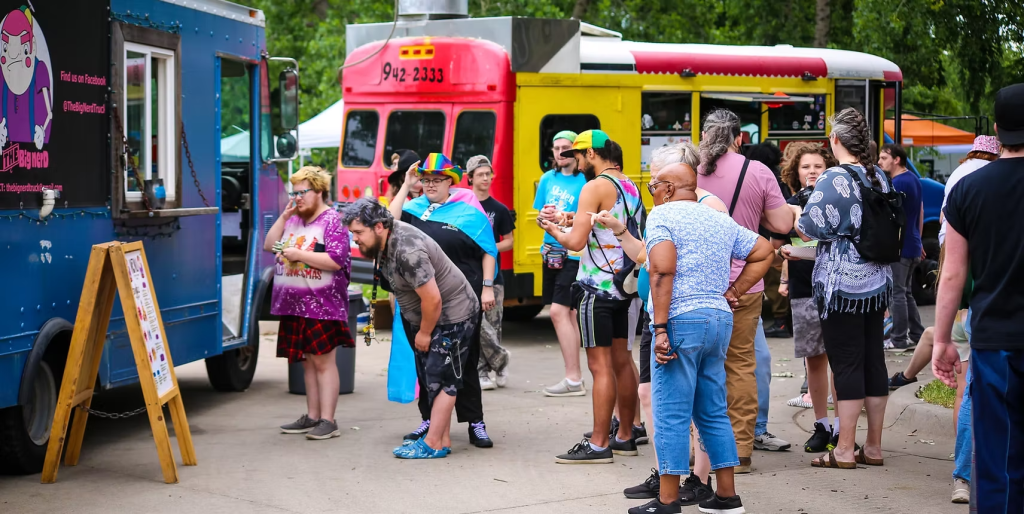
I think I posted about the Big Gay Market last year here on Scottie’s. It’s really cool, and it was Sunday 6/14 this year. It always makes me reminisce about, among other things, when I first came upon Scottie’s blog.
It was named “Scottie’s Toybox” at the time, with the same tagline, “Come See What I Share.” It sounded like Big Gay Fun to me, so I clicked through from MPS one time, and sure enough, there was a little big gay fun, a few resources for queer and other marginalized groups, and some issues on which people could take action if they cared to, along with a little general news. It was another time, it now seems. Anyway, Scottie transitioned to Playtime not as long a while back, I think due to Word Press anomalies, or something. I may not recall that correctly; I was a reader/sometime commenter, and it was nice. The Big Gay Market always reminds me of that, and I smile! 🏳🌈
Because of some election results and the associated removal of rights from, well, about everyone, but everyone isn’t as unsafe as those who are marginalized; and the scope of the blog has changed as well.
But on Big Gay Market day, I like to post about it. I bet everyone has a bright spot like this by them, and I know Scottie and I would like to know about those, too! Below is a report about, then the home page of Wichita’s Big Gay Market. Relax and enjoy!
A news report/interview from our local CBS affiliate.
(I dislike this channel, for its owner is an evil corporation and they’ve dumbed things down significantly, but as far as Google knows, they’re the only channel who has covered the Big Gay Market this year. For the record, I saw a short report on our local NBC affiliate at 5 PM, too, but can’t find it online Sunday evening. You can watch/listen on the page; it’s a short interview with the founder.)
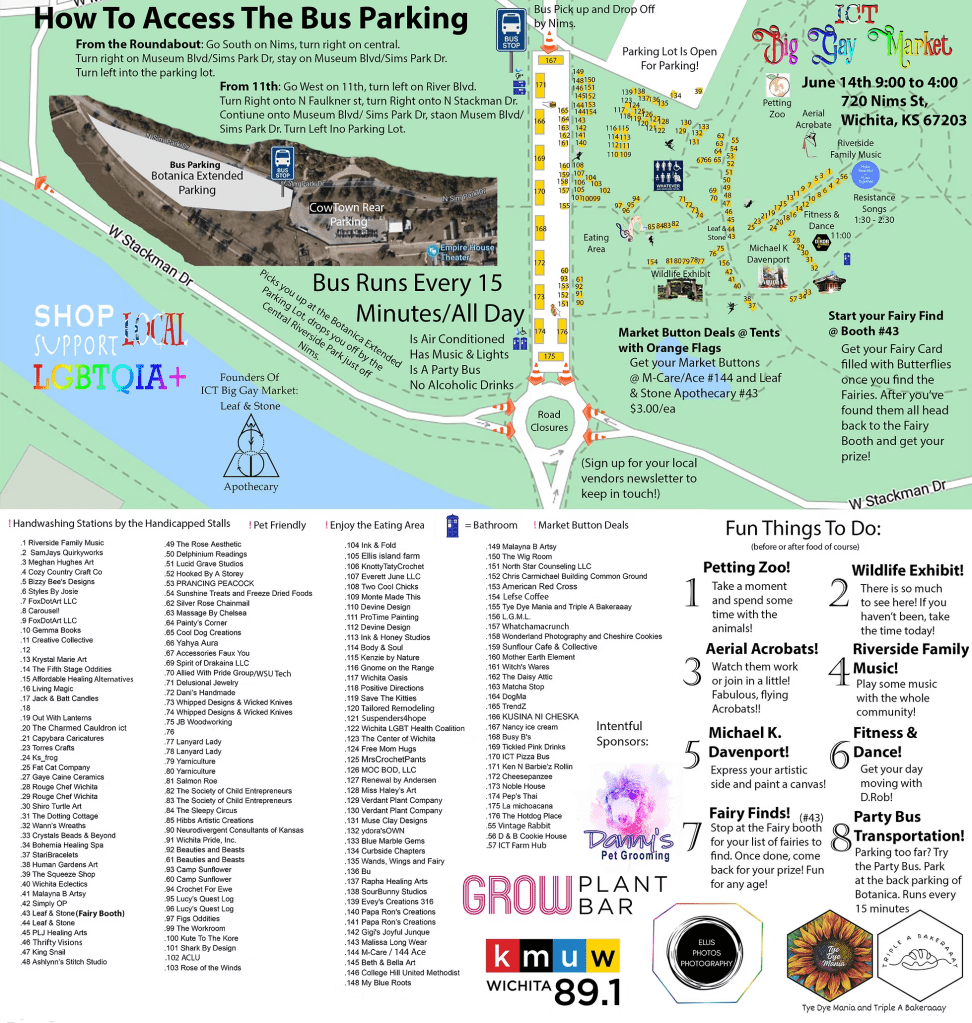
WICHITA, Kan. (KWCH) – The 5th Annual ICT Big Gay Market returns Sunday, June 14, bringing a full day of vendors, food and family-friendly activities to Central Riverside Park. Organizer and founder James Boyd says the event is designed to feel like a “huge farmers market” that is welcoming to all ages and packed with things to see, taste, and shop, with nearly 150 vendors expected this year.
Admission is free, but attendees can choose to purchase a Market button. You do not need a button to attend, but some vendors will offer special discounts to button holders. Button proceeds go toward a $2,000 Trades Scholarship through WSU; once that goal is reached, remaining funds will help support next year’s market.
Event details
What: 5th Annual ICT Big Gay Market
When: 9:00 a.m. – 4:00 p.m. Sunday, June 14
Where: Central Riverside Park, 720 North Nims St., Wichita
Cost: Free to attend (optional Market button available)
Copyright 2026 KWCH. All rights reserved. To report a correction or typo, please email news@kwch.com
Central Riverside Park June 14th 9:am to 4:pm 720 North Nims st Wichita, KS 67203
Wether your looking for a day out and a meal, some shopping or chilling to local music this can be a fun time for everyone! Local creators from all around Wichita have come together to show support to our local LGBTQ community!
2026 has come so quickly it’s hard to believe we are celebrating our 5th season of ICT Big Gay Market!
Jeff & James put together a community scholarship that supports the futures of soon to be students at WSU TECH! Our goal is to help one person with a $2,000.00 boost to their passion. We all help out where we can, you can donate to this scholarship here:
Roller derby was already queer-friendly. Then it got more inclusive.
Years before trans athletes in sports embroiled national politics, roller derby — the five-player high-contact sport with punk rock nicknames — tackled the question of who could play.
For Juniper Simonis, that night in 2012 replays like the start of a favorite movie. It’s a warm summer evening, and she’s speeding through Ithaca, New York, on her bike. The wind is in her hair — at least as much as it could be under a bike helmet. Mariee Siou, the American folk singer, is blasting through her headphones.
The moment is memorable because of the feelings of freedom and hope sparked by an email she has just received. It says that the Ithaca League of Women Rollers derby team voted to allow her to play.
“As somebody who played sports and was queer, but those were two very separate parts of my life, the promise and the opportunity … to integrate those was very hopeful for me.”
Simonis is transgender. She had been voted on by an all-women’s team.
“Getting a message that was like, ‘You are welcome,’ was very, obviously, very uplifting.”
While Juniper Simonis fondly recalls the day she was accepted into an all-women’s roller derby team, she says there have also been challenges. (Alyson Works Photography)
Years before trans athletes in sports embroiled national politics, roller derby — the five-player high-contact sport with punk rock nicknames — tackled the question of inclusion. The policies and practices are often imperfect. Transgender women and men as well as athletes of color still face discrimination in the sport. But time and again, its athletes have opted to remain inclusive.
Nicole Williams, known as Bonnie Thunders on the track, is widely considered to be the greatest derby skater of all time and often referred to as the “LeBron James” of the sport. She’s been skating for 20 years and has seen the sport evolve on trans issues.
She acknowledges that there was a time when she and other skaters knew less about trans women and what it might mean to skate with them, but the experience of actually playing with them changed minds over the years. She says a sport that excludes trans people just doesn’t make sense to her.
“When I see, ‘protect women’s spaces,’ that feels so repressive,” she said. “I don’t want to discount that women’s spaces are important. They are, but I don’t really identify with that in the way that I used to.”
The history of derby
Roller derby traces its roots back to the 1930s, when sports promoter Leo Seltzer got the idea to hold a roller skating endurance race on a banked track. Even in its first iteration, roller derby was co-ed, according to the Smithsonian — though men made more money than women.
That endurance race that Seltzer started gave rise to the contact sport we know today, according to derby veteran and Angel City League Derby Director Rachel “Rotten” Johnston.
“Over the course of these races, people start to run into each other. They get tired, they try to sabotage each other,” Johnston said. “And so that’s the thing that people started to get really into.”
Derby evolved from the 1960s through the 1980s into a five-player sport and a highly produced televised spectacle. But it wouldn’t become nationally governed until the early aughts. As it evolved, it also became heavily centered on women, though the sport has some men’s teams.
In 2001, a group of women in Austin, Texas, decided to give the sport organization and structure. Some believed it should be held on a banked track, like the early days. Others favored a flat track because it didn’t have to be specially built. But largely, they shared a common culture.
“There was definitely something really cool about a tough punk rock chick of that era. And, roller derby in its earliest form was as much about the bar fights and the black eyes as it was about the skating,” Johnston said. “It was, it was like, I get to wear this badass outfit that’s also kind of sexy. … It was post riot grrrl kind of coming into the 2000s, a direct rebuttal of the pop culture that was happening.”
Out with Britney Spears and Paris Hilton. In with “Beyonslay,“ “Iron Maven” and “belle right hooks.”
The question of inclusion
This freaky feminist counter-culture prided itself on skating outside the rules of femininity and gender norms. It was decidedly queer and queer-friendly, a sport that celebrated the strength of women and welcomed all kinds of bodies. Most sports had been made for men and adjusted to include women. Derby, however, had been dreamed into existence by women, and women ruled the track.
Its popularity exploded. The sport went from a handful of skaters, shaky on their skates, to hundreds of teams operating under the Women’s Flat Track Derby Association (WFTDA) and the Roller Derby Coalition of Leagues (RDCL). The former swelled to over 400 leagues across six continents. The RDCL stayed smaller, with just eight teams.
At no point did the WFTDA ever actively ban trans athletes, but its early policies created some barriers and confusion for trans people looking to play. Williams notes that in the early aughts skaters wanted a safe space to compete away from men.
“At the time, ‘cis’ wasn’t really even a term we were using,” Williams said. “And it was cis men that we didn’t want.”
Early WFTDA policy around trans participation generally mirrored that of the Olympics at the time: Transgender women were allowed to skate if they had undergone hormone replacement therapy for two years.
But trans skaters said this was applied unevenly at best. Some teams allowed trans women to skate even if they hadn’t met the medical requirements.
“The gender policy that we were working from was well-intentioned, but certainly not iron-clad,” Johnston said.
In the 2010s some trans skaters started asking questions about the policy.
One of them was Penelope Nederlander, known as Fifi Nomenon on the track. Nederlander decided to try out for the LA Derby Dolls in 2010. At the end of her tryout, she sat down with a mentor who was showing her the ropes.
“I was like, ‘I know it’s pretty obvious, but you know I’m trans, right?’” she asked. “She’s like, ‘Oh, I had no idea.’”
The following day, the mentor pulled Nederlander aside. Did her driver’s license have an “F” on it for “female”? Yes, Nederlander said.
Cool. She was good to go.
“That was wild, that was unbelievable,” Nederlander said of the ease with which she was accepted.
Everyone else in Nederlander’s life had to be taught her new name and pronouns and coached on how to talk about her. Derby gave her a community she belonged to as her authentic self.
“It was the first group of friends who I met who only knew me as Penny, and that was huge,” she said.
An open door
This policy of vague acceptance on a case-by-case basis, however, would not stand forever. Eventually players demanded a policy of full inclusion for trans skaters. In 2015, WFTDA updated its policy to say that anyone of a marginalized gender is welcome and encouraged to skate, regardless of how they look or their transition status.
This policy opened the door for people early in the transition. It also created space for athletes assigned female at birth who wanted to medically transition to remain part of the sport.
Among them was Drew Flowers, whose Derby name is OMG WTF. Flowers has been skating since 2008 and is nonbinary.
“I identified so hard with this being a female sport, a woman’s only sport,” Flowers said.
Bonnie Thunders, who plays for Rose City, has been skating for 20 years and says she has seen the sport evolve on trans issues. (Jase Sanders)
“I really kind of didn’t give the benefit of the doubt to my teammates, to my community, that they were going to be supportive of me.”
It was not only derby that was at stake for Flowers. They owned a skate shop with their partner, who happens to be Nicole Williams. Their livelihood depended on the community’s embrace. Williams assured Flowers it would be OK.
“It was definitely a scary time, for sure,” they said. “I will say, the moment that I did decide, ‘I’m going to do this,’ I had reached a point in my life where I was like, ‘I have to do this.’”
Today, both skate for the Rose City Rollers Wheels of Justice.
More work to be done
Of course, derby is far from ideal. Flowers, Simonis and Nederlander have all faced substantial challenges as trans people in the sport.
Donita Green, known as Blaxyl Rose on the track, said that gender-diverse skaters regularly report facing harsher penalties from referees. It’s even more pronounced for Black skaters like Green, who plays for Angel City Derby in Los Angeles.
“I’ve seen firsthand how much worse some of these microaggressions and problems happen when you are a dark-skinned Black skater. … You add knowledge of trans identity, and it’s just it tends to be even worse,” Green said. “We talk often about skating while Black. It just happens.”
Simonis said she has been assaulted by other players because she is transgender.
A way forward
But for all of its shortcomings, derby has at least attempted something most sports have not: It has prioritized inclusion above its perceived legitimacy.
That’s not because roller derby is not a serious sport. For several Olympic cycles, derby was on the consideration list for inclusion, but WFTDA skaters had reservations. For one, the Olympic Committee recognized USA Roller Sports as the official governing body, not WFTDA, even though WFTDA housed the lion’s share of teams and players. But more importantly, roller derby players were reluctant to engage in international games that parachuted into host countries and imposed strict gender rules on athletes. Eventually, they abandoned the idea.
Nederlander wants it to be OK for athletes to talk openly about how cisgender men and cisgender women might have different advantages or disadvantages in sports.
It doesn’t have to mean transgender women aren’t women or don’t deserve safe places to play or that they represent a threat to their teammates.
“I want to arrive at the same conclusion, but with honesty about it,” she said, adding that trans women should still get to compete even if some are taller than some cisgender women. “In roller derby, there doesn’t seem to be an important difference. We really don’t have any complaints about trans skaters. So that’s awesome. … And I think that that’s just a more honest, accepting way, and it keeps the other side from using that stuff against us.”
Many argue that including transgender women in sports would compromise fairness and safety. Johnston said that years of derby have proven otherwise.
“I think that people who are concerned about people getting hurt are missing the fact that we’re playing a full contact sport. You’re going to get hurt no matter what,” she said. “You know, life isn’t fair, and sports most certainly are not fair.”
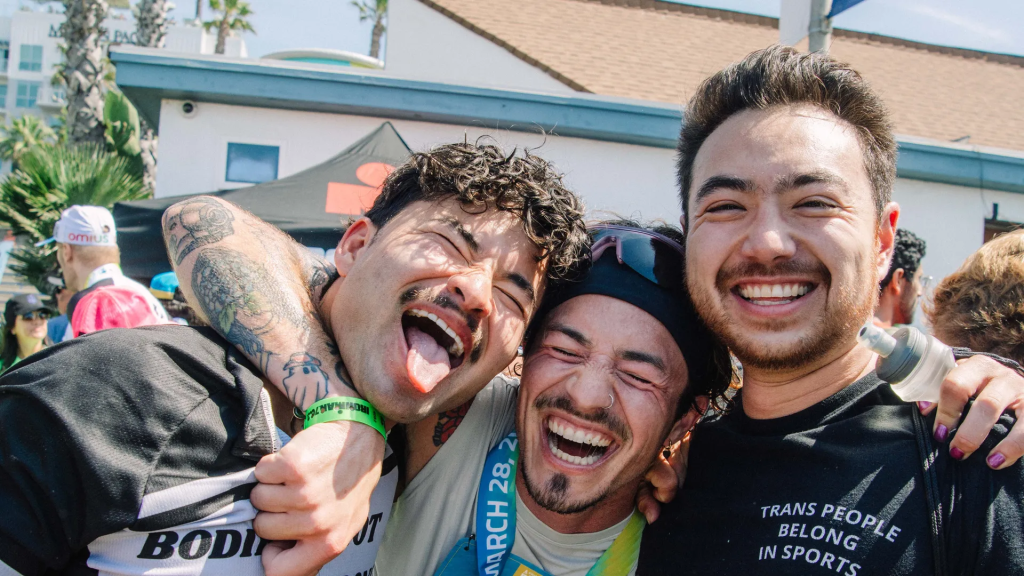
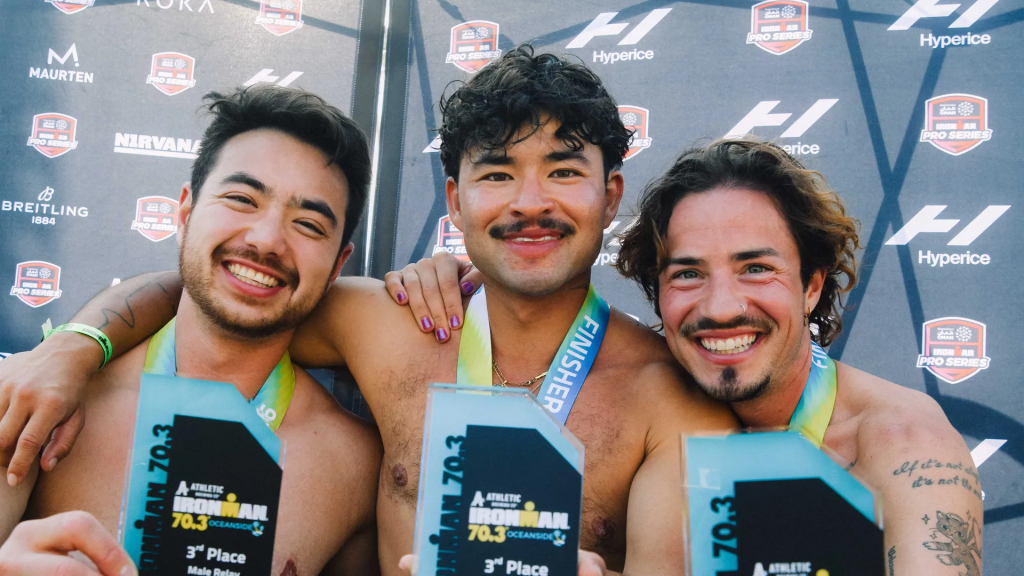
In March, the trio took third place at the 2026 Athletic Brewing Ironman 70.3 Oceanside competition, beating over 200 other teams.
Read Hiltz’s letter to the team below:
Schuyler, Chella, and Cal,
Congratulations on your podium finish at one of the toughest endurance events in the world! An Ironman podium is no joke. Beyond the months of training, sacrifice, and trust in your fellow teammates, a performance like that requires so much heart and grit. And it’s no surprise to me that you three embody those qualities so well.
Team Iron Transmasc represents so much to so many. Sometimes in sports, believing you can do something is supported by seeing someone else do it first. And when that someone looks like you, shares the same identity, pronouns, hairstyle, or top surgery scars, it can ignite a hope and fire to believe in yourself, and chase your dreams like never before.
As a nonbinary and endurance athlete myself, it was very special to see three out and proud transmasculine athletes execute a fantastic team effort and earn a podium performance together.
Thank you for your visibility and representation, and for inspiring me and so many others to believe that there’s a place for transmasculine people on podiums in endurance sports and beyond. — Nikki Hiltz
Congratulations are in order for Team Iron Transmasc, who won third place at the 2026 Athletic Brewing Ironman 70.3 Oceanside competition.
On Saturday, March 28, Team Iron Transmasc nabbed the third place spot in an ironman competition, a team sport that includes swimming, bike riding, and running. The team included champion trans swimmer Schuyler Bailar, deaf nonbinary cyclist Chella Man, and trans nonbinary marathoner Cal Calamia.
In an Instagram post celebrating their win, the trio wrote that they wanted to compete “without losing our love of the sport and synchronizing as friends.”
They continued, “In a world that is increasingly hostile toward trans people with an undue emphasis on athletics, we came together to showcase trans excellence, trans collaboration, and trans joy.”
The trio said they competed “for every person disenfranchised by transphobia, white supremacy, ableism, colonialism. For Palestinians, Iranians, Sudanese, Congolese. For every human’s right to exist exactly as we are, everywhere we are.”
The trio bested over 200 other teams to win their third place victory, per Out.
As part of the caption, the champions also pointed out that their victory took place just a few days after the IOC banned trans women from competition in female events.
“Sports are a human right of which so many people are deprived,” they wrote.
Bailar spoke further about trans participation in sports in an interview with Out given prior to the trio’s victory.
“One of the reasons that the recent IOC decision is so devastating is because it sends a message that sports are going to lead through discrimination, as opposed to being on a progressive way of moving humanity forwards, which is what they should be doing,” Bailar said.
Calamia told Out that the trio “kind of crushed it.” The running portion of the race was the third leg of the competition. Calamia said that, in their final moments, they passed a runner to nab a podium spot.
“There was a runner that was also competing in the relay that I passed at the very, very end of the whole thing, within the last 10 meters,” they said. “I had to close the deal. There was no part of me that would quit. And we got that spot on the men’s podium! It was amazing!”
Each competitor included a visual signifier of their trans identity on their uniform, Calamia mentioned. They had a trans flag on their running shorts, Schuyler had trans-colored goggles and Chella had a sign that said “bodies are not bans.”
Calamia said the trio have their eyes on future competitions, as well. “We’re already talking about what we’re going to do next,” they said. “We want to scale this up and get more trans athletes doing relays like this. We’re just excited to keep inspiring people and providing a counterweight to the other conversations about trans athletes.”
(You may listen to this, on the page linked above)
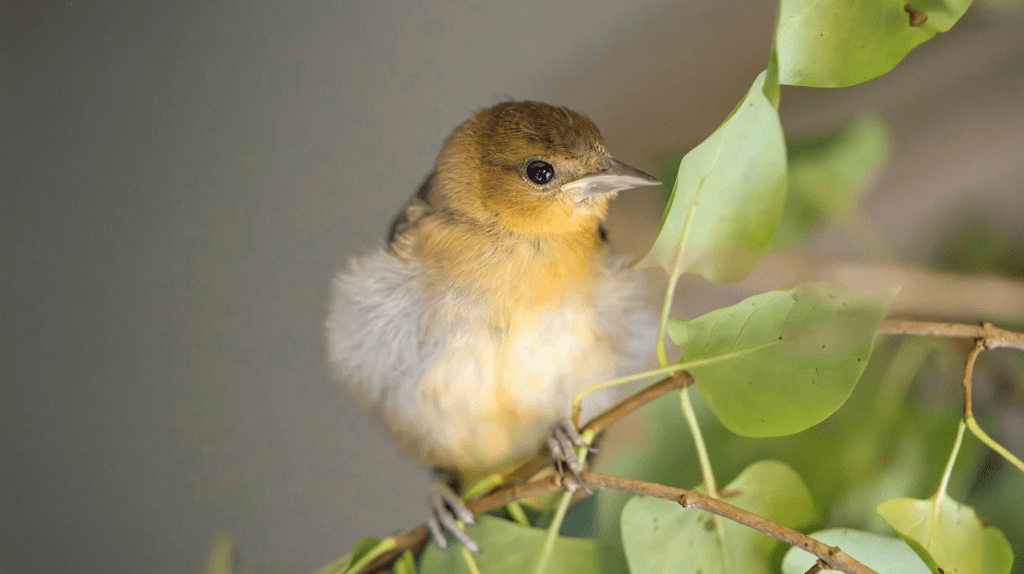
Sparky the Baltimore Oriole. Photo by Melissa Groo.
One early May, I watched a pair of Baltimore Orioles courting in my backyard. Before long, the female was weaving an intricate nest in the sugar maple outside my bedroom window. Three weeks later, the begging calls of chicks emanated from within.
As a self-professed “wildlife biographer,” I sought to photograph every stage of their story. I learned each oriole’s unique traits: the father’s dulcet chirrups as he patrolled his territory and the specific flight paths he took to the nest, the mother’s burnt-orange plumage as she moved surreptitiously through the trees, and her cryptic, leaf-like flutter down to the jelly feeder. I marveled at their tireless vigilance against marauding Blue Jays and squirrels and the dozens of daily forays they made to find insects for their nestlings.
One day, hearing a great ruckus, I rushed outside to find the parents flitting about a chick on the ground. She was injured and squawking piteously, likely captured by a predator and then released in the ensuing fray.
I scooped her up, pleading uselessly with the parents for forgiveness, and raced her to Cornell University’s wildlife hospital, not far from my home. She’d suffered puncture wounds and a ruptured air sac. After a stint in the hospital and then with a rehabilitator, she was transferred to me (a subpermittee under a wildlife rehabilitator’s license) in hopes of a release. But first, we needed to prove she could fly.
I named this tiny, spunky bird Sparky. (snip-MORE)
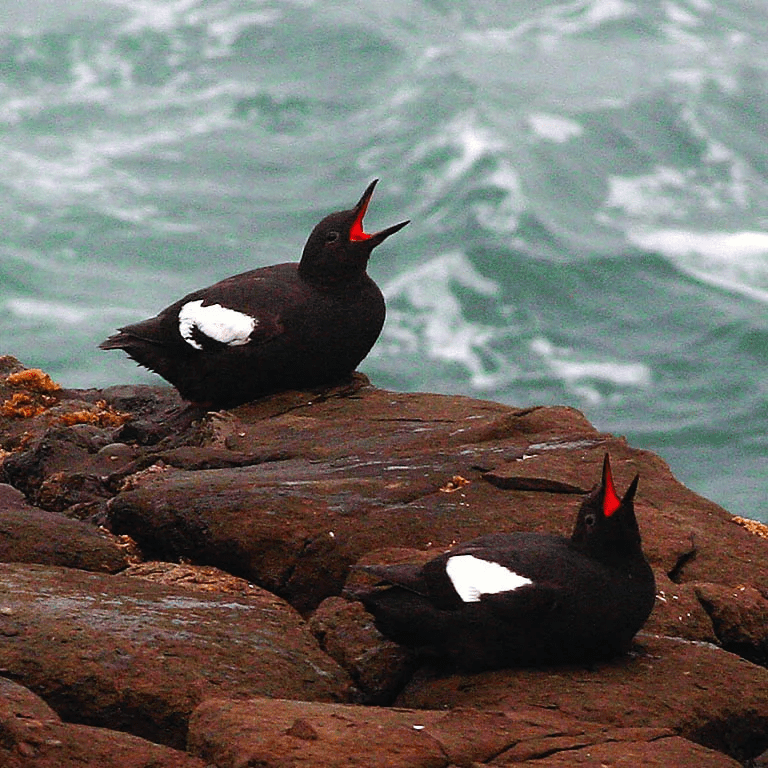
The Pigeon Guillemot is an attractive member of the auk family, a group of marine birds that also includes the puffins, murres, and auklets. The auks are largely known to forage on the open ocean, with some species diving to extraordinary depths for their food. The Pigeon Guillemot, however, forages in shallow waters near the shore and doesn’t usually dive deeper than about 100 feet. Nonetheless, they are graceful divers, “flying” underwater, their partially opened wings helping them maneuver and propelling them along. Like other auks, they use their feet as rudders.
Pigeon Guillemots are particularly fond of small fish and crustaceans, which they chase out from under rocks on the sea floor. But foraging among the nooks and crannies is not without its risks — the Pigeon Guillemot itself is food for other marine life, including the giant Pacific octopus!
Nesting colonies can be quite large, especially on small offshore islands with few predators. And Pigeon Guillemots dress quite elegantly for the occasion: During the breeding season, males and females sport velvety black plumage with a broad, white, vaguely V-shaped wing patch, all set off by their flashy, bright red feet. After the breeding season concludes, however, these birds molt to a mostly white and ashy black-and-gray plumage. (snip-MORE)
Mo Turner doesn’t often think about their time in the Oklahoma House of Representatives.
In that building, they were Mauree — the first out nonbinary state legislator in United States history; the first Muslim elected in Oklahoma; a Black, queer, gender non-conforming lawmaker in one of the most conservative states in the country. Elected at 27 to represent House District 88, which includes much of Oklahoma City, they stepped into a political institution that had never belonged to someone like them before.
The job almost broke them. Turner left office in November 2024, four years into their tenure, after the work took a toll on their health. They are still recovering.
“I spent January 2026 walking. And weeping. And reading,” Turner said. After the legislature took over their life, they had to find a way back to who they were before a national spotlight brought constant harassment, abuse and stress. They’ve found solace in a particular song near the end of the Hamilton musical, when the eponymous founding father takes long, quiet walks after losing his son and stepping away from politics.
Turner’s own walks can go on for three hours.
If there’s one lesson Turner took from their time at the statehouse, it’s that politics won’t help communities. People will.
Turner left the House of Representatives in November 2024, four years into their tenure, after the work took a toll on their health. They are still recovering. (Katrina Ward for The 19th)
“I want people to understand that policy is not coming to save you,” they said. “We get justice, we get faith, we get warm meals, we get community right here when we start talking to folks.”
Although the United States is a representative democracy, our political system still rejects anyone who strays too far from the norm. Turner’s story shows how far from equal the nation’s politics still are — and how being an out LGBTQ+ elected official today is just as revolutionary as it was five decades ago.
The violence holding democracy back
Elaine Noble was the first openly LGBTQ+ person ever elected to a state legislature, serving two terms in the Massachusetts House of Representatives in the 1970s. She described the campaign as ugly: her car was destroyed, her windows were shot through, her headquarters were vandalized. The harassment she received from colleagues in the statehouse was ugly, too. She routinely heard obscene profanities. Once, someone left human feces on her desk. Another time, a man stopped her as she walked to work and spat on her.
These are not just scenes from a distant past. Political violence against LGBTQ+ candidates is rising, according to a new report from the Victory Institute. Many LGBTQ+ candidates who ran for office between 2023 and 2025 experienced death threats on the trail. One candidate said their house was shot up by a neighbor. Another said that someone posted in a local newspaper’s online thread that a bullet should be put through their brain. Another candidate was shoved off a porch while door-knocking.
Some LGBTQ+ candidates receive death threats on social media at least once a week, according to the Victory Institute. A number of them respond to those threats by limiting voter engagement. Some avoid door-knocking and social media. Others decline public events entirely.
American politician and LGBT activist, Elaine Noble smiles after addressing the crowd at a Gay Rights rally on Boston Common, Boston, Massachusetts, 13th June 1977. Noble is openly gay and the Democratic Member of the Massachusetts House of Representatives from Back Bay, Boston. (Stan Grossfeld/The Boston Globe/Getty Images)
Rising violence against LGBTQ+ candidates doesn’t just scar candidates; it scars democracy, according to the authors of the report.
“This is changing who feels able to run for office, how candidates are showing up in their campaigns, whether they can even remain in public life at all,” said Pooja Prabhakaran, director of elected and appointed officials engagement at the LGBTQ+ Victory Institute. “The broader piece of it is, who is able to serve and participate in democracy?”
Death threats against Turner began as soon as they entered office. They received voicemails filled with racial slurs and obscene emails targeting their religion and LGBTQ+ identity. As a freshman lawmaker, they were surprised to learn that not everyone was treated that way. They thought death threats were commonplace.
Turner has dealt with harassment on a larger scale than many other LGBTQ+ candidates do, Prabhakaran said. For other trans people or LGBTQ+ people of color who consider running for office, there is a chilling effect: Do they want to be subjected to the same treatment?
Threats against Turner escalated after they were censured by the Oklahoma House of Representatives in 2023, during their second term. They were accused by the Republican leadership of “harboring a fugitive” — a trans person who went to the statehouse with their partner to protest a bill that would ban gender-affirming care for minors.
At the protest, the couple got into a scuffle with a state trooper after one of them threw water at a state representative. One was arrested. The other sought out Turner’s office.
Once Turner took office, there were eight Black legislators in the Oklahoma statehouse — a record. Currently, there are six. (Katrina Ward for The 19th)
“This person’s spouse was just arrested. They came to my office to process. That’s what happened,” Turner told The 19th at the time, in 2023. “I let folks get their affairs in order, because everyone was in agreeance that they were going to go ahead and turn themselves over.”
Democrats said Turner cooperated with law enforcement during the search for the protester. Still, they were punished. Republicans asked Turner for a formal apology in exchange for keeping their committee assignments. They declined.
“I think an apology for loving the people of Oklahoma is something that I cannot do,” they said at a press conference following the censure.
Many constituents already saw Turner as a trusted confidant. People would call to ask where they should move to escape anti-LGBTQ+ laws and how to crowdfund to help someone travel for an abortion. As politics restricted daily life, more and more people came to Turner for help.
Now, after earning that trust, they were silenced. They couldn’t shape legislation through committees or join caucus discussions to speak on behalf of voters in their district.
The threatening calls and emails got worse.
Some political violence is based on a candidate’s beliefs. Some of it is driven by a desire to intimidate them out of politics altogether because of their identity. Those who challenge the status quo often face the most backlash, said Kelly Dittmar, director of research at the Center for American Women and Politics at Rutgers University. And those conditions don’t just stop once someone gets into office, she said.
“I can have an elected position, but my power in that position is very much influenced by all of these other dynamics that are not formalized,” Dittmar said. There’s a difference between politics as usual within a two-party system, where everyone jockeys for influence, and being seen as a threat for being different or a minority, she said.
Hostile territory
In 2023, Oklahoma lawmakers introduced 35 anti-LGBTQ+ bills, according to the American Civil Liberties Union (ACLU) — a lot more than most other states at the time. They passed laws enabling broad discrimination against trans people and restricting young students from learning about LGBTQ+ people. Inside the statehouse, Turner felt demoralized.
The next year, their Republican colleagues introduced 55 anti-LGBTQ+ bills. Oklahoma already had few legal protections for LGBTQ+ people, and things only got worse.
“I’m going into a job that doesn’t care about me in a state that it feels like doesn’t care about me,” they said, reflecting on how they felt at the time.
Still, Turner was making an impact. As the first out transgender lawmaker in Oklahoma’s statehouse, they inspired young people. Students told Turner that they had never cared about politics until seeing them in office. High school and middle school students would approach them in the capitol to ask questions about their tenure for class reports.
They represented more than just House District 88. They represented younger generations of queer people in Oklahoma and beyond. Turner felt the weight of the responsibility. That’s what made it so hard for them to leave.
Turner found an ally in then-Rep. Monroe Nichols, a Democrat who now serves as the first Black mayor of Tulsa. Nichols was the only one who seemed to genuinely care that Turner was receiving death threats. He was the only one who made them feel human.
“I do think that there was solidarity in him being a Black man from Tulsa of all places, understanding what it looked like to feel discrimination or oppression,” Turner said.
In March, Turner went back to the statehouse to help a friend, the executive director at Freedom Oklahoma, a state LGBTQ+ advocacy group, monitor anti-trans bills. But the building is still full of red tape. (Katrina Ward for The 19th)
Once Turner took office, there were eight Black legislators in the Oklahoma statehouse — a record. Currently, there are six. Most politicians in the building are White. The status quo of power in Oklahoma is very much White, cisgender, heterosexual and male, said Dittmar of Rutgers University. And those who break that mold are seen by others as a threat, she said.
Then there’s this: In a state like Oklahoma, Democrats have very little leverage. On top of the low pay and high stress, there’s a small chance of achieving any concrete policy wins. Republicans sponsor most state laws because 80 percent of the lawmakers are Republicans. Barely any bill passes without Republican support. Being in the minority party means taking on the steep personal costs of being in office in exchange for little payoff.
Toward the end of those four long years, Turner didn’t feel like a good legislator anymore. In their words, they were phoning it in. Although they did spark a committee hearing on repealing the state’s HIV criminalization law, none of their bills advanced.
Turner would frequently sit in their car in the parking lot before work, trying to breathe through the rising panic and find the will to go inside. Walking into the statehouse each day was taking a deep toll on them.
The stress grew until they landed in the emergency room. At the beginning of their last legislative session, they were diagnosed with multiple sclerosis and underwent a procedure to have cancerous cells removed from their body. That health scare followed bouts of migraines, panic attacks and depression.
As their health cratered, they felt alone. After their visit to the emergency room, none of their colleagues checked to see how they were doing.
Turner knew something had to change. They were worried for their nephew, Anthony, whom they are raising on their own. While juggling their job and all the harassment that came with it, they were setting up daycare and school drop-offs — everything that comes with being a single parent. Sometimes, Anthony would join them on the House floor if work ran late. But they had to leave by 7 p.m. to make it home at a reasonable time for dinner, bath and bedtime.
“I remember one day thinking, I would like to see him grow up,” they said.
So they left. They walked away from politics.
“It was a tough decision to make because I know that representation matters. And some days, me just showing up to work is the representation that people need,” they said.
This is the passion that still fuels Turner: showing up for Oklahomans and showing up for young LGBTQ+ people who don’t feel heard by their elected representatives.
What real change looks like
In March, Turner went back to the statehouse to help a friend, the executive director at Freedom Oklahoma,a state LGBTQ+ advocacy group, monitor anti-trans bills. But the building is still full of red tape: Initially, they were barred from entering the gallery by statehouse security. The experience became a reminder of why they left.
To actually make change in their community, Turner knew they would have to work outside of politics.
Here’s how: They’re working with the immigrant advocacy group Dream Action Oklahoma, making and distributing zines on how bystanders can intervene when Immigration and Customs Enforcement agents are out making arrests. They help serve community breakfast with the Foundation for Liberating Minds, a Black-led abolitionist group based in Oklahoma. And in their new job, they get to work with LGBTQ+ students from across the country.
Turner is the director of public policy and advocacy at GLISTEN, a national nonprofit that lobbies for LGBTQ+ students. They’re working to expand GLISTEN’s National Student Council, a leadership program for high schoolers. They’re working on the curriculum for that program and thinking about how these students want to grow. Many of them want to become activists, or already are. These students represent a future that is rapidly changing, regardless of how many anti-LGBTQ+ laws are passed; more and more young people are identifying as queer and trans.
Turner is the director of public policy and advocacy at GLISTEN, a national nonprofit that lobbies for LGBTQ+ students. (Katrina Ward for The 19th)
Working with students is a bright spot for Turner. Their organization is asking LGBTQ+ students about their experiences, their school policies and what they think needs to be different. And amid so much anti-LGBTQ+ hostility in politics, kids are making it clear that they’re ready to make change on their own terms.
“Youth aren’t just saying, ‘Oh, god, policy is so bad, whatever.’ They’re saying, ‘No, maybe I will run for office. Or ‘I’ll work on my friend’s campaign.’ They’re being outspoken,” Turner said. “Our power lies in the streets, outside of any state legislature, and it always will.”
Turner doesn’t think they will ever go back to politics. But that doesn’t mean they’ve stopped paying attention. They still keep tabs on bills moving through Oklahoma’s legislature. Lately, they said, things have been going from bad to worse.
The legislature just passed a law to create criminal penalties for providing gender-affirming care to minors and adults. No public funds or property may be used to provide the care, which threatens state university hospitals. The state Medicaid program will also no longer cover gender-affirming care for any patients.
This bill is just another step in stripping health care from all Oklahomans, Turner said. They want people to respond to laws like this by doing more than signing a petition or calling their local reps. They can reach out directly to state agencies, donate to local healthcare fundraisers or just talk to their neighbors.
“When the government fails us, what do we have?” they said. For Turner, the answer is clear: community.
In a way, Turner has returned to their home turf as an activist. Before elected office, Turner worked with local branches of the ACLU, the NAACP and the Council on American-Islamic Relations. They learned the ways of the statehouse and now they know how to push for change outside.
And they don’t plan on leaving the state or their community in House District 88. Their brother went to college in this district. They worked an internship here. They met friends at Picasso Cafe and The Red Cup and had first kisses at local bars. Oklahoma City feels like such a queer place to them, and they have fallen in love with it.
“This is my home. I love it,” they said. “I’m going to stay and fight.”
As I have written about before this is simply a move by Christian nationalists in the military and government to force everyone to conform to their religious beliefs and desires. This is again to return to the 1950s when it was normal for Christianity to seem like the dominant religion of the majority of people in the country. The reasons stated make so sense for the purpose claimed as Belle points out. This is a minority fundamentalist / evangelical believers trying to force their rule and beliefs onto the majority. Hugs
Sam and crew go over Graham Platner’s win and his interview with Mika Brzezinski Scarborough on Morning Joe. Amoung the jokes about her interview they go over his acceptance speech. I am personally satisfied he has answered all the questions. I love his line “… if you give me the chance I will be a senator for the people who cannot afford to buy a senator”. I am a progressive and a believer in DSA policies. Graham Platner is not the perfect person who is flawless and unlike many his flaws are out in the open, not hidden behind a facade of fake religious politeness. He is a populist. I am not looking for religious leaders in our lawmakers, I am not expecting someone who walked blamelessly through life, that they way only one person did and his name was Jesus. I am looking for someone whose policies help the lower incomes and the public at large, not the privileged few. I am looking for a congress and White House filled with people who do not think elected office is their golden ticket to personal wealth and authority over others. Real people screw up and those that ask and work for a second chance should be given a chance to show they deserve it. In my opinion Platner has and does shown he deserves his forgiveness. Plus people look at Graham’s past are not looking at Collin’s past or even Mika who started dating Joe when he was still married. To me a lot of these people going on about Platner’s past seem to hold him to a different standard than they themselves are held or republican canidates are held. Hugs.