The delusion is in MAGA supporters still believing Trump is some anti-elite “drain the swamp” champion for the working class—when, in reality, his inauguration featured the world’s richest billionaires (Musk, Bezos, Zuckerberg, and others with over $1 trillion in combined wealth) seated prominently behind him on the platform, grinning like they own the place. It was a blatant display of oligarchy, not populism.
This is entirely about white grievance and the loss of automatic white privilege. These people believe any white person is better than any black person and they do not want people of color to rise in any company or corporation past basic level worker. They have had white privilege for so long that equality seems like oppression to them. They do not want a country where everyone is equal and all have the same rights. They are demanding a return to a white male dominated society that gave automatic superiority to white people. They also don’t want women or the LGBTQ+ to have rights or be fairly treated in the work force. Hugs
A sign on the wall of the U.S. Department of Justice building in Washington, D.C., U.S., November 14, 2025. REUTERS/Elizabeth Frantz
The Trump administration has launched investigations into the use of diversity initiatives in hiring and promotion at major U.S. companies, the Wall Street Journal reported on Sunday.
Google (GOOGL.O), opens new tab and Verizon (VZ.N), opens new tab are among a list of companies that have received Justice Department demands for documents and information about their workplace programs, the report said, citing people familiar with the investigations.
Reuters could not immediately verify the report. Verizon, Google, and the Justice Department did not immediately respond to requests for comments.
The probes are being conducted under the False Claims Act, the report said, adding that companies under scrutiny include sectors like automotive, pharmaceuticals, defense, and utilities, and some have met in person with Justice Department officials.
The False Claims Act is a federal civil law that allows the government to recover funds lost due to fraud.
President Donald Trump moved quickly after taking office in January to eradicate federal DEI programs and discourage them in the private sector and education, including by directing the firing of diversity officers at federal agencies and pulling grant funding for a wide range of programs
Reporting by Mihika Sharma in Bengaluru; Editing by Ronojoy Mazumdar and Rashmi Aich
Ellie House and Mike Wendling Gainesboro, Tennessee
BBC/Ellie House
Real estate developer Josh Abbotoy on the site of his planned future development outside Gainesboro. Abbotoy’s customers, including two self-described Christian nationalists, have caused controversy locally
As Josh Abbotoy gazes out at lush green woods and pastureland nestled among Tennessee’s Appalachian hills, he describes what he intends to build here: a neighbourhood with dozens of residential lots, centred around a working farm and, crucially, a church.
“A customer might very well buy and build roughly where we’re standing right now,” he says as we hike up to the top of a ridge.
Mr Abbotoy is founder of the real estate company Ridgerunner, which has bought land here and in neighbouring Kentucky. But his is no garden-variety housing development.
Mr Abbotoy is prominent in US conservative circles and describes his development as an “affinity-based community” – marketed to people not only interested in the peace and quiet of rural life, but in a constellation of right-wing ideals.
“Faith, family and freedom,” he says. “Those are the values that we try to celebrate.”
BBC/Mike Wendling
Josh Abbotoy points to a map of his development in the Ridgerunner offices in Gainesboro
Initially he didn’t attract much local attention after setting up shop in Jackson County.
But in late 2024, a local TV news report broadcast controversial statements made by two of Mr Abbotoy’s first, and most outspoken, customers: Andrew Isker, a pastor and author originally from Minnesota, and C Jay Engel, a businessman from California.
They are self-described “Christian nationalists” who question modern values, such as whether female suffrage and the civil rights movement were good ideas, and call for mass deportations of legal immigrants far in excess of President Donald Trump’s current plan. Another thing they sometimes say: “Repeal the 20th Century.”
The TV report raised an alarm bell amongst some local residents.
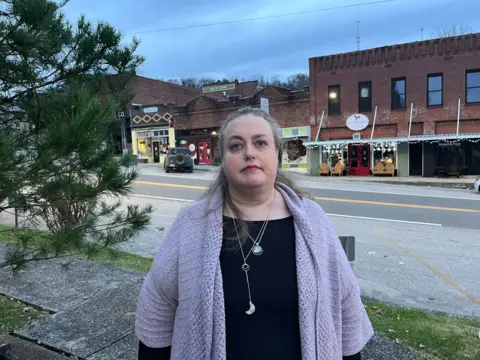
“You don’t know who these people are, or what they’re capable of,” says Nan Coons, a middle-aged woman who spoke in a firm southern accent during a recent interview near the town square in Gainesboro – of which this land is a part.
“And so it’s scary.”
Although Abbotoy himself does not identify as a Christian nationalist, he says concerns about his tenants are overblown.
The Ridgerunner development has since drawn national attention. And people in Gainesboro, home to around 900 people and one traffic light, have now found themselves in the middle of a dispute that is a proxy for much bigger political battles.
Podcasters move in
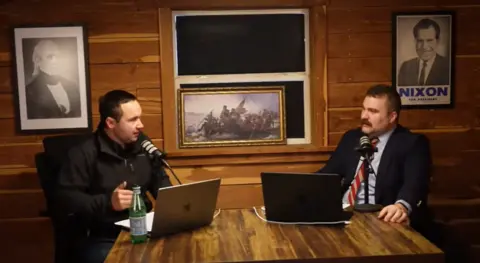
Mr Isker and Mr Engel announced their move to Gainesboro last year on their podcast Contra Mundum – Latin for “against the world”.
On their show, which is now recorded in a studio within Ridgerunner’s Gainesboro office, they have encouraged their fans to move into small communities, seek local influence, and join them in their fight to put strict conservative Christian values at the heart of American governance.
“If you could build places where you can take political power,” Mr Isker said on one episode, “which might mean sitting on the [board of] county commissioners, or even having the ear of the county commissioners and sheriff… being able to do those things is extremely, extremely valuable.”
Contra Mundum
C Jay Engel (l) and Andrew Isker (r) shown during an episode of their podcast
On X, Mr Engel has popularised the idea of “heritage Americans” – a fuzzy concept but one that applies mainly to Anglo-Protestants whose ancestors arrived in the US at least a century ago. He says it is not explicitly white, but it does have “strong ethnic correlations”.
He’s called for mass deportations of immigrants – including legal ones – writing: “Peoples like Indians, or South East Asians or Ecuadorians or immigrated Africans are the least capable of fitting in and should be sent home immediately.”
In their broadcasts and writings they have also expressed anti-gay sentiments. The podcasters deny they are white nationalists.
Both are Ridgerunner customers, and Mr Isker’s church will move into the community’s chapel when it’s complete.
The ‘resistance’
Their hardcore views have alarmed residents, with some locals setting up an informal resistance group.
“I believe that they have been attempting to brand our town and our county as a headquarters for their ideology of Christian nationalism,” says town matriarch Diana Mandli, a prominent local businesswoman who until recently owned a pub on Gainesboro’s central square
Late last year, Mandli led the charge by writing a message on a chalkboard outside her business: “If you are a person or group who promotes the inferiority or oppression of others, please eat somewhere else.”
BBC/Mike Wendling
More signs opposed to the new development followed. When people caught wind that the Ridgerunner guys were holding a meeting at a nearby fast food joint, dozens turned up to confront them.
Ms Coons, whose ancestors have lived in Gainesboro since around the time of the US Revolutionary War, says she engaged Mr Engel in conversation.
“He explained to me that what they’re promoting is what he called ‘family voting’… one vote per family, and of course, the husband in that family would be the one voting” with women frozen out of the electorate.
Mr Engel has since said publicly that it’s not “wrong” for women to vote, although he does support the idea of household suffrage.
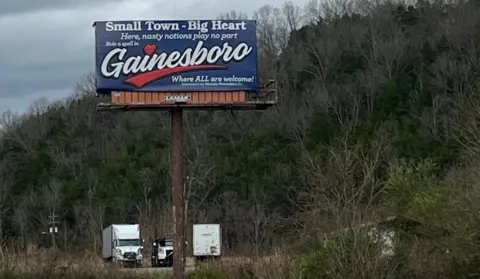
BBC/Mike Wendling
Local residents put up a billboard outside of town
In a county that voted 80% for Donald Trump in the last election, Ms Coons is used to living next door to neighbours with conservative views.
But she and others came away from the protest convinced more than ever that the beliefs of their new neighbours were too extreme.
They say they don’t want to run them out of town, but intend to sound the alarm about what they say are extreme views, as well as thwart any future attempt to take over the local government.
“This is where we have to draw the line,” Ms Coons says.
What is Christian nationalism?
Christian nationalism is a nebulous worldview without a single coherent definition.
At the extreme end, as outlined by theorists including author Stephen Wolfe, Christian nationalists advocate for rule by a “Christian prince” – an all-powerful religious dictator, who reigns over the civil authorities and leads his subjects to “godliness”.
Less extreme versions take the form of calls for Christian law to be explicitly enshrined in American legal codes, for religious leaders to get heavily involved in politics, or simply for an acknowledgement of the Christian background of America’s founding fathers.
This multiplicity of definitions has created a strategic ambiguity that experts say has helped Christian nationalism seep into the mainstream.
Big ideas or far-right plan?
Mr Abbotoy’s development is still in the early stages – his company is building roads and organising sanitation infrastructure. When the BBC visited in November, workers were busy knocking down a decrepit old barn, one of many that dot the Appalachian landscape.
But business is brisk. Around half of the lots are already under contract. Mr Abbotoy anticipates that the first houses will be built and new customers will begin moving in at the beginning of 2027.
BBC/Ellie House
Building on the Brewington Farms site will start within months, with new residents moving in soon, in just over a year
Many of his customers, he says, are moving to heavily Republican Tennessee from Democratic-majority states like California and New York.
“People want to live in communities where they feel like they share important values with their neighbours,” he says.
Mr Abbotoy says he doesn’t call himself a Christian nationalist, but describes the criticism of his customers as “absurd” and says they have no intention to try to take over local government.
“They’re talking about big ideas and books,” he says. As for some of their more controversial views, he insists that “rolling back the 20th Century can mean a lot of things. A lot of conservatives would say we took a lot of wrong turns.”
Mr Isker and Mr Engel did not respond to multiple requests for comment and a list of questions.
BBC/Ellie House
Nan Coons belongs to an informal group of Gainesboro residents who are alarmed at their new Christian nationalist neighbours
Small-town fight goes nationwide
The fight here in Gainesboro has drawn in players far from small-town Tennessee.
Mr Abbotoy, who was educated at Harvard Law School, is also a partner at a conservative venture capital fund, New Founding, and a founder of the American Reformer, a website that has published the writings of a number of other prominent Christian nationalists.
His opponents meanwhile have received research assistance and advice from a national organisation, States at the Core, established last year to tackle authoritarianism in small communities. It is funded by a constellation of left-wing organisations. States at the Core declined our request for an interview.
The men of Ridgerunner have pointed to the organisation as evidence that the pushback against their project has been orchestrated by powerful liberals. The locals say this is ridiculous.
“Nobody’s cut me a cheque to say anything,” Ms Coons says.
In Gainesboro, people on all sides see a much bigger story – one of large-scale political fights playing out in rural America.
Republicans have made huge gains in rural areas this century, and in 2024 Trump stretched his lead in rural communities, winning 69% of the vote. The Democratic Congressional Campaign Committee recently announced a reported eight-figure investment ahead of the 2026 midterm elections, a chunk of which will be dedicated to winning rural voters.
“There’s definitely a renewed, [Democratic Party] focus on rural engagement,” Mr Abbotoy says. “And at the same time, there’s been a wave of people moving to small town America precisely because they like the Bible Belt, they like the conservative traditional culture.”
But Nan Coons and her allies say they aren’t ready to concede rural areas like her hometown to Christian nationalists.
“If we are going to turn this tide, it starts on your street, it starts in your neighbourhood, it starts in your small town,” she says.
“I have to stand for something, and this is where I stand.”
More tRump stupidity / tRump putting his branding everywhere / is he the president or chief architect / Fluffing tRump’s ego / tRump’s grifting / tRump’s lies & misinformation
That’s $100,000/head. tRump doesn’t care as he spends the taxpayers money / countries treasury like a drunk spending other peoples money. He is a tryant in that he thiinks that money is his todo what he wants even though the law states that only congress controls spending. This is human traficing plain and simple. Hugs
In September 2025, Turner’s agency sponsored a far-right anti-LGBTQ extremist to lead a massive Christian nationalist rally on Washington DC’s National Mall, the first-ever such event formally sanctioned by the federal government.
In June, it was reported that Turner is moving to take over the former National Science Foundation building as his agency’s headquarters, where he has demanded a full-floor executive suite, a private dining room, and parking for his five personal cars.
It is not lost on me that the above story is a woman with a career telling other woman they need to be stay at home mothers / trad wives to please a man because of religious dogma. Hugs
Yarborough appeared here last month for his bill that would ban Pride flags at government buildings, including public schools.
He appeared here in April 2025 for his bill that would ban thousands of books, including classic novels, over sexual content.
Yarborough appeared here March 2025 for his bill that would ban civil rights ordinances enacted by cities and counties, including, presumably, LGBTQ protections.
He first appeared on JMG in 2010, when as a member of the Jacksonville City Council he declared that gays, Muslims, and atheists should not be permitted to hold public office, otherwise God will smite the country.
In April 2023, lawmakers approved Yarborough’s ban on drag shows before minors. Yarborough is also the author several anti-trans bills.
Borrero appeared here in 2023 for a ban on Pride flags that died in committee. He tried again last year, but that attempt died after passage in its first committee hearing.
Borerro first appeared on JMG in January 2022 for his successful bill mandating that Florida public schools recognize an annual “Victims Of Communism Day.”
Oltmann appeared here last year when he called for executing Joe Biden, adding, “I want to send the mainstream media to the gallows, radical leftists to the gallows, traitors to our nation to the gallows, and they all kind of fit in the same bucket.”
In 2022, he appeared here when he announced that he would lead a “well-armed action” to install Kari Lake as governor of Arizona.
In 2021, he appeared here when he called for executing the 19 Republican Senators who voted to avert a government shutdown.
Homeland Security Secretary Kristi Noem | Steven Spearie/The State Journal-Register / USA TODAY NETWORK
Rep. Robert Garcia (D-CA) confronted Homeland Security Secretary Kristi Noem about the administration sending a gay man to a prison camp in El Salvador and not even knowing if he’s still alive. Noem said that it wasn’t her problem.
Noem, who has bragged in the past about shooting her dog to death, appeared before the House Homeland Security Committee for a hearing yesterday, where Garcia asked her about Andry Hernandez Romero, a gay hair dresser from Venezuela who came to the U.S. legally to escape anti-LGBTQ+ violence and who was sent to the CECOT camp in El Salvador, which is known for torturing inmates, earlier this year.
The administration, which sent immigrants to the CECOT without letting courts determine if they were in the country illegally or if they had committed any crimes, has refused to try to bring anyone back from the camp.
“Would you commit to just letting his mother know – as a mother-to-mother – if Andry is alive?” Garcia asked Noem. “He was given an asylum appointment by the United States government. We gave him an appointment, we said, Andry, come to the border at this time and claim asylum, he was taken to a foreign prison in El Salvador.”
“His mother just wants to know if he’s alive. Can we check and do a wellness check on him?”
Noem said she doesn’t “know the specifics” of Hernandez Romero’s case but said that since he’s in El Salvador, Garcia should be asking El Salvador’s government about him.
“This isn’t under my jurisdiction,” Noem said.
Garcia reminded her that she said that the Salvadoran prison is a “tool in our toolkit” for fighting crime.
“You and the president have the ability to check that Andry is alive and not being harmed,” he said. “Would you commit into at least looking and asking El Salvador if he is alive?”
“This is a question that is best asked to the president and the government of El Salvador,” Noem responded drily.
Hernandez Romero is a Venezuelan immigrant who trekked to the U.S. and entered legally last year at San Diego. There, he asked for asylum, saying that he was being targeted in Venezuela for being gay and due to his political beliefs. He was held in a CoreCivic detention center, where he was screened by Charles Cross Jr.
“The government had found that his threats against him were credible and that he had a real probability of winning an asylum claim,” his lawyer, Lindsay Toczylowski, said.
In March, he, along with over 200 other immigrants, was taken in shackles to the CECOT camp in El Salvador. Even his lawyer said she didn’t know what happened to him until he was gone and missed a hearing in his immigration case.
In a video from the CECOT, Hernandez Romero could be heard saying, “I’m not a gang member. I’m gay. I’m a stylist,” as he was slapped and had his head shaved.
It was later revealed that the evidence Immigration and Customs Enforcement (ICE) had against Hernandez Romero was his tattoos, which came from a report from the contractor CoreCivic, specifically from former police officer Charles Cross Jr., who lost his job with the Milwaukee police after he drunkenly crashed into a house and allegedly committed fraud. His name was subsequently added to the Brady List, a list of police officers who are considered non-credible for providing legal testimony in Milwaukee County.
Cross claimed that Hernandez Romero had crown tattoos associated with a gang. The tattoos are labeled “Mom” and “Dad” and are common symbols associated with his hometown of Capacho, Venezuela. Capacho is known for its elaborate festival for Three Kings Day, and a childhood friend, Reina Cardenas, told NBC News that it was that festival that awakened Hernandez Romero’s desire to be an artist.
“Andry dedicated his life to arts and culture, and he worked hard to better his craft,” Cardenas said.
Subscribe to the LGBTQ Nation newsletter and be the first to know about the latest headlines shaping LGBTQ+ communities worldwide.
This AG was not elected to any office, he was handpicked and given his job by DeathSantis. Both are Christian nationalist who feel it is great to force their religion on others even as they do not live by their own church doctrines in any way. They seem to feel forcing the public to live by their church doctrines or what ever view they think their god endorses is perfectly fine regardless if others disagree. They are the first to scream the loudest if their rituals or they think their rights to oppress others is interfered with, but they also seem unable to give others the same rights they demand for themselves. Hugs
Florida Attorney General James Uthmeier (R) is urging the Pensacola City Council to shut down a Christmas-themed drag show, which he has deemed “demonic” and “harmful” to children, despite how it is exclusively for adults over the age of 18.
The city’s Saenger Theatre plans to host “A Drag Queen Christmas” on December 23. The website says fans should “expect a fabulous remix of classic Christmas hits, dazzling themed variety performances, and interactive moments to share your Christmas cheer.”
A letter from Uthmeier claimed the show “openly mocks one of the most sacred holidays in the Christian faith” and expressed horror that some of the queens evoke “satanic imagery” in their outfits or characters. He also decried the fact that it will be playing at the same time as the city’s family-centered Winterfest.
“So, while Penscola children are taking pictures with Santa, men dressed as garish women in demonic costumes will be engaged in obscene behavior mere feet away,” he ranted, even though the drag show will take place inside a theater where the children at the festival won’t be able to see it.
The Pensacola city attorney has reportedly refused to cancel the show, saying it would violate the drag show production company’s First Amendment rights and the city’s contract with the theater’s management company.
Uthmeier, however, said the city – which owns the theater – has a legal right to supersede the management company’s decision to put on the show if it deems a performance detrimental to public health or safety. He said the drag show meets this criterion because it will be taking place near children at Winterfest, even though they won’t be able to see it.
“While the First Amendment safeguards freedom of expression, it does not require a city to platform and endorse disgusting, obscene content that denigrates its residents’ religious beliefs,” Uthmeier concluded.
He claimed it may even amount to religious discrimination and could cause legal issues for the city, especially if one of the “deranged performers” were “to expose themselves to the kids” nearby. The preposterous idea that LGBTQ+ people are inherently a danger to children has long been used by the right to fearmonger and stir anti-LGBTQ+ sentiment.
The letter comes after a group of churches in the city launched a campaign to pressure the Pensacola City Council to cancel the drag show. The controversy has caused an uproar in the community, the Pensacola News Journal reported, where pro- and anti-LGBTQ+ residents continue to clash over whether the drag show should be permitted to go on.
At a packed and contentious city council meeting in early October, resident Jermaine Williams called out the hypocrisy of those claiming to oppose the show on religious grounds.
“I mean, we see how y’all vote,” Williams said. “Half of these people that spoke today wouldn’t know Jesus if they stared him in the face.”
Another resident, Stephen McCollum, gushed that drag queens are “more than entertainers.”
“They’re small business owners. They’re advocates and they’re educators who use creativity to uplift others and welcome all. They welcome all, demonstrating that this art form is more than just a performance. It’s a form of connection, and it’s a form of community, and it’s a form of hope.”
Uthmeier has long used his position to vilify and terrorize LGBTQ+ people. Earlier this year, he launched a crusade against a Life Time Fitness in Palm Beach Gardens after discovering that the private business had a trans inclusive policy. State law requires people use facilities aligned with their sex assigned at birth, but that does not apply to private businesses.
Uthmeier, however, claimed otherwise in a letter sent to the gym. He falsely claimed that trans inclusion leads to “assaults, exploitation, and fear” and that he was merely doing this to protect women and girls.
Even after Life Time said it would comply with his demands, Uthmeier posted a video in which he visited the gym in person to make sure they are “not allowing trans women into women’s bathrooms, not in Florida,” and “actually following the law.”
“It appears they are,” he reported to followers, though it’s unclear how he could have confirmed this without major privacy violations of the individuals entering and exiting the locker rooms there.
This past October, Uthmeier also filed a friend-of-the-court brief in support of a parental rights activist who dubiously claims her child’s middle school helped her child secretly transition. She has now petitioned the Supreme Court to take her case.
Uthmeier’s brief claims government officials across the United States “are fundamentally altering the upbringing of children and keeping parents in the dark” with “secret transition” policies.
These policies do not involve schools encouraging students to be trans or transition, but rather to support any students who willingly communicate that their gender identity differs from their sex assigned at birth and to allow the student to choose when to share that private information with their parents. For some students with anti-trans parents, telling them could be dangerous.
Subscribe to the LGBTQ Nation newsletter and be the first to know about the latest headlines shaping LGBTQ+ communities worldwide.
After spending this year working to implement as much of its gargantuan right-wing policy agenda, Project 2025, as possible, the Heritage Foundation has unveiled its anti-LGBTQ+ goals for 2026.
Over the past month, the far-right think tank has been preparing for next year, releasing an ad campaign and doing multiple interviews about its plans. The activity has brought renewed attention on Heritage Foundation’s 2025-2026 policy priorities, which were titled “Restoring America’s Promise” when they were released in March. At the time, the group named nine key priorities, including “root[ing] out the deep state” and “counter[ing] the CCP [Chinese Communist Party].”
The bulk of its anti-LGBTQ+ goals lie in the priority titled “Put Family First,” in which the Heritage Foundation declares that “every child conceived deserves to be born to a married mother and father who will love, guide, and protect them throughout their lives.”
The organization goes on to claim that “family breakdown and rampant abortion tears at the soul of our country and saps it of strength and moral authority,” while “radical ideologies that deny social and biological truths about sexual embodiment, marriage, and unborn life poison our courts, our culture, and our laws.”
“The Heritage enterprise will advance policies at the state and federal level to restore the nuclear family to the center of American life and to reduce both the demand and supply for abortion at all stages of human development,” it concludes. This language appears to oppose same-sex marriage given its emphasis on children being born to a married father and mother. It also appears to oppose transgender identity given its condemnation of ideologies that “deny social and biological truths about sexual embodiment” — this falls inline with a longstanding Heritage Foundation fight against trans people.
Elsewhere, the Heritage Foundation indicates its anti-trans views in a priority titled “Expand Education Freedom,” in which the group declares that the education system is “failing our children” through “the scourge of woke ideas like critical theory and radical gender ideology.” The terminology “radical gender ideology” is often used by conservatives to refer to trans and nonbinary identities.
The Heritage Foundation has been around since 1973, when it was founded by conservatives who found President Richard Nixon too liberal and feared both fiscal liberalism and federal government expansion. It has been consistent in its campaigns against LGBTQ+ rights, from consulting with then-governor Mitt Romney to figure out ways around preventing the legalization of gay marriage from being implemented in Massachusetts to lobbying against Title IX protections for trans students implemented during the Obama administration.
More recently, the organization has made headlines for its 920-page policy blueprint Project 2025, which presents a far-right Christian vision for the second Trump administration that includes several anti-trans measures, as well as the dismantling of the Department of Education and undoing other federal checks and balances. Although the Heritage Foundation has been releasing regular “Mandate for Leadership” blueprints ahead of incoming presidential administrations since the 1980s, Project 2025 has received considerable attention given that the group staffed and advised the first Trump administration (in July 2024, a CNN review found that at least 140 people working for Trump were involved with the Heritage Foundation). One of Project 2025’s architects, Russell Vought, currently runs the Office of Management and Budget.
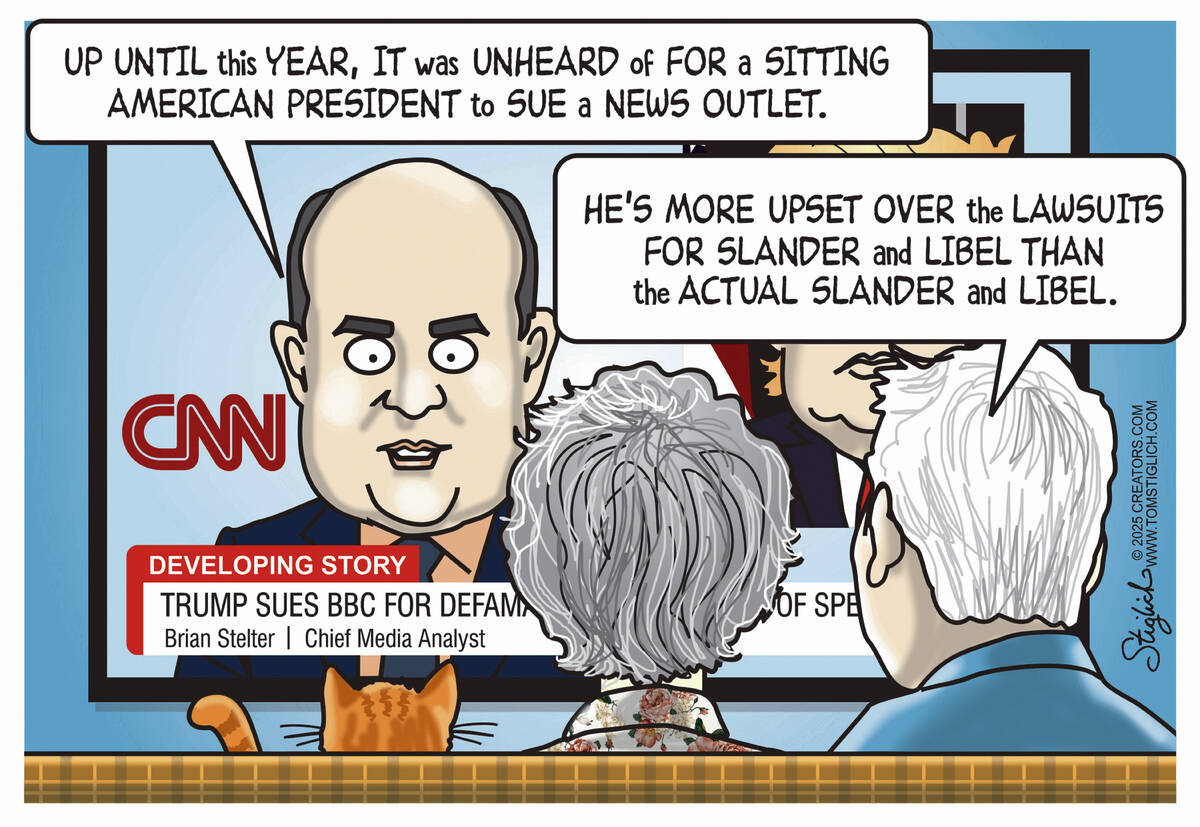
Following late-night host Jimmy Kimmel’s temporary removal in September, Federal Communications Commission Chairman Brendan Carr seemingly confirmed speculation that the Trump administration’s actions are a part of Project 2025. At the time, Glee star Kevin McHale shared an X post stating that “This was all in Project 2025,” after reposting another X post that framed right-wing attacks on media — which also include the Trump administration’s lawsuit against 60 Minutes, The New York Times, and Wall Street Journal — as First Amendment assaults. In response, Carr — who wrote Project 2025’s chapter on the FCC — shared a GIF of Jack Nicholson nodding in apparent confirmation.


















































 Homeland Security Secretary Kristi Noem | Steven Spearie/The State Journal-Register / USA TODAY NETWORK
 Florida Attorney General James Uthmeier speaks about the arrest of 28 members of the Mongols motorcycle gang during a press conference at the Stephen Saboda Training Center near Daytona Beach, Wednesday, July 2, 2025. | © Nigel Cook/News-Journal / USA TODAY NETWORK via Imagn Images
 Tom Williams/Getty Images
 Scottie's Playtime