Please understand the horrific conditions these children are being held in. Bug and dirt filled food, guards in these concentration camps they are held in tell the kids not to waste their oxygen by complaining or making the guard deny them. While physical abuse and verbal abuse is a given there is no doubt that some sexual abuse is happening. One boy had appendicitis and the guards refused him treatment until he was throwing up in a hallway that they even dealt with him and even then they kept him from medical attention for another 6 hours. The boy barely survived. First they don’t see these brown children as people and second the government has stopped paying for the medical care of the detained people in their care. Hugs
Detainees held at the South Texas Family Residential Center wave signs during a demonstration in Dilley, Texas, Saturday, Jan. 24, 2026.
A protest broke out Saturday at the South Texas family detention complex in Dilley, about 70 miles south of San Antonio, after guards abruptly ordered attorneys to leave while detainees — many of them children — poured into open areas of the facility chanting “Libertad,” or “Freedom,” according to an immigration attorney who witnessed the event.
Immigration attorney Eric Lee said he was at the Dilley facility for a confidential visit with clients — an immigrant family of six, including five children — when guards began shouting for everyone in the waiting area to leave, citing what they described as “an incident.”
As the Michigan-based attorney walked toward his car, he said he heard what sounded like “hundreds of children” shouting, with voices he described as “high-pitched” and “urgent.” He said he could see children streaming from dormitory areas behind a chain-link fence and chanting “Libertad.”
Lee said clients he later spoke with told him the protest was triggered by concerns over the treatment of Liam Conejo Ramos, a five-year-old who was taken into custody with his father in Minnesota earlier this week and transferred to the Dilley facility.
Lawmakers and advocates are calling for the child’s release, while the Department of Homeland Security disputes claims about how the boy was taken into custody and faces criticism over access to the facility.
School officials in Columbia Heights, Minnesota, have said federal agents took the child from a running car in the family’s driveway and directed him to knock on the door of the home — an action the superintendent described as “essentially using a 5-year-old as bait.”
The Department of Homeland Security has disputed that account, saying agents did not target the child, were focused on apprehending the child’s father—whom DHS said fled on foot—and attempted to have the child’s mother take custody of the boy.
Lee described Saturday’s action inside the facility as a peaceful demonstration, not a riot, and said the show of solidarity carried risk for detained families.
Lee said the protest unfolded against what he described as harsh day-to-day conditions inside the Dilley detention center. He characterized the facility as “a horrible, horrible place,” alleging that drinking water is “putrid” and often undrinkable, and that meals have contained “bugs,” dirt, and debris.
“The guards are just as tough as the guards at the adult facilities. This is not a place that you would want to have your child be for even 15 minutes,” Lee said.
Lee said the site does not operate as “civil detention,” arguing it functions like a punitive facility despite housing families.
CoreCivic, the private prison company that operates the site under federal contract, has previously said the facility is intended to provide an “open and safe environment” with access to services such as recreation, counseling, and legal resources.
Texas Public Radio reached out to Immigration and Customs Enforcement for comment on the disturbance and on Lee’s allegations regarding Liam Ramos’ treatment but had not received a response by Saturday evening.
The Dilley detention complex — known for years as the South Texas Family Residential Center — closed in 2024 and later reopened, as federal authorities expanded detention capacity for immigrant families, according to prior reporting and company statements.
Saturday’s episode comes amid heightened scrutiny of immigration enforcement nationally, including protests in Minneapolis following the January 7 killing of Renée Macklin Good during an ICE operation, and another fatal shooting involving federal immigration agents reported Saturday.
TPR was founded by and is supported by our community. If you value our commitment to the highest standards of responsible journalism and are able to do so, please consider making your gift of support today.
No doubt we’ve all seen that AG Bondi has contacted Gov. Waltz stating that if he will forward the MN voter rolls to her, the federal government violence will stop in MN. Last I knew, that offer was declined. Meanwhile, they’re still in MN, and now they’re raiding in Maine (I’m certain their Republican US Senator is deeply concerned, though not concerned enough to demand a turnaround.) Anyway, below are some links and snippets about preparation. The fact is that immigration enforcement has been around in every state for years, but they mostly haven’t been Gestapo-awful, or not at the massive numbers of people abused and killed, as they are currently. So, it isn’t as if things can’t happen instantaneously anywhere. If we still haven’t begun building local community, it’s definitely time. Aside from making sure we can take care of our neighbors and vice-versa, here are some good guidelines for dealing with our reality. We can do this. There is a place for everyone.
snippet: Today, after a year of rapid, large-scale mobilizing, resistance to rogue immigration agents is seeing its own set of commandments emerge. From compiling strategies from across the United States, 10 Rules of Resistance for #ICEOut can be identified. Taken as a whole, they offer all of us a robust approach to denying ICE the basic necessities of their operation.
10 Rules of Resistance for #ICEOut
No silence.
No selling.
No service.
No hotel rooms.
No entry.
No informing.
No looking away.
No collaboration.
No transporting.
No detention centers.
(You can add to this list, of course. There’s no limit to the ways we can resist.)
Nonviolent movements succeed by strategically pressuring the pillars of support for an injustice to withhold or withdraw things like information, cooperation, funding, labor and more. These 10 Rules of Resistance for #ICEOut offer ways to deny immigration agencies the key resources they need to function effectively. ICE cannot function without detention centers, transportation of detainees, access to businesses and properties, staging areas in parking lots, surveillance, telecommunication, recruitment ads, deliveries, or even quiet and uninterrupted sleep at hotels. (snip-more at link-the title above)
General strikes can have a tremendous impact, but to succeed they require an organized majority, networks of solidarity and resources to weather repression.
The call is coming from a rapidly growing coalition that includes the Amalgamated Transit Union Local 1005, Service Employees International Union Local 26, UNITE HERE Local 17, Communications Workers of America Local 7250, the Saint Paul Federation of Educators, the Minneapolis Federation of Educators, the Minnesota AFL-CIO, Sunrise Movement, and grassroots groups like Tending the Soil, among others.
That breadth matters — it’s not just a tiny group but an array of organized, powerful entities.
The action carries momentum. It follows the extreme violence carried out by ICE and other immigration agents in Minnesota — and the courageous, sustained pushback by Minnesotans who have stepped in to protect one another. The Jan. 23 one-day economic blackout is not the only tactic on the table. It sits alongside legal challenges, corporate pressure campaigns targeting ICE enablers, mutual aid and direct services, physical interventions, and more.
This is how real movements tend to move: not in a straight line, but through overlapping experiments. (snip-see the rest by clicking the title above)
The movement for justice and democracy is growing and has displayed significant political clout: mobilizing unprecedented millions in mass protest, resisting ICE attacks in Minneapolis and other cities, turning interim electoral outcomes against MAGA policies, and building pressure for National Guard withdrawals. Trump’s ratings have slumped to the lowest level of his second term. A recent poll shows a majority of Americans opposed to ICE’s aggressive tactics.
Now we are at a critical juncture, a moment of escalating risk, but also opportunity for political gain. Protests and protective actions have surged in Minneapolis, especially following the murder of Renee Nicole Good. Citizens and public officials in Minneapolis have condemned the brutality of ICE and Border Patrol operations and their blatant acts of racial and ethnic profiling. They are demanding the withdrawal of federal forces and a halt to the de facto military siege of city neighborhoods.
Very interesting report. Seems that Noem and her boyfriend wanted wide spread round ups to create a spectacle because they felt it would look good for them on TV. Others wanted to prioritize criminals which is what tRump kept saying. Let’s be clear, Noem and that crew are die hard racists who want to terrorize nonwhite people and make sure that everyone understands that in their minds it is a white country with white people in charge. They don’t see nonwhite people and immigrants as humans. Hugs
I have never understood the rights hate of LGBTQ+ people just for being different. I used to think it was they couldn’t understand it because they did feel that way. If they did not feel that way then it must be wrong or not exist. The very same things they say about trans people they said about gay people when I was a school kid. I remember that people were pushing to ban gay guys, and it was always gay guys just like it is always trans women, from teaching because they would molest the kids. Now it is we can’t let trans people use the bathroom that corresponds to their gender identity because of some fear they will molest the little girls. Always to protect the kids but if that was the goal then may I mention religious leaders? I think also the fear some religious right wingers have is that they find trans women attractive and that terrifies them. They want to force kids to go through the wrong puberty so it is harder for them to fit in with the stereotypes people have of what is masculine or feminine. For some they think they are doing the bidding of their deity but I don’t remember reading Jesus saying anything about trans people. But he did preach love and tolerance a lot. Maybe the pain and cruelty is the point after all. Hugs
Trans youth almost always feel less suicidal while undergoing treatment. (Getty
Trans youth almost always feel less suicidal while undergoing treatment. (Getty)
Yet another study proving that trans youth almost always feel less suicidal on gender-affirming care has been thrown on the pile of evidence that puberty blockers are safe and effective.
Research set to be published in the Journal of Paediatric’s February volume has once again proved that trans adolescents show “meaningful reductions” in depression and anxiety after beginning clinically-endorsed hormone therapy.
Co-written by paediatricians in Nevada, Texas, and Missouri, the study examined the wellbeing of 432 patients before and after undergoing treatment.
The participants, aged 12 to 20, were surveyed on their mental health before and at least 364 days after beginning appropriate medical treatment such as puberty blockers and hormone replacement therapy (HRT).
Trans youth regularly come under attack by politicians. (Getty)
Using the Ask Suicide-Screening Questions (ASQ) toolkit – an internationally acknowledged assessment of suicidality in young people and adults – researchers found significant improvements in the mental health of patients across the board.
Suicidality among participants decreased significantly over time, according to the study’s results, with rates continuing to decrease as time went on.
The reductions, clinicians noted, were consistent regardless of gender identity, treatment duration, and, interestingly, the age at the start of therapy.
This not only once again proves that gender-affirming care is remarkably effective in improving the wellbeing of trans patients, but that its effectiveness in reducing suicidal tendencies does not diminish as patients get older.
Clinicians recommended following-up the study with a “larger sample and longer follow-up” to sufficiently prove the consistency of gender-affirming care’s mental health treatments.
Politicians continue to ban puberty blockers despite evidence
Numerous studies across the globe have proven that gender-affirming care is almost always a good thing for trans people, especially trans young people.
One study from October 2024 found that 97 per cent of trans under-18s were “highly satisfied” with the results of gender-affirming treatment, while another from March in the same year found that, out of 548 patients who accessed trans healthcare, just two regretted it.
Regret rates for gender-affirming treatment are very low according to a paper from May 2024, which found that patients are more likely to regret knee surgery, breast augmentation, and even having children than those starting gender-affirming care.
Despite the mountain of evidence proving that gender-affirming care can be, and almost always is, life-saving, anti-trans politicians and political pundits regularly claim trans young people shouldn’t be allowed to access clinically-approved medical treatment.
Wes Streeting has routinely come under fire for his policies on trans people. (Getty)
At least 27 states in the US ban gender-affirming care in some capacity, preventing over 40 per cent of America’s trans youth population from accessing care. Puberty blockers are also banned for trans youth in the UK, despite being freely available for cisgender youth.
The Trevor Project, an LGBTQ+ suicide prevention organisation, warned these bans have “detrimental impacts” on the mental health of trans young people, who are already disproportionately likely to feel suicidal.
Research conducted by Dr Natacha Kennedy in the University of London found that Wes Streeting’s ban on puberty blockers for trans young people is “significantly, extensively, and relentlessly harming trans children and young people”.
She spoke to the parents of trans young people who were once “happy, well-adjusted, and little different from most cis children”, but who have now resorted to self-harm because of an inability to access care.
Suicide is preventable. Readers who are affected by the issues raised in this story are encouraged to contact the Samaritans on 116 123 (www.samaritans.org), or Mind on 0300 123 3393 (www.mind.org.uk). Readers in the US are encouraged to contact the National Suicide Prevention Line on 1-800-273-8255.
Texas A&M University, earlier this month, banned a philosophy professor from teaching about Plato’s Symposium because it’s too gay (well, in their words, for discussing “gender ideology”), and, while obviously philosophy classes should be allowed to teach about Plato and state lawmakers and administrators shouldn’t be interfering in curricula… they are right that the specific texts that they banned are pretty gay.
If the legislators’ and administrators’ goal is to make LGBTQ+ people feel more isolated and alone as a way of getting them to conform and pretend to be cisgender and heterosexual, this won’t be enough to accomplish that goal — however, it’s a necessary step towards that goal.
I grew up in the ’90s in a conservative part of central Indiana, and I went to college on the other side of the country, determined to get away from everyone I knew and to live my life as I wanted. One of the classes I had to take in my first semester at college as an 18-year-old freshman was a survey of Western civilization-type class that included Symposium as one of its readings.
I still remember the professor warning us in the class prior to reading Symposium that the text was about “love” and that, for Plato, that very much included love between two men. This was 2001, pre-September 11, just a couple of years after Ellen DeGeneres came out, and at a time when homosexuality was illegal in many states, so, yes, we got a “trigger warning,” and the potential trigger was a discussion of homosexuality.
It’s hard to say what impact that book had on me. Pretty much the only mentions of homosexuality in grade school that I remember from Indiana were the slurs kids would throw around every other sentence, the jokes and insults that were never any deeper than calling someone gay, the Christians randomly arguing (against no one!) that homosexuality was sinful, the casual discussions of violence against gay people (I grew up in the days when fantasizing putting all gay men on an island and dropping a bombshell on them was just a normal thing for people to talk about, like the weather)… and here I was — a freshly minted adult among other adults — talking about Plato, the famous philosopher who (pretty much every adult my whole life had said) was an important historical figure. And Plato was gay. Maybe not “gay” in the modern sense, but he was writing books about loving men, and that was close enough for me.
[This] is why MAGA wants to end liberalism itself. To them, people are workers, soldiers, baby-producing machines, not human…. It’s a cold and sad way of looking at the world.
One of the passages that Texas A&M University had an issue with was Aristophanes’ speech about the origin of love. The short version is that, in the distant past, humans rolled around like balls with four arms and four legs and two faces. Some people were all male, some all female, and some a mix. They were powerful and a threat to the gods, so Zeus cut them all in half. Now they (we) spend our lives looking for our other half and holding on when we find them.
While the point of the story isn’t an explanation of why some people are gay and others are straight, it’s baked in, and modern readers are going to notice that Aristophanes is saying that same-sex love has the same origin as opposite-sex love. They’re all just normal variants of human sexuality, and it’s not something that anyone else in the book even comments on. That is, same-sex love is just another legitimate expression of love that comes from the same place, at least for Aristophanes. Others in the book have different opinions about male same-sex love, but none are disapproving.
I wasn’t the only one to take that message from that story. I have heard it mentioned by other queer people throughout my adult life. It featured prominently in the late-90s musical (and later film) Hedwig and the Angry Inch. It’s a part of the queer lexicon.
“The ‘gender ideology’ of this tale comes to us from the fourth century BC,” writes Guardian columnist Osita Nwanevu. “And philosophers in the many centuries since have examined it not only for what it tells us about the Greeks in Plato’s day but for what it might tell us, as far removed as we might be from ancient Athens, about sex, love, and longing. It is a tale about universal aspects of the human experience philosophers have examined in the service of understanding what it means to be a human being.”
Nwanevu’s larger point is that the underlying ideology of the presidential administration — as shown in Stephen Miller’s claim that the world is “governed by strength” and Vice President J.D. Vance’s statement that America is nothing more than a “homeland” for “people with a shared history and a common future” — is really selling people short. What it means to be human is much more than mere strength and domination, and America is supposed to be an idea and an ideal, not just a piece of land where we live.
LGBTQ+ rights flourished in the post-war world, as did other human rights protections; ending the constant spats over pieces of land inspired people to understand that there’s a lot more to being human…
That is, America is supposed to be about all people’s inherent value and right to “Life, Liberty and the pursuit of Happiness,” not Miller’s “iron laws of the world” — those of “might makes right” — that Nwanevu rightly calls “the laws of animals.”
This is fundamental to how the global neo-fascist movement sees the world: For them, everything is about domination and resource-hoarding. All other considerations are secondary.
It can be seen in the attacks on LGBTQ+ rights that are often justified by pointing to a decline in the birthrate, or in the attacks on humanities and social sciences at universities, degrees that many claim (often incorrectly) don’t pay well. This can be seen in the complaints that schools shouldn’t teach kids to be more tolerant of diverse people — a necessary skill in a multicultural world where we all get along — and should instead teach them the bare minimum of reading, writing, and arithmetic (and, since it’s the 21st century, how to code). It can be felt in the right-wing mockery of art and arts funding when they never have complaints about spending money on military equipment that will never (and should never) see combat.
And it’s in this horrifying Greenland business, which is what Miller was talking about when he was discussing “the iron laws of the world.”
| Shutterstock
On the one hand, invading Greenland would end NATO, end all sorts of ties between the U.S. and Europe, and end the peaceful world created in the latter half of the 20th century that led to prosperity in the West and an end to the wars for territorial expansion that defined Europe for millennia.
On the other hand, Greenland looks kinda big on Mercator-projection maps, and adding a big splotch to the part of the world labeled “United States” would make the president feel like he actually accomplished something of value in his life.
It shouldn’t be surprising that LGBTQ+ rights flourished in the post-war world, as did other human rights protections; ending the constant spats over pieces of land inspired people to understand that there’s a lot more to being human, to be concerned with their own and other people’s happiness, and to try to live up to the ideals laid out in previous centuries.
Which is why MAGA wants to end liberalism itself. To them, people are workers, soldiers, baby-producing machines, not human. Our worth is measured in terms of how much stuff we can produce, how much we can contribute to our nation’s domination over other nations. Individuals’ fulfillment and happiness are secondary. It’s a cold and sad way of looking at the world.
So Plato, of all people, is taking a beating in Texas. Learning about philosophy opened my mind when I was young and taught me to ask questions about what life could offer. (The part of Symposium about how homosexuality results in intellectual reproduction instead of biological reproduction like heterosexuality wasn’t even on the syllabus at Texas A&M, but I still haven’t forgotten about it.)
In the war on human-ness itself, LGBTQ+ identities will always be one of the first victims. That’s why they don’t want us learning about ourselves.
Subscribe to the LGBTQ Nation newsletter and be the first to know about the latest headlines shaping LGBTQ+ communities worldwide.
That is because of the constant refrain they are hearing from the right. If they hear hate all day they start to hate. That is why anti-bullying campaigns were so important in schools. They taught kids young that it was OK to be different and not everyone is straight or cis. Hugs
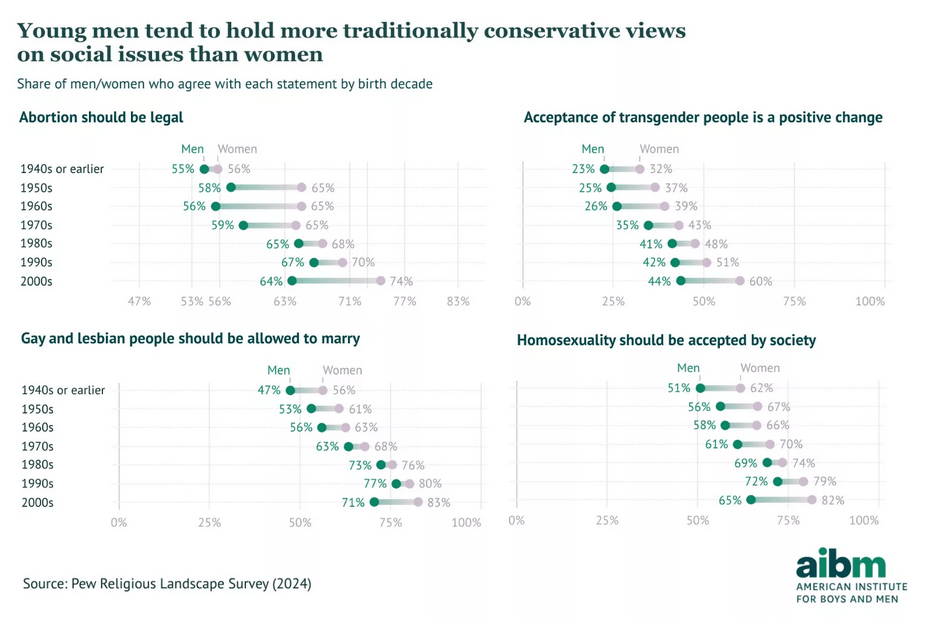
Young men are more likely to hold homophobic views, study suggests.
Men born in the 2000s are far more likely to hold conservative views on LGBTQ+ rights compared to previous generations and women of the same age, a study has suggested.
Polling from the Pew Research Center found that men aged 24 and under are far more likely to oppose same-sex marriage and even homosexuality generally than those born between the 1980s and 1990s.
Men are also far less likely to support LGBTQ+ rights than women of the same age. In fact, women are consistently more likely to be LGBTQ+ allies than men across all age ranges.
The 2024 study, highlighted in a report from the American Institute for Boys and Men (AIBM) in December, found that 71 per cent of men born in the 2000s believe same-sex marriage should be legal. Comparatively, 77 per cent of men born in the 1990s and 73 per cent born in the 1980s support same-sex marriage.
Research from the Pew Religious Landscape Survey. (AIBM)
Sixty-five per cent of 2000s men believe homosexuality should be accepted in society, over seven per cent less than those born in the 1990s and three per cent less than 1980s men.
Women aged 24 and under, meanwhile, are far more likely to support LGBTQ+ rights, with 83 per cent supporting same-sex marriage and 82 per cent supporting homosexuality generally.
AIBM noted the gender gap for those born in the 2000s was the widest in nearly every subject compared to every other decade.
Trans rights were by far the most contentious subject among young people. 60 per cent of 2000s women said they believe trans people should be accepted by society, while just 44 per cent of 2000s men answered similarly – a gender gap of 16 per cent.
Support for same-sex marriage saw a 2000’s gender-gap of 12 per cent, support for homosexuality had a gap of 17 per cent, and abortion rights a gap of 10 per cent.
Washington University professor of practice, Ryan Burge, argued the survey results prove that young men are increasingly influenced by “social-issue messaging”, particularly from right-wing religious groups.
“As academics often say – we need more time and more data,” he wrote. “I suspect the next five years of survey results will significantly clarify the trajectories of young men and women when it comes to religion.
“As their lives stabilise, they settle into careers, and some begin to marry and start families, we will get a much clearer sense of whether religion is actually taking hold. If a shift is coming, these next few years will be decisive.”
Research published in 2024 suggested that Gen Z are more likely to identify as LGBTQ+ than Republican compared to other generations.
The Axios poll found that just 21 per cent of those aged between 12 and 27 describe themselves as Republican, while more than a quarter described themselves as LGBTQ+. It also found that young people are far more likely to be religious than other generations.
Early Tuesday morning, final appropriations bills for the Departments of Labor, Health and Human Services, and Education—and related agencies—were released, marking the last major funding measures to be negotiated in the aftermath of the record-breaking government shutdown fight in 2025. That standoff featured multiple appropriations bills loaded with anti-transgender riders and poison pills for Democrats, ultimately ending in a short-term continuing resolution that punted many of those provisions to the end of January. While other “minibus” packages funding individual agencies moved forward, the Education and HHS bills were conspicuously absent, as they contained some of the most sweeping and consequential anti-trans riders ever proposed in Congress. Now, with the final bills released, it is clear that no anti-transgender riders were included—meaning transgender people will largely be spared new congressional attacks through most of 2026 should they pass as-is.
As the government shut down on Oct. 1, the state of appropriations bills needed to reopen the federal government for any extended period was extraordinarily dire for transgender people. Dozens of anti-transgender riders were embedded across House appropriations bills, even as those provisions were largely absent from the Senate’s versions. The riders appeared throughout nearly every funding measure, from Commerce, Justice, and Science to Financial Services and General Government. The most extreme provisions, however, were concentrated in the House HHS and Education bills, including language barring “any federal funds” from supporting gender-affirming care at any age and threatening funding for schools that support transgender students. Taken together, those measures would have posed a sweeping threat to transgender people’s access to education and health care nationwide.
Those fears eased somewhat when the government reopened under a short-term continuing resolution funding operations through the end of January. In the months that followed, Democrats notched a series of incremental victories for transgender people, advancing multiple appropriations “minibus” packages that stripped out anti-trans riders as the government was funded piece by piece. As amendment after amendment fell away, those wins grew more substantial, including the removal of a proposed ban on gender-affirming medical care from the NDAA—even after it had passed both the House and Senate. Still, the most consequential question remained unresolved: what would ultimately happen to the high-impact anti-trans provisions embedded in the HHS and Education bills.
Now, the package has been released—and for the moment, transgender people can breathe again. The final HHS and Education bills contain no anti-transgender provisions: no ban on hospitals providing gender-affirming care to transgender youth, no threats to strip funding from schools that support transgender students or allow them to use the bathroom, and no mandate forcing colleges to exclude transgender students from sports or activities like chess or esports. The bills are strikingly clean. As such, they avert yet another protracted shutdown fight in which transgender people are once again turned into political bargaining chips—and, at least for now, remove Congress as the immediate vehicle for new federal attacks, should they pass as-is.
When asked about the successful stripping of anti-trans provisions, a staffer for Representative Sarah McBride tells Erin In The Morning, “Rep. McBride works closely with her colleagues every day to defend the rights of all her constituents, including LGBTQ people across Delaware. In the face of efforts by the Trump administration and Republicans in Congress to roll back health care and civil rights, she was proud to work relentlessly with her colleagues in ensuring these funding bills did not include anti-LGBTQ provisions. It takes strong allies in leadership and on committees to rein in the worst excesses of this Republican trifecta, Rep. McBride remains grateful to Ranking Members DeLauro, Murray, and Democratic leadership for prioritizing the removal of these harmful riders.”
This does not mean that transgender people will not be targeted with policies and rules that affect them in all areas of life. The Trump administration has acted without regard to law in forcing bans on sports, pulling funding from schools and hospitals, and banning passport gender marker updates. The Supreme Court has been increasingly willing to let the office of the presidency under Trump do whatever it would like to transgender people. However, the lack of passage of bills targeting transgender people means that these attacks will only last for as long as we have Trump in the White House, and a future president should hopefully be easily able to reverse the attacks.

 Brenda Bazán




 Shutterstock