Why do these haters hate so much towards the LGBTQ+ people? We never hurt them, but they claim we hurt their god. But if that is true then can’t their all powerful god fix such an offense? Unless he made the LGBTQ+ people as he wanted them to be.
I want to point out the total switch and bait these haters use. Read the article to see the hate and refusal to accept anyone not straight and cis. Here is a quote from this person; notice how he frames it just to incite outrage.
Forcing local schools to permit a teenage boy who ‘identifies’ as a girl to use changing rooms, locker rooms, and bathrooms with five-year-old girls.”
See the bait and switch? A teen boy is somehow threatening your little 5 yr old girl. Oh the humaity.
Congressman Brian Babin, R-Texas, Chairman of the House Science, Space, and Technology Committee, speaks about the introduction of the Birthright Citizenship Act at a press conference on Thursday, Jan. 23, 2025. | Jack Gruber / USA TODAY NETWORK
A Republican member of Congress went to an event hosted by a hate group and, during a prayer, thanked God for sending Donald Trump to stop children from being led “down the path of homosexuality and perversion.”
“Lord, we beseeched thee,” prayed Rep. Brian Babin (R-TX) at the Family Research Council’s (FRC) National Gathering for Prayer and Repentance event at the Museum of the Bible in D.C. on February 4. The FRC is classified as an anti-LGBTQ+ hate group by the Southern Poverty Law Center.
“Our prayers were answered in getting us a new president and taking a different direction in our country than we had seen for the previous four years,” he continued. “Apostasy, blasphemy, taking our children down the path of homosexuality and perversion. Open borders. Criminals running rampant in our streets.”
“Lord, we have new leadership, and we thank you for that. But Lord, we know that government is not going to save our country. It’s going to be the American people returning to the path that you have set out for us and our Founding Fathers.”
Babin has consistently gotten a score of “0” on HRC’s Congressional Scorecard for the past several sessions of Congress, showing his solid opposition to LGBTQ+ equality.
In 2022, Babin was one of several Congressional Republicans who introduced a federal bill in the House to ban schools, libraries, hospitals, government entities, or other organizations from “hosting or promoting any program, event, or literature involving sexually-oriented material.” The bill defined “sexually-oriented material” to include anything that discusses LGBTQ+ people.
In 2015, Babin was outraged that the Supreme Court ruled in favor of allowing same-sex couples to marry in its Obergefell v. Hodges decision.
“As a strong supporter of traditional marriage and a firm believer in state sovereignty, I am deeply disappointed that five members of the U.S. Supreme Court have over-ruled tens of millions of Americans – including millions in the State of Texas – who have voted to enact state statutes and state Constitutional amendments to define marriage as between one man and one woman,” he said at the time.
“Traditional marriage has been under assault as courts and some state legislatures have sought to both redefine marriage as something other than between one man and one woman and to penalize and discriminate against those who have religious and conscience convictions against the redefinition of marriage,” he continued.
In 2016, he introduced a bill to roll back Obama-era protections for transgender students, saying that those protections were “throwing common sense and decency out the window and forcing local schools to permit a teenage boy who ‘identifies’ as a girl to use changing rooms, locker rooms, and bathrooms with five-year-old girls.”
The Obama-era protections did not allow for boys to use girls’ facilities. Instead, they were recommendations about how schools could accommodate transgender students, which included allowing them to use facilities associated with their gender identity.
Subscribe to the LGBTQ Nation newsletter and be the first to know about the latest headlines shaping LGBTQ+ communities worldwide.
The parents of a transgender teen who died by suicide earlier this year are speaking out about the toll Idaho’s anti-trans laws and the Trump administration’s anti-trans crusade took on their daughter.
“You worry about that hatred being internalized, and that’s what happened to my kid,” Elyse Thorpe told NBC News in a recent profile. “It got inside.”
Thorpe and ex-husband Joseph Pollard describe their late daughter, May Pollard, as an energetic and curious child who loved sloths, video games, and writing poetry. She just wanted to live her life and experience the same things any teen does. But she was also keenly aware of the wave of anti-trans laws and sentiment that have swept Idaho and much of the U.S. in recent years.
According to NBC News, May, who had also been diagnosed with autism, came out as trans when she was in eighth grade. She began receiving gender-affirming medical care in ninth grade. But due to Idaho’s ban on such care for minors, passed in 2022 and upheld by the Supreme Court in 2024, her parents were forced to travel to Portland, Oregon, every six months to get May the care she needed. Following President Donald Trump’s return to office in January 2025, Thorpe began making the 13-hour round trip by car to avoid creating a flight record amid the administration’s relentless crackdown on gender-affirming care for young people.
While the treatment improved things for May, the obstacles placed between her and the care she needed by anti-trans legislators continued to weigh on her.
Then, in July 2023, Idaho’s law banning trans students from accessing single-sex bathrooms and locker rooms that align with their gender identity took effect. Lambda Legal filed a lawsuit challenging the law on behalf of Boise High School’s Sexuality and Gender Alliance, and in July 2025, May joined the lawsuit under the pseudonym Jane Doe. In court filings, May described feeling stigmatized by being forced to use her campus’s two single-occupancy restrooms, which came to be referred to as the “trans bathrooms.”
“It is scary having to look around before to see if anyone will see me going into the single-user restroom, as I worry about people gossiping and speculating about me being transgender,” she said. “I don’t want people to know I am transgender without my consent — even students who might be friendly. For me, it is not a part of myself I talk about or that I feel is the most important part of my identity.”
Her parents told NBC News that May would avoid eating and drinking during the school day, hoping to not have to use the school’s bathrooms. “I just want to fit in,” she wrote in her affidavit in the Lambda Legal case. “It is upsetting to think that I may have to go through the rest of high school without access to something as basic as the ability to use the same restroom as everyone else.”
May’s parents say she became more troubled last fall and winter, according to NBC News. She attempted to run away to Oregon, and at least one of her poems seemed to reference self-harm. Then on the morning of January 27, Thorpe woke to find May missing from her bedroom. She later found her daughter’s body in a downstairs bedroom. May was just 16 years old.
When a detective asked her parents whether anyone might have wanted to harm May, Thorpe responded that “A lot of America” did.
“There is a huge amount of animosity, every single day, thrown at trans kids,” an angry and grieving Pollard told the detective. “The whole f**king country. The whole f**king administration, every single f**king day.”
As NBC News notes, over the last few years, Idaho Gov. Brad Little (R) has signed 15 anti-LGBTQ+ laws. In April, Little signed a pair of bills, one of which made it a criminal offense for trans people to use the bathroom associated with their gender, while the other banned Pride flags on government buildings.
As for Lambda Legal’s challenge to the state’s school bathroom ban, at the time of May’s death, she was one of just two plaintiffs left in the case, as all the others had graduated high school and no longer held standing. Earlier this spring, Lambda Legal moved to dismiss the case after the final plaintiff graduated.
But Thorpe has continued to protest Idaho’s anti-trans laws. According to NBC News, she stood outside Gov. Little’s office during a March 31 protest holding a photo of her daughter.
“I wanted to support the protesters and remind everyone, including the governor,” Thorpe told the outlet, “that the stakes are real.”
“The parents go and testify, and we say, ‘Children are going to die,’” she said. “We tell the legislators that, and they dismiss it. I guess they think it’s hyperbole, or they think it’s hysteria, or they think it’s an acceptable outcome, probably some mix of those things. So I don’t understand why there is an unwillingness to connect these laws to these outcomes. It was right there from the start.”
Subscribe to the LGBTQ Nation newsletter and be the first to know about the latest headlines shaping LGBTQ+ communities worldwide.
I watched this three times because the message is so good. The fact that the reverend of this faith can rejoice in diversity makes me wonder what hater preachers and haters get out of their faith, out of their hate? I have been listening to the book Separation of Church and Hate by John Fugelsang. He is like Dan McClellan in that he is a biblical scholar; he knows the original manuscripts, times of use for each edition, and where different translations screw things up, and Fugelsang is a comedian, so he can throw it all out there with humor. I recomend everyone try to find the book or the audio book. He has whole chapters taking on the different haters and the clobber verses of the bible. He shows what the original meaning, as far as can be known of each of those verses was, correcting the misunderstand and hate. He like me feels that Christians follow Christ, biblcians follow the bible and they get that wrong because they don’t know the subtext or original intent; they hear only what the weekend preacher said who is preaching his version of the bible, not Christ’s. Happy Pride week Halifax. Long may your flags fly. Hugs
An update on my procedure to shave the spinal cord in my lower spine. The people at the surgical center were grand. I can’t describe them any other way. One nurse even joked with Ron and me that she would love to spend time with us off work hours because she loved our sexual innuendo banter with each other, stuff like we can’t even think straight after 36 years together and that we don’t say move straight forward we say move gayly forward. But work required her to only join us around the fringes but we had her laughing so hard. All of the staff were wornder and one even walked me to the bathroom when I felt I needed to pee. It was relatively embarrassing, but as I had worked in ICUs before I realized it was totally every day normal for the nurses to see my butt. She did hang the IVs and give me privacy which was more than we were able to do for the ICU patients.
When they took me into the procedure room, I was worried that I might not be out enough and would feel pain. The anesthesiologist asked me if I had ever had a colonoscopy. I repiled yes. He said do you remember it? No I replied. Same here he said, once we get you positioned, you won’t remember anything. They got me positioned, and then he told me that once they got me an arm rest for my right hand he would administer the aniestha. I was gone even before the arm rest was set up. Totally out. Woke up in the recovery room, and once I was awake they went and got Ron.
I have a list of do and don’ts. But on the way home we stopped to eat, I had a large breakfast for me. Then we got home, and I went to bed until 12:30. Got up, ate again, and locked the Majority Report into the fun half so I can watch it free, and went back to bed. Then I slept until nearly 5 PM. Got up and started working on the cartoon / meme / news post that was to go out today. I will go out tomorrow. Sorry about that, the spirit is willing, but the body is very weak right now. On the plus side the pain in my right leg I have been living with seems to have diminished greatly and in some cases gone away.
The video below is very funny and points out how tRump is now just a befuddled grandpa who thinks everything must be about him and how he is the greatest even when he is clueless about what he is talking about. The host points out the mistakes and money interests of the entire cabinet. Hope you enjoy. Hugs
I recently had a somewhat uncomfortable conversation with my Dad. At 88-years old, he is understandably considering what comes next, and knowing that I’m a ‘blowhard democrat and therefore think I know everything‘, lol, he made it part of my own considerations – at least out loud. But, as we talked, I began to realize that how we look at “what comes next” truly inspires how we view this thing called life, what we value and hold dear.
When I was much younger, I had the opportunity to read Jonathan Livingston Seagull by Richard Bach. I think I’d like to read it again. It was a story that had a great impact on a young troubled life, and while I am sure I didn’t get nearly as much from the book as was offered, I still carry some of that book within my thoughts nearly 35 years later. Chief among those ringing ideas was the consideration that we are on this world to be excellent, to fly free and powerfully, to be our best selves. It is an idea that gives me hope and conviction on the same blade, for I’ve not made much of myself. What I have done, perhaps better late than never, is I’ve begun to understand what is important to me and I’ve tried to adjust my life accordingly.
During my studies of different religions, I found a great deal of beauty. It is probably shocking to some, but Muslims have a beautiful religion filled with dedication to their God, peace and humility. I recently heard a person of influence, a politician, say publicly that he “hated the Muslim religion”. I thought that was tragic. He has painted a billion people with a the same brush and feels fully justified in his self-righteous hate. His words did not influence me to hate Muslims, they only brought me sadness. Here is a man who hopes to profit by hate, and I can only imagine what those wages bring.
Over the years, I’ve come to find a lot of hope in the Christian Faith, but I don’t find myself deluded into thinking that the Bible is definitive or that the Pulpit is infallible. Clearly humans have left their mark on both, and both have gained their insecurities and foibles. Unfortunately, most religions are marked by the greedy and deluded powerful who are sure that they know what is best for everyone and damned be those who disagree. As a result, parishioners lose their search for what is beautiful and magnificent in whatever may come next. They instead follow a set of rules, a kind of club, a group identity. They have given up on God and hope only to please the pastor and Sister Bertha Betterthanyou. They have forsaken courage to seek for the safety of the flock.
Perhaps this is just what we are. How many of us are caught in this idea that by hating someone else, we are somehow doing as God would want? I would be very curious to ask them what they value, and then would I be so brave to ask how their spoken values reflect their current words. Do they value freedom, or just their own freedom? Do they value love, or only for those like them? Do they value hope, but do performative acts some man told them would get them into Heaven? Do they seek or are they comfortable in being told what to think, what to feel, what to do? Do they look for what comes next or are they seeking identity and safety in a church, a political movement, in the acceptance of someone seeking to control them?
I don’t know what I would tell Dad if he asked me again. I don’t think the answer is in religion, any religion. I do think there is something that comes next, what I would loosely if respectfully refer to as God, and if I could quote Ghandi I’d say that God is not restricted by any single religion. I want to believe that this beautiful thing called life doesn’t end. I want to believe in Love. I want to rest in Hope. I want to live a life absolutely riddled with awe at how fabulous humanity can be, rather than live a life of judgement and insecurity. And, when I regard my final days I hope I am looking forward with eager anticipation for all the wonders I will experience.
Ro Khanna details the abuses the Israelis commit against the palestinians and how the authorities do nothing to stop these abuses. Khanna gives numerous details and says that the israeli governments want to make it clear that no one should go to see the attractions and abuse done to the Palestinians but should only visit the Jewish parts of Israel. This is the best reporting of what happened to the congressman and the other US citizens. Hugs
Doctors and human rights experts documented hundreds of incidents from June 2025 through May 2026 and estimate true number is ‘far greater’
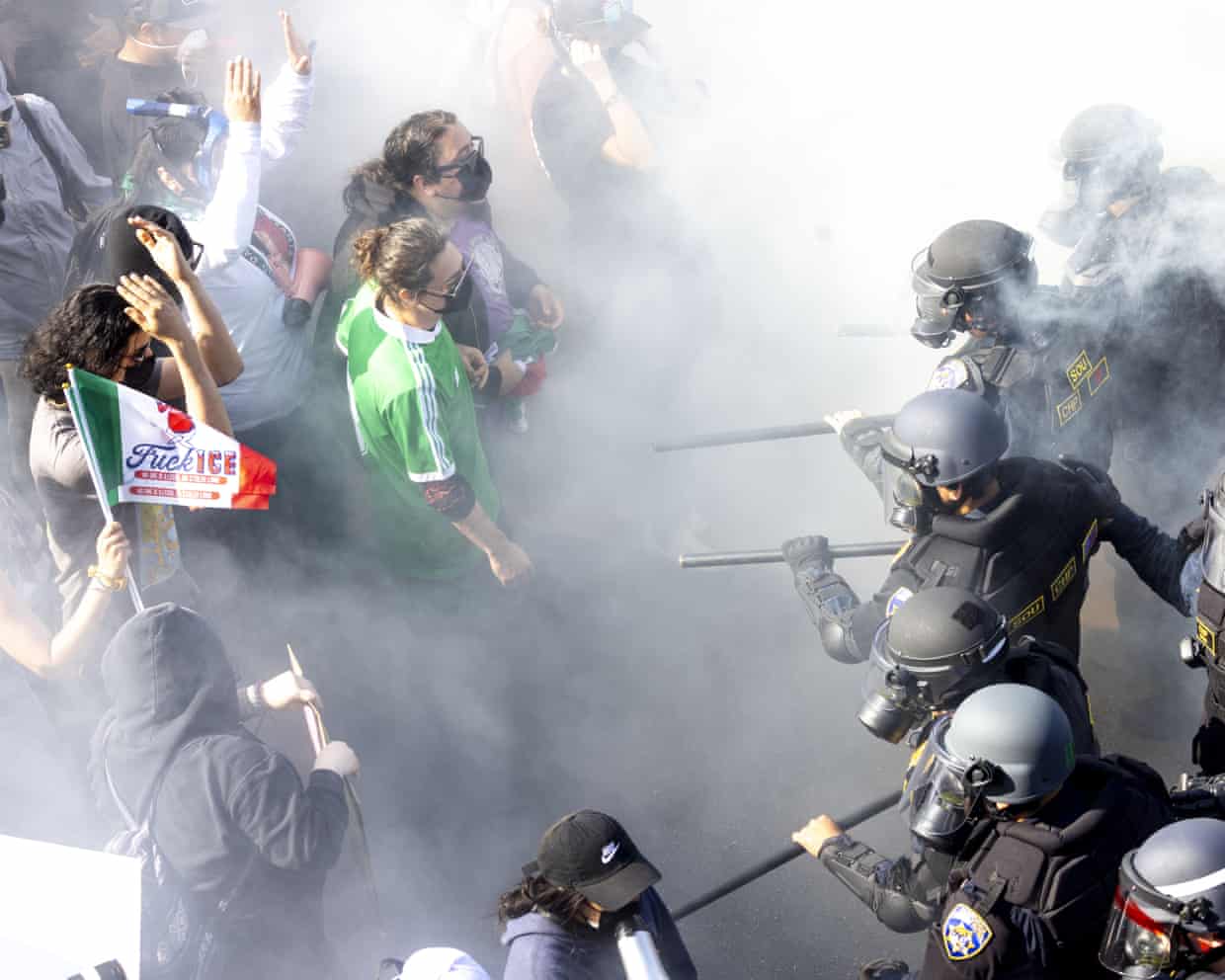
Smoke fills the air as protesters face off with California Highway Patrol officers in Los Angeles, California on 8 June 2025. Photograph: Jill Connelly/ZUMA Press Wire/Shutterstock
It’s been a brutal tactic deployed by local and federal law enforcement officials time and again over the past year: using teargas, rubber bullets and pepper spray to control protests outside ICE detention centers or during enforcement operations.
Now, a new report lays bare the scale of the use of these crowd control weapons during anti-immigration demonstrations across the US, including hundreds of incidents that resulted in lasting and traumatic injuries.
The report and an interactive map was created by Physicians for Human Rights (PHR) and the Human Rights Center at the University of California, Berkeley (HRC) and released this week. Doctors and human rights experts with PHR and HRC documented 412 verified incidents of the “misuse” of these crowd control weapons, also known as “less-lethal weapons”, from June 2025 through May 2026.
“This is a concerning story,” said Dr Rohini Haar, the lead author of the report and a PHR medical expert, in an interview with the Guardian.
The report documented 203 injuries stemming from the alleged misuse of the crowd control weapons. Some of the injuries included blindings, traumatic brain injuries, lacerations, fractures and contusions.
The researchers struggled to confirm the full scale of the injuries, because “visual investigative techniques cannot adequately assess invisible injuries, such as chemical injury or chronic pain or hearing loss”.
“The true number of injuries is likely far greater,” the report adds.
Such tactics were on display earlier this summer, when dozens of protesters gathered outside the Delaney Hall immigration detention center in Newark, New Jersey, in solidarity with detained immigrants on hunger strike. As protests became more and more heated, a line of masked Immigration and Customs Enforcement (ICE) officials stood outside to guard the detention center.
During a scuffle, ICE officials pepper sprayed Andy Kim, a New Jersey senator, making national news and helping set off one of the country’s flashpoints in demonstrations against the Trump administration’s immigration enforcement operations.
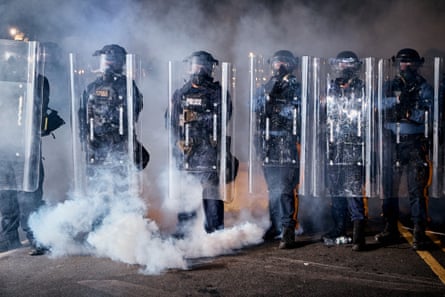
State police officers stand behind shields as tear gas fills the area outside the Delaney Hall detention center during a protest in Newark, New Jersey. Photograph: Andrés Kudacki/AP
In the days and weeks that followed, local and state officials also moved in on protesters, using batons and shields, deploying teargas canisters and arresting dozens. Many were injured during the demonstrations outside Delaney Hall by the crowd control weapons that the local, state and federal officials used.
The use of crowd control weapons in New Jersey was not new – local, state and federal law enforcement officials have used them on protesters nationwide opposing the aggressive anti-immigrant arrests, detentions and deportations.
But their use has become widespread as the backlash to Trump’s immigration crackdown has grown – prompting researchers to track down incidents and the types of weapons used nationwide, and to establish a map where readers can see how those weapons have been used in their communities.
Haar began working on the report after she saw news of a pastor being blasted in the face with a chemical weapon by a federal official in Oakland. Haar and PHR have been researching the impacts of crowd control weapons for years.
“Those weapons can cause harm,” Haar added. “It’s just when they’re used, how they’re used and if they’re used.”
DHS did not respond to Guardian inquiries about the report’s findings before publication.
The crowd control weapons include chemical irritants, including teargas, pepper spray and Mace, along with “kinetic impact projectiles”, which include rubber bullets and bean bag rounds. Researchers with PHR and HRC also documented the use of stun grenades, water cannon and other “improvised” weapons, like horses and riot police shields.
Haar explained to the Guardian that they qualified “misuse” by a number of methods. First, they tracked whether people in “protected categories”, including journalists and health workers, were targeted by officials. Next, they documented if vulnerable populations, including elderly people and children, were affected. And lastly, they tracked whether the weapons were used improperly, like using the weapons in close range, targeting people’s heads or going against the weapons’ manufacturing guidelines.
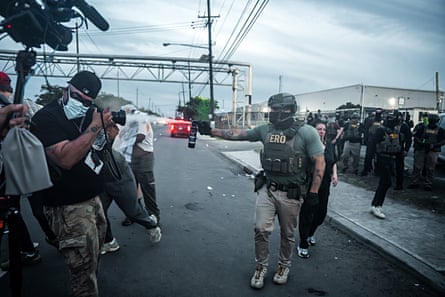
An Immigration and Customs Enforcement (ICE) agent fires tear gas toward demonstrators and members of the press at the Delaney Hall Detention Facility. Photograph: Olga Fedorova/EPA
A report from earlier this year by ProPublica identified 70 children across the US who had been harmed by teargas or pepper spray – not just at protests, but during immigration enforcement operations as well.
On a national level, officials with the Department of Homeland Security (DHS), like ICE or Customs and Border Protection (CBP) officials, were responsible for over half of all misuse incidents – 64%. But local law enforcement officers also played a role in many incidents.
“The involvement of state and local [authorities] is also concerning,” Haar added. “Because in many places, they’re coming on top of what is already happening with DHS. But in places like Los Angeles, there is a lot more involvement [of local law enforcement officials].”
The researchers found that there was an increase in the use of these weapons during immigration enforcement surge operations under the command of former Border Patrol commander-at-large Gregory Bovino, who took a hardline approach to his enforcement tactics. After the shooting deaths of two US citizens in Minneapolis by federal immigration officials, Bovino was pulled from his position. He became critical of the Trump administration, accusing them of not taking a tough-enough approach, and retired in March of this year.
“In each city where there were federal directions to escalate enforcement, incident counts rose sharply within days,” PHR said in a statement announcing the report and the map. “Much of this was coincident with the arrival of Greg Bovino.”
“Many of the enforcement operations that coincided with spikes in documented misuse were also promoted through public social media accounts, including Bovino’s,” PHR continued.
For researchers, the scale of the use of the crowd control weapons harkened back to law enforcement’s response to the 2020 racial justice protests. That year, protesters throughout the country took to the streets to protest police killings of people of color throughout the US. And in some cities, the Border Patrol’s elite unit participated in arrests and crowd control operations.
Since June 2025, mass protests have erupted in Los Angeles, Chicago, Minneapolis, Newark and Portland. The report documented that over 90% of the documented “misuse” incidents happened in those regions.
DHS and local law enforcement officials have fallen under repeated criticism for their response to their protests and their aggressive use of force. Since January of 2025, federal immigration officials with DHS have been responsible for at least 11 shooting deaths. The two most recent fatal shootings by immigration authorities took place this month, less than one week apart, in Texas and in Maine.
On 7 July, ICE agents shot and killed Lorenzo Salgado Araujo, a 52-year-old construction worker, during an arrest operation in Houston as he drove his work van. And just this Monday morning, a 26-year-old Colombian man was shot and killed by a federal official in Biddeford, Maine, DHS confirmed.
Please notice the brutality towards the ones they detail and those bystanders. They assault the people recording them and they threaten them with more violence and arrests. To the ICE no one has rights. How long will we tolerate this lawless militia type behavior towards the people? No law enforcement would get away with this. They do it because they are masked and Stephen Miller will do anything to protect the ICE thugs doing his dream of a country of only white people who follow every order of the authoritarian government. Warning it is a hard video to watch. But we must. Hugs

 Alex Bollinger (He/Him)February 10, 2026, 9:03 am ESTCongressman Brian Babin, R-Texas, Chairman of the House Science, Space, and Technology Committee, speaks about the introduction of the Birthright Citizenship Act at a press conference on Thursday, Jan. 23, 2025. | Jack Gruber / USA TODAY NETWORK