After over 21 months of Israel’s brutal assault on Gaza, the humanitarian crisis in the Strip has reached its worst point yet. 94% of Gaza’s hospitals have been destroyed or damaged. Dozens of children have died from malnutrition. And Israeli troops continue to kill scores of Palestinians as they try to receive food from the so-called “Gaza Humanitarian Foundation.”
In this second part of Zeteo’s live ‘Unshocked,’ Dr. Yasser Khan – a Canadian ophthalmologist and plastic surgeon who has traveled twice to Gaza since October 7, 2023 – describes to Mehdi and Naomi how Israel’s humanitarian assault on Gaza has turned injuries and disabilities in Gaza into, “a death sentence.”
Dr. Yasser Khan: “It was horrific, the most horrific things that I’ve ever seen.”
In the interview, Dr. Khan shares the stories of his many patients, the vast majority of whom he says were women and children.
Dr. Khan also discusses how upon returning from Gaza, many of his colleagues in the medical field refused to believe such stories, with some even going out of their way to tell him that, “‘he’s done nothing to be a hero.’”
Dr. Khan explains how he came to the conclusion that what he was seeing in Gaza was indeed a genocide and why he takes so much inspiration from the people in Gaza. Mehdi, Naomi, and Dr. Khan also take questions from a live audience.
Do consider becoming a paid subscriber so you can get early access to exclusive content like this.
Also, if you are interested in learning more about Israel’s assault on Gaza’s healthcare system, check out Zeteo’s most recently acquired documentary, ‘Gaza: Doctors Under Attack.’
I could have written large parts of this myself. It is scary to be in our position and at the mercy of those who have so much money they will never understand our needs or it seems even care. Most of congress are multimillionaires. They see their jobs not to look out for people like me, but to gain ever more wealth and power for themselves. Which leads to the billionaire bailout bill the republicans are pushing to pass right now. Hugs
The author asserts cuts to programs such as Social Security Disability Insurance will make it difficult for her to afford basic necessities The program provides month payments to people who have a disability that stops or limits their ability to work. (Dreamstime/TNS)
Being a care provider in a nursing home is backbreaking work. It includes heavy lifting and spending all day on your feet, helping patients eat, dress and use the bathroom while keeping track of dozens of patients who all have different needs, medicines and preferences. It’s never easy, but during my career I held myself to the standard of providing the care I would want someone to give to one of my family members.
I was a certified nursing assistant and medication aid in nursing homes before retiring due to health problems. I loved my job. It provided me with more than a paycheck; it gave my life meaning. It felt good to be someone people could depend on, especially in times of need. I loved being the first face my patients would see in the morning and the last at night. It was physically and emotionally draining at times, but always worth it. I’ve learned that anything in life worth having is a struggle to obtain. I miss working every day.
Now, my main source of income is Social Security Disability Insurance. Without it, I wouldn’t be able to cover my rent or help take care of my daughters, grandchildren or father. My monthly disability check, which I put toward rent, laundry, bills and other necessities, goes fast. The only way I am able to cover the rest of my expenses each month is through programs such as the Supplemental Nutrition Assistance Program and the Low Income Energy Assistance Program and Medicaid.
I’m prediabetic, so I have to be mindful about what I eat. SNAP is the only way I am able to afford healthy food. Lately, the price of everything in the grocery store has gone up. I shop carefully, but some weeks I have to forego buying meat to save money. My SNAP benefits have gone down significantly in recent months, which has already made it harder for me to afford the food I need. Across Pennsylvania, over 2 million people receive SNAP benefits. That’s thousands of families in our state, just like me, who depend on this program to put food in the mouths of their children.
I’ve received Medicaid on and off for over 20 years. It has helped me pay for important surgeries including a vision surgery, cystoscopy and a hysterectomy. Medicaid helps me cover copays and deductibles and access mental health services. Losing Medicaid would mean sacrificing health care and having to pay my medical costs out of my own pocket, which I cannot afford.
Every winter, LIHEAP benefits help me keep my home warm. It keeps my heating bill manageable so that I don’t have to use the stove to generate heat. Without LIHEAP, I would need to make tough decisions about which bills to pay, whether that’s rent, electricity or gas. It would be a situation of robbing Peter to pay Paul. My monthly budget is extremely fragile and the possibility of losing LIHEAP, which provides me about $200 each winter, is enough to put my whole financial situation at risk. When I hear that politicians in Washington want to make billions of dollars worth of cuts to SNAP, Medicaid, LIHEAP and other programs, it makes me incredibly anxious. Without these programs, I wouldn’t be able to stock my fridge, go to the doctor or heat my home.
I spent decades caring for patients in need and did it with pride. No one ever expects to be disabled and suddenly have to stop working. You never know what could happen and never think it could happen to you until it does. I didn’t think I would ever need back the tax dollars I put into the system. But God had a different plan for me. These programs are so important for me and millions of Americans.
But the programs are also part of what makes America a great and a caring nation. They ensure that any American — our neighbor, our family member, or a co-worker — who gets sick can live with dignity in the richest nation on earth. It seems like Republicans in Congress have no interest in supporting everyday people. They just want to make the rich richer.
By voting in favor of cuts to Medicaid and SNAP, my Congressional representative, Rep. Ryan Mackenzie, voted to turn his back on constituents like me. With these cuts, people will suffer and end up on the streets. People like me, who are already doing everything we can to make it work, will struggle even more.
I am calling on Sens. Fetterman and McCormick to chart a different path and put an end to these proposed cuts. Lives are on the line. It’s time for our leaders to show that they care and that they are willing to stand up against billionaires. On behalf of the millions of Pennsylvanians who rely on these SNAP, Medicaid and LIHEAP, I urge you to protect these programs and our ability to provide for our families.
This is a contributed opinion column. Pamela Berman is a Bethlehem resident and former certified nursing assistant. The views expressed in this piece are those of its individual author, and should not be interpreted as reflecting the views of this publication. Do you have a perspective to share? Learn more about how we handle guest opinion submissions at themorningcall.com/opinions.
Kennedy, a longtime vaccine skeptic, ousted the 17-member Advisory Committee on Immunization Practices (ACIP) earlier this week in a stunning move that shocked medical experts. He defended his action in an interview with Fox News’ Martha MacCallum, claiming that “97% of the people on the committee had conflicts of interest.”
He repeated falsehoods about vaccines that were immediately fact checked by doctors on social media platform X. He falsely claimed there were between 69 and 92 mandatory vaccines in the U.S. today and that most of the vaccines, excluding the COVID-19 vaccine, had not gone through safety tests.
“So nobody has any idea what the risk profiles are on these products, and we don’t know whether they have anything to do with the epidemic of chronic disease,” Kennedy said, presenting no evidence for his claims.
“In almost every single case, the reason was anti-trans discrimination in the form of pressure to ‘detransition’ from one’s family, friends, or community.”
Erin In The Morning is a reader-supported publication. To receive new posts and support my work, consider becoming a subscriber.
Upgrade to paid
A report on the largest survey ever of trans Americans’ health was released on Wednesday, June 11, and its findings reaffirmed what many academics, health care providers and trans people already know: gender-affirming care saves and improves lives, but transphobia often dissuades people from pursuing or continuing it when they need it most.
Over 84,000 trans, nonbinary and gender nonconforming people aged 18 and up responded to the 2022 U.S. Transgender Survey, spearheaded by Advocates for Trans Equality (A4TE). Of respondents who had transitioned, 9% had gone back to living as their sex assigned at birth at some point in their lives, at least for a short while—but in almost every single case, the reason was anti-trans discrimination from one’s family, friends, or community.
“Social and structural explanations dominated the reasons why respondents reported going back to living in their sex assigned at birth at some point,” the report found. “Only 4% of people who went back to living in their sex assigned at birth for a while cited that their reason was because they realized that gender transition was not for them. When considering all respondents who had transitioned, this number equates to only 0.36%.”
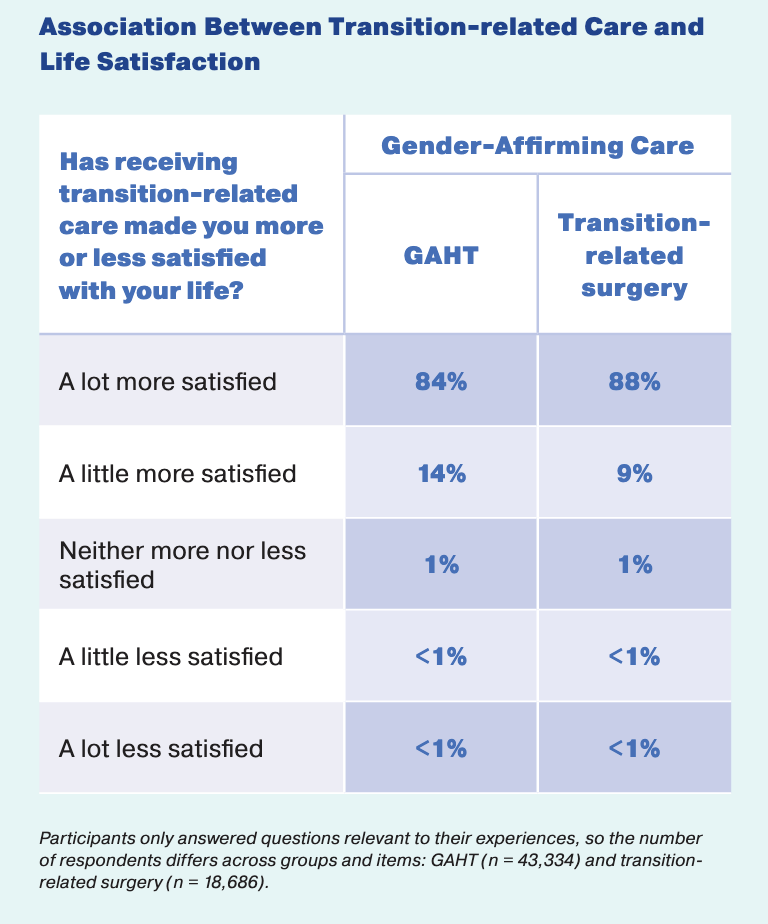
Meanwhile, respondents who received gender-affirming hormone therapy (GAHT) or gender-affirming surgery overwhelmingly reported feeling “more satisfied” with their lives—98% and 97% respectively.
Graphic courtesy of the 2022 U.S. Transgender Survey – Health and Wellbeing Report
This watershed report contradicts the popular narrative being circulated by mainstream media, far-right politicians and anti-trans groups that transgender people are “detransitioning” en masse due to life-shattering “transition regret.” In reality, it shows gender diverse people are living rich and vibrant lives—so long as they are provided the space, support and care they need from their health care providers and communities.
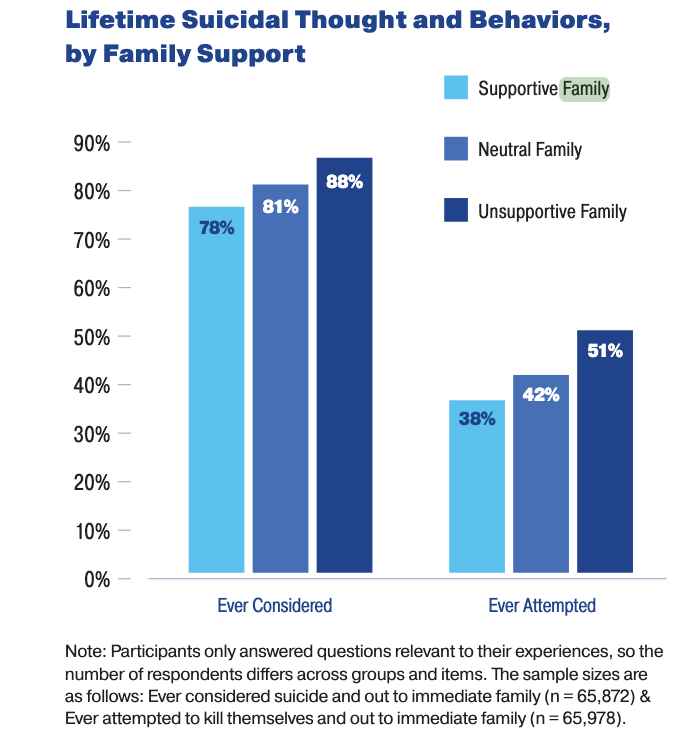
The survey found a trans person’s overall health and wellbeing also heavily depends upon rates of familial support, a factor that has a profound influence over a trans person’s lifetime experience of suicidality.
Graphic courtesy of the 2022 U.S. Transgender Survey – Health and Wellbeing Report
The survey has been released in increments as researchers at A4TE wade through the unprecedented amounts of data from trans people who lent their voice to the project. It is a much-needed, comprehensive overview on the challenges—and victories—seen in trans health care since the prior iteration of the study. The report is especially vital considering the Trump Administration moved to remove transgender people from the U.S. Census and other government websites, rendering trans communities potentially invisible, and robbing researchers of crucial data informing public policy decisions.
“Having real concrete and rigorous data about the realities of trans people’s day-to-day lives is also a vital part of dispelling all of those assumptions and stereotypes that plague the public discourse about our community,” said Olivia Hunt, A4TE’s Director of Federal Policy, during a press briefing this week.
The report also touched upon trans people’s access to health care, which increased between 2015 and 2022; the quality of care, as trust between doctors and trans patients has improved; disparities between trans people across racial groups, which showed trans people of color are generally more prone to experience discrimination compared to white trans people; and the mental health challenges facing the trans community, as 44% of respondents met the criteria for serious psychological distress, compared to less than 4% of the general U.S. population.
Many of these issues have likely been exacerbated since the data was collected. The lead-up to President Donald Trump’s return to the Oval Office incited a new wave of anti-trans animus, impeding access to care and stirring up transphobic vitriol and harassment.
“From 2015 to 2022, state-level policy environments became more protective in some ways for trans people; however, in 2022 alone, when the USTS was administered, 315 anti-LGBTQ bills were introduced across the country, many of which harm trans and nonbinary people’s access to healthcare, participation in sports, access to public facilities, or other facets of public life,” the report says.
“This political landscape has only worsened since the administration of the 2022 USTS, with the introduction of 571 anti-LGBTQ nationwide in 2023 and 489 in 2024,” it continues. “At the time of writing, data on trans and nonbinary people has been erased from federal health surveys. As funding for LGBTQ research is stripped away, the USTS has become an ever more critical resource on the lived experiences of trans and nonbinary people.”
Nonetheless, trans life and trans joy has persisted, as testimonies featured in the U.S. Trans Survey demonstrate.
“I have thrived in the past 12 months in transition, I have a genuine smile on my face most days & laugh with genuine joy,” wrote Charlotte, a trans woman, in her survey response. “I have grown into the woman I was meant to be.”
And as Roo, a nonbinary person, wrote: “Once I learned what it meant to be trans, I never looked back. I traded in my Regina George-esque life for a future with a balding head and a predisposition for a beer gut. I’ve never been more happy to be alive—every single day. ”
Erin In The Morning is a reader-supported publication. To receive new posts and support my work, consider becoming a subscriber.
Trump officials transferred the migrants to the East African nation in response to a judge’s order. They now face threats that include rocket attacks from Yemen.
June 6, 2025 at 5:51 p.m. EDTyesterday at 5:51 p.m. EDT
A U.S. Air Force plane used for deportation flights is stationed at Biggs Army Airfield in Fort Bliss, El Paso, on Feb. 13. (Justin Hamel/AFP/Getty Images)
Nearly a dozen immigration officers and eight deporteesare sick and stranded in a metal shipping container in the searing-hot East African nation of Djibouti, where they face the constant threat of malaria and rocket attacks from nearby Yemen, according to a federal court filing issued Thursday.
A federal judge in Boston interrupted an Immigration and Customs Enforcement deportation flight taking immigrants from Cuba, Vietnam, Myanmar, Laos and Mexico to South Sudan more than two weeks ago. U.S. District Judge Brian E. Murphy said the flight violated his order prohibiting officials from sending immigrants to countries where they aren’t citizens without a chance to ask for humanitarian protection. He instructed officials to arrange screenings.
Trump officials could have flown the immigrants back to the United States. Instead, they were taken to Djibouti, where in late May officers turned a Conex container into a makeshift detention facility on U.S. Naval Base Camp Lemonnier, according to Mellissa Harper, a top ICE official, who detailed the conditions Thursday in a required status update to the judge.
Three officers and eight detainees arrived at the only U.S. military base in Africa unprepared for what awaited them. Defense officials warned them of “imminent danger of rocket attacks from terrorist groups in Yemen,” but the ICE officers did not pack body armor or other gear to protect themselves. Temperatures soar past 100 degrees during the day. At night, she wrote, a “smog cloud” forms in the windless sky, filled with rancid smoke from nearby burning pits where residents incinerate trash and human waste.
The Trump administration has urged the Supreme Court to stay Murphy’s April order requiring screenings under the Convention Against Torture, which Congress ratified in 1994 to bar the U.S. government from sending people to countries where they might face torture. In a filing in that case Thursday, officials told the Supreme Court that Murphy’s order violates their authority to deport immigrants to third countries if their homelands refuse to take them back, particularly if they are serious offenders who might otherwise be released in the United States.
Matt Adams, a lawyer for the detainees and legal director of the Northwest Immigrant Rights Project, said the government is delaying interviewing the men to determine whether they have a reasonable fear of harm. The judge ordered the government to provide the detainees with access to their lawyers, but Adams said they haven’t spoken to them.
Lawyers fear the Trump administration is delaying the screenings in hopes that the Supreme Court stays Murphy’s order and clears the way for officers to deport the men to South Sudan. He said detainees are likely to prevail in proving they have a credible fear of being tortured because South Sudan is on the brink of civil war and they are not citizens of that country.
“What person wouldn’t have a reasonable fear of being dropped into a war torn country that they know nothing about?” he said.
While Djibouti is one of the hottest inhabited places on earth, a Navy guide to Camp Lemonnier says it has air conditioning, WiFi, a Pizza Hut, a Planet Smoothie, and a medical clinic. It also has a movie theater, a restaurant called “Combat Cafe,” a gym and a swimming pool.
But Harper wrote that the officers and detainees staying in the shipping container have not had access to basic necessities. Officers and detainees began to suffer symptoms of a bacterial upper respiratory infection soon after deplaning, including “coughing, difficulty breathing, fever, and achy joints.”
Medication wasn’t immediately available. She wrote that the flight nurse has since obtained treatments such as inhalers, Tylenol, eye drops and nasal spray, but they cannot get tested for the illness to properly treat it.
“It is unknown how long the medical supply will last,” Harper wrote, though the camp guide has a clinic on-site.
The officers spend their days guarding eight immigrants convicted of crimes that include murder, attempted murder, sex offenses and armed robbery, court records show. Harpersaid Defense Department employees “have expressed frustration” about staying in close proximity to violent offenders.
Harper said ICE has had to deploy more officers available to work in “deleterious” conditions to give the initial crew a break. Currently 11 officers are assigned to guard the immigrants and two others “support the medical staff,” she said. They work 12-hour shifts guarding immigrants, taking them to get medication, and to use the restroom and the shower in a nearby trailer, one at a time. Officers pat down the detainees, searching them for contraband.
At night and on breaks, officers sleep on bunk beds in a trailer, with one storage locker apiece. Some wear N95 masks even while they sleep, because the air is so polluted it irritates their throats and makes it difficult to breathe. The area is dimly lit, which Harper wrote poses a security risk to the officers.
Department of Homeland Security officials seized on the court filings to criticize the judge.
“This Massachusetts District judge is putting the lives of our ICE law enforcement in danger by stranding them in [Djibouti] without proper resources, lack of medical care, and terrorists who hate Americans running rampant,” said DHS spokeswoman Tricia McLaughlin on X. “Our @ICEgov officers were only supposed to transport for removal 8 *convicted criminals* with *final deportation orders* who were so monstrous and barbaric that no other country would take them. This is reprehensible and, quite frankly, pathological.”
A lawyer for the detainees said they are also worried about their clients’ health, and said the government is responsible for the current situation. Trina Realmuto, a lawyer for the detainees and executive director of the National Immigration Litigation Alliance, noted Murphy gave the government the option of returning the men to the United States.
“The government opted to comply overseas,” she said. “This is a situation that the government created by violating the order and easily can remedy with a single return flight.”
Family members who finally reached the detainees by phone said the trailer where they are being kept has air conditioning, but that they remain in leg irons and without sufficient access to medicine.
Murphy had said DHS abruptly launched the deportation flight even though it plainly violated his April 18 preliminary injunction barring them from removing people without due process. Federal law prohibits sending anyone — even criminals — to countries where they might be persecuted or tortured.
Although McLaughlin said officials couldn’t deport them to their home countries, Mexico President Claudia Sheinbaum said at a news conference last month that the U.S. government did not inform her of the Mexican national sent to Djibouti, Jesus Munoz Gutierrez, who was convicted of second-degree murder in Florida 20 years ago, court records show.
She said the U.S. would have to follow protocols to bring him to Mexico, if he wishes to be repatriated, and she said he could be detained upon arrival. She said Mexico is reviewing the case.
Murphy has also ordered the government to return a gay Guatemalan man who was deported to Mexico, where he said he had been kidnapped. The man returned Wednesday.
(And let me interject that I know that sometimes I’m a language/punctuation police officer, but I despise the term “reverse discrimination.” Either discrimination has happened, or it hasn’t, to be proven to whoever decides. There is no “reverse discrimination”. grr. Also, this is not a spoiler nor my opinion on the case, it’s simply that I guess it’s good for some people that I do not sit upon the SCOTUS, because I’d want to dismiss and tell them to use appropriate words so that the court could accurately decide based upon the evidence of discrimination, without being distracted by superfluous words. Please be at liberty to laugh at me about this. Then read all the following. -A)
It’s June 1, and that means we’re starting the last month, more or less, of this Supreme Court term. The cases the Court has had briefing on and heard oral argument in will all be decided by the end of this month, although some years it spills over into the first week of July.
We never know which cases are coming next. The Court doesn’t decide them in the order they hear them argued. But usually the biggest, most impactful cases aren’t decided until the end.
This week for “The Week Ahead,” I’ve got a scorecard with some of the most important still-undecided cases for this term on it. The goal is to give you some background to refer to, so when you hear the Court has announced a decision in a certain case you’ll be prepared to understand its significance.
Here they are, in order of when they were argued, although that’s likely to have little to nothing to do with when we will see opinions.
U.S. v. Skrmetti
The issue in this case is whether states can ban gender-affirming care for trans youth in the context of a 2023 Tennessee law that bans gender-affirming care, like puberty blockers and hormone therapy, for transgender patients who are minors. The Biden administration intervened in the case and was a party along with three transgender teens and their parents. That changed with the change in administrations. The Trump Justice Department, as you would expect, is on the other side of the case.
A key issue in the case is whether denying treatment to trans youth that is available to their gender conforming peers violates the Constitution by denying them equal protection under the law. A federal district court judge held that it did. But the Court of Appeals reversed. About 25 other Republican dominated states have similar laws. The result in this case will apply beyond Tennessee.
At oral argument, the conservative Justices seemed disinclined to accept the argument that this law is a form of sex discrimination, even though cisgender kids will be able to access treatment that transgender people won’t be able to receive if these laws stand. But the votes seemed to be in place to permit Tennessee and other states to keep their restrictive laws in place.
Free Speech Coalition v. Paxton
The case involves a 2023 Texas law that is supposed to keep minors from accessing pornography online. It requires websites to verify a person’s age before they are admitted to the site. But an industry group that calls itself the Free Speech Coalition sued, claiming the law violates the rights of adults who want to access the content, an impermissible burden on free speech. The ACLU is on their side in the case.
There was at least some indication at oral argument that the Justices are aware we no longer live in a world of dial up internet connections and want to revisit the standards that are used to “protect kids.” The technical legal issue is whether the court of appeals used the wrong legal standard to decide the case. Instead of using the highest standard of review and requiring the Texas law to pass “strict scrutiny” before it could burden the adults’ right to have access to protected speech, they only required that there be a “rational basis” connecting the law to its intent to protect minors.
Ames v. Ohio Department of Youth Services
The Court’s decision in this case could potentially signal a sea change in reverse discrimination employment litigation. The case involves a straight woman who claims she faced “reverse discrimination” on the job because she wasn’t gay, leading her to be passed over for promotion opportunities. The issue is whether a plaintiff who is a member of a majority group has to show that her employer is the “unusual” one who discriminated against the majority, before bringing a case under Title VII of the Civil Rights Act of 1964. If she wins, this sort of reverse discrimination case could become easier to bring.
The plaintiff lost out on a promotion to a lesbian woman. She was subsequently demoted and the position she was removed from was given to a gay man. All of this started 13 years into her employment, after a new boss, who was a gay woman, became her supervisor.
There was speculation following oral argument that the plaintiff might win unanimously. Justice Sotomayor seemed to say she thought the plaintiff might have a valid claim, noting that based on the record before the Court, there was “something suspicious” about what happened. The consensus among the Justices seemed to be that everyone had to be treated equally.
Smith & Wesson Brands v. Estados Unidos Mexicanos
There are two technical legal issues in this case, but together, they add up to an answer to the question of whether Mexico can sue U.S. gunmakers for what it has long maintained is their responsibility for the epidemic of gun violence within its borders. Mexico argues that a number of U.S. gunmakers made it possible for traffickers to illegally purchase firearms in the U.S., only for them to be provided to Mexican drug cartels.
The Court will decide: (1) Whether the production and sale of firearms in the United States is the proximate cause of alleged injuries to the Mexican government stemming from violence committed by drug cartels in Mexico; and (2) whether the production and sale of firearms in the United States amounts to “aiding and abetting” illegal firearms trafficking because firearms companies allegedly know that some of their products are unlawfully trafficked.
If the Court decides in Mexico’s favor, its lawsuit against U.S. gun manufacturers will move forward.
Louisiana v. Callais
This is the Louisiana redistricting case. The issues revolve around whether a Louisiana congressional district created to comply with the Voting Rights Act resulted in an unconstitutional gerrymander that discriminates based on race. The Callais plaintiffs are a group of “non-African Americans” who say the redistricted map violates the Constitution because it takes race into account in violation of the 14th Amendment.
Although the Court may be inclined to do away with the Voting Rights Act at some point, this case is reminiscent of a 2023 gerrymandering case out of Alabama, where a 5-4 majority that included Chief Justice Roberts and Justice Kavanaugh upheld the Voting Rights Act and forced Alabama to comply with it, rejecting maps drawn by the state legislature that made it all but impossible for Black citizens to elect candidates of their choice to Congress.
This case might have a similar outcome. It has similarly complicated facts and an up-and-down history on appeal. It comes down to whether Louisiana, whose population is about 1/3 Black, will have a second Black opportunity district. The technical issues involve whether a three-judge district court in this case was mistaken when it ruled that race predominated in the Louisiana legislature’s decision on maps, whether it erred in finding those decisions couldn’t pass the strict scrutiny test and a set of preconditions known as the Gingles factors, and whether the case is the sort of “non-justiciable” matter that should be resolved through the political process, not decided in the courts.
Mahmoud v. Taylor
The issue here is whether religious parents’ rights are violated when a school board doesn’t give them the ability to opt out from having LGBTQ-themed books available to their children in elementary school. The issue is presented as: Whether public schools burden parents’ religious exercise when they compel elementary school children to participate in instruction on gender and sexuality against their parents’ religious convictions and without notice or opportunity to opt out.
At oral argument, the Court’s conservative majority seemed sympathetic toward the parents.
Trump v. CASA, Inc. (consolidated with Trump v. Washington and Trump v. New Jersey)
This is the birthright citizenship case that was argued only earlier this month. We discussed it here. The issue isn’t whether Trump can end birthright citizenship. Rather, it’s whether the Supreme Court should stay the district courts’ preliminary injunctions except as to the individual plaintiffs and identified members of the organizational plaintiffs or states while the litigation works its way through the courts.
It’s hard to believe that it was just over a year ago that I sat outside, across the street from the U.S. Supreme Court building in the Senate Swamp, listening to the oral argument and preparing to comment on it in real time. (snip)
At the time, I wrote, “The case is all about Donald Trump and whether he can be prosecuted for the most serious of his crimes against the American people, trying to hold onto power after losing the 2020 election. It’s also about the legacy of the Roberts Court and whether history will view the already unpopular Justices as the Court that gave away democracy.”
Overall, there are more than 30 cases remaining on the Court’s dockets. There are also a number of procedural and other issues pending in cases that haven’t been fully briefed for a decision on the merits this term. This is the so-called shadow docket, where litigants ask the courts to make decisions in cases characterized as emergencies. Cases involving deportations and DOGE are among them. And also, the wild card, a number of cases still percolating through the lower courts where the issues aren’t yet ripe enough to be before the Supreme Court, but could become so in the next few months, at least enough to merit a trip to the shadow docket and interfere with the Supreme Courts’ summer break. The biggest question that remains for me is whether this Court will continue down the path it set itself upon last term, or will tell Trump no in a meaningful way?
Welcome to the new week. Thanks for being with me at Civil Discourse as we approach our third anniversary.
Detained children line up in the cafeteria at the Karnes County Residential Center in Karnes City, Texas, on 10 September 2014. Photograph: Eric Gay/AP
The Trump administration is trying to end a cornerstone immigration policy that requires the government to provide basic rights and protections to child immigrants in its custody.
The protections, which are drawn from a 1997 consent decree known as the Flores Settlement Agreement, limit the amount of time children can be detained by immigration officials. It also requires the government to provide children in its custody with adequate food, water and clean clothes.
The administration’s move to terminate the Flores agreement was long anticipated. In a court motion filed Thursday, the justice department argued that the Flores agreement should be “completely” terminated, claiming it has incentivized unauthorized border crossings and “prevented the federal government from effectively detaining and removing families”.
Donald Trump also tried to end these protections during his first term, making very similar arguments.
Ice arrests at immigration courts across the US stirring panic: ‘It’s terrifying’
Read more
The move to end protections follows a slew of actions by the Trump administration that target children, including restarting the practice of locking up children along with their parents in family detention. Immigration advocacy groups have alleged in a class-action lawsuit filed earlier this month that unaccompanied children are languishing in government facilities after the administration unveiled policies making it exceedingly difficult for family members in the US to take custody of them. The president and lawmakers have also sought to cut off unaccompanied children’s access to legal services and make it harder for families in detention to seek legal aid.
“Eviscerating the rudimentary protections that these children have is unconscionable,” said Mishan Wroe, senior attorney at the National Center for Youth Law. “At this very moment, babies and toddlers are being detained in family detention, and children all over the country are being detained and separated from their families unnecessarily.”
The effort to suspend the Flores agreement “bears the Trump administration’s hallmark disregard for the rule of law – and for the wellbeing of toddlers who have done no wrong”, said Faisal al-Juburi of the Texas-based legal non-profit Raices. “This administration would rather enrich private prison contractors with the $45bn earmarked for immigrant detention facilities in the House’s depraved spending bill than to uphold basic humanitarian protections for babies.”
The Trump administration in 2019 asked a judge to dissolve the Flores Settlement Agreement, but its motion was struck down. During the Biden administration, a federal judge agreed to partially lift oversight protections at the Department of Health and Human Services, but the agreement is still in place at the US Customs and Border Protection (CBP) and US Immigration and Customs Enforcement agencies.
“Children who seek refuge in our country should be met with open arms – not imprisonment, deprivation and abuse,” said Sergio Perez, executive director of the Center for Human Rights and Constitutional Law.
The settlement is named for Jenny Flores, a 15-year-old girl who fled civil war in El Salvador and was part of a class-action lawsuit alleging widespread mistreatment of children in custody in the 1980s.
Since the settlement agreement was reached in 1997, lawyers and advocates have successfully sued the government several times to end the mistreatment of immigrant children. In 2018, attorneys sued after discovering unaccompanied children had been administered psychotropic medication without informed consent.
In 2024, a court found that CBP had breached the agreement when it detained children and families at open-air detention sites at the US southern border without adequate access to sanitation, medical care, food, water or blankets. In some cases, children were forced to seek refuge in portable toilets from the searing heat and bitter cold.