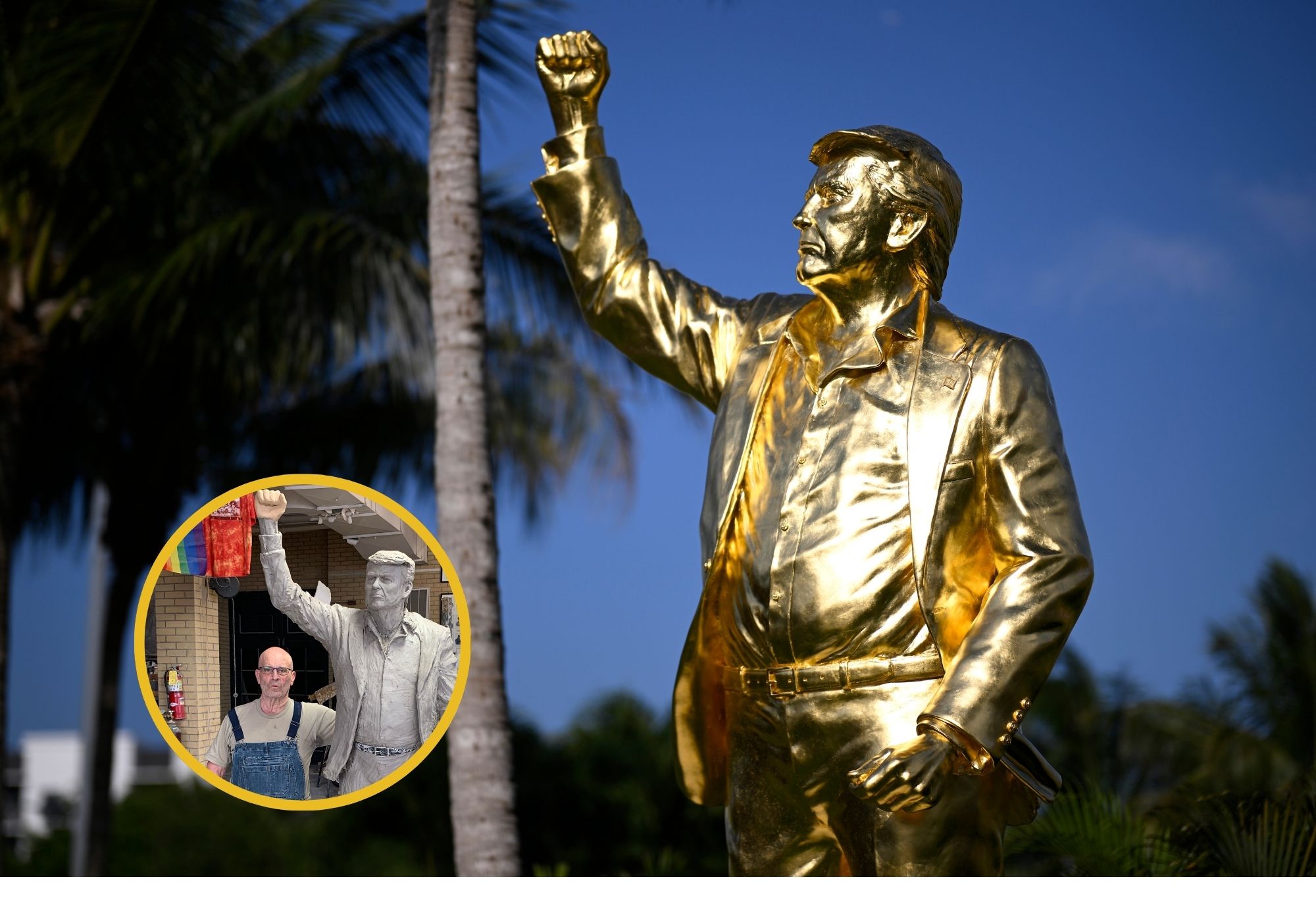
Doral Trump statue sculptor Alan Cottrill says no other commission has been as chaotic.Golden statue photo by Orlando Ramirez/Getty Images; overlaid photo from Alan Cottrill. New Times photo collage.
A towering, gold-leaf statue of President Donald Trump was unveiled with great fanfare on Wednesday at Trump National Doral golf course, in a dedication ceremony that included a prayer from a MAGA-aligned pastor who put the president on speakerphone. But the artist behind it had choice words when asked about the two-year creation process.
“This was a clusterfuck,” Ohio-based sculptor Alan Cottrill tells New Times.
From his foundry in Zanesville (about an hour east of Columbus), Cottrill has worked on hundreds of commissioned statues now standing across the country, including multiple at the Ohio State University. But never has a commission been as chaotic as the crypto bro-funded, gold-leafed, looksmaxxed Trump unveiled this week at Trump’s golf club, he says.
“I usually deal with people that have everything organized. From the start, this was chaos,” Cottrill says. “I have 400 life-size or larger statues around the country. The patron sets a date when they want it installed, and I have it installed on that date. And almost never, anytime whatsoever, does anyone miss a payment, because I always do what I say I’ll do, and the patron always does what they say they’re going to.”
That wasn’t the case with the 15-foot (22 feet when you include the platform) Trump statue. Demands to nix the turkey neck and make the model skinnier, missed payments, and calls to install the statue last-minute — no Cottrill commission has been as complicated as the statue dubbed “Don Colossus.”
The statue in question, seen near the ninth tee during the first round of the Cadillac Championship 2026 at Trump National Doral Miami on April 30 in Doral.
Tech bros Ashley Sansalone (a cryptocurrency developer based in Canada) and Dustin Stockton (a Republican strategist) teamed up with a group of other crypto bros to pay Cottrill $500,000 for the creation of a Trump statue based on the fist pump he gave after the July 2024 assassination attempt in Pennsylvania. If Stockon’s name sounds familiar, it’s because authorities raided his property in connection with allegations that he was involved in defrauding donors of former Trump advisor Steve Bannon’s effort to crowdfund the southern border wall in Trump’s first term.
Sansalone and Stockton didn’t respond to New Times‘ requests for comment. But Stockton told the U.K paper The Times that the group did not agree with the sculptor’s description of what happened.
From Clay Clump to 15-Foot Trump
Cottrill, an Army veteran and founder of an international pizza chain, was in his late 30s when he touched clay for the first time and declared, “This is the mistress I’ve traveled the world in search of,” as he puts it in his website bio.
“Well, I tell people it’s kinda like the first time I kissed a girl. The minute I did that, man, that’s all I wanted to do,” Cottrill tells New Times.
From there, Cottrill built a business that’s attracted more than 500 commissions, with most standing in public places throughout the nation. In 2024, he got the call about making a giant Trump statue. The group of cryptocurrency acolytes, Stockton told The Times, was to highlight “one of the most iconic moments and to show our appreciation of his embrace of crypto.”
He said the group was in agreement: “If we are going to do this, we had to make it Trumpian.” Also, it had to look like gold.
When asked by New Times about his political leanings and whether he was excited by the commission request, Cottrill says, “No comment.”
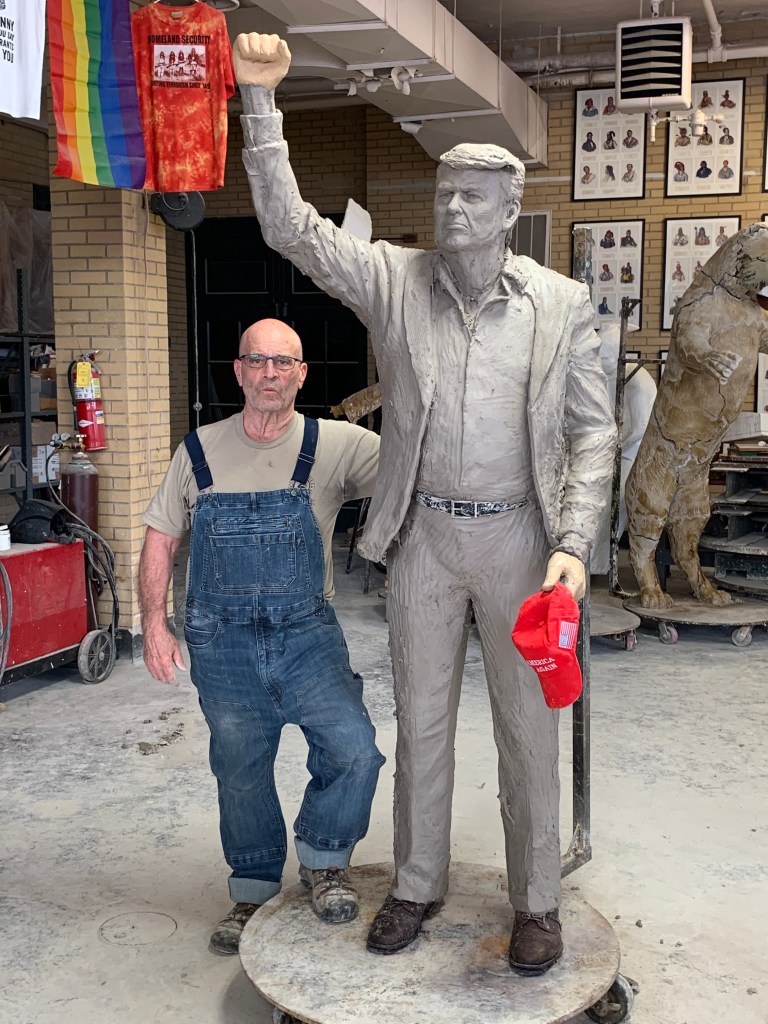
The process of molding skinny Trump began with a life-sized clay model that wasn’t quite to the liking of Cottrill’s patrons, he said.
“I had him even skinnier than he is, a little bit. I knew they’d want that,” Cottrill said about the first model. “They said, ‘Oh, he’s too big.’ I’m close enough to his age, and I got some turkey neck going on, and I knew what that was. That’s what happens when you’re almost 80.”
Perhaps the only photo you’ll ever see of Trump fist-pumping in front of a pride flag. Photo from Alan Cottrill
Cottrill says it actually only took him four-and-a-half months to make the 50 pieces he’d put together to make the giant Trump. It took another year and a half, however, for the installation at Trump National Doral to happen because it took weeks for Sansalone and Stockton to make their final $90,000 payment.
The tech bros in 2024 paid an initial $300,000 for the initial statue, then paid another $60,000 a year later for the gold-leaf plating, and another $150,000 to use imagery of the statue to promote a crypto token, Cottrill said. But getting the payment was easier said than done.
“‘You were supposed to make these payments nearly a year ago. I can’t trust you to do that,’” Cottrill recalls telling his patrons. “So I held the statue. I put it in an undisclosed location and said it won’t be delivered until the final payments have been made.
“Like I told the crypto guys from the beginning, I said, ‘Hey, I don’t fuck around, so you don’t fuck around with me.’ And, like my daughter said, ‘They fucked around and found out.’”
After months of holding the statue hostage, the final payment finally came on April 22 with a phone call saying Cottrill had to have the statue installed the next day, ahead of the 2026 Cadillac Championship that ran April 30 to May 3.
“So I got in a truck with my foundry manager and we drove straight down and when we got to dropoff, we were told that we need this installed and all the gold leaf touched up by dawn tomorrow,” Cottrill said. “We usually would take three days to do all that, so we worked through the night till 4 a.m., and we finally finished. Then we slept two or three hours, got in the truck, and drove 18 hours straight back to Zanesville.”
Cottrill high-tailed it out of South Florida because he wasn’t actually invited to the unveiling and dedication ceremony that followed (another first for the sculptor).
When asked if Cottrill would ever work with the crypto bros or Trump’s team again, specifically for the upcoming Trump Presidential Tower in Miami, which, according to renderings, will include a large, gold-leaf Trump statue, he didn’t need to hear the full question before responding, “Fuck no.”
“Once somebody has shown that they can’t be trusted to do what they say,” he adds, “you don’t work with them anymore.”
Trump himself appeared to be pleased, writing on his platform Truth Social, “The Real Deal – GOLD – At Doral in Miami. Put there by great American Patriots!!! President DJT” However, the sculptor tells New Times, “don’t forget it’s just a normal bronze statue with a coating of gold leaf over the entire thing.”
A lot of gold leaf: “There were over 3000 3in.² leaves of 23.75 carat gold attached to the surface to cover the entire 15 foot statue,” he adds.
B. Scott McLendon joined New Times staff in 2025. A national award-winning journalist, he previously covered education, crime, courts, and local government for daily newspapers in Alabama, Louisiana, and Texas. He holds a bachelor’s in journalism from Troy University.
This was a private event held and paid for by the group for a set amount of time at the park. It is a normal occurrence at parks like this. If this had been a Christian church doing the event it would have caused no backlash and been accepted. But because it was a Muslim sponcered event with mostly clothing of this sect of the Islamic faith that also encouraged the eating of foods not normally eaten by Christians it caused a backlash of Islamophobia. Hate for people and customs different from the Christian religion practiced by white people is common in the nearly theocratic Texas. Hugs
The park is available for rent at a cost of $5,000 an hour, Dallas News reported.
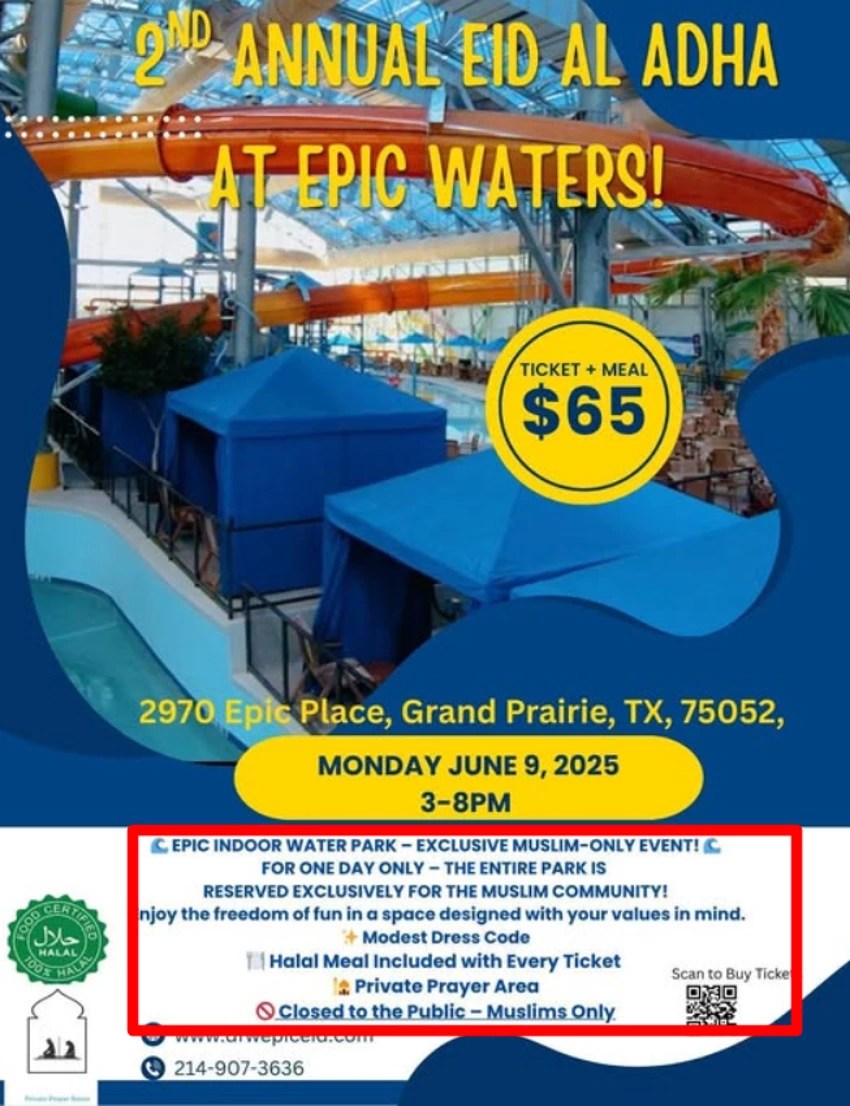
A private event at a Texas city-owned water park has been canceled following backlash and a direct threat by Gov. Greg Abbott to withhold more than $500,000 in state public safety funding.
A spokesperson for the City of Grand Prairie said Thursday the city canceled the DFW Epic Eid Celebration scheduled for June 1 at the Epic Waters Indoor Waterpark.
“After further review and in the best interest of the City of Grand Prairie, the June 1 Eid event at Epic Waters Indoor Waterpark has been canceled,” the spokesperson said.
The event at the city-owned waterpark was initially promoted with flyers describing it as “Muslims only” and included a modest dress code requiring burkinis for women, halal food, a private prayer room and rules encouraging attendees to maintain personal space and “lower the gaze.”
After backlash on social media, organizers updated promotional materials to state that “all are welcome,” provided attendees follow the modest dress code.
Abbott’s Public Safety Office shared a letter with The Christian Post that had been sent to Grand Prairie Mayor Ron Jensen warning that the “DFW Epic Eid” event “was publicly and openly advertised as discriminating based on religion” and therefore violated agreements between the city and the Public Safety Office.
The letter from Public Safety Office Executive Director Andrew Friedrichs said the event “purports to be public facing and discriminatory at the same time” and compared it to advertising for a “Whites only” event.
“All Muslims — but only Muslims — may attend,” Friedrichs wrote. “An event at a city-owned pool that was publicly and indiscriminately advertised as ‘Whites only’ would surely violate the Constitution.”
Event organizer Dr. Aminah Knight later updated the online flyer to clarify that the DFW Eid Celebration is a “privately organized and privately funded event held through a standard rental of Epic Waters, just like many other private gatherings hosted at the park.”
“At its core, this event is about creating a space where individuals and families, particularly those who value modest dress and a modest environment, can come together and enjoy a recreational setting comfortably,” Knight wrote.
Knight added that anyone “of a different faith who wants to celebrate the Eid holiday with us and adhere to the modest dress code” is welcome to attend.
A screenshot of an online flyer for a 2025 “Muslims only” event at the Epic Indoor Waterpark in Grand Prairie, Texas. | Screenshot/Facebook
A Facebook post shared by Knight in May 2025 promoting last year’s event included a flyer calling it an “exclusive Muslim-only event” and stating that the taxpayer-funded facility was “closed to the public” for “Muslims only.”
It is unclear whether the City of Grand Prairie approved the flyer or its contents. The city did not respond to CP’s request for comment by Thursday afternoon.
While the 2026 event flyer listed Knight as the organizer, a video shared on social media by Muhammad Abdullah, listed as the director of Outreach & Youth at Al-Hedayah Academy in Fort Worth, claimed he organized the event.
In a video posted Tuesday, Abdullah blamed “Islamophobia” for the public response to the now-canceled event and said, “By the way, I’m organizing that with my wife.”
CP reached out to Al-Hedayah Academy, where Abdullah is pictured as a member of the mosque’s “spiritual team,” seeking clarification Thursday on whether the mosque was involved in organizing the event.
According to Knight, more than 600 people attended the event last year, and all “lovers of modest fashion and those who are curious about Eid and what modesty at a waterpark can look like” are welcome to attend.
Owned by the city of Grand Prairie near the Dallas and Tarrant County border, Epic Waters — which has no ties to the planned Muslim-centric development formerly known as “EPIC City” — is an 80,000-square-foot waterpark with a retractable roof and the longest indoor lazy river in North Texas, according to its website.
Epic Waters opened in 2017 after voters approved a 0.25% sales tax, according to city documents. The park is available for rent at a cost of $5,000 an hour, Dallas News reported.
I remember when penny candy went to nickel candy under Pres. Nixon, and applied what we learned in our school “Weekly Readers” to figure that out. Of course there were larger problems. A few years later, my dad lost his business due to general economic woe with high inflation, and I’m pretty sure everyone remembers how personal and smaller business econ went in the 80s. I don’t know why we have to repeat history, when certainly more than a few people can remember this stuff. But, here it is in a concise video. Sharing it would be awesome!
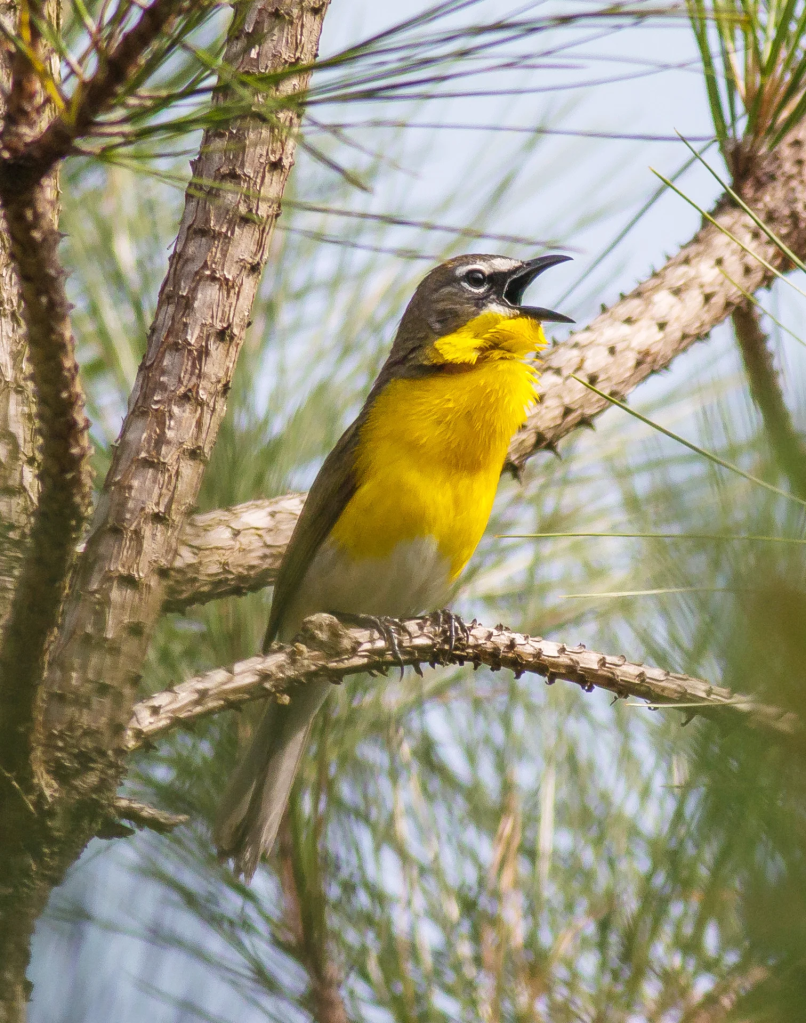
At first glance, the Yellow-breasted Chat seems to be a mishmash of many bird families: its larger size and stout bill resemble a Scarlet Tanager’s, while its skulking habits and complex vocalizations seem more like those of a thrasher or mockingbird. Taxonomically, this bird was considered an unusual wood warbler in the family Parulidae. However, in 2017, the American Ornithologists Union gave this bird its own family — Icteriidae — based on its unique physical and genetic features. It is considered to be related to the blackbirds and meadowlarks of the Western Hemisphere.
Among birders, the Yellow-breasted Chat is best-known for two features of its behavior: its habit of staying hidden at most times within the thickest vegetation available, and its loud, wild, weird song and flight display. In 1953, ornithologist Arthur Cleveland Bent described the Chat’s song as a “medley of strange sounds, musical and otherwise, catcalls, whistles, and various bird notes coming from points now here, now there in the bushes” — sounds which would “betray the presence of this furtive and elusive clown among birds.” The song is indeed a strange and wonderful mix of cackles, clucks, whistles, and hoots. Only males are known to sing, and they do so from deep inside the densest cover. A male chat may sometimes sound as if he’s laughing at the frustrated birders trying to locate him. (snip-MORE)
And thanks to MDavis for intro’ing this guy, who is great!
I’d run across this article linked somewhere earlier this past week. But, I couldn’t read it or post it, because it was behind a paywall. Well, thanks to Punctuated.Equilibrium over on MPS Friday night, here it is! Well, a goodly snip of it. Give ’em a click to read it all, because they lifted the paywall so that everyone who wants to know can read it.
During President Joe Biden’s term, the Department of Justice could say, at least, that it had investigated the president’s son. Republicans in Congress also conducted a yearslong investigation into the Hunter Biden business ties and how they might link back to the president. Here, though, we have nothing; every story I’m about to point to has not produced even a unified statement of concern from, say, a half dozen Republican senators worried about government corruption.
Remember, Hunter’s story was about drawing a $50,000/month salary while his dad was vice president and then allegedly trying to arrange some business ventures he might cut Joe Biden in on once he was out of office. Republicans’ yearslong investigation never turned up any hard evidence of the latter, though there was enough smoke I still think the story was plausible.
Today, we’re talking about the president’s children launching multi-billion dollar business ventures — several of them — while the president is in office, and then explicitly exchanging all manner of domestic policy victories, foreign policy concessions, and literal pardons in the construction of those deals. Trump himself has all but admitted this is happening. He told The New York Times that “nobody cared” when he tried to separate his family business from his administration during his first term, so he isn’t even trying now.
I have tracked these stories with one of my senior editors for the last year and a half. The list of things that have happened is so long and shocking when you see it all together that I’m not entirely sure how to present it. I’ve gone back and forth; maybe I should build a flow chart? What about a spreadsheet? Should this be a YouTube video, instead of a written piece? Will anyone actually read the entire thing? Can anyone actually process this level of self-dealing, corruption, and shadiness at once?
Ultimately, I decided that the best I can do is try to write all these instances down in an engaging way that might grab your attention and wake us all up from whatever stupor we’re in. So… here goes.
Let’s start with the cryptocurrency.
Perhaps the largest vehicle for Trump’s self-dealing has been his foray into cryptocurrency. This is a complicated space that I will try to make as straightforward and simple as possible.
In 2024, the Trump family launched a crypto company called World Liberty Financial. Trump is listed as a “co-founder emeritus.” By December of 2025, they had profited roughly $1 billion from proceeds while holding $3 billion in unsold cryptocurrency tokens, amassing a fortune larger than their entire real estate portfolio. At the same time the president was pushing his family’s new crypto venture, he was cutting crypto regulation, touting the potential of private digital currencies to help the U.S. economy, and promising to unleash the industry he and his family were simultaneously profiting from.
But the president wasn’t only directly making money in an industry he was deregulating; the Trumps benefitted through intermediaries, too. Last summer, World Liberty Financial bought a publicly listed firm and raised $750 million from investors to buy its own cryptocurrency, WLFI. The Wall Street Journal tepidly described this setup as an “unusually circular transaction with the same party as buyer and seller” that could net the Trump family an additional $500 million.
Essentially, the Trump family launched a cryptocurrency firm while deregulating the crypto industry, then bought a separate firm that it used to buy its own cryptocurrency while also raising three quarters of a billion dollars from investors to buy that same cryptocurrency.
Just days before he was inaugurated, Trump alsolaunched a personal “memecoin” called $TRUMP. Memecoins are cryptocurrencies made about internet jokes, pop culture moments, or viral trends. They have no underlying value or technological purpose; the value of the coin is driven entirely by social hype. Trump created hype for his memecoin by launching it months after being elected and just three days before being inaugurated. He promoted $TRUMP on social media and, while president, even held a dinner for the top 220 holders of the coin at one of his golf resorts in Virginia. He held another one at Mar-a-Lago this past weekend. The initial coin offering released 200 million tokens of its billion-token supply to the public on the first day. The price skyrocketed 300% overnight and hit an all-time high of $74.27 on January 19, right before Trump’s inauguration. $TRUMP has since cratered, losing 97% of its value (for context, if you had bought $1,000 at its peak, your $1,000 would now be worth about $30).
Trump, naturally, profited. The exact figures are hard to pin, but The Financial Times estimated that the scheme netted him personally about $350 million, while Trump’s holdings of the coin through a separate partnership could be worth billions more. It wasn’t just the president, either; First Lady Melania Trump launched her own memecoin, which also skyrocketed in value before a massive sell-off that she profited from (what people in the industry call a “rug pull”). Most of the people who bought and held the coin based on the hype the Trumps created ended up losing most of their money, but the coin’s creators got rich (or, in this case, richer).
This cryptocurrency foray hasn’t just been a vehicle for self-enrichment, but also a vehicle for quid pro quos. Perhaps the most obvious and overt involved Justin Sun, a crypto billionaire who was being investigated by the SEC for fraud. Sun, in the midst of his investigation, bought $75 million of WLFI — the World Liberty Financial coin — and then became an adviser at the company. Shortly after that investment, the SEC backed off its investigation and settled with him for $10 million, a small fraction of the expected penalties he was set to pay (on top of potential prison time). Of course, it’s possible that the SEC, an organization now openly being influenced by the president, just happened to back off its investigation in the weeks following Sun’s $75 million investment into Trump’s crypto firm.
It’s also possible that the two events are related.
The crypto story, though, hardly ended there. In late April, CBS reported that Sun was suing the Trump administration’s World Liberty Financial, alleging fraud. That’s right: Sun, whose initial case has since concluded, has now turned around and sued the Trump family, alleging that the president and his sons are illegally blocking him from selling his digital tokens that are worth as much as $1 billion. Sun also claims that World Liberty Financial tried to pressure him into investing in its stable coin, and that the company froze his tokens after he refused to commit more money to the business.
It’s hard to identify the villain.
Sun’s apparent quid pro quo to get out from under government oversight is just one example. Changpeng Zhao, the founder of Binance, was pardoned by President Trump shortly after Zhao helped boost WLFI’s prominence by allowing the currency to be traded on the crypto exchange Binance, which Zhao started. After the pardon, Zhao became one of the Trumps’ business partners, boosting the family’s crypto empire while skating serious charges that he allowed money to flow to terrorists, cyber criminals, and child abusers on his platform.
If that’s not enough, more shocking news broke this week. According to The Wall Street Journal, World Liberty Financial inadvertently partnered with two men the U.S. government had sanctioned a month before for helping run a transnational criminal syndicate that had stolen billions of dollars from Americans through online scams. To repeat: Last fall, the Trump administration announced criminal charges against a transnational criminal syndicate for stealing billions of dollars from Americans in online scams. A month later, two of the men it sanctioned partnered with the Trump family’s crypto company.
The evidence of crypto investments from foreign nationals operating as de facto bribes doesn’t end there. Consider the story of Sheikh Tahnoun bin Zayed Al Nahyan, the brother of the United Arab Emirates (UAE) president and one of the most powerful politicians in the Middle East (he’s served as the UAE’s national security advisor since 2016). He stewards an empire of wealth worth roughly $1.5 trillion, and a firm closely tied to him secretly signed a deal for a 49% stake in WLFI worth $500 million — including $187 million paid upfront to Trump family entities just days before Trump’s inauguration. Shortly after Trump took office, the administration undid a national security block that would have prevented the UAE from getting up to 500,000 advanced Nvidia AI chips.
Some right-wing writers, like National Review’s Andrew McCarthy, have been brave enough to take this story head-on — but many have ignored it.
Sometimes, the favors happen en masse. The crypto industry as a whole was a top donor to Trump’s 2025 inauguration fund, and the SEC then dropped or paused over a dozen cases against crypto firms, or simply handed them huge access to government-directed crypto entities. Several of those cases, like Sun’s, were tied directly to donations. Coinbase donated $1 million; its lawsuit was dropped. Ripple ($4.9 million) and Solana ($1 million) had their tokens added to the national Digital Asset Stockpile.
I want to pause here to remind people that we spent all four years of the Biden administration talking about Hunter Biden’s alleged $50,000 a month salary while working at an energy firm in Ukraine, and the possibility that he was setting up some business deals for his father after he left the vice presidency. Rep. Marjorie Taylor Greene (R-GA) introduced articles of impeachment alleging Biden “abused the power of the Office of the Vice President, enabling bribery and other high crimes and misdemeanors, by allowing his son to influence the domestic policy of a foreign nation and accept various benefits—including financial compensation—from foreign nationals in exchange for certain favors.”
Conversely, the final tally of investments from parties with conflicts of interest into crypto assets personally managed by the Trump family safely enters the range of billions of dollars — a scale of thousands of millions, in just one sector and in just over one year, while the president was actually in office.
In this interview Graham Platner responds to his detractors accusations against him. He discusses the tattoo and the Jewish times report that says he had talked about it while working at a bar during the time frame he was not working there. So there is not any credible evidence that he knew what the tattoo was. As he said why would he have danced with it in full display to his extended Jewish family? He makes sense. He understands that people may not like him because he is not polished as a politician. He also says he stumbles verbally and struggles to correct and improve himself. It was a hard hitting interview and Platner came off as very reasonable. Hugs
Now, in this must-watch interview, Mehdi Hasan speaks to Platner not just about his vision for a progressive “political revolution” in Washington DC but also about some of his controversies, including his social media and his tattoo that resembled a Nazi symbol.
“This person is already thinking bigger, writing, ‘If this succeeds the people can band together to buy even more companies that get intentionally bankrupt by private equity and we can start bringing back consumer friendly practices or seizing the means of production maybe.’”
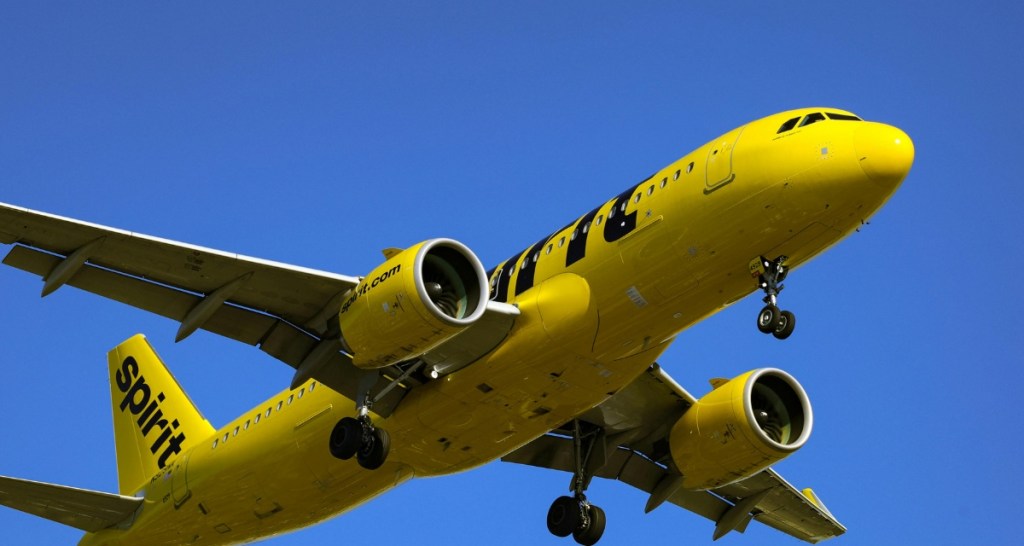
“Get in losers, we’re going to buy an airline” is the short bio next to the smiling face of Hunter Peterson, an aviation enthusiast making waves as he tries to disrupt the air travel industry. On Saturday, May 2, at 3 a.m., Spirit Airlines abruptly shuttered, leaving thousands of employees out of work and thousands of travelers holding unusable tickets.
There was no notice or warning. One day, people were booking tickets, and the next, the budget airline went dark. The airline made air travel affordable to a subset of people who otherwise couldn’t afford it.
The FAA and other airlines scrambled to offer solutions for those booked with the budget airline. While Spirit is offering refunds, the loss of a budget airline giant will be felt. Peterson decided to go further by doing something unheard of in the airline industry–crowdsource to buy an airline.
The idea behind crowdsourcing funds is to make the airline people-owned. This means there would be no corporation backing the airline. No overpaid CEO, and no large shareholder who gets to decide the fate of the company. Peterson calls it Spirit 2.0, and much to his surprise, an astonishingly large number of people were interested.
What started as a zany idea quickly turned into an unexpected movement. Peterson set up a website where interested people could pledge money starting at $45–the average price of a Spirit ticket. The potential CEO wanted to keep the price point within reach. None of the money has left anyone’s accounts. Their pledge acts as a placeholder for future funds, but the clock is ticking.
It may sound like an elaborate joke or scheme to go viral, but Peterson is doing the work. Not only has he met with the Spirit Flight Attendants’ Union, but he’s also spoken with attorneys. In videos shared on Instagram, he explains the importance of doing the legal footwork before money leaves people’s accounts.
“I just got off two calls,” Peterson says. “One, with one of the largest law firms in the world that specializes in mergers and acquisitions, aviation distress assets, and debt, and they basically said, this is doable. We can do this. I also got off a call with someone that represents high-net-worth individuals who may be interested in basically giving us some money to just burn to figure out the legalities of this.”
Peterson explains that in less than a week, they’ll be auctioning the operation certificate for Spirit. This means that if this lofty goal is going to be reached, potential small-donor investors need to reach the astronomical $1.75 billion total. Yes, billion.
Before giving the brief update, Peterson’s site letsbuyspiritair.com had already raised over $24 million. The total continues to climb rapidly, with people pledging amounts anywhere from $45 to $850. Since the website popped up, the total pledged has reached $437 million, and it’s restoring hope in people trying to make this proposed people-owned airline a reality.
“ITS ACTUALLY HAPPENING WE CAN DO THIS,” one person screams.
“Is this feeling I have…. hope? It’s been so long since I’ve felt it lol,” another says.
This person is already thinking bigger, writing, “If this succeeds the people can band together to buy even more companies that get intentionally bankrupt by private equity and we can start bringing back consumer friendly practices or seizing the means of production maybe.”
Someone else shares, “This Spirit Airlines 2.0 project is giving me hope for America. I know there are more important fish to fry when it comes to issues in America. But if we are successful with this, imagine all the other issues we can address (e.g. healthcare, reparations, homelessness, etc.) using this framework. Like truly power to the people.”
A week before the US went to war with Iran, Pete Hegseth, the war secretary, invited the head of his church to lead prayers at the Pentagon. From his pulpit in Idaho, Doug Wilson, a 72-year-old ultraconservative pastor, preaches that homosexuality is a sin, women who dress immodestly are “sluts”, and Charles Darwin’s theory of evolution is the “silliest thing in the world”.
Despite Hegseth’s evangelising, Wilson says the Trump administration is far from morally pure. He says the president is “not someone I would call a godly Christian man”, and disagrees with Trump’s appointment of a gay man, Scott Bessent, as his Treasury secretary because homosexuality is not just a sin, it is “a bad one”.
Of all his gripes, however, Wilson is most indignant about the 1960s sexual revolution, a moral catastrophe that he condemns frequently in his blog posts, sermons and books. He thinks women should dress modestly. But what is modest dress? “Not what they’re doing now,” he says. “I could pick on yoga pants.” He continues: “Men know what they think of hookers, which is not very much. When you’re just giving it away to every slob on the bus who wants to look, you’re degrading the currency.”
Does that mean Wilson and his followers sympathise with the dress codes enforced by Shia clerics in Iran? “No, because wrapping them up in a bedsheet is another way of degrading them. It is possible to be modest and attractive — attractive without attracting. Bundling them up the way really conservative Muslims do is a different kind of degradation. Like you’re not a person. But for a woman to dress like a slut is a different kind of degradation. Both kinds of degradation play off of each other.”
Wilson appeared here last month when he called for criminalizing homosexuality and outlawing all LGBTQ events.
In March, Wilson declared that under his Christian nationalist theocracy, all non-Protestant public events – such a Catholic parades that venerate the Virgin Mary – would be banned.
Also in March, a separate pastor at Hegseth’s church prayed for God to kill Senate candidate James Talarico.
Pete Hegseth’s pastor: ‘Women who dress immodestly are sluts’
The Equal Employment Opportunity Commission has sued the New York Times for discriminating against a white, male employee who claims to have been denied a promotion based on his demographic attributes. It marks the third lawsuit President Trump or his administration has filed against the Times in less than five years.
The Times also filed its own lawsuit against the Defense Department last year over its restrictions on journalists. A federal judge ruled in the outlet’s favor in March. The EEOC said Tuesday that the lawsuit, filed in U.S. District Court for the Southern District of New York, alleges the Times violated the Title VII of the Civil Rights Act of 1964, as amended.
The federal agency, which sits under the executive branch, pointed to the lack of promotion for a “well-qualified white male employee” along with the Times’ diversity, equity, and inclusion policies and a 2021 “Call to Action” to increase non-white and female representation in its leadership. “Federal law is clear: making hiring or promotion decisions motivated in whole or in part by race or sex violates federal law. There is no diversity exception to this rule,” EEOC chair Andrea Lucas said in a statement.
People at the paper say the claim is absurd. “I’m sorry, there are plenty of white guys at the top of the New York Times. Not really something that’s holding you back,” said the reporter. To name one prominent example, Joe Kahn, the paper’s executive editor, is a white male, as are many members of the masthead.
Rhoades Ha, the Times spokesperson, said, “The allegation centers on a single personnel decision for one of over 100 deputy positions across the newsroom, yet the EEOC’s filing makes sweeping claims that ignore the facts to fit a predetermined narrative.”
The employee originally filed the complaint in July 2025 with the EEOC office in New York. One staffer noted it could now be impossible for the Times to take action against the complainant: “This person now has job security for good after this suit. What a mess.”
Purely by coincidence, yeah, last week the NYT reported on the “deeply demoralized” work culture at the EEOC.
EEOC chief Andrea Lucas last appeared here when a judge ruled that she can have the names of Jewish employees at the University of Pennsylvania.
She appeared here in January 2026 when she ended federal guidelines against anti-LGBTQ workplace harassment.
In December 2025, Lucas appeared here when she posted a video seeking plaintiffs in lawsuits for anti-white male workplace discrimination.
A white male New York Times employee filed a complaint with the Equal Employment Opportunity Commission alleging that the paper discriminated against him by not giving him a promotion because he is a white male.
Advocates for LGBTQ+ Catholics expressed surprise to see the Vatican publishing the testimonies of married gay men.
Some of the hundreds of LGBTQ+ Catholics and their families who joined a Holy Year pilgrimage to Rome, celebrating a new level of acceptance in the Catholic Church and crediting Pope Francis for the change, walk through the Holy Door of St. Peter’s Basilica at the Vatican, Sept. 6, 2025. (AP Photo/Andrew Medichini)
The Vatican released a report on Tuesday (May 5) that included the testimony of two married gay Catholics and acknowledged the church’s role in “the solitude, anguish, and stigma that accompany persons with same-sex attractions and their families.” The report also reflects on the negative impacts of conversion therapy, or “the devastating effects of reparative therapies aimed at recovering heterosexuality.”
“ It’s a big deal because they included testimonies and published testimonies from two LGBTQ people, both of them married, which is also unusual for the Vatican to do,” said the Rev. James Martin, a founder of Outreach, an LGBTQ Catholic ministry. “As far as I know, it’s the first time that in any official publication of the Vatican, they’ve included witnesses and testimonies and stories from LGBTQ Catholics in any kind of detailed way.”
The report comes from a group of theologians, including bishops, priests, a sister and a layperson, convened by the Vatican to study “controversial” issues raised by the Synod on Synodality, Pope Francis’ signature listening initiative, to which Martin was a delegate. Though church reform advocates hoped — and traditionalists feared — that the synod would bring major changes to church teaching around gender and sexuality, the decision to relegate contentious issues, such as LGBTQ+ inclusion, to study groups instead of general discussion was widely seen as a damper.
As expected, the synod study group report does not announce major changes to church doctrine, but it does suggest that the Catholic Church address the impasse between “doctrinal firmness” and “pastoral welcome” by listening and using a transdisciplinary approach, such as incorporating insights from psychology, alongside the Bible and church doctrine.
“ It’s a really good — I would even say historic — document,” said Yunuen Trujillo, a lesbian lay minister from Los Angeles. “ It’s still calling for all Catholics to engage in a process of discernment that is respectful of people’s lived experiences.”
Trujillo, author of “LGBTQ Catholics: A Guide to Inclusive Ministry,” said it might take a while for LGBTQ+ Catholics in the pews to feel the impact and noted that the document only focuses on lesbians, gays and bisexual people. “But I do believe it would be a positive impact, not a negative one,” she said.
In this Oct. 4, 2023, file photo, Pope Francis, far right, participates in the opening session of the 16th General Assembly of the Synod of Bishops in the Paul VI Hall at the Vatican. (AP Photo/Gregorio Borgia)
Marianne Duddy-Burke, a married lesbian Catholic and DignityUSA’s executive director, said, “ The most significant thing for me was the recognition that top-down trying to dictate behavior and morality on the basis of dogma isn’t working,” adding she was “hopeful” to see the report using the language of a “paradigm shift.”
The “paradigm shift” the report proposes is a move away from applying abstract theological principles to on-the-ground realities and instead seeing theory and practice as a “virtuous cycle.” For the two to effectively inform each other, the report argues, requires a focus on relationships, transparency and learning. The document offers this theological framework not just for LGBTQ+ issues but for broader use, including in nonviolent activism and protest.
This synod document was written by the study group, not the pope, but its release to the public would have required his authorization.
The report’s release garnered some blowback, a portion of which fell on Pope Leo XIV. Far-right Catholic news organization LifeSite published a story on the report, raising concerns that the report was questioning “the sinful nature of homosexuality” and leaving unresolved the “debate on same-sex ‘marriage.’” Co-founder John-Henry Westen released a video warning that the report’s pro-LGBTQ+ stance makes clear the meaning of “synodality” under Leo.
Advocates for LGBTQ+ Catholics expressed surprise to see the Vatican publishing the testimonies of married gay men.
“ I was expecting a rather bland report. And this was not that,” said Francis DeBernardo, executive director of New Ways Ministry, which serves LGBTQ Catholics. “ In days gone by in the church, they would try to tick off the token box by getting someone who had certain traits and characteristics, but who was just not critical of the church in any way.”
Martin said this is the first time he remembers seeing conversion therapy “critiqued that strongly” in a Vatican document. “There have been certain bishops who have been very muted in their critique of conversion therapy, but then there have also been bishops who have used organizations whose techniques really verge on conversion therapy,” he said.
One gay Catholic wrote of “wounds from the Christian community” in his Vatican-released testimony. “I cannot ignore the scars I carry. I have witnessed the devastating effects of ‘conversion therapies’ and the break-up of families, which felt like an attack on God’s sensitive and blameless creation. These experiences deeply hurt, because they target the inherent dignity of a person who simply bears the love of another of the same gender.”
But the married Portuguese man also wrote of his deep faith in the Eucharist and his sharing “a life of faith, service, and love” with his husband. “I live my life in profound peace with God, who knows me from my mother’s womb.”
“I feel the Church needs to move beyond mere ‘welcoming’ and ‘pity,’” he wrote in the testimony. “We need to proclaim the unspoken truth: God loves you and desires your wholeness. Sexuality is one part of our life, and difference is a hallmark of Creation.”
DeBernardo said the testimonies of LGBTQ+ people and their advocates have also been moving for the 17 bishops who have participated in three different meetings with New Ways Ministry in recent years. “We had a bishop at the end of the meeting in tears because he was so regretful of the way he had thought about LGBTQ people,” DeBernardo said.
“Dialogue really is the first step,” said DeBernardo. “ The genius of Pope Francis is that he realized that people had to start talking with one another, and learning about each other and not having the fear and the stereotypes.”
For Duddy-Burke, who represents a grassroots group led by LGBTQ+ Catholics that was banned 40 years ago from meeting in Catholic spaces — and who said she has struggled for years as a result to even have these conversations — the document inspires hope: “We didn’t have a place at the table and, and this document says that it’s time that we did,” she said.
At the same time, Duddy-Burke worries about whether those who hold the power will continue to dialogue and be willing to have their “minds and hearts changed.”
“And how will that be managed in parts of the world where it’s absolutely unsafe and it’s sometimes illegal, you know, for people to come forward as queer?” she asked.
The synod report also addresses “active nonviolence,” highlighting the examples of Martin Luther King Jr., Mahatma Gandhi, Filipino “People Power” and Polish “Solidarity” anti-government movements, as well as the experience of a Catholic Serbian conscientious objector. Peace has been a major focus of Leo’s pontificate, and his recent anti-war statements have led to conflict with the Trump administration, which has used theological language to promote its war in the Middle East.
In the Vatican report, the theologians suggest that “just war theory,” which Catholic U.S. Vice President JD Vance has referenced to defend the war, is “inadequate” in the modern context. “Since war can no longer be confined to military targets but overflows into civilian life, taking on new forms (hybrid, asymmetrical, etc.), the recourse to frameworks used in the past for legitimate defence — and even more so for ‘just war’ — appears increasingly inadequate,” they write.
On Tuesday, the Vatican also released the report of another Synod study group dedicated to bishop selection and other bishop issues. That report proposed broad consultation — including the perspectives of lay people, in addition to clergy and religious — when it comes to potential bishop candidates as well as ideal future bishop qualities.

 Doral Trump statue sculptor Alan Cottrill says no other commission has been as chaotic.Golden statue photo by Orlando Ramirez/Getty Images; overlaid photo from Alan Cottrill. New Times photo collage.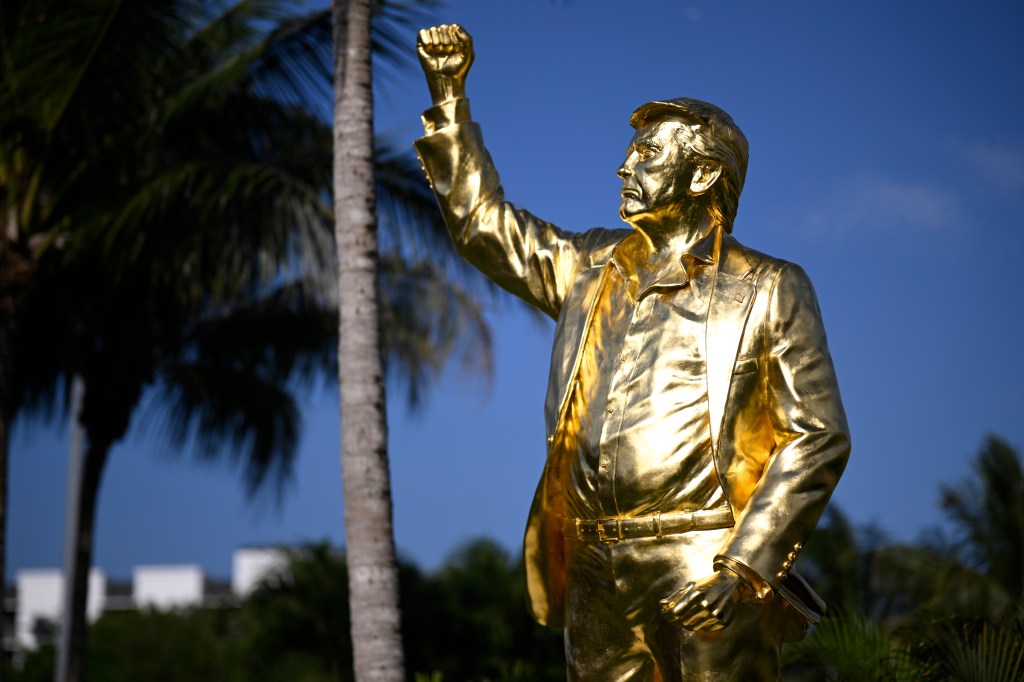




 Scottie's Playtime