Got Bread?

The early start of wheat harvest in Sumner County isn’t a good thing

June 01, 2026  Cueball

By James Jordan, Sumner Newscow — The month of May is barely over, and the wheat harvest has already started in Sumner County. That is not a good thing. Last year, the harvest didn’t get going well until mid-June, which is still on the early side.

Drought conditions over the winter and early spring caused the wheat to mature earlier than it should have, resulting in poorer yields.

Recent rains are likely too little too late; wet conditions may even hamper the harvest.

Last year, there was good wheat in the fields, but wet conditions prevented a bumper harvest.

State and local wheat officials say the wheat that is out there is not in very good shape.

According to the Kansas Wheat Association, the crop generally looked good as it went into its dormant stage in the late fall. There was not much rain in March and April, which is the primary growing stage, turning a promising crop into a dismal one.

The drought conditions in that growing stage force the wheat to develop faster. It limits the yield and accelerates growth, which is why we have wheat ready to harvest so early.

There are still some areas in Sumner and Cowley County that may get good yields. Conditions are much worse in western and central Kansas.

According to USDA statistics, as of the beginning of May, 41 percent of the wheat was very poor or poor, with 35 percent being fair. Only 24 percent was rated good or excellent.

As of last week, the wheat commission reported 55 percent as poor to very poor, and 30 percent as fair. Only 15 percent was rated good.

Last year at this time, 48 percent was rated as good to excellent.

The USDA estimates that this year’s crop could be the smallest nationwide since 1965 and 25 percent smaller than last year.

Exclusive: NYC Mayor Zohran Mamdani Explains the Mission Behind Housing Initiative to Help Black and Brown Families

NYC Mayor Zohran Mamdani spoke exclusively to The Root about “Block by Block,” which targets Black and brown communities most impacted by housing disparities.

By Phenix S Halley Published May 29, 2026

Since New York City Mayor Zohran Mamdani stepped into office in January, he’s unveiled ambitious policies that aim to address systemic issues that many leaders before him often neglected. Now, his administration has launched a new “Block by Block” housing plan to confront the city’s deep racial inequities in housing.

The proposal focuses heavily on the Bronx, where Black residents disproportionately face unsafe buildings, displacement, and limited affordable housing access. Mamdani argues the housing crisis is inseparable from systemic racism, pledging stronger tenant protections, aggressive action against negligent landlords, and major investments in affordable housing. He spoke with us in an exclusive interview about why “Block by Block” matters and why it’s time for political leaders to address the elephant in the room: protecting and uplifting Black and other disenfranchised groups through real policy.

The Root: During your 2025 campaign, some Black voters voiced concerns that they wouldn’t be a priority. Although “Block by Block” addresses some of those concerns, targeted at the New York City Housing Authority (NYCHA) and Black communities in the Bronx, how do you continue to ensure the most disenfranchised people have direct access and remain a priority?

Mayor Zohran Mamdani: I think the cost-of-living crisis is the most pressing issue in our city. And it is a crisis that every New Yorker faces. It’s also a crisis that has not been borne evenly across the city. Black New Yorkers have faced such pressure to afford life in this city that we have seen manifest in 200,000 Black New Yorkers being pushed out of the city, the population of Black children and teenagers declining by 19% over a recent period of time. It is incumbent upon us, if we want to fight to continue to preserve “the gorgeous mosaic,” as [former Mayor] David Dinkins once described our city as, to invest in everything that we can to make this city more affordable.

“Block by Block” is a vision to not only preserve the little affordability that we have in this city, but also hold on to that affordability to ensure that it becomes a reality for far more New Yorkers. We know that public housing is one of the few places where working-class New Yorkers can find a way to make ends meet in the city, yet it’s one of the few places that has been left out of any conversation around housing for decades. And that’s why we’ve made the decision to invest $5.6 billion into public housing, which is the largest investment any mayor has made in decades, so that we can actually ensure that we not only continue to provide this kind of affordability, but that it comes with a habitability as well, so that New Yorkers are not forced to accept conditions that frankly go beyond what any person should have to agree to.

The Root: If you can do this in 100 days, why do you think past mayors and other political leaders across the U.S. haven’t addressed disparities in housing on a larger scale? Are there any risks involved with prioritizing people of color?

Mayor Mamdani: I’ll give you an example of public housing:
The Reagan administration made sweeping cuts to public housing. It began a chapter in our city and our country’s history of disinvesting in one of the most critical ways for working-class people to afford to live in the cities they help build.

Too often, in our politics, we’ve cited the immense cost as a justification for inaction. We have said, “Well, NYCHA has a capital backlog of about $80 billion; therefore, anything is just a drop in the bucket.
So we are going to continue to rely on the federal government to take the lead here. We know full well that Republican administrations and Democratic administrations have not addressed this issue, that waiting is not an answer. And so we have decided to take the lead ourselves and show that the city is committed to this in a way that goes beyond the rhetoric of past administrations and starts to translate that into a new reality for current NYCHA residents.

The Root: Outside of “Block by Block,” what are you most proud of in the first 100 days of your administration?

Mayor Mamdani: I am most proud of our vision for Universal Childcare. 
We delivered more than $1 billion, thanks to a partnership with Governor [ Kathy] Hochul. And that is money that allowed us to add 2,000 additional seats for childcare for three-year-olds and, now for the first time in New York City history, free childcare for two-year-olds. 
And the reason I’m most proud of this is that in New York City, childcare costs $20,000 per child, and that’s considered a good deal. And when we deliver universal and high-quality childcare at no cost to families across the city, it transforms their ability to build a life here, and that’s exactly what we want to be doing.

Iowans Be Aware, and Beware-

Co-founder of Wichita private school contending for Iowa GOP’s gubernatorial nomination

Iowa Democratic Party raises red flag about dozens of Zach Lahn’s flights to Kansas

By:Tim Carpenter-May 29, 2026

TOPEKA — Private school founder, farmer and businessman Zach Lahn is running an insurgent Republican campaign for governor in Iowa.

The former Kansan has labeled this outsider bid as an “Iowa First” campaign. He’s opposed abortion and high taxes, but defended gun rights, school vouchers and religious freedom. He told Iowa voters he admired President Donald Trump’s tenacious fight against the political establishment.

“I told my wife many times, if I ever ran for anything, the only thing I’d ever want to run for was governor,” Lahn said.

Lahn grew up near Sioux City, Iowa, graduated from University of Colorado in Boulder, worked for Montana and Colorado congressmen, served as Montana director of Americans for Prosperity and as an AFP fundraiser, and bought a Belle Plaine, Iowa, farm previously owned by relatives. He launched an unorthodox school in Wichita and voted in Kansas elections in the 2018, 2020 and 2022 cycles.

Lahn’s campaign didn’t respond to a request for comment about why he chose to run for governor in Iowa rather than Kansas or questions raised by the Iowa Democratic Party about his close ties to Kansas and decision in 2024 to transfer his voter registration to Iowa.

Lahn has stood out among Iowa’s GOP gubernatorial candidates by denouncing lobbyists, corporations and organizations with outsized influence on politics. He’s not been shy about criticizing Democrats and Republicans responsible for blocking public policy reform.

“I’m fighting the ‘Uni-party.’ Both sides have been bought off in many ways,” he said.

Lahn is on the Tuesday primary ballot with U.S. Rep. Randy Feenstra, state Rep. Eddie Andrews, former state Rep. Brad Sherman and former Iowa Department of Administrative Services director Adam Steen. The Democratic nominee will be Iowa state Auditor Rob Sand, who is running unopposed.

For the first time since 2006, an incumbent Iowa governor won’t be on the ballot. Republican Gov. Kim Reynolds, with one of the lowest approval ratings in the country, didn’t seek reelection.

Populist approach

Michael Smith, a political science professor at Emporia State University, said old-school political theory dictated gubernatorial candidates had to be rooted in a state’s political infrastructure and local community life to be relevant. That changed as Trump assumed control of GOP politics and showed how firebrand conservatives, including those without prior experience in public office, might find a lane to run, he said.

“It’s all different now,” said Smith, who indicated Lahn could be a beneficiary of that shift. “He’s trying to be his own kind of populist.”

Lahn created momentum for his candidacy by loaning the campaign $2 million and using that cash to fill the airwaves with television advertising.

After working for Americans for Prosperity, an advocacy group associated with founders of Koch Industries, Lahn moved to Wichita to launch the unconventional private school named Wonder. The pre-kindergarten through 12th-grade school opened in 2018 on the campus of Wichita State University. It was financed by Chase Koch, the son of billionaire Charles Koch, and Chase Koch’s wife at the time, Annie Koch.

Annie Koch and Lahn subsequently divorced their spouses and were married. They have seven children in a blended family and the kids have been featured in campaign materials.

Kansas voter registration records show Zach Lahn voted in Kansas with a provisional ballot in November 2018, in-person at a Sedgwick County polling place in November 2020 and with an advance ballot in the August 2022 primary. Zach Lahn registered to vote in Iowa on Oct. 17, 2024. Transferring his registration at that time allowed him to meet the state’s two-year residency requirement for a run for governor in 2026.

Jennifer Konfrst, a professor of journalism and strategic political communication at Drake University in Des Moines, said there was potential for Lahn’s “Iowa First” campaign slogan to come across as disingenuous among voters aware of his lengthy presence in Kansas. Iowa voters appreciate the life history of candidates, she said, but some dig deeper into whether a candidate’s staff came from Iowa or Washington, D.C.

“Being from here matters,” said Konfrst, a Democratic member of the Iowa House not seeking reelection. “It’s not unimportant that somebody who wants to be governor of Iowa isn’t from here.”

Kansas connections

In July 2024, according to Sedgwick County’s register of deeds, Annie Lahn purchased a home in Kechi near Wichita and declared on mortgage documents it was her primary residence. One year after acquiring the property, Zach and Annie Lahn sold the home to an LLC for $1.

Business records filed with the Kansas Secretary of State’s Office identified the LLC’s “authorized person” as Wichita resident Mikaela Ledbetter, who made a modest donation in December 2025 to Zach Lahn’s campaign for governor.

Less than two weeks after the transaction in July 2025, Annie Lahn registered to vote in Belle Plaine, Iowa. Zach Lahn and his previous wife, Lauren, had purchased that Belle Plaine homestead in 2014.

The Des Moines Register reported in April that Zach Lahn flew from Iowa to Wichita in his personal airplane 37 times since Oct. 1, 2025. Zach Lahn told the Register the flights allowed him to be with children that he and his wife had from previous marriages.

“I’m trying my best to be present for things,” Zach Lahn told the Register. “I have no worries that we’ll be able to fulfill every duty we need to do on the campaign or as governor.”

Zach Lahn told the newspaper he moved from Kansas to Iowa in 2023 and was an official Iowa voter in the 2024 general election and a 2025 local election.

Iowa Democratic Party spokesperson Terra Hernandez seized upon the Register’s reporting to declare Zach Lahn a “Kansas carpetbagger.”

“Lahn has been trying to fool Iowa voters since the start of his campaign, thinks he can pay his way to the governor’s mansion with his millions in out-of-state money and spends more time in Wichita than Belle Plaine,” Hernandez said.

On campaign trail

During the gubernatorial campaign, Zach Lahn has emphasized he was a sixth-generation Iowan with family roots as far back as the Civil War.

His campaign has concentrated on restoration of academic achievement in the state’s education system and removal of classroom educators who insisted on advancing personal ideology.

“We don’t have a spending problem. We have a quality problem,” Zack Lahn said during a GOP forum broadcast by KCCI in Des Moines.

He said he would work to preserve Iowa family farms after 10,000 vanished during the past 20 years. He said one-fourth of Iowa land was now owned by out-of-state investors. He proposed raising property taxes on Iowa land held by nonresidents so property taxes for Iowa residents could be lowered.

He’s questioned economic development strategies in Iowa that did little to stem the brain drain of youth to other states.

Zack Lahn, endorsed by MAHA Action associated with U.S. Health and Human Services Secretary Robert Kennedy Jr., made a campaign issue of rising cancer rates in Iowa. He promised to veto any bill granting agricultural chemical companies immunity from lawsuits tied to alleged failure to accurately warn consumers of health risks.

“I believe big ag and big pharma have treated our farmers and families as numbers, not neighbors,” Zack Lahn said.


Clay Jones, Open Windows

Speaking of the Trump 250 dollar bill…

Don Jr. is also making big bucks off the presidency

Ann Telnaes

Propublica has a story about another Trump family grift


Vanilla 250

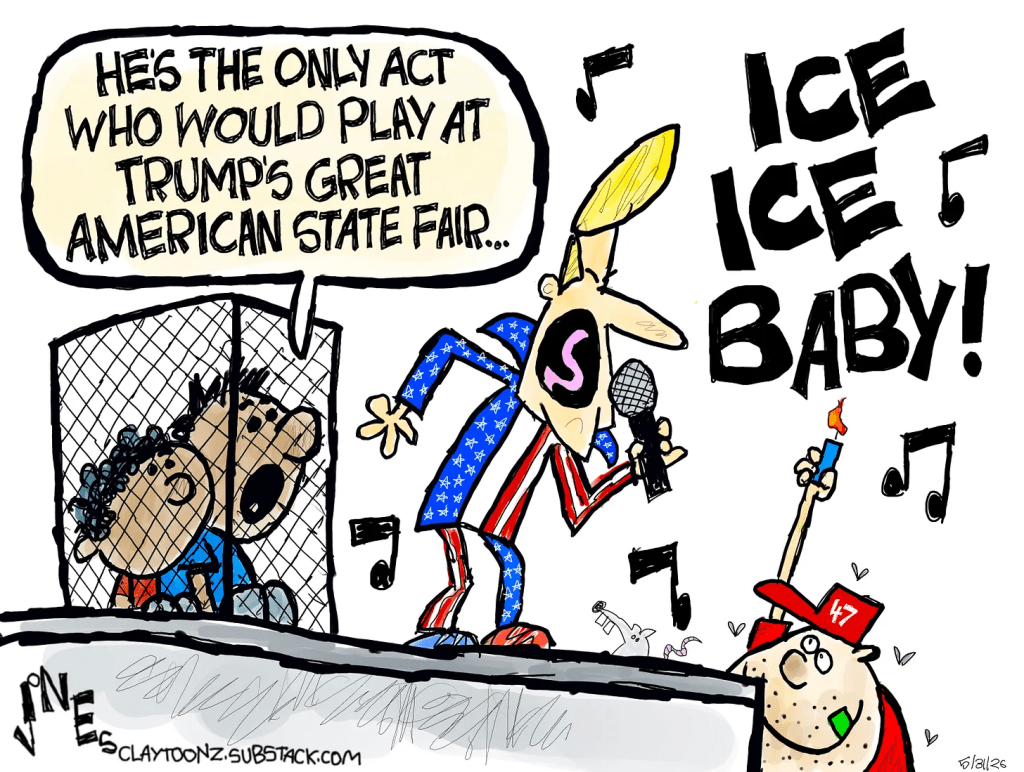
A washed-up musician singing for a washed-up president.

Clay Jones

When artists were invited to participate in what’s being called the Great American State Fair, they were promised that it was not political or partisan. And proving that point, Donald Trump will be kicking it off.

The Great American State Fair is described as a birthday bash to celebrate America’s 250th anniversary, and it will include a series of concerts on the National Mall from June 24 to July 10.

After several artists dropped out, including Morris Day and the Time, Young MC, the Commodores, Martina McBride and Bret Michaels, Trump took to Truth Social and said, “I understand Artists are getting ‘the yips’ having to do with their performance … so I am thinking about bringing the Number One Attraction anywhere in the World, the man who gets much larger audiences than Elvis in his prime, and he does so without a guitar, the man who loves our Country more than anyone else, and the man who some say is the Greatest President in History (THE GOAT!), DONALD J. TRUMP, to take the place of these highly paid, Third Rate ‘Artists,’ and give a major speech, rallying the Country forward like I have done ever since being President!”

The “yips” is what Trump has when he TACOs out or something. (snip-MORE)


Treasonous Scales

I don’t trust my scale either

Clay Jones

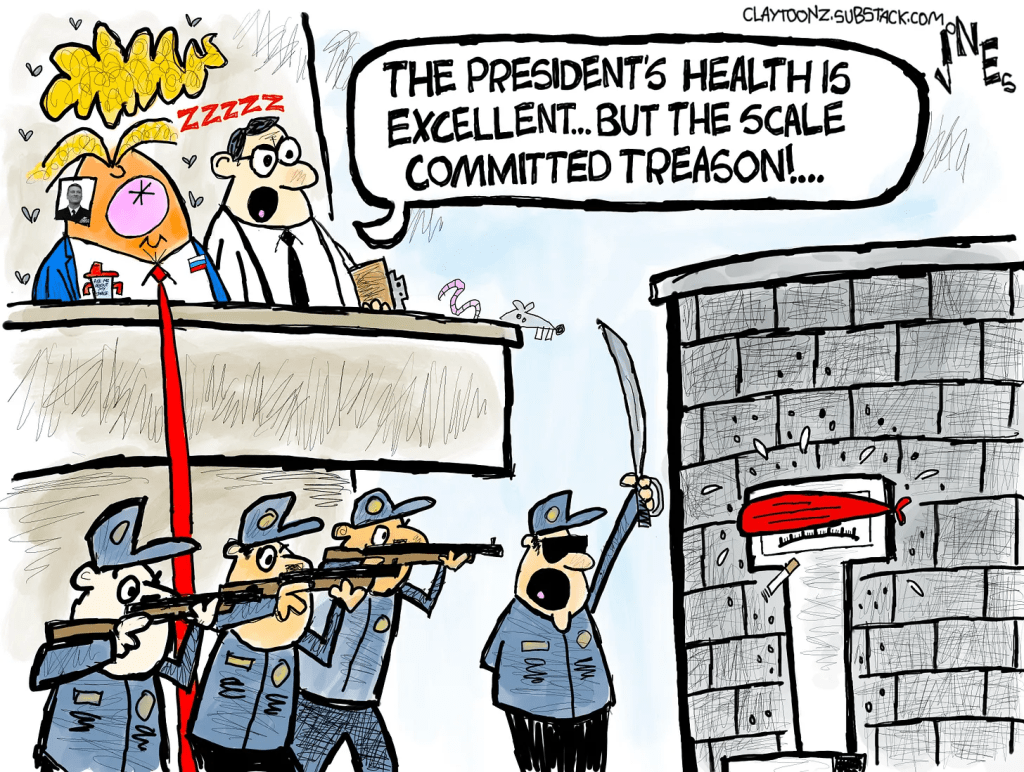
Donald Trump had another mystery visit to a doctor’s office this week.

Three years ago, only 28% of Americans surveyed by a Washington Post-ABC News-Ipsos poll said Trump was NOT healthy enough to serve as president. Today, that same poll found that 55% of Americans don’t believe Donald Trump is healthy enough to serve as president. There needs to be a poll asking if he’s mentally healthy enough to be president.

Trump has always rambled incoherently, but it seems to be distressing people more now in combination with his cankles, hand bruises, swollen eyes, and excessive blinking. Shhhh…he’s sleepy.

Trump had a physical in April of last year, and then he had a semi-annual physical in October, and now he has gone back for his third physical in 13 months. Additionally, he’s been to a Dentist twice over the past five months, which surprises everyone. He still has his teeth? (snip-MORE)


White House Cage Fight

The Trump regime loves them some cages

Clay Jones

All my life, I have heard people say they respect the office of the president, even if they do not like the current occupant. Even though I did not like or respect George W. Bush, I still respected the presidency. But it’s getting harder and harder to respect the office when the current occupant is holding cage fights on the south lawn.

Are we in gladiator times? Are we conducting fights on the self lawn to distract us from our troubles, like inflation, illegal tariffs, ICE goons shooting Americans in the streets, and Donald Trump’s chosen war? In addition to a gaudy oversize ballroom, should we also build a replica of the Roman Colosseum on the White House grounds? Is today’s Caesar, Donald Trump, going to give a thumbs up or a thumbs down to determine the fate of the loser of each bout? Will wenches be feeding Trump grapes during the fights? (snip-MORE)

Some clips from The Majority Report on different subjects


Pentagon Recruits Troops To Attend WH Cage Match

Pentagon Recruits Troops To Attend WH Cage Match

May 29, 2026

The Washington Post reports:

The Pentagon is moving to recruit hundreds of troops to appear as spectators next month at President Donald Trump’s UFC cage-fighting event on the White House lawn, and requiring those who attend to pay their own way and meet height and weight requirements, according to people familiar with the matter and internal memos reviewed by The Washington Post.

The Defense Department in recent days has solicited troops across the services to attend the June 14 event. Officials are seeking junior enlisted personnel and junior officers specifically, according to internal messages that make clear travel will be “member-procured.”

Junior troops make up the military’s lowest pay grades. One memo, circulated within the Air Force, stipulates that to be eligible, personnel “MUST MEET CURRENT WAIST-HEIGHT RATIO and current physical fitness standard.” Troops will be required to wear their short-sleeve dress uniforms, the memo adds.

Read the full article.

Erin Brockovich & Data Centers

Erin Brockovich Asks Americans for Help as She Launches Data Center Map

updated May 29, 2026 at 12:27 PM EDT

Environmental activist Erin Brockovich is appealing to the public for help after launching a website to report data center concerns as the rapid expansion of AI-driven facilities across the United States increasingly clashes with local communities.

The appeal threatens to thrust an iconic anti-corporate activist into the heart of the battle to expand AI infrastructure at a time of growing public skepticism about the technology’s impact on jobs, safety and the environment.

The website, brockovichdatacenter.com, lists several “key concerns” surrounding such data centers, including high energy consumption that drives environmental impacts and costs, substantial water use for cooling that can strain local supplies, increased e‑waste from frequent hardware upgrades, exposure to location risks such as natural disasters or geopolitical instability, growing scalability pressures that can outpace local infrastructure, and constant noise from cooling systems and generators that can disrupt nearby communities.

“These challenges highlight the need for sustainable, secure, and efficient AI data center practices,” the website says. “Self-reporting is the best way we can get this information out to the public!”

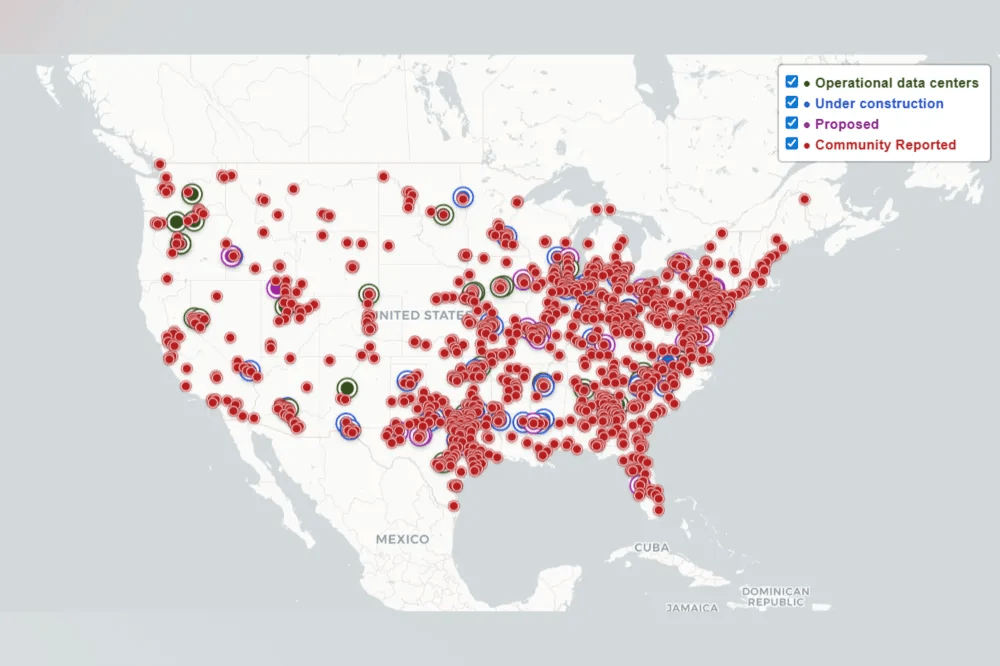
A map on brockovichdatacenter.com shows major AI data centers in the U.S. that are either operational or under construction, overlaid with locations w…Read More
 | brockovichdatacenter.com

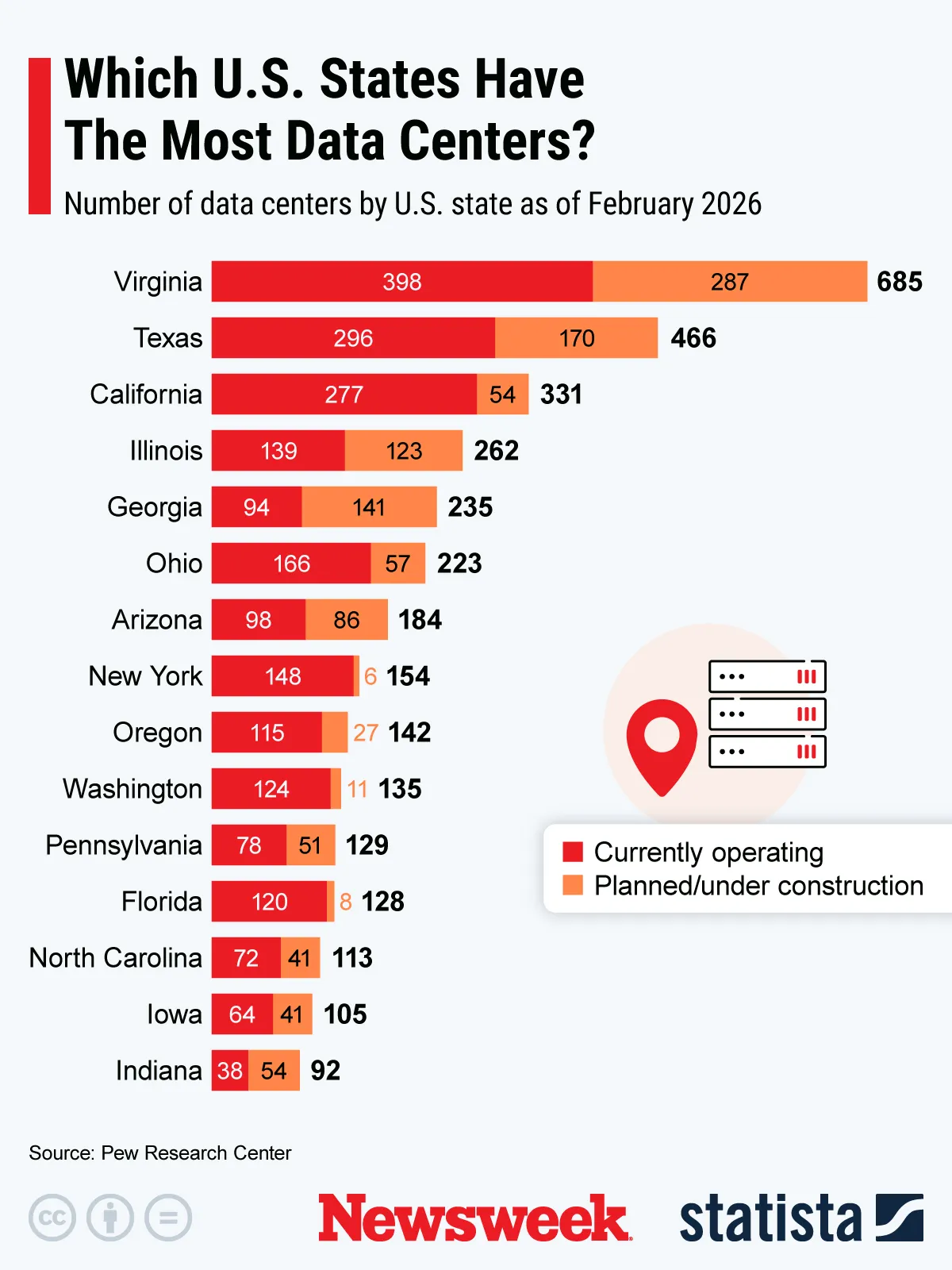
There are now more than 4,200 data centers—built to train, deploy and deliver AI—across the U.S., according to Data Center Map.

According to the website’s statistics, more than 2,716 reports have been submitted, with the most in Texas (612), as of Monday. The state is home to more than 460 data centers, according to Data Center Map.

The greatest concern among communities was water, followed by electricity, health and wildlife.

“The race to build AI infrastructures is unfolding town by town across America. In some places, data centers are welcomed. In others, they are delayed, contested or abandoned altogether. This map captures the real-world footprint of that race—revealing patterns of growth, conflict and uncertainty,” Brockovich said.

Who Is Erin Brockovich?

(snip-we know who she is. Or, please click through to read on the Newsweek page)

The States Becoming America’s AI Engine Room

As data centers become more visible across America’s landscape, some states are seeing more than others.

  • Virginia
    Long a hub for government contractors and cloud infrastructure, Virginia—particularly Northern Virginia’s “Data Center Alley”—offers proximity to federal agencies and one of the world’s densest fiber networks. Established infrastructure reduces build times and attracts hyperscalers looking to scale quickly.
  • Texas
    Texas combines vast, inexpensive land with a deregulated energy market that gives companies flexibility in securing large power loads. Cities like Dallas and Austin also bring a growing tech workforce and business-friendly policies that appeal to major AI investors.
  • Ohio
    Ohio has positioned itself as a Midwestern data hub, with strong incentives and central geographic access to U.S. population centers. Its legacy industrial sites are often repurposed for data centers, offering space and existing infrastructure at competitive costs.
  • Arizona
    Arizona’s dry climate is favorable for certain cooling technologies, while its abundant land and aggressive economic development incentives have drawn major tech firms. Phoenix, in particular, has become a key destination for new AI and cloud infrastructure builds.
  • Georgia
    Georgia, anchored by Atlanta, offers strong connectivity as a Southeast internet exchange hub. State and local tax breaks, combined with access to both talent and transport infrastructure, have made it increasingly attractive for large-scale data operations.
  • Utah
    Utah benefits from lower real estate costs, a stable regulatory environment, and access to renewable energy sources. Its growing tech sector, known as “Silicon Slopes,” provides an emerging talent pool to support AI-focused expansion.

Why companies are choosing these states:

  • Cheap land: Large-scale AI data centers require vast footprints; these states offer space at significantly lower costs than coastal markets.
  • Power access: Reliable, high-capacity energy grids, often with options for renewable sourcing, are critical for AI workloads.
  • Tax breaks: State and local governments are competing aggressively with incentives to attract long-term infrastructure investment.
  • Fewer regulations: Streamlined permitting and business-friendly policies enable shorter development timelines and reduced compliance burdens.

REPORT: Trump To Pull US Assets Set Aside For NATO

Putin must be so pleased with his US employee and asset.  This thin skined ego managi in dementia with a cult following and a terrified Republican Party has ruined all efforts to rein in dictatorships and authoritarian countries.  The only authoritarian country they attack is because it has the wrong religion for the religious part of the cult.  This tRump guy wrote love letters to the dictator of North Korea and bows deeply metaphorically to Putin, talking lovingly about autocrats around the world who push white supremacy and the Christian family values talking points.  But since his first term he has had it out for NATO seemingly at Putin’s behest.  He has refused to provide Ukraine with weapons and support again something Putin has been demanding.  tRump repeated Russian talking points of Ukraine starting the war with Russia.  He has constantly attacked NATO partners about funding not understanding that funding is not money put into a pot for NATO to use, the funding was what each country could / would put into the group in weapons, people, and equipment.  He is angry that NATO did not support the US illegal unprovoked war against a country who had not attacked the US.  But the NATO charter specifically mandates that they wouldn’t be required to do so in that case.  But the only time that article five was activated was for the US after 9-11 attack on the US.  tRump is not allowed to remove the US legally from NATO so this is a way he can legally do it with out really removing us from NATO.   I wanted to post the linked article but it required allowing adverts and I simply won’t do that.   Hugs 

REPORT: Trump To Pull US Assets Set Aside For NATO

Union Activism

Yet Another Thing To Keep Track Of:

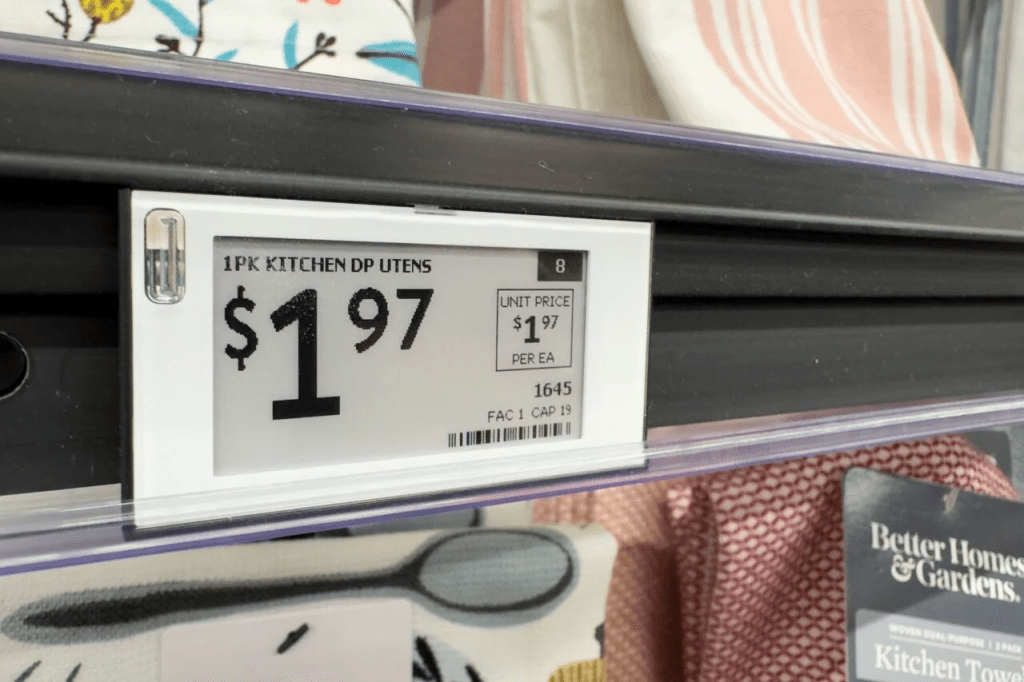
Majority of Americans Support Ban on Surveillance Pricing and Electronic Shelf Labels

Surprisingly, 3% saying it would make them more likely to shop at a store.

By Matt Novak

A whopping 68% of Americans say they worry about surveillance pricing increasing the cost of goods, while just 5% believe it will lead to lower prices, according to a new survey from GBAO Strategies distributed by the United Food and Commercial Workers International Union. Twenty percent say it will likely just keep prices the same.

The new survey is part of the UFCW’s “Affordable Groceries and Good Jobs Campaign,” an effort to encourage states to pass laws banning surveillance pricing and electronic shelf labels (ESLs), the increasingly common price tags that some activists worry allow companies to rapidly change prices in stores several times per day.

The concern includes obvious dynamic pricing models, like increasing the cost of cold beverages when it gets hot outside, but also involves more sophisticated and as-yet theoretical examples like increasing the cost of food staples when a customer’s data is analyzed in store and it’s determined they’re willing to pay more.

Fifty-eight percent of Americans in the survey say digital price tags would make them less likely to shop in a store, with 35% saying it would make no difference, and 3% saying it would make them more likely to shop there. Sixty-seven percent are in favor of banning ESLs outright, according to the new survey.

Walmart, which has patented AI-powered price changes, has been rolling out electronic shelf labels across its stores, and it aims to feature them in every U.S. location by the end of 2026. But the company has insisted it’s not going to use ESLs for jacking up prices and insists that a human manager must be in the loop when prices change.

Unsurprisingly, 66% of those surveyed say they’re worried about the cost of groceries. And it’s no wonder, given the trajectory of inflation in recent months. The University of Michigan’s May sentiment index hit a record low last month at 44.8, down five points from April, according to Bloomberg.

In April, inflation rose 3.8% on an annualized basis, while wages rose just 3.6%, the first time wages have failed to keep up with inflation since 2023, according to CBS News. And that’s causing major concerns about supermarkets’ plans to squeeze customers for more money with new tech.

The new survey takers at GBAO Strategies noted that some grocery stores are replacing paper price tags with digital price tags and asked Americans whether that technology was likely to increase or decrease prices for consumers. Just 3% thought it would decrease prices, while 65% thought stores would use digital price tags to increase prices. 24 percent of participants believe it will keep prices about the same, with the remainder (8%) saying they don’t know.

UFCW International Vice President Ademola Oyefeso told Gizmodo that he believes electronic shelf labels are a tool for price gouging and that tech companies are marketing them for that purpose.

“The ESL industry sells the prospect of higher prices and job losses as positives,” said Oyefeso. “Across the country, families are having to make tough choices in the grocery aisle every day as a result of sky-high prices, and polling clearly shows that they want these predatory technologies banned.”

Proponents of digital shelf labels take issue with the idea of using the term surveillance pricing at all. They prefer terms like “personalized pricing” and believe that stores have an incentive to make pricing competitive. But unions like UFCW don’t believe that’s true and are urging legislation to be passed around the country to fight it.

“Federal and state lawmakers know these practices are wrong, and the UFCW urges them to get ahead of them before they appear in every store,” Oyefeso told Gizmodo. “Any lawmaker that is serious about cutting costs for hardworking families must support a ban on electronic shelf labels and surveillance pricing in grocery stores.”

At least a dozen states are currently considering legislation that would regulate surveillance pricing, with Maryland recently passing the first law banning the practice at grocery stores. But activists have spoken out about that law and worry that it has way too many loopholes.