I hate the YouTube algorithm and and myself more for giving into it and saving all the hateful abuse videos I get. I am crying now trying not to alert Ron who is in the next room with the door between us open. I had two open windows. In one I had so many tabs of abuse that the algorithm pushed them to me because I occasionally watch them. I deleted 8 of them before switching to the other open window. What does YouTube think I need to see / hear after all that deleting and not watching all those videos? The two videos below.
Am I the one to blame but if so what does that say about all the vulnerable children who are led down hate rabbit holes? At least the harm happening here is to me done myself aidded by the shit pushed into my feeds and I am so stupid that I click on them and leave the tab open while I try to move onto something else. But eventually I end up coming back to the ones that hurt me so much. Who is to blame? As always in my life, as in my childhood … I am, and I have always been according to those that hurt me. Goodnight. Scottie. Hugs
Trumpeter Robyn Steward thought clubs weren’t for her until she encountered Fabric’s accessible upgrade – the new home for her radically inclusive, space-themed night
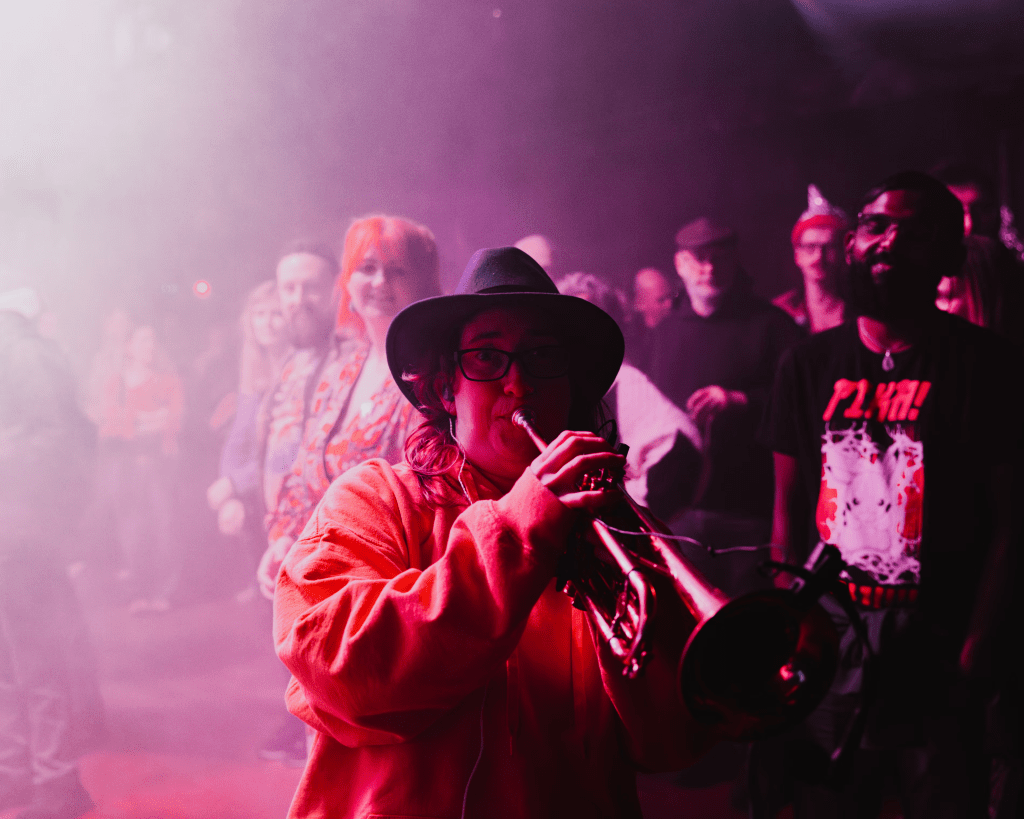
Working the crowd … Robyn playing at one of her Robyn’s Rocket nights at Fabric. Photograph: Siân O’Connor
Until May last year, trumpeter Robyn Steward had never been in a nightclub space, save for playing trumpet with Lancaster duo the Lovely Eggs at London’s Heaven, and a few nights in a university hall that doubled as a lunch room. Steward is autistic and has multiple disabilities including cerebral palsy. “Sometimes strobes can trigger migraines for me, or feel overwhelming,” she says. “I feel like my body’s a bit lost.”
When she wanted to see a gig at Fabric nightclub in London, she asked a friend to go with her as a carer. “I was amazed at how accessible it was,” she says. Subtle touches integrate multiple access needs into the space. “The mezzanine level meant that I didn’t have the strobes in my face. There was a rail that I could hold on to, and there was seating opposite the balcony so I could sit and watch the gig.” She also noticed Fabric’s recently upgraded sensory dancefloor, which deliberately transforms sound into tactile vibrations to better cater for the hearing impaired. “I could see that the lights were strobing and everything, but I felt safe,” Steward says.
Inspired, she contacted Fabric to see if they might host her long-running, space-themed experimental music night Robyn’s Rocket, which since 2017 has been booking noise bands, DJs and improv groups in London venues from Deptford to Dalston. While it champions disabled and autistic performers and audiences, Robyn’s Rocket is principally about integration. “People with and without learning disabilities – and autistic and non-autistic people – should spend time together, where there isn’t any kind of power dynamic,” she says. Her aim is to create a space “where people are all just having a really nice time together”.
We meet in a music studio in Deptford, south London, the day before the Rocket’s first night at Fabric. Steward, 39, is relentlessly upbeat; straight after the interview, she heads to the shops where a friend helps her figure out an unspecific drinks rider request. It’s in keeping with the Rocket spirit of clarifying what might usually be assumed or implied. Online, she supplies detailed visual storyboards of how an evening will progress. All artists fill out detailed tech and access riders. Every box and cable is given a name, shape or colour. All Rocket gigs are livestreamed and timings are strictly adhered to so those streaming the gig don’t get lost. “The schedule, once it’s agreed, it’s pretty non-negotiable,” Steward says.
On arrival, everyone is presented with a silver rocket-shaped badge, angled up, across or down as a visual barometer of how much communication they’re comfortable with. Fabric is adorned with more than 100 posters: signposts always feature words and shapes and are populated with cartoon characters, human and alien. Silver foil covers the stage, and live projections from visual artist Rucksack Cinema are suitably astral. “You’re into new planets, are you?” crows the frontman of “cosmic dross” band Henge.
For Steward, the space theme is also about imagining an equitable new world. “You might meet somebody here with a learning disability, or an autistic person. You might not. But everyone is equal in this space.” The Robyn’s Rocket nights echo the aesthetic and political spirit of Afro-futurist jazz visionary Sun Ra and his Arkestra. “The idea that you can create a different dimension, almost a different planetary experience, at these events is very consistent,” says Mark Williams, co-founder of the Deptford-based arts charity Heart N Soul (where Steward is an associate artist). “It’s using imagination and creativity to free people, and to exist on a different kind of plane.”
Steward was born in Suffolk, and took to music when a tutor brought instruments to her primary school: “I really wanted to go on the trumpet, but they ran out of time, so I spent a whole week blowing raspberries.” The tutor returned for an assembly the next week, and Steward immediately requested the trumpet. “I played a clear note straight away.”
As an infant, Steward used Makaton (a language that uses a combination of signs, symbols and speech) to communicate until she attended Musical Keys, a group for children with special needs, aged three: “It was song based, and so I learned to speak that way – there was a lot of repetition.” Once she learned to speak, she wouldn’t stop; her parents got her a Dictaphone for long car journeys: “They’d say, ‘You can talk to this Dictaphone as much as you want, but leave us alone in the front.’ I would make my own radio shows that would come out sounding like Alan Partridge’s Knowing Me, Knowing You.”
Unlike her East Anglian counterpart, Steward is an excellent, direct communicator. The first half of her career was spent delivering autism training, speaking at conferences, and in research. She’s also written books such as The Autism-Friendly Guide to Self Employment. But, by age 30, Steward became “very conscious that I needed to think about what I want to spend the rest of my life doing”. She had recently learned to improvise on trumpet through the big band at a local adult education centre, and seeing a gig by trumpeter Andy Diagram (who plays the trumpet with guitar pedals) proved crucial to developing her own art. With the help of Heart N Soul, she built Robyn’s Rocket up from a small residency in Deptford to a regular slot at Cafe Oto in east London, later inviting musicians including Alabaster DePlume, Coby Sey and Mica Levi to perform.
The vocalist Seaming To played a Rocket night in 2024. “More and more friends of mine are realising that they have neurodivergent aspects,” Seaming To says. “And quite a lot of them find it really awkward coming out to noisy places. At Robyn’s night, you can admit to feeling awkward, and it’s all acceptable.”
On the night, Steward dons her trademark purple fedora and doubles up as space trumpeter and energetic MC. “I’ve done this gig partly because I just wanted to put Henge on,” she says, beaming from the stage. For all the very human practicalities of Robyn’s Rocket, Steward still has celestial ambitions. “And why wouldn’t you want to put them on in a homemade spaceship?”
On Tuesday, Maine Secretary of State Shenna Bellows ruled that a proposed ballot initiative banning trans students from school sports and bathrooms will not appear before voters this November. The billionaire-funded campaign initially submitted 79,692 signatures—well over the 67,682 required to qualify—and the Secretary of State’s office certified the question for the ballot in March. But indications soon emerged that the signature-gathering process was riddled with improper procedures and, in at least one documented case and potentially many others, outright forgery. After a court remand, an evidentiary hearing, and a sworn-testimony review of the petitions, 12,542 signatures were invalidated, leaving the campaign 532 short of the threshold. Barring an appeal—which is likely though its success is far from certain—transgender students in Maine can rest a little easier this election cycle.
The infractions are striking. One out-of-state circulator left his petition forms unattended at a Topsham polling place on Election Day—twice—allowing voters to sign without a witness present, in direct violation of Maine law. Another circulator did the same at a Saco polling place, leaving her table for extended periods while crowds of voters signed unwitnessed petitions. When asked under oath whether she had destroyed the unwitnessed forms as required, she said yes—but a photograph submitted into evidence showed one of those forms was in fact turned in for validation. Most troubling of all, an out-of-state signature gatherer paid per signature submitted forms that appear to contain outright forgeries: one voter listed on her petition testified under oath that she had never signed it and had never even heard of the initiative. After the Oxford town clerk flagged additional suspicious signatures, an Elections Division review compared every name on the circulator’s forms against voter registration applications—and concluded that every single one of her validated signatures should have been thrown out as signed by another person.
Based on the evidence, Bellows ruled Tuesday that the initiative had failed to qualify for the November ballot. The decision marked a reversal of her own March certification, when her office initially determined that the petition contained enough valid signatures to move forward. That earlier ruling was challenged in Cumberland County Superior Court by three Maine voters, who alleged that thousands of signatures had been collected in violation of state law. In April, Justice Deborah Cashman agreed that the original review had been incomplete and remanded the case back to the Secretary of State’s office for further factfinding, ordering a new determination of validity within thirty days. That process produced the May 12 evidentiary hearing—where witnesses, including town clerks and voters whose names appeared on petitions, testified under oath—and ultimately the decision invalidating thousands more signatures than the initial review had caught. Bellows adopted that recommendation in full.
The initiative would have done far more than what its sports-focused branding suggested. It would have defined a person’s sex for school purposes as “a person’s biological status as male or female recorded at birth on the person’s original birth certificate”—a definition that would have stripped transgender students of legal recognition in Maine schools. It would have required public schools to “maintain separate restrooms, locker rooms, shower rooms, and other private spaces for each sex,” extending the ban well beyond athletics and into every gendered space in a school building. It would have created a private right of action allowing any student to sue their school for “direct injury” suffered from a violation of the act, effectively turning every transgender student’s presence in a bathroom or on a sports team into potential litigation. And it would have specifically carved transgender students out of the Maine Human Rights Act.
The anti-trans signature drive was not a grassroots effort. It was bankrolled by Illinois billionaire Richard Uihlein, the co-founder of Uline office supplies, who donated $800,000 to fund the entire effort. Uihlein has given more than $250 million to political causes since 2016, and is a major funder of the American Principles Project, which routinely spends tens of millions on anti-trans campaign ads during election years. He is not alone: an independent analysis published by Atmos and HEATED found that 80% of 45 major anti-trans organizations in the U.S. have received funding from fossil fuel companies or billionaires. The Maine initiative was part of that broader pattern—an attempt by a small handful of extraordinarily wealthy donors to use direct democracy as a workaround in states where elected legislatures have refused to engage in anti-trans legislation.
The decision was greeted with relief by the LGBTQ+ coalition that has fought the initiative since the day it was filed. “Maine has strict rules in place to protect the integrity of our elections and our system of direct democracy. The paid, out-of-state signature gathers and the billionaire who paid to try to put this question on the ballot failed to follow the rules,” said David Farmer, campaign manager for the Campaign for Free and Fair Schools, the coalition led by EqualityMaine, GLAD Law, and the Maine Women’s Lobby. “We believe that the appeals process and the reviews by the Secretary of State are working as the law intends. They are protecting the integrity of our elections.”
The Maine ruling is not the end of fight. Similar billionaire-backed initiatives have been certified for the November ballot in Washington and Colorado, where voters will decide whether to bar transgender students from sports as well as medical care restrictions. Both efforts are also funded by conservative megadonors, and both are part of the same strategy that produced the Maine initiative: use ballot initiatives to roll back trans rights in states whose elected legislatures have refused to do so. The Maine anti-trans campaign is expected appeal Bellows’ decision to Maine Superior Court within the ten-day window the law allows.
the story about brands trying to disalign themselves from the results of the politics they support a little heartier than they do the other side? Well, here are legislators working on the same thing, again, and if the companies do it, it could work. We’ve been saying we need this for a couple of years, at least.It would be a good time for we the people to increase our pressure on companies, as well.
WASHINGTON (AP) — The Congressional Black Caucus on Tuesday called on major corporations across the U.S., including those that previously expressed support for voting rights and racial justice, to oppose redistricting efforts by Republican-led states that seek to eliminate majority-Black U.S. House districts.
In a letter sent to more than 250 companies, members of the Black Caucus urge them to condemn the redistricting efforts, which the lawmakers describe as “coordinated efforts to silence Black voices at the ballot box.” Some of the companies had co-signed their own message to Congress five years ago urging lawmakers to pass the John Lewis Voting Rights Act, a Democratic proposal to restore and update the Voting Rights Act.
That 2021 coalition, Business for Voting Rights, was backed by many of the country’s most valuable and influential companies, including Apple, Amazon, Google, Meta, Microsoft, Tesla, Salesforce, Target, PayPal, Intel and Starbucks.
Tuesday’s letter is the latest effort by the Congressional Black Caucus and its allies to gather support for preventing more Republican-led states from redrawing their legislative maps in ways that would dilute Black political representation. Several states have moved to eliminate congressional districts represented by Black Democratic lawmakers after a U.S. Supreme Court ruling last month that severely weakened a key provision of the Voting Rights Act.
“Corporations that have profited from Black consumers, relied on Black workers, and amassed wealth in part from Black communities cannot look away while Black political power is dismantled in plain sight,” Rep. Yvette Clarke, chair of the Black Caucus, said in an interview.
Clarke described the letter as “putting corporate America on notice,” but she said the caucus was not seeking an adversarial relationship with corporations. Among those receiving Tuesday’s letter were companies based overseas that have a significant presence in the U.S.
The caucus last week called for Black athletes to boycott public universities in states that are gerrymandering their congressional maps to eliminate districts held by Black lawmakers. The 59-member Congressional Black Caucus consists entirely of Democrats, including more than a third from Southern states.
Some lawmakers have said mass protests and federal legislation might be necessary to undo the efforts underway in Republican-led states. Any new federal voting rights law would almost certainly require Democrats to secure majorities in both chambers of Congress and win the presidency.
It is unclear how companies will respond to the demands. The Associated Press reached out for comment to dozens of companies that were sent a letter by the caucus, but has not recieved a response.
“Many companies that previously issued statements after the murder of George Floyd, pledged billions toward racial equity initiatives, and spoke forcefully in defense of democracy following January 6 now face a defining test of whether those commitments were rooted in principle or convenience,” the caucus’ letter states.
It also represents the latest instance of the caucus expressing frustrations with corporate America. A 2024 Black Caucus report noted that lawmakers were “troubled that some corporations that made pledges in 2020 have taken several steps in the opposite direction,” such as rolling back or failing to follow through on pledges to diversify their workforces.
“We understand who the occupant in the White House is and the reality of Republicans being in charge,” Democratic Rep. Steven Horsford of Nevada said of the caucus’ message. “But what corporate America also understands is that there will be a shift at some point.”
The letter calls on companies to publicly condemn the redistricting plans, meet with Black Caucus members to discuss corporate America’s role in protecting voting rights and disclose their political donations to Republican politicians in states that are redistricting their congressional maps.
President Donald Trump last year kicked off the unusual mid-decade round of congressional redistricting when he pushed Texas lawmakers to redraw their maps in a way that would add Republican seats. Democratic-led California responded, but it has been mostly Republican states redrawing their lines since as the party tries to maintain its majority in the U.S. House during this year’s midterm elections.
The effort was supercharged by the Supreme Court decision, which allowed even more Republican states to redraw congressional maps that previously had protected minority communities.
Horsford, who chaired the Black Caucus during President Joe Biden’s Democratic administration, said the caucus is demanding that companies “stand on the side of democracy, fairness and equal representation.”
“This is about power, who holds it and what it’s used for,” he said. “And when you’re diluting Black economic and political power, we need to know where these companies stand in this moment, and what side of history they’re on.”
More than two-thirds of adults oppose the construction of the massive and costly complexes used to power artificial intelligence, with a majority saying they’d prefer to have a nuclear power plant in their backyard instead. While women and men overwhelmingly expressed opposition, women did so more intensely. Out of 1,000 adults surveyed, 55 percent of women said they strongly oppose data centers, compared to 43 percent of men. In fact, men were more likely to favor data centers, citing their economic benefits and job opportunities.
Jeffrey Jones, a senior editor at Gallup and the study’s author, attributed the distinction to women having more empathy for public-facing issues like the environment and healthcare, and favoring Democratic policies that protect the environment. Resistance to data centers often focuses on the imposition of environmental and financial problems, like water scarcity, noise and air pollution, and excessive energy use that can result in higher utility bills and increased health complications for the low-income communities of color who live near where they are usually built.
“A lot of the opposition is based on environmental concerns about using too many resources, especially water,” Jones added. “Centers need a lot of water to cool the computing machines that they’re using. Land, electricity, and resources are the most common concerns people have.”
Gendered fears about the environment are nothing new, experts say. Women are disproportionately impacted by environmental degradation and at higher risk of poverty, food insecurity and gender-based violence when displaced by climate change, the United Nations reports. Studies have consistently shown that women are also key to driving inclusive, effective action to address the impacts of climate change.
“I’ve been organizing for 15 years, and it’s always been the case that women are leading our fights,” said Danny Cendejas, a campaign specialist for MediaJustice, who works with grassroots movements across the country that are opposing data centers. “We are definitely seeing everyone join the fight, but we have to recognize the truth, and it’s women, trans, queer and nonbinary people leading the work.”
Cendejas pointed to environmental justice movements in places like Memphis, Tennessee, and Amarillo, Texas, which have already been overburdened by environmental pollutants and health impacts from gas and oil industries. Those impacts are now being exacerbated by data centers.
“There’s a big connection where big tech is targeting Black, Brown and Indigenous communities,” Cendejas said. “The progress that has been made over the years to shut down coal plants or gain protections… a lot of that is being undone, by big tech and the demand for data centers.”
Data centers have become an increasingly pressing issue for candidates and their campaigns heading into the midterms in November. They’re also a rare source of bipartisan concern in a polarized political environment.
“There are really strong feelings about this. I see this playing out as a political issue, and now people who are running for governor, Senate, or local offices, are having to take a position on this, whereas this is not something people were talking about two years ago,” Jones said. “And now politicians across both parties are coming out as against data centers, which seems like the more popular viewpoint.”
During a House hearing on Wednesday featuring the Environmental Protection Agency’s Assistant Administrator for Water Jessica Kramer, Democratic Rep. Alexandria Ocasio-Cortez of New York held up jars of an opaque, brown liquid that she said had come out of a rural community east of Atlanta where Donald Trump got 70 percent of the vote in the last election. Meta has disputed the claim.
“This is the current drinking water in Morgan County, Georgia, right after a data center was constructed, the Meta data center was constructed,” Ocasio-Cortez said. “The only difference between the clean water and this was that data center.”
In New Mexico, first-time candidate Daisy Maldonado is running for county commissioner in Doña Ana County on a platform that includes opposition to Project Jupiter, a $165 billion mega data center under construction in the area. Maldonado was recently endorsed by Sen. Bernie Sanders of Vermont, a proponent of data center regulation, adding to the national conversation about community resistance to AI infrastructure and environmental accountability.
“I see a lot of moms concerned,” said Ana Carolina de Assis Nunes, a researcher at the nonprofit Data & Society Research Institute who studied Pittsburgh’s data center industry. “It’s very connected to ‘I want a good future for my kids and if things go this way, I don’t know what world we will have for them in 15 years.’”
To Nunes, the Gallup poll’s results serve as a reminder and reflection of the gendered impacts of AI in society.
“A lot of the interviewees we had in Pennsylvania, when it comes to developers, or people in government, are mostly men, but people who are activists and doing work on the ground, they are mainly women,” Nunes said.
Over lunch a bit ago, I watched the finale of “The Late Show with Stephen Colbert.” What a mix of happy and sad. Joy Reid gives us a good rundown on her Substack, along with pertinent history. I subscribe for free, so do give her a click to finish reading and watching; I promise you’ll be happy you did! And sad, too.
Late night TV is all but dead, anyway, right? Colbert made it into the lifeboats before the ship went down.
Viewership of the three major network offerings is down 70-80 percent in the “money demo” (18-49) and 9 percent overall versus the peak year for the genre, 2015; the year Colbert took over The Late Show from David Letterman, Jimmy Fallon succeeded Jay Leno and Jimmy Kimmel moved to 11:35 p.m. That said, Colbert was the highest rated late night show and still brought in an audience north of 2.4 million every night; a number CNN would kill for.
In reality, the declines in viewership really only account for the very much dying medium of network (and cable) television. The realty is, most people who watched Colbert, and still catch Kimmel, Fallon and Comedy Central’s The Daily Show, watch on YouTube or catch (and share) the clips on social media (well not the clips – since these geezer broadcast companies will ding any creator who posts their clips on a YouTube channel – as if sharing their content hurts them…) Or they subscribe to the app where John Oliver’s show runs. The real death of the genre has nothing to do with the talents of the hosts. It’s about the audience moving online (and the younger audience choosing streamers over everyone): (snip; skipping to a fun part, but seriously do go read and watch in the entirety!)
Still, for the Ellisons to unceremoniously end not just Colbert’s tenure on The Late Show, but to end the show altogether, is a sign. It’s a sign of the right wing billionaire stranglehold on our media — with the MAGA Zionist family in control of Paramount CBS and soon of Warner Bros and CNN, too, Jeff Bezos ruining the Washington Post, and the Murdochs controlling Fox, the New York Post and the Wall Street Journal. Between that and the rotten billionaire boys club that controls every social media app, we live in a MAGA hellscape that answers the question: what would happen if old time South African apartheid went global?
And the number of CBS employees who are now unemployed because a Zionist family and their MAGA claque wants to give a weak, whiny president who can’t take a joke comfort TV to watch as he drools himself to sleep in his gold-covered Barcalounger every night is both sad and infuriating. (snip-skipping again)
My next appearance, and the first time we met in person was in July 20 2021:
(snip-skipping again)
But beyond the personal, I think it’s important to recall that Colbert has been, alongside people like Jimmy Kimmel, Seth Myers and others outside the very white, male confines of network late night — a brave voice of resistance against Trumpism and autocracy. And that voice will be missed. Silencing Stephen was clearly the Ellisons’ goal. But in this new world of independent media, silencing people isn’t so easy.
Good reads:
This throwback piece on the initial Colbert announcement is great, and not just because it also mentions me. And I love the title:
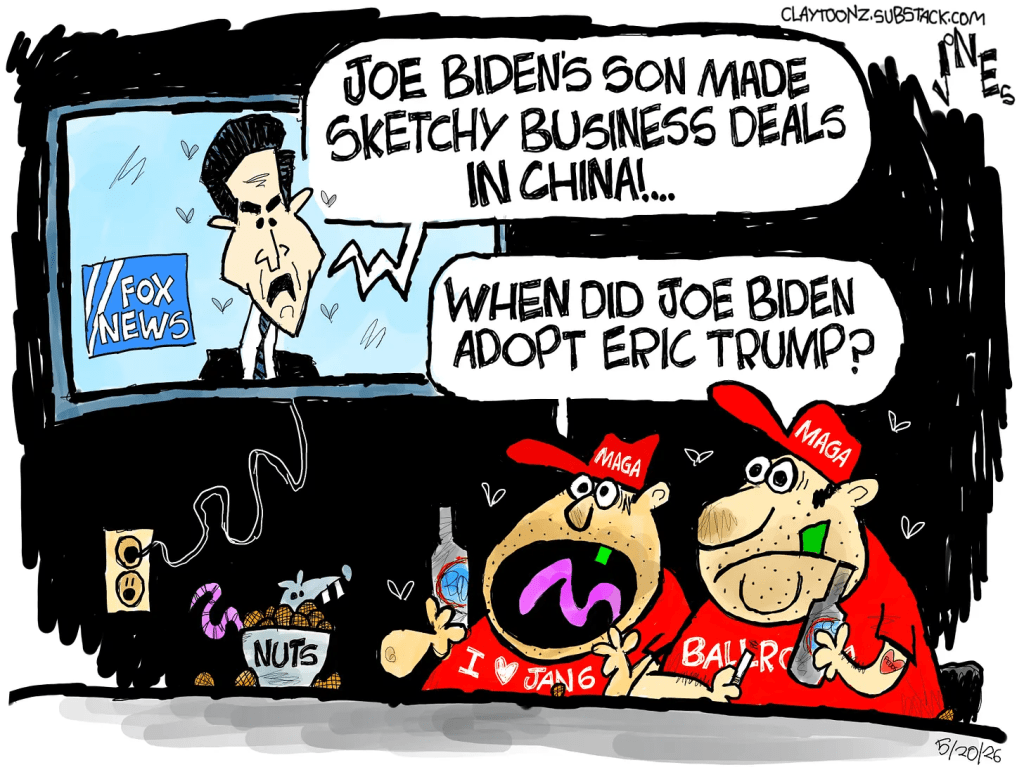
Eric Trump is threatening to sue Jen Psaki for a segment on her MS NOW show.
Psaki questioned on her show, The Briefing with Jen Psaki, if there’s a conflict of interest by Eric joining his father on his trip to China. She cited an article by the Financial Times that reported that Alt5 Sigma, a company with ties to Eric Trump, was pursuing a deal to build data centers in the US with a Chinese chipmaker that American lawmakers have warned is connected to the ruling Communist Party.
Presidents usually put a blind trust in charge of their finances while they are in office, but not Donald Trump. Instead of a blind trust, he has put Eric in charge of the family business. That does not prevent Donald from controlling his money, and in fact, he has been making a lot of trades and investments lately himself. Psaki pointed out that this arrangement with Eric was supposed to prevent conflicts of interest, “but there he is.” (snip-MORE)
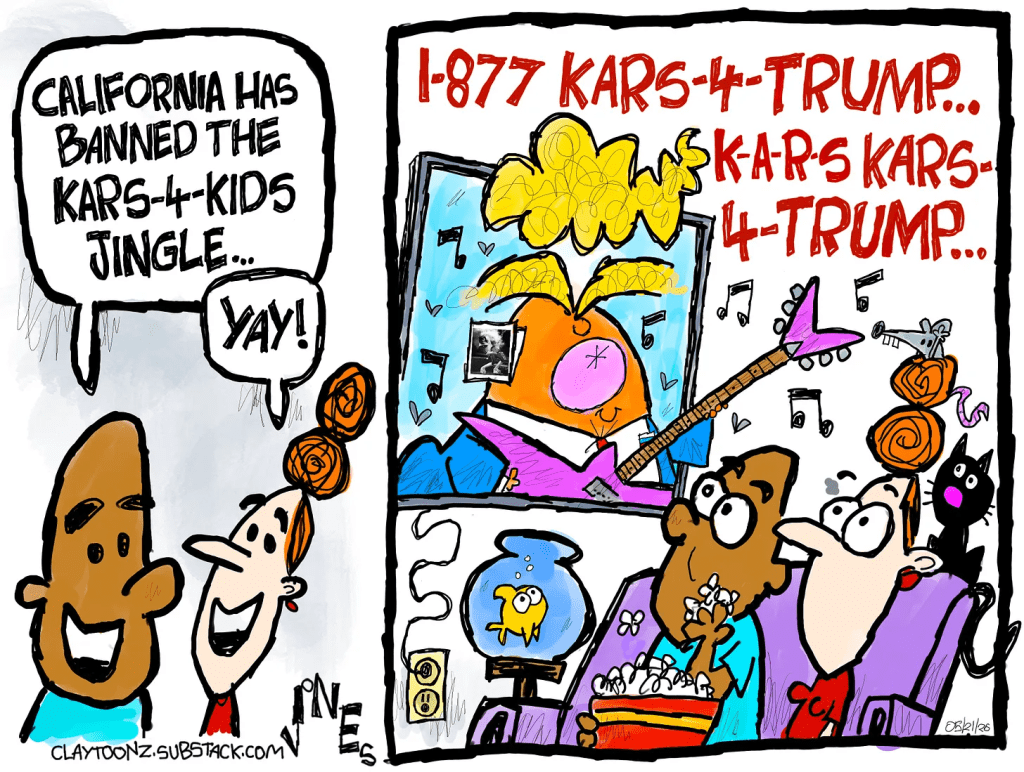
Usually, when someone tells you about a news item you may not have heard about yet, they’ll leave out some pertinent facts. When I first heard that California had banned the Kars4Kids jingle, the most annoying song in the world, they did not tell me why. I thought to myself that California couldn’t do that because of the First Amendment. Right? No one has banned Nickelback yet.
As it turns out, the supposed nonprofit group, Kars4Kids, has to stop airing its jingle in California because the judge found that it violated the state’s false advertising and unfair competition laws. (snip-MORE)
The $1.8 billion slush fund that the Justice Department is awarding to Donald Trump’s criminal allies is so blatantly corrupt that even Republicans can’t defend it. Some Republicans are so upset that they’re actually speaking out publicly against it.
Referring to acting Attorney General, Todd Blanche, and the fact that J6 terrorists are eligible for the so-called “anti-weaponization fund,” Mitch McConnell said, “So the nation’s top law enforcement official is asking for a slush fund to pay people who assault cops? Utterly stupid, morally wrong – take your pick.”
Senate Republicans derailed a massive immigration enforcement bill and left town until early today, despite Donald Trump ordering them to pass the $7o billion bill before June 1. How disgusting do you have to be to sicken sycophantic MAGAt Republicans? (snip-MORE)
Every day, hair salons sweep countless hair clippings off their floors and toss them into the trash without much thought. But in parts of France, Belgium, and Luxembourg, those discarded strands are finding an entirely different purpose: helping forests grow.
French recycling company Capillum has developed a surprisingly effective way to reuse human hair by turning it into biodegradable mulch that protects young trees from hungry deer. The company collects hair from participating salons and transforms it into flattened fiber sheets that can be wrapped around vulnerable saplings.
What sounds unusual at first actually solves several environmental problems at once.
A second life for salon clippings
Hair salons generate an enormous amount of waste each year. Most clippings are simply thrown away, even though human hair is remarkably durable because it is made largely from keratin, a fibrous protein that breaks down slowly over time.
Capillum saw potential in a material most people never think twice about. The company accepts hair regardless of texture, length, color, or whether it has been dyed. Once gathered, the hair is fed into a machine that minces everything together into dense fiber sheets that can be laid around the base of trees. The process transforms something typically viewed as garbage into a practical tool for conservation efforts.
Why young trees need protection
Many forests depend on saplings surviving long enough to mature and replenish the ecosystem. However, young trees often struggle in areas with large deer populations. Deer are known to chew on bark, especially during seasons when food is scarce. Because saplings have thin bark and delicate trunks, even small amounts of damage can stunt their growth or kill them entirely.
Foresters have historically relied on plastic fencing and tree guards to keep deer away. While those barriers can work well, they also create waste and require maintenance over time.
Capillum’s recycled hair mats offer another approach. The scent of human hair naturally discourages deer from getting too close to the trees, steering them toward other vegetation instead. The method protects saplings without harming wildlife.
A biodegradable alternative to plastic
Unlike plastic guards, the hair fibers gradually decompose and return nutrients to the soil. As the keratin breaks down, it releases nitrogen and amino acids that can support plant growth. That nutrient-rich quality is one reason some gardeners have long experimented with placing hair into compost piles or using it directly in garden beds. Knowing this, Capillum sells its eco-friendly hair mulch to home gardeners interested in more sustainable growing methods.
Human hair is more useful than most people realize(snip-MORE)
Surely there are people here in the US, in our profit-driven society, who could do this recycling, as well.