Here in the USA, we mourn our loved ones when they pass with funeral services and wearing dark solemn clothing. It’s usually a sad time in our families when we have to say goodbye to grandpa forever. Different cultures grieve and treat death differently with traditions that have been around for centuries.
One culture that has created a unique and interesting way to face death and the deceased is Mexico. Mexico is colorful, noisy, and lots of fun. The people, the food, and the celebrations are bright, loud, and unequaled. So when it comes to death, in true Mexican style, Mexicans celebrate with color, food, and music.
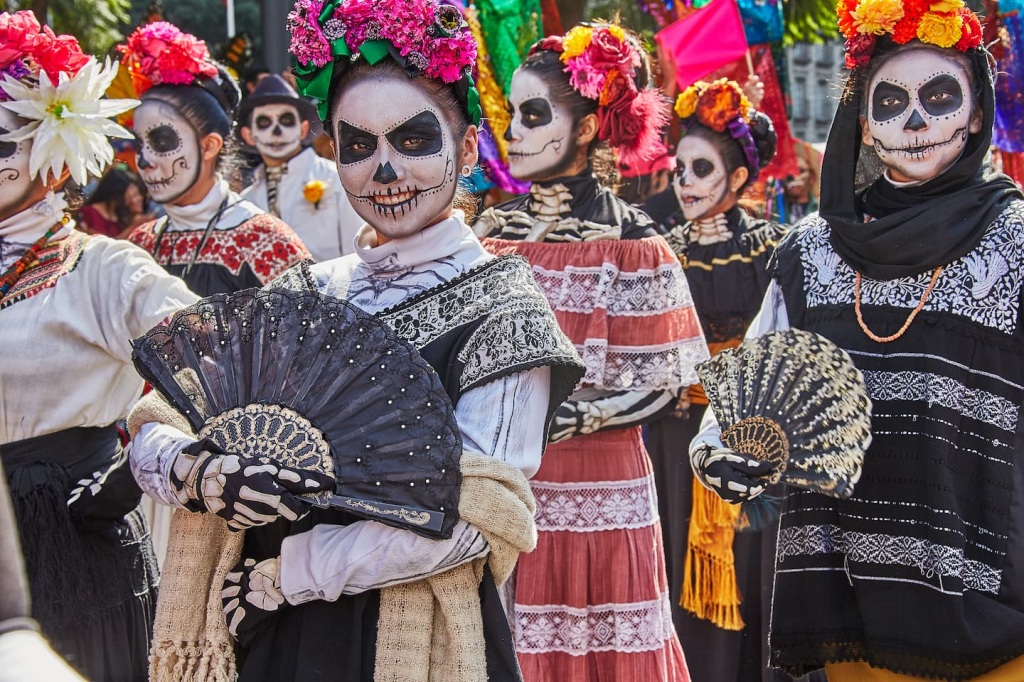
Day of the Dead is a 2-day celebration where it is believed that the passageway between the real world and the spirit world is open so our deceased loved ones can come back to visit us. What do we do when grandpa comes back from the land of the dead? We make his favorite meal and we offer him his favorite drink. We sing, dance, and rejoice before he heads back to the underworld for another year.
When Is Day of the Dead
Day of the Dead is celebrated on November 1st and 2nd. It is sometimes confused with Halloween because of the symbolic skulls but is not related at all.
It is said that on November 1st the children who have passed come back to visit and celebrate as angelitos and on the following day, November 2nd, it’s the adults (Difuntos) turn to show up for the festivities.
Family members prepare for several weeks in advance for the tradition by creating altars, decorating burial sites, and cooking specific Day of the Dead food. (snip-MORE)
=====
Day of the Dead Traditions
Ofrendas
In the weeks leading up to the holiday, Mexican families will begin to decorate their homes for the holiday. The centerpiece will be the Ofrenda, or Altar de Muertos, a display meant to commemorate the lives of loved ones. This tradition can be traced back to the Aztecs, who would place offerings for the dead, including food and flowers, on tree stumps on their days of remembrance.
The traditional Ofrenda is divided into various levels to represent the various stages of life and death. There can be two levels, representing heaven and Earth, three levels, representing heaven, Earth, and the underworld, or seven levels, representing the seven stages souls have to cross to reach eternal rest. It is decorated with purple and orange, the traditional colors of the holiday, and often adorned with papel picado, a popular Mexican paper craft that is made up of ornate cut-outs. The papel picado used for the holiday will feature specific images and motifs associated with Day of the Dead, such as sugar skulls and dancing skeletons. Traditional Mexican oilcloths are commonly used to drape the surface of the Ofrenda. (snip-MORE)
Calavera: Sugar Skull
Skull Imagery in Mexico and its History
Skull imagery has a long history dating back to the traditions of pre-Columbian civilizations. The Aztecs had several festivals of remembrance where they would worship the Goddess Mictecacihuatl, ruler of the afterlife and keeper of the dead. Mictecacihuatl was often represented as a skeleton, adorned with a crown of flowers and skulls. For many pre-Columbian cultures, human skulls or skull motifs were used as decoration on walls as a sacrificial offering to the gods. These are commonly referred to by the Nahuatl term Tzompantli. Some of these, such as the Mayan Chichen Itzá Tzompantli in Yucatán, and the Aztec Huey Tzompantli in Mexico City, remain to this day and can be viewed by visitors.
Another motif that may have influenced calavera imagery as we know it today is likely a type of European art known as Danse Macabre. These paintings and engravings, often featuring dancing skeletons, were meant to represent the inevitability of death and were used as decorations in churches across Europe. It is probable that the Danse Macabre motifs were brought over by Spanish missionaries and later fused with Indigenous skull imagery. (snip-MORE)
OK, so we’ve posted about this here at least a couple of times, and now we’re in the week where people will not be receiving benefits on which they depend, to eat. Here’s one more story. And, yes, this is a particular cause of mine, so I want to note that I’ve been looking around town to see where I might be able to help out should this come to fruition, as it appears to be doing. My posting may be sparser, because trying to help people get enough to eat will take up more time now. But, as we’ve also written here, building and sustaining community is important during times such as those we in the US find ourselves, and for me, helping people get enough to eat is sustaining community. So, while I’ll still be around, I may not post as often; the energy only goes so far. Here’s today’s AP story:
The new notice comes after the Trump administration said it would not tap roughly $5 billion in contingency funds to keep benefits through the Supplemental Nutrition Assistance Program, commonly referred to as SNAP, flowing into November. That program helps about 1 in 8 Americans buy groceries.
“Bottom line, the well has run dry,” the USDA notice says. “At this time, there will be no benefits issued November 01. We are approaching an inflection point for Senate Democrats.”
The shutdown, which began Oct. 1, is now the second-longest on record. While the Republican administration took steps leading up to the shutdown to ensure SNAP benefits were paid this month, the cutoff would expand the impact of the impasse to a wider swath of Americans — and some of those most in need — unless a political resolution is found in just a few days.
The administration blames Democrats, who say they will not agree to reopen the government until Republicans negotiate with them on extending expiring subsidies under the Affordable Care Act. Republicans say Democrats must first agree to reopen the government before negotiation.
Democratic lawmakers have written to Agriculture Secretary Brooke Rollins requesting to use contingency funds to cover the bulk of next month’s benefits.
Government shutdown The AP has journalists around the country covering the shutdown of the federal government. What questions do you have for them?
But a USDA memo that surfaced Friday says “contingency funds are not legally available to cover regular benefits.” The document says the money is reserved for such things such as helping people in disaster areas.
It cited a storm named Melissa, which has strengthened into a major hurricane, as an example of why it’s important to have the money available to mobilize quickly in the event of a disaster.
Some states have pledged to keep SNAP benefits flowing even if the federal program halts payments, but there are questions about whether U.S. government directives may allow that to happen. The USDA memo also says states would not be reimbursed for temporarily picking up the cost.
Other states are telling SNAP recipients to be ready for the benefits to stop. Arkansas and Oklahoma, for example, are advising recipients to identify food pantries and other groups that help with food.
Sen. Chris Murphy, D-Conn., accused Republicans and Trump of not agreeing to negotiate.
“The reality is, if they sat down to try to negotiate, we could probably come up with something pretty quickly,” Murphy said Sunday on CNN’s “State of the Union.” “We could open up the government on Tuesday or Wednesday, and there wouldn’t be any crisis in the food stamp program.”
Jasper Nathaniel joins the program from the occupied West Bank and walks us through the horrific settler violence he survived over the weekend. October 20, 2025.
This was the first report I watched on this. This one is longer because he tells the whole story and shows clips he took on his phone at the time. The mob was going to kill him after the IDF set the group up to be murdered at the hands of illegal settlers. The military told them to go to the spot where the settlers were hiding. Please watch to see the very illegal and horrific ways Israeli is treat people to simply drive them off of and steal their lands. Hugs
US Embassy ABANDONS Journo After Israeli Mob Attack
A 55-year-old Palestinian woman, Umm Saleh Abu Alia, was hospitalized after being brutally attacked by a masked Israeli settler in Turmus Ayya, West Bank. Captured on video by US journalist Jasper Nathaniel, the unprovoked assault shows the woman struck unconscious and hit again on the ground. Settlers continue to harass Palestinian farmers during the olive harvest, while the Israel Defense Forces claim to have intervened. This horrifying incident highlights escalating tensions and ongoing violence in the occupied West Bank.
Israeli settlers burn trees, assault Palestinians in occupied West Bank olive harvest attacks
In the occupied West Bank, armed Israeli settlers systematically attack Palestinian olive harvesters and farmers, burning trees and beating farmers. These assaults, often protected by Israeli forces, have caused severe injuries. Palestinians, joined by international activists, continue harvesting to avoid surrendering their land, despite the violence and threats aimed at driving them away. For them, this is a fight for their very livelihood and homeland.
Israel’s Next Move: Create ‘Six Little Gazas’ In West Bank | Jasper Nathaniel | TMR
Happy Monday from Atlanta! I just tried to convince thousands at a public health conference that it’s time to reimagine systems—not just defend the status quo. I’m happy to report that tomatoes weren’t thrown my way. This is my fourth state in five days, and the highlight is actually seeing the seasons change and meeting a lot of you in person. I couldn’t be more excited to see my girls (and survive another round of the KPop Demon Hunters soundtrack).
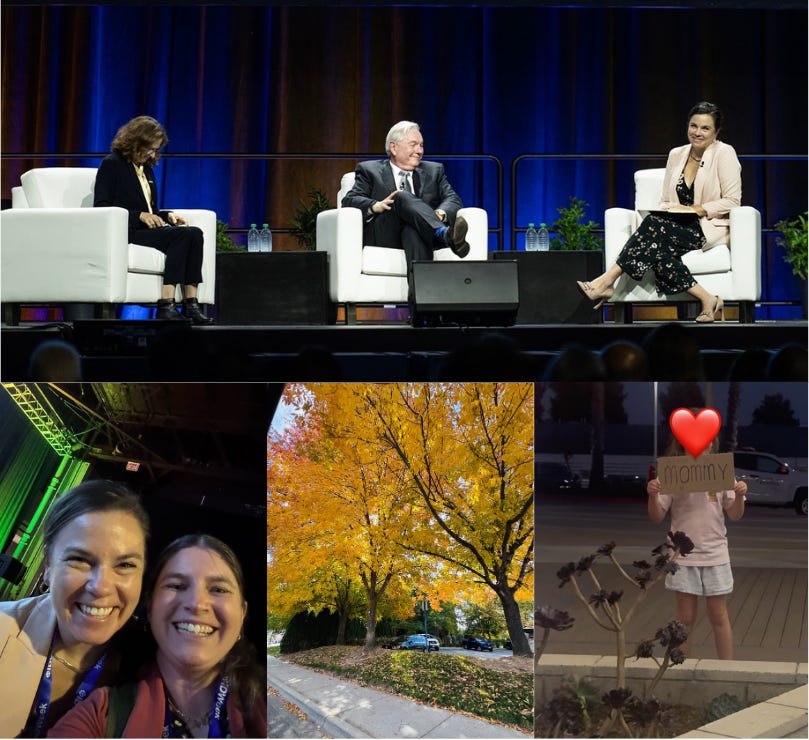
Top: Plenary stage with Mike Osterholm; From the bottom left: Met YLE reader Krisandra Allen at the conference. Fall leaves in Idaho. My daughter welcoming me home at the airport.
This week’s Dose runs the gamut: from what’s really going on with lead in protein powders (and whether you should be worried), to a refreshing burst of leadership as 15 governors join forces to strengthen public health collaboration, to falsehoods swirling around mammograms. We’ll wrap with an infectious disease weather report and a quick note for dog owners on an FDA recall.
Let’s go!
Consumer Reports found lead in protein powders. How bad is it?
Last week, Consumer Reports released an analysis revealing elevated lead levels in several popular protein powders and shakes. Google searches for “lead in protein powder” spiked 300%, and influencers lit up social media. Depending on which news source you read, it was either a five-alarm fire or no big deal.
So what’s actually going on? Lead is everywhere—soil, food, water, and air. Thankfully, overall exposure has dropped dramatically since the 1970s, and modern lab tests can now detect vanishingly small amounts (down to parts per billion). But detection does not necessarily equal danger.
How bad is bad?That’s where things get tricky because not everyone agrees:
California limit: 0.5 mcg/day. This number comes from a very conservative calculation: regulators took the “no observable effect” level for reproductive harm for inhaled lead exposure in workplaces and divided it by 1,000. Many experts argue that this threshold is unrealistic. It’s also not linked to adverse health outcomes.
FDA’s limit: 2.2 mcg/day for kids, 8.8 mcg/day during pregnancy, and 12.5 mcg/day for other adults based on blood lead levels, toxicology data, and a built-in 10x safety factor.
European Union limit: Allows up to 3 mg/kg (3 ppm) in food supplements—roughly 90 mcg per 30-gram scoop of protein powder. In this case, the FDA is far more cautious than Europe (and that’s not usually how things go).
Back to the report: of the 23 protein supplements they tested, two-thirds exceeded “Level of Concern.” One brand (Naked Nutrition Vegan Mass Gainer) hit nearly 16 times the limit. But because Consumer Reports used California’s exceptionally strict benchmark, those numbers sound scarier than they really are.
The average American already gets 5.3 mcg of lead daily from food and the environment. That’s another reason California’s cutoff doesn’t make much sense. Still, some products identified in the report could push intake close to the pregnancy (8.8 mcg) or adult (12.5 mcg) daily thresholds.
What this means for you: Don’t worry too much. While the FDA continues to reduce lead exposure through programs like Closer to Zero and the Total Diet Study (that is, if the funding continues), there are several things we can do in our own homes, especially for parents of kids and during pregnancy.
Check to see if your protein supplement (or any supplement, really) has third-party testing for heavy metals (like USP or Informed Sport).
Advocate for more pre-market regulatory oversight in the supplement industry (which has very little, if any at all) by writing to your local representative.
Eat a diet that includes a variety of nutrient-dense foods, which helps limit exposure to specific food sources and ensures we get an array of protective nutrients.
Prioritize getting your protein from whole food sources.
Big thanks to YLE’s Megan Maisano—Registered Dietitian Nutritionist— for writing this section.
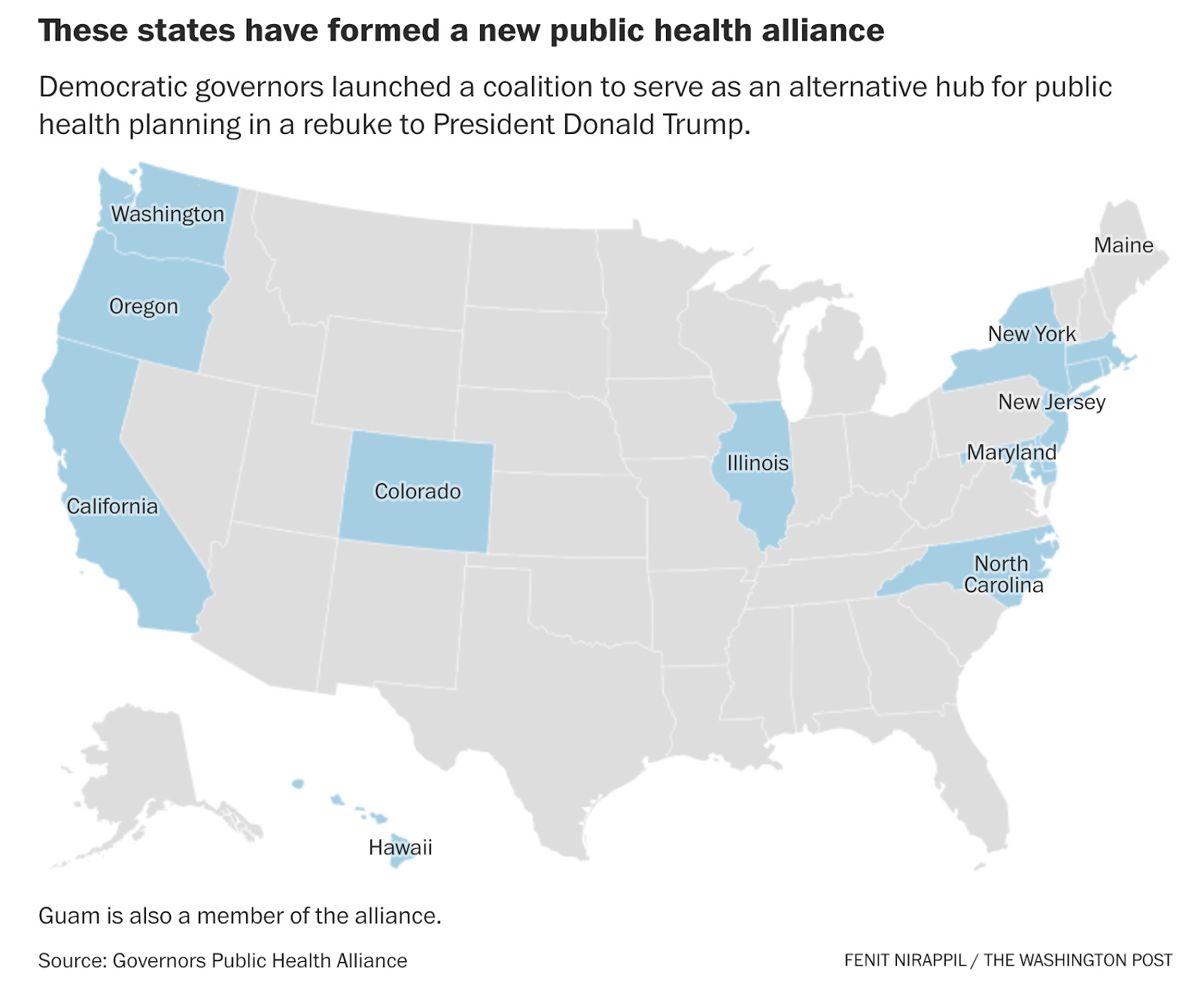
Fourteen states and Guam join forces to launch Governors’ Public Health Alliance
Governors from 14 states and Guam announced the creation of the bipartisan Governors’ Public Health Alliance, which is a new effort to strengthen coordination and collaboration across state lines.
Why do we need this? In the U.S., authority over health rests with the states, not the federal government. Health (encompassing both health care and public health) is not only the highest budget item for a state but also the primary reason for state bankruptcy. In other words, governors hold enormous power over your health.
Today, though, federal support is shifting fast, funding is drying up, and states are being forced to get creative. States must decide whether to maintain their public health departments (due to funding cuts), how to continue purchasing vaccines (if the federal government stops recommending them), whether to negotiate drug prices (like insulin), and more. We saw a similar challenge during the pandemic with bulk purchasing of PPE.
In general, the more coordinating, collaborating, and innovative thinking, the better.
However, I’m growing increasingly concerned about the partisan gaps in public health. Although some Republicans are on the advisory board and the initiative was framed as bipartisan, no Republican-led states have joined. This worries me for my friends in red states, like Texas, but it also has implications for everyone, as diseases don’t care about borders.
What this means for you: If your state is included, you can rest assured your governor is talking to others, which is a helpful step toward innovative solutions. You could argue it was needed before this moment, too. Public health has been siloed for far too long.
Mammograms save lives. They’ve been wrongly targeted.
Happy Breast Cancer Awareness month! Unfortunately, this month has driven some influencers to post false claims about the harms of mammograms. So let’s clear this up.
Breast cancer is the second leading cause of cancer death in women in the U.S., and accounts for 1 in 3 new cancers among women each year. (It affects men too, just at lower rates.) There is strong scientific consensus in support of routine mammograms to prevent breast cancer and detect it early:
Regular mammograms starting at age 40 are recommended for everyone, but may have even greater benefit for Black women, who are 40% more likely to die from breast cancer than white women and more likely to have aggressive cancers, younger.
There’s some critical nuance here:
With each mammogram, breast tissue is exposed to a small amount of ionizing radiation. But! We’re exposed to this type of radiation every day in our natural environment. At high doses, radiation exposure can change DNA and cause harm, but the amount of radiation exposure during a mammogram is about the same as flying from California to New York.
Organizations disagree on whether mammograms every year or every other year are optimal. Screening recommendations are based on evaluating science to maximize benefit (lives saved) while reducing patient worry, unnecessary costs, and diagnosing and treating cancers and pre-cancers that ultimately wouldn’t cause health problems—also called “overdiagnosis.” This is a balancing act.
Mammograms are just one tool for detecting cancer, and women with dense breasts or high risk for cancer (e.g., family history, known genetic predispositions, or other key risk factors) may benefit from additional screening, such as through an MRI.
For more, see YLE’s deep dive on breast cancer screening recommendations.
Infectious disease “weather report”
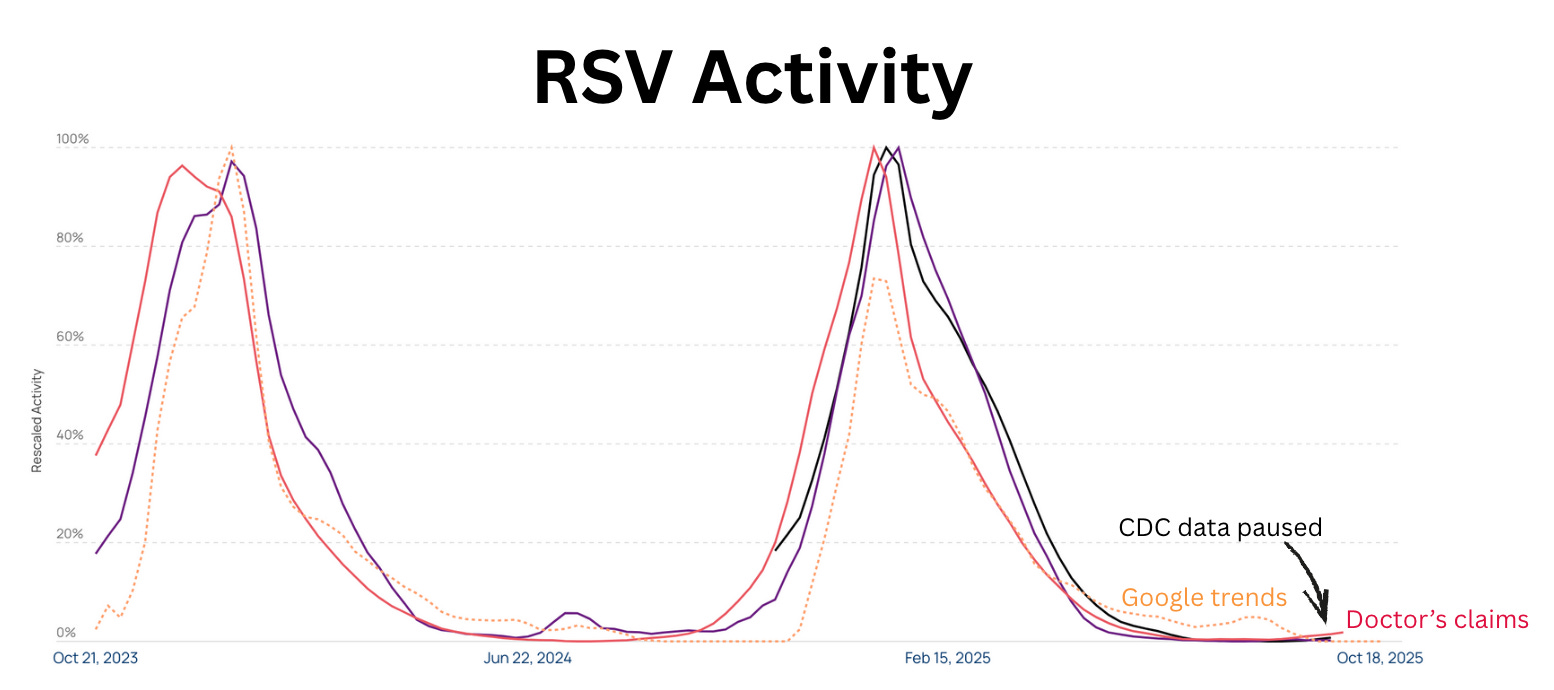
In the U.S., flu and RSV are still quiet. CDC data is still on pause because of the government shutdown, so we’re continuing to reference PopHive data. RSV activity is still low but growing in southern states, like Louisiana and Texas.
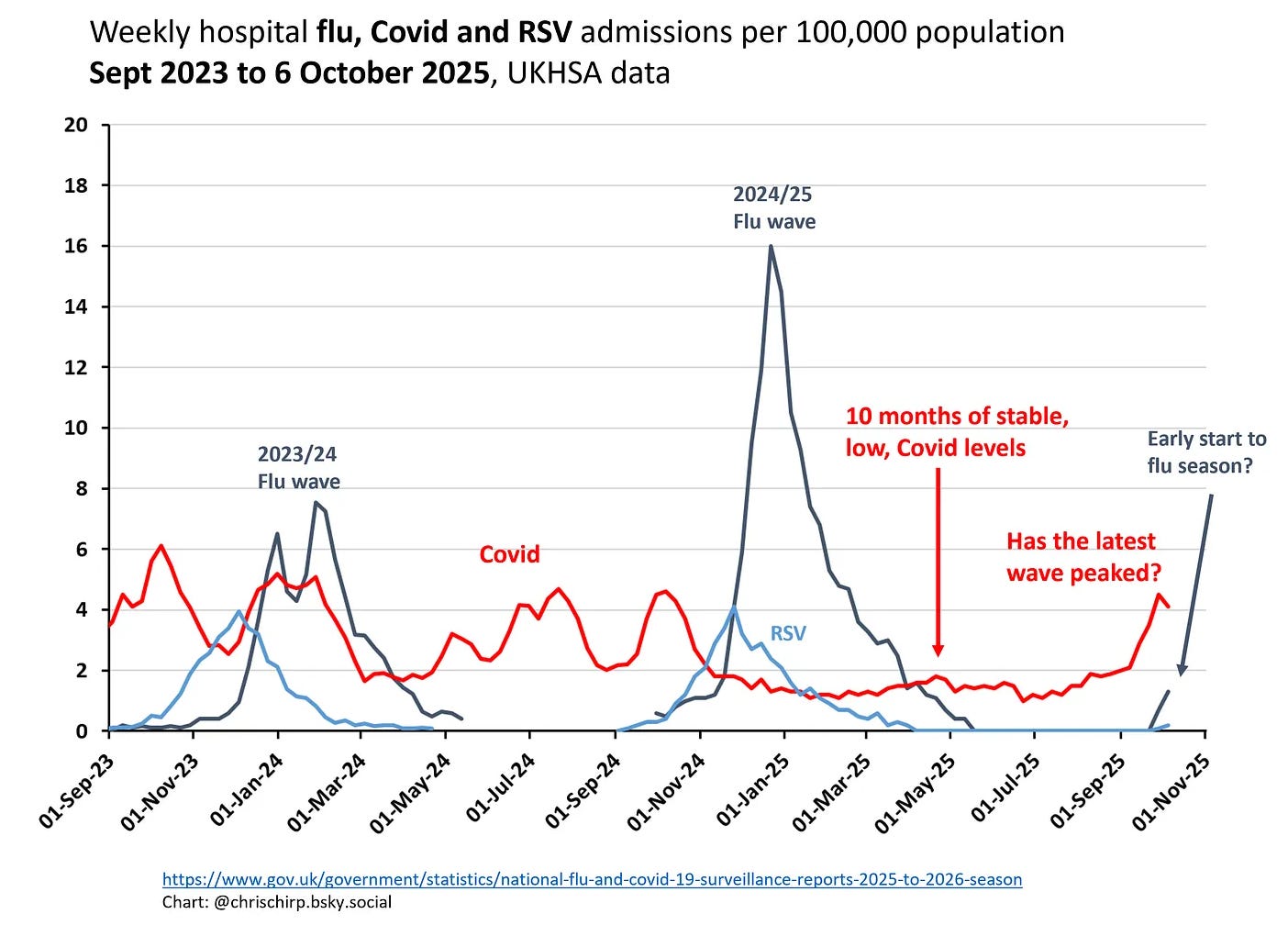
However, Covid-19 is having a moment in the U.K., with hospitalizations increasing exponentially after a 10-month lull. This isn’t driven by a dramatic variant, but rather by a lack of immunity building up over time. Flu might also be increasing, which suggests it’s coming soon (as expected) for the U.S.
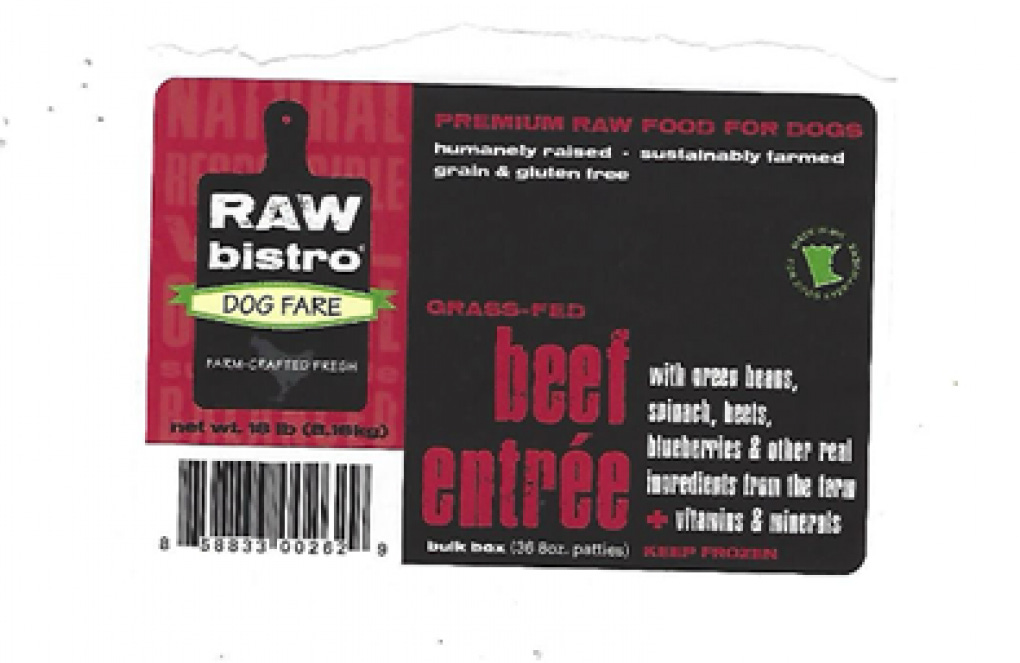
The FDA recalled Raw Bistro frozen beef dog food for possible Salmonella contamination. The recalled products were sold directly to consumers and to select distributors between Sept. 1 and Sept. 17 in California, Colorado, Illinois, and Minnesota.
Salmonella can make dogs sick, just like humans. Contaminated food can cause illness days later in dogs. And dog owners can get sick from handling contaminated food or dog bowls.
What this means for you: Check the lot numbers on your dog’s food, and toss it if they are included in the FDA recall notice. Sanitize bowls if they held contaminated food, wash your hands, and watch for warning signs in your dog: lethargy, vomiting, diarrhea, and loss of appetite. If you notice these signs, take your pet to the vet.
That’s it for this week! Share your fall leave pics in the comments below so that I can continue to live vicariously through you.
Love, YLE
Your Local Epidemiologist (YLE) is founded and operated by Dr. Katelyn Jetelina, MPH PhD—an epidemiologist, wife, and mom of two little girls. YLE is a public health newsletter that reaches over 400,000 people in more than 132 countries, with one goal: to translate the ever-evolving public health science so that people are well-equipped to make evidence-based decisions. This newsletter is free to everyone, thanks to the generous support of fellow YLE community members. To support the effort, subscribe or upgrade below:
Growing up as someone who is different from the majority is difficult no matter the circumstances. For the LGBTQ+ it is horrific when just your very existence is called an abomination and you are equated with the worst being in history. Especially when your parents and your god are pushing the idea that you are a monster who can only be cured if you follow their god, their church doctrines, have their feelings about everything in your life. Hugs.
A guest essay by Sean Robinson – Spencer’s boyfriend.
Subscribe
When I was around 10 years old, I remember horsing around in the grass with my oldest brother. I asked him the meaning of homosexuality, a word that I had heard from my parents and from the New Order Amish and Mennonite communities I was surrounded by growing up in upstate New York and rural Virginia.
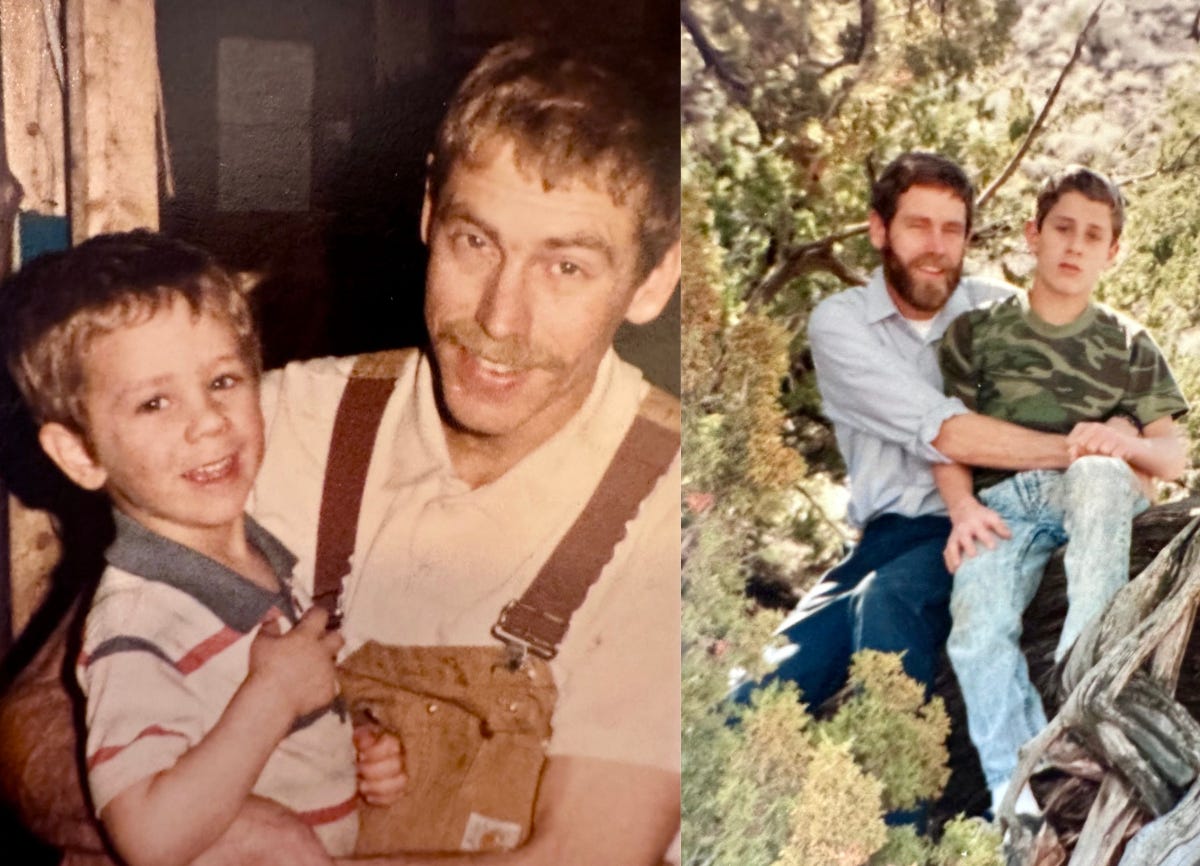
Sean and his dad Upstate New York. Photo courtesy of Sean.
While I wasn’t certain what the word meant, I knew it was bad and I was pretty sure it was me. So when my brother responded to my question by saying that homosexuality is “demonic,” I pushed those thoughts down.
A few years later, my dad told me that once someone becomes a homosexual, they will “want more and more and more” and it will lead to a sexual desire for “children, then animals, then blood.”
Sean and his dad through the years. Photos courtesy of Sean.
Subscribe
Hearing these ideas persistently and consistently made me feel like there was this horrible thing inside of me that I just hated. I had learned that it was akin to being a pedophile, and that’s how I felt about myself.
These feelings created so much shame and fear but most of all a level of embarrassment that was so intense that I vowed to myself I would take my secret to the grave.
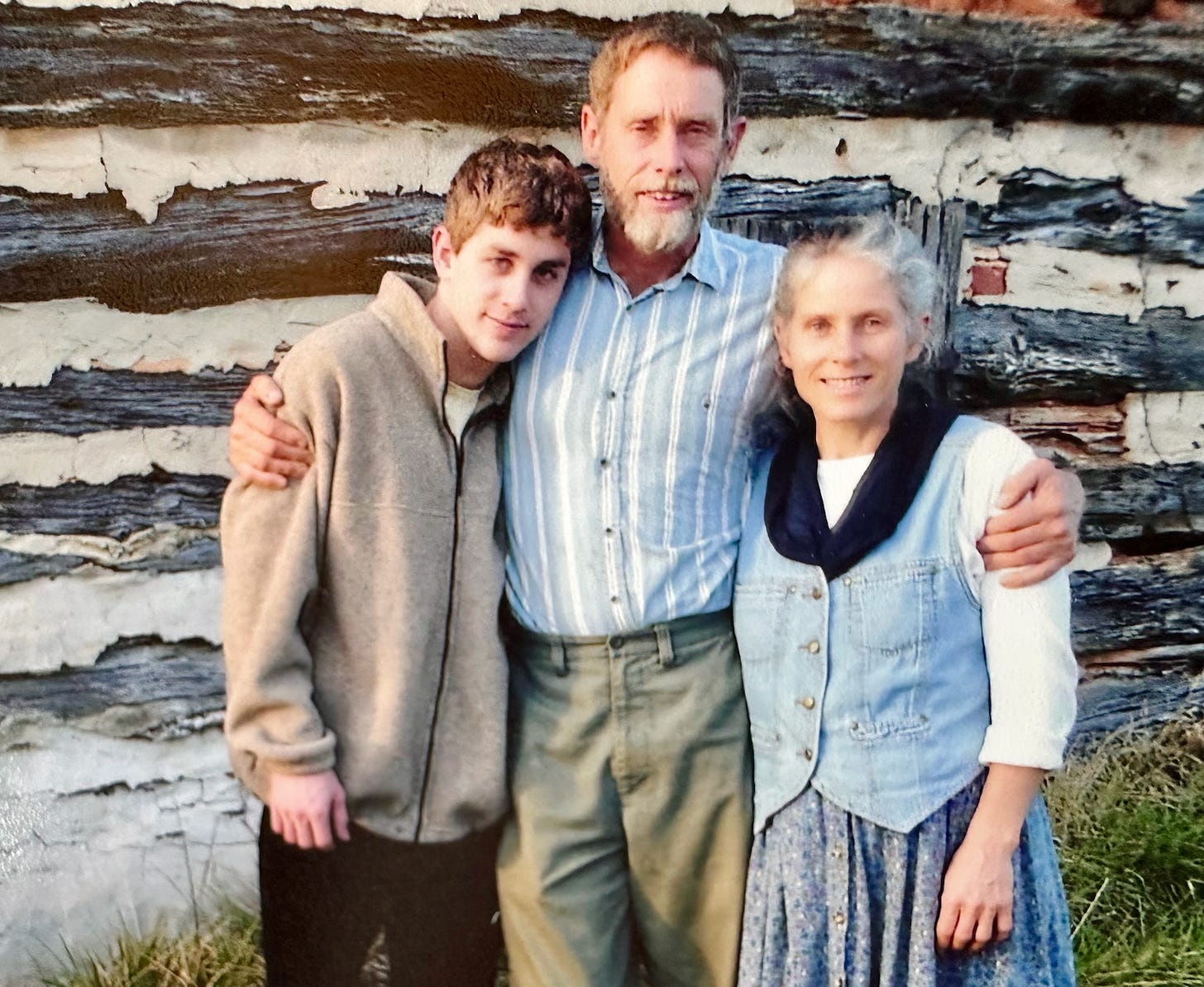
Sean and his parents. Photo courtesy of Sean.
Subscribe
But I didn’t. When I met just one gay person at Danville Community College, I felt a small but significant rumbling of hope. This encounter gave me the courage to leave. So at 17, I told my parents I was moving to New York City to pursue the performing arts.
While I was semi-interested in being on screen, I saw NYC as a symbol of a new life where I could be my authentic self. A few months after I moved, I came out to my mom over the phone, who later told me—through a puddle of tears—that I might as well have died in a car accident.
I had to dig to make a life for myself with few people in my corner. I utilized NYC social programs like SNAP benefits, free health care and low-income housing. These services gave me the bootstraps I needed to pull myself up.
The years of familial and community rejection and efforts to change me through conversion therapy took more than two decades of treatment, medication and supportive friendships to help me find a formula where today—at 40 years old—I can manage my depression, anxiety, tics (that were at one point debilitating), no-contact relationship with my parents and low self-esteem.
I am so grateful to the heroes who helped me through these years: Paul Warner, Jerry Meadors and countless others. You lifted me up, taught me the ropes, allowed me to couch surf and showered me with love.
Sean in his teens. Photo courtesy of Sean.
Fighting the demons of my past, including years of religious trauma and physical abuse disguised as “corporal punishment,” is something I’d wish on nobody. When I read Uncloseted stories that discuss how nearly 40% of LGBTQ kids seriously considered suicide in the last year, my heart breaks because I know that could have been me if my path had veered a degree in a different direction.
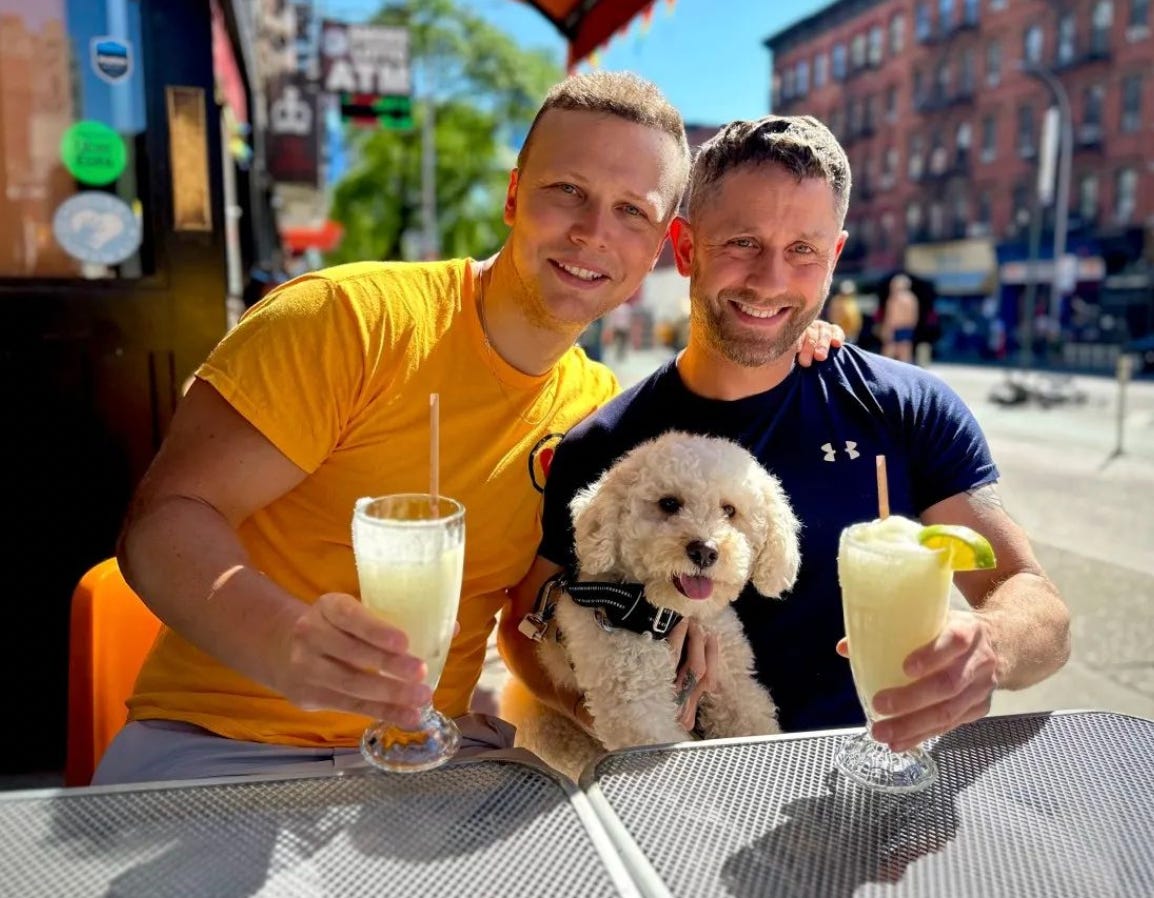
Sean with Spencer and his psychiatric service dog Carson. Photo courtesy of Sean.
Flash forward 20 years and I’m sitting next to Spencer, who’s helping shine a spotlight on the very thing I tried to suppress in the darkness of my mind. I am now a video editor at MTV, working on RuPaul’s Drag Race, the groundbreaking television show that has helped so many queer kids across America feel seen and feel safe—something every child deserves.
I’ve always been resilient and tough.
But finally, I feel calm and free.
Response from Sean’s Dad:
In a text message to Uncloseted Media, Sean’s dad, Chris Robinson, wrote that he remembers saying that “when the moral fabric of societies begin to decay it usually starts with the sin of not acknowledging Almighty God, the Giver and Sustainer of life. [If] that condition of man continues then more sin comes [including] adultery, fornication and general unfaithfulness. The next level is men allowing women and children to rule. This would have been the feminist movement of the 60’s. Next comes homosexuality then bestiality and finishing up with child and adult sacrifice and much shedding of blood. This progression is recorded in Genesis and through the Chronicles and Kings in the Bible.”
In response to Sean’s references to corporal punishment, his dad wrote that he remembers being “shocked at [Sean’s] fearless defiance to [his] authority … as being the one responsible for order in the home” and that he would punish him—after multiple verbal warnings for misbehavior—by giving him “4 or 5 good licks with the switch and [would then] give him a hug and prayer and hope he got the message.” His dad added that he and Sean had many good times too and that he “still shed[s] a tear at times in memory of [his] little Seany.”
Response from Sean’s Mom:
In a text message to Uncloseted Media, Sean’s mom, Michelle Robinson, does not remember telling Sean after he came out that he might as well have died in a car accident. “My mind is blank for anything specific,” she wrote.
In response to Sean’s reference to corporal punishment, his mom says that out of the hundred times where corporal punishment was administered correctly through biblical spanking done with love, there were “a handful of times when his father admits he acted more in anger as [an] immediate reaction because of Sean’s behavior and he realizes he should’ve done that differently [and that his dad] always immediately apologized and they always had special time together and they worked through that.”
“We believed in honoring God with our life. We were not perfect but our heart was to please God,” she wrote, adding that Sean was treated with love as a child and through adulthood.
Sean’s brother did not respond to Uncloseted Media’s request for comment.
If objective, nonpartisan, rigorous, LGBTQ-focused journalism is important to you, please consider making a tax-deductible donation through our fiscal sponsor, Resource Impact, by clicking this button:






 Scottie's Playtime