
Category: Health / Healthcare / Illness / Vaccines
Lewis’s Woodpecker
American Bird Conservancy has changed its page. It seems even easier to use. Here are some bits about this week’s bird.

About
Most woodpecker species in the United States and Canada display a mix of black, white, and red plumage, but don’t tell the Lewis’s Woodpecker. Its unusual mix of colors includes a red face, pink belly, glossy green back, crown, and nape, and silver-gray collar. The bird is simply stunning.
Lewis’s Woodpecker also differs from other members of its family in many of its foraging styles and food choices. In the summer, the bird eats mostly insects, catching them in flight by swooping out from a perch like a flycatcher or by foraging in flight like a swallow. Wide, rounded wings give the bird a buoyant, straight-line flight, more like a jay or crow than a woodpecker. The bird seldom excavates for wood-boring insects; unlike other woodpeckers, this species lacks the strong head and neck muscles needed to drill into hard wood.
In the fall, Lewis’s Woodpeckers switch to eating nuts and fruit, chopping up acorns and other nuts and caching them in bark crevices for later consumption. During the winter, they aggressively guard these storage areas against intruders, including other woodpecker species.
Ornithologist Alexander Wilson described the species in 1811 and named it for Meriwether Lewis, who observed the bird in 1805 during the Lewis and Clark expedition.
Threats
Birds around the world are declining, and many of them, like Lewis’s Woodpecker, are facing urgent, acute threats. Moreover, all birds, from the rarest species to familiar backyard birds, are made more vulnerable by the cumulative impacts of threats like habitat loss and invasive species.
Habitat Loss
Surveys indicate that Lewis’s Woodpecker populations may have declined by about 60 percent since the 1960s, and much of the reduction is likely due to loss or alteration of suitable nesting habitat. Like all other woodpeckers, the Lewis’s Woodpecker requires cavities in snags (standing, dead, or partly dead trees) for nesting. Logging, the suppression of wildfires, and grazing have altered many of the western forests where the species is found. The changes to the landscape often result in large areas dominated by trees that are the same age, leaving few dead or decaying trees available for the birds’ nests.
Pesticides & Toxins
Pesticides take a heavy toll on birds in a variety of ways. Birds can be harmed by direct poisoning from pesticides, lose insect prey to pesticides sprayed on crops and lawns, or be slowly poisoned by ingesting small mammal prey that have themselves ingested rodenticides. Lewis’s Woodpeckers are likely exposed to pesticides in orchards and other agricultural settings.
Ms. Rachel Calls-Out NYT In Response To Leaked Internal Memo
Clay Jones Draws-
First Pedophile by Clay Jones
What did Trump know and when did he know it in regards to Epstein? Read on Substack

This caricature of Trump is the first drawing I have attempted since the stroke. Isn’t it crazy that I haven’t drawn anything in over a month? This was done with my left hand, and it was extremely difficult. I still don’t have enough stability with my right arm. I did hold a guitar pick for a few minutes today while strumming my Taylor 214. I’m not selling my guitars just yet. No, I do not plan to draw in the future with my left hand. Coincidentally enough, I drew it while waiting for an occupational therapist to arrive.
Trump and Epstein
Donald Trump is a horrible person. He is vile, corrupt, petty, mean, narcissistic, immature, greedy, dishonest, selfish, cruel, and evil, so naturally, he would be best friends with a pedophile.
“I have met some very bad people,” Jeffrey Epstein wrote in a 2017 email. “None as bad as Trump. Not one decent cell in his body.”
It’s not Epstein’s opinion of Trump that we should care about. After all, Jeffrey Epstein was a pedophile. Who cares about Trump’s opinion when he disses Joe Biden or Barack Obama? Does anyone really believe Jack Smith is a lunatic just because Trump says it? If we don’t care about Trump’s opinion about people, then we shouldn’t care about Jeffrey Epstein’s. I’m sure people don’t get worse than Jeffrey Epstein. So I don’t care about Epstein’s opinion; I care about his recollections.
Yesterday, House Democrats released emails in which Epstein wrote that Trump had “spent hours at my house” with one of his victims. And another email, Epstein wrote that Trump “knew about the girls.”
Speaker Mike Johnson no longer has a choice, and next week, the House will finally vote on whether or not to release all the investigative material it has on Jeffrey Epstein.
In one email to Ghislaine Maxwell, Epstein wrote, “I want you to realize that that dog that hasn’t barked is Trump.. [VICTIM] spent hours at my house with him.”
Epstein goes on to write that Trump “has never once been mentioned”, including by a “police chief”.
Maxwell replied, “I have been thinking about that.”
I wonder why Trump spent hours at Epstein’s house with one of his victims. But I don’t think it’s a mystery as to why Trump doesn’t want any of the investigative material to be released.
I believe Maxwell will have her sentence commuted when Trump believes it is politically safe to do so. She’s been given treatment for now until Trump feels he can make that commutation. This is an exchange for her not implicating Trump with Epstein’s pedophilia or labeling Trump as a pedophile himself.
Death by Lightning is a four-episode mini-series on Netflix about the assassination of James Garfield. If you are a history buff, such as myself, I believe you will thoroughly enjoy this show.
Did you know that November is Diabetes Awareness Month? Fortunately, for me, I am aware now that I have type 2 diabetes. So far, it’s not really that big of a deal for me. I mean, it’s a big deal that I’ve had to adjust my diet, nothing really tastes good anymore, I have to stick a needle in my stomach every night, I have to reward salt, as if I was a snail, and I may not ever have sushi with soy sauce, ever again, but other than that, it’s not a big deal. My goal at this point is that I do not ever lose a foot to it. But so far, my numbers have been good since I started managing it about a month ago. I am currently wearing a sensor on my arm, and my numbers have been low. I have lost weight since I found out, but that’s mostly because I spent half the month eating hospital food. As soon as I can walk again (and I’m taking baby steps), I will exercise more.
My appeal to you is that if you’re not aware whether or not you have diabetes, please get yourself checked out. I suspected I might be diabetic for a few years, but being the coward that I am, I refused to see a doctor until I had to. It was the same thing with my high blood pressure. I suspected it was bad, but I didn’t see a doctor until a stroke gave me no choice. If you suspect that you have high blood pressure, don’t ignore it like I did. I implore you to see a doctor and do something about it so that you don’t end up where I am right now. However, despite what happened, I am extremely lucky. It could’ve been worse.
Get yourself checked out. (snip-there is MORE on his substack, which deserves the clicks. He drew! *\0/* )
“Your brain is BROKEN”: John Fetterman Humiliated by Krystal Ball Over Shutdown Cave
The Incalculable Cost Of The Gaza Genocide
Abby Martin joins the program to discuss her new film, Earth’s Greatest Enemy which exposes the U.S. military as the world’s largest polluter. Live-streamed on November 6, 2025.
Two clips from The Majority Report.
The Democrats Have An Olds Problem | Rebecca Traister | TMR
The End Of Chuck Schumer?
Detransition is key to politicians’ anti-trans agenda. But what is it really like?
Nov 12, 2025 Orion Rummler
This story was originally reported by Orion Rummler of The 19th. Meet Orion and read more of his reporting on gender, politics and policy.
For some people, gender shifts over time, often through changes in one’s sense of self. A transgender man may realize they are nonbinary and stop hormone replacement therapy. A trans woman may face so much discrimination that she represses her identity. And some trans people medically reverse their transition to live as their sex assigned at birth.
These experiences are all part of a process known as detransitioning. Although detransitioning does not have a consistent social or academic definition, it generally applies to someone who has sought a gender transition and then stopped, shifted or reversed aspects of it. Their experiences offer a deeper look at how discrimination and gender norms impact our lives, how gender-affirming care can be improved, and how identity is perhaps more fluid than previously thought.
As experts work to understand detransitioners, their vulnerabilities and their highly individualized needs, their identities are being co-opted as part of a national campaign against transgender rights. Health care access and research are being blocked by politicians for both trans people and detransitioners — while anti-trans rhetoric puts everyone at risk.
The Federal Trade Commission and the Justice Department are investigating gender-affirming care as medical fraud, and they are rooting this effort in detransitioners’ stories that fit the narrative the Trump administration wants to advance. The White House wants the National Institutes of Health to study “regret” and “detransition,” even as it cuts any federal funding for researchthat mentions the word “trans.” The U.S. Department of Education hosted a “Detrans Awareness Day” event last March. Meanwhile, its functions have been severely undermined by layoffs and budget cuts.
The White House and agencies like the Justice Department claim that gender-affirming care is mutilating children, overlooking that young trans people live happily after transition and the studies showing that adolescents who regret transition are in the minority. Government officials describe trans people and detransitioners as victims of a medical conspiracy to boost profits and force gender ideology on families. Now, they are seeking evidence to prove those claims by subpoenaing hospitals for patients’ private data, including doctors’ notes, patient addresses and Social Security numbers.
Gender-affirming care has been broadly endorsed by the medical community for its effectiveness in treating gender dysphoria, a persistent distress felt when one’s body is out of sync with their identity. The 2022 U.S. Trans Survey, which polled over 92,000 trans and nonbinary people 16 and older, found that social and medical transition were profound sources of life satisfaction. Experts and advocates agree that more research and more understanding are needed to improve trans medical care. But under Trump, they also expect transgender and intersex health to keep getting worse, not better.
The 19th spoke with two detransitioners who feel harmed and usedby the Trump administration, which has positioned itself as a protector of those who detransition. Adriana lives in New York City, where she feels safe to express herself among so many LGBTQ+ people, but has struggled to access adequate health care. Ara lives in North Carolina, a state that has several laws restricting trans rights and health care access — and where support from a mental health program and her partner has helped her navigate the challenges of detransitioning. As politicians stoke fear about gender non-conformity, their experiences offer a deeper understanding of what it means to live authentically in a politically volatile time.
Still, more young people have been exploring their identities, expanding the boundaries of gender and adding to the cultural and social norms surrounding it. Detransitioners’ experiences are part of that social evolution. Their stories of regret and pain exist alongside stories of joy and empowerment — and these are all part of a journey of self-discovery that may have turned out to be more complicated than they initially thought. The question is, will elected officials support them on this journey or cause more harm?
‘Taking away trans health care is taking away people’s lives’
As providers of trans health care have become political targets, Ara Kareis’ own routine treatments have been disrupted.
‘I just feel like such a power source’
The joy that Adriana Del Orden feels in her body could have only come through exploring her gender. She’s tired of being told that she ruined her life.
The politics of detransition
Political rhetoric doesn’t capture the complexity of detransitioning — or what taking away health care means.
From Clay Jones-
He’s published more, but I got behind. Here is 11/11’s.
Rants, Strokes, and Cartoons by Clay Jones
A little summary of what’s been going on Read on Substack

Here’s the latest signature. This was done on my iPad, which was a little sad for me because I hadn’t used it in over a month. I had to reboot my Procreate program, and there was some lag. Don’t worry, baby. Daddy’s coming home.
A hard part about writing my signature is controlling my arm and applying pressure. Someone mentioned that I should strum one of my guitars as physical therapy, but I think there are better exercises. Plus, not being able to strum a guitar only makes me sad. It’s almost as sad as not being able to draw.
So why did six Democrats (one Independent and whatever the fuck Fetterman is) cave in on the government shutdown? They had just overwhelmingly won elections in New York City, New Jersey, and Virginia last week. The public was correctly blaming Donald Trump and Republicans for the shutdown. Proof of that was Donald Trump’s fight with courts to prevent snap benefits from feeding the hungry. Are Democrats upset over flight delays? Are they afraid Thanksgiving would be ruined? What did they get for rolling over?

Michael De Adder correctly has them surrendering.
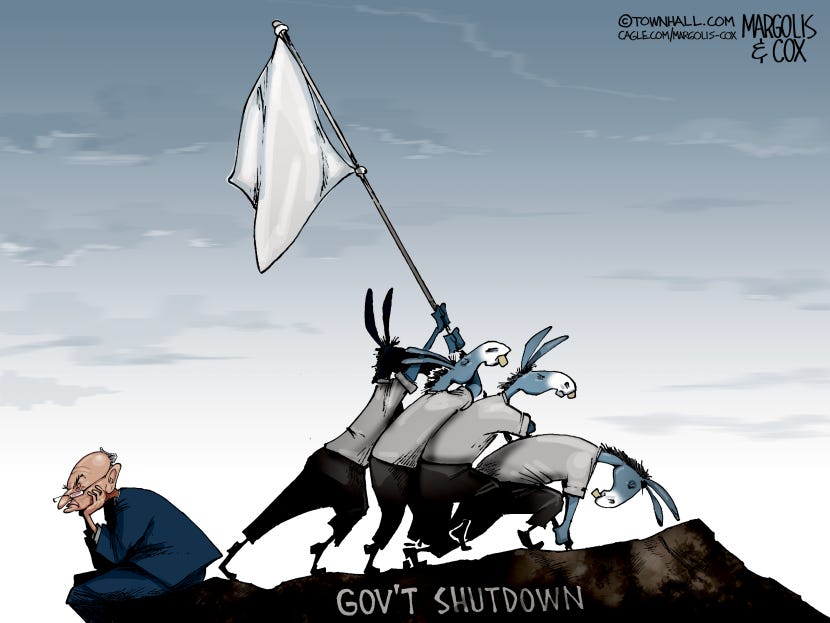
Fake cartoonists Margolis and Cox have them surrendering, too. I can’t tell what’s going on with the person in the left-hand corner because the artwork is so bad. Why didn’t they finish writing “government?” There is plenty of room.
In the new deal, SNAP and WIC will receive additional funding, and there are a few other modest concessions on spending levels elsewhere in the government. Laid-off federal workers will be rehired, and furloughed federal workers will be given back pay. But remember, this entire fight was over subsidies for the Affordable Care Act being suspended. In exchange for rolling over, Democrats got a promise from Republicans that there would be a vote on healthcare subsidies. Basically, Democrats got a promise from Republicans that they’ll think about it.
Ezra Klein, an opinion columnist for The New York Times, wrote, “This, in the end, is the calculation the defecting Senate Democrats are making: They don’t think a longer shutdown will cause Trump to cave. They just think it will cause more damage.”
I understand why Democrats may get that impression. Donald Trump is flying to Asia, playing golf, traveling to me MAGA-Lardo, going to football games for no fucking reason, and ramping up support to name the new stadium in Washington, DC after him, and it’s obvious he doesn’t care about people starving. So what does Trump care if the government shuts down? And what do Republicans care either? They’re all on vacation. Mike Johnson sent Republicans on vacation. They want Democrats to own the shutdown, but they’re not doing anything to end it.
It is especially frustrating because these Democrats have been in Washington, DC long enough to know better than to trust Republicans. I wouldn’t be surprised if Republicans never even hold a vote on the subsidies for the Affordable Care Act. I mean, House Republicans did not make this deal, so they don’t have to hold a vote on the subsidies. Only Senate Republicans have promised to hold a vote.
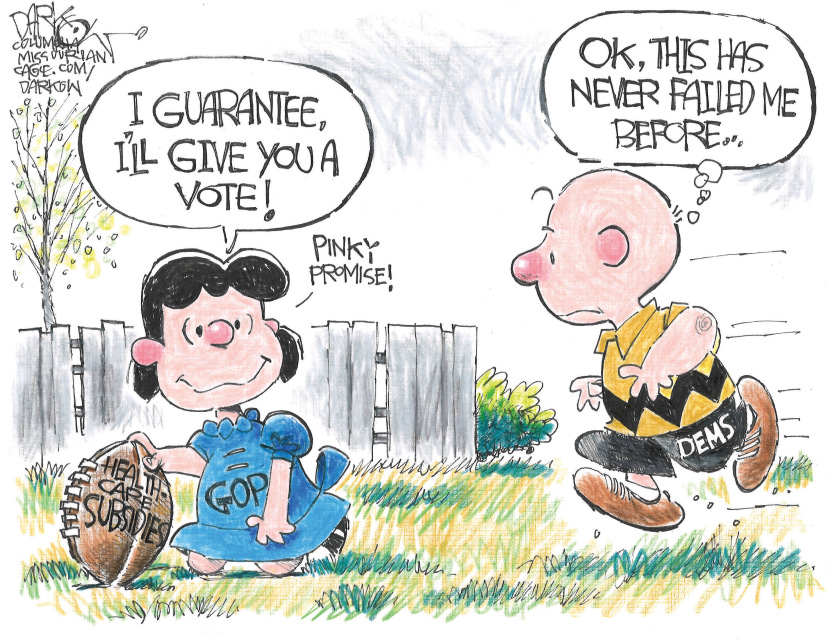
Kicking Lucy’s football is a lazy trope, but John Darkow has it right that Democrats are nothing but a bunch of suckers.
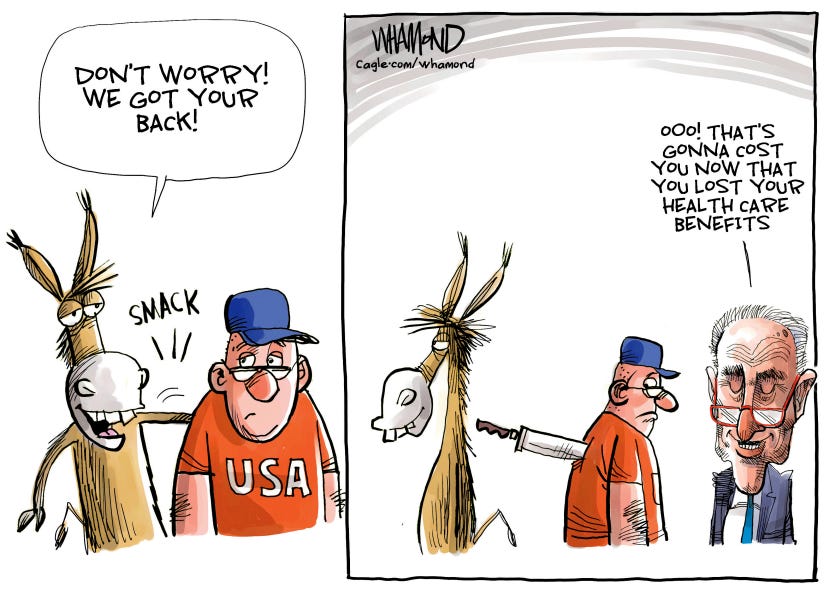
Chuck Schumer did not vote for this plan, but do you blame him as the Democratic Senate leader for it happening, as Dave Whamond has cartooned about here? Personally, whether Schumer deserves part of the blame or not, doesn’t matter in concerning his fate, as he has always been a weak leader.
Democrats have the view that Donald Trump is not caving, thus they’re caving into in without even negotiating. Are you telling me that Donald Trump’s strategy of not giving a fuck is working to sway Democrats?

Chris Britt has it right that these eight are nothing but a bunch of chickens.
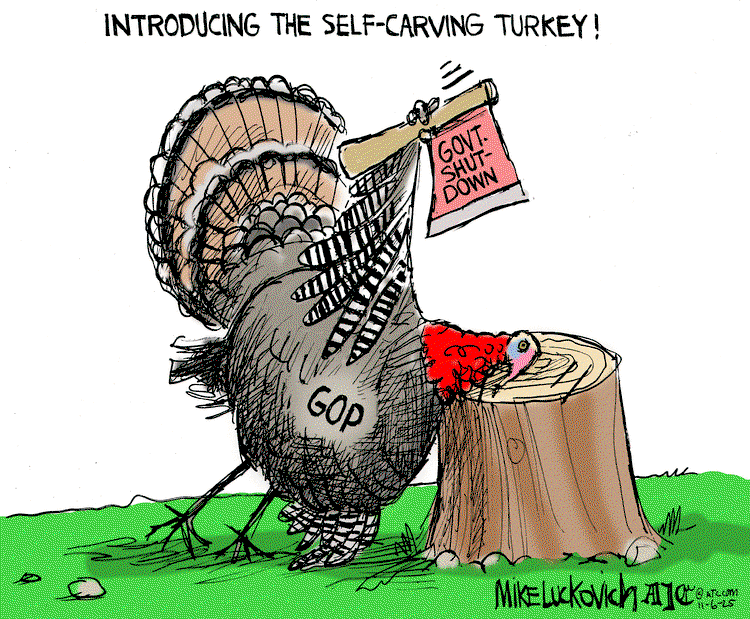
Mike Luckovich sure this cartoon last week or so, but now I believe it’s the Democrats, who are curving themselves up. If nothing else, they’re serving Obamacare up for the slaughter.
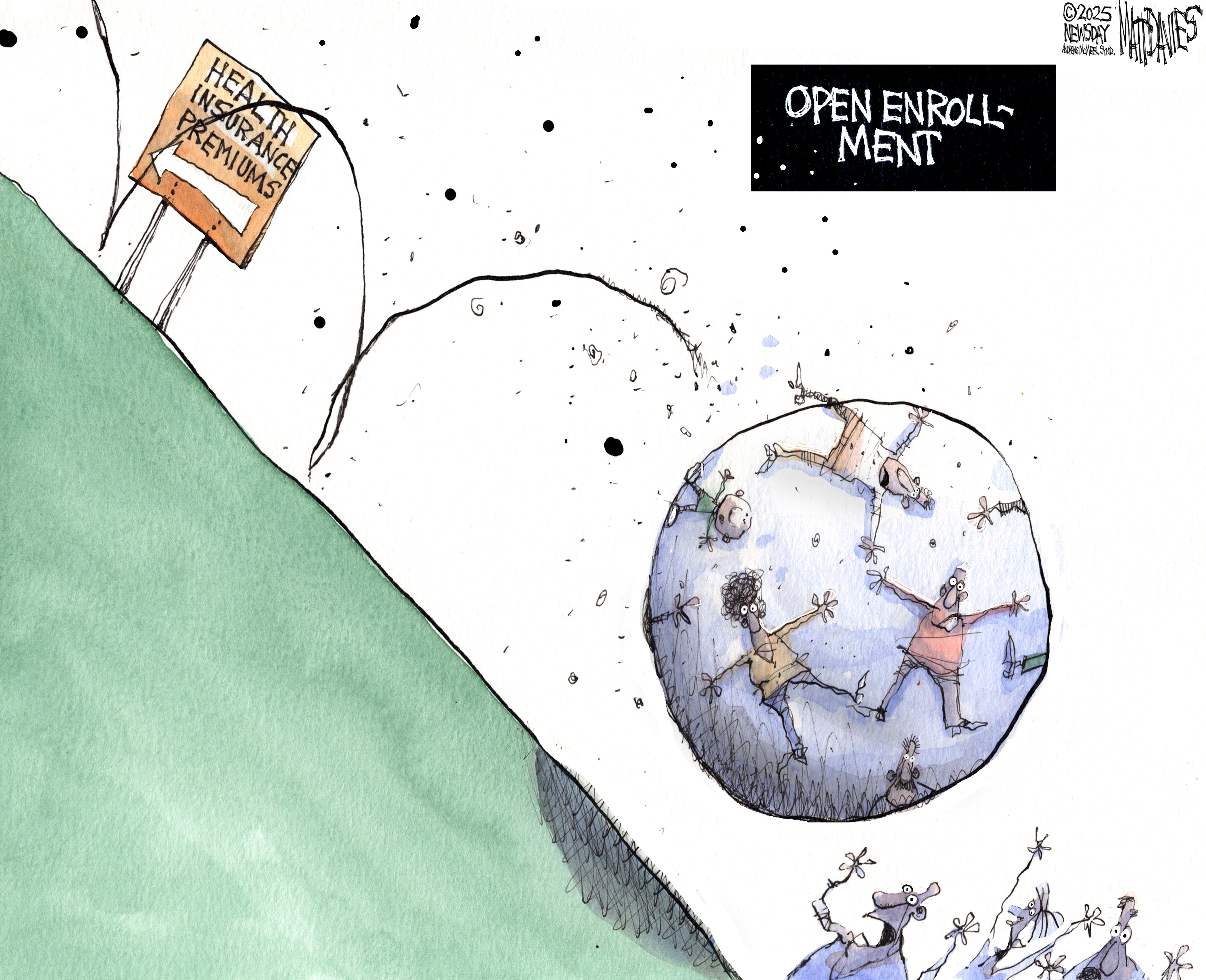
I don’t think anyone has explained the healthcare subsidy situation better than Matt Davies has. As someone who is benefiting from Obamacare and government subsidies, I feel like we’re getting rolled over.
And Steve…
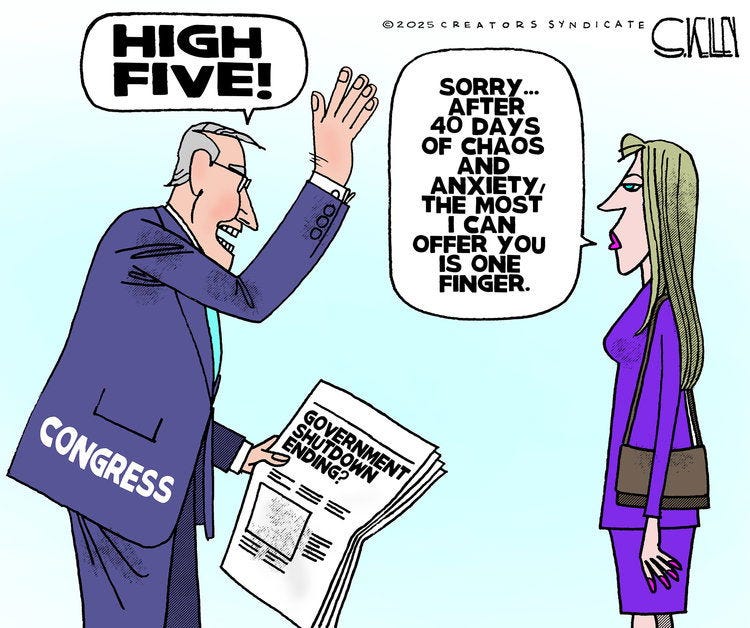
I know you get reprints when you don’t blame anyone specific, but it wasn’t just Congress that was responsible for the shutdown. Maybe someday you’ll be able to cartoon about issues after you understand them.
This was almost as cowardly as…
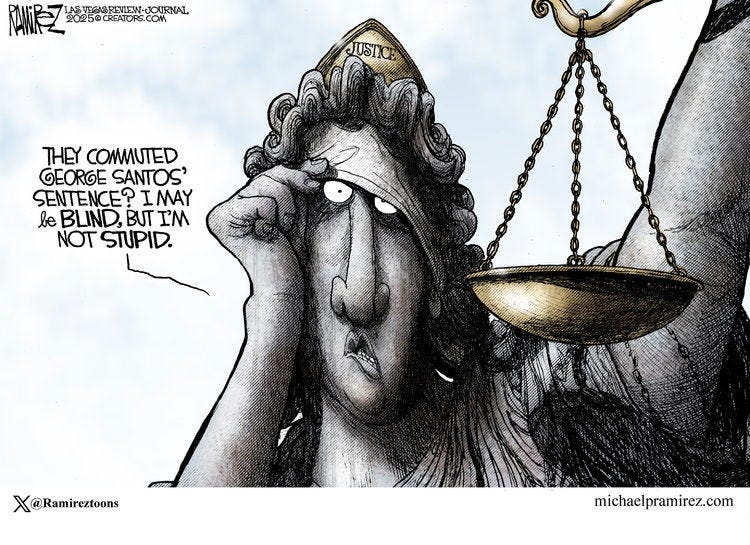
…when Ramirez was afraid to blame Donald Trump for pardoning George Santos. Seriously, Michael… “they” did not pardon George Santos. Only one person could have pardoned George Santos, and I don’t know if you know how the Constitution works, but it doesn’t say that person is “they.”
Was Rudy Giuliani guilty of trying to help Trump steal the 2020 election? Donald Trump thinks he is. That’s why he got a pardon this week. This isn’t like Joe Biden giving his son and Dr. Anthony Fauci pardons, Fauci being preemptive, because Donald Trump has proved those were necessary as he has turned the entire Justice Department into his personal attack dog, and is ordering it to go after his political enemies and seek revenge. But nobody was really going after Rudy on criminal charges in federal courts. A pardon does not save Rudy from paying out the civil judgment from the Georgia election workers any more than it stops his farts or black shoe dye from running down his skull.
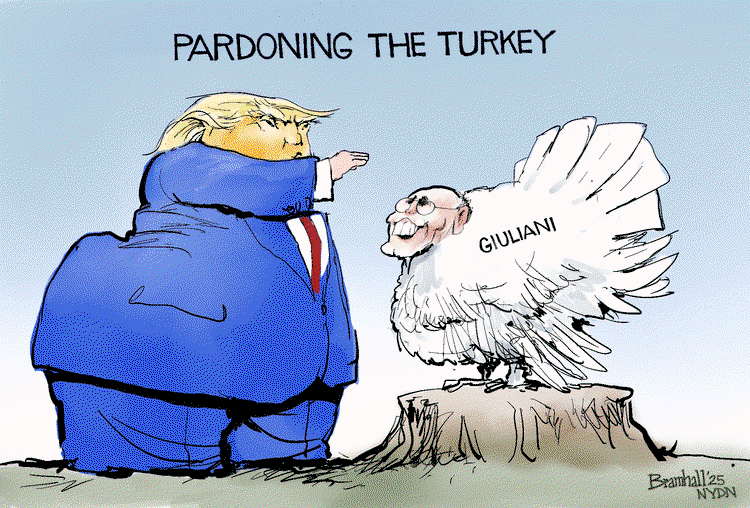
Bill Bramhall, who was a couple of days after Lucko’s turkey, caught that this pardon was in the right season.
Along with Giuliani, Trump pardoned John Eastman, a corrupt lawyer who advised Trump’s 2020 campaign; Mark Meadows, the former White House chief of staff; Boris Epshteyn, a presidential adviser; and Sidney Powell, an insane lawyer who blamed conspiracy theories for Trump’s defeat to Joe Biden. None of these people has been charged in federal courts, though they have been charged in state courts. Trump’s pardons are only symbolic as they don’t protect his friends from state charges.
This is another example of Trump using the presidency to help himself and his friends and not the American people. This is what happens when a felon gets pardon powers.
I’m sick of the new normal, which includes pandering to a 79-year-old toddler. Part of this new normal is naming shit after Trump. There’s talk of renaming the Kennedy Center after Donald Trump. There’s talk of renaming the metro system in Washington, DC after Trump, the $1000 savings account for newborns is called the Trump account, lawmakers had proposed renaming Dulles International Airport after Trump, and now, Trump is demanding that the new football stadium on the old RFK Stadium site be named after him. Donald Trump didn’t have anything to do with securing the stadium deal any more than he did with ending the war between Hamas and Israel.
As for the Metro, a Republican introduced a bill that threatened to withhold federal funding for Washington’s rail system unless the name was changed to the Trump train. Why? There’s no fucking reason given for this fealty to Trump. Republicans want to hold funding hostage, not for any policies or improvement, but just to name the system after Donald Trump. I seriously doubt Donald Trump has ever taken a ride on the Metro.
As you may know from reading this blog, I love Subway systems. I use the Metro more than any other train system, and it’s one I know very well. I will take it as a personal insult if the name is officially changed to the fucking Trump Train. This will be an insult to the entire city of Washington, and no longtime resident of the city will ever refer to it as the goddamn Trump Train.
I have said it before, and I will say it again. This is some Saddam Hussein-level bullshit. Of course, Republicans don’t care about the optics anymore.
I’m very surprised the Supreme Court refused to revisit gay marriage. You know if zealots Clarence Thomas and Amy Coney Barrett had their way, they would try to overturn it the same way they did with Roe. Precedent doesn’t mean anything to the Supreme Court anymore. Neither does the Constitution nor the law. SCOTUS would rather go by the Old Testament than by the United States Constitution.
Donald Trump is promising tariff payments to middle-income Americans. He said, “We’re going to issue a dividend to our middle-income people and lower-income people of about $2,000. And we’re going to use the remaining tariffs to lower our debt.”
Two things: this contradicts his argument that tariffs are not taxes being paid by American consumers, and his tariffs aren’t bringing in enough revenue to give everyone $2,000. If you make Americans pay these tariff dividends from the budget, then aren’t Americans paying for the dividends just like they’re paying for the tariffs? Donald Trump doesn’t even have any details for this new plan. He thinks it’s magic money that’s going to appear out of thin air.
Donald Trump wants the tariffs to pay off the deficit. American consumers are paying the tariffs. Donald Trump wants to pay American consumers out of the debt for paying for the tariffs. You don’t need to be an economics major to know that this is madness.

As Bill points out, it’s the tariff, stupid. If Democrats do come out winning over Trump’s tariff policy, I’m sure they will find a way to blow it.
Donald Trump is now demanding that the BBC apologize to him for editing part of a video of his speech before the January 6 attack, and to pay him lots of money, or he will sue them for $1 billion. This sounds like Dr. Evil threatening the BBC.

As Jack points out, ethics are lapsing with the American media. Now, when 60 Minutes interviews him (after CBS allowed him to bribe them), it’s about as ethical as when Fox News does not give him follow-up questions.
Trump believes the video made him sound more violent than he really was, ignoring that the attack on January 6 was violent and an attempt to overturn the 2020 election. But as usual, Donald Trump is demanding to be bribed. The American press has failed to stand firm against Donald Trump and his threats, so I hope the British press does not give in. I need to believe in something.

Joel Pett points out what Donald Trump wants edited out.
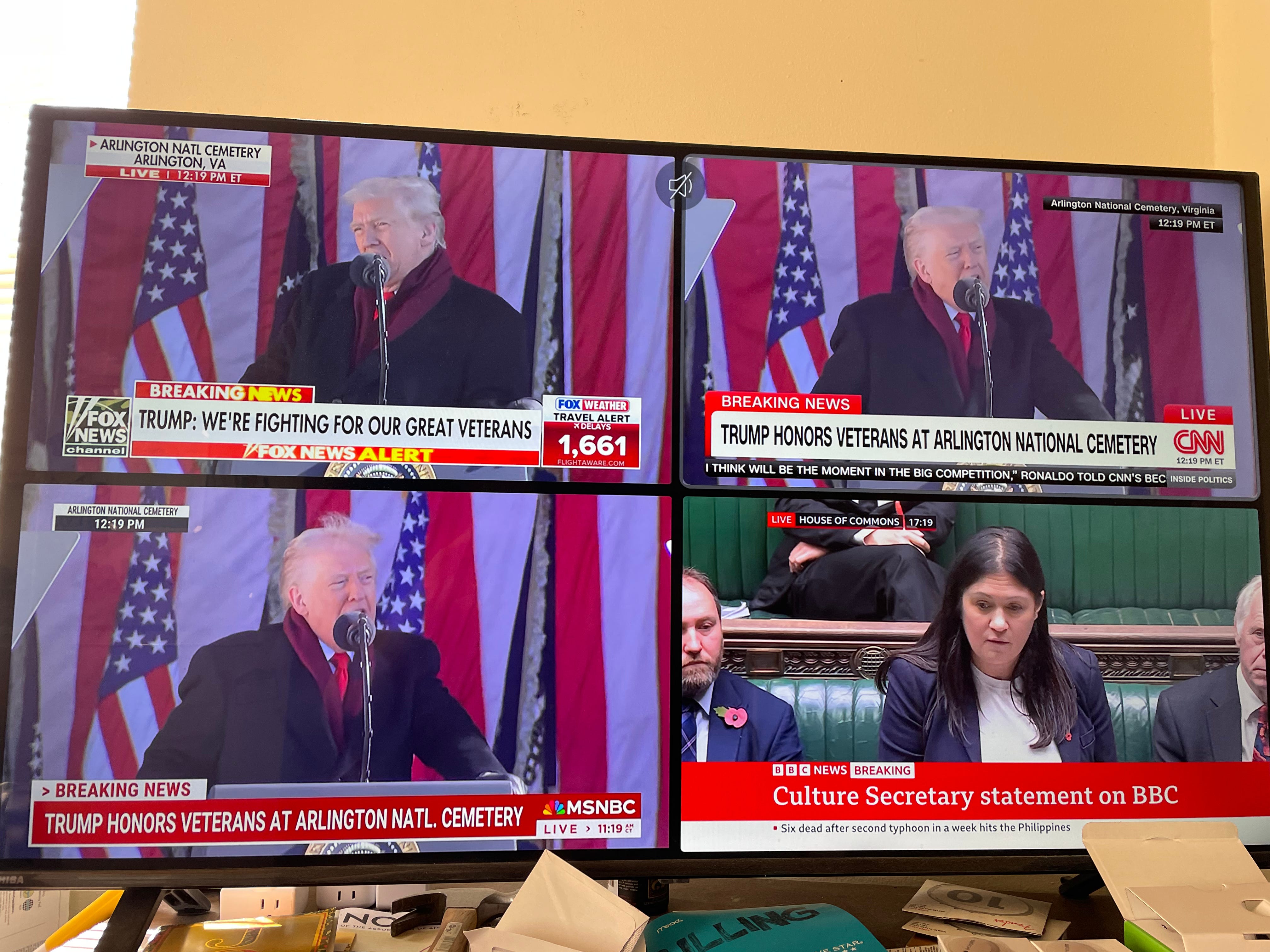
This is one reason why I like to have the BBC as one of the four channels in the multiview feature.
Have you heard of Mar-a-Lago face? Usually, people who have a little work done don’t want to advertise it. Most people lie about it when questioned. But now it seems that they’re all going the Kristi Noem route, and going for the Melania. Having your lips filled and being proud of it is very much a Palm Beach thing, but now it’s extending to Washington, DC. Now there are MAGAts in Washington who are having work done, and they’re proud of it. They want everyone to know, which means their faces look fucking stupid. It seems the facelift of Washington isn’t just going to be in the city. I guess collagen-filled lips are better for kissing Donald Trump’s ass with. Dammit, that’s a political cartoon.
If I see a bunch of Kristie Noems on the “Trump Train,” I’m going to lose my shit. Last June, during Trump’s birthday parade, I did tell some MAGAts on the metro to fuck Trump. A MAGAt’s right to free speech to wear that ugly cap on the Metro also applies to my free speech to tell them to go fuck themselves.
Let’s talk about some stroke stuff. I am currently wearing a temporary heart sensor. I hate it. Since I got out of the hospital, it’s been the bane of my existence.
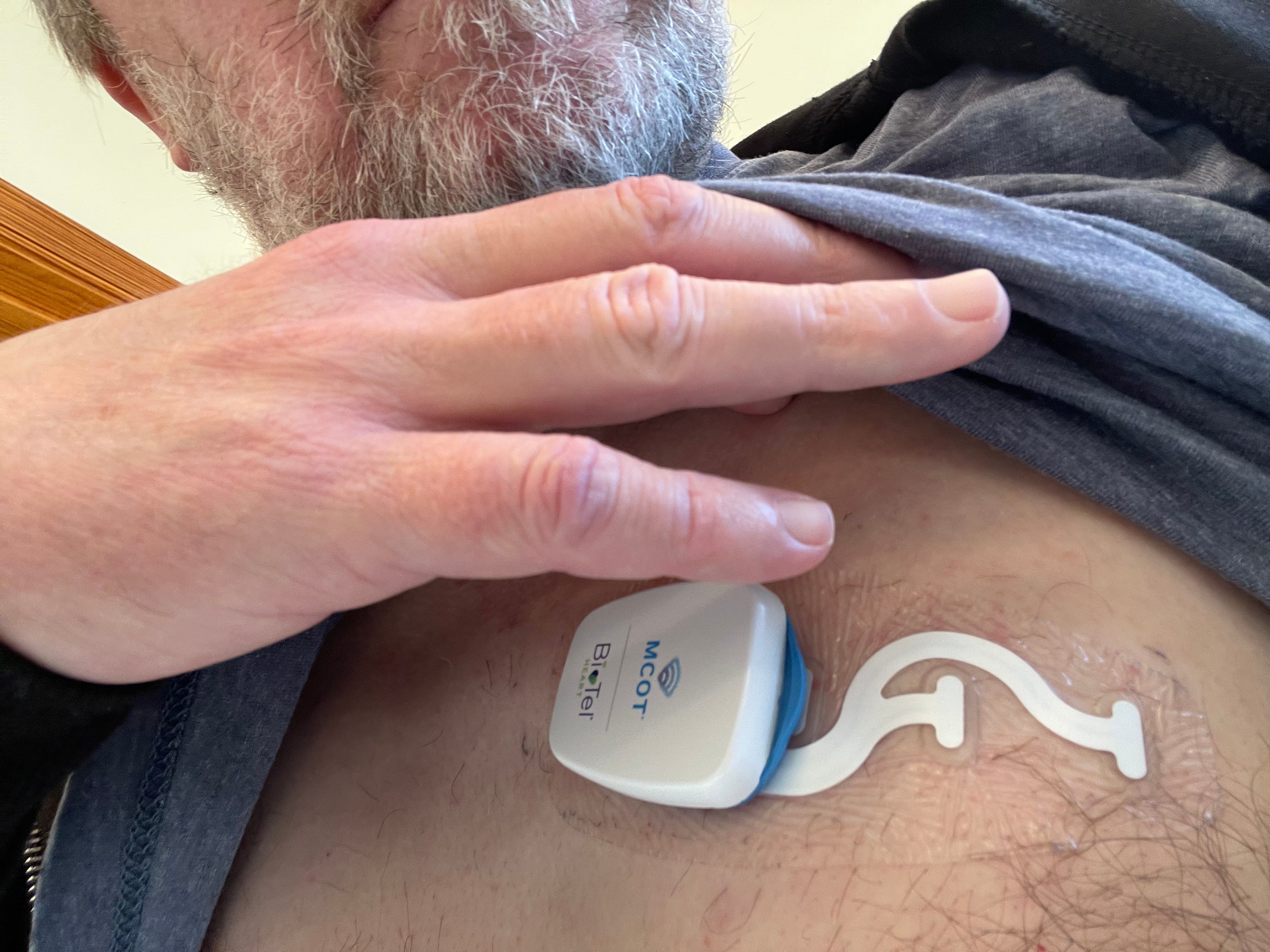
(snip-go see. It’s a decent-sized blog entry.)
Let’s talk about Trump and Obamacare royalties….
Please watch. As she says the site is called Dunning Kruger and states it is not fake news or lies because it is totally fictional and made up. But tRump believes it. Hugs
 Scottie's Playtime