Some Important Info; May Not Be Everywhere Because the U.S. Gov’t Is Observing the Epstein Shutdown

Lead in protein powders. What you need to know by Katelyn Jetelina

The Dose Read on Substack

Happy Monday from Atlanta! I just tried to convince thousands at a public health conference that it’s time to reimagine systems—not just defend the status quo. I’m happy to report that tomatoes weren’t thrown my way. This is my fourth state in five days, and the highlight is actually seeing the seasons change and meeting a lot of you in person. I couldn’t be more excited to see my girls (and survive another round of the KPop Demon Hunters soundtrack).
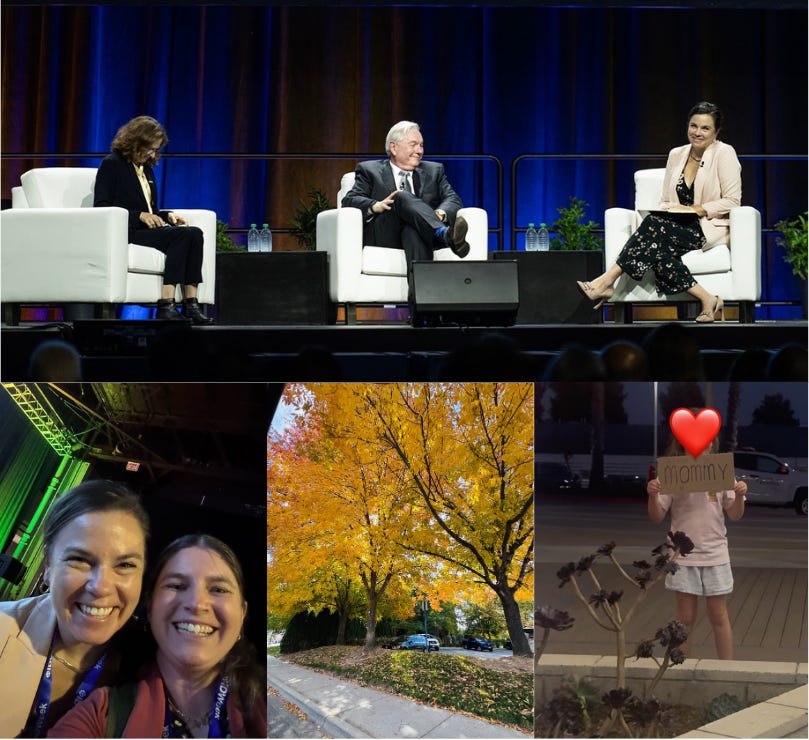
Top: Plenary stage with Mike Osterholm; From the bottom left: Met YLE reader Krisandra Allen at the conference. Fall leaves in Idaho. My daughter welcoming me home at the airport.

This week’s Dose runs the gamut: from what’s really going on with lead in protein powders (and whether you should be worried), to a refreshing burst of leadership as 15 governors join forces to strengthen public health collaboration, to falsehoods swirling around mammograms. We’ll wrap with an infectious disease weather report and a quick note for dog owners on an FDA recall.

Let’s go!


Consumer Reports found lead in protein powders. How bad is it?

Last week, Consumer Reports released an analysis revealing elevated lead levels in several popular protein powders and shakes. Google searches for “lead in protein powder” spiked 300%, and influencers lit up social media. Depending on which news source you read, it was either a five-alarm fire or no big deal.

So what’s actually going on? Lead is everywhere—soil, food, water, and air. Thankfully, overall exposure has dropped dramatically since the 1970s, and modern lab tests can now detect vanishingly small amounts (down to parts per billion). But detection does not necessarily equal danger.

How bad is bad? That’s where things get tricky because not everyone agrees:

  • California limit: 0.5 mcg/day. This number comes from a very conservative calculation: regulators took the “no observable effect” level for reproductive harm for inhaled lead exposure in workplaces and divided it by 1,000. Many experts argue that this threshold is unrealistic. It’s also not linked to adverse health outcomes.
  • FDA’s limit: 2.2 mcg/day for kids, 8.8 mcg/day during pregnancy, and 12.5 mcg/day for other adults based on blood lead levels, toxicology data, and a built-in 10x safety factor.
  • European Union limit: Allows up to 3 mg/kg (3 ppm) in food supplements—roughly 90 mcg per 30-gram scoop of protein powder. In this case, the FDA is far more cautious than Europe (and that’s not usually how things go).

Back to the report: of the 23 protein supplements they tested, two-thirds exceeded “Level of Concern.” One brand (Naked Nutrition Vegan Mass Gainer) hit nearly 16 times the limit. But because Consumer Reports used California’s exceptionally strict benchmark, those numbers sound scarier than they really are.

The average American already gets 5.3 mcg of lead daily from food and the environment. That’s another reason California’s cutoff doesn’t make much sense. Still, some products identified in the report could push intake close to the pregnancy (8.8 mcg) or adult (12.5 mcg) daily thresholds.

What this means for you: Don’t worry too much. While the FDA continues to reduce lead exposure through programs like Closer to Zero and the Total Diet Study (that is, if the funding continues), there are several things we can do in our own homes, especially for parents of kids and during pregnancy.

  • Check to see if your protein supplement (or any supplement, really) has third-party testing for heavy metals (like USP or Informed Sport).
  • Advocate for more pre-market regulatory oversight in the supplement industry (which has very little, if any at all) by writing to your local representative.
  • Eat a diet that includes a variety of nutrient-dense foods, which helps limit exposure to specific food sources and ensures we get an array of protective nutrients.
  • Prioritize getting your protein from whole food sources.

Big thanks to YLE’s Megan Maisano—Registered Dietitian Nutritionist— for writing this section.


Fourteen states and Guam join forces to launch Governors’ Public Health Alliance

Governors from 14 states and Guam announced the creation of the bipartisan Governors’ Public Health Alliance, which is a new effort to strengthen coordination and collaboration across state lines.
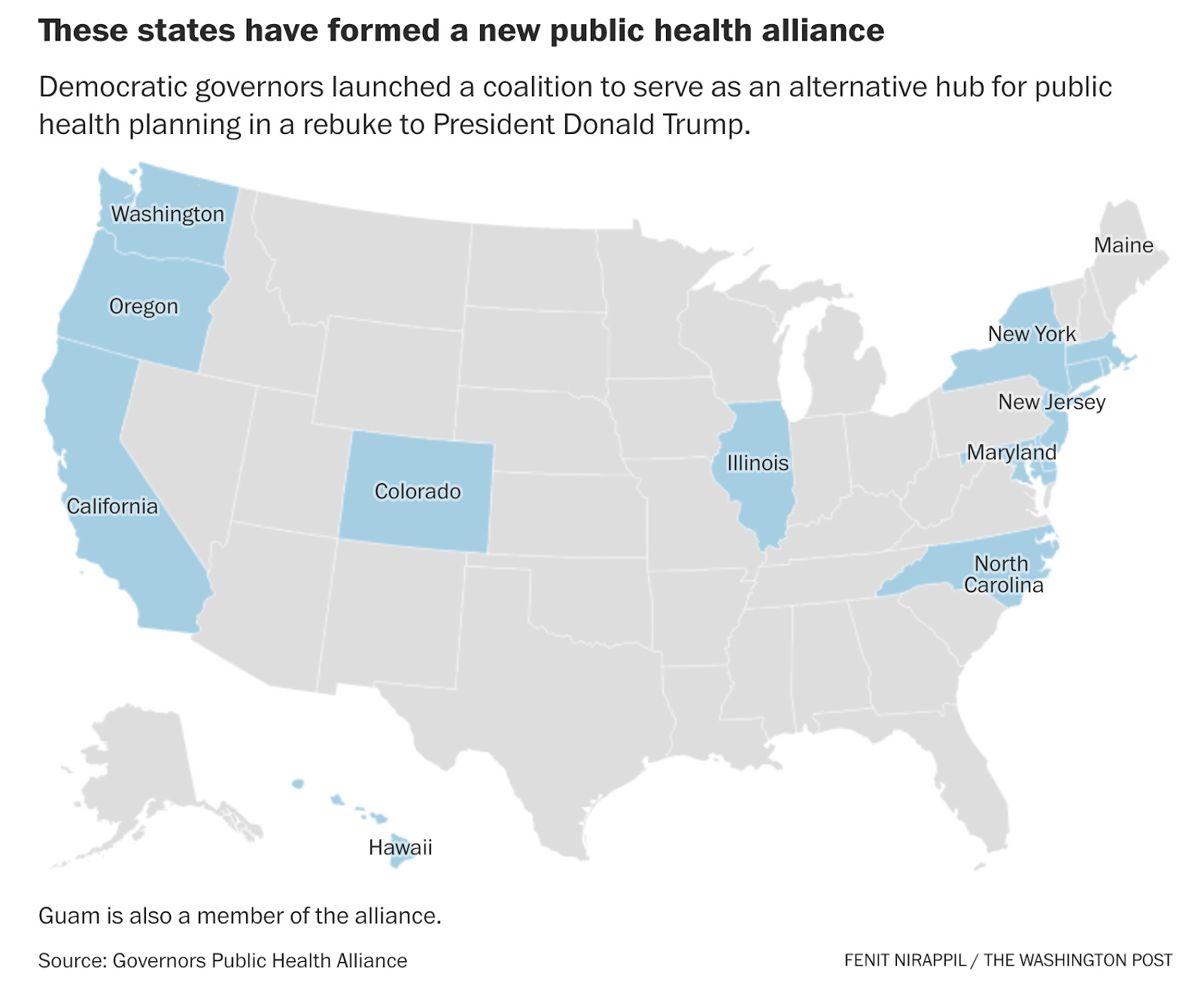
Why do we need this? In the U.S., authority over health rests with the states, not the federal government. Health (encompassing both health care and public health) is not only the highest budget item for a state but also the primary reason for state bankruptcy. In other words, governors hold enormous power over your health.

Today, though, federal support is shifting fast, funding is drying up, and states are being forced to get creative. States must decide whether to maintain their public health departments (due to funding cuts), how to continue purchasing vaccines (if the federal government stops recommending them), whether to negotiate drug prices (like insulin), and more. We saw a similar challenge during the pandemic with bulk purchasing of PPE.

In general, the more coordinating, collaborating, and innovative thinking, the better.

However, I’m growing increasingly concerned about the partisan gaps in public health. Although some Republicans are on the advisory board and the initiative was framed as bipartisan, no Republican-led states have joined. This worries me for my friends in red states, like Texas, but it also has implications for everyone, as diseases don’t care about borders.

What this means for you: If your state is included, you can rest assured your governor is talking to others, which is a helpful step toward innovative solutions. You could argue it was needed before this moment, too. Public health has been siloed for far too long.


Mammograms save lives. They’ve been wrongly targeted.

Happy Breast Cancer Awareness month! Unfortunately, this month has driven some influencers to post false claims about the harms of mammograms. So let’s clear this up.

Breast cancer is the second leading cause of cancer death in women in the U.S., and accounts for 1 in 3 new cancers among women each year. (It affects men too, just at lower rates.) There is strong scientific consensus in support of routine mammograms to prevent breast cancer and detect it early:

  • Randomized trials show that mammograms reduce the risk of death from breast cancer by 12-20%, depending on age. For every 1,000 mammograms, one death is prevented.
  • Regular mammograms starting at age 40 are recommended for everyone, but may have even greater benefit for Black women, who are 40% more likely to die from breast cancer than white women and more likely to have aggressive cancers, younger.

There’s some critical nuance here:

  • With each mammogram, breast tissue is exposed to a small amount of ionizing radiation. But! We’re exposed to this type of radiation every day in our natural environment. At high doses, radiation exposure can change DNA and cause harm, but the amount of radiation exposure during a mammogram is about the same as flying from California to New York.
  • Organizations disagree on whether mammograms every year or every other year are optimal. Screening recommendations are based on evaluating science to maximize benefit (lives saved) while reducing patient worry, unnecessary costs, and diagnosing and treating cancers and pre-cancers that ultimately wouldn’t cause health problems—also called “overdiagnosis.” This is a balancing act.
  • Mammograms are just one tool for detecting cancer, and women with dense breasts or high risk for cancer (e.g., family history, known genetic predispositions, or other key risk factors) may benefit from additional screening, such as through an MRI.

What this means for you: The benefits of mammograms far outweigh the risks. The U.S. Preventive Task Force, the American College of Radiology, the American Society of Breast Surgeons, and the American College of Obstetricians and Gynecologists recommend routine mammograms starting at age 40 for women at average risk of breast cancer. If you have risk factors for breast cancer, dense breasts, or you’re 75 or older, talk to your doctor about your screening goals and plan. Don’t know your risk? Here’s one risk assessment tool.

For more, see YLE’s deep dive on breast cancer screening recommendations.


Infectious disease “weather report”

In the U.S., flu and RSV are still quiet. CDC data is still on pause because of the government shutdown, so we’re continuing to reference PopHive data. RSV activity is still low but growing in southern states, like Louisiana and Texas.
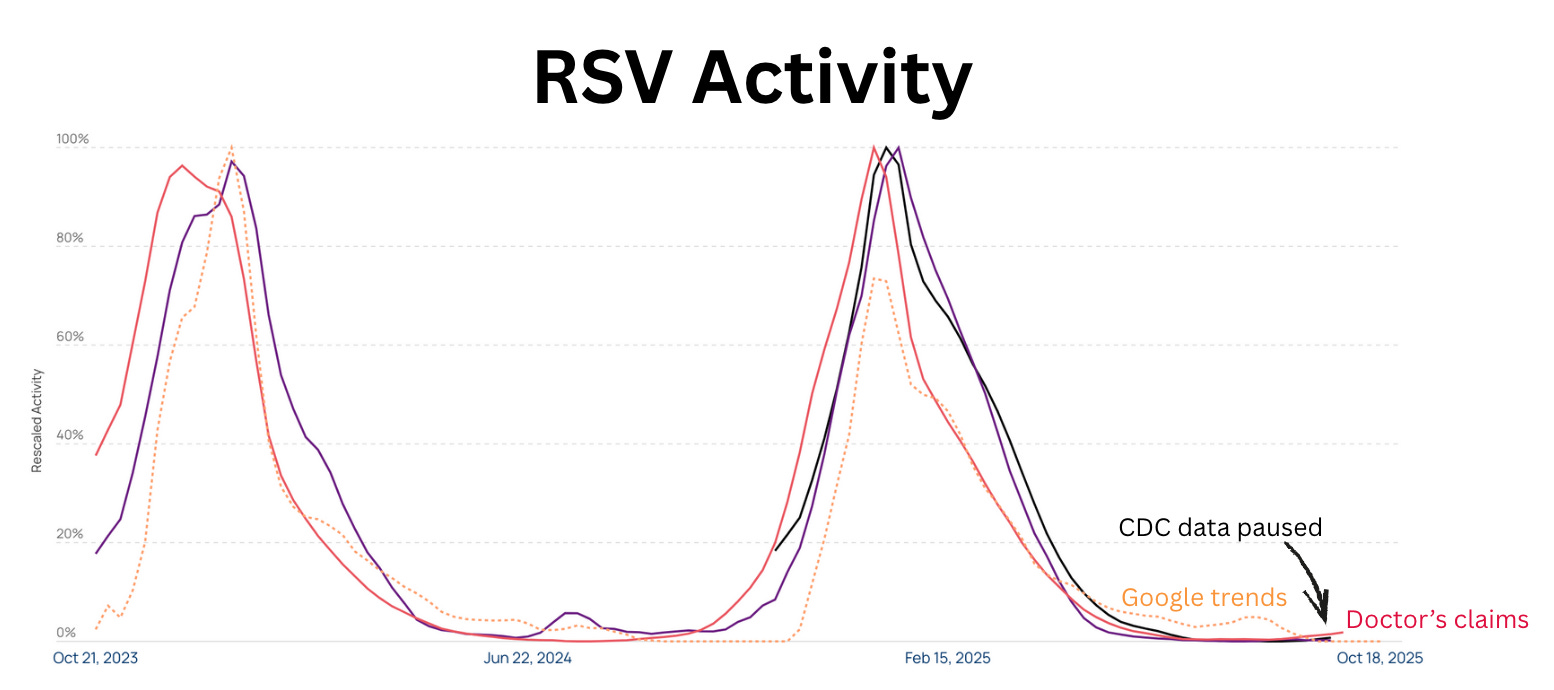
RSV Activity in the U.S. Figure from PopHIVE

However, Covid-19 is having a moment in the U.K., with hospitalizations increasing exponentially after a 10-month lull. This isn’t driven by a dramatic variant, but rather by a lack of immunity building up over time. Flu might also be increasing, which suggests it’s coming soon (as expected) for the U.S.
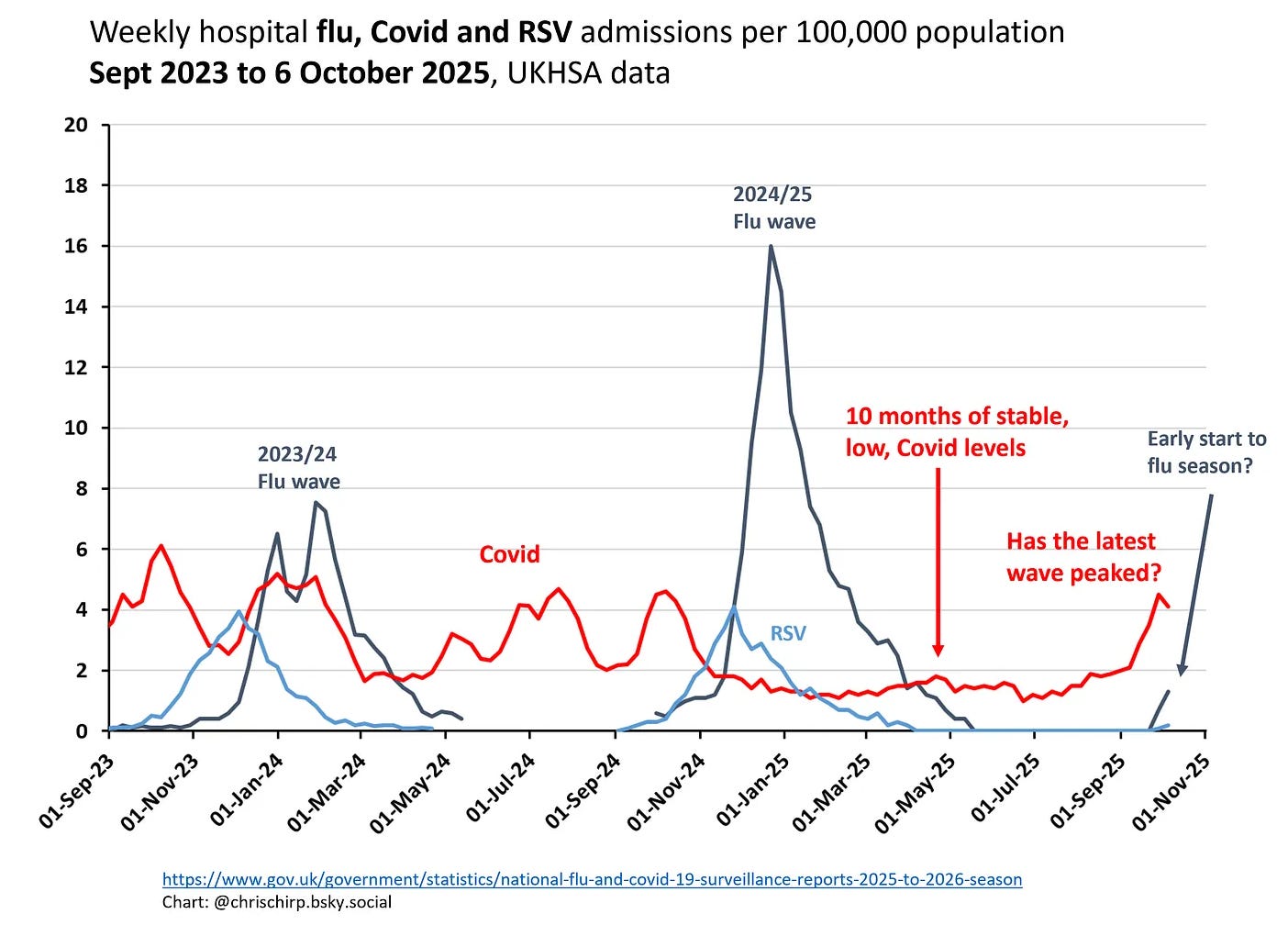
Figure from Dr. Christina Pagel’s Substack.

Dog owners, check your pup’s food

The FDA ​​recalled Raw Bistro frozen beef dog food for possible Salmonella contamination. The recalled products were sold directly to consumers and to select distributors between Sept. 1 and Sept. 17 in California, Colorado, Illinois, and Minnesota.
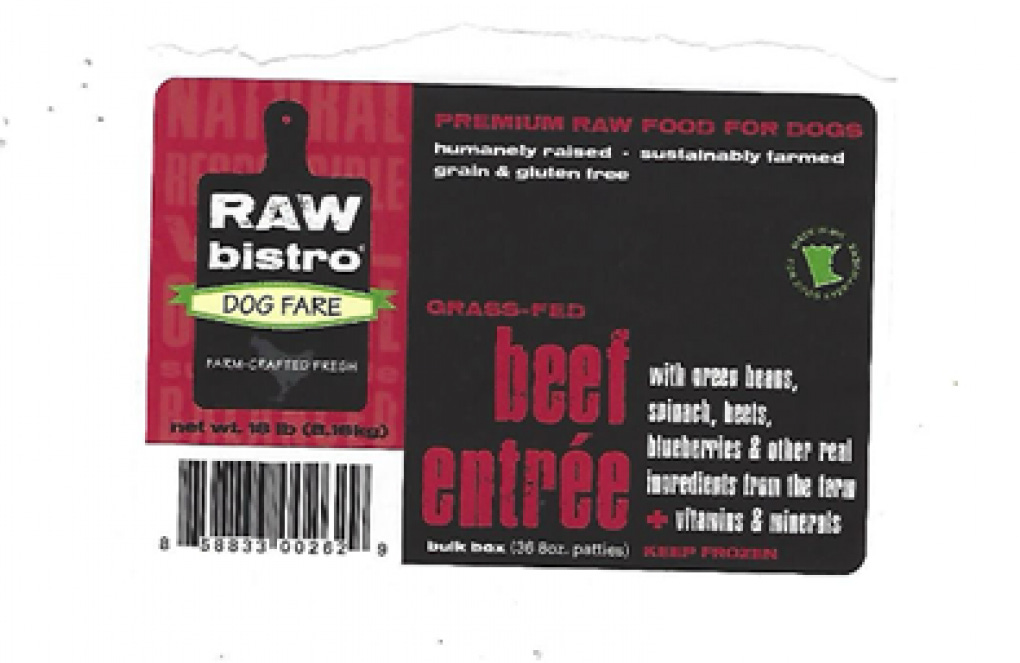
Salmonella can make dogs sick, just like humans. Contaminated food can cause illness days later in dogs. And dog owners can get sick from handling contaminated food or dog bowls.

What this means for you: Check the lot numbers on your dog’s food, and toss it if they are included in the FDA recall notice. Sanitize bowls if they held contaminated food, wash your hands, and watch for warning signs in your dog: lethargy, vomiting, diarrhea, and loss of appetite. If you notice these signs, take your pet to the vet.


That’s it for this week! Share your fall leave pics in the comments below so that I can continue to live vicariously through you.

Love, YLE


Your Local Epidemiologist (YLE) is founded and operated by Dr. Katelyn Jetelina, MPH PhD—an epidemiologist, wife, and mom of two little girls. YLE is a public health newsletter that reaches over 400,000 people in more than 132 countries, with one goal: to translate the ever-evolving public health science so that people are well-equipped to make evidence-based decisions. This newsletter is free to everyone, thanks to the generous support of fellow YLE community members. To support the effort, subscribe or upgrade below:
Presidential Libraries: Last Week Tonight with John Oliver (HBO)

And the scams continue.   Hugs

Boston Legal – Same sex attraction disorder (Alan Shore)

Keeping Up With Clay Jones

Stroke day by Clay Jones

How it happened Read on Substack

I visited Southern California last June. I got to hang out with friends. I ate fish tacos and sushi. I went to the beach, and I got to walk on the Oceanside boardwalk. I saw pelicans and sea lions. I had a great time. You might remember this. But near the end of this trip, I started to suffer from some shoulder pain. I thought it was just a pinched nerve, probably from sleeping on a teenage girl’s bed. No, she was not in the bed at the same time. She was in Ireland. The pain lasted for a few days, but vanished after I had gotten back to Virginia.

I had a pretty good summer. I went to the National Cartoonist Society’s convention in Boston for just an afternoon. I visited New York City for a few days, and I saw my good friend Alexandra. I went to the annual convention of the Association of American Editorial Cartoonists outside of Washington, DC, and I won the Rex Babin Award for Excellence in Local Cartooning. It may have been the best time I’ve ever had at one of our conventions.

Next on my agenda was a trip to Europe. I was going to visit Berlin, then fly to Sweden, then take a train and visit Copenhagen, then Hamburg, and then Amsterdam, where I was going to visit the Van Gogh Museum. I was going to spend a night in Brussels, then spend a few extra days in Paris, and see the Louvre. I was going to wrap up my trip by revisiting old friends in London and Dublin. And a week before this European trip, my shoulder started to hurt again.

I thought the pinched nerve had come back. On Monday, October 6, the pain came back with a vengeance. The shoulder pain from June was no comparison to the pain I had two weeks ago. While the pain was brutal, it didn’t stop me from getting down on my hands and knees and cleaning my toilet because my Landlady and a plumber were coming to my apartment the next day. By Thursday, with my European trip just four days away, I thought there was no way I could go jet-setting with this sort of pain. I was still thinking about Europe that morning, but by that afternoon, I was thinking about the hospital.

The pain was at its worst on Thursday. I took some aspirin in the morning, and a couple of hours later, I took some ibuprofen. I worked on the day’s cartoon, not knowing it would be my last for a while. But a point came where I just had to lie down, even before my cartoon was done. I lay down for a short while, and when I got up, I noticed I was a little lightheaded. When I walked to the bathroom, my hands were along the walls so I wouldn’t fall. I finished my cartoon and realized that I was having a hard time putting the Apple Pencil where I wanted it to go. It was about this time that I started to think about the hospital.

I was in the mode of thinking that the hospital was kind of silly. I Googled about my shoulder pain, and I saw that it could be a symptom of a stroke. I thought, “Not on the right side, right?” Yes, even on the right side.

I decided to eat something first because I didn’t know when I would get a chance to eat again. I started to make some Chef Boyardee, which I don’t like at all, but I just needed to get something in my system. And I realized then that my right leg wasn’t really working. I could stand and I could walk, but I was kind of dragging my leg. A few hours later at the hospital, my entire right side pretty much collapsed.

I have a lot of friends here in Fredericksburg, but I thought of who would get me to the hospital the quickest. I thought about who would come running right away. Who would come running when I cried? I thought Melisa Casacuberta would be the quickest. I sent Melisa a message, simply asking if she could do me a favor and take me to the emergency room. I didn’t tell her why. She was at my house within 10 minutes. First, I had to navigate my stairs, which I did while having both hands on the handrails. I live above a restaurant, and as I stood outside waiting for Melissa, I leaned against a pillar, pretending to be Joe Cool as customers walked past me.

I live close to the hospital, so it didn’t take long to get there. I packed my iPhone, MacBook, and iPad (I was thinking I could still draw some cartoons) with me in my backpack. The security guard at the hospital made me walk through security three times because something in my backpack kept making the metal detector go off. Never mind, I was having a stroke. I didn’t sit and wait in the waiting room as the staff saw me immediately. Within minutes, I was in an MRI.

Yup. I had a stroke.

As you probably already know, I am now at the rehab center. Each day is filled with physical therapy as well as what you might call mental therapy. When I’m not in therapy, and I’m lying in my bed, I am working on some of my therapy. Today was Sunday, and I was supposed to have it off from therapy, but one of the trainers, one I had never worked with before, came in and asked if I wanted a workout anyway. She said she had some time and asked some of the other trainers who she could work with, and she was told I was pretty much good to go. She kicked my ass.

It bothers me that yesterday was No Kings Day, and I didn’t get to do anything with it. Several of my friends, even a few who visited me here, like Melissa Colombo, participated. I have cartoon ideas every day, and it kills me that I’m not drawing them. I wonder if there are any cartoonists out there who would actually want to use my ideas? Not that I would give them to them.

I think from this point that I should start blogging about news instead of just about myself. I don’t want to be a broken record. I am already a broken human. That doesn’t mean I’m not going to write about the stroke anymore, but I need to start writing about the attack the fascists on this country. I have time to think of the columns when the nurses forget I’m in the bathroom. Yes, they do that.

The columns are still hard to write as I am doing them by dictating into the MacBook microphone and typing with one finger. If you see any mistakes or boogers, you’re just gonna have to live with them, like boogers. That was a boo-boo.

I’ll leave you with something funny I’ll leave you with something funny.

One of my trainers is very serious. I have yet to hear him laugh. He is a nice guy, and he’s not strict. I just don’t think he laughs.

Yesterday. I was in a session, and I was walking in the gym. This requires a lot of concentration while I am walking. The trainer is right in front of me, and usually, there’s another trainer right behind me with the wheelchair ready for me to fall into it.

There are usually several trainers and patients in the gym at the same time. I could hear one trainer talking to his patient while we were walking, and he asked the patient what his favorite food was. The patient said his favorite food was baloney sandwiches. I looked at my trainer while I was walking and said, “Baloney sandwiches? Bleah!” I finally made my trainer laugh.

May be an image of 1 person and kayak

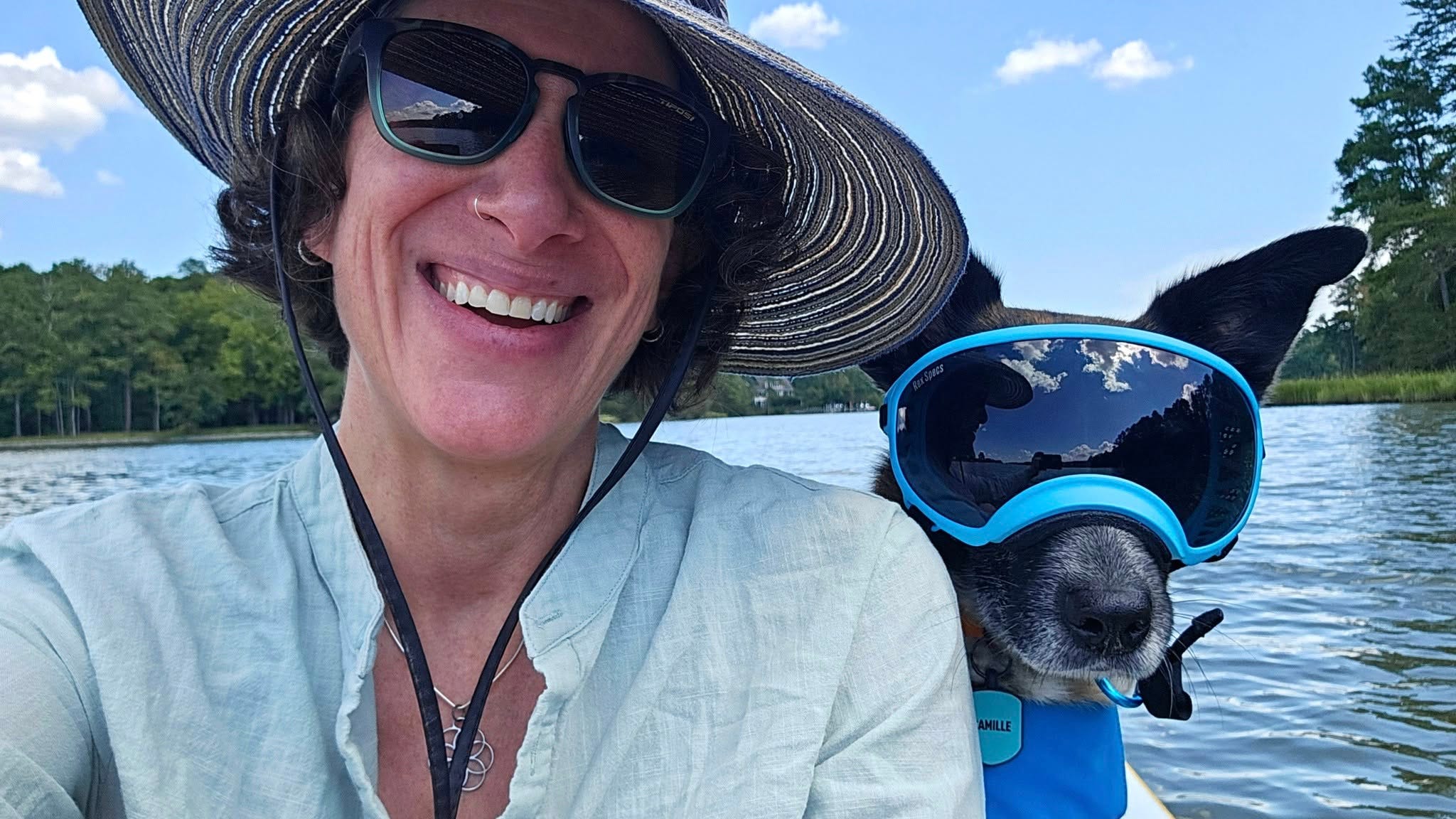
This is Melissa Colombo. She has been a godsend. She has checked my apartment, briefed my insistent Roomba, brought me clothes so I would not walk around here with my ass hanging out, checked my mail, taken out my garbage, thrown spoiled food out of my fridge, visited me in rehab, and has even done some of my laundry.

That dog hasn’t done shit. (snip)

Zohran Mamdani clips from The Majority Report

DUMB AS A ROCK WITH SKIN CANCER! | Armageddon Update

My Boyfriend Founded Uncloseted Media. It’s What I Needed as a Kid

Growing up as someone who is different from the majority is difficult no matter the circumstances.  For the LGBTQ+ it is horrific when just your very existence is called an abomination and you are equated with the worst being in history.  Especially when your parents and your god are pushing the idea that you are a monster who can only be cured if you follow their god, their church doctrines, have their feelings about everything in your life.  Hugs.  


https://www.unclosetedmedia.com/p/my-boyfriend-founded-uncloseted-media

At 40 years old, I am still shedding an upbringing of religious trauma. But today, I feel free.

Three clips from The Majority Report about ICE being totally out of control

ICE Makes Huge Mistake In Chicago


Trump’s ICE Is Out Of Control

ICE Goes Fully Unhinged By Smashing Into Watchdog’s Truck

Well, I Didn’t Get My Post Newsletter Until Yesterday. Belated National Dictionary Day:

In a Word: National Dictionary Day

Why dictionary lovers celebrate Noah Webster’s birthday.

Andy Hollandbeck

Senior managing editor and logophile Andy Hollandbeck reveals the sometimes surprising roots of common English words and phrases. Remember: Etymology tells us where a word comes from, but not what it means today.

On October 16, 1758, Noah Webster and his wife Mercy Steel Webster welcomed a new son into their lives. They named him after his father. Noah Sr. was a farmer and weaver, and Mercy was a homemaker, and by all outward appearances, they lived a rather normal life in the West Division of Hartford — what would become West Hartford, Connecticut.

Though the elder Webster had never attended college himself, he placed great value on education, so from an early age, Mercy taught the younger Noah what she could of spelling, mathematics, music, and other subjects. At age 6, he began attending a one-room schoolhouse; later in life, he described his untrained teachers there as the “dregs of humanity.”

Regardless, Noah took to learning like a fish to water, eventually outgrowing the educational opportunities of his hometown. When he was 16, Noah Sr. mortgaged the family farm so that they could afford to send the younger Noah to Yale University to continue his studies; he graduated four years later in 1778, in the midst of the American Revolution.

After Yale, Noah wanted to study law, but his family couldn’t afford it. Remembering the deficiencies and horrors of his grade school days, he recognized that education might be a better place to make his mark. So he became a teacher.

Most of the books used in American classrooms at the time still came from England — some even included pledges to King George. There was also the matter of patriotism. There was a scarcity of American textbooks for American children, and Noah Webster decided he could help.

So in 1783, he published his own textbook, A Grammatical Institute of the English Language. Because it was printed with blue covers, it was known colloquially as the Blue-Backed Speller, and it became one of the most popular American books of the late 18th century, helping teach children to read, spell, and pronounce words.

But the words themselves were still anchored in Great Britain, and the lexicography coming out of England didn’t encompass the American experience. This realization set Webster on a course that would change the language. In 1801, he began collecting words and their definitions with the aim of creating an American dictionary.

His first edition, published in 1806, was called A Compendious Dictionary of the English Language, and it contained the spellings and brief definitions of 37,000 English words, including thousands of new words that originated on the left side of the Atlantic, words like skunk and raccoon and moccasin (entered as “Moccason or Moggason”).

Webster wasn’t the first to refer to his word hoard as a dictionary. That word had been used in English to describe a reference work at least since the early 16th century, including in the titles of Henry Cockeram’s The English Dictionarie (1623), Thomas Blount’s Glossographia; or, a dictionary interpreting the hard words of whatsoever language, now used in our refined English tongue (1656), Samuel Johnson’s Dictionary of the English Language (1755), and Francis Grove’s A Classical Dictionary of the Vulgar Tongue (1788).

The word was apparently coined by John of Garland, a 13th-century English teacher, from the Latin dictio “speech, word.” There are quite a few dict words in English from the same source, such as edict (“to speak out”), contradict (“to speak against”), and benediction (“to speak well”). The adjectival form of dictio is dictionarius, meaning “of words.” In Medieval Latin, a book containing an ordered list of words was called a dictionarium (which might be a shortening of dictionarius liber), whence the English dictionary sprang.

Compendious is an interesting word. It traces to the Latin preposition com “with, together” and pendere “to hang, to weigh.” Compendium is literally “that which is weighed together,” but in Latin it meant “a shortening, a shortcut.” A compendium is a concise summary of a larger work or, more generally, a compilation of related things. The adjective compendious, then, was chosen to indicate Webster’s attempt to be both comprehensive but also brief.

And brief is a good word to describe the entries in Webster’s Compendious Dictionary, especially when compared with all the information found in dictionary entries today. The vast majority of entries are a single line on pages arranged in two columns. And while they are technically accurate definitions, they don’t always help the reader understand how to use the word. For example:

Definite, n. a thing defined or explained

Sailing, n. the act or art of sailing

Stoic, n. a philosopher of the sect of Zeno

Webster continued to collect, define, and compile words, and in 1828, at the age of 70, he published what is considered his magnum opus: An American Dictionary of the English Language, containing definitions for about 70,000 words. That the word American replaced Compendious in the title says a lot about his motivations. He was working toward a new edition when he died in 1843.

Webster famously simplified (corrected is the word he used) the common spellings of some entries based primarily on pronunciation, creating the separation between British English and American English that exists today. For example, his dictionary dropped the u from words like colour and honour. He also favored -ize over ­-ise in words like crystalize and emphasize, though he wasn’t wholly consistent.

Though Webster’s dictionary was widely popular in the United States, not everything he included was universally welcomed or adopted. Some of his spelling reforms simply didn’t take: For instance, he entered the word bedclothes into his dictionary as bedcloathssleigh as sley, and tongue as tung. He also included words that some found objectionable. In the December 27, 1828, issue of The Saturday Evening Post can be found this bit of snark:

Webster’s Dictionary has been issued from the press of Mr. Converse, the publisher. It is contained in two large quarto volumes, and is executed in a manner highly creditable to the press of our country. He introduces into his new dictionary as legitimate, the word lengthy. We should like to know whether his reasons for so doing are breadthy and strengthy.

Regardless of the criticisms, Webster’s lexical toils set the foundation for American dictionary scholarship that extends into modern times; the dictionaries of Merriam-Webster are the direct descendants of Noah Webster’s An American Dictionary of the English Language.

And that’s why October 16 — the anniversary of Noah Webster’s birth — is today celebrated by lexicographers, linguists, and logophiles as National Dictionary Day.

RFK Goes Full Weirdo