
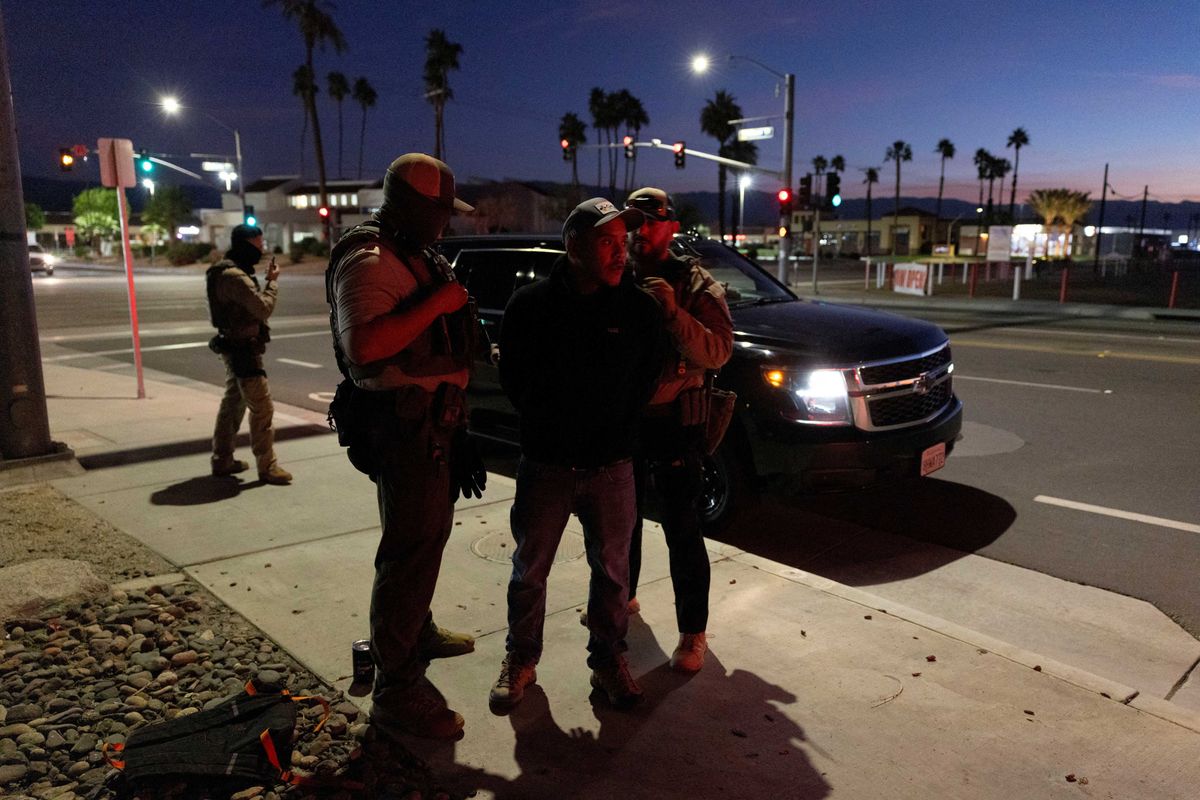
ICE going car to car checking skin color and accents. Paper please is now something happening in the US. Stephen Miller must be so proud to see his Nazi America dream come true so fast. Hugs
Category: Health / Healthcare / Illness / Vaccines
This Got Ugly
Anti-trans person gets Tim Pool twisted and the conversation verse off the tracks. Tim tries to educate her bigotry but she won’t have it and he knows his teenage boy audience wants to hear hate not explanations of truth. Hugs
Extra Josh Johnson
I caught this on TV the other day while I did a jog. It’s great, not very long.
Another Thing We Can Do

and we know they’ll be doing it for us when it’s our turn! This is a partial copy of their page.
https://www.standwithminnesota.com/

Minnesota is under occupation by federal agents from ICE and CBP, and they need your help.
Not just Minneapolis, and not just people protesting. Across Minnesota, ICE continues to stop, harass, and detain people regardless of their citizenship status. Normal life in Minnesota has been interrupted, as schools have been forced to close or go virtual, as people live in fear of leaving their homes or going to work.
Minnesotans are organized and activated to respond to this violence. But they need our help.
This directory of places to donate to all comes from activists on the ground, plugged into the situation. Everything is vetted, with the exception of individual GoFundMes (not everyone is in our networks, and we don’t want to pick and choose who is worthy of help.)
If you don’t have resources to give, please amplify what you are hearing and seeing about Minnesota, across social media, but also to your networks, friends, and family offline.
Read our testimonies and know what life is like in Minnesota right now.
Overwhelmed by the amount of listings here? Donate to the Immigrant Law Center of MN, who is providing assistance to hundreds of people with families detained by ICE, or the Immigrant Rapid Response Fund, a fund assembled by a coalition of Twin Cities Foundations committed to getting assistance out the door as quickly as possible.
Mutual Aid & Materials Purchasing
These funds are administered by neighbors helping their neighbors, not large organizations. This is one of the most direct ways to help and to get cash and resources into people’s hands quickly.
Rent Relief Funds
Mutual Aid Funds
Provide Food Support
Crowdfunding Campaigns
We are only including campaigns which have not met their goals. To get a campaign added please email contact@standupforminnesota.com
For Individuals
Funds for Schools & Students
Funds for Communities
And there is so much more on the page. Please thoughtfully consider what you can do, including simply telling people about this when it comes up (or when you bring it up, maybe?) And thank you!
The Country Hates ICE
ICE assaults a guy for videotaping them which is LEGAL Because they are gang thugs who don’t want their abuses recorded. Their goal is threefold. Remove the nonwhites, create fear and force instant obedience to mob gang rule, and cement a cult like government that supports their gang thug activity. These are the far right white supremacist Christian nationalist Militias that for decades have threatened their neighbors with violence, and now they are sanctioned by the government, given no restraints, and turned loose on the public. Notice they attack as a pack once the first one attacks the filming bystander because the gang thug couldn’t stand to have his authority challenged. I don’t know what to do to force democratic leadership to not vote for the last funding bill unless ICE is unmasked and restrained. Something has to be done before we end up as Iran with hundreds of thousands of protestors dead. Hugs
So an update and thank you for Kamyk, and Ron is on the road to Texas.
First thank you to everyone who donated to Kamyk’s go fund me. He had to start it out at the minimum of $300 due to the rules of the site. The real goal is $1,000 which will allow him to get the game, a secure pack for storing it, and a little left over for a set of earbuds and a few games. Currently he has to have it set for $600 because the rules say he has to set it up in stages. I don’t understand it but he sent me the goals and I put it on the page. The current amount donated is $315. Again thanks to everyone for helping if you can. I understand if you can’t. I can’t until next week when Ron gets paid. This last week we had to put the groceries and medications on the credit card.
Which leads me to the second update I want to share. After I got home from my visit with Suzy Sunshine in which we both decided she couldn’t help me, Ron got a call from his sister. She had fallen and broke her wrist a few days ago. I guess it was bad. So Friday around noon she called and was very upset. Ron said he never saw her this way before. She told him she couldn’t handle the situation of trying to show the home and everything along with the pain in her wrist that she couldn’t use for anything. She wanted him to come to Texas and be with her. It would be for at least a month maybe more and then she would be coming back to Florida in March anyway. In two weeks she will have surgery on the wrist and will need the extra help anyway.
Ron looked at me and I knew what he wanted to ask so I told him it was OK. I understood the bond between him and his sister. I understand he needs to help her in her time of need. I was in a good place, I have the van and it is running well, and we already did the large grocery shopping. I would be OK for a month and half if he needed. So he spent yesterday afternoon packing and left in the car early this morning for Texas. It is about 1,000 miles to where his sister lives. He is going to do it in two days. The good thing is it should give me lots of time to do all the blogging stuff. Hugs
Some MS Now clips about ICE
The video below shows another shooting where the ICE thug fired into a car striking a person when he shifted his weapon to his other hand. The car was not moving and full of pepper spray. The man was not trying to drive. Yet ICE told a judge the man had weaponized his vehicle in an attempt to run over ICE thugs. The judge dismissed the case because ICE refused to hand over the body cam footage that showed what the ICE thug did and that DHS was lying. Again. Hugs
ICE’s Violent Terror Campaign Is Worse Than You Thought…
ICE is not following any police procedures or laws. They are disregarding all civil right granted by law or the constitution. ICE white supremacist gang thugs believe they have no restraint or can be held accountable in any way. I see their criminal actions in almost every clip and the way they use their weapons is horribly wrong. I was trained in pepper spray and can tell you that we had to be sprayed to be certified. I can bet none of them did. Because they wouldn’t do it at point-blank range as then it is no longer nonlethal but very lethal. In this clip a woman describes being picked up by ICE and harmed, harassed, taunted, threatened, and she is a citizen. She said ICE had no qualms about detaining her nor harming her. Plus ICE is proudly damaging people’s cars and phones and there is no one to go to for repairment. So the citizen must pay the costs for the ICE thug’s temper tantrums. Land of the free much? Hugs
Protester permanently blinded after DHS agent fires nonlethal round at close range
These criminal gang thugs ICE are out of control and unless the police stand up for the public we are not a land of the free and we have no rights. Only might makes rights if that is the case, only those with the guns have rights. They hurt people and destroy property and suffer no consequences. Can a modern nation, a civilized nation survive that? This is shithole drug cartel warlord country. Now ICE will rush into peaceful protestors legally standing where they are allowed, grab one and drag them on to federal property to detain and beat them. Hugs
The video shows a group of protesters standing on the steps of the center, with several chanting and holding signs and one holding a megaphone. An officer then grabbed one of the young demonstrators—who appeared to be standing peacefully—by the arm, and dragged him up the steps.
https://www.rawstory.com/trump-dhs-2674880952/
For Science! And For Species Protection & Diversity, Too
New study reveals that 1,300 new species have been added to the global mammal count
Jan 12, 2026 1:24 PM
According to a new study published in the Journal of Mammalogy, the number of living mammal species has increased by 25% since 2005 — meaning that more than 1,300 new species have been added to the scientific record.
Just a few mammals in that crowded class include new creatures like the mouse opossum (Marmosa chachapoya) of the Peruvian Andes, the olinguito (Bassaricyon neblina) of Ecuador, and the dwarf shrew (Crocidura stanleyi) of Ethiopia.
“Our recognition of 25% more mammal diversity now than 20 years ago indicates an overall improvement in our understanding of how global mammals interact with their environments,” Dr. Nathan Upham, lead researcher and Arizona State University professor, told A-Z Animals.
“Each species is genetically unique, not interbreeding with their close relatives, and thus presumably doing something unique on the landscape — specializing in different food or habitat type or location of activity,” he explained.
Upham’s research centered on a series of mathematical equations.
Since 2005, the Mammal Diversity Database has listed an additional 1,579 species.
Of those new species, 805 were newly described and 774 were “splits,” or offshoots, of what was originally thought to be a single species. 226 species were also merged after new evidence came to light.
In total, that means 1,353 species have been discovered since 2005, amounting to an average of 65 new mammal species being introduced to the scientific record every year.
In his interview with A-Z Animals, Upham emphasized that species are not evolving at a faster rate; they are simply becoming easier to find and identify.
“Next-generation DNA sequencing technologies have dramatically lowered the cost of obtaining DNA across the genomes from hundreds of individuals simultaneously,” Upham said.
Upham’s spotlight on mammalian research is supported by a larger, separate study published in Science Advances by John Wiens, a professor in the University of Arizona Department of Ecology and Evolutionary Biology.
Together with his fellow researchers — Xin Li, Ding Yang, and Liang Wang — Wiens estimated that 16,000 new species are discovered each year.
“These thousands of newly found species each year are not just microscopic organisms, but include insects, plants, fungi, and even hundreds of new vertebrates,” Wiens told the University of Arizona.
In 2025, Wiens also spearheaded research on the rate of species extinction and found that it lags significantly behind new species identification.
“Our good news is that this rate of new species discovery far outpaces the rate of species extinctions, which we calculated to about 10 per year,” Wiens said.
“Discovering new species is important because these species can’t be protected until they’re scientifically described,” he added. “Documentation is the first step in conservation – we can’t safeguard a species from extinction if we don’t know it exists.”

Photograph of a newly discovered mammal, the Bassaricyon neblina, or “Olinguito,” taken in the wild at Tandayapa Bird Lodge, Ecuador. Header image via Mark Gurney / Wikimedia Commons (C. C By 3.0)
You may also like: This mammal vanished from Ohio nearly 200 years ago. Trail cameras just captured footage of it

