
Category: History
Osceola, The Mobe, SNAG, & More in Peace & Justice History for 10/21
October 21, 1837 Osceola painted by George Catlin, 1838 The U.S. Army, enforcing President Andrew Jackson’s 1830 Indian Removal Act, captured Seminole Indian leader Osceola (meaning “Black Drink”) by inviting him to a peace conference and then seizing him and nineteen others, though they had come under a flag of truce. Under the law, they and the others of the “Five Tribes” (Choctaws, Chickasaws, Creeks and Cherokees) were to be moved, by force if necessary, west of the Mississippi to Indian Territory (Arkansas and Oklahoma). The Seminole had moved to Florida (then under the control of Spain) from South Carolina and Georgia as they were forced from their ancestral lands, then forced further south into the Everglades where they settled. Read more about Osceola |
| October 21, 1967 In Washington, D.C., more than 100,000 demonstrators from all over the country surrounded the reflecting pool between the Washington and Lincoln monuments in a largely peaceful protest to end the Vietnam War.It was organized by “the Mobe,” the National Mobilization Committee to End the War in Vietnam. Some then marched on, encircled and attempted to storm the Pentagon in what some considered to be civil disobedience; 682 were arrested and dozens injured. This protest was paralleled by demonstrations in Japan and Western Europe, the most violent of which occurred outside the U.S. Embassy in London where 3,000 demonstrators attempted to storm the building. 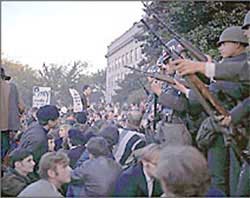 at the Pentagon Read two different accounts of the day with photographs: |
| October 21, 1983 In the first public action of the new Seattle Nonviolent Action Group (SNAG), 12 people blockaded the Boeing Cruise Missile plant in Kent, Washington; none were arrested. |
| October 21, 1994 In an “Agreed Framework” to “freeze” North Korea’s nuclear program, the United States and North Korea (Democratic Peoples’ Republic of Korea or DPRK) agreed over the next 10 years to construct two new proliferation-resistant light water-moderated nuclear power reactors (LWRs) in exchange for the shutdown of all their existing nuclear facilities. The DPRK also agreed to allow 8,000 spent nuclear reactor fuel elements to be removed to a third country; to remain a party to the Nuclear Non-Proliferation Treaty (NPT); and to allow inspections by the International Atomic Energy Agency. In the deal negotiated by Ambassador at Large Robert Gallucci, the U.S. agreed to normalize economic and diplomatic relations with Pyongyang and to provide formal assurances against the threat or use of nuclear weapons by the United States. The details of the agreement and what has followed Interview with Robert Gallucci, Dean, Walsh School of Foreign Service, Georgetown U. |
https://www.peacebuttons.info/E-News/peacehistoryoctober.htm#october21
Presidential Libraries: Last Week Tonight with John Oliver (HBO)
And the scams continue. Hugs
Boston Legal – Same sex attraction disorder (Alan Shore)
“Are You Now, Or Have You Ever…”, The Saturday Night Massacre, & More In Peace & Justice History for 10/20
October 20, 1947 The House Un-American Activities Committee (HUAC) opened public hearings into alleged Communist influence in Hollywood. To counter what they claimed were reckless attacks by HUAC, a group of motion picture industry luminaries, led by actor Humphrey Bogart and his wife, Lauren Bacall, John Huston, William Wyler, Gene Kelly and others, established the Committee for the First Amendment (CFA). Read more |
| October 20, 1962 A folk music album, “Peter, Paul and Mary,” hit No. 1 on U.S. record sales charts. The group’s music addressed real issues – war, civil rights, poverty – and became popular across the United States. The trio’s version of “If I Had A Hammer” (originally recorded by The Weavers, which included the song’s composers, Pete Seeger and Lee Hays) was not only a popular single, but was also embraced as an anthem by the civil rights movement.  About Peter, Paul and Mary  |
| October 20, 1967 The biggest demonstration to date against American involvement in the Vietnamese War took place in Oakland, California. An estimated 5,000-10,000 people poured onto the streets to demonstrate in a fifth day of massive protests against the conscription of soldiers to serve in the war. [see October 16, 1967] Read more |
| October 20, 1973 In what was immediately called the “Saturday Night Massacre,” President Richard Nixon’s Press Secretary, Ron Ziegler, announced that Special Watergate Prosecutor Archibald Cox had been dismissed. Cox had been investigating Nixon, his administration and re-election campaign. Nixon had demanded that he rescind his subpoena for White House recordings.  Archibald Cox  Richard Nixon Earlier in the day, Attorney General Elliot Richardson had resigned, and Deputy Attorney General William Ruckelshaus had been fired, both for refusing to dismiss Cox. Solicitor General Robert Bork, filling the vacuum left by the departure of his two Justice Department superiors, fired Cox at the president’s direction. |
https://www.peacebuttons.info/E-News/peacehistoryoctober.htm#october20
Well, I Didn’t Get My Post Newsletter Until Yesterday. Belated National Dictionary Day:
In a Word: National Dictionary Day
Why dictionary lovers celebrate Noah Webster’s birthday.
Senior managing editor and logophile Andy Hollandbeck reveals the sometimes surprising roots of common English words and phrases. Remember: Etymology tells us where a word comes from, but not what it means today.
On October 16, 1758, Noah Webster and his wife Mercy Steel Webster welcomed a new son into their lives. They named him after his father. Noah Sr. was a farmer and weaver, and Mercy was a homemaker, and by all outward appearances, they lived a rather normal life in the West Division of Hartford — what would become West Hartford, Connecticut.
Though the elder Webster had never attended college himself, he placed great value on education, so from an early age, Mercy taught the younger Noah what she could of spelling, mathematics, music, and other subjects. At age 6, he began attending a one-room schoolhouse; later in life, he described his untrained teachers there as the “dregs of humanity.”
Regardless, Noah took to learning like a fish to water, eventually outgrowing the educational opportunities of his hometown. When he was 16, Noah Sr. mortgaged the family farm so that they could afford to send the younger Noah to Yale University to continue his studies; he graduated four years later in 1778, in the midst of the American Revolution.
After Yale, Noah wanted to study law, but his family couldn’t afford it. Remembering the deficiencies and horrors of his grade school days, he recognized that education might be a better place to make his mark. So he became a teacher.
Most of the books used in American classrooms at the time still came from England — some even included pledges to King George. There was also the matter of patriotism. There was a scarcity of American textbooks for American children, and Noah Webster decided he could help.
So in 1783, he published his own textbook, A Grammatical Institute of the English Language. Because it was printed with blue covers, it was known colloquially as the Blue-Backed Speller, and it became one of the most popular American books of the late 18th century, helping teach children to read, spell, and pronounce words.
But the words themselves were still anchored in Great Britain, and the lexicography coming out of England didn’t encompass the American experience. This realization set Webster on a course that would change the language. In 1801, he began collecting words and their definitions with the aim of creating an American dictionary.
His first edition, published in 1806, was called A Compendious Dictionary of the English Language, and it contained the spellings and brief definitions of 37,000 English words, including thousands of new words that originated on the left side of the Atlantic, words like skunk and raccoon and moccasin (entered as “Moccason or Moggason”).
Webster wasn’t the first to refer to his word hoard as a dictionary. That word had been used in English to describe a reference work at least since the early 16th century, including in the titles of Henry Cockeram’s The English Dictionarie (1623), Thomas Blount’s Glossographia; or, a dictionary interpreting the hard words of whatsoever language, now used in our refined English tongue (1656), Samuel Johnson’s Dictionary of the English Language (1755), and Francis Grove’s A Classical Dictionary of the Vulgar Tongue (1788).
The word was apparently coined by John of Garland, a 13th-century English teacher, from the Latin dictio “speech, word.” There are quite a few dict words in English from the same source, such as edict (“to speak out”), contradict (“to speak against”), and benediction (“to speak well”). The adjectival form of dictio is dictionarius, meaning “of words.” In Medieval Latin, a book containing an ordered list of words was called a dictionarium (which might be a shortening of dictionarius liber), whence the English dictionary sprang.
Compendious is an interesting word. It traces to the Latin preposition com “with, together” and pendere “to hang, to weigh.” Compendium is literally “that which is weighed together,” but in Latin it meant “a shortening, a shortcut.” A compendium is a concise summary of a larger work or, more generally, a compilation of related things. The adjective compendious, then, was chosen to indicate Webster’s attempt to be both comprehensive but also brief.
And brief is a good word to describe the entries in Webster’s Compendious Dictionary, especially when compared with all the information found in dictionary entries today. The vast majority of entries are a single line on pages arranged in two columns. And while they are technically accurate definitions, they don’t always help the reader understand how to use the word. For example:
Definite, n. a thing defined or explained
Sailing, n. the act or art of sailing
Stoic, n. a philosopher of the sect of Zeno
Webster continued to collect, define, and compile words, and in 1828, at the age of 70, he published what is considered his magnum opus: An American Dictionary of the English Language, containing definitions for about 70,000 words. That the word American replaced Compendious in the title says a lot about his motivations. He was working toward a new edition when he died in 1843.
Webster famously simplified (corrected is the word he used) the common spellings of some entries based primarily on pronunciation, creating the separation between British English and American English that exists today. For example, his dictionary dropped the u from words like colour and honour. He also favored -ize over -ise in words like crystalize and emphasize, though he wasn’t wholly consistent.
Though Webster’s dictionary was widely popular in the United States, not everything he included was universally welcomed or adopted. Some of his spelling reforms simply didn’t take: For instance, he entered the word bedclothes into his dictionary as bedcloaths, sleigh as sley, and tongue as tung. He also included words that some found objectionable. In the December 27, 1828, issue of The Saturday Evening Post can be found this bit of snark:
Webster’s Dictionary has been issued from the press of Mr. Converse, the publisher. It is contained in two large quarto volumes, and is executed in a manner highly creditable to the press of our country. He introduces into his new dictionary as legitimate, the word lengthy. We should like to know whether his reasons for so doing are breadthy and strengthy.
Regardless of the criticisms, Webster’s lexical toils set the foundation for American dictionary scholarship that extends into modern times; the dictionaries of Merriam-Webster are the direct descendants of Noah Webster’s An American Dictionary of the English Language.
And that’s why October 16 — the anniversary of Noah Webster’s birth — is today celebrated by lexicographers, linguists, and logophiles as National Dictionary Day.
Zohran Dominates Cuomo During NYC Mayor Debate
1st Labor Union Formed in the American Colonies, & The Persons Case Is Decided In Canada in Peace & Justice History for No Kings Day:
October 18, 1648 I. Marc Carlson The Shoemakers Guild of Boston became the first labor union in the American colonies. Labor organization in colonial times —————————————————– October 18, 1929 The Persons Case, a legal milestone in Canada, was decided. Five women from Alberta, later known as the Famous Five, asked the Supreme Court of Canada to rule on the legal status of women. Some decisions of Magistrate Emily Murphy had been challenged on the basis that she was not a legal person, and she was a candidate for appointment to the Canadian Senate. After the Supreme Court ruled against them, they appealed to the British Privy Council.The Privy Council found for the women on this day (eight years after the case began and eleven years after women received the federal vote), declaring that women were persons under the law. October 18 has since been celebrated as Persons Day in Canada, and October as Women’s History Month.  Sculpture by Barbara Paterson of the Famous Five in Ottawa, first on Parliament Hill to honor women The other women activists in the Famous Five: Henrietta Muir Edwards, Nellie McClung, Louise McKinney, and Irene Parlby. The Persons Case |
https://www.peacebuttons.info/E-News/peacehistoryoctober.htm#october18
What Moderates Get Wrong About Growing The Democratic Party
The video below talks about the shut down and how the democratic party base has changed and is moving in one direction, while the party leadership has moved or stayed where they have been for decades. They talk about the money in politics and the consulting / strategy class who still want to run campaigns designed for getting the 1990s suburban populations along with the mythical older center voters. They also discuss the AIPAC / Israeli lobby who try to get their hooks into every candidate or congressional members. Hugs
Former U.S. Representative for New York’s 16th Congressional District, Jamaal Bowman joins the program.
U.N. World Food Day
is today in Peace & Justice History. Feeding people is my main “thing,” so I’m featuring it today. There is so very much that has happened on October 16, and it can all be seen on this page.
| October 16th every year |
| United Nations’ World Food Day is recognized every year. |
 Scottie's Playtime