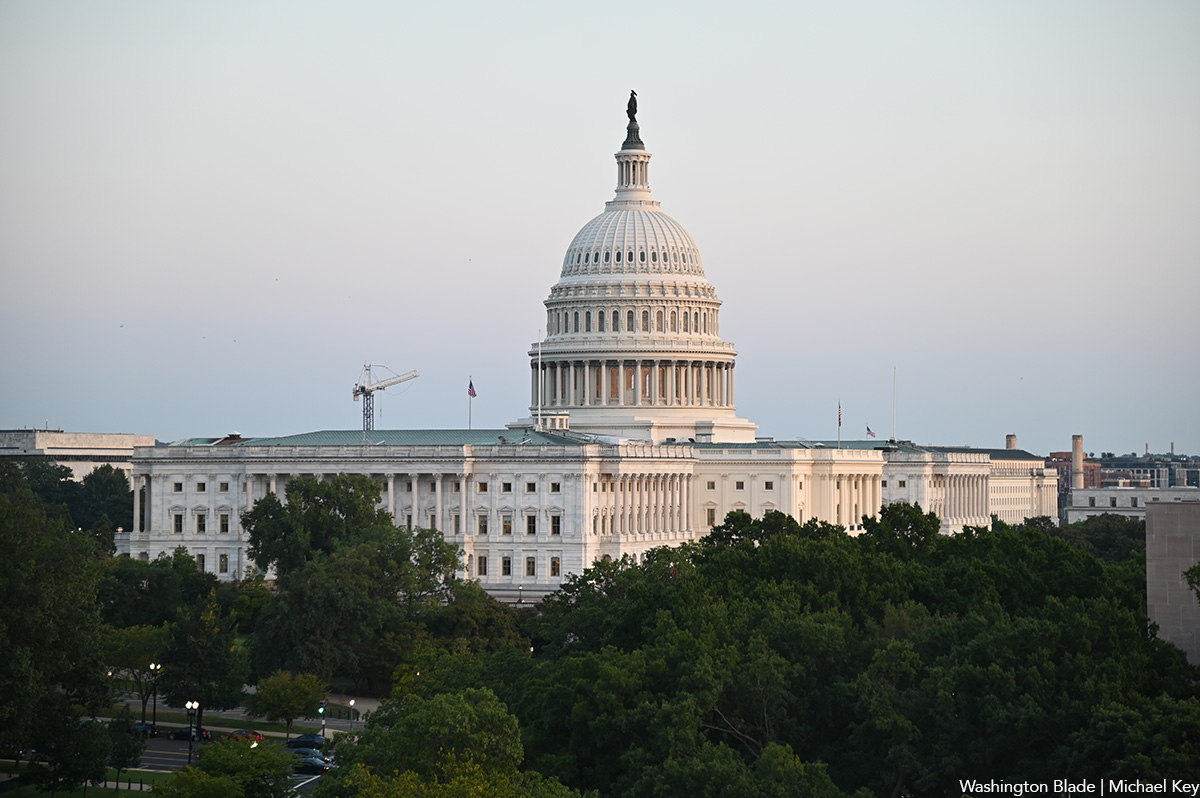
On the last post I made about this I was going to write a long intro. However when I read the comments every point I would have made is made in the comments in far fewer words than I would have done. So if you wish to see opinions on what the government is doing to follow Russia and wipe the LGBTQ+ from society in the name of protecting children / straight people / cis people / and religious privilege to discriminate then please read the comments. Hugs
The Trump administration is investigating three dozen Illinois school districts to assess if their curriculums include “gender ideology” — and parental opt-outs — and whether trans students can participate in competitive sports.
The districts are the latest in a string of public schools, colleges and universities across the country named as subjects of similar federal investigations since President Donald Trump began his second term last year.
The ACLU of Illinois said the Trump administration is wrongly interpreting both federal and state law.
This summary was written by the reporters and editors who worked on this story.
Three dozen Illinois school districts are the latest in a string of public schools, colleges and universities across the country named as subjects of federal investigations into whether the institutions teach about sexual orientation and “gender ideology,” and whether parents can opt out of such curriculum.
The inquiry, announced by the U.S. Department of Justice on Thursday, will also “assess” whether the 35 school districts around the state, plus Chicago’s largest charter school network, allow transgender students to use single-sex bathrooms or participate in competitive sports.
The DOJ’s notice did not say what prompted the investigation or why the districts — which range from rural schools with extremely small enrollment to one of the largest districts in Illinois — and the agency did not respond to a request for clarification. More than half of the school districts are in the Chicago area, though the list does not include any of the large suburban school districts that have attracted attention in recent years for litigation over trans students’ access to bathrooms and locker rooms.
But Thursday’s announcement did point to a June 2025 U.S. Supreme Court decision that requires school districts to allow opt-outs for LGBTQ-related lessons in the classroom, plus a more recent March ruling blocking a California policy that allowed schools to keep a student’s gender transition private from their parents.
“This Department of Justice is determined to put an end to local school authorities keeping parents in the dark about how sexuality and gender ideology are being pushed in classrooms,” Assistant Attorney General Harmeet Dhillon said in the news release.
Dhillon, who advised Trump’s 2020 reelection campaign and rose to prominence as the face of several unsuccessful lawsuits against California’s COVID-19 pandemic restrictions, is the administration’s key lawyer on civil rights issues. As assistant attorney general for civil rights, Dhillon oversees the “Title IX Special Investigations Team” — a joint effort between the DOJ and U.S. Department of Education that was launched last year.
“Supreme Court precedent leaves no doubt: Parents have the fundamental right and primary authority to direct the care, upbringing, and education of their children,” Dhillon said. “This includes exempting their children from ideological instruction that contradicts their values or decisions about their children’s health and best interests.”
In a statement, Gov. JB Pritzker dismissed the inquiry as the Trump administration continuing to “punish states the president does not like,” calling it a “sham investigation.”
“The Civil Rights Division used to investigate actual discrimination concerns to ensure all individuals are treated equally under the law, but they’re now focused on belittling the rights and humanity of LGBTQ+ communities,” he said.
In 2019, Pritzker signed legislation requiring Illinois public schools’ history curriculum “include a study of the roles and contributions of lesbian, gay, bisexual, and transgender people in the history of this country and this state,” but Thursday’s news release made no mention of the law.
String of investigations
The DOJ’s announcement is similar to more than a dozen from the Trump administration since the president began his second term last January, most citing Title IX, the sweeping 1972 federal law that prohibits sex discrimination in education.
One of his first official acts back in power was signing an executive order dubbed “Keeping Men out of Women’s Sports,” which threatened to “rescind all funds from educational programs that deprive women and girls of fair athletic opportunities.”
That included school lunch funds from the U.S. Department of Agriculture, as the state of Maine found out in early 2025 after a public spat between the president and Gov. Janet Mills at the White House over the executive order. After the Department of Education launched an investigation into the state’s education agency and subsequently froze the funding, a judge ordered the USDA to unfreeze the funds, and the agency settled the suit.
Inquiries announced last year in states like New York, Oregon and Washington are ongoing, though the administration has claimed it found evidence of violation of Title IX in Kansas and Colorado school districts. The administration has also launched, and in some cases wrapped up, similar assessments of public universities and community colleges.
ACLU of Illinois cites wrong interpretation
Ed Yohnka with the ACLU of Illinois said the Trump administration is wrongly interpreting both federal and state law, which he said are both “clear that students have an ability to play on sports teams and to use private areas consistent with their gender identity.”
Yohnka also said it was ironic that the Trump administration, brought to power by Republicans who generally oppose government overreach, was trying to limit local control of school districts.
“None of these schools need some ideological culture warrior in Washington, D.C., telling Watseka what their curriculum should be,” he said. “The notion that Justice Department is going to launch investigations and divert money for education because the president signed a piece of paper is just a misuse of our tax dollars.”
Yohnka said he wasn’t aware of any pattern among the three dozen districts the DOJ is investigating, but one school official from rural northwest Illinois has an “emerging operational theory.” In a social media post Friday, Oregon Community Unit School District 220 Superintendent PJ Caposey said he didn’t have “definitive answers” from the DOJ as to why his district was included, he posited it may have something to do with the districts’ participation in a federal School Violence Prevention Program grant.
“To be absolutely clear, this does not confirm that grant participation is the reason for inclusion, nor can we state that as fact,” he wrote. “It is simply one possible connection being explored as we work to better understand the broader picture.”
Capitol News Illinois is a nonprofit, nonpartisan news service that distributes state government coverage to hundreds of news outlets statewide. It is funded primarily by the Illinois Press Foundation and the Robert R. McCormick Foundation.
We’re nearing Pride Month, and you know what the means–the queer books will soon be visible, and this month is prepping us very well in a variety of genres.
A scorching second-chance romance between a talented screenwriter and a phenomenal musician from the New York Times bestselling author of Before I Let Go.
“A triumph of art and emotion.” —Talia Hibbert, New York Times bestselling author
You never forget your first love. Isn’t that what they say? Verity Hill knows this truth intimately. She didn’t simply miss Wright “Monk” Bellamy when they parted ways in college. She’s haunted by his touch. Every kiss, any lover since—it’s a shadow of what they had.
Time heals all wounds. Isn’t that what they say? Monk doesn’t believe that for a second. He wasn’t simply betrayed when he and Verity split. He was devastated, with parts of him left behind in the ruins of all that was destroyed.
More than a decade after their disastrous breakup, Verity and Monk must work together on the set of an epic Harlem Renaissance biopic. With Monk, now a world-class musician, creating the score, and Verity, an award-winning screenwriter, penning the script, there’s Oscar buzz before shooting even begins. This once-in-a-lifetime project could catapult them both to new heights, but can they can put the past behind them for the sake of the film … for the sake of something more?
Hard to imagine anyone reading a romance site doesn’t know when Queen Kennedy Ryan’s got a new book coming, but you may not have known that her newest–the second in the Hollywood Renaissance series–stars a bi female lead and features a steamy m/f/f threesome before we even hit chapter three. It’s a hard-won second chance as Verity and Monk find their way back to each other from then, including a diagnosis of bipolar disorder for Verity in between, and because it’s Ryan, you know the story is treated with the respect and care it deserves. (Emph. mine-A.)
I love this video. John Fugelsang is a wonderful person to elaborate on the bible and he does so as a follower of Jesus, not Paul or the Old Testament. His mother was a nun and his father was a monk and the way he describes his father wearing his robes is as the Christian jedi of Flatbush. He explains how those using the bible to attack or bash others including the LGBTQ+ are not following Jesus that they are following Paul. He explains clearly how Jesus brought a new covenant for the people doing away with the old one in Leviticus. He explained how those using the bible to bash others and not feed & clothe the stranger/ immigrant are totally against what Jesus preached. He also mentioned how those trying to force the Old Testament of the bible in schools never want the words of Jesus hung in classrooms in public schools, they never want the sermon on the mount posted on the walls. Those kind of people only want authoritarian laws or do and dont do pushed on kids. Enjoy the video, I listen to him on The Daily Beans (news with swearing) friday newscast and his Sirius talk show. Hugs
As Congress finalizes its funding for fiscal year 2027, Republicans are attempting to include five anti-LGBTQ riders in the National Security and Department of State Appropriations Act.
A rider is an unrelated provision tacked onto a bill that must pass — in this instance, the bill provides funding for national security policy and for the State Department.
The riders range from restricting Pride flags in federal buildings to banning transgender healthcare, but all aim to limit the visibility and rights of LGBTQ Americans.
Section 7067(a) prohibits Pride flags from being flown over federal buildings.
Section 7067(c) restricts the United States’ ability to appoint special envoys, representatives, or coordinators unless expressly authorized by Congress. These roles have historically been used to promote U.S. interests in international forums — including advancing human and LGBTQ and intersex rights and other policy priorities. The change would halt what the Congressional Equality Caucus describes as providing “critical expertise to U.S. foreign policy and leadership abroad.”
Section 7067(d) reinforces multiple anti-equality executive orders signed by President Donald Trump, effectively requiring that foreign assistance funded by the United States comply with those orders. This includes rescinding federal contractor nondiscrimination protections, including for LGBTQ people.
Section 7067(e) prohibits funding for any organization that provides or promotes medically necessary healthcare for trans people or “promotes transgenderism” — effectively banning funds for organizations that recognize trans people exist. This is despite the practice of gender-affirming care being supported by nearly every major medical association.
Section 7067(g) reinforces two global gag rules put forward by the Trump-Vance administration. One is the Trans Global Gag Rule, which prohibits foreign assistance funding for organizations that acknowledge the existence of trans people or advocate for nondiscrimination protections for them, among other activities. The second is the DEI Global Gag Rule, which prohibits foreign assistance funding for organizations that engage in efforts to address the ongoing effects of racism, sexism, and other forms of bigotry outside the United States.
The global gag rule has its roots in anti-abortion policy introduced by President Ronald Reagan in 1984, when the 40th president barred foreign organizations receiving U.S. global health assistance from providing information, referrals, or services for legal abortion, or from advocating for access to abortion services in their own countries. Planned Parenthood notes that the policy also affects programs beyond abortion, including efforts to expand access to contraception, prevent and treat HIV/AIDS, combat malaria, and improve maternal and child health.
If organizations funded by the State Department engage in these activities, they could lose funding.
This anti-LGBTQ push aligns with broader actions from the Trump-Vance administration since the start of Trump’s second term, which have focused on restricting human rights — particularly those of trans Americans.
The House Appropriations Committee is responsible for drafting the appropriations legislation. U.S. Rep. Tom Cole (R-Okla.) serves as chair, with U.S. Rep. Rosa DeLauro (D-Conn.) as ranking member. The committee includes 34 Republicans and 27 Democrats.
For FY27 appropriations, Congress is supposed to pass and have the president sign the funding bills by Sept. 30, 2026.
On Monday, the Colorado Senate Judiciary Committee passed HB26-1322, a bill that creates a private civil right of action allowing survivors of conversion therapy to sue the practitioners who subjected them to it. The bill, which has no statute of limitations for such claims, would likely make the practice of conversion therapy financially prohibitive in the state. It comes in the aftermath of the Supreme Court’s 8-1 decision last month in Chiles v. Salazar, which found that Colorado’s 2019 ban on conversion therapy unconstitutional—effectively legalizing the discredited practice nationwide. The new bill has one final legislative hurdle to clear—the full Colorado Senate—before heading to Governor Jared Polis’s desk, though the governor has so far offered only lukewarm signals about whether he will sign it, saying he is “hopeful there is still time to construct a framework he could support.”
The bill targets what it calls “sexual orientation or gender identity change efforts”—defined as “any practice by a licensed mental health professional that seeks to direct a patient toward a predetermined sexual orientation or gender identity outcome, or to eliminate or reduce sexual or romantic attractions or feelings toward individuals of a particular sex or gender, regardless of the sexual orientation or gender identity the patient is directed toward.” The inclusion of “eliminate or reduce sexual or romantic attractions” is notable—conversion therapists have long used this framework to argue disingenuously that they are not trying to change a person’s sexual orientation, merely helping them manage unwanted feelings. The bill explicitly carves out any counseling or therapy that “provides acceptance, support, and understanding of a patient” or “facilitates a patient’s coping, social support, and identity exploration and development”—meaning therapists who support a patient’s own process of self-discovery, without steering them toward a predetermined outcome, would face no liability.
The bill uses a novel legal mechanism to target conversion therapy—a private right of action. Rather than the government banning conversion therapy outright, which is what the Supreme Court struck down in Chiles, the bill instead allows survivors to sue their practitioners directly, stating that “a person who suffered an injury as a result of sexual orientation or gender identity change efforts may bring a civil action for damages” against their conversion therapist. It also states that a lawsuit to recover damages can be commenced “at any time without limitation,” making its statute of limitations effectively endless. The mechanism may be insulated from the constitutional problem the Supreme Court identified in Chiles because the government is not restricting speech—instead, private citizens are seeking civil remedies for harm they suffered, the same way a patient can sue a doctor for malpractice. As Alejandra Caraballo, a clinical instructor at Harvard Law School, told Erin in the Morning after the Chiles ruling, “While the Supreme Court decision limits the abilities of states to regulate conversion therapy through professional standards, they did not limit the ability for states to protect LGBTQ youth from these abusive practices through tort or malpractice law.”
If the mechanism sounds familiar, it is because Republicans pioneered it to get around Supreme Court rulings they didn’t like—most famously in Texas’s SB 8, the 2021 abortion “bounty hunter” law. That law banned abortion after six weeks not through government enforcement but by allowing any private citizen to sue anyone who performed or aided an abortion for $10,000 in damages. The legal trick was simple: when abortion providers tried to challenge SB 8 in court, they couldn’t get an injunction because there was no government official to enjoin. Courts found that you can’t sue “the state” to block a law that only private citizens enforce. The Supreme Court effectively let SB 8 stand, and the strategy worked—abortion access in Texas collapsed virtually overnight even while Roe v. Wade was still the law of the land. Kansas used the same model in SB 244, which allows anyone to sue a transgender person for using a restroom that doesn’t match their assigned sex at birth. Now, Colorado Democrats are exploiting the same constitutional loophole in the opposite direction—using private civil enforcement to deter a harmful practice that the Supreme Court says the government cannot directly ban.
It is important to note that some have raised concerns the bill could be weaponized against gender-affirming therapists—with anti-trans groups arguing that helping a trans youth transition constitutes its own form of “conversion therapy.” But the bill contains multiple layers of protection against such misuse. Its carveouts explicitly shield counseling that provides “acceptance, support, and understanding of a patient.” The bill also has protections in its causation standard. To establish that conversion therapy caused harm, a court must weigh “the nature, duration, and intensity” of the efforts, “the age and vulnerability of the plaintiff at the time,” “the relationship between the plaintiff and the mental health professional,” and “expert testimony regarding the general psychological effects of sexual orientation or gender identity change efforts.” It is unlikely that judges will consider anti-trans activists to be considered medical “experts” on this topic.
LGBTQ+ organizations, activists, and Democratic lawmakers in the state have supported the bill’s passage. “This decision only reinforces the urgent need for state-level protections,” said One Colorado, the state’s largest LGBTQ+ advocacy organization. “[HB 1322] provides a pathway for accountability, allowing survivors to seek justice against those who administer this harmful practice. We remain committed to ensuring that those responsible for such profound damage are held accountable.” Rep. Karen McCormick, a Democrat from Longmont, was blunt about the bill’s intent: “The purpose of this bill is seriously to send a chilling effect to any licensed professional therapist who may think about bringing that practice back.”
Conversion therapy is a discredited practice broadly decried by every major American medical organization. The APA concluded in a 2009 systematic review that the practice is “unlikely to be successful and involves risk of harm, including depression, suicidality, and anxiety,” and called for its total elimination. The United Nations has deemed conversion therapy a form of torture. A 2020 study published in the American Journal of Public Health found that LGBTQ+ youth subjected to conversion therapy were more than twice as likely to report attempting suicide. For transgender people specifically, conversion therapy often takes the form of so-called “gender exploratory therapy,” a rebranded approach that seeks to convince trans youth they are not actually transgender, keeping transition just out of reach by tricking trans youth that it might be offered if they jump through endless hoops while intending to deny it the entire way.
The bill now heads to the full Colorado Senate for a floor vote, where Democrats hold a 23-12 majority and passage is expected. Coloradans who support the bill can contact their state senator through the Colorado General Assembly’s legislator lookup tool. If the Senate passes the bill, it will go to Governor Polis, whose signature remains the final and most uncertain step. Polis, the first openly gay governor elected in the United States, signed the original 2019 conversion therapy ban and has called the practice “a scam and a waste of people’s hard-earned money”—but his office has stopped short of committing to sign this bill, saying only that he is “hopeful there is still time to construct a framework he could support.” What changes, if any, the governor is seeking remain unclear. The bill includes a safety clause that would make it take effect on July 1, 2026, and would exempt it from voter referendum. If signed, Colorado would become the first state in the country to use a private right of action to combat conversion therapy in the wake of the Supreme Court’s ruling.
*** Personal note*** I ran out of steam early yesterday. I only went back to bed for an hour in the morning, but by 3:30 pm, between the pain and being so tired I went to bed before 4 pm. I got up about 5:30 am. Hugs
Russia began the campaign against LGBTQ+ people by first targeting trans people as a threat to children. Then once the people got used to that line they claimed that any mention of non-cis non-straight way of living was sexualizing kids and so a threat to them. Mentioning or showing a gay person was equated with showing a kid hardcore porn. Fully nude bodies. It worked in their society. That is the play book the right wing haters / Christian nationalists have used against trans people here. How soon until they try to go the entire way to force the entire country / society to be straight and cis and that Christianity be the national religion enforced by white men who force those around them to follow their personal church doctrines. But what these nut jobs really want and understand is removing all mention and signs of being not cis or straight won’t stop LGBTQ+ people from existing. Gay, lesbian, bisexual, questioning / queer / nonbinary, and all others not straight or cis are born to straight cis parents. What these outstanding moral Christians like Congress person Randy Fine from Florida want is that non-straight and non-cis kids be harassed and assaulted like when he was in school making them afraid to come out or be themselves publicly. In other words these haters want the facade of a straight cis country such as when one of the presidents of Iran said they did not have any gay people in his country ignoring a well know community that was there. They want anyone not like them to be afraid to live their lives in case they are discovered. They think that will please their god. The god who they believe created all people also created the LGBTQ+ ones as well. They think that the all knowing god will not know people are faking it due to fear and that they will be rewarded for causing that fear in the LGBTQ+ community. Very Christian of them. Hugs
The designation could mean anybody associated with the group risks years behind bars for supporting an extremist organization — akin to terrorism charges under the nation’s criminal code.
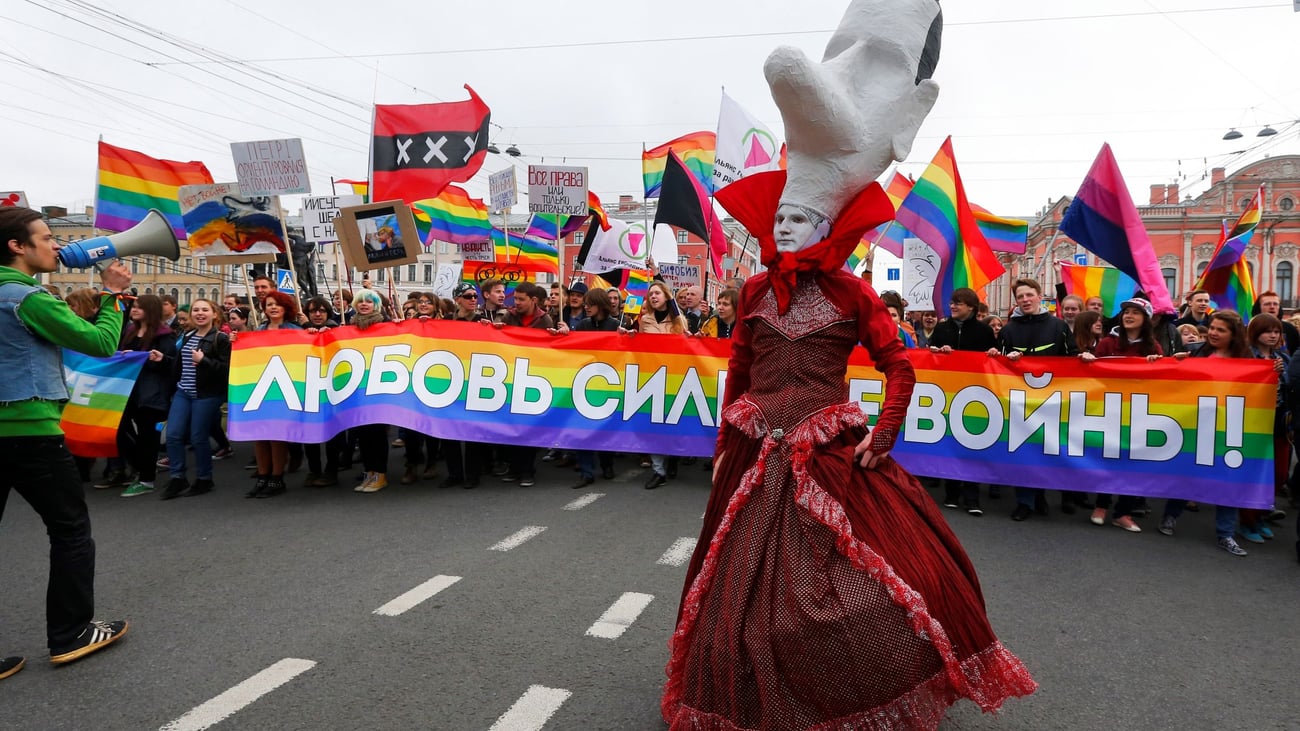
A gay rights activist wearing a headpiece walks ahead of a squad of gay rights activists, during a traditional May Day rally in St.Petersburg, Russia, Thursday, May 1, 2014. The poster reads : ‘Love is stronger than war!’ (AP Photo, File)
A Russian court on Monday labelled the country’s top LGBTQ rights group as “extremist,” effectively outlawing the organization and paving the way to prosecute its supporters.
Russia has for years targeted LGBTQ organizations but has become even more hostile since launching its full-scale assault of Ukraine in 2022, massively accelerating the country’s hardline conservative turn.
On Monday, a court in St. Petersburg ruled in favor of a case brought by the Russian justice ministry to brand the Russian LGBT Network — a top LGBTQ rights nonprofit — “extremist.”
“The public movement has been designated as an extremist organization, and its activities are banned in Russia,” the court’s press service said on Telegram.
The hearing was held behind closed doors.
The designation could mean anybody associated with the group risks years behind bars for supporting an extremist organization — akin to terrorism charges under Russia’s criminal code.
Amnesty International in February slammed the justice ministry’s move to seek the label.
“This move reflects a deliberate strategy by the Kremlin to legitimize and weaponize homophobia in its assault on dissent and equality,” said Marie Struthers, Amnesty International’s Eastern Europe and Central Asia director.
Russian President Vladimir Putin has for years denounced anything that goes against what he calls “traditional family values” as un-Russian and influenced by the West.
In 2023, Russia’s Supreme Court banned what it called the “international social LGBT movement” as an “extremist organisation”.
As part of the crackdown, Russia has in recent years targeted LGBTQ clubs and bars, raiding them and arresting owners.
Courts have also issued fines and short-term jail sentences to people displaying LGBTQ “symbols,” such as clothes, jewelry or posters featuring the rainbow flag.
Personal note. I am doing better. I am eating two meals a day most days. Not much for supper but something most nights. I am still fatigued / tired but I am not spending so many hours in bed. I am still going to bed early and staying in bed 12 to 14 hours. I go to in the morning and in the afternoon but that is partly due to the intense pain in my right butt and leg along with my back not just being too tired to stay up. I will try to get enough caught up enough to do a video. Ron has caught on and is paying a lot of attention to me. He is worried. He is doing everything he can around the house including doing the dishes when I am in bed so I find them done the next morning. But as I tell him this will take time. I did not get so ill overnight; I won’t get back to full strength quickly either. Hugs