As I keep saying this is a small very loud mostly religious driven minority using ever tool and lie they can to change perception of the LGBTQ+ to erase them from society to create the cis straight society they want to force on everyone. We must counter them by being as loud and forceful to not only refute their lies but also promote the joy of living freely as an inclusive society. Hugs
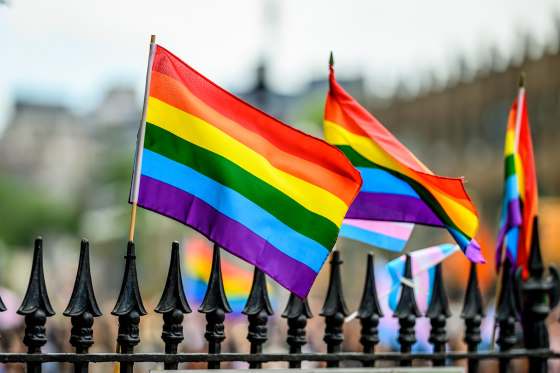
Close-Up of rainbow flag with crowd In background during LGBT Pride Parade. Getty Images.
Ohio lawmakers on both sides of the aisle have introduced several LGBTQ-related bills so far this General Assembly.
Republicans have put forth a drag ban bill, a piece of legislation that would make it harder for a student to use a different name or pronoun at school, and a bill requiring transgender political candidates to list their deadname, among others.
On the other side of the aisle, Democrats have introduced the Ohio Fairness Act and a bill that would ban conversion therapy.
An Ohio court partially overturned a ban on gender-affirming care for LGBTQ youth earlier this year, meaning doctors can still prescribe puberty blockers and hormone therapy.
Anti-LGBTQ bills
Ohio House Bill 249 would ban drag performers from performing anywhere that is not a designated adult entertainment facility. State Reps. Angie King, R-Celina, and Josh Williams, R-Sylvania Twp., introduced the bill, which has had sponsor testimony.
This is a re-introduction of a bill from the previous General Assembly that did not make it out of committee and faced much opposition.
Ohio House Bill 190 would require parental permission for schools to use different pronouns or different names for students that don’t match up with the biological sex or birth name.
Williams and state Rep. Johnathan Newman, R-Troy, introduced the bill, which has had sponsor testimony.
Ohio House Bill 172 would ban children 14 and older from receiving mental health services without parental consent. Newman also introduced this bill, which has had sponsor testimony.
Ohio House Bill 196 would require political candidates to list their former names on candidacy petitions. This, however, would not apply to names that have been changed due to marriage. King and state Reps Rodney Creech, R-West Alexandria, introduced the bill, which has had sponsor testimony.
Ohio House Bill 262 would designate the weeks from Mother’s Day to Father’s Day as Natural Family Month. Williams and state Rep. Beth Lear, R-Galena, introduced the bill, which has had sponsor and opponent testimony.
Pro-LGBTQ bills
Ohio Senate Minority Leader Nickie Antonio, D-Lakewood, has introduced a few bills that support LGBTQ people. Antonio is the only openly gay lawmaker in the Ohio General Assembly.
Ohio Senate Bill 70, also known as the Ohio Fairness Act, would expand anti-discrimination laws to include sexual orientation and gender identity. House Bill 136 is a companion bill.
Antonio has introduced the Ohio Fairness Act in every General Assembly since she was elected to the Ohio House of Representatives in 2011 and this is the first time since 2018 the bill has no Republican support.
Ohio Senate Bill 71 would ban any licensed health professionals from doing conversion therapy when providing mental health treatment to minors. Antonio and state Sen. Beth Liston, D-Dublin, introduced the bill. House Bill 300 is a companion bill.
Ohio Senate Bill 211 would designate the first full week of June as “Love Makes a Family Week.” Antonio introduced this bill as well.
None of these bills have had any hearings so far this General Assembly. Ohio lawmakers are on summer break and will come back to the Statehouse this fall.
The minority groups trying to push hate on the LGBTQ+ are well funded by billionaires like J.K. Rowling and the Christian church. They are using every media they can to turn young people against the LGBTQ+ using the most misinformation they can generate. And as much as they want / demand society return to their fantasied Christian 1950s pro white cis straight only country it was not true then and can’t be true now. Their goal is the total erasure of the LGBTQ+ and also any rights for those gained in the civil rights act. Below is a quote from the article. Hugs.
“I’m almost 40 and have seen so much progress like equal marriage,” Kelly says. “But something is changing. Hatred towards people like me is becoming mainstream again.”
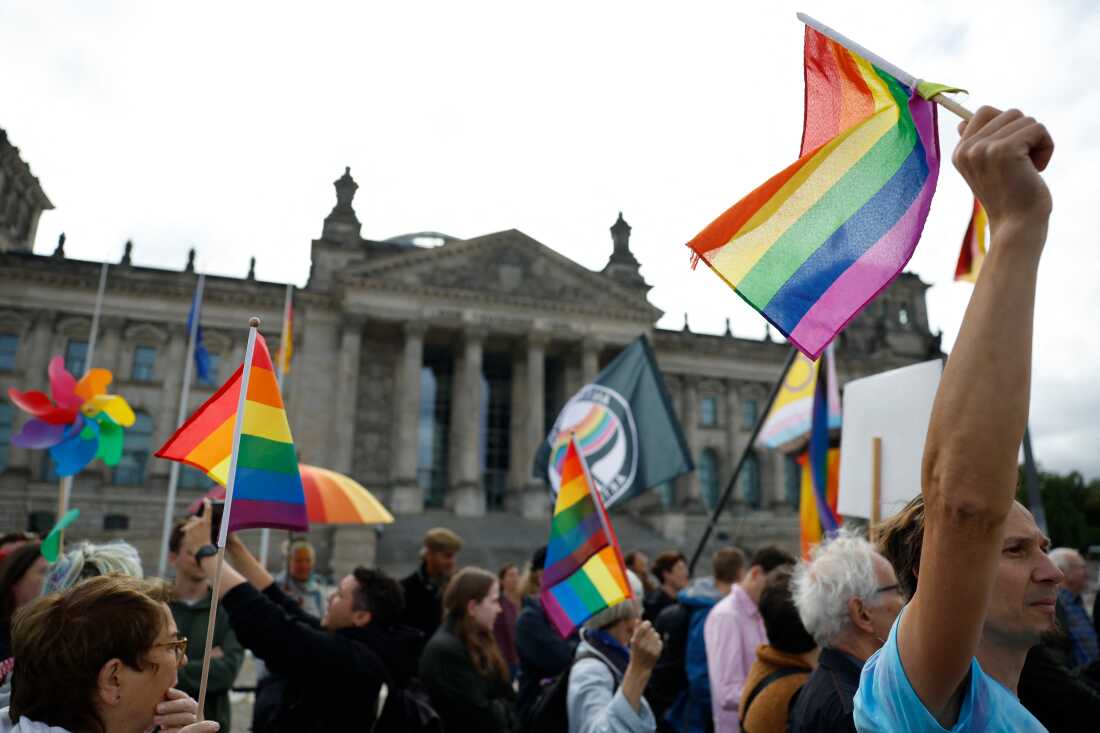
Demonstrators participate in an event called “Show the flag: For queer visibility in the Bundestag!” in front of the Reichstag building that houses Germany’s lower house of parliament, the Bundestag, in Berlin, on July 8. The conservative president of the Bundestag said the rainbow flag would no longer be raised on top of the parliament building during Pride month, which in Germany runs from June 28 until July 27.
Odd Andersen/AFP via Getty Images
The tree-lined neighborhood near Nollendorfplatz square in central Berlinis as gay today as it was a century ago.
It’s where Christopher Isherwood wrote novels chronicling the rise of the Nazis amid the city’s rich queer nightlife that inspired the musical Cabaret.
Every summer, the neighborhood throws its own smaller-scale LGBTQ+ Pride event separate from the city’s main annual parade taking place this weekend.
It’s just one of more than 200 Pride events taking place in Germany this year. But with far-right extremist groups staging anti-Pride protests, many Pride attendees fear for their safety.
Sipping on a cocktail as the street party gets underway, 62-year-old Georg Schmidt says he’s relieved that this event is a relaxed affair. He says he attended a different local pride parade last month across town in the district of Marzahn and the mood there was tense.
“There was a massive police presence to shield us from anti-Pride protests. We only felt safe because the police kept us apart,” Schmidt says.
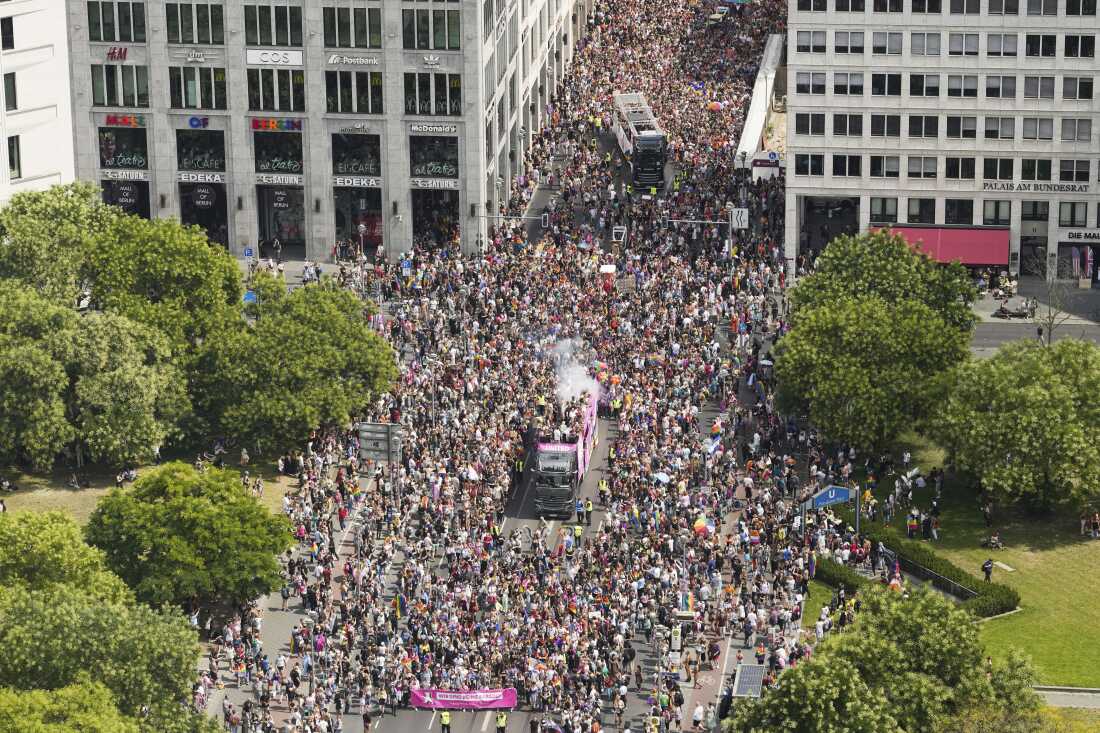
Revelers march down the Leipziger Strasse street during a Pride parade in Berlin, July 23, 2022.
Markus Schreiber/AP
Sabine Volk, a researcher at the Institute for Research on Far Right Extremism at the University of Tübingen, says these groups attract young men who promote what they call traditional family values — a kind of pride that has little to do with rainbow flags.
“The key slogan is that the German flag and Germany itself is already colorful enough,” Volk says. “And the overall message is that queer life does not have a place in Germany.”
President of German Parliament Bundestag Julia Klöckner speaks to the media on July 8 in Berlin.
Thomas Trutschel/Photothek via Getty Images
Speaking on public broadcaster ARD, Merz signaled his support for the rule at Germany’s parliament, the Bundestag, with the words, “the Bundestag is not a circus tent” — a remark to which many have taken umbrage.
Merz backs his colleague’s argument that the lower house must maintain neutrality and cannot support events with a political agenda.
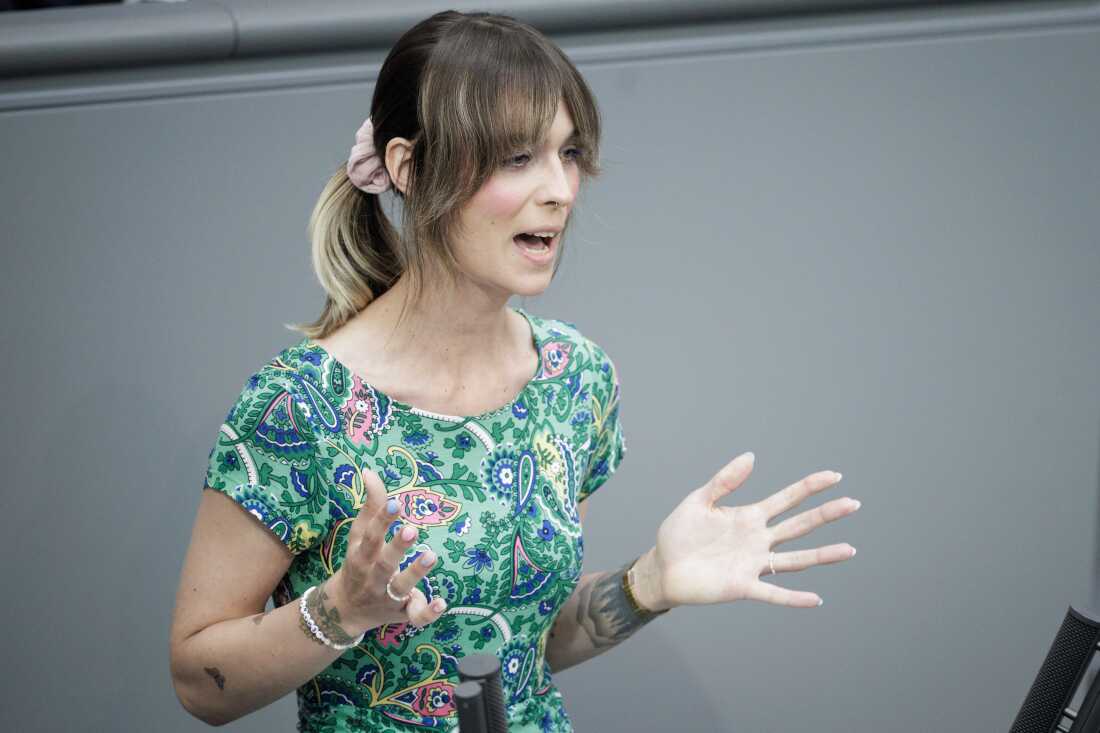
Nyke Slawik speaks during a parliamentary debate on queer hate crime in the Bundestag. Photo: Carsten Koall/dpa (Photo by Carsten Koall/picture alliance via Getty Images)
Carsten Koall/picture alliance via Getty Images
Opposition Green Party lawmaker Nyke Slawik criticized the move. “Declaring the rainbow a political symbol is highly problematic” stressing that “queer people are not an ideology; they are people!” Slawik told public broadcaster ZDF.
Slawik argues they are people increasingly in need of protection. Germany’s federal police report an almost tenfold increase in reported queerphobic hate crimes since 2010 and they believe the majority of cases go unreported.
The issue is not divided by party political lines; criticism of Merz’s choice of words has come from within his own party. Sönke Siegmann, the chair of the Christian Democrats’ LGBTQ+ Association, says some within his party are still catching up on terminology.
“If you say queer in my party, most people take a deep breath and say: ‘Oh, that’s a left-wing term,’ ” Siegmann observes. He says he has spoken with Merz since he made his “circus tent” comments.
“We explained to him what queer really means and two days later when asked in Parliament about LBGTQ+ hate crimes and what his government will do about them, Merz actually used the term queer,” Siegmann says.
Back inthe Nollendorfplatz area, rainbow flags fly every month of the year. But local resident Chris Kelly says the mood here is not as “live and let live” as it once was. He recently opened a boutique that sells high-end garments made from industrial strength rubber. He says business is good and he has a broad customer base, but it was almost impossible trying to find premises for the boutique.
“We found plenty of suitable spaces to rent and our finances are solid, but a lot of landlords rejected us, saying they didn’t want people like us,” Kelly remembers. “Real estate agents had warned us, but I was flabbergasted to encounter such prejudice in Berlin’s queerest, gayest neighborhood.”
Kelly’s store is located just down the street from Romeo and Romeo, a gay bar whose owner was attacked last month. Kelly says he too gets more verbal abuse than he used to and he hears again and again of attacks on members of the LGBTQ+ community.
“I’m almost 40 and have seen so much progress like equal marriage,” Kelly says. “But something is changing. Hatred towards people like me is becoming mainstream again.”
Kelly points out that a few doors down in the other direction is where the legendary nightclub Eldorado stood until the Nazis closed it down in 1933, eventually sending its queer clientele to concentration camps.
A commuter walks down the steps of Berlin’s Bundestag subway station, decorated with rainbow colors, the symbol of the LGBTQ+ community, on July 24.
John MacDougall/AFP via Getty Images
As preparations for Berlin’s main Pride parade get underway, the city police say they’ve received a permit request for a counterdemonstration protesting “against Pride terror and identity disorders.”
In reaction to the Bundestag president’s decision not to fly the rainbow flag on top of parliament this year, Berlin’s transport authority has decorated its Bundestag subway station stop in rainbow colors, writing on Instagram: “So our Bundestag is ready for Pride.”
Kelly urges people to attend Pride and stand up to a new generation of the far-right. He has no desire to say Goodbye to Berlin and the neighborhood around Nollendorfplatz, as Isherwood was forced to do.
GENEVA — The U.N. Human Rights Council voted on Monday to renew the mandate of an LGBTQ rights expert, a move welcomed by advocates amid the absence of the United States, a former key supporter that is now rolling back such protections.
Western diplomats had previously voiced concerns about the renewal of the mandate of South African scholar Graeme Reid who helps to boost protections by documenting abuses and through dialogue with countries.
The motion for a three-year renewal passed with 29 votes in favor, 15 against and three abstentions. Supporters included Chile, Germany, Kenya and South Africa while several African nations and Qatar opposed it.
“The renewal of this mandate is a spark of hope in a time when reactionary powers worldwide are trying to dismantle progress that our communities fought so hard to achieve,” said Julia Ehrt, executive director of campaign group ILGA World.
The United States, which has disengaged from the council under President Donald Trump, citing an alleged antisemitic bias, was previously a supporter of the mandate under the Biden administration.
Since taking office in January, Trump has signed executive orders to curb transgender rights and dismantle diversity, equity and inclusion practices in the government and private sector.
His administration says such steps restore fairness, but civil rights and LGBTQ advocates say they make marginalized groups more vulnerable.
In negotiations before the vote, Pakistan voiced opposition to the mandate on behalf of Muslim group OIC, calling it a tool to advocate “controversial views.”
I really like this scholar. He is not a preacher, he studies the bible for what it is and not what he wants it to be. He doesn’t tell you what to think or believe, he simply explains the texts and passages of the bible explaining what they mean as he does. Hugs
This is entirely about erasing the LGBTQ+ community from society. They teach and preach hate about us then use that acts of violence and vandalism to claim the “public” is against the LGBTQ+ representation. Why we generate such hate for just living our lives openly like they do is beyond my understanding. The people pushing hardest to erase the LGBTQ+ have only misunderstood texts in their holy book written over centuries in different cultures and languages. Yet they read it as if the words they are reading mean the same now or are correctly translated. And still that doesn’t give them the right to remove the LGBTQ+ from the public square and teach hate against us. The reasons given by the transportation secretary are meaningless garbage and complete untrue. Hugs
In a literal erasure of LGBTQ+ identity in South Florida, the city of Boynton Beach has complied with recent orders from Gov. Ron DeSantis (R) and the Trump administration to eliminate a rainbow crosswalk in the beachside city.
Video reveals a road crew painting over the once-colorful intersection at East Ocean Avenue and Southeast First Street on Wednesday morning. It’s now painted black.
Boynton Beach has “removed the inclusionary-painted intersection on the 100 block of East Ocean Avenue to ensure full compliance with state and federal transportation mandates and address safety concerns,” a statement from the city read. “The decision follows recent guidance from the U.S. Transportation Secretary and the Florida Department of Transportation.”
The Pride commemoration was first unveiled in June 2021.
The rainbow intersection has been vandalized before. During Pride month in 2023, surveillance video captured a motorcyclist burning out over the mural, leaving black tread marks across it. He then stopped to record the damage he caused.
The Pride erasure comes just days after a coordinated campaign by the Florida governor and the federal Transportation Department to remove rainbow intersections across the state.
On July 1, former Road Rules reality star and current Secretary of Transportation Sean Duffy issued a social media edict to all U.S. governors to remove the crosswalk art.
“Taxpayers expect their dollars to fund safe streets, not rainbow crosswalks,” Duffy declared. “Political banners have no place on public roads. I’m reminding recipients of @USDOT roadway funding that it’s limited to features advancing safety, and nothing else. It’s that simple.”
In the order and subsequent interviews, Duffy implies the Pride crosswalks are causing chaos on the roads and have led to traffic fatalities.
“Far too many Americans die each year to traffic fatalities to take our eye off the ball,” Duffy told the far-right Daily Signal.
“Roads are for safety,” he said somewhat incongruously, “not political messages or artwork.”
Duffy didn’t specify what percentage of the 39,345 traffic deaths in the U.S. in 2024 were caused by rainbow crosswalks.
Other cities in South Florida with rainbow intersections, including Delray Beach, Fort Lauderdale, and West Palm Beach, face the same state and federal mandates. It wasn’t immediately clear whether or how they would comply.
Other Pride crosswalks in the state have also been subject to vandalism, some repeatedly.
Florida Transportation Secretary Jared Perdue enthusiastically endorsed the federal mandate the day after it was issued.
“Florida’s proactive efforts to ensure we keep our transportation facilities free & clear of political ideologies were cemented into law by @GovRonDeSantis,” Perdue posted to socials. “Great to now have our federal partners also aligned behind this same common-sense policy.”
Rand Hoch, president of the Palm Beach County Human Rights Council, called the orders “blackmail”.
“This is just another example of the president and the governor blackmailing local governments by telling them they’re going to withhold funding so they can try to publicly erase the LGBTQ+ community,” he told the Sun-Sentinel. “This seems to be a priority of these administrations.”
Despite the public erasure, Hoch, who was present at the 2021 unveiling of the Boynton Beach Pride intersection, said LGBTQ+ people “are not going to disappear.”
Subscribe to the LGBTQ Nation newsletter and be the first to know about the latest headlines shaping LGBTQ+ communities worldwide.
Mesopithecus pentelicus thrived in the rainforests of the late Miocene, 7 million years ago. Credit: Mauricio Antón
Small, slender and short-lived, with broad noses, big, dark-adapted eyes, living underground, and in the shadows of a shattered, steamy, chaotic world. Richard Musgrove asks: will this be us in 10,000 years?
Climate change is the greatest challenge in human history – current trends could have us eventually approaching extremes not seen on our planet for 15 million years. Will a destabilised global climate wreak economic havoc, leading to societal collapse, mass mortalities, even extinction? Or will we pull ourselves out of this spectacular self-imposed nose-dive?
Which raises the question – what if we don’t? How will humanity change on a much hotter Earth?
Numbers matter
Uncharted territory approaches as we nudge the Paris Agreement’s 1.5°C above preindustrial levels, on track for a potentially catastrophic 2.7°C by 2100. What about 2200, or 3200?
Globally, days above 50°C have doubled since the 1980s – in Australia, Pakistan, India and the Persian Gulf – with the ‘feels-like’ temperature often higher. Even immediately reduced carbon emissions will still mean lingering planet-wide heating and associated effects for many thousands of years.
Our adaptability has led us this far, but what does evolution have in store for our species if we don’t rise to face our greatest challenge? The answer is unlikely to be in the mirror.
Nothing sweats like us (snip-MORE)
===========
Medicaid ‘gamers’ are the new ‘welfare queens’ by Aaron Rupar
Republicans are taking strawman arguments to absurd extremes. Read on Substack
Earlier this month, Donald Trump and congressional Republicans passed a grotesque budget bill that (partially) funds massive tax breaks for the wealthy and a ramped-up ICE goon squad by cutting cutting $1.1 trillion from Medicaid and an additional $185 billion from federal food assistance programs, all while adding $2.8 trillion to the deficit.
Not surprisingly, the bill is massively unpopular. As a result, Republicans are gaslighting Americans about its impact, particularly regarding the cuts to Medicaid, which are expected to cost 10 million Americans their health coverage.
The Medicaid cuts could result in more than 16,000 extra deaths per year, researchers say. Republicans have tried to distract from that reality with a combination of blatant lies and misdirecting rhetoric. To hear them tell it, they’re only cutting supposed waste, fraud, and abuse. So when you lose benefits, they’re here to explain why it’s probably your own damn fault.
The lazy gamer myth
Republican messaging surrounding Medicaid cuts borrows heavily from Ronald Reagan’s playbook. (snip- MORE)
Of course, there are innumerable instances when the Bible has historically been used to enforce the idea that gender is a divinely ordained binary, with male and female genders that are distinct, complementary, and assigned at birth.
Indeed, the Bible’s general attitude toward gender is expansive, with verses exploring God’s focus on the interior over the exterior, the distinction between sex and gender, the role of eunuchs in scripture, and more.
Here are 10 Bible verses that show a biblical approach to gender that is as varied as the colors in a rainbow.
Genesis 1:27 So God created humans in his image, in the image of God he created them; male and female he created them.
Day and night. Water and dry land. Male and female. The creation poem might sound like it’s dealing in binaries, but we know that all of these things have transitional elements. Day and night contain transitions at dawn and dusk; the spectrum of water and dry land includes tidal plains and coral reefs; and people who are intersex, genderqueer, nonbinary, and more can be found between “male and female”.
Genesis 25:27 When the boys grew up, Esau was a skillful hunter, a man of the field, while Jacob was a quiet man, living in tents.
Jacob is described as “smooth” (Genesis 27:11) and stays in the tent where he cooks – traditional female attributes in the ancient world. Yet he is chosen over his “hairy” brother Esau, a skilled hunter, to lead God’s people, showing that God does not place value on traditional gender norms.
Isaiah 56:4-5 For thus says the Lord: To the eunuchs who keep my Sabbaths, who choose the things that please me and hold fast my covenant, I will give, in my house and within my walls, a monument and a name better than sons and daughters; I will give them an everlasting name that shall not be cut off.
Eunuchs were men who had been castrated, especially those employed to guard the women’s living areas. They represent clear historical examples outside of the gender binary in the Bible and are welcomed into the temple and to the community of worship.
Matthew 19:11-12 But [Jesus] said to them, “Not everyone can accept this teaching, but only those to whom it is given. For there are eunuchs who have been so from birth, and there are eunuchs who have been made eunuchs by others, and there are eunuchs who have made themselves eunuchs for the sake of the kingdom of heaven. Let anyone accept this who can.”
The disciples ask Jesus to clarify the explanation of gender in Genesis 1 as it relates to divorce. In answering them, Jesus offers this non-judgmental example of eunuchs that invokes a range of genders. This indicates the law should be flexible enough to allow for this range, instead of being too narrow to recognize its existence.
Galatians 3:27-28 As many of you as were baptized into Christ have clothed yourselves with Christ. There is no longer Jew or Greek; there is no longer slave or free; there is no longer male and female, for all of you are one in Christ Jesus.
The apostle Paul explains that unity in Christ is what’s important, superseding the concept of gender and other identity markers.
Mark 11:17 [Jesus] was teaching and saying, “Is it not written, ‘My house shall be called a house of prayer for all the nations’? But you have made it a den of robbers.”
In this verse, Jesus is referencing Isaiah 56, when eunuchs are welcomed into the community at temple. He prioritizes welcoming all people, regardless of gender.
Acts 8:38-39 He commanded the chariot to stop, and both of them, Philip and the eunuch, went down into the water, and Philip baptized him. When they came up out of the water, the Spirit of the Lord snatched Philip away; the eunuch saw him no more and went on his way rejoicing.
1 Samuel 16:7 But the Lord said to Samuel, “Do not look on his appearance or on the height of his stature, because I have rejected him, for the Lord does not see as mortals see; they look on the outward appearance, but the Lord looks on the heart.”
When the prophet Samuel was charged by God to look for a new king, David didn’t seem as king-like as the other options presented to Samuel — but he was still the right choice. Once again, we see that God does not share the human preoccupation with external biological features. Our physical bodies do not determine deeper matters of our identity.
Romans 2:29 Rather, a person is a Jew who is one inwardly, and circumcision is a matter of the heart, by the Spirit, not the written code. Such a person receives praise not from humans but from God.
As with the example of God choosing David because of what was in his heart, here the Bible says that physical alteration (like being circumcised) isn’t what matters to God — it’s what’s in the heart.
Genesis 16:13 So [Hagar] named the Lord who spoke to her, “You are El-roi,” for she said, “Have I really seen God and remained alive after seeing him?”
Hagar changes the name she uses for God, reflecting a change in how she recognizes who God is — not a change in God’s own identity, but an uncovering that leads to a fuller understanding and affirmation of God’s identity. Similarly, someone may choose to change the gender (and the name that goes with it) that they identify with as a reflection of a greater understanding and affirmation of who they are, out of a desire that the world may better know and understand them, too.
Heather BradyHeather Brady is the audience engagement manager at Sojourners.
This is the latest installment in the Sacrilegious Humor series. This is a series that I would like readers to help me with. If you know of a comedy bit that is irreverent towards religion, makes fun of religion, pokes fun at sincerely held religious beliefs, or challenges the firmly held religious beliefs of others, please email me the name of the bit or a link to it.
Even as an atheist, I’m a big fan of Jesus. I really am. What’s not to like? A tall, gorgeous man with great abs and flowing hair getting his feet washed by prostitutes. And encouraging people to love their neighbors while slaying in a loose kaftan. And Jesus was an immigrant, by the way. Let’s not forget . . .
Jesus would have loved trans people. He changed water into wine; is that not itself an act of transition? And you know how I know Jesus would love trans people? Because he loved people. He loved all people. So, of course, he would love trans people and all queer people. I mean, Jesus was followed around at all times by 12 single hot guys, all of them also sporting kaftans. You do the math. Jesus loved the gays, America. Deal with it.
The only thing our current president has in common with Jesus is that they both owe their career to their dads.
Seriously, just think to imagine what it must feel like to be trans person in America today. Our government has legislated that trans people do not exist. It is trying to erase them completely. Imagine having to stockpile your essential lifesaving medicine because your president might cut off access to it for no other reason than it makes him look strong to his base. If the government is going to declare a whole group of people shouldn’t exist, why can’t it be truly a dangerous group of people like those who take off their socks and shoes on airplanes and then go into the bathroom? Why can’t it be people who use leaf blowers at unearthly hours in the morning? Why can’t it be unkind people? Which brings us back to Jesus. Yes, of course. Jesus just wants all of us to be kind. So, for once, America, I beg you, let’s all really try to give kindness a go. Like my little mom says, “It doesn’t cost anything to be kind.” And I guarantee you any situation you find yourself in will go better with a little kindness.
Bruce Gerencser, 68, lives in rural Northwest Ohio with his wife of 47 years. He and his wife have six grown children and sixteen grandchildren. Bruce pastored Evangelical churches for twenty-five years in Ohio, Texas, and Michigan. Bruce left the ministry in 2005, and in 2008 he left Christianity. Bruce is now a humanist and an atheist. (snip)
Very informative and heart felt. Aron Ra is well known for his thought approach to atheism and science, delivering it in a way that a normal person can understand. The things he says at the end and the pictures he shows makes clear that as he says this is not about protecting anyone but about enforcing bigotry. Hugs
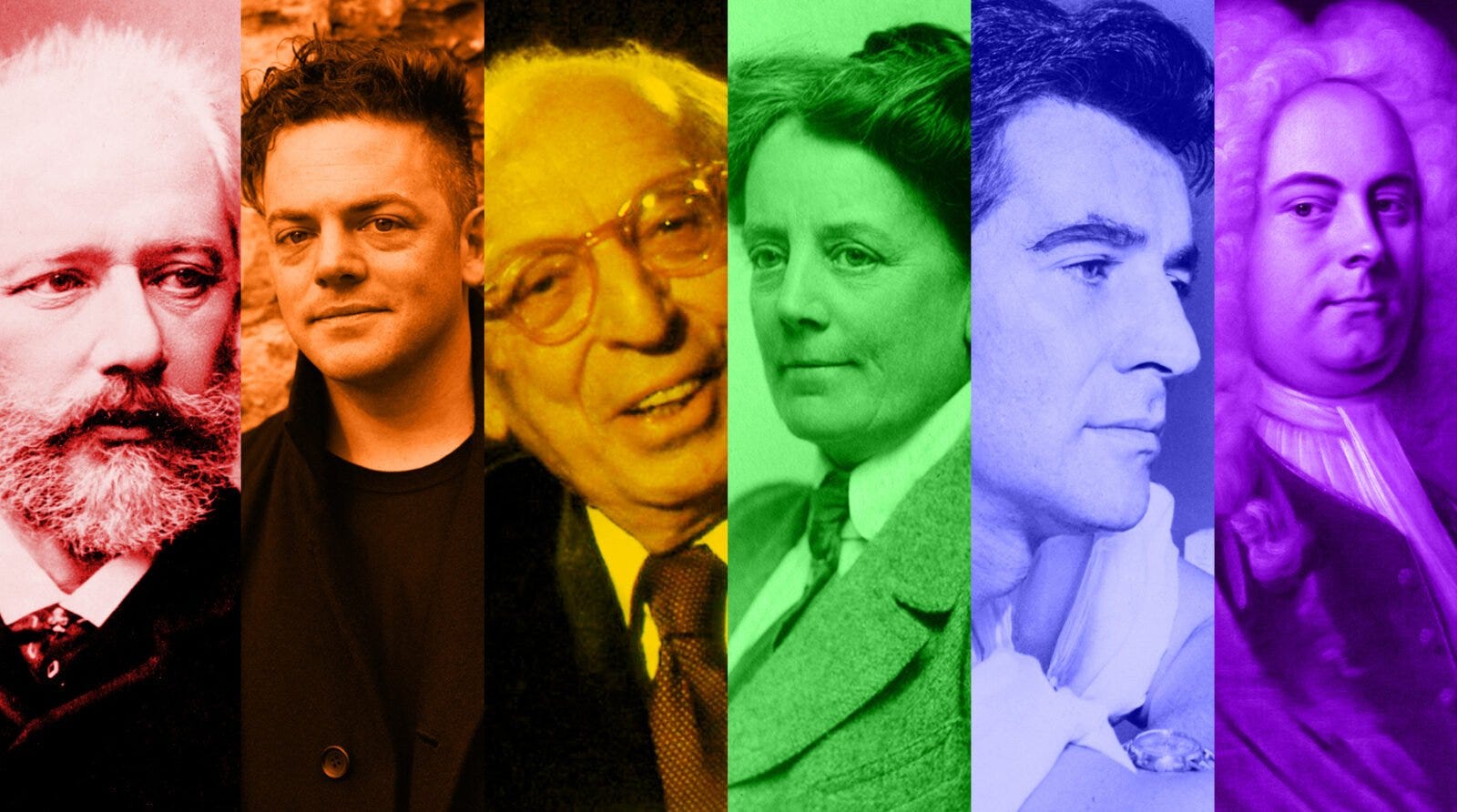
The year was 1877, and Pyotr Ilyich Tchaikovsky was drowning. Not in the Moscow River, though he’d fucking consider it soon enough, but in the suffocating heteronormative bullshit of Imperial Russia. Here was a man whose soul screamed in B-flat minor, whose heart pounded in 4/4 time, and whose sexual identity was buried so deep beneath layers of social expectation that it would take historians over a century to dig through the wreckage and find the truth: Tchaikovsky was gay as a fucking rainbow, and it nearly destroyed him.
I literally played the youtube video musical all through writing this shit. Thats how fucking awesome this is.
Tchaikovsy, how I love you.
The Tortured Genius Behind the Swan Lake
Let’s cut through the academic ass-kissing and get to the brutal reality. Pyotr Ilyich Tchaikovsky, born in 1840 in Votkinsk, Russia, was a man caught between two worlds: the soaring heights of musical genius and the crushing depths of societal homophobia. This wasn’t some gentle “product of his time” situation—this was a death sentence with a fucking bow tie.
In 19th-century Russia, being gay wasn’t just socially unacceptable; it was literally illegal and punishable by exile to Siberia or worse. The Orthodox Church considered homosexuality a mortal sin, the state considered it a criminal act, and society considered it grounds for complete social annihilation. Tchaikovsky knew this shit intimately, and it carved holes in his psyche that would bleed beautiful, agonizing music for the rest of his life.
The evidence of Tchaikovsky’s sexuality isn’t hidden in some dusty archive—it’s splattered across his correspondence like blood on a battlefield. His letters to men, particularly to his nephew Vladimir “Bob” Davydov, drip with passion that no amount of Victorian-era emotional repression can disguise. These weren’t your typical “Dear Friend” pleasantries; these were love letters disguised as family correspondence, each word carefully chosen to dance around the truth that could have killed him.
The Marriage That Nearly Killed Him
Enter Antonina Miliukova, a woman whose timing was about as good as a heart attack during a symphony performance. In 1877, this aspiring opera singer decided to confess her love to Tchaikovsky through a series of increasingly desperate letters. Most gay men throughout history have developed sophisticated avoidance techniques for such situations, but Tchaikovsky was operating under a particularly cruel form of internalized homophobia mixed with genuine terror.
The composer’s response? He fucking married her. On July 18, 1877, Pyotr Ilyich Tchaikovsky walked down the aisle like a man walking to his execution, because that’s essentially what it was. The marriage was a disaster from day one—a psychological horror show that lasted all of nine weeks before Tchaikovsky fled like his ass was on fire.
But those nine weeks? They nearly broke him completely. Tchaikovsky’s mental health, already fragile from years of sexual repression and social anxiety, shattered like a champagne flute hitting concrete. He attempted suicide by walking into the Moscow River in October 1877, hoping to catch pneumonia and die “naturally” rather than face the shame of admitting his marriage was a lie. The water was too fucking cold, and he survived, but the psychological damage was done.
The Brother Who Lived Free
While Pyotr was busy torturing himself with heteronormative performance art, his younger brother Modest was living his truth with the kind of balls that would make a bull jealous. Modest Tchaikovsky was openly gay in a time when that shit could get you killed, and he gave exactly zero fucks about what society thought.
Modest became a prominent playwright and librettist, penning the libretto for Pyotr’s “Queen of Spades” among other works. Their artistic collaboration flowed from deep fraternal understanding and shared sensibilities—two gay brothers finding ways to create beauty in a world that wanted them dead. But the difference between them was stark: Modest embraced his identity and lived authentically, while Pyotr remained trapped in a cage of his own making.
The psychological impact of watching his brother live freely while he remained closeted must have been excruciating. Modest’s existence was living proof that authenticity was possible, even in Imperial Russia, but Pyotr’s internalized shame and terror kept him locked away from his own truth.
The Music That Bled Truth
Here’s where Tchaikovsky’s genius becomes both heartbreaking and historically significant: he couldn’t live his truth, so he composed it. Every note, every crescendo, every heart-wrenching melody was a piece of his closeted soul screaming for recognition. The “Pathétique” Symphony, his final masterpiece, isn’t just music—it’s a fucking suicide note written in B minor.
Listen to the 1812 Overture and try to tell me that’s the work of a heterosexual man. The dramatic tension, the explosive release, the way it builds to an almost unbearable climax—this is the musical equivalent of a man who’s been sexually and emotionally repressed his entire life finally finding a way to express what he can’t say out loud.
Swan Lake, The Nutcracker, Sleeping Beauty—these aren’t just ballets, they’re coded messages from a gay man who couldn’t be gay. The tragic heroines, the impossible love stories, the themes of transformation and hidden identity—Tchaikovsky was writing his own story in every goddamn note, and the world was too busy enjoying the pretty music to notice the pain behind it.
The Psychological Massacre of the Closet
The psychological effects of Tchaikovsky’s forced closeting weren’t just personal—they were epidemic. Here was one of the world’s greatest composers, a man whose music would outlive empires, reduced to a trembling, suicidal wreck because he couldn’t love who he wanted to love. The internalized homophobia didn’t just damage him; it robbed the world of the person he could have been if he’d been free to live authentically.
Tchaikovsky’s diaries and letters reveal a man in constant psychological torment. He described his sexuality as a “curse” and spent his life trying to cure himself of feelings that were as natural as breathing. The self-hatred was so profound that it affected every aspect of his existence—his relationships, his work, his health, even his death.
The composer died in 1893, officially of cholera, but the circumstances were suspicious enough that many historians believe he committed suicide. Whether he died by disease or by his own hand, the cause was the same: a society that killed its own children rather than let them love freely.
The Ripple Effect on LGBTQ+ History
Tchaikovsky’s story isn’t just about one tortured genius—it’s about the systematic destruction of queer lives throughout history. Every note he wrote in anguish represents thousands of LGBTQ+ people who were crushed by the same forces that nearly destroyed him. His music became a sanctuary for queer people who recognized their own pain in his melodies, a coded language that said “you are not alone” to generations of closeted individuals.
The philosophical implications are staggering. Here was a man whose gifts to humanity were immeasurable, whose music brought joy to millions, whose artistic legacy is literally priceless—and society nearly destroyed him because of who he loved. How many other Tchaikovskys did we lose? How many symphonies were never written because their composers were too busy trying to survive in a world that wanted them dead?
The Social Impact of Closeted Genius
Tchaikovsky’s forced closeting had massive social implications that ripple through history. His marriage to Antonina became a cautionary tale about the dangers of forced heteronormative performance, but it also demonstrated how society’s homophobia damages everyone involved. Antonina became a victim too, trapped in a marriage with a man who could never love her the way she deserved.
The composer’s patroness, Nadezhda von Meck, provided him with financial support for thirteen years on the condition that they never meet in person. This relationship, conducted entirely through letters, became one of the most important in his life precisely because it was free from the sexual and social expectations that tormented him elsewhere. Von Meck understood, perhaps intuitively, that Tchaikovsky needed space to be himself—even if she never knew exactly what that meant.
The Philosophical Questions That Haunt Us
Tchaikovsky’s life raises philosophical questions that should make every thinking person’s blood boil. What is the moral cost of forcing human beings to deny their fundamental nature? How do we measure the artistic and social contributions we lost when we systemically oppressed LGBTQ+ people? What masterpieces were never created because their potential creators were too busy fighting for survival?
The composer’s struggle with his identity wasn’t just personal—it was a reflection of humanity’s broader failure to accept and celebrate diversity. His music became a form of resistance, a way of smuggling queer sensibility into mainstream culture without triggering the violent backlash that open authenticity would have provoked.
The Legacy That Survives
Despite the psychological torture he endured, Tchaikovsky’s music survives as a testament to the resilience of the human spirit. His compositions continue to move audiences to tears, to inspire dancers and musicians, to provide soundtrack for some of humanity’s most beautiful moments. The Swan Lake pas de deux has become synonymous with romantic love, performed by countless couples who have no idea they’re dancing to the work of a closeted gay man.
This is the ultimate irony: the music that emerged from Tchaikovsky’s repression has become the soundtrack for heterosexual romance across the globe. His pain became everyone’s pleasure, his torment became the world’s joy. It’s both beautiful and heartbreaking—a reminder that LGBTQ+ people have always been here, creating beauty even in the darkest circumstances.
The Modern Relevance
Tchaikovsky’s story remains devastatingly relevant because homophobia didn’t die with the 19th century. In Putin’s Russia, being openly gay is still dangerous. In dozens of countries around the world, LGBTQ+ people face imprisonment, violence, or death for being authentic. The composer’s struggle continues in the lives of countless individuals who still can’t live their truth without fear.
But his story also demonstrates the power of art to transcend oppression. Tchaikovsky couldn’t be openly gay, but his music queered the world anyway. Every performance of Swan Lake is a small act of resistance, every rendition of the Nutcracker Suite is a celebration of queer creativity, every tear shed during the Pathétique Symphony is a recognition of the pain caused by forcing people to hide who they are.
The Psychological Impact on Modern LGBTQ+ Communities
For modern LGBTQ+ people, Tchaikovsky’s story serves as both inspiration and warning. His music provides comfort and validation—proof that queer people have always existed, have always created beauty, have always found ways to express their truth even under impossible circumstances. But his psychological torture also serves as a reminder of what happens when society forces people to deny their authentic selves.
The composer’s internalized homophobia mirrors the struggles many LGBTQ+ people face today. The self-hatred, the attempts to “cure” himself, the desperate conformity to heteronormative expectations—these patterns persist in communities where acceptance is still lacking. Tchaikovsky’s story helps modern queer people understand that their struggles are part of a larger historical pattern, that they’re not alone in their pain.
The Fucking Truth We Can’t Ignore
Here’s the bottom line: Pyotr Ilyich Tchaikovsky was gay as a fucking rainbow, and society nearly destroyed one of history’s greatest musical geniuses because of it. His story isn’t just about one man’s struggle—it’s about the systematic oppression of LGBTQ+ people throughout history and the incalculable cost of that oppression.
Every time someone tries to deny or diminish Tchaikovsky’s sexuality, they’re participating in the same erasure that tortured him during his lifetime. Every time someone argues that his personal life doesn’t matter, they’re missing the point entirely. His sexuality wasn’t separate from his music—it was the source of his music, the pain that created beauty, the truth that couldn’t be spoken but had to be expressed.
The evidence is there for anyone willing to look: the passionate letters, the disastrous marriage, the psychological torment, the coded themes in his compositions. Tchaikovsky was a gay man living in a world that wanted him dead, and he survived by bleeding music instead of truth. His story deserves to be told honestly, completely, and without the sanitizing bullshit that has obscured it for too long.
We owe it to Tchaikovsky, to his brother Modest, to every LGBTQ+ person who has ever had to hide their truth, to tell this story with the visceral honesty it deserves. Because in the end, the music was never just about entertainment—it was about survival, resistance, and the unbreakable human spirit that creates beauty even in the darkest fucking circumstances.
Tchaikovsky’s legacy isn’t just musical—it’s a testament to the fact that LGBTQ+ people have always been here, creating the culture that defines human civilization, even when that same civilization tried to destroy them. His story is our story, his pain is our pain, and his music is our victory song—a reminder that love, in all its forms, will always find a way to express itself, even when the world tries to silence it.
Citations:
Suchet J. 2019 “Tchaikovsky: The Man Revealed”
Poznansky, K. 2014 “Tchaikovsky: The Quest for the Inner Man “