Republican Crime In Peace & Justice History for 7/24

July 24, 1974
The United States Supreme Court (U.S. v. Nixon) unanimously ordered President Richard Nixon to surrender tape recordings of White House conversations regarding the Watergate affair. Speaking for the Supreme Court in front of a packed and hushed courtroom, Chief Justice Warren E. Burger (a Nixon appointee) rejected President Nixon’s claims of executive privilege (virtually total confidentiality for the White House) because the need for fair administration of criminal justice must prevail.

The White House feared review of the recordings by a U.S. district judge would reveal, among other crimes, impeachable offenses.
Listen to the tapes online  (It’s a YouTube playlist!)
July 24, 1983
Canadians and Americans spanned the international border at Thousand Islands Bridge, linking New York and Ontario, to protest nuclear weapons and border harassment of peace activists.

Thousand Islands Bridge
July 24, 1983
Women tagged a U.S. warplane with anti-nuclear graffiti at Greenham Common, an air base in England. The Greenham Common Women’s Peace Camp had been set up just outside the perimeter of the base in 1981 to get U.S. Cruise missiles, some of which were deployed at the base, out of their country. Other tactics included disrupting construction work at the base, blockading the entrance, and cutting down parts of the fence.

Read more about The Greenham Common Women’s Peace Camp

https://www.peacebuttons.info/E-News/peacehistoryjuly.htm#july24

$ informative shorter clips from The Majority Report

H.D. Thoreau Protests; Detroiters, Too, This Date In Peace & Justice History

July 23, 1846
Author Henry David Thoreau was jailed for refusing to pay the poll tax as a protest against the Mexican war, which in turn led to his writing “Civil Disobedience.” This essay became a source of inspiration for Leo Tolstoy, Mahatma Gandhi, and Martin Luther King, Jr.
From Thoreau’s essay:

“Unjust laws exist: shall we be content to obey them, or shall we endeavor to amend them, and obey them until we have succeeded, or shall we transgress them at once?”


Daguerreotype of Henry David Thoreau
Out of Thoreau’s jailing grew a legend: The great American philosopher Ralph Waldo Emerson visited Thoreau in jail. Emerson asked, “Henry, why are you here?” Thoreau replied, “Why are you not here? Under a government which imprisons unjustly, the true place for a just man is also a prison.”
Thoreau was not alone in his opposition: Thomas Corwin of Ohio denounced the war as merely the latest example of American injustice to Mexico: “If I were a Mexican I would tell you, ‘Have you not room enough in your own country to bury your dead.’” Henry Clay [former speaker of the House and presidential candidate] declared, “This is no war of defense, but one of unnecessary and offensive aggression.”
Abraham Lincoln also opposed the war, and lost his seat in Congress as a result.
The entire essay (in annotated form) 
July 23, 1967
Detroiters angry at loss of jobs and, especially, at the abusive and virtually all-white police department, started rioting in what became known as the Detroit Rebellion.
The intitiating incident was an early-morning raid on a blind pig (Detroit for after-hours drinking club) on 12th Street.
The violence spread elsewhere in the city, and led to President Lyndon Johnson’s calling out 8000 members of the National Guard. Order was not restored for six days.

In the end, there were 43 known dead, 347 injured, 3800 arrested, 1000 families homeless. Thirteen hundred buildings burned to the ground and twenty-seven hundred businesses were looted.
Online documentary on all aspects of what happened, “Ashes to Hope” 
The Rebellion from a 40-year perspective

https://www.peacebuttons.info/E-News/peacehistoryjuly.htm#july23

Priorities

(This is here in part because clicking through to read on Substack for free is good for her numbers, and she deserves all the numbers. -A)

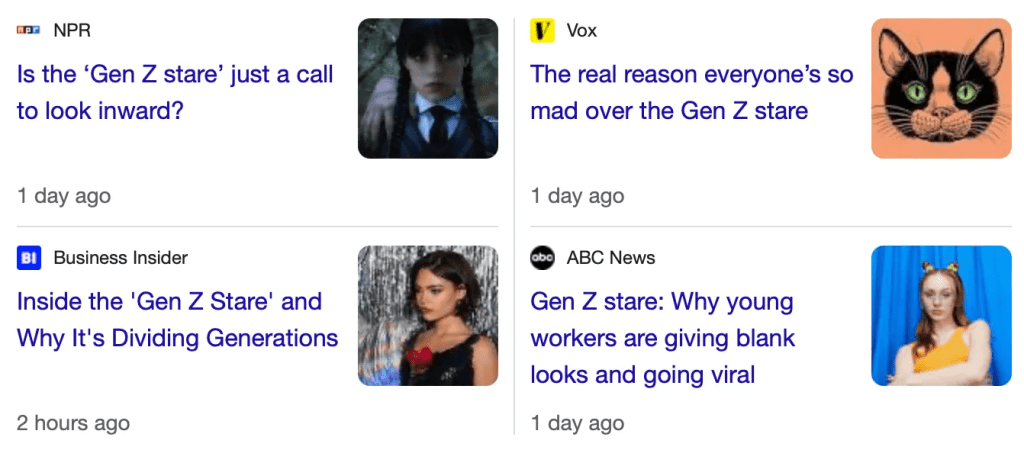
My Thoughts on the ‘Gen Z Stare’ by Charlotte Clymer

And I do have thoughts. Read on Substack

Legacy media is very concerned with the ‘Gen Z Stare’

In the past week, there’s been robust discourse in legacy media about the so-called ‘Gen Z Stare’ and the bursts of generational conflict it reportedly captures.

It’s gotten write-ups by The New York Times, The Washington Post, USA Today, The Boston Globe, NBC News, ABC News, CNBC, Newsweek, Indy100, Axios, Fortune, Vox, Vice, Business Insider, The Independent, Forbes, Buzzfeed, Slate, HuffPost, Glamour, People, and Marie Claire, among others.

As a millennial, I am apparently urged to be concerned about this phenomenon of Gen Z folks supposedly failing to appropriately interact with me through sufficiently pleasant facial expressions, so I thought it might be helpful to offer my thoughts:

The sitting president of the United States is currently covering up a massive sex trafficking operation that targeted children and likely implicates a number of powerful people who are currently out in the world and free to continue preying on children.

The sitting president of the United States just successfully pressured Paramount and CBS to cancel the #1 late-night talk show on broadcast television as part of what appears to be a blatant bribery deal because the host has been critical of him.

The sitting president of the United States just got the extremist Republican majority in Congress to strip 11 million Americans of health care coverage by the end of 2026 and upwards of 17 million Americans when you account for new federal work requirements. (snip-MORE; it’s succinct and quick, and it’s all good facts for grocery/other places lines, for discussion.)

Some The Majority Report clips on ICE and the democrats

Frederick Douglass Does Some Great Work at Seneca Falls, Dockum Drug Store Sit-Ins, & More, in Peace & Justice History for 7/19

July 19, 1848 
The first Women’s Rights Convention in the U.S. was held at Seneca Falls, New York. Its “Declaration of Sentiments” launched the movement of women to be included in the constitution.The Declaration used as a model the U.S. Declaration of Independence, demanding that the rights of women as individuals be acknowledged and respected by society. It was signed by sixty-eight women
and thirty-two men.
The impetus came from Elizabeth Cady Stanton and Lucretia Mott, both of whom had been excluded, along with all the other female American delegates, from the World Anti-Slavery Convention (London, 1840) because of their sex.


Frederick Douglass, the former slave and abolitionist leader attended the convention and supported the resolution for women’s suffrage.
When suffrage finally became a reality in 1920, seventy-two years after this first organized demand in 1848, only one signer of the Seneca Falls Declaration, Charlotte Woodward, then a young worker in a glove manufactory, had lived long enough to cast her first ballot.
The Seneca Falls Convention and the Early Suffrage Movement 
The Declaration of Sentiments
July 19, 1958
Several black teenagers, members of the local NAACP chapter (National Association for the Advancement of Colored People), entered downtown Wichita’s Dockum Drug Store (then the largest drugstore chain in Kansas) and sat down at the lunch counter.

Wichita sit-in sculpture
The store refused to serve them because of their race. They returned at least twice a week for the next several weeks. They sat quietly all afternoon, creating no disturbance, but refused to leave without being served. Though the police once chased them away, they were breaking no law, only asking to make a purchase, a violation of store policy.
This was the first instance of a sit-in to protest segregationist policies. Less than a month later, a white man around 40 walked in and looked at those sitting in for several minutes. Then he looked at the store manager, and said, “Serve them. I’m losing too much money.”
That man was the owner of the Dockum drug store chain.
That day the lawyer for the local NAACP branch called the store’s state offices, and was told by the chain’s vice president that “he had instructed all of his managers, clerks, etc. (statewide), to serve all people without regard to race, creed or color.”
July 19, 1974 
Martha Tranquill of Sacramento, California, was sentenced to nine months’ prison time for refusing to pay her federal taxes as a protest against the Vietnam War.
July 19, 1993
President Bill Clinton announced regulations to implement his “Don’t Ask, Don’t Tell” policy regarding gays in the military, saying that the armed services should put an end to “witch hunts.” The policy was developed by General Colin Powell, then Chair of the Joint Chiefs of Staff, and eventually summarized as “don’t ask, don’t tell, don’t pursue, don’t harass.”
July 19, 2000
A federal administrative law judge ordered white supremacist Ryan Wilson to pay $1.1 million in damages to fair housing advocate Bonnie Jouhari and her daughter, Dani. The decision stemmed from threats made against Jouhari by Wilson and his Philadelphia neo-Nazi group, ALPA HQ.


Bonnie and Dani Jouhari

https://www.peacebuttons.info/E-News/peacehistoryjuly.htm#july19

Good Trouble Today, The Young Lords Begin To Repair A Hospital, & More In Peace & Justice History for 7/17

Good Trouble demonstrations today, all. Let’s do what we can to make a visible stand for democracy!

July 17, 1927
In a significant early use of close air support, a U.S. Marine squadron of seven airplanes dive-bombed rebels and peasants surrounding Marines and Nicaraguan military (then under direct U.S. control) in Ocotal, Nicaragua, killing more than 100. The rebels were opposed the presence of U.S. forces, essentially continuously in their country since 1909. 
Why was the U.S. in Nicaragua? 
July 17, 1970

The Young Lords Party entered the Lincoln Hospital in the South Bronx, NYC. The hospital, located in a condemned and dilapidated building, was filled with pain, degradation, neglect, flies, and humiliation. The YLP set up care units in the Hospital, and drew attention to the abysmal conditions.
The direct-action takeover prompted a response by the government, and the building of a new Lincoln Hospital.
The Lincoln Hospital Offensive 
=July 17, 1976

The opening ceremony of the 21st Olympic Games in Montreal was marked by the withdrawal of more than twenty African countries, Iraq and Guyana, and their 300 athletes. They had demanded that New Zealand be banned from participation because its national rugby team had toured South Africa, itself banned from the Olympics since 1964 for its refusal to end the racially separatist policy of apartheid.
The Soweto Massacre, in which 150 children were killed by South African troops, had occurred just one month earlier. The apartheid government had been using international sport as a means to build respectability. The following year, however, in reaction to the Olympic boycott, the nations of the British Commonwealth (which includes New Zealand) adopted the Gleneagles Agreement, discouraging all sporting contacts with South Africa.
African countries boycott Olympics 
Gleneagles Agreement  (It’s a .pdf)
July 17, 1979
Fighters of the Sandinista National Liberation Front overthrew the U.S.-supported dictatorial regime of Anastasio Somoza in the Central American republic of Nicaragua and forced him to flee the country. The notorious and feared U.S.-trained National Guard crumbled and its surviving commanders negotiated a surrender, despite their superiority in armaments.
The Sandanista Revolution
  
Anastasio Somoza
 
Girls born after the historic Sandinista victory. Legal voting age in Nicaragua is 16 years.
The overthrow: Sandinista rebels take Nicaraguan capital

https://www.peacebuttons.info/E-News/peacehistoryjuly.htm#july17

Some clips from The Majority Report dealing with Racism in the US and Israel and ICE.

Busy Day In Peace & Justice History, from Crusaders Sacking Jerusalem To Strikers To Nukes, & More:

July 16, 1099
 
The Sacking of Jerusalem
Soldiers from all over Catholic Europe, known as Crusaders, overtook the defenses of Jerusalem and slaughtered both the Jewish and Muslim populations. According to Fulk of Chartres in his contemporaneous account, “Many fled to the roof of the Temple of Solomon, and were shot with arrows, so that they fell to the ground dead. In this temple almost ten thousand were killed. Indeed, if you had been there you would have seen our feet colored to our ankles with the blood of the slain. But what more shall I relate? None of them were left alive; neither women nor children were spared.”
Pope Urban II initiated this effort to wrest the Holy Land from the hands of the “Infidel” (the city had been under Islamic rule for 460 years) and assured those who joined the first crusade that God would absolve them from any sin associated with the venture.
———————————————————————————————————-
July 16, 1877

Firemen and brakemen for the Pennsylvania and Baltimore & Ohio Railroads refused to work, and refused to let replacements take their jobs. They managed to halt all railroad traffic at the Camden Junction just outside of Baltimore. The railroad companies had cut wages and shortened the workweek.

A contemporary artist’s rendering of the clash in Baltimore between workers
and the Maryland Sixth Regiment during the Great Railroad Strike of 1877. The governor had called out the troops on behalf of the railroad company.
After a second pay cut in June, Pennsylvania RR announced that the same number of workers would be expected to service twice as many trains. The work stoppage spread west and eventually became the first nationwide strike
Background and growth of the Strike 
——————————————————————————————————–
July 16, 1945

The U.S. Army’s Manhattan Project succeeded as its first hand-made experimental atomic bomb, known as the “Gadget,” was successfully detonated at the top of a 30m (100 ft.) tower in the desert near Alamogordo, New Mexico (at the Trinity test site now part of the White Sands Missile Range). The original $6,000 budget for the intensive and secret weapons development program during World War II eventually ballooned to a total cost of nearly $2 billion (more than $25 billion in current dollars).


“Gadget” explodes

The “Gadget” just before the Trinity test July 16, 1945.
Assembled in the McDonald Ranch house nearby, the orange-sized plutonium core, weighing 6.1 kg (13.5 lbs.), yielded an explosive force of more than 20 kilotons (equivalent of 20,000 tons of TNT).
Trinity Atomic Bomb  (A good read -A.)
What it’s like there today: “My Radioactive Vacation” 
———————————————————————————————————-
July 16, 1979

The largest release of radioactive material in the U.S. occurred in the Navajo Nation. More than 1200 metric tons (1,100 tons) of uranium tailings (mining waste) and 378 million liters (100 million gallons) of radioactive water burst through a packed-mud dam near Church Rock, New Mexico. The river contaminated by the spill, the Rio Puerco, showed 7,000 times the allowable standard of radioactivity for drinking water downstream from the broken dam shortly after the breach was repaired.

A month later, only 5% of the tailings had been cleaned out.
Warnings not to drink the contaminated water were issued by officials, but non-English-speaking Navajo never heard them, having no electrical power for TV or radio. Humans and livestock continued to drink the water.

———————————————————————————————————-
July 16, 1979


Saddam Hussein became president of the Iraqi republic, secretary general of the Ba’ath Party Regional Command, chairman of the Revolutionary Command Council, and commander-in-chief of the armed forces. He had been the ambitious protegé of Ahmed Hassan al-Bakr, who resigned on this day.

———————————————————————————————————-
July 16, 1983

During a time of increasing tension between the U.S. and the U.S.S.R. (Union of Soviet Socialist Republics), and an escalating nuclear arms race, 10,000 peace activists formed a human chain linking the two superpowers’ embassies in London, England.
The same day, members of the Greenham Common Women’s Peace Camp painted the U.S. spy plane, Blackbird, and composed this song for their activities:
[to the tune of Count Basie’s “Bye, Bye, Blackbird”]
“Here I stand paint in hand
Speaking low, here I go
Bye bye blackbird
Just a dab of paint or two
Here I stand paint in hand
Speaking low, here I go
Bye bye blackbird
Just a dab of paint or two
Grounds you for a week or two
Bye bye blackbird.
 No one in the base could undermine you
Till we did some countersigning on you
Now you’re just a silly joke
Invented by some macho bloke
Blackbird bye bye.”

https://www.peacebuttons.info/E-News/peacehistoryjuly.htm#july16

The Longest Walk, & More, In Peace & Justice History for 7/15

July 15, 1834
The Spanish Inquisition, a centuries-long brutal effort by the Catholic Church to root out heresy, begun in 1481, was officially abolished by King Bonaparte. Spain’s King Ferdinand and Queen Isabella had chosen Catholicism as their religion and asked the pope to help purify the people of Spain. Many thousands were forced to convert, were tortured to encourage confession, or burned at the stake.

Witch burning during the Inquisition
More on the Inquisition 
July 15, 1919
Following World War I, the U.S. War Department announced that it had classified more than 337,000 American men as “draft dodgers.”
Read a brief history of Conscientious Objection in America 
July 15, 1978
The Longest Walk, a peaceful transcontinental trek for Native American justice, which had begun with a few hundred departing Alcatraz Island, California, ended this day when they arrived in Washington, D.C. accompanied by 30,000 marchers.

They were calling attention to the ongoing problems plaguing Indian communities throughout the Americas: lack of jobs, housing, health care, as well as dozens of pieces of legislation before Congress canceling treaty obligations of the U.S. government toward various Indian tribes.
They submitted petitions signed by one-and-a-half million Americans
to President Jimmy Carter.


The Longest Walk Zinn Project

https://www.peacebuttons.info/E-News/peacehistoryjuly.htm#july15