
This person Same is interviewing is from the Cato Institute. Sam and David talk about the bigotry and attempt to purify the country of non-white people. tRump and his racist administration claim to want to remove 100 million from the US. There is no where near that number of undocumented people in the country. That number is almost 1/3 of the US population. Undocumented immigrants were estimated at 14 million in 2023 at the highest. So where are the rest of these people coming from? Legal documented immigrants and non-white citizens born in the US. That is why they are rounding up brown people who immigrated here legally and why they are trying so hard to end birth right citizenship. The goal has become clear and it is scary to me. To cement the white majority for as long as possible and stop the slow decline of the white majority / rize of minority demographics. Stephen Miller and the other racists in tRump administration want an apartheid state like the former South African one was. They want no rights for non-whites. They want no non-whites in positions of authority. The administration is going after businesses and higher education for not prioritizing whites over any other group. They feel no white male is less qualified than any non-white. If a non-white person scored 95 and the white person scored 75, these racists feel the white person is still more qualified because of their skin color. The racists feel the only DEI that should be allowed is the promotion of white males over everyone else. Hugs
Category: Misogyny
Chip Roy Makes Huge Mistake
This is about the save act. Chip Roy and the republicans constantly say it is no problem for people in the US to get a identifcation or be able to vote if they have changed their name via marriage. Fact is even Chip Roy’s own staff is struggling to get it done. And as Sam says that staff member gets the time off work and has the backing of a high level boss. The Save Act allows states to let people use the marriage license as a document but doesn’t require it. So only the blue states run by democrats will. Florida wont. And the state I was born in doesn’t allow for birth certificate changes without a court order. Roy says he doesn’t want to publicize this flaw or give it credit because the republicans want women / and gay men who might have changed their names to be blocked from voting. Again it is about promoting their view of a perfect world / and voter. A straight cis Christian white male who votes only for restrictive republicans and has a right wing ideology. Hugs
Sigh. I Think We Saw This Coming, But Here It Is:
To me, this is basic misogyny; soon it will be simpler for the Olympics to ban women and girls entirely. I will note that it doesn’t seem that they’re going to check for trans men. I wonder if trans men ought to play in women’s sports, under this “logic”? Meanwhile, all the girls and women who are a little too tall, a little too strong, a little larger built in the shoulders, etc., etc. are going to be excluded along with other women who passed through male puberty before transitioning. The illogic of this makes my head explode.
I will add that there is a special place in hell for women who undermine other women; especially those who get somewhere, then yank the ladder up behind them. Lookin’ at Kirsty Coventry, pictured below, now IOC President.
Transgender women athletes banned from female Olympic events by new IOC policy
By GRAHAM DUNBARUpdated 2:25 PM CDT, March 26, 2026
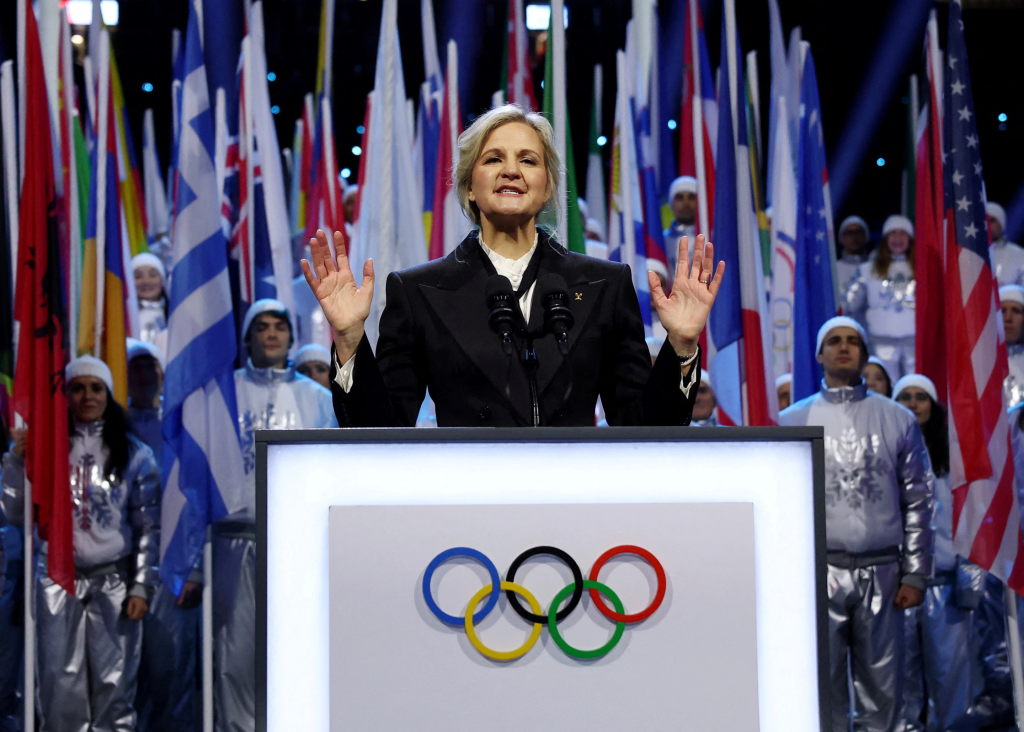
GENEVA (AP) — Transgender women athletes are now excluded from women’s events at the Olympics after the IOC agreed to a new eligibility policy on Thursday which aligns with U.S. President Donald Trump’s executive order on sports ahead of the 2028 Los Angeles Games.
“Eligibility for any female category event at the Olympic Games or any other IOC event, including individual and team sports, is now limited to biological females,” the International Olympic Committee said, to be determined by a mandatory gene test once in an athlete’s career.
It is unclear how many, if any, transgender women are competing at an Olympic level. No woman who transitioned from being born male competed at the 2024 Paris Summer Games, though weightlifter Laurel Hubbard did at the Tokyo Olympics in 2021 without winning a medal.
The eligibility policy that will apply from the L.A. Olympics in July 2028 “protects fairness, safety and integrity in the female category,” the IOC said.
“It is not retroactive and does not apply to any grassroots or recreational sports programs,” said the IOC, whose Olympic Charter states that access to play sport is a human right.
After an executive board meeting, the IOC published a 10-page policy document that also restricts female athletes such as two-time Olympic champion runner Caster Semenya with medical conditions known as differences in sex development, or DSD.
“We know that this topic is sensitive,” IOC President Kirsty Coventry said in an online news conference to explain the policy.
Coventry and the IOC have wanted a clear policy instead of continuing to advise sports’ governing bodies who previously have drafted their own rules.
“At the Olympic Games, even the smallest margins can be the difference between victory and defeat,” Coventry, a two-time Olympic gold medalist in swimming, said in a statement. “So, it is absolutely clear that it would not be fair for biological males to compete in the female category.”
She set up a review of “protecting the female category” as one of her first big decisions last June as the first woman to lead the Olympic body in its 132-year history.
Female eligibility was a strong theme in a seven-candidate IOC election last year — held after a furor around women’s boxing in Paris — when Coventry’s main rivals pledged a stronger policy to leading on the issue.
“This was a priority for me way before President Trump came into his second term,” Coventry said. “There’s not been any pressure (on) us to deliver anything from anybody outside of the Olympic Movement.”
Before the 2024 Paris Olympics, three top-tier sports — track and field, swimming and cycling — excluded transgender women who had been through male puberty. Semenya, who was assigned female at birth in South Africa and has testosterone levels higher than the typical female range, won a European Court of Human Rights judgment in her years-long legal challenge to track and field’s rules which did not overturn them. (snip-there is more, sort of pleading for understanding, but go see the rest of it if you like)
The expert group agreed the current gene test is “the most accurate and least intrusive method currently available.” The saliva, cheek swab or blood sample screens for “the SRY gene, a segment of DNA typically found on the Y chromosome that initiates male sex development in utero and indicates the presence of testes/testicles.”
Still, the mandatory gender screening — already conducted by the governing bodies of track and field, skiing and boxing — is likely to be criticized by human rights experts and activist groups.
Athlete appeal to CAS?
The IOC policy can — and likely will — be challenged at the Court of Arbitration for Sport in the Olympic body’s Swiss home city Lausanne, perhaps by an athlete acting alone.
Track athletes Dutee Chand of India and Semenya challenged previous versions of their sport’s eligibility rules at the court.
Any potential appeal would examine science underpinning IOC research which was not published Thursday. A case could occupy much of the near-28 months until the L.A. Olympics open.
“As we know in today’s world,” Coventry said, “any and all rules and regulations at any point in time could always be challenged.” (snip)
The White House welcomed the IOC’s decision, describing it as the result of the executive order.
“The IOC aligning their policy with President Trump’s executive order ahead of the 2028 LA Games is common sense and long overdue,” White House spokesman Davis Ingle said in a statement.
The women leading the farmworker movement won’t let it be defined by Cesar Chavez
The sexual abuse allegations against Chavez have rocked them. But their focus is still on protecting other women.
This story was originally reported by Chabeli Carrazana, Shefali Luthra and Marissa Martinez of The 19th. Meet Chabeli, Shefali and Marissa and read more of their reporting on gender, politics and policy.
Monica Ramirez has spent much of her life spotlighting the pervasiveness of sexual violence against women farmworkers. She, like many in that movement, considered civil rights leader Cesar Chavez an icon.
Since allegations came to light this week that Chavez sexually assaulted women and girls as young as 12 — including fellow movement leader Dolores Huerta — Ramirez and the larger farmworker community have been left reeling. Now, they’re trying to reconcile how this man who so many revered — whose name is on streets, schools and even a holiday — could perpetrate the violence that has plagued women farmworkers for decades.
The community has been “shaken to its foundation,” said Ramirez, the founder of Justice for Migrant Women, a civil rights organization focusing on farmworker and migrant women. She and other leaders are now trying to push forward the farmworker movement and continue the work that many women — not just Chavez — spearheaded.

“The farmworker movement is a leaderful movement, and women have always been part of that leadership,” Ramirez said. But their work has often been made invisible, sometimes by the very men who stood beside them in building worker power for Latinx people in the United States.
“In order to have a movement, in order to have a boycott, in order to organize any kind of action, it’s often women who are helping to organize the meetings, helping to bring their compañeras,” Ramirez said.
Chavez was one of the most revered figures in the Latinx civil rights movement. The labor leader cofounded what became the United Farm Workers union alongside Huerta, and was most known for a series of strikes and protests that grew unionization efforts across California. After Chavez’s death in 1993, he was posthumously awarded the Presidential Medal of Freedom, the nation’s highest civilian honor. In 2014, former President Barack Obama designated his birthday, March 31, as a federal holiday to celebrate his legacy, which many states had already marked.
Now, many of those celebrations are being canceled or renamed after a bombshell, yearslong investigation published by The New York Times Wednesday found evidence of a pervasive pattern of sexual abuse perpetrated by Chavez. Two women said Chavez sexually abused them for years as girls, when the organizer was in his 40s and had already become a powerful global figure. Ana Murguia said Chavez first assaulted her when she was 13; Debra Rojas was 12.
In the years following the abuse, both suffered from depression, panic attacks and substance abuse.
“I feel like he’s been a shadow over my life,” Rojas told the Times. “I want him to stop following me around. It’s time.”
Huerta, the renowned activist who coined the rallying cry, “Sí, se puede,” spoke at length about emotional and physical abuse from her longtime organizing partner — a disclosure she had never made publicly. She told the Times that he raped her in a secluded grape field in 1966, and had pressured her to have sex with him another time during a work trip in 1960. Both encounters resulted in children. Huerta concealed the pregnancies and arranged for the baby girls to be raised by others.
She was shaken upon hearing the allegations from other women, and told the Times she struggles to reconcile the man she knew and the one who assaulted her.

In a statement released Wednesday, Huerta said she carried her secret for 60 years because “building the movement and securing farmworker rights was my life’s work. The formation of a union was the only vehicle to accomplish and secure those rights and I wasn’t going to let Cesar or anyone else get in the way.”
She said she spoke up because she learned there were others coming forward.
“The farmworker movement has always been bigger and far more important than any one individual. Cesar’s actions do not diminish the permanent improvements achieved for farmworkers with the help of thousands of people,” she said. “We must continue to engage and support our community, which needs advocacy and activism now more than ever.”
Magaly Licolli knew exactly what Huerta was talking about in her statements about Chavez.
Licolli is the co-founder and executive director of Venceremos, an organization advocating for poultry workers in Arkansas, and she’s heard stories about sexual harassment and assault on women for years.
Before she started Venceremos, she was fired from another poultry worker organization after speaking up about multiple accusations of sexual harassment and assault against a well-known organizer.
“Women came forward and accused the organizer of sexually assaulting them or sexually harassing them. When I brought that to the board, they didn’t believe it,” Licolli said. “I had to stand with the women … I cannot do this work pretending I’m doing justice when I’m hiding injustice.”
Licolli felt that echoed this week.
“Women of color, we are not trusted on what we go through. We have to prove with pictures, with testimony, our own stories for our own stories to be validated,” she said. “I’m happy that now it’s something that people are talking about, and I’m happy that people are now reflecting about what is the role of women in the movement and when we have to be silenced toward that kind of injustice to protect the work that we do.”

A growing share of farmworkers are women, according to the U.S. Department of Agriculture: about 26.4 percent in 2022, the most recent year for which data is available. Most are Latina.
A 2012 report by Human Rights Watch, an advocacy organization, found that women farmworkers are often at risk of sexual harassment or assault, with virtually every worker interviewed for the report saying they either had experienced harassment or assault or knew someone who had. Farmworkers work in mixed-gender settings, and they have limited worker protections But women typically lack avenues to report their experiences, the report’s authors wrote, in large part because of immigration status. As of 2022, most farmworkers were immigrants without U.S. citizenship.
“Sexual violence and harassment in the agricultural workplace are fostered by a severe imbalance of power between employers and supervisors and their low-wage, immigrant workers,” the report said.
A 2024 review published in the Journal of Agromedicine suggested that as many as 95 percent of women farmworkers in the United States have experienced workplace sexual harassment.
None of the women in the Times story spoke publicly until recently because of the shame and fear associated with reporting abuse against prominent organizers.
But over the past decade, after the growth of the #MeToo movement and the release of millions of Epstein files that have implicated numerous people in powerful positions, survivors have been more willing to speak up about their experiences.
Ramirez, who also founded the public awareness campaign known as the Bandana Project to raise awareness of sexual violence against farmworker women, said she now expects more women to come forward with their own stories. At an event Wednesday night shortly after the news broke, she said one woman came up to her to tell her how sexual assault was a problem in the fields where she worked as a teenager.
“Now that we understand clearly that this issue of sexual violence is an endemic problem in our society … the question we have to answer is: Knowing that, how serious are we going to get in our commitment to ending the problem?”
California lawmakers already plan to change the name of Cesar Chavez Day on March 31 to “Farmworkers Day,” and efforts are underway to remove his name from landmarks. But the real work to come will be about investing resources and support to improve the culture that has protected perpetrators in organizing spaces over victims.
Rep. Delia Ramirez, an Illinois Democrat who worked in organizing before entering politics, said it was “devastating” that the claims took so long to come out. She said when she became an executive director of a nonprofit at 21, she, too, had faced situations that in hindsight were not appropriate, and left the organization with a responsibility to create safer environments for other young women.
“Oftentimes women, especially women of color, we end up having to hold so many things for the sake of the movement, family, community,” Delia Ramirez told the 19th. “I don’t believe that there is one hero for our movements. Movements are led by a collective, and you can’t create some pedestal for one person, because humans will always fail you.”

Moving forward, Monica Ramirez said people will be watching how leaders in the farmworker movement respond to the allegations. Do they take a defensive posture or question the veracity of the survivors’ accounts? The revelations about Chavez come at a time when sexual misconduct by powerful men has been in the spotlight, all while the country grapples with a wave of immigration enforcement actions that are targeting Latinx people.
Licolli, the poultry organizer, said she has “never romanticized the immigrant community and the immigrant movement.” Sexual abuse happens in every movement and it doesn’t negate the work that’s been done to secure worker power, she said.
And for the farmworker women who are leading this work, it feels more urgent than ever that they continue leading.
Rosalinda Guillen, a farmworker and organizer in Washington state, leads Community to Community Development, an explicitly feminist and women-led organization — a perspective that she said lends itself to advocating for workers who are also parents, and that she said offers space for women farmworkers to assert their needs.
Guillen never met Chavez but was inspired to devote herself to organizing on behalf of farmworkers after his death. The news has been a “revision of everything that many of us know about the farmworker movement,” she said.
Her organization is removing images of Chavez from its office, Guillen said. “We revisited our values and principles in how we work together, reiterating there is no room for that,” she said, referring to sexual misconduct.
On Wednesday, while staff were still processing the reports, five farmworkers walked in. They had just lost their jobs.
Her staff switched gears, turning to figure out what those workers needed and how they could support them.
“They walked in reminding us this is the focus,” Guillen said. “This is why we’re here: To protect farmworkers.”
You just grew up intolerant.


Remember Stormy Daniels?
Here’s an update.
There’s Danger On The Right
Right-Wing Women Discover Misogyny Not As Fun As They Thought Part 378,272,347,230,326
The red pill, it turns out, is filled with rat poison.
Robyn Pennacchia Mar 13, 2026
I realized recently that it’s been a while since we’ve seen an incel mass murderer. Because, really, for a time there, it seemed like something of an endless parade of angry young men going on murder sprees over not being able to get laid. It occurred to me the reason for this may be that, while they’re probably still not getting laid, they’re certainly less alone now. “Incel culture” has become mainstream on the Right. They hate women like incels. They talk like incels. Terms like “foid” (short for “femoid” or “female android”), “looksmaxxing,” “______ mogged,” “the wall” have entered their lexicon. Many of them are straight up turning themselves into incels just by hating women and various other groups of people so much that they are repulsive to women.
These days, they don’t have to go to dark corners of the internet in order to share their insane theories about women, to be told by other men that they are inherently superior to women, that women are crazy and evil and that giving them rights has ruined everything. They just have to go over to X The Everything App or to YouTube or, you know, listen to a sizeable majority of the mainstream male Republican pundits.
There are even more than a few women they can listen to. Women who will gladly tweet and stream and podcast all about how they think feminism and the sexual revolution ruined everything for women as well, who will even claim they want to #RepealThe19th because of how stupid and crazy we all are.
But that sort of pretense isn’t easy to maintain, especially once it’s no longer serving you. Thus, we’ve increasingly seen stories about alt-right women defecting from the movement after they have “seen the light” and suddenly come to realize that these men don’t actually like them, either. This week, we’ve got one in New York mag.
They all have pretty much the same story at this point. They fell into all of it because they were mad about “woke scolds” and thought it was cool and rebellious to embrace far-right ideology, because they enjoyed the attention they got for repeating anti-feminist talking points and maybe even believed that they’d rather be stay-at-home moms — literally nothing wrong with that! No one cares! Go and be well! — or that working instead of raising children was making women “crazy.” Then they realized, at some point — whether because they ended up in a pretty bad domestic violence situation like Lauren Southern, or because their baby daddy let his acolytes post AI child sexual abuse images of them on his social media site as happened to Ashley St. Clair, or because they realized that the Right did not actually allow for differing opinions or criticism, or because they realized that the men they were sucking up to hated their guts as much as they hate ours.
“Anna,” a former “celebrated pundit of the New Right,” anonymously told New York her own version of this well-worn origin story. She was liberal when she was younger and living in a conservative town, but then she left and …
[D]uring college in the mid-2010s, she was exposed to the overweening, haughty moralism of Peak Woke.
“I’m somebody, dispositionally, who likes to have a good time,” she tells me. She found the humorlessness of the contemporary left more alienating than the conservatism of her youth.
She wasn’t attracted to the right by the romanticized aesthetic of “traditional America” — big beautiful houses and bread-making and families with half a dozen children. Rather, she says, “I was in love with the frisson of transgression.” The online right had begun to engage more explicitly with forbidden subjects: nativism, race science, and gender essentialism drawn from evolutionary psychology. “There was an element of gnosticism to it,” she says, “the sense that you know secret things that other people don’t know.”
Ah yes, the “frisson of transgression.” “Gnosticism.” What a fabulously intellectual way to say “I got tingly from being a bigot and didn’t actually care about who I harmed as long as I felt special.” Another woman who spoke to New York said about the same thing.
[Alex] Kaschuta [who hosted the alt-right podcast Subversive], like Anna, says she was initially attracted to the New Right out of curiosity, contempt for woke pieties, and a taste for transgression. “I’ve always liked edgy stuff, unfortunately — that’s one of my problems,” she says, laughing.
We’ve seen a lot of this. People attempting to write off racist, misogynistic or otherwise shitty views as some attempt to “freak out the squares” — as though it’s somehow similar to middle schoolers trying to convince their teachers that they are Satanists just to mess with them. The thing is, you don’t do the latter unless you think it’s dumb that people are freaked out by Satanists (which it is), and you don’t do the former unless you think it’s dumb for people to not want to be harmed by bigotry. This kind of thing doesn’t exist in a vacuum.
Anyway, “Anne” seems to have realized the error of her ways when they started to harm her.
“Over time, the language of New Right misogyny got way more tuned in to red-pill-type stuff,” she says. Among young MAGA men, there ceased to be a huge difference between self-understood trads — Christians who tend to (patronizingly) venerate women’s special contributions to family and religious life — and rageful incels, who see women as conspirators in a plot to deprive them of sex and status. Both groups, Anna says, came to see women as “these objects you can use at will. So if you want a marriage, if you want a lifelong ‘bang maid,’ then you can pursue that. And if you want to just have endless hookups, you can pursue that by using these dating tactics within the red-pill sphere.”
While the language has certainly become more coarse over time, while it’s much more “acceptable” on the Right to now say, as Nick Fuentes does, that you’d like to see women put in concentration camps, this really isn’t anything new. In fact, what many of these women imagined themselves “rebelling” against was the silly feminist notion that these men thought these things and behaved this way in the first place. That the “woke scolds” were imagining all of this sexism and racism that didn’t actually exist anymore. Indeed, the swiftness with which they waver between blatant misogyny and racism and claiming that these things are not a problem in today’s society will give you whiplash.
Now, I am always glad for people to defect from any bad way of thinking, whatever it is that wakes them up. The fewer of these fuckers, the better. That being said, I do think this is all bullshit. I do think that the reason they’re leaving is because they’re being pushed out, not because they are suddenly realizing that right-wing ideology is bad.
The Right has fallen in love with the narrative of “the woke scolds were too much and we were all rebels who would never be any good, so we had to become Nazis!” but that is, and always has been, absolute bullshit. If someone’s instinct is to “rebel” or even simply to be contrarian, they’re not going to be out here demanding that everyone go along with them — because once that happens, you’re not a rebel anymore, you’re not “transgressive,” you’re just like everyone else. Their anger wasn’t ever that they couldn’t use slurs. The power to do so was within them all along. What they were mad about was that it wasn’t socially acceptable for them to do so. That other people weren’t doing it.
Similarly, no one (other than companies that don’t want to pay people enough money to subsist on a single income) has done anything to prevent any of these women from becoming housewives or stay-at-home moms. I’ve been a feminist my entire life. I’ve been a feminist in a professional capacity for over a decade at this point. At no point have I ever heard any feminist disparage “stay-at-home moms.” Literally not once. Ever. This is a narrative that lives exclusively in the minds of paranoid conservatives who live in terror of someone policing their life choices the way they police the life choices of others.
But you know what? Even if they did! Even if absolute legions of feminist writers devoted themselves fully to proclaiming that stay-at-home moms should not exist … other people’s opinions are not the law.
The fact is, both the men and the women who participate in this bullshit are looking for the same thing — validation and self-esteem. They want to be told “you’re better than other people just by being you.” For all the talk of “merit” on the Right, this is what they’re most thirsty for. The men want to be told they’re inherently superior to women — as well as people of color, Jewish people, LGBTQ+ people, etc. depending on their personal identity — and the women wanted to be told they’re “not like the other girls!” or “so based!”
I suppose it is entirely possible that these women spent years in the dark and are just now realizing that the men in their movement really do hate women and really do want to deprive them of rights and that this would be unpleasant for them were it to actually occur — this seems to be what “Anna” feels happened to her.
“You almost don’t realize what’s happening until five years later,” Anna says, “when you look back and you’re like, Oh gosh, I was being used.” She also blames herself: “I was too frivolous with ideas.”
But I don’t think these defections are happening by coincidence at a time when shitty men now feel so “empowered” that they no longer require the permission of pick-me girls willing to say “I agree! Women are terrible and crazy and too emotional and shouldn’t have rights!”
Arguably, these women are no longer necessary to their movement and are being cast aside as such. Conservative men no longer feel like they need to be able to point to a woman and say “Look! She’s okay with it!” because they have gotten to the point where they do not care about that anymore.
This, indeed, is more or less what Kaschuta’s former compatriots had to say about her.
Many attacked her looks (Kaschuta is blond and conventionally attractive) and then attributed her defection to those same insults. Charles Cornish-Dale, a New Right figurehead who goes by the name Raw Egg Nationalist and appeared several times on Subversive, posted on X, “The truth about the whole saga … is that people (i.e., men) started calling Alex fat and telling her they didn’t want to be browbeaten and tone-policed by a woman.” This, he said, was the real reason she had turned against the right, “not principles or ideas.”
At this point in their evolution, they now feel free to denigrate those women just as furiously as they denigrate feminists, if not moreso.
They now take pledges to, as the article notes, “rape, kill and die” for Nick Fuentes (frequently abbreviated “RKD4NJF”). As “Anna” put it, they are “insisting that women subject themselves entirely to male authority, while advertising that male authority will be cruel and vicious and fickle.” They no longer feel the need to pretend that this is meant to be a good time for women as well. They’re just viscerally furious at women for existing and “ruining” everything for them by insisting upon being treated like human beings. They want to see us all punished for this and they no longer want to have to pretend to not hate a few women here and there.
In return, they are gaining power in the Republican Party. A follower of Fuentes’s was just elected as president of the College Republicans of America.
Granted, these defections and even these men outright saying that they want a world in which they get to be horrible to women will probably not deter other women from attempting to join in on all the #RepealThe19th good times. Because sure, they’ll still get a few “so based” and “If only all women were like you!” comments here and there and that will make it all worth it for them — for a while, at least, until they, too, experience the spontaneous revelation that they will have to also accept a much larger dose of disrespect in exchange.
Another Women’s History Post
Short, sweet, and simple, by an artist I have adored since Jr. high and my own radio.
A Post for Women’s History Month
(Well, another one!) I watched part of Sherri Shepherd’s interview of Jayne Kennedy yesterday morning. I didn’t catch the beginning, but recognized the name earlier when I read it. I looked her up, and found the following from BET, and that’s the post. In addition to what’s included, Jayne Kennedy seems to be living with depressive anxiety, from what I gleaned in the Sherri interview. I couldn’t find anything about that, but she’s written a book, Plain Jayne that I intend to read as soon as I can. From this article, I figured out how I recognized her name and her face; I recall when she was in the Miss USA pageant in the late 1970s. Then I recalled she got a job on some sports show, as covered below. Anyway, this woman, aside from being talented and beautiful, is also courageous. Follow the links within for more information.
Women’s History Month: Celebrating Jayne Kennedy, The First Black Woman To Conquer Network Sports
Explore the multifaceted journey of the Emmy-winning trailblazer who transitioned from Hollywood to the NFL, changing the game forever.
By Tamara Brown March 9, 2026

NEW YORK – JANUARY 1: Jayne Kennedy and Brent Musburger on “N.F.L. Today,” on the CBS Sports television network. Circa 1978.
In the late 1970s, the network TV sports was a club where the doors were mostly locked to anyone who wasn’t white and male. But Jayne Kennedy didn’t just knock; she blasted those doors off the hinges.
As we continue our Women’s History Month spotlight, we’re looking back at the woman who, in 1978, became the first Black woman to co-host a major national sports program. When Kennedy stepped into the anchor chair on CBS’s The NFL Today, she did more than just read highlights.
Jayne Kennedy, now 74, held that ground-breaking role from 1978 to 1980, quickly becoming one of the most recognizable faces in the country. Before her history-making run at CBS, the former Miss Ohio USA was already a star. She got her start as a dancer on Rowan and Martin’s Laugh-In and spent years touring with legends like Bob Hope and Dean Martin.
While her Hollywood resume is long, her impact on the sports world is what truly changed the culture. Beyond the NFL, Kennedy remains the only woman to host the long-running series Greatest Sports Legends. She even stepped into the ring as the first female color commentator for men’s professional boxing.
Even now, Kennedy isn’t slowing down. She was a key player in the LA28 Foundation, helping secure the bid for the 2028 Olympic Games in Los Angeles. She’s also sharing her full story in her new memoir, Plain Jayne, which dives into the grit, faith, and ambition it took to navigate a career filled with hurdles.
By breaking that ceiling nearly 50 years ago, Kennedy didn’t just make a name for herself. She made sure that for the rest of us, the path was already paved with the excellence she brought to the screen every Sunday.
News On The KS Anti-Trans Law
I emailed this to me on Sunday, but have only just gotten back to it to post here. My apologies on that, but it’s been both busy and stormy here! Anyway, I haven’t heard anything about the status of this; I hadn’t heard anything about it at all until I read it in Kansas Reflector. With no further ado:
Kansas AG offers to delay enforcement of anti-trans law until March 26 while judge weighs challenge
By:Morgan Chilson-March 6, 20266:25 pm
LAWRENCE — Kansans won’t know until at least Tuesday if a judge will delay implementation of the state’s new “bathroom law,” but a concession by Attorney General Kris Kobach means key components of the law can be delayed until March 26.
Douglas County District Judge James McCabria heard arguments Friday about Senate Bill 244, the controversial new law that forces people to use bathrooms in government buildings and gender markers on driver’s licenses based on sex assigned at birth.
The three-hour hearing focused on technicalities, including whether the law meets any one of five specific criteria that would lead the judge to approve a temporary restraining order and pause enforcement of the law for up to 14 days.
Attorneys with the American Civil Liberties Union and the Kansas Department of Administration said the law’s speedy implementation provided no grace period to Kansans needing a new driver’s license and for government leaders statewide to put a system in place for tracking bathroom usage.
The law took effect Feb. 26, a little over a week after the GOP-led Legislature overrode Gov. Laura Kelly’s veto. Kansans who held driver’s licenses with a gender marker that didn’t match their sex at birth were told their licenses were immediately invalidated and government leaders statewide were told they had to immediately enforce the bathroom portion of the bill.
Kobach told McCabria he agreed to give Kansans who needed to update driver’s licenses until March 26 to complete that. He also said he wouldn’t enforce the law’s penalties — which could be as high as $125,000 per day for violations — for cities, counties, municipalities and schools that might violate the bathroom rules, as well.
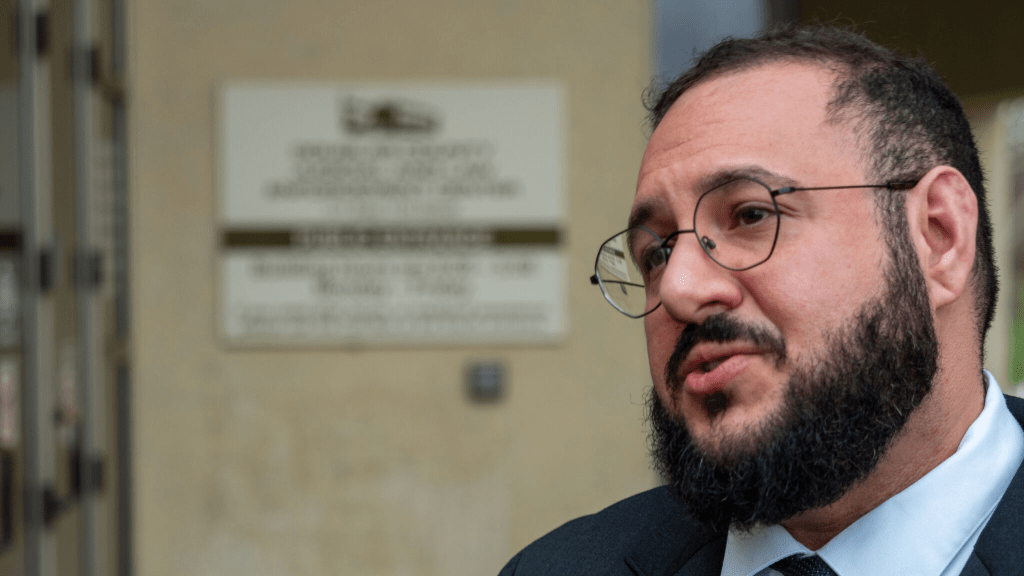
Harper Seldin, senior staff attorney for the American Civil Liberties Union, talks to reporters after a Douglas County District Court hearing on March 6, 2026. Seldin asked the judge to place a temporary restraining order on the state to stop implementation of a new law that forces Kansans to use bathrooms and have documentation in their biological sex at birth. (Photo by Sherman Smith/Kansas Reflector)
Harper Seldin, an ACLU attorney representing the two Lawrence transgender men who brought a case against the law under pseudonyms Daniel Doe and Matthew Moe, told the judge the law violates the Kansas Constitution.
SB 244 infringes on the rights of personal autonomy, expectations of privacy, and equal protection under the law, and has other issues, he said.
“The attorney general is incorrect when he says that we’re asking the court to break new ground,” Seldin said. “This is not a novel set of theories that require the government to do anything. The thread through these individual rights claims is that this is about Daniel and Matthew’s right to be left alone by the government.”
Seldin also said the law targets transgender individuals, which can be shown by the results of its implementation even if it’s not stated outright. He said the way SB 244 was implemented violated the Kansas Constitution when the bathroom portion of the bill was “logrolled” into the bill that originally addressed driver’s license and birth certificate gender markers.
Logrolling refers to dropping a bill into an unrelated bill, sidestepping the opportunity for public input. Seldin said cramming two separate subjects into one law violates the Kansas Constitution, which has a “single subject” clause.
Kobach said the two issues are congruent in that they both deal with defining sex within Kansas government.
“It’s this idea that bills should mean what they say and say what they mean,” Seldin said. “There’s a particular perniciousness to a law that hides the law.”
Kobach told the judge that a driver’s license is a government document, used for government purposes, and the state has the right to define the information contained in the document.
McCabria questioned Kobach about briefs included in the plaintiff testimony outlining the negative psychological effects on transgender people being made to use documents that don’t match their gender identity.
“Whatever a person may feel about their need to be perceived by the world in a certain way, what right do I have to compel the government to identify me in that way?” McCabria asked.
Kobach said the driver’s license is a document that records pertinent information, and sex is one of the elements, along with eye color and birthdate, that doesn’t change over time.
Kobach said the bathroom portion of the bill maintains the status quo in Kansas, where he contended residents have always gone to the bathroom that matches their biological sex at birth.
Seldin said trans people in the state have been going to the bathroom without any harms for decades.
Kobach said women who hear a man’s voice or see a man in private spaces could become anxious about their safety.
He acknowledged plaintiff’s assertions about the psychological or emotional harm they may suffer but told McCabria that in a balance of equities, that didn’t outweigh the harms of “99-plus percent of the population.”
When McCabria asked him to substantiate that number, Kobach said he didn’t mean to imply that everyone outside of transgender individuals were harmed by the law.
“Many courts have recognized the fear that ‘biological females’ have when a ‘biological male’ is in the bathroom with them, and that is something that I think any Kansan can identify with, especially a female,” Kobach said after the hearing.
Asked how women would be affected by seeing or hearing a transgender man who now has to use a woman’s bathroom, Kobach said, “All kinds of hypothetical cases are possible.”
McCabria said he had hoped to make a ruling Friday but that he needs more time to study the filings in the case and examine constitutional issues. He said he expects to rule by Tuesday.
“I think most people want to be respectful,” Seldin said after the hearing. “I think most people don’t want to pry into other people’s private lives. I think a law like this suggests the opposite, that Kansans have some prurient interest in other people’s habits and private spaces. And I don’t think that’s right.”
Z Kemp attended the hearing because her partner and many friends are affected. She said the law has caused “a lot of stress and anxiety.”
“That’s just unnecessary because as they’ve stated before, there was — especially with the bathroom situation —- no prior problem,” she said. “It’s only a problem whenever you make it a problem. I don’t think it’s that radical to just let trans people be. Just let them go to the bathroom.”
Avie Fallis said she has been through a lot of physical and legal changes to find herself. She said she is tired of well-meaning people recommending that she leave Kansas, which is her home state where her family and loved ones live.
“I feel like it’s a fire that’s just growing,” she said. “I’m not going to run away from fire. I feel like it should be extinguished.”
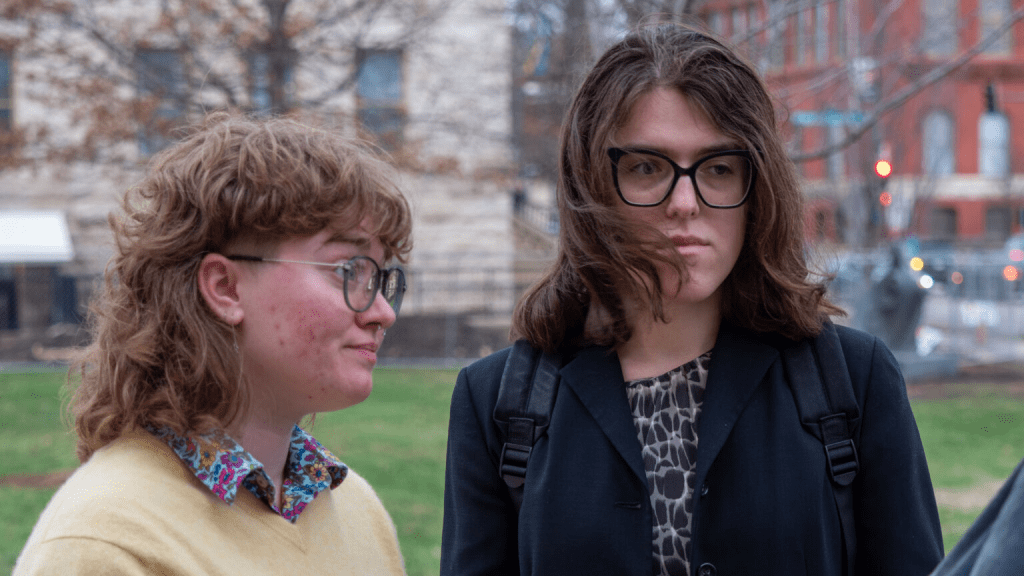
Z Kemp, left, and Avie Fallis attended a Douglas County District Court hearing March 6, 2026, about Kansas’ new law because it affects them and their loved ones. The law forces people to use the bathroom related to their biological sex at birth and to put that sex marker on their driver’s licenses and birth certificates. (Photo by Sherman Smith/Kansas Reflector)
 Scottie's Playtime