‘They’re killing us’: Immigrants complain of inhumane conditions inside NYC holding site

Immigrants without criminal backgrounds have been among the fastest-growing groups of ICE detainees. Less than a third of ICE detainees, 28.5%, are convicted criminals, according to the data. Another quarter have pending criminal charges and the rest have no criminal histories.

https://gothamist.com/news/theyre-killing-us-immigrants-complain-of-inhumane-conditions-inside-nyc-holding-site

——————————————————————————————————-
We rely on your support to make local news available to all

Make your contribution now and help Gothamist thrive in 2025. Donate today

Immigrants being detained in federal holding rooms in Lower Manhattan have complained of being unable to bathe or change clothes, cramped conditions, sometimes being provided just one meal a day, and sleeping on concrete benches or the floor.

Some immigrants staying at U.S. Immigration and Customs Enforcement holding rooms at 26 Federal Plaza also report stays lasting days at a time — as many as 10 days in one case referenced in a court filing.

“ There’s no room to sit down – standing room only,” said Rebecca Rubin, an immigration attorney for the New York Legal Assistance Group, who has had at least three clients detained in the cells.

The allegations came in court papers filed by lawyers representing immigrants held at the Lower Manhattan facility and in interviews with immigrants who said they were detained there.

Congressmembers, who for weeks have been refused entry at the site on the ground that the facilities are not “detention centers” but rather off-limits “processing centers,” have also raised concerns.

“Do not go treating people subhumanly — treating immigrants, simply because they are not born here — as if they are second class, as if they are not human,” Rep. Dan Goldman, a New York Democrat, told reporters Tuesday in a press conference outside the facility. “That is not what this country’s about.”

DHS Assistant Secretary Tricia McLaughlin, in a statement, dismissed the complaints in their entirety: “Any claim that there is overcrowding or subprime conditions is categorically false. All detainees are provided with proper meals, medical treatment, and have opportunities to communicate with their family members and lawyers.”

She added: “As we arrest and remove criminal illegal aliens and public safety threats from the U.S., ICE has worked diligently to obtain greater necessary detention space while avoiding overcrowding.”

In a previous statement, McLaughlin said, “26 Federal Plaza is not a detention center. It is a Federal building with an ICE law enforcement office inside of it.”

The holding areas are guarded rooms on the 10th floor of the federal government office building, just steps away from state and federal courthouses and City Hall. Those being detained include immigrants taken into custody after immigration court hearings in the same building.

The rooms used to be temporary holding areas where immigrant detainees were held for a few hours before being transferred to larger, more permanent and resourced detention centers, according to local immigration attorneys. But the lawyers said in recent months, detainees have been sleeping overnight in overcrowded facilities, some for days.

“In the past… it was sort of understood that (detainees) weren’t going to be spending any sort of meaningful time there,” said Harold Solis, co-legal director of Make the Road New York, the local chapter of the national immigrants’ rights advocacy group. “This is definitely a different reality that people are experiencing there.”

S. Michael Musa-Obregon, a New York-based immigration attorney, added, “It used to be a holding pen, like a central booking. Now it’s becoming a temporary jail.”

Several members of New York’s congressional delegation, including Reps. Nydia Velázquez, Adriano Espaillat, Jerry Nadler and Goldman, all Democrats, have tried in recent weeks to inspect the holding areas but were denied entry.

Federal law allows lawmakers to inspect detention facilities, with no notice needed. But in a conversation with Nadler and Goldman, ICE Deputy Field Office Director William Joyce said the site was a temporary “processing center,” not a detention facility and not subject to inspection.

In the June 18 exchange with the two lawmakers, recorded by Gothamist in a hallway at 26 Federal Plaza, Joyce said the holding areas were “approaching capacity.”

He added that detainees were being held overnight, but that claims of migrants staying for a week or more were “an exaggeration.”

‘These conditions are inhumane’

Immigration lawyers contend, based on ICE’s public detainee tracking system, that a detainee named Joselyn Chipantiza-Sisalema had been detained inside the facility for 10 days.

Make the Road NY filed a lawsuit on July 3 against the federal government, advocating for her release.

Lawyers for Chipantiza-Sisalema, a 20-year-old high school student, wrote in a court filing, “She has told her parents that her conditions of confinement are extremely distressing: she is sleeping on the floor, she is in the same clothes she was detained in and the food she is provided is inadequate.”

Chipantiza-Sisalema wasn’t allowed to call or visit with a lawyer, she wasn’t allowed to call anyone but her parents and she had spoken with her family only three times, for a minute each time, according to the court filing.

Chipantiza-Sisalema was transferred to another detention facility on Friday, according to Solis.

“These conditions are inhumane as individuals detained do not have access to beds, regular meals, or communication with loved ones or counsel,” lawyers wrote in Chipantiza-Sisalema’s case. “Detainees also report that they are not able to bathe or change clothes; that the temperature can be extremely hot or cold; and that medical care is not provided.”

Another detainee, Derlis Snaider Chusin Toaquiza, a 19-year-old high school student, was fed one to two meals a day and “forced to sleep sitting up for lack of space,” his attorneys wrote in a lawsuit demanding his release from ICE detention. Toaquiza was held for two days in a small room with over 60 people, according to the filing.

“The room was so crowded that he could not lie down and he had to sleep sitting up,” the filing said.

Enrique, 52-year-old former detainee from Peru who asked not to share his last name for fear of retaliation against his family still living in the United States, said he slept in a holding cell at 26 Federal Plaza for six days in late June.

Enrique said that when he first entered the roughly 5 by 10 meter room, there were about 30 people. Guards gave him an aluminum blanket to stay warm.

By the time he was transferred to another detention center, six days later, he said there were 100 people and not enough blankets to go around.

“We were on top of each other,” Massamba Gueye, a 29-year-old detainee from Senegal, told Gothamist. He said he was detained with about 30 men in a room for one night in early June. Gueye said while he was there, another man fainted, hit his head and started bleeding — but guards didn’t respond.

“Nobody was bothered to even try to help him,” Gueye, who has since been transferred to another ICE facility, said in a phone interview.

‘They’re killing us. My liver is killing me.’

Immigrants detained at 26 Federal Plaza and their relatives also complain about lack of medical care.

Samara Simone de la Cruz Gooden, 22, said her husband Joan Paul Alcivar de la Cruz, a 27-year-old from Ecuador, was detained at 26 Federal Plaza for at least four to five days in late June. Gooden said most of her husband’s liver had been removed before his detention and he requires a special diet, which he didn’t receive while staying in the holding cell.

“He broke down,” Gooden said. “He was like, ‘They’re killing us. My liver is killing me. I’m pooping out a lot of blood. I’m so scared.’”

De la Cruz didn’t receive any medical help while he was detained at 26 Federal Plaza, Gooden said. Eventually, he was rushed to the hospital, she said, where she wasn’t allowed to speak with him.

De la Cruz was eventually transferred to a facility in Louisiana, where he is currently being held. Attorneys at the New York Legal Assistance Group have filed a lawsuit advocating for his release.

Concerns have arisen about ICE detaining immigrants for days in short-term holding facilities elsewhere across the country.

A lawsuit filed last week in California claims that ICE is holding immigrants in another “processing center” in a basement in downtown Los Angeles — in what the lawsuit describes as “dungeon-like facilities,” with overcrowded, windowless rooms holding dozens of detainees.

Some rooms are so cramped that detainees can’t sit or lie down for hours at a time, the lawsuit alleges. The lawsuit also alleges that detainees lack necessary food, medical care and access to legal counsel. New York Attorney General Letitia James and attorneys general for 17 states filed a brief in support of that lawsuit.

More detention space is coming

On Tuesday, New York City Comptroller Brad Lander, Public Advocate Jumaane Williams and Goldman observed immigration court hearings and arrests inside 26 Federal Plaza.

While speaking to members of the press outside afterward, Goldman shared testimonies of migrants he said had been detained inside, who complained of overcrowded conditions and insufficient food and water.

Lander and Williams urged New Yorkers and elected officials to visit the building and observe immigration court hearings and subsequent ICE arrests. Lander was arrested last month while escorting a man away from his immigration court hearing.

Under President Donald Trump, ICE has ramped up immigration arrests, while at once contending with a shortage of detention space. As of the end of June, nearly 58,000 people were being held in ICE detention centers, according to the latest agency data — far exceeding ICE’s current detention capacity of 41,000 beds.

Immigrants without criminal backgrounds have been among the fastest-growing groups of ICE detainees. Less than a third of ICE detainees, 28.5%, are convicted criminals, according to the data. Another quarter have pending criminal charges and the rest have no criminal histories.

Trump’s signature “big, beautiful” domestic policy bill, recently signed into law, includes about $170 billion to support the administration’s immigration crackdown. That includes about $45 billion for immigration detention centers, which the American Immigration Council estimates will allow ICE to expand its detention capacity to 116,000 beds.

Jessica Gould contributed reporting.

This story was updated with comment from the Department of Homeland Security.

The Longest Walk, & More, In Peace & Justice History for 7/15

July 15, 1834
The Spanish Inquisition, a centuries-long brutal effort by the Catholic Church to root out heresy, begun in 1481, was officially abolished by King Bonaparte. Spain’s King Ferdinand and Queen Isabella had chosen Catholicism as their religion and asked the pope to help purify the people of Spain. Many thousands were forced to convert, were tortured to encourage confession, or burned at the stake.

Witch burning during the Inquisition
More on the Inquisition 
July 15, 1919
Following World War I, the U.S. War Department announced that it had classified more than 337,000 American men as “draft dodgers.”
Read a brief history of Conscientious Objection in America 
July 15, 1978
The Longest Walk, a peaceful transcontinental trek for Native American justice, which had begun with a few hundred departing Alcatraz Island, California, ended this day when they arrived in Washington, D.C. accompanied by 30,000 marchers.

They were calling attention to the ongoing problems plaguing Indian communities throughout the Americas: lack of jobs, housing, health care, as well as dozens of pieces of legislation before Congress canceling treaty obligations of the U.S. government toward various Indian tribes.
They submitted petitions signed by one-and-a-half million Americans
to President Jimmy Carter.


The Longest Walk Zinn Project

https://www.peacebuttons.info/E-News/peacehistoryjuly.htm#july15

Clay Jones Says

Stop Talking About Epstein by Clay Jones

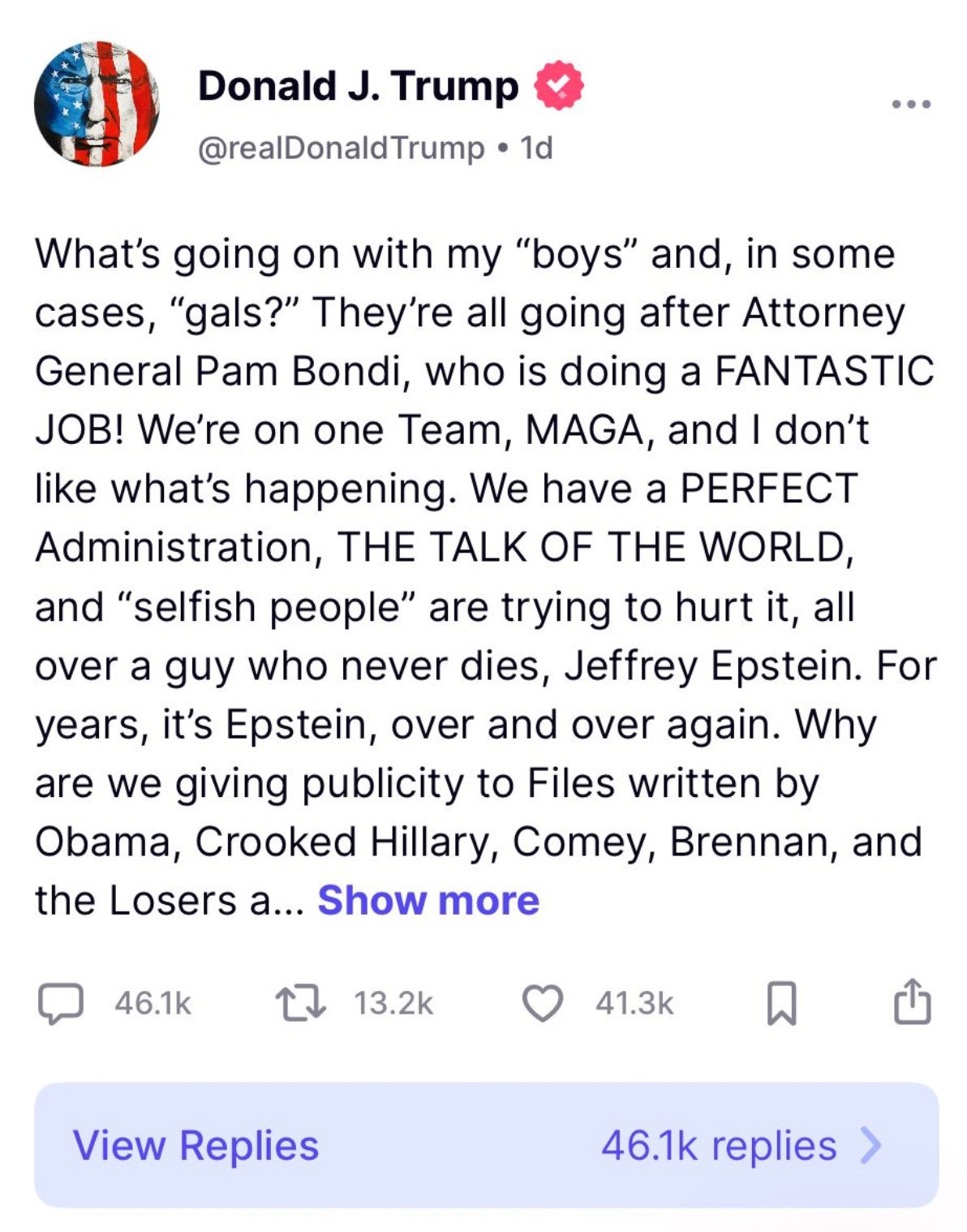
Donald Trump is clearly getting frustrated Read on Substack

Donald Trump wants you to stop talking about Jeffrey Epstein.

First, what’s with that “boys and girls” crap? Does he still envision himself as the nation’s “daddy?” Second, a perfect administration? Sorry, TACO, but we’ve seen Pete Hegseth, Kristi Noem, Kash Patel, Pam Bondi, JD Vance, and others of your team in action. You have clearly stocked your pond with the least qualified and dumbest fish of all time.

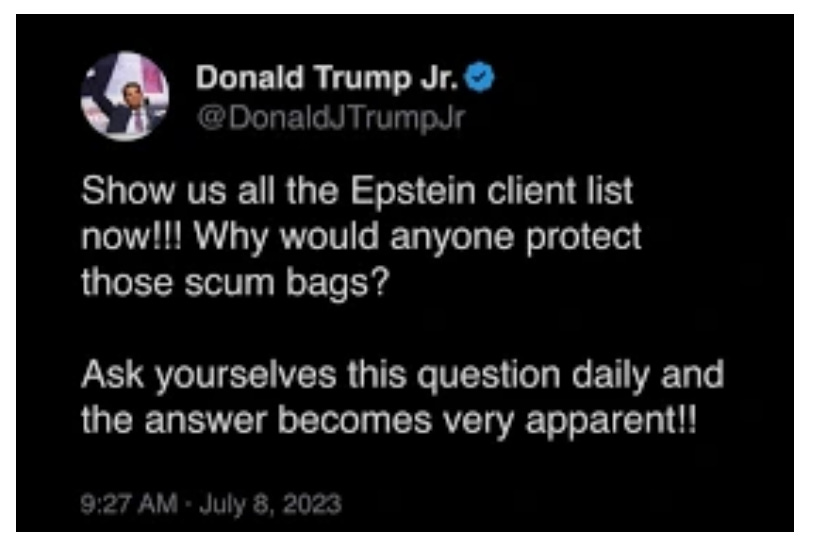
But I get it. Trump wants people to stop talking about Epstein, when previously, he encouraged his cult to talk about Epstein. Look at this tweet from his number one idiot offshoot from 2023.

Is Trump protecting “those scum bags” or is he one of those scumbags? Hmmm? Trump and Jeffers used to party together. Trump told us they were very similar, as they both liked women, with Epstein liking them on the younger side. Was Trump talking about young women, or did he make that statement because he knew about the pedophilia? What did Trump witness, or take part in, when he flew on Epstein’s plane?

Trump talked about his administration being “perfect,” while it was his stupid and unqualified Attorney General who went on Fox News and claimed the Epstein Client List was on her desk, and then later said it never existed. How is that perfect?

But ya know, I don’t think there ever was an Epstein Client List. When did we first hear of this supposed client list?

I believe it was MAGAts who first claimed that there’s an Epstein Client List, because they used it against Biden. But it’s been said so much, “clientlistclientlistclientlistclientlistclientlist,” that it has even gaslighted liberals.

I’m seeing memes from some of my liberal friends asking why Epstein co-conspirator Ghislaine Maxwell is in prison if there’s not a client list. If the only evidence against her is a client list, then she wouldn’t be in prison. How would a client list convict her? There’s a whole hell of a lot more evidence against Epstein than a supposed client list.

And what would the client list be for? He wasn’t in the business of pedophilia, right? It was an activity, a hobby. It was terrible and messed up, but that’s not how Epstein made his millions. I’m sure there is a list of his clients for his finance business.

Now, Trump is being yelled at by MAGAts. How sweet is that? They really want the client list released, which probably doesn’t even exist. It’s not the first time Trump claimed something that’s not true. Trump never did prove that Obama was born in Kenya. He never proved he won the 2020 election. He still hasn’t proven White Genocide in South Africa. We haven’t even seen all the fraud DOGE supposedly found.

But to MAGAts, not releasing the Epstein Client List, or the Epstein Files, makes Trump as bad as the Deep State, which, by the way, also hasn’t been proven to exist.

There are files on Epstein, and Bondi has said she’s not releasing those either. Fuck the client list, let’s see those files. While I don’t believe there is a client list, and feel free to disagree with me, there are Epstein files. Neither Trump nor Bondi has explained to us why those aren’t being released.

The best way to distract a MAGAt is with another conspiracy theory or bigotry. Remember, MAGAts love Trump because they hate the same people. So over the weekend, Trump threatened to revoke Rosie O’Donnell’s citizenship, even though a president doesn’t have that power. Did it work to distract the MAGAts. No, it just gave them something else to rave about while still howling for the Epstein Client List.

Good luck getting your base, Donald, to stop talking about the thing you wouldn’t shut up about. Usually, MAGAts do whatever you say. Maybe you need to remind them that they’re in a cult.

Squirrels: If you’ve ever visited the White House, you probably noticed the squirrels. There are a lot of squirrels at the White House. The fences that keep me and you out are ineffective against squirrel penetration. They go wherever they want. Ronald Reagan used to collect acorns from Camp David to feed the squirrels at the White House. Ike hated them because they would bury acorns in his golf green. But, there aren’t just grey squirrels at the White House, but also black squirrels. To be more specific, black Canadian squirrels.

Things like this fascinate me. I noticed them in Central Park too, but I haven’t researched that yet.

During the Theodore Roosevelt administration, the guy in charge of the National Zoo or the Smithsonian asked Canada for some black squirrels. They’re not native to the United States, though they’re the same squirrels as our grey ones except for the black coats, which might be thicker. It’s cold in Canada, yo.

So, we traded some grey squirrels for their black squirrels, and some either escaped from the zoo, or a few were released. One version explains that they were released at the zoo, with expectations that they would stay on the zoo grounds, but again….fences. Squirrels ignore them.

Today, Washington, DC has black squirrels, and they’re not going anywhere. It’s estimated that half of the squirrels in the city are descendants of the Canadian squirrels, even though the zoo originally only got a few of them. Squirrels are rodents, and rodents screw a LOT.

Not everyone feels the way Ike did, and there’s some civic pride in the black squirrels. There was even a bar in Adams Morgan named the Black Squirrel.

And that’s why there is a black squirrel in today’s cartoon.

What I hope is that Donald Trump notices all the Black immigrants all over his lawn that he can’t do anything about. (snip-MORE)

Again on the Christian America

It’s Bastille Day in France! & More, In Peace & Justice History for 7/14

July 14, 1789
Bastille Day in France: Parisian revolutionaries and mutinous troops stormed and dismantled the Bastille, a former royal fortress converted to a state prison, that had come to symbolize the tyranny of the Bourbon monarchy. This dramatic action was proof that power no longer resided in the King as God’s representative, but in the people, and signaled the beginning of the French Revolution and the First Republic.

Bastille Day  for kids
July 14, 1798
A mere 22 years after the Declaration of Independence, Congress passed the Sedition Act, making it a federal crime to “. . . unlawfully combine or conspire together, with intent to oppose any measure or measures of the government of the United States . . . or to excite any unlawful combinations therein, for opposing or resisting any law of the United States, or any act of the President of the United States . . . .”
The Declaration: 
“…whenever any Form of Government becomes destructive of these ends [life, liberty and the pursuit of happiness], it is the Right of the People to alter or to abolish it, and to institute new Government….”
“An act for the punishment of certain crimes against the United States” 
July 14, 1887
Adrian C. “Cap” Anson, both manager and captain of the Chicago Whitestockings (National League), refused to let his baseball team take the field as long as the Newark Little Giants included their starting pitcher, George Stovey, an African-American, in the lineup. “Get that nigger off the field!” Anson was heard to say. Newark refused to allow Anson to dictate the use of their personnel, but the game was ruled a forfeit to Chicago. At the time there were only 20 black players in all of professional baseball.
The same day, the directors of the International League (which included Newark) barred any of their teams from hiring black players in the future. By the following year there were only six black players left on all the teams in four leagues. All-black teams were formed, but the last of them, the Acme Colored Giants from Celeron, New York, of the Iron and Oil (I&0) League, stopped playing in 1898. No African-American would play in white organized baseball again until Jackie Robinson nearly 50 years later.
July 14, 1955
The Air Pollution Control Act of 1955 became law, the first in a series of laws that ultimately became the Clean Air Act in 1963.
This first law simply provided funding to the Public Health Service to conduct research.


History of the Clean Air Act 
July 14, 1958

King Faisal II
A group of Iraqi army officers staged a coup in Iraq and overthrew the monarchy of King Faisal II (who had ascended to the throne at age four). The new government, led by Abdul Karim el Qasim, was ousted in 1963 by a coup helped by the CIA and led by the Arab Socialist Ba’ath Party—later dominated by Saddam Hussein. 
Read more 

DHS Tells Police That Common Protest Activities Are ‘Violent Tactics’

That pesky thing called the US CONSTITUTION says that the people have a right to protest the government.  The last ten or more years the federal government has been trying to restrain the rights of the people to protest or have their voices heard.  This is another example.  Hugs

https://www.wired.com/story/dhs-tells-police-that-common-protest-activities-are-violent-tactics/

DHS is urging law enforcement to treat even skateboarding and livestreaming as signs of violent intent during a protest, turning everyday behavior into a pretext for police action.

The Department of Homeland Security is urging local police to consider a wide range of protest activity as violent tactics, including mundane acts like riding a bike or livestreaming a police encounter, WIRED has learned.

Threat bulletins issued during last month’s “No Kings” protests warn that the US government’s aggressive immigration raids are almost certain to accelerate domestic unrest, with DHS saying there’s a “high likeliness” more Americans will soon turn against the agency, which could trigger confrontations near federal sites.

Blaming intense media coverage and backlash to the US military deployment in Los Angeles, DHS expects the demonstrations to “continue and grow across the nation” as protesters focused on other issues shift to immigration, following a broad “embracement of anti-ICE messaging.”

The bulletins—first obtained by the national security nonprofit Property of the People through public records requests—warn that officers could face assaults with fireworks and improvised weapons: paint-filled fire extinguishers, smoke grenades, and projectiles like bottles and rocks.

At the same time, the guidance urges officers to consider a range of nonviolent behavior and common protest gear—like masks, flashlights, and cameras—as potential precursors to violence, telling officers to prepare “from the point of view of an adversary.”

Protesters on bicycles, skateboards, or even “on foot” are framed as potential “scouts” conducting reconnaissance or searching for “items to be used as weapons.” Livestreaming is listed alongside “doxxing” as a “tactic” for “threatening” police. Online posters are cast as ideological recruiters—or as participants in “surveillance sharing.”

One list of “violent tactics” shared by the Los Angeles–based Joint Regional Intelligence Center—part of a post-9/11 fusion network—includes both protesters’ attempts to avoid identification and efforts to identify police. The memo also alleges that face recognition, normally a tool of law enforcement, was used against officers.

Vera Eidelman, a senior staff attorney with the American Civil Liberties Union, says the government has no business treating constitutionally protected activities—like observing or documenting police—as threats.

DHS did not respond to a request for comment.

“Exercising those rights shouldn’t be justification for adverse action or suspicion by the government,” Eidelman says. Labeling something as harmless as skateboarding at a protest as a violent threat is “disturbing and dangerous,” she adds, and could “easily lead to excessive force against people who are simply exercising their First Amendment rights.”

“The DHS report repeatedly conflates basic protest, organizing, and journalism with terroristic violence, thereby justifying ever more authoritarian measures by law enforcement,” says Ryan Shapiro, executive director of Property of the People. “It should be sobering, if unsurprising, that the Trump regime’s response to mass criticism of its police state tactics is to escalate those tactics.”

Fusion centers like JRIC play a central role in how police understand protest movements. The intelligence they produce is rapidly disseminated and draws heavily on open-source data. It often reflects broad, risk-averse assumptions and includes fragmentary and unverified information. In the absence of concrete threats, bulletins often turn to ideological language and social media activity as evidence of emerging risks, even when tied to lawful expression.

DHS’s risk-based approach reflects a broader shift in US law enforcement shaped by post-9/11 security priorities—one that elevates perceived intent over demonstrable wrongdoing and uses behavior cues, affiliations, and other potentially predictive indicators to justify early intervention and expanded surveillance.

A year ago, DHS warned that immigration-related grievances were driving a spike in threats against judges, migrants, and law enforcement, predicting that new laws and high-profile crackdowns would further radicalize individuals. In February, another fusion center reported renewed calls for violence against police and government officials, citing backlash to perceived federal overreach and identifying then-upcoming protests and court rulings as likely triggers.

At times, the sprawling predictions may appear prescient, echoing real-world flashpoints: In Alvarado, Texas, an alleged coordinated ambush at a detention center this week drew ICE agents out with fireworks before gunfire erupted on July 4, leaving a police officer shot in the neck. (Nearly a dozen arrests have been made, at least 10 on charges of attempted murder.)

In advance of protests, agencies increasingly rely on intelligence forecasting to identify groups seen as ideologically subversive or tactically unpredictable. Demonstrators labeled “transgressive” may be monitored, detained without charges, or met with force.

Social movement scholars widely recognize the introduction of preemptive protest policing as a departure from late-20th century approaches that prioritized de-escalation, communication, and facilitation. In its place, authorities have increasingly emphasized control of demonstrations through early intervention, surveillance, and disruption—monitoring organizers, restricting public space, and responding proactively based on perceived risks rather than actual conduct.

Infrastructure initially designed to combat terrorism now often serves to monitor street-level protests, with virtual investigations units targeting demonstrators for scrutiny based on online expression. Fusion centers, funded through DHS grants, have increasingly issued bulletins flagging protest slogans, references to police brutality, and solidarity events as signs of possible violence—disseminating these assessments to law enforcement absent clear evidence of criminal intent.

Surveillance of protesters has included the construction of dossiers (known as “baseball cards”) with analysts using high-tech tools to compile subjects’ social media posts, affiliations, personal networks, and public statements critical of government policy.

Obtained exclusively by WIRED, a DHS dossier on Mahmoud Khalil, the former Columbia graduate student and anti-war activist, shows that analysts drew information from Canary Mission, a shadowy blacklist that anonymously profiles critics of Israeli military action and supporters of Palestinian rights.

In federal court Wednesday, a senior DHS official acknowledged that material from Canary Mission had been used to compile more than 100 dossiers on students and scholars, despite the site’s ideological slant, mysterious funding, and unverifiable sourcing.

Threat bulletins can also prime officers to anticipate conflict, shaping their posture and decisions on the ground. In the wake of violent 2020 protests, the San Jose Police Department in California cited the “numerous intelligence bulletins” it received from its local regional fusion center, DHS, and the FBI, among others, as central to understanding “the mindset of the officers in the days leading up to and throughout the civil unrest.”

Specific bulletins cited by the SJPD—whose protest response prompted a $620,000 settlement this month—framed the demonstrations as possible cover for “domestic terrorists,” warned of opportunistic attacks on law enforcement and promoted an “unconfirmed report” of U-Haul vans purportedly being used to ferry weapons and explosives.

Subsequent reporting in the wake of BlueLeaks—a 269-gigabyte dump of internal police documents obtained by a source identifying as the hacktivist group Anonymous and published by transparency group Distributed Denial of Secrets—found federal bulletins riddled with unverified claims, vague threat language, and outright misinformation, including alerts about a parody website that supposedly paid protesters and accepted bitcoin to set cars on fire, despite a clear banner labeling the site “FAKE.”

Threat alerts—unclassified and routinely accessible to the press—can help law enforcement shape public perception of protests before they begin, laying the groundwork to legitimize aggressive police responses. Unverified DHS warnings about domestic terrorists infiltrating demonstrations in 2020, publicly echoed by the agency’s acting secretary on Twitter, were widely circulated and amplified in media coverage.

Americans are generally opposed to aggressive protest crackdowns, but when they do support them, fear is often the driving force. Experimental research suggests that support for the use of coercive tactics hinges less on what protesters actually do than on how they’re portrayed—by officials, the media, and through racial and ideological frames.


Dell Cameron is an investigative reporter from Texas covering privacy and national security. He’s the recipient of multiple Society of Professional Journalists awards and is co-recipient of an Edward R. Murrow Award for Investigative Reporting. Previously, he was a senior reporter at Gizmodo and a staff writer for the Daily … Read More

YOU HAVE THE LEGAL AUTHORITY, F*****G USE IT

One voice was yelling he was a US citizen.  The conditions are horrible.  They get their drinking water from the toilet.   Maxwell Frost is a progressive treasure.  Hugs

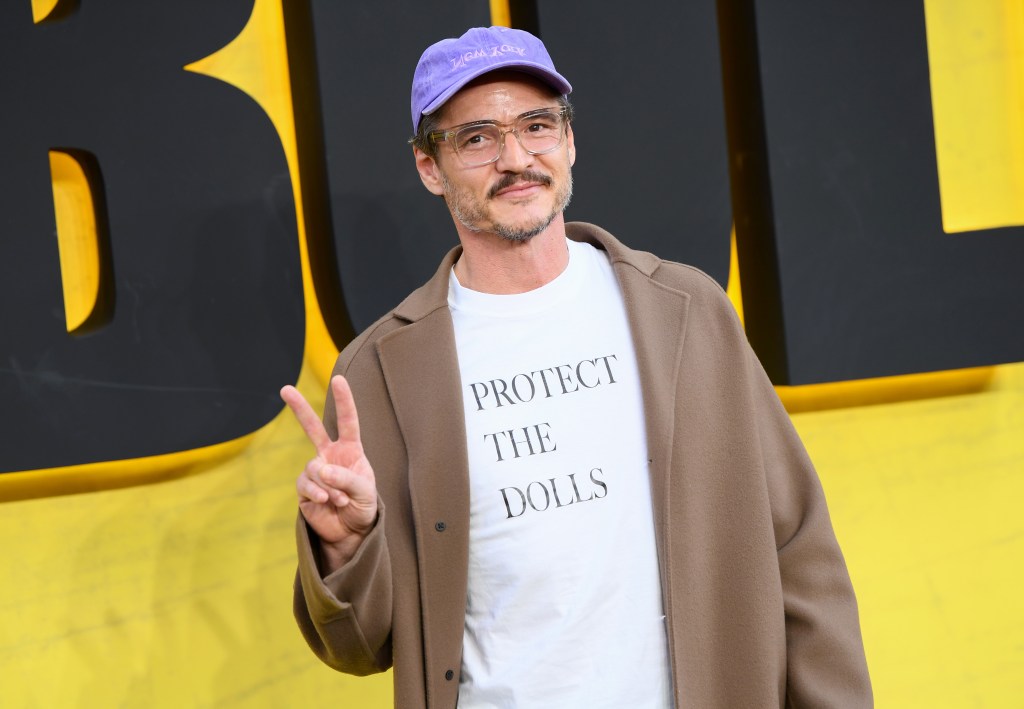
Pedro Pascal comes out swinging for the trans community yet again at Fantastic Four premiere

https://www.thepinknews.com/2025/07/09/pedro-pascal-fantastic-four-trans/

Ice Ice Barbie by Clay Jones

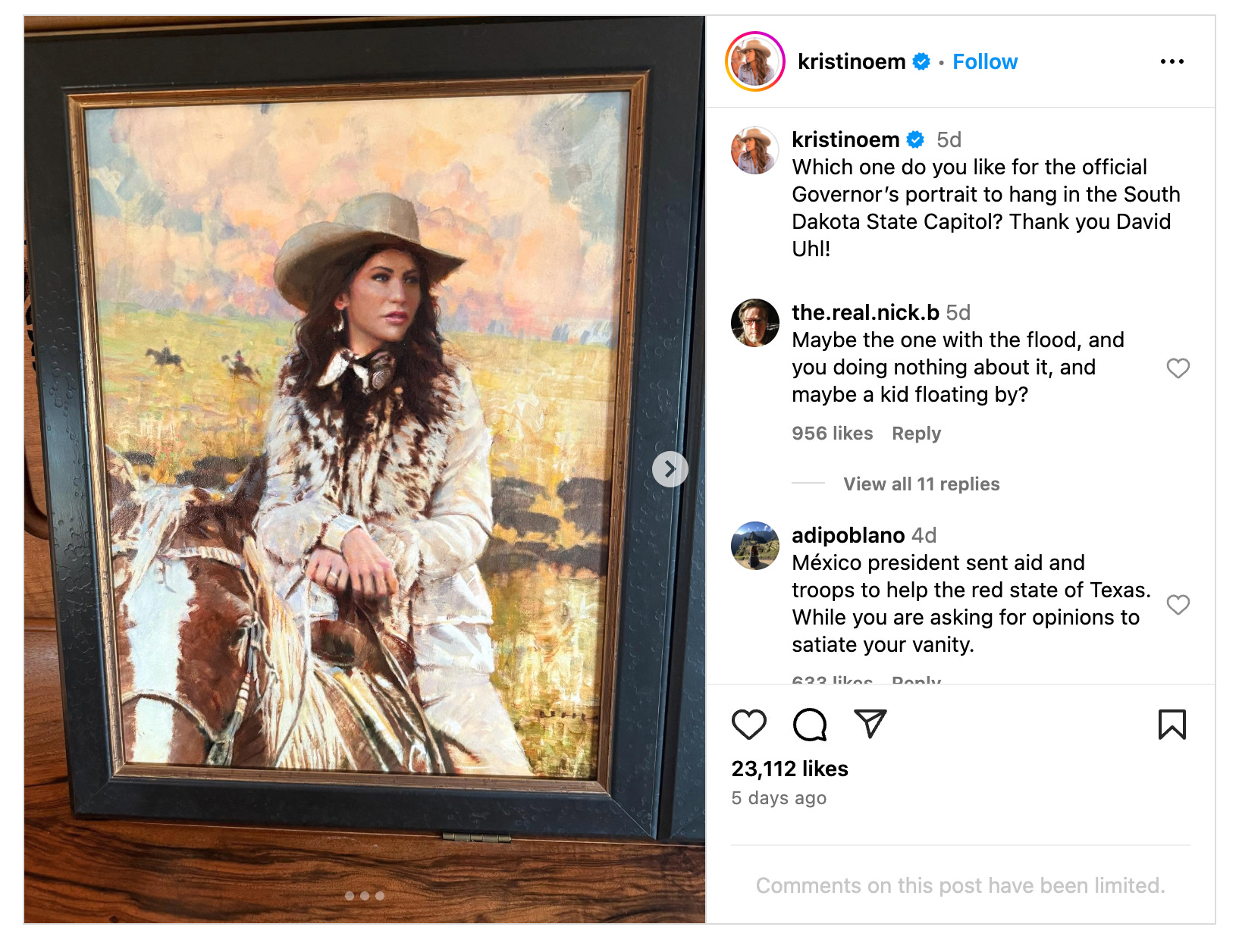
Noem is more interested in her face than in providing assistance to the Texas flood survivors Read on Substack

ICE Barbie, Kristi Noem, the Director of Homeland Security, is failing at her job miserably.

A portrait of Noem is going to be displayed in the South Dakota Capitol building, and there are three options. Who gives a shit, right? Kristi Noem, that’s who. Noem went on Instagram and posted to her creepy followers, “Which one do you like for the official Governor’s portrait to hang in the South Dakota State Capitol? Thank you David Uhl!” She added the three paintings of herself on horseback by artist David Uhl.”

She did this five days ago, during the floods in Texas that have killed at least 120 so far.

Here are the other two portraits.

I wonder how much South Dakota tax money was spent on this.

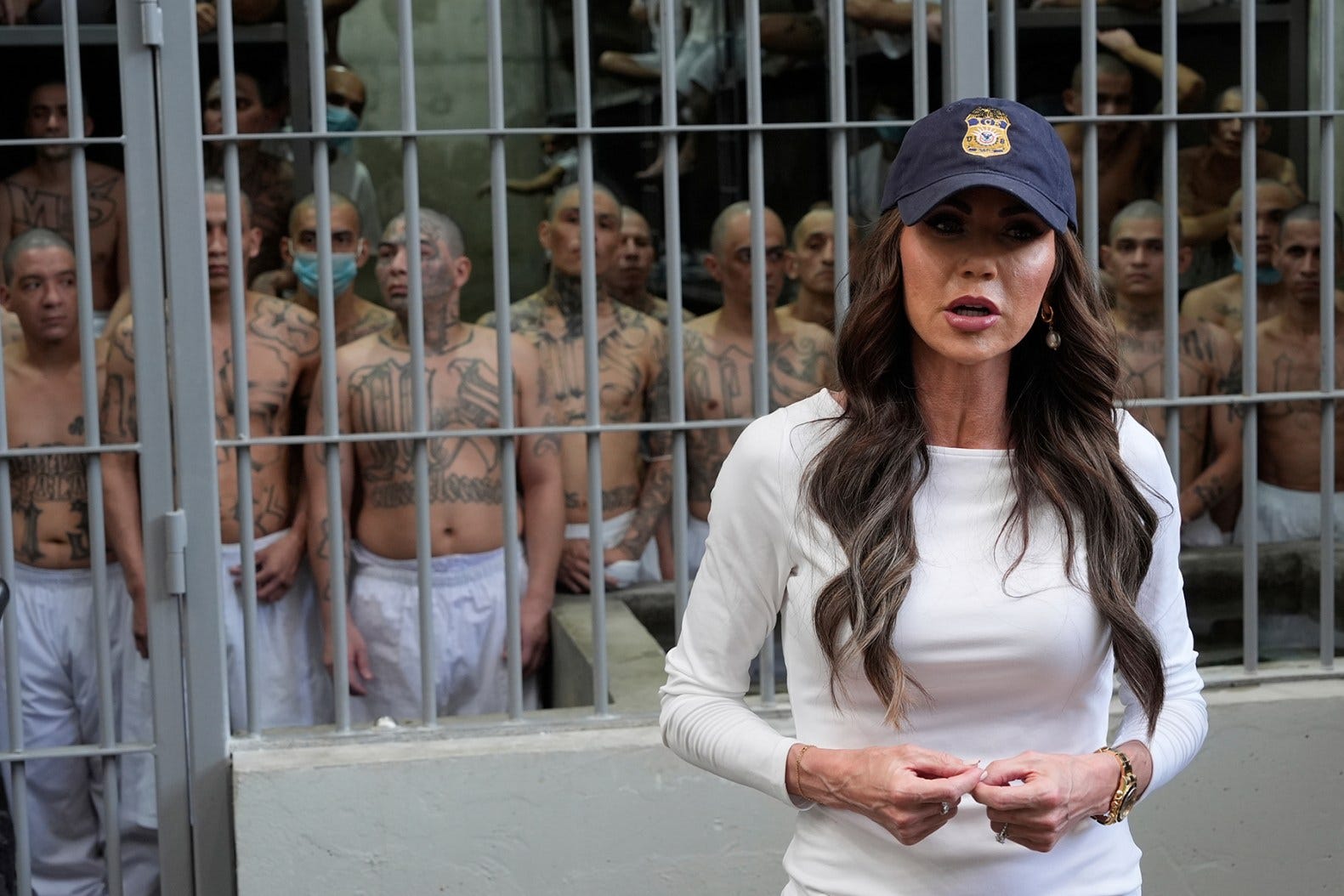
Before Noem’s survey about herself, Puppy-Killah Kristi did her stupid photo-op in El Salvador with the notorious prison behind her, with Trump deportees as props. She was in full makeup while making sure her shiny $10,000 Rolex was visible, which is probably less than her teeth cost.

She’s done other photos with guns, posing as an ICE agent. In one of them, she wasn’t holding the gun correctly and got roasted for it online. I bet she can’t ride a horse either.

We should be relieved that she didn’t shoot that ICE agent in the face. In her defense, she does know how to shoot a gun because that’s how she murdered her puppy. So there, critics.

Kristi is the kind of person that if you went out to dinner with her, she’d humbly say at some point, “Enough of me talking about myself. Now let’s hear you talk about me.” She can’t get over herself. She might be the female equivalent of Donald Trump. She already has the fake hair, and now she just needs the ridiculous tie, the orange make-up, and an adult diaper that hasn’t been changed since his first flip-flop on tariffs.

Remember, Kristi used to look like this…

…before she looked like this.

She definitely went for the Melania look, which is an improvement over the look for hunting wolves from a helicopter. She even got free dental work while she was governor, on the condition that she make a commercial for the Texas dentist who did her work.

It seems that’s the only time she’s interested in Texas, when she can get free dental work, but not when there’s a disaster.

According to The New York Times, two days after catastrophic floods roared through Central Texas, the Federal Emergency Management Agency (FEMA) did not answer nearly two-thirds of calls to its disaster assistance line.

An anonymous source close to the issue said the lack of responsiveness happened because the agency had fired hundreds of contractors at call centers.

FEMA, which is a part of Homeland Security (I have to include that because trolls are commenting on this cartoon on Facebook asking, “What’s DHS got to do with FEMA?”), laid off the contractors on July 5 after their contracts expired and were not extended, according to the documents and the person briefed on the matter. Noem, who has instituted a new requirement that she personally approve expenses over $100,000, did not renew the contracts until Thursday, five days after the contracts expired, and about a week after the floods started.

Where was ICE Barbie? She was probably spending her time looking at herself in a mirror, or maybe she confused Texas for one of the seven Native American tribes that banned her from their reservations.

Adam Zyglis: There’s a part of this cartoon that is my standing in solidarity with my colleague Adam Zyglis. So what happened with Adam? Adam, who works for the Buffalo News, drew a cartoon mocking Republican hypocrisy, asking for federal aid after protesting against federal disaster relief for other states. This has upset Republicans, which shows more hypocrisy for the gang that shouts “snowflake” at their political opponents. They even cried on Fox News about it.

Now, an event at the Buffalo History Museum by the Buffalo News Guild, which was to feature Adam among other journalists, has been postponed because of “credible” death threats toward Adam and his family.

And just today, a MAGAt posted on one of my client’s shares of a cartoon of mine about how Democrats are the violent ones. (snip-MORE, and it’s great)

Queer History With Brunch

Or, whenever you read this. There are 4 snippets, all important to maintaining visibility of people through representation in history. Language alert, in case you’re at work.

Queer History 847: Sarah Orne Jewett – The Defiant Pen That Refused to Bow by Wendy🏳️‍⚧️🏳️‍🌈🌈
Read on Substack

Sarah Orne Jewett wasn’t just a writer—she was a goddamn literary revolutionary who told the world to fuck off while she lived her truth in broad daylight. Born in 1849 in South Berwick, Maine, this fierce woman carved out a life that would make modern queer folk weep with recognition and rage at how little has changed. Her “Boston marriage” with Annie Adams Fields wasn’t just a relationship; it was a middle finger raised high to a society that demanded women choose between intellectual fulfillment and emotional intimacy.

The term “Boston marriage” itself is a sanitized piece of historical bullshit that literary scholars use to avoid saying what everyone with half a brain knows: these women were lovers, partners, and soulmates who built lives together while the world pretended they were just “very close friends.” Jewett and Fields lived this reality for nearly three decades, creating a partnership that was more authentic and enduring than most heterosexual marriages of their era—or ours, for that matter.

Sarah Orne Jewett Love Letter to Annie Adams Fields

The Making of a Literary Badass

Sarah Orne Jewett emerged from a world that wanted to stuff women into corsets and drawing rooms, but she said “fuck that noise” and became one of America’s most celebrated regional writers. Her father, Theodore Herman Jewett, was a country doctor who took his daughter on his rounds through rural Maine, exposing her to the harsh realities of working-class life that would later infuse her writing with a authenticity that urban literary elites couldn’t fake if they tried.

This early exposure to real people living real lives—not the sanitized version of existence that polite society preferred—shaped Jewett’s understanding that truth was more important than propriety. She watched women struggle to survive in a world that offered them shit options: marriage to men who might abuse them, spinsterhood that meant poverty and social isolation, or the kind of life she would eventually choose—one that required courage, defiance, and the willingness to let people think whatever the hell they wanted. (snip-MORE)

Queer History 594: Alexander Hamilton – The Founding Father Who Loved Hard and Wrote Gay as Fuck Letters by Wendy🏳️‍⚧️🏳️‍🌈🌈
Read on Substack

In the pantheon of American mythology, Alexander Hamilton has been sanitized, straightened, and scrubbed clean of anything that might challenge the heteronormative fairy tale we tell ourselves about our founding fathers. But here’s the thing about historical whitewashing—it can’t erase the actual fucking words these men wrote to each other. And Alexander Hamilton, that brilliant, passionate, self-destructive bastard who helped birth a nation, wrote letters to John Laurens that were so goddamn romantic, so emotionally intimate, so clearly beyond the bounds of “normal” male friendship that historians have been performing Olympic-level mental gymnastics for centuries to explain them away.

Alexander Hamilton and the National Economy

Born in 1755 on the Caribbean island of Nevis, Hamilton clawed his way from bastard orphan to the right hand of George Washington through sheer intellectual brilliance and an intensity that burned like a fucking supernova. But it was his relationship with fellow revolutionary John Laurens that revealed the depth of his capacity for love, passion, and the kind of emotional vulnerability that straight male mythology pretends doesn’t exist. Their correspondence reads like a love affair conducted through the medium of revolutionary politics, and anyone who thinks these men were just “very good friends” has clearly never read a love letter in their goddamn life.

The Making of a Revolutionary Heart

Alexander Hamilton’s early life was a masterclass in how trauma and abandonment can forge either a monster or a revolutionary—and sometimes both. His father abandoned the family when Alexander was ten. His mother died when he was thirteen, leaving him and his brother orphaned and destitute in a world that had no fucking patience for bastard children with no connections.

The psychological impact of this early abandonment cannot be overstated. Hamilton developed the kind of intense, desperate need for connection that would characterize all his relationships—romantic, political, and personal. He threw himself into every relationship with the fervor of someone who had learned early that love was scarce and could disappear without warning. (snip-MORE)

Queer History 673: Renée Vivien – The Sapphic Rebel Who Burned Bright and Fucking Died for Love by Wendy🏳️‍⚧️🏳️‍🌈🌈
Read on Substack

In the suffocating, corseted world of turn-of-the-century Europe, where women were expected to be seen and not heard, to marry well and breed often, and to suppress any hint of sexual desire that didn’t serve patriarchal ends, Renée Vivien said “fuck that” with every passionate verse she penned. Born Pauline Mary Tarn in 1877, this British-American poet didn’t just write love poetry to women—she set the goddamn literary world on fire with verses so erotically charged, so unapologetically sapphic, that they made Victorian sensibilities spontaneously combust.

Renée Vivien - 96th of October

Vivien wasn’t just a poet; she was a fucking revolutionary who wielded language like a sword against the heteronormative assumptions of her time. She lived fast, loved hard, and died young at 32, leaving behind a body of work that would make contemporary lesbian poets weep with envy and recognition. Her life was a middle finger to every social convention that tried to cage women’s desires, a testament to the power of living authentically even when the world wants to crush you for it.

The Making of a Sapphic Goddess

Pauline Mary Tarn was born into privilege in London on June 11, 1877, but privilege couldn’t protect her from the psychological warfare that society wages against women who dare to love other women. Her father died when she was eleven, and her mother, perhaps recognizing something unconventional in her daughter, shipped her off to boarding school in Paris. It was there, in the City of Light, that Pauline would transform herself into Renée Vivien—a name that literally means “reborn” and “living,” because sometimes you have to kill your old self to become who you’re meant to be. (snip-MORE)

Queer History 847: Mary Glasspool – Holy Shit, She Actually Did It by Wendy🏳️‍⚧️🏳️‍🌈🌈
Read on Substack

In the grand fucking theater of religious hypocrisy, where LGBTQIA+ people have been told for millennia that they’re damned, broken, and unwelcome at the altar of God’s love, Mary Glasspool stood up in 2010 and said, “Bullshit.” Not with those exact words, mind you—she’s a bishop, after all—but with something far more powerful: her entire goddamn life.

New York Assistant Bishop Mary Glasspool to retire in June – Episcopal News  Service

Born in 1954 in New York, Mary Douglas Glasspool didn’t just break the stained-glass ceiling of the Episcopal Church; she obliterated it with the force of a woman who refused to let anyone else define her relationship with the divine. When she was consecrated as the first openly lesbian bishop in the history of Christianity, she didn’t just make history—she rewrote the fucking rulebook on what it means to serve God while being authentically, unapologetically queer.

The Holy Shit Moment That Changed Everything

Picture this: It’s January 15, 2010, and the religious establishment is losing its collective mind. Conservative bishops are clutching their pearls, traditionalists are having actual conniptions, and somewhere in the background, you can practically hear the sound of centuries-old prejudices cracking like ice on a frozen pond. Mary Glasspool, a 55-year-old woman who had been serving her church and community with distinction for decades, was about to be consecrated as a bishop in the Episcopal Church—and she wasn’t hiding who she was or who she loved.

The consecration ceremony at Christ Cathedral in Los Angeles was a watershed moment that sent shockwaves through the Anglican Communion worldwide. Here was a woman who had spent her life in service to others, who had demonstrated exceptional leadership, theological acumen, and pastoral care, and the fact that she happened to love women was somehow supposed to disqualify her from serving God? Fuck that noise. (snip-MORE)