A Closer Look At USDOJ Court Order Defiance

plus more.

The Trump DOJ Has Utterly Collapsed and It Ain’t Pretty

INSIDE: Patrick J. Schiltz … Stephen Miller … Mark Kelly

David Kurtz Feb 04, 2026

The Destruction: DOJ Edition

One of the intended consequences of President Trump’s politicization of the Justice Department is to leave behind a weakened, overwhelmed, decimated organization that simply can’t do its job.

They’re hollowing out the DOJ by purging nonpartisan career attorneys, making life intolerable for those who remain, and replacing them with loyalists sucks the capacity out of the organization. It can’t handle as many cases, isn’t capable of tackling ambitious ones, and the quality of the lawyering suffers in all cases.

This is all coming home to roost in a very visible way in Minnesota, where the lawless Operation Metro Surge has produced hundreds of habeas cases filed by wrongfully detained immigrants. The chief federal judge in Minnesota, speaking for an overwhelmed judiciary, has already publicly castigated the Trump administration for not preparing for the flood of cases that its mass deportation operation in the state was bound to generate. (Chris Geidner explains the ins and outs of why we’re seeing so many cases.)

Meanwhile, the Minnesota U.S. Attorney’s Office has been crippled by mass resignations, including some of its most senior career attorneys. That has left the remaining DOJ attorneys in Minnesota inundated with more cases than they can keep up with. But I’m not sure that does justice to what’s been happening. It’s quite a bit worse than that.

The quality of lawyering has eroded to such a point that government lawyers have been unable to keep up with the court orders demanding that detainees be released. As a result, detainees have lingered in confinement even after courts have ordered their release.

Last week, as the Star Tribune first reported, Ana Voss, a career DOJer who was the chief of the civil division in the Minnesota U.S. Attorney’s Office, submitted an astonishing court filing in which she admitted that her office had not followed a judicial order to release a detainee because they hadn’t seen the email.

“I did not timely read these orders,” Voss reportedly said in the court filing. “I understand that is inexcusable.”

But it doesn’t appear to be a case of incompetence or willful disregard. As Voss explained in the filing: “It has become apparent to me that I am not able to effectively triage and review every order which is not an acceptable practice for me or the United States.”

Voss is reported to have subsequently resigned.

Numerous reports have suggested that mass resignations in the Minnesota U.S. Attorney’s Office are not due solely to the failure to investigate the fatal shootings of Renée Good and Alex Pretti. My suspicion is that the hell-on-wheels inundation of immigration cases is another contributing factor.

More evidence of that emerged yesterday, when Julie Le, an attorney for the government, essentially melted down in court, as FOX9’s Paul Blume reported :

“I wish you would just hold me in contempt of court so I can get 24 hours of sleep,” Le said. “The system sucks, this job sucks, I am trying with every breath I have to get you what I need.”

As Joyce Vance notes, Le is not a regular assistant U.S. attorney but a “special” AUSA. She is reported to have been working as a DHS attorney before being detailed to the Minnesota U.S. Attorney’s Office to help with the flood of immigration cases. Le had been assigned over more than 88 cases since December.

It’s easy to see this as attorneys getting what they deserve for participating in a corrupted system, but remember it’s the detainees who are languishing despite courts ordering their release. I’ve seen defiant DOJ political appointees in court telling judges to shove it. Le does not appear to be one of those kinds of attorneys:

“I am here to make sure the agency understands how important it is to comply with court orders,” said Le, who became visibly emotional during the court hearing.

Le was removed from the U.S. Attorney’s Office after her courtroom remarks, NBC News reports.

When chief Judge Patrick J. Schiltz said last week that the Trump administration had violated 96 court orders in 78 cases since Jan. 1 in Minnesota alone, I first thought this was another Trump administration gambit to defy the judicial branch. And it may be, but it’s not as direct as the confrontations in the Alien Enemies Act and Abrego Garcia cases.

As Princeton’s Deborah Pearlstein notes:

It seems increasingly clear the rampant noncompliance with court habeas orders happening in immigration cases now is not a problem of attorney ethics. It’s a symptom of structural, institutional collapse at the Department of Justice.

The Trump administration is tearing down U.S. Attorney’s offices and undermining Main Justice so that there simply aren’t the resources to even respond to the judicial branch. A burn it all down ethos. Catch me if you can.

Keep an Eye on This One …

U.S. District Judge Paul Magnuson of Minneapolis ordered the pretrial release of two immigrants accused of assaulting an ICE agent who shot one of the men in an incident last month. But the men did not make it out of the courthouse before they were re-detained, by ICE, the Star Tribune reports.

Attorneys for Alfredo Aljorna and Julio Sosa-Celis were quickly back in court, filing a habeas petition seeking their release from ICE custody. Last night, chief Judge Patrick J. Schiltz ordered the Trump administration not to remove the men from Minnesota and, if they already had, then to return them to Minnesota immediately.

Not to get overlooked: At the pretrial hearing, the mens’ attorneys introduced into evidence photos of the shooting scene that suggest the ICE agent shot through a closed door and undermine the government’s account what happened.

Quote of the Day

“In the last few weeks, our family took some consolation thinking that perhaps Nee’s death would bring about change in our country. And it has not.”—Luke Ganger, brother of Renee Good

Judge Protects Anti-ICE Protesters

U.S. District Judge Michael Simon issued a temporary restraining order barring federal agents from using tear gas and other crowd-control weapons against peaceful protesters and journalists outside an ICE facility in Portland, Oregon.

In his order, Simon was harshly critical of the Trump administration:

  • “the repeated shooting and teargassing of nonviolent protesters at the Portland ICE Building will likely keep recurring … Defendants’ violence is in no way isolated.”
  • “statements made by DHS officials and senior federal executives show that the culture of the agency and its employees is to celebrate violent responses over fair and diplomatic ones.”
  • “Rather than reprimanding DHS violence against protesters, senior officials have publicly condoned it.”
  • “There are clear instances of excessive force, including a use of force incident recorded by ICE’s own cameras and deemed “inappropriate” and “not reasonable” by a Federal Protective Service (“FPS”) Deputy Regional Director. Yet, the agents involved were not put on leave and do not appear to have been held accountable in any way.”

(snip-Stephen Miller and more)
From ProPublica and MPS:

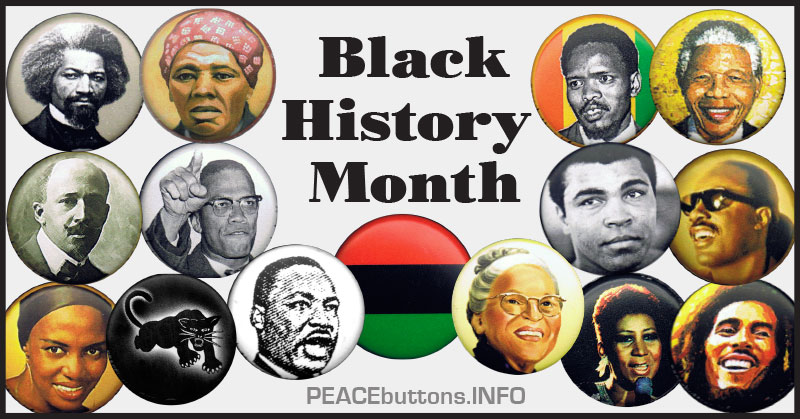
Beginning Black History Month 2026

So far, it’s not illegal for us to acknowledge that February is Black History Month, so here we are, doing just that. Ha! There is even some Black History for this very date in Peace and Justice History:

February 1, 1960

Greensboro first day: Ezell A. Blair, Jr. (now Jibreel Khazan), Franklin E. McCain, Joseph A. McNeil, and David L. Richmond leave the Woolworth store after the first sit-in on February 1, 1960.
Four black college students sat down at the Woolworth’s lunch counter in Greensboro, North Carolina, and were refused service because of their race. To protest the segregation of the eating facilities, they remained and sat-in at the lunch counter until the store closed.
Four students returned the next day, and the same thing happened. Similar protests subsequently took place all over the South and in some northern communities.
By September 1961, more than 70,000 students, both white and black, had participated, with many arrested, during sit-ins.


On the second day of the Greensboro sit-in, Joseph A. McNeil and Franklin E. McCain are joined by William Smith and Clarence Henderson at the Woolworth lunch counter in Greensboro, North Carolina.

“Segregation makes me feel that I’m unwanted,” Joseph McNeil, one of the four, said later in an interview, “I don’t want my children exposed to it.
Listen to Franklin McCain’s account of what happened 
February 1, 1961
On the first anniversary of the Greensboro sit-in, there were demonstrations all across the south, including a Nashville movie theater desegregation campaign (which sparked similar tactics in 10 other cities). Nine students were arrested at a lunch counter in Rock Hill, South Carolina, and chose to take 30 days hard labor on a road gang. The next week, four other students repeated the sit-in, also chose jail.

In light of current events, I thought it’d be good to review how Black History Month came to be. Below is a bit on its beginnings.

The History of Black History Month

Black History Month was first observed as Negro History Week in February 1926, but the inspiration for the commemoration began over a decade earlier through a steady stream of electrifying events, discoveries, and other celebrations of Black excellence. In 1915, American historian Dr. Carter G. Woodson attended the national celebration of the fiftieth anniversary of emancipation in Washington D.C. This event was widely attended and proved to be profoundly inspiring for Dr. Woodson who, later that year, joined forces with A. L. Jackson, William B. Hartgrove, George Cleveland Hall, and James E. Stamps to establish the Association for the Study of Negro Life and History, known today as the Association for the Study of African American Life and History ​(ASALH 2024)​. ASALH had the ambitious goal of educating the public about the achievements, inventions, and progress made by Black Americans, and though the Association’s intellectual efforts were remarkable – they began to publish The Journal of Negro History in 1916 and founded Negro History and Literature Week in 1924 – Dr. Woodson had a wider vision of his mission. Wishing to continue to discover and celebrate the history of the Black past, Dr. Woodson announced the celebration of Negro History Week through a press release. 

Accounts of the contributions of Black Americans were notably absent from history books, credited to white men, or omitted altogether. Progressive communities and schools were ripe for the rich history that Negro History Week offered. Matching the popularity of the week, Woodson and the Association established an annual theme for the celebration to guide and inspire educators. Weary of those simply wishing to capitalize on a popular event, “Woodson warned teachers not to invite speakers who had less knowledge than the students themselves” ​ (ASALH 2024)​. Additionally, ASALH expanded their offerings to provide study materials: pictures, lessons for teachers, plays for historical performances, and posters of important dates and people. This cemented the celebration of Black history in schools and communities, and Negro History Week grew in popularity throughout the following decades, with mayors across the United States endorsing it as a holiday. 

Negro History Week grew into Black History Month in 1970 under the leadership of Black educators and students at Kent State University and would become a federally recognized event six years later. President Gerald Ford recognized Black History Month in 1976 during the celebration of the United States Bicentennial. He urged Americans to “seize the opportunity to honor the too-often neglected accomplishments of Black Americans in every area of endeavor throughout our history” ​(Franklin 2022)​. Today, nearly one hundred years after that initial celebration, it is prudent to reflect on the designed purpose of Black History Month and discover that after all this time, these lessons are still relevant, inspiring, and necessary. As Dr. Woodson said, “Real education means to inspire people to live more abundantly, to learn to begin with life as they find it and make it better” ​(Woodson 1933)​. 

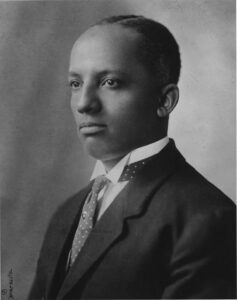
Pictured: Dr. Carter G. Woodson, The “father of Black history”

Photo Credit: Addison Norton Scurlock, Public domain, via Wikimedia Commons

​​Bibliography  

​​ASALH. 2024. The Founders of Black History Month: The Origins of Black History Month. December 18. Accessed January 16, 2025. asalh.org/about-us/origins-of-black-history-month/

​ASALH. 2024. Carter G. Woodson Timeline: ASALH – the Founders of Black History Month. December 19. Accessed January 16, 2025. asalh.org/carter-g-woodson-timeline/

​Franklin, Jonathan. 2022. Here’s the Story behind Black History Month – and Why It’s Celebrated in February. February 1. Accessed January 16, 2025. www.npr.org/2022/02/01/1075623826/why-is-february-black-history-month

​Woodson, Carter G. 1933. The Mis-Education of the Negro. Trenton: Africa World Press. 

==========

All right! So, we see that Black History Week then Month has been around for at least 20 years longer than our current POTUS, who seems to be ignoring the month’s existence. But, there’s no reason any of the rest of we the people have to! Including all history makes the US so much richer in knowledge. Most local historical and cultural organizations are going to have commemorations this month. What fun it will be, and how community-unifying for each of us to find an activity near us, and join in!

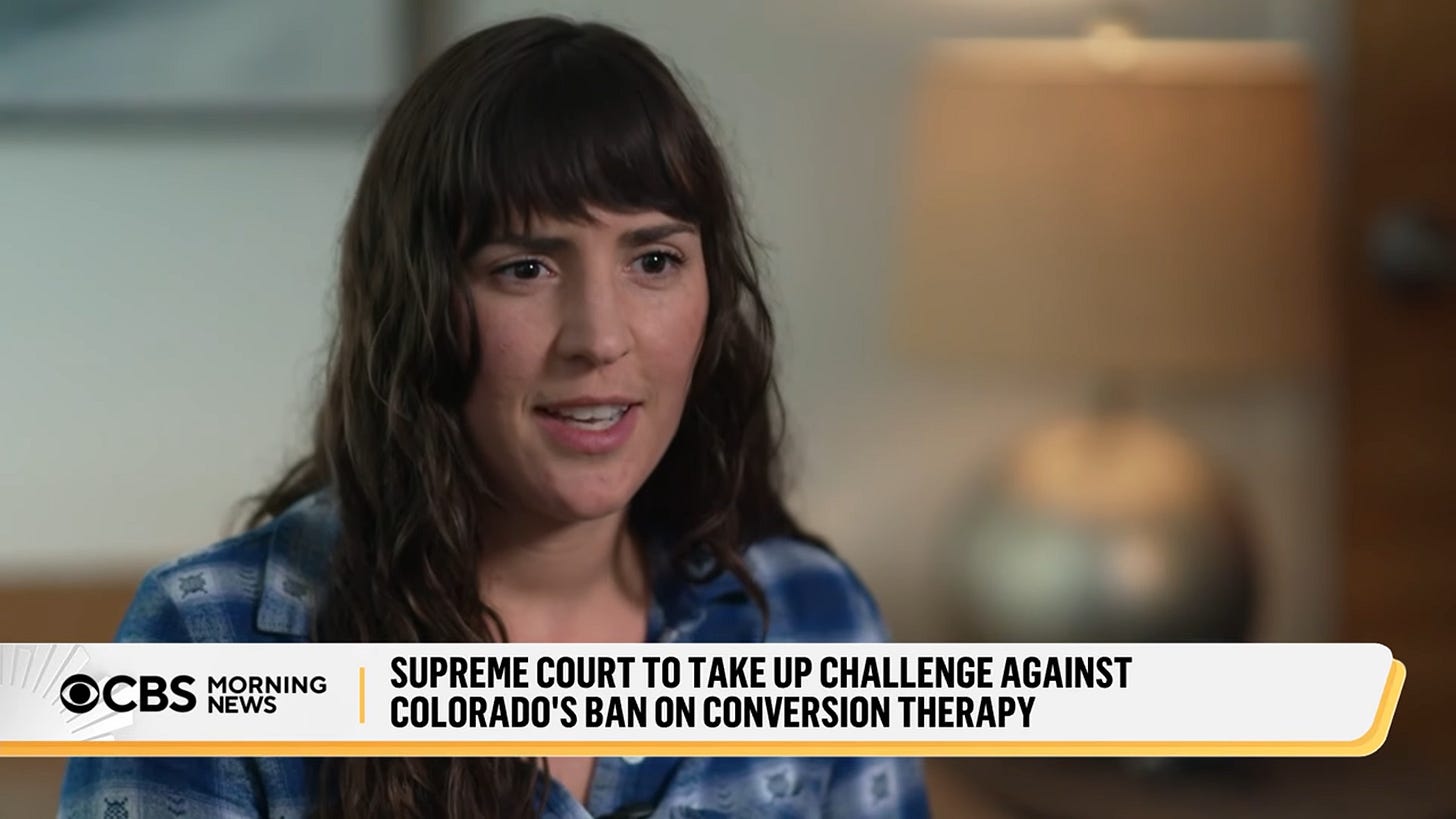
Alliance Defending Freedom’s Cruel History with Conversion Therapy

I often say that a lot of anti-trans anti-gay anti-LGBTQ+ people have their feelings because they don’t feel different from the cis straight majority so can’t understand or accept that such things because they simply don’t feel that way.  If they don’t feel it it can’t be real which is the same with how many white people feel about racism.  Remember the old question of how do you know you’re gay or trans or lesbian or nonbinary or what ever simply because the people who grew up straight and cis felt normal in society?  But if you ask them when they knew or how they knew they were straight and / or cis they are confused. If a boy at 10 comes out as gay the parents freak out, but if that same kid starts showing interest in girls the parents are ecstatic about their boy growing up.  Why the difference?  Because one fulfills their expectations and the other … well it just is not like them.  It simply comes down to tradition and what feels normal for them.  Every person who asked me if I tried to change my sexual orientation and there have been so many, to them I ask have you?  They act offended.  Why would I do that and I reply, then why should I.  Then if they persist for some reason that I should do conversion therapy I ask could they convert from their straight / cis desires to being LGBTQ+?  Again they are stunned why they would do that and instantly claim not I couldn’t do that.  Then again why ask me to do it?  Hugs


https://www.unclosetedmedia.com/p/alliance-defending-freedoms-cruel

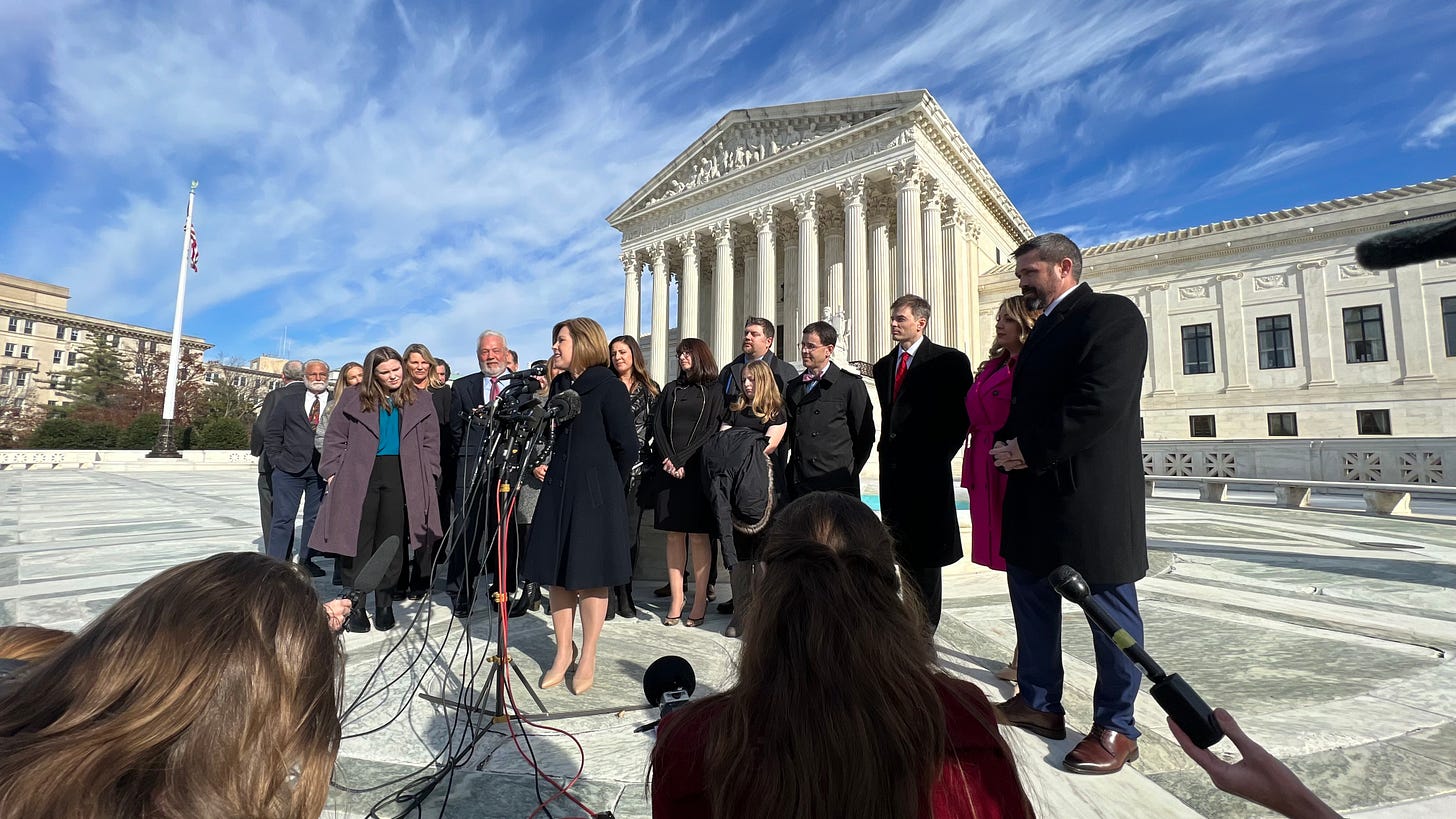
The Christian legal group is currently trying to convince the Supreme Court to overturn Colorado’s ban on conversion therapy.

Epstein files key findings: Musk discussed visiting island in 2013

Again, a congressperson, low ranking.  Where are the upper ranks of the democratic leadership?  Hugs

Two From Clay Jones

I haven’t shared this guy’s work in some time, either.

I am a member of the Association of American Editorial Cartoonists, and I also sit on its board of directors. Today, our president, Marc Murphy, wrote a statement for the organization in defense of journalist Don Lemon, who was arrested by the Trump regime for doing his job.

(snip-MORE, and it’s hot; go read it!)

=====

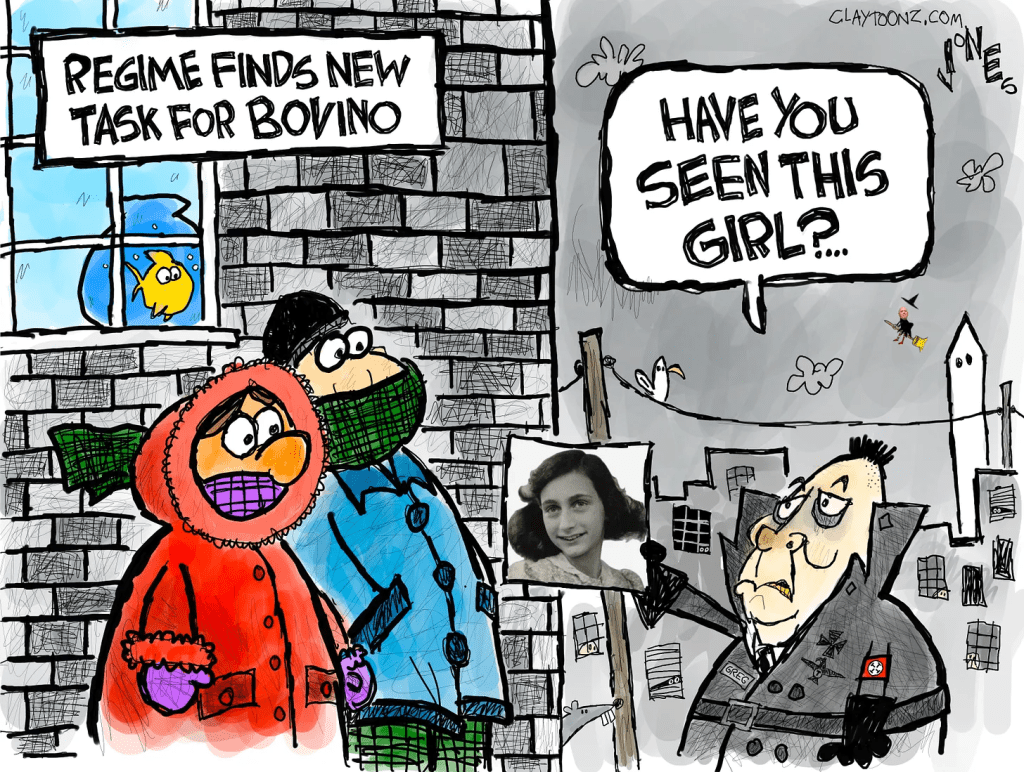
My favorite part of Raiders of the Lost Ark is when they remove the lid, and Greg Bovino’s face melts off. Of course, that would be impossible. He’s not tall enough to reach the top of the ark. By the way, I love this woman.

You know Donald Trump only cares about the optics because he has been perfectly happy with Greg Bovino’s job performance. Trump doesn’t have a problem with American citizens protesting ICE being murdered in the streets. It’s just too bad the optics aren’t good about that, as even Republicans are starting to cringe. Notice that Trump didn’t have any empathy for Congresswoman Ilhan Omar being attacked? And it’s probably his fault.

(snip-MORE, and it, too, is quite hot!)

‘Drawdown’ of MN immigration agents in the works: Trump border czar

Another lower ranked Democrat going on media to hammer the lefts talking points that we need to stress to the public.  Leadership?  Hugs

Some news stories links I wish to share.

Senate Minority Leader Chuck Schumer (D-N.Y.) on Wednesday laid out his party’s demands for voting for Homeland Security funding: End roving patrols by Immigration and Customs Enforcement (ICE); tighten rules governing use of warrants by officers targeting migrants; establish a universal code of conduct governing federal law enforcement officers’ use of force; prohibit federal officers from wearing masks; and require officers to wear body cameras and proper identification.


More congress critters on MS Now. I even found one of Schumer posted 26 minutes before I checked again.

Well I had hoped to hear from Schumer but at least he is demanding the reforms be in writing.   He is getting a lot of pressure to do something this time.  But he wanted to end the last shut down with a loss because he was afraid the republicans would destroy the filibuster.   He settled for a vote that meant nothing and was totally performative.  Will he do the same here?  Hugs

Well at least he can articulate the points that need to be made in a strong manner.  I liked him better clean shaven.  My view on a beard is either grow one big, bushy, and long or don’t grow it.  Scruffy is a sad look I think and reminds me of teenagers getting their first facial hairs.    I wonder what political job he will run for next.  I think Senate, or governor.  Hugs


And So Now It Goes To Court

a-gain. And again. Possibly yet again, though it shouldn’t need to go past the state Supreme Court. But still. Statements within.

‘This bill spits on basic human decency’: Kansas Legislature passes bathroom ban without hearing

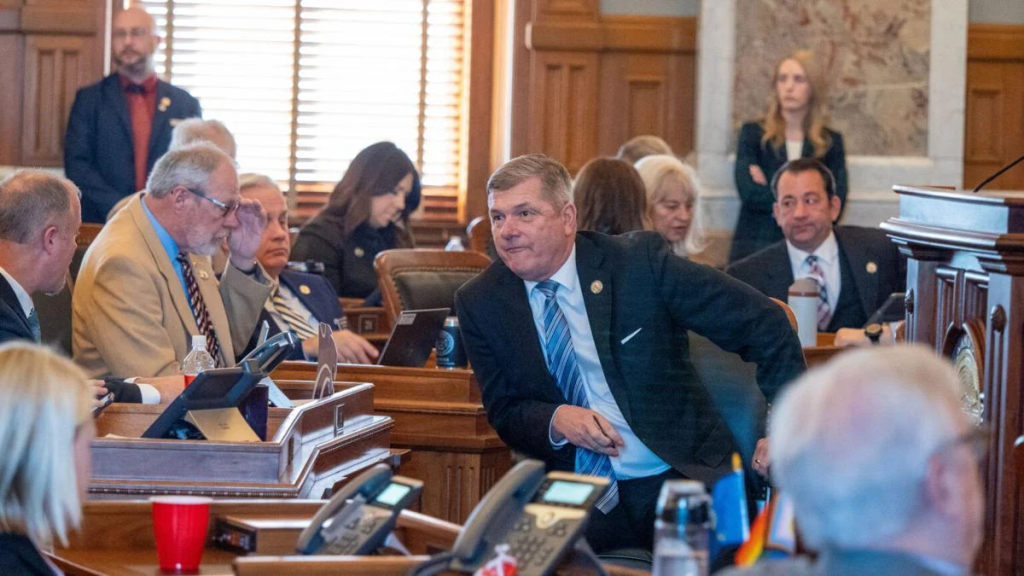
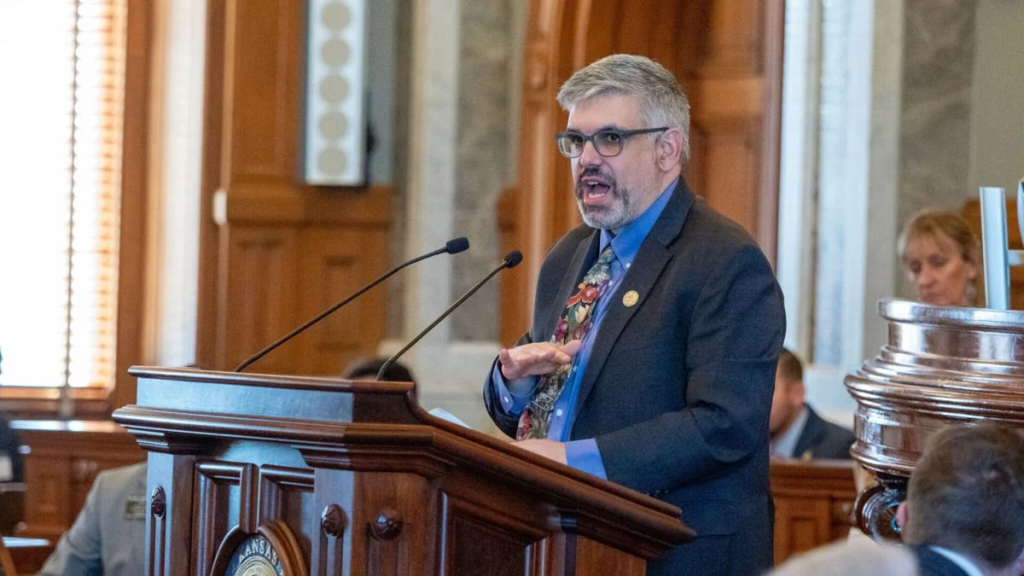
House Majority Leader Chris Croft suspended rules to force an emergency vote immediately after the Jan. 28, 2026, House debate on a bathroom bill forcing people to use facilities aligned with their biological sex at birth. The move pushed the bill through immediately instead of waiting one day as is usually required. (Photo by Sherman Smith/Kansas Reflector)

TOPEKA — The GOP-led Kansas House and Senate on Wednesday approved a “bathroom bill” targeting transgender people after House Democrats delayed passage by six hours, proposing multiple amendments to set the stage for a possible legal challenge. 

House Majority Leader Chris Croft, an Overland Park Republican, called for emergency action to take the vote immediately after debating the bill instead of waiting a day as rules require. House Substitute for Senate Bill 244 passed on an 87-36 vote along party lines, with one Republican opposed.

The Senate concurred with the bill Wednesday evening, voting 30 to 9, also along party lines. The bill will go to Gov. Laura Kelly, who is expected to veto the legislation. It passed both chambers with the two-thirds majority needed to override a veto. 

Democrats fought the bill’s passage in the House, basing their arguments on two primary concepts — that the bill was rushed through the legislative process, giving little time for public input, and that it is an inhumane attack on transgender people. 

“This bill spits on basic human decency, and I’m embarrassed we had to spend the entire day trying to defeat this thing,” said Rep. Susan Ruiz, D-Shawnee.

Ruiz also said she believed the bill was targeted at a specific legislator, referring to Rep. Abi Boatman, a Wichita Democrat who is a transgender woman. Boatman was selected to fill a vacant seat in early January.

“I have sat here for five and a half hours and listened to this entire room debate my humanity and my ability to participate in the most basic functions of society,” Boatman said at the close of debate. “From the bottom of my heart, I hope none of you have to ever sit through something like that.”

The legislation would require people to use the bathroom in government buildings that matches their biological sex at birth, rather than their gender, and requires governments to enforce the rule. Both the governmental body and individuals could face steep fines for violating the law.

The bill also requires that the sex listed on a driver’s license and birth certificate match the person’s biological sex at birth.

House Minority Leader Brandon Woodard, D-Lenexa, said in an interview after the House adjourned that the amendments and testimony presented by Democrats throughout the day “gave a lot of fodder” to Kansas courts to make a decision when the case is revived.

During debate, Democrats repeatedly referenced Kansas Attorney General Kris Kobach failed attempt in court to ban gender marker changes on driver’s licenses. Woodard said he didn’t think this bill would hold up in court, either.

“As long as Kris Kobach’s our attorney general, I think he’s going to continue to lose in court,” he said.

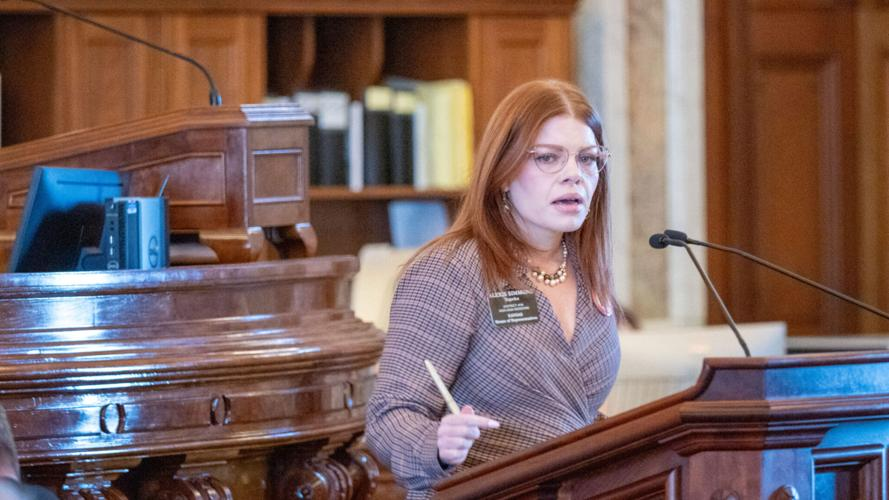
Rep. Alexis Simmons, D-Topeka, talks about her experience with sexual assault during a Jan. 28, 2026, House debate on a bill to regulate who can use a bathroom in a government building. (Photo by Sherman Smith/Kansas Reflector)

Emotional testimony

It was a long debate full of emotion, sometimes anger, often frustration. Several times legislators were accused of impugning another legislator, and loud exclamations resonated from both sides of the chamber, including emphatic shouts of “oh, baloney.”

Rep. Alexis Simmons, D-Topeka, said she hadn’t planned to talk about a personal trauma but felt compelled to speak up when she heard others testify about how difficult it would be for women who have been raped to share a bathroom with a man.

She referred to testimony by Rep. Charlotte Esau, R-Olathe, who said the bill protected the “silent” women who are unwilling to speak up about being assaulted and who need women-only spaces to feel safe.

“I’m a victim of a sexual assault and never once did I think it was somebody else’s responsibility to manage my trauma,” Simmons said. “I feel enormous sympathy for victims of trauma, that goes without saying, but I do not appreciate my trauma being used to justify legislation that we know will cause harm to people.”

Simmons said she felt more threatened by men than she had ever felt by a transgender person. 

“Here in this building, as an intern, as a committee assistant, as staff and as a legislator, I have been sexually harassed more than you would believe,” she said. “If we’re going to talk about women’s safety, we should address the real trauma, which is how women are treated, not putting the spotlight on one new member of our Legislature.” 

Rep. John Carmichael, D-Wichita, rejected claims made by Rep. Susan Humphries, R-Wichita, and Rep. Bob Lewis, R-Garden City, who argued the bill would protect women.

The bill instead will force transgender men, who live as and look like men, to use a woman’s restroom, Carmichael said. 

“He is going to sit down at the stall next to your granddaughter,” Carmichael said. “Is that what you really want? Not only that, there are other facilities which have locker rooms or the like. That hairy-faced man will be standing naked, showering next to your daughter. That’s what this bill requires.”

Other legislators spoke about concerns that the bill would embolden people to attack transgender individuals.

Rabbi Moti Rieber, with Kansas Interfaith Action, watched all six hours of debate, his face often grim.

“This bill is a combination of a culture war-obsessed supermajority and a broken legislative process, using every process trick in the book to get unnecessary and harmful legislation into law with no public input,” he said.

Rep. Dan Osman, D-Overland Park, opposes a bathroom bill during a six-hour House debate on Jan. 28, 2026. The bill forces people to use the bathroom that matches their sex at birth. (Photo by Sherman Smith/Kansas Reflector)

Process problems

Throughout the day, Democrats pointed to process problems surrounding the bill. The Judiciary Committee revealed a hearing on House Bill 2426 with less than 24-hour notice. At a later hearing, the bathroom portion of the bill was added with no advance notice and no chance for public input.

Then, in a procedure referred to as “gut and go,” the committee dumped the contents of HB 2426 into Senate Bill 244, which allowed the Senate to simply concur without ever holding a hearing on the overwritten bill.

“Procedurally, it is the absolute worst bill I have ever heard in the Kansas Legislature,” said Rep. Dan Osman, D-Overland Park, who also serves on the Judiciary Committee. “It was done with one purpose and one purpose only — to ensure that the absolute least number of people were available as opponents to this bill and that they were unaware that there would even be a hearing.”

Additionally, there is no fiscal note — a formal notice provided by budget analysts and researchers about how much a bill will cost — for the bathroom provision. That means it is unclear how much local governments could have to pay to ensure they are complying with the law.

Rep. Kirk Haskins, D-Topeka, said he was upset about the rushed schedule and the lack of a fiscal note.

“It upsets me when we rush things through that deal with my constituents, and my constituents, they don’t get a say. That’s what happened here,” he said. “This is a trend. I don’t know what’s going on. Yesterday, we had committee meetings without information. We heard a bill, we didn’t have a proponent, just because we have the power to do it.”

Some legislators focused on details, such as how enforcement would be handled and what would happen if someone violated the bathroom restrictions. Humphries, the Wichita Republican who chairs the Judiciary Committee, said complaints would be made to the governing body if someone suspected a person was using a bathroom that didn’t match their sex at birth. 

The bill outlines fines for individuals and also that governing bodies could be held accountable — to fines as high as $25,000 — if they don’t require people to use bathrooms as outlined.

In an interview after the House adjourned, Haskins said he would be comfortable seeing Boatman, as a transgender woman, in the men’s restroom at the Statehouse.

“I’m comfortable with anybody in the restroom,” he said. “I think the bill is based upon fearmongering on issues that are not critical to Kansas, and wherever she wants to go, Rep. Boatman, I’ve got her back.”

This story was originally published by the Kansas Reflector