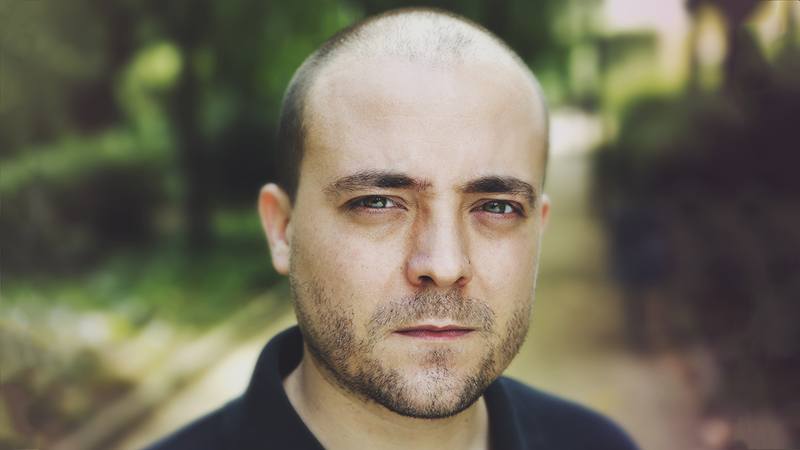
A U.S. Army veteran who was arrested during an immigration raid at a Southern California marijuana farm last week said Wednesday he was sprayed with tear gas and pepper spray before being dragged from his vehicle and pinned down by federal agents who arrested him.
George Retes, 25, who works as a security guard at Glass House Farms in Camarillo, said he was arriving at work on July 10 when several federal agents surrounded his car and — despite him identifying himself as a U.S. citizen — broke his window, peppered sprayed him and dragged him out.
In this image taken from video provided by United Farm Workers, George Retes speaks about being arrested at an immigration raid at a Southern California marijuana farm during a press conference held over Zoom in Oxnard, Calif., Wednesday, July 16, 2025. (United Farm Workers via AP)
“It took two officers to nail my back and then one on my neck to arrest me even though my hands were already behind my back,” Retes said.
Massive farm raids led to hundreds being detained
The Ventura City native was detained during chaotic raids at two Southern California farms where federal authorities arrested more than 360 people, one of the largest operations since President Donald Trump took office in January. Protesters faced off against federal agents in military-style gear, and one farmworker died after falling from a greenhouse roof.
The raids came more than a month into an extended immigration crackdown by the Trump administration across Southern California that was originally centered in Los Angeles, where local officials say the federal actions are spreading fear in immigrant communities.
California Gov. Gavin Newsom spoke on the raids at a news conference Wednesday, calling Trump a “chaos agent” who has incited violence and spread fear in communities.
“You got someone who dropped 30 feet because they were scared to death and lost their life,” he said, referring to the farmworker who died in the raids. “People are quite literally disappearing with no due process, no rights.”
Retes was taken to the Metropolitan Detention Center in downtown Los Angeles, where he said he was put in a special cell on suicide watch and checked on each day after he became emotionally distraught over his ordeal and missing his 3-year-old daughter’s birthday party Saturday.
Milk is poured on a protester’s face after federal immigration agents tossed tear gas at protesters during a raid in the agriculture area of Camarillo, Calif., Thursday, July 10, 2025. (AP Photo/Michael Owen Baker)
He said federal agents never told him why he was arrested or allowed him to contact a lawyer or his family during his three-day detention. Authorities never let him shower or change clothes despite being covered in tear gas and pepper spray, Retes said, adding that his hands burned throughout the first night he spent in custody.
On Sunday, an officer had him sign a paper and walked him out of the detention center. He said he was told he faced no charges.
Retes met with silence when seeking explanation
“They gave me nothing I could wrap my head around,” Retes said, explaining that he was met with silence on his way out when he asked about being “locked up for three days with no reason and no charges.”
Tricia McLaughlin, assistant secretary of the Department of Homeland Security, confirmed Retes’ arrest but didn’t say on what charges.
“George Retes was arrested and has been released,” she said. “He has not been charged. The U.S. Attorney’s Office is reviewing his case, along with dozens of others, for potential federal charges related to the execution of the federal search warrant in Camarillo.”
A federal judge on Friday ordered the Trump administration to halt indiscriminate immigration stops and arrests without warrants in seven California counties, including Los Angeles. Immigrant advocates accused federal agents of detaining people because they looked Latino. The Justice Department appealed on Monday and asked for the order to be stayed.
The Pentagon also said Tuesday it was ending the deployment of 2,000 National Guard troops in Los Angeles. That’s roughly half the number the administration sent to the city following protests over the immigration actions. Some of those troops have been accompanying federal agents during their immigration enforcement operations.
Retes said he joined the Army at 18 and served four years, including deploying to Iraq in 2019.
“I joined the service to help better myself,” he said. “I did it because I love this (expletive) country. We are one nation and no matter what, we should be together. All this separation and stuff between everyone is just the way it shouldn’t be.”
Veteran pledges to sue federal authorities for his ordeal
Retes said he plans to sue for wrongful detention.
“The way they’re going about this entire deportation process is completely wrong, chasing people who are just working, especially trying to feed everyone here in the U.S.,” he said. “No one deserves to be treated the way they treat people.”
Retes was detained along with California State University Channel Islands professor Jonathan Caravello, also a U.S. citizen, who was arrested for throwing a tear gas canister at law enforcement, U.S. Attorney Bill Essayli posted on X.
The California Faculty Association said Caravello was taken away by agents who did not identify themselves nor inform him of why he was being taken into custody. Like Retes, the association said the professor was then held without being allowed to contact his family or an attorney.
Caravello was attempting to dislodge a tear gas canister that was stuck underneath someone’s wheelchair, witnesses told KABC-TV, the ABC affiliate in Los Angeles.
A federal judge on Monday ordered Caravello to be released on $15,000 bond. He’s scheduled to be arraigned Aug. 1.
“I want everyone to know what happened. This doesn’t just affect one person,” Retes said. “It doesn’t matter if your skin is brown. It doesn’t matter if you’re white. It doesn’t matter if you’re a veteran or you serve this country. They don’t care. They’re just there to fill a quota.” ___ Associated Press writer Jamie Ding contributed from Los Angeles.
This is a fun half from an Emma Thursday 07-17-2025
This last one is from the Nazi authoritarian cult of tRump maga who I posted a meme of getting fired and asking for money because his boss felt his was not a good fit for the company. FAFO
Very informative and heart felt. Aron Ra is well known for his thought approach to atheism and science, delivering it in a way that a normal person can understand. The things he says at the end and the pictures he shows makes clear that as he says this is not about protecting anyone but about enforcing bigotry. Hugs
July 21, 1878 Publication of “Eight Hours,” written by Reverend Jesse H. Jones (music) and I.G. Blanchard (lyrics), the most popular labor song until “Solidarity Forever” was published by the IWW (Industrial Workers of the World) in 1915. “Eight hours for work, Eight hours for rest; Eight hours for what we will.” All the lyrics (The eight-hour was an established concept before the song.)
July 21, 1925 The so-called “Monkey Trial” ended in Dayton, Tennessee, with high school teacher John T. Scopes convicted of violating a state law against teaching Darwin’s theory of evolution. It was considered illegal to contradict the Bible’s description of God’s seven-day creation of the world in Genesis. The trial pitted two of America’s leading advocates as the opposing lawyers: William Jennings Bryan, thrice the Democratic presidential candidate (1896, 1900, 1908) and the state’s prosecutor; Clarence Darrow, a lawyer famous for representing the underdog, at the defense table. Referred to as “the trial of the century” even before it began, it was the first trial ever broadcast (on radio). Bryan became ill and died shortly after the trial’s end; the conviction was later overturned by Tennessee’s Supreme Court. The Defendant John T. Scopes The Attorneys: Darrow & Bryan/ The Verdict: Thou Shall Not Think Interest in the trial by the populace and the media (and the heat in the courtroom) prompted Judge John T. Raulston to move the trial outdoors to the courthouse lawn. Bryan himself was called as a witness on the literal interpretation of scripture. Attorney General Thomas Stewart, in response to Darrow’s questioning, asked, “What is the meaning of this harangue?” “To show up fundamentalism,” shouted Mr. Darrow, “to prevent bigots and ignoramuses from controlling the educational system of the United States.” Mr. Bryan sprang to his feet, his face purple, and shook his fist in Darrow’s face: “To protect the word of God from the greatest atheist and agnostic in the United States.” ACLU History: The Scopes ‘Monkey Trial’ More about the Monkey Trial
July 21, 1954 Major world powers, meeting in Geneva, Switzerland, reached agreement on the terms of a ceasefire for Indochina, ending nearly eight years of war. The war began in 1946 between nationalist forces of the Communist Viet Minh, under leader Ho Chi Minh, and France, the occupying colonial power after the Japanese lost control during World War II. The Geneva conference included France, the United Kingdom, the U.S., the U.S.S.R., People’s Republic of China, Cambodia, Laos, and both Vietnamese governments (North and South). The peace treaty called for independence for Vietnam and a 1956 election to unify the country. However, only France and Ho Chi Minh’s DRV (Democratic Republic of Vietnam (North)) signed the document. The United States did not approve of the agreement. Instead, they backed Emperor Boa Dai and Prime Minister Ngo Dinh Diem’s government in South Vietnam and refused to allow the elections, knowing, in President Eisenhower’s words, that “Ho Chi Minh will win.” The result was the Second Indochina War, more commonly known as the Vietnam War. The treaty is signed
July 21, 1976 Plaza de Mayo mother A military junta under General Jorge Rafael Videla took power in Argentina on March 24, disbanding parliament and taking over all labor unions. The military kidnapped hundreds of people from two villages of Jujuy province in northern Argentina, thirty of whom never returned from a clandestine detention center. Most of those disappeared worked for the Ledesma sugar refinery. Since 1983, on the Thursday closest to July 21, Madres de Plaza de Mayo (an organization of mothers and wives of the missing) are joined by others, and walk the 7 km (4.3 miles) from Calilegua to San Martin, demanding answers about their loved ones. Madres de Plaza de Mayo is supported by Amnesty International and the United Nations Human Rights Commission. Read more
If asked to pick one Lady Gaga song to encapsulate who she is and what she stands for, you’d be hard pressed to come up with a better choice than “Born This Way.” Released in 2011, the song is a vibrant, full-body dance anthem that calls on listeners to celebrate who they are. “God makes no mistakes,” she sings in the refrain. “I’m on the right track, baby / I was born this way.” The song was immediately embraced upon release, particularly by the LGBTQ+ community.
As it turns out, this wasn’t the first time a song by that name made that kind of impact. In 1977, Motown Records released the disco anthem “I Was Born This Way,” an upbeat tune featuring a largely unknown Black gospel singer who responds to critics with a refrain that was a head-turner for its time: “I’m happy. I’m carefree. And I’m gay. I was born this way.”
In 2021, Gaga directed people’s attention to that song, saying it was the inspiration for her own hit. And in the new documentary I Was Born This Way, which premiered at the Tribeca Film Festival in June, directors Daniel Junge and Sam Pollard shine a light on its creation and its singer, Carl Bean, an extraordinary individual who spent his life serving his LGBTQ+ community.
Junge and Pollard’s film starts with the story of Bean’s childhood in Baltimore. And many of the main moments are unforgiving: His mother abandons him at birth because she doesn’t feel ready to have a child; his uncle sexually assaults him for years; Bean attempts to kill himself as a teenager after his previously loving adoptive father hits him for being gay.
Bean, who died in 2021 at age 77, faced hardships in his life, many of which the film explores. But none of the horrors of Bean’s life land with the kind of bleakness one might expect. It’s not that the documentarians pull their punches, either. It’s Bean — there’s a persistent lightness to his spirit, the quiet joyfulness of someone who by some miracle is able to see a broader perspective. Those qualities so suffuse the story of his life that no darkness can overcome them.
And that faith sustained him when he moved first to New York City, where he would sing with Harlem’s Christian Tabernacle Choir, and then when he moved to Los Angeles and started writing his own songs. In New York, he worked at Macy’s and became lifelong friends with Cissy Houston, Estelle Brown, and Dionne Warwick; in Los Angeles, he signed a record deal but then discovered they only saw him as a gospel singer. And then, out of nowhere, Motown Records reached out.
The song “I Was Born This Way” has its own interesting history, which Junge and Pollard track. It was originally written years earlier by Bunny Jones, a New York City beautician who was friends with Stevie Wonder and later became a promoter. She wrote the song for one of her acts, a gay performer. But it wasn’t until two years later, when Motown reworked the song for disco and gave it to Bean to sing (with his friend Estelle Brown on backup), that it took off.
“There was such a feeling of freedom and relief and release when you danced to that song,” Minority AIDS Project program director Mike Jones says in the documentary. “All of the things we were trying to say throughout our lives to many of our friends and family that we could not say were in that song.”
While the collapse of disco would see the song fade from people’s memories, the film reveals the ways it continued to quietly live on. Musician and record producer Questlove talks about how often it has been sampled in other work over the decades. Among other places, you can hear it on Debbie Gibson’s “One Step Ahead,” Deee-Lite’s “Good Beat (Turn Up the Radio Mix),” and Rick Wade’s “Free.” The song, he says, “is the music equivalent of the Giving Tree.”
Meanwhile, Bean faced an unexpected fork in the road. Motown offered him the chance to do another big song. But “I Was Born This Way” had changed his perspective on the meaning and purpose of his life. “I had found my niche,” he said. “I knew my gig was to be a change agent in our society.”
And the film recounts how that choice led him down a path he could not have expected. Seeing how little was being offered to people of color when the AIDS pandemic erupted in the early ’80s, Bean started making visits on his own, traveling from person to person he learned about on Los Angeles city buses. Eventually he founded the Minority AIDS Foundation, which provided a hotline for information and to arrange visits.
When he learned from social workers that he would gain greater access to those who were sick if he became clergy, he also got ordained. Unexpectedly, some of those he visited asked for an Easter service. He provided it, not realizing it would be such a positive experience that they would aske him to lead to more services. Eventually, he started his own church, Unity Fellowship, an African American Christian community specifically for LGBTQ+ people.
Bean’s decades of generosity would eventually cost him. In his later years, he found himself unable to move his lower body. “All of those years of racism, of homophobia, all of that death and dying, it had an effect on my mind, my spirit, my being,” he said. “My body shut down.” The revelation is stunning — there’s been no sign over the course of the film that he has been suffering or overwhelmed with grief.
It’s a telling reminder of the sacrifices and generosity of so many queer people like Bean, whose stories are not well known. It’s also a testament to their irrepressible joy: At the end of the film, asked whether he has any last words for the camera, Bean offers a simple thought that pours directly out of the work of his life, including his famous song. “Find the place in you that allows you to love yourself and others,” he says. “It begins with love and ends with love.”
Then, as the film crew starts to pack up, he starts laughing warmly. There’s no reason. He just has so much to give.
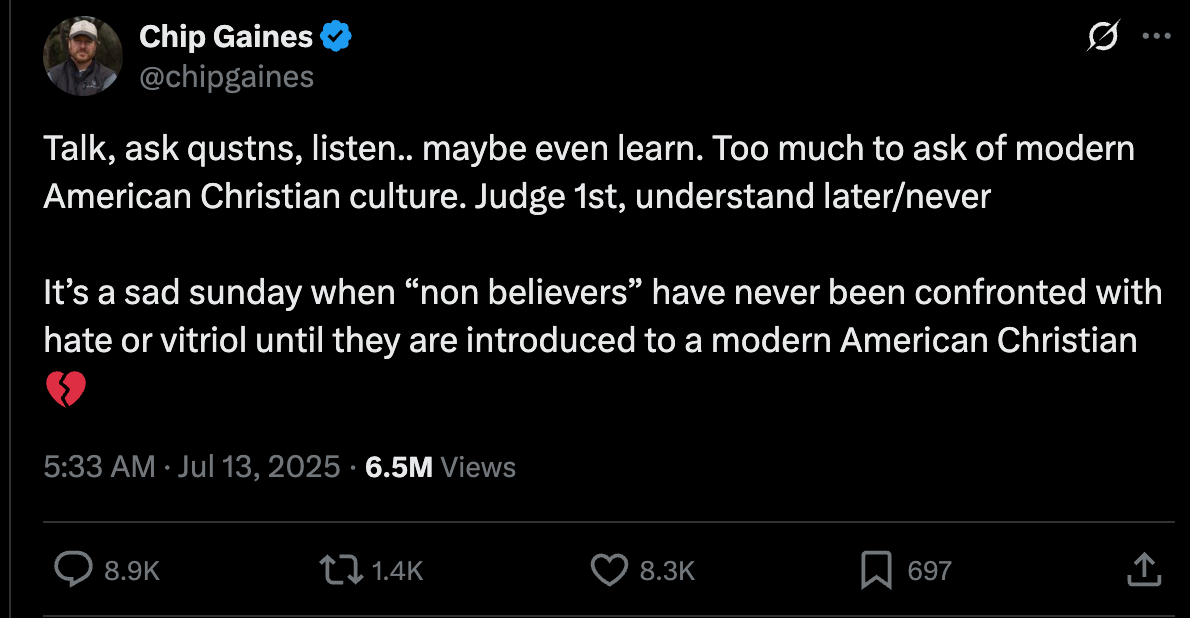
(One’s a meme.) It’s likely been obvious since I’ve been posting here, that aside from some comments I make which are my own and don’t represent the blog, I’m careful about what sort of energy I put into the Playtime universe. I’ve just finished reading Evan Hurst’s Moral High Ground for today, and while it’s wildly, hilariously entertaining as well as pertinent, it’s not the energy I want to put out, so instead, here is a meme from me, with a bit from the piece, which is linked, and if you like really snarky humor, please do go enjoy it! It’s just a little rougher than I want to post here, even though I restacked it on substack. To be totally clear, the meme applies to myself and what Chip Gaines said. And now, we carry on- A.
Heartbreaking: The Worst Person You Know Just Made A Great Point
Snippet from The Moral High Ground:
I don’t know what Chip Gaines’s walk with the Lord on these issues has consisted of, bu his response to the manufactured controversy from God’s most wasted creations confirms that he’s indeed been on some version of such a walk, unlike anybody else in this post.
One line in there tells me that Chip, wherever he is exactly on this issue, his heart is at least aiming in the direction of Jesus:
Talk, ask qustns, listen.. maybe even learn. Too much to ask of modern American Christian culture. Judge 1st, understand later/never It’s a sad sunday when “non believers” have never been confronted with hate or vitriol until they are introduced to a modern American Christian
“Maybe even learn. Too much to ask of modern American Christian culture.” That’s biting, but that’s not the line. “Judge 1st, understand later/never.” He’s not fucking around, but that’s still not the line.
“It’s a sad sunday when ‘non believers’ have never been confronted with hate or vitriol until they are introduced to a modern American Christian.”
There it is. That’s the one that says he gets it. (snip-do go read it all, if you like; link below!)
Chip And Joanna Done Pissed Off The Bigots, Oh Lord by Evan Hurst
Joanna better not give a gay couple any shiplap! Read on Substack