Donald Trump’s ICE is doing exactly what he wants. And now they are holding a political prisoner for nearly a year in an ICE detention camp simply because 33-year-old Leqaa Kordia dared to champion views the Trump regime opposes. This should concern all Americans especially given the recent warning from concentration camp expert Andrea Pitzer—who explained on my SiriusXM show that history tells the Trump regime building massive ICE detention camps will ultimately be used to imprison political prisoners.
That should not be a surprise to anyone who follows the history of fascist and other right wing regimes. Trump is following the fascist playbook, complete with his own secret police that has terrorized and even killed Americans who defy him. The most glaring example being the murder of Renee Good and Alex Pretti—who were then smeared by Trump officials as “domestic terrorists.”
Shockingly, we just learned that Trump’s ICE shot and killed another US citizen, 23 year old Ruben Ray Martinez, almost a year ago in March of 2025. However, Trump’s secret police covered up their involvement until recent media reports broke the story open. The details surrounding the murder of Martinez–who worked at Amazon–are simply unbelievable with ICE claiming that for some unknown reason this young man with no criminal record suddenly used his car to attack ICE officers.
Beyond that ICE has terrorized American citizens who dared film them—which they are legally entitled to—assaulted protesters and engaged in conduct consistent with an occupying army, not federal agents.
But it’s not ICE acting as a rogue agency—Trump wants them to do this. Trump—like Putin– wants to silence dissent as we’ve seen with his regime targeting all who oppose him from comedians like Jimmy Kimmel to seeking to criminally charge and imprison six Democratic members of Congress for warning members of the military to not follow illegal orders. A grand jury blocked that–at least for now.
That is why the case Leqaa Kordia demands far more attention given it’s a sneak preview of what we can expect from Trump for not just immigrants–but also U.S. citizens. Leqaa is a 33-year-old Palestinian woman with family in Gaza and the United States. Her mother is a US citizen living in Paterson, New Jersey—which is where Leqaa was staying and working as a waitress until she taken by ICE.
Leqaa Kordia
Kordia—who came to the US in 2016 on a student visa and was in the process of seeking permanent residence status via her mother –has no criminal record. The diminutive woman poses no threat to anyone. But to the Trump regime she is dangerous because she participated in peaceful protests advocating for Palestinian humanity. In the case, of Leqaa this issue is very personal in that she has lost nearly 200 relatives in Gaza.
But Leqaa’s case is not about Palestine—nor it is about Israel. Rather, it’s about freedom of speech—and the Trump’s regime targeting those who dare defy them.
How this case began was that in March of 2025, ICE informed Leqaa they wanted to speak to her. In response, she voluntarily appeared at the ICE office in Newark, New Jersey–where she was quickly arrested, thrown into an unmarked van and sent 1,500 miles away to the Prairieland Detention Facility in Texas far from her lawyer and family.
Since then, she has been detained in horrific conditions. As Leqaa detailed in a recent op-ed, the ICE facility she has been held in for nearly a year “is filthy, overcrowded and inhumane.” She slept in a plastic shell “surrounded by cockroaches and only a thin blanket.” And the food quality is so atrocious, it has caused her to vomit resulting in significant weight loss.
Worse, just a few weeks ago she experienced the first seizure of her life, collapsing to the floor. From there, ICE transported her to a hospital where her wrists and legs shackled to her bed for the three days. As she put it, “The entire time I was chained…I felt like an animal.” And simply to be cruel, ICE refused to tell her lawyers or family where she was or her medical condition.
None of this should be happening. As her lawyer Amal Thabateh explained to me, two different immigration judges ruled that Leqaa should be released on bond. But the Trump regime instead invoked a little used procedure to keep her in detention open ended.
To do that, serial liar DHS Secretary Kristi Noem smeared Leqaa as being a “terrorist” sympathizer for expressing concern for Palestinians in Gaza. They even claimed that releasing Leqaa—who again has no criminal record and was living with her US citizen mother in New Jersey–was somehow a threat to our nation. Of course, this is the same Noem who smeared with lies Renee Good and Alex Pretti as “terrorists” to justify their murders so we know she will say anything to defend the Trump regime’s crimes against humanity.
The idea Leqaa is a political prisoner is not just my view. Amnesty International lists her on their website demanding that the US government “release detained protester.” Her case is in the same section on the Amnesty website where they are calling for the release of dissidents in Russia, Belarus and other authoritarian regimes. This is where our nation is now viewed by human rights organizations.
Deeply alarming is that these ICE dentition centers are increasingly become death camps. At least 32 people died in ICE custody in 2025—the highest number in two decades. And in the past six weeks, six people have died in ICE custody including one man killed by ICE agents as they were restraining him. Will anyone be held accountable for this man’s death? That is like asking will anyone be held accountable for the death of Russian dissident Alexei Navalny killed in a Russian prison two years ago. We know that no one will be prosecuted because Russia is an authoritarian nation. As disturbing as it sounds, so is the United States under Trump.
But for those who refuse to submit to Trump and want to stand up for freedom of speech, I hope you will sign the Amnesty International petition calling for the US government to release Leqaa. Other ways to help this young woman include calling on your members of Congress to demand her release. You can also consider making a donation to her online fundraising page to help her and her family. Finally, you can follow Leqaa’s campaign for freedom on Instagram and amplify the updates.
As Andrea Pitzer repeatedly warned in our conversation on concentration camps, it does not end with people like Leqaa. It begins with people like Leqaa being held with in a camp for as long as the regime wants to keep her–in horrific conditions–simply because they want to silence her political views. They then continue until they reach people like us. But as the famous poem goes, by then it’s too late because when “they came for me…there was no one left to speak out.”
——
Below is my recent interview about Leqaa’s wrongful detention with her lawyer Amal Thabateh, who is with Creating Law Enforcement Accountability & Responsibility (CLEAR) Project and Laila El-Haddad, an award-winning Palestinian author, social activist, policy analyst and journalist.
The Dean’s Report by Dean Obeidallah is a reader-supported publication. To receive new posts and support my work, consider becoming a free or paid subscriber.
I feel like it’s been a while since we’ve checked in on Monica Cole and the “One Million Moms” that are definitely in the room with her right now as we speak, but this one was just too good to pass up. As many of you may know, I am originally from the Massachusetts/Rhode Island area, and am thus possessed of a certain fondness for Dunkin’ Donuts. Especially since they started carrying coffee milk, the only kind of milk I will drink on its own because I am not a freak like Robert F. Kennedy Jr. and Kid Rock.
It’s like chocolate milk but coffee flavored and it is magical, thank me later.
Anyway! The One Million Moms are very upset about a Dunkin’ Donuts ad that features Megan Thee Stallion, on account of how it is just too sensual.
Let us watch!
If you are a normal human person, you are probably thinking that this is nothing and pretty much as wholesome as a Dunkin’ Donuts ad featuring Megan Thee Stallion could possibly be.
If you are Monica Cole, however, you are thinking:
One Million Moms has received complaints regarding the new ad campaign from Dunkin’ Donuts. The “Dunk N’ Pump” commercial features Megan Thee Stallion, aka hot-girl coach, Pro-Tina, launching the new Protein Refreshers. Unfortunately, the offensive ad also features a vulgar workout routine full of sexual innuendos with an extremely sensual message.
Megan wears a thong skimpy leotard with flesh-colored leggings in this disgusting ad along with the “backup performers” wearing similar outfits. While sipping on a Dunkin’ Protein Refresher, they perform inappropriate and crude moves and the commercial ends with Megan performing the splits.
This type of advertising is entirely unnecessary. Dunkin’ has deliberately chosen to produce controversial advertisements instead of wholesome ones.
Apparently, Dunkin’ executives do not care how damaging and destructive such ads are to our children. Everyone knows kids repeat what they hear and see. This ad demonstrates weak marketing, and Dunkin’ should have the corporate responsibility not to use an age-old euphemism that offends families.
Let them know that, as a parent and a consumer, you are disgusted by their recent irresponsible marketing choices.
Dunkin’ needs to know that parents disapprove!
Man, they are really, really running out of material if this is the most sensual ad they can find to complain about.
What is it she’s worried about? That “kids repeat what they hear and see?” That they will start wearing thong leotards, which do not even come in children’s sizes?
For the record, as I (by strange coincidence) mentioned Friday, I watched this episode of Saved By The Bell approximately 17,000 times as a child and never once purchased a thong leotard or sported mall bangs.
What battle will they be fighting next? The war on the Jane Fonda Workout?
Honestly, this ad is so innocuous that I am convinced that One Million Moms is just trying to take up newly minted MAGA weirdo Nicki Minaj’s beef with Megan as a bizarre show of solidarity. They’ve been really scraping the bottom of the barrel lately. The last commercial they were upset about was the State Farm Super Bowl ad featuring Danny McBride and Keegan-Michael Key, because it “features the scantily clad girl-group KATSEYE dancing provocatively.” For approximately two seconds.
As if that’s the most annoying State Farm ad anyone’s ever seen.
Sadly for Monica Cole, Elmore City, Oklahoma — the inspiration for the movie Footloose — rescinded its ban on dancing some time in the late ‘90s. However! The town of Purdy, Missouri, reportedly still has one on books, so she can just move there and live a life free of dancing, without having to bother anyone else.
This is horrific that a young person has had to live with racism all his life and now has to protect his family and others from a racist gang of thugs who only want to hurt brown people like him. He is doing a great thing but he shouldn’t need to do this in the land of the free. Hugs.
Cesar Vasquez, who has supported families of undocumented immigrants since age 14, has become a community lifeline – and a known ICE target
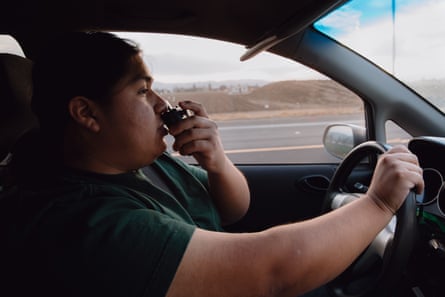
While most 18-year-olds worry about college papers and spring break plans, Cesar Vasquez drives through coastal California farm towns scanning for unmarked SUVs before dawn. He flips down his driver’s seat visor to look at a taped list of license plates he has already identified as Immigration and Customs Enforcement (ICE) vehicles, and jots down a few new ones he suspects could be. His phone buzzes constantly – tips from neighbors, text chains from volunteers alerting to ICE activity – all in an attempt to keep his community safe from being swept up in federal agents’ widening dragnet.
This is what organizing looks like for this son of undocumented immigrants. In his home town of Santa Maria, a small farming town on California’s central coast where over 80% of farm workers are undocumented, Vasquez has become both a crucial community lifeline and a known target of federal immigration enforcement.
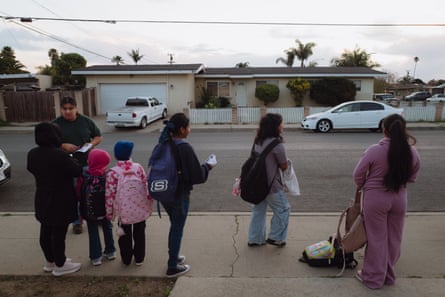
Outside the ICE office in Santa Maria, California, Cesar Vasquez and a group of activists gather to decide who will patrol each neighborhood.
Vasquez began volunteering with the 805 Immigrant Rapid Response Network as a high school senior. Last August, he was hired full-time as a rapid response organizer, covering North Santa Barbara and San Luis Obispo counties, overseeing volunteers, supporting families and tracking ICE activity.
Routinely, he visits the families of detained immigrants. “There have been so many occasions where I walked through the door, and a kid was expecting their father or mother,” Vasquez said wistfully. “And it was just me, and I had to explain what happened to their parents.”
Other times, for Vasquez, the reality is personal. He recalled in December, speaking with families waiting for news about their detained relatives outside the immigration enforcement office in Santa Maria, when an ICE vehicle slowed down in front of them. The agent’s voice crackled from the car’s speaker, loud enough to carry through the open window: “How’s your mother, Cesar? We’ll go visit her soon.”
Vasquez drove straight home and found his mother washing clothes.
“I took her car keys and told her to stop everything she’s doing. My hands were shaking,” Vasquez said. “I then moved her to a secret location that I have precisely for this moment.”
As the sun rises in Santa Maria, Vasquez continues monitoring ICE activity in his neighborhood. The 18-year-old says he spends more time in his car than anywhere else these days.
Growing up as a birthright citizen of undocumented parents
Vasquez’s mother is one of the thousands of undocumented farm workers in Santa Maria whom he is trying to protect. She left her home in a tiny town in Mexico to cross the US-Mexico border at age 13 in search of a better life. Vasquez’s biological father was one of the first people she encountered – a Guatemalan American whose family was settled in California and who held US citizenship. He was also abusive and never legally married her, keeping her from accessing US citizenship, Vasquez said. When Vasquez was an infant, his mother ran away with her three children to Santa Maria, a town about 150 miles (240km) north of Los Angeles, where she found work in the strawberry fields. She has been trying to secure documentation for more than a dozen years now.
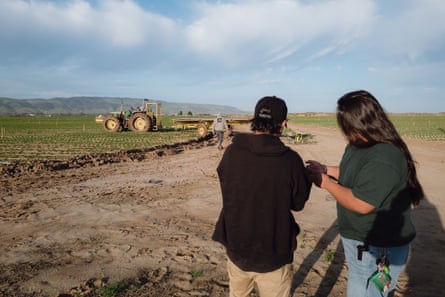
Vasquez distributes flyers on immigration rights to farmworkers in Santa Maria on 6 February.
Strawberry picking is physically demanding work, and the pay is minimal. Pickers spend hours bent over in the fields under the California sun, with no benefits, no sick days and no guaranteed work once the season slows between October and March. Climate change has made the labor even more precarious, disrupting growing cycles and shrinking paychecks. Rising costs of living – rent, food, transportation – have squeezed families further. In Santa Maria, where a two-bedroom apartment can cost $3,000 a month, many families crowd into single rooms or garages.
Built on an economy of strawberries, lettuce and wine grapes, Santa Maria has long depended on undocumented labor while rendering those workers largely invisible. Many arrived during waves of Mexican migration in the 1980s and 90s, settling into a community where immigration enforcement and workplace exploitation became routine. Before Donald Trump’s recent immigration priorities, ICE enforcement in the region tended to be more targeted – focusing on people with criminal convictions or referrals from local jails, rather than broad community sweeps. ICE didn’t even have a holding facility in Santa Maria until 2015.
But since 2025, enforcement has intensified dramatically with rapid‑response trackers documenting more than 620 immigration arrests across Santa Barbara, Ventura and San Luis Obispo counties, with Santa Maria often at the center of daily apprehensions. These high‑profile raids – often carried out with unmarked vehicles and tactical gear, drawing protests and criticism from community leaders – reflect a broader national surge in immigration enforcement under Trump.
Vasquez holds his mother along the river in Santa Maria. He keeps a feather with him, which he says brings spiritual cleansing when he burns sage.
When Trump was first elected, Vasquez was only nine years old. He was already well-acquainted with the repercussions of growing up in a mixed-status household.
“I mean, it’s common for most children of immigrants to be doing things for their parents like filling out their legal forms, right?” Vasquez said. “But in fourth grade, I had to learn what a warrant looked like and what rights I had.”
He was in a Halloween costume shop, age 14, when it clicked that his fears and concerns weren’t just his own. He overheard a woman at the register, saying she had saved all year to buy her son a costume, but it didn’t fit. The store wouldn’t take it back. Her shirt was stained with strawberries, her exhaustion visible. He’d seen his own mother do the same thing countless times, so he offered to buy the woman’s son the costume.
Building a network at 14
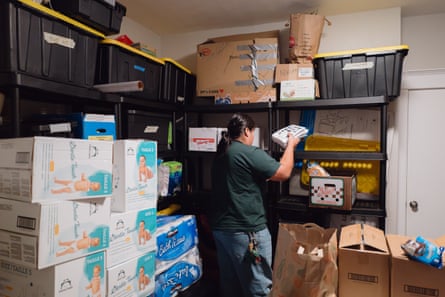
At age 14, Vasquez founded La Cultura Del Mundo, an entirely youth-led organization that eliminates what he calls the “red tape” associated with traditional aid. They prioritize direct, unrestricted support to families in need, asking, “How much do you need?” rather than requiring forms. The group then rapidly mobilizes whatever the family requests, whether that’s cash assistance, groceries, rent help or other essential support.
In August, La Cultura Del Mundo drew national attention when Vasquez organized La Marcha De La Puebla, a national protest against ICE raids that involved nearly 30 cities across 17 states, drawing about 10,000 participants.
Seventeen-year-old Claudia Santos is one of the many young people Vasquez has inspired. “My sister and I heard about a school walkout and just decided to go. After that, Cesar told us about a meeting at city hall, and that’s how I got involved,” Santos said. “I did it because I feel like the kids coming here from Mexico deserve a good future too.”
Vasquez packs up flyers to hand out to the immigrant community as they head to work in Santa Maria.
While Vasquez was organizing in high school, he was simultaneously struggling with his own mental health. He commuted by bus an hour each way to a school in a predominantly white neighborhood with good academic prospects.
When he told his counselor that he had anxiety, “she couldn’t understand that I was uncomfortable because I was brown in a white school, where the principal was racist and the students were racist. It led me to become really suicidal.”
Being misunderstood drove him closer to his community. He transferred to his local school and graduated early. Despite being accepted into San Diego State University, he deferred enrollment.
Most kids who grow up in Santa Maria look forward to leaving. One of Vasquez’s older sisters became a teacher in Los Angeles, the other a graduate student in the UK. But Vasquez likes that the impact of his work is immediate.
Tina van den Heever, one of his teachers from Santa Maria high school, said it was clear Vasquez was a leader with great potential: “To be honest, I worry about his safety, because as we’re seeing, the United States tends to silence people who stand up in the way that he does.”
‘I think about the kids being left behind’
During a four-day raid in late December, Vasquez’s uncle was among the 118 people detained.
“I think about the kids being left behind,” Vasquez said. “The children home for winter break whose parents never returned because of the December raids. And there was no way to know what happened to them because school didn’t reopen until days later.”
Vasquez distributes flyers on immigration rights to parents.
During the raids, flower vendors disappeared from the streets. When Vasquez later visited the area, the children of a family he had gotten close to told him they had gone inside after hearing his warning. They were safe.
The work – the constant alertness, the phone calls at all hours, the weight of knowing families depend on his network – has taken a toll. But he sees no alternative.
“I’m continuously preparing for the worst,” Vasquez said. He keeps a “to-go bag”, extra clothes and cash in his car.
Every time ICE picks up someone in the Central Coast valley, Vasquez plays the same song in his car: Hasta La Piel (Down to My Skin) by the Mexican American artist Carla Morrison. The lyrics speak to having and losing, wanting and not being able to say, intense love and desperate fear of loss – an homage to those who have been detained.
“They want us to be afraid,” he said. “But fear is what keeps people isolated.”
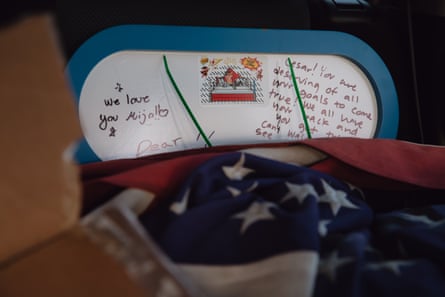
In the back seat of his car, a whiteboard filled with encouraging messages for Vasquez sits alongside an American flag.
Jennifer Chowdhury reported this story while participating in the USC Annenberg Center for Health Journalism’s Kristy Hammam Fund for Health Journalism




 Cesar Vasquez, who has supported families of undocumented immigrants since age 14, has become a community lifeline – and a known ICE target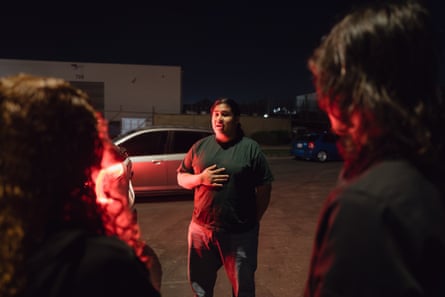


 Scottie's Playtime