
Reform-led Durham council cut off funding to the annual Pride celebrations.
— Trades Union Congress (@The_TUC) May 26, 2026
So trade unions launched a fundraiser to save it, eventually raising more money than was cut.
Which means this year's Pride will be bigger than ever.
In the 1980s, the LGBT+ community raised thousands… pic.twitter.com/M2BYBrD6uC
Category: Vote / Voting
Open Windows,Clay Jones
White House Dementia
Did you hear about the nut job at the White House who believed he was Jesus Christ?
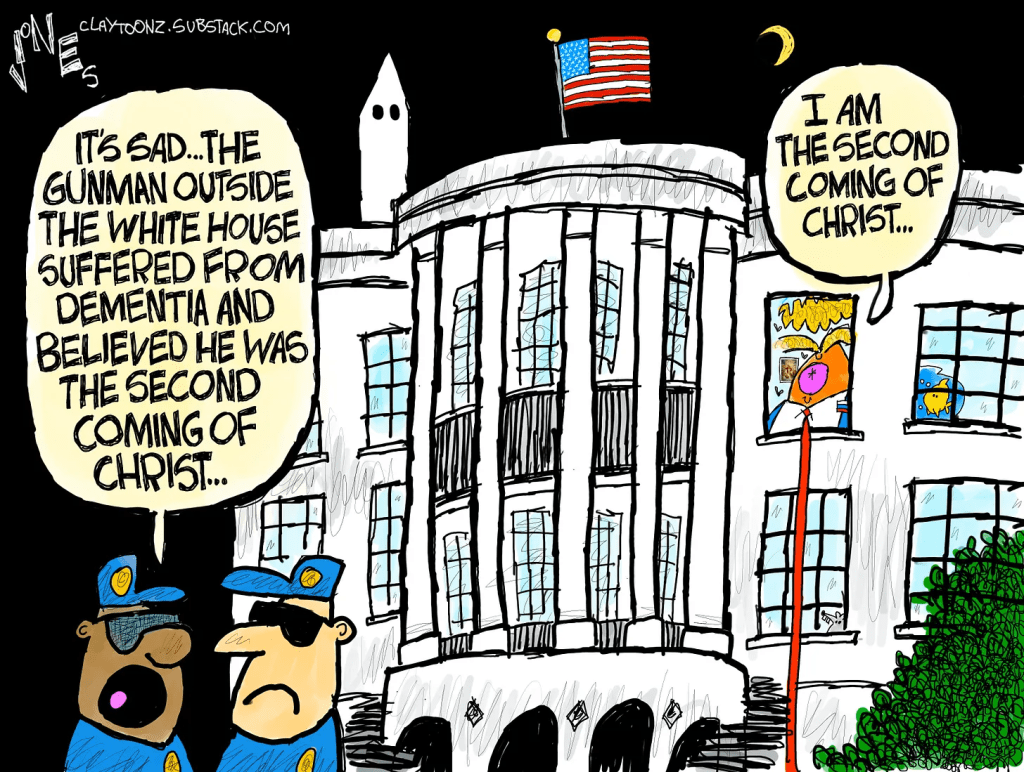
Last Saturday, Nasire Best, a 21-year-old man from Maryland, approached a White House checkpoint near 17th Street and Pennsylvania Avenue NW shortly after 6 p.m. ET, pulled a gun from a bag, and opened fire on Secret Service officers. Officers returned fire, striking Best, who was taken to a hospital and later died.
According to a July 2025 D.C. Superior Court filing, Best was previously “known to the United States Secret Service” around the White House complex. According to the court filing, Best walked into a restricted area at a White House pedestrian access control post, ignored commands to stop, and “claimed he was Jesus Christ and that he wanted to get arrested.” He was arrested on an unlawful entry charge in that incident.
The filing said Best interacted with the Secret Service, walking around the White House complex and asking how to gain access at various entry posts. It also said he had been involuntarily committed in June 2025 after obstructing vehicle entry to the White House complex. (snip-MORE)
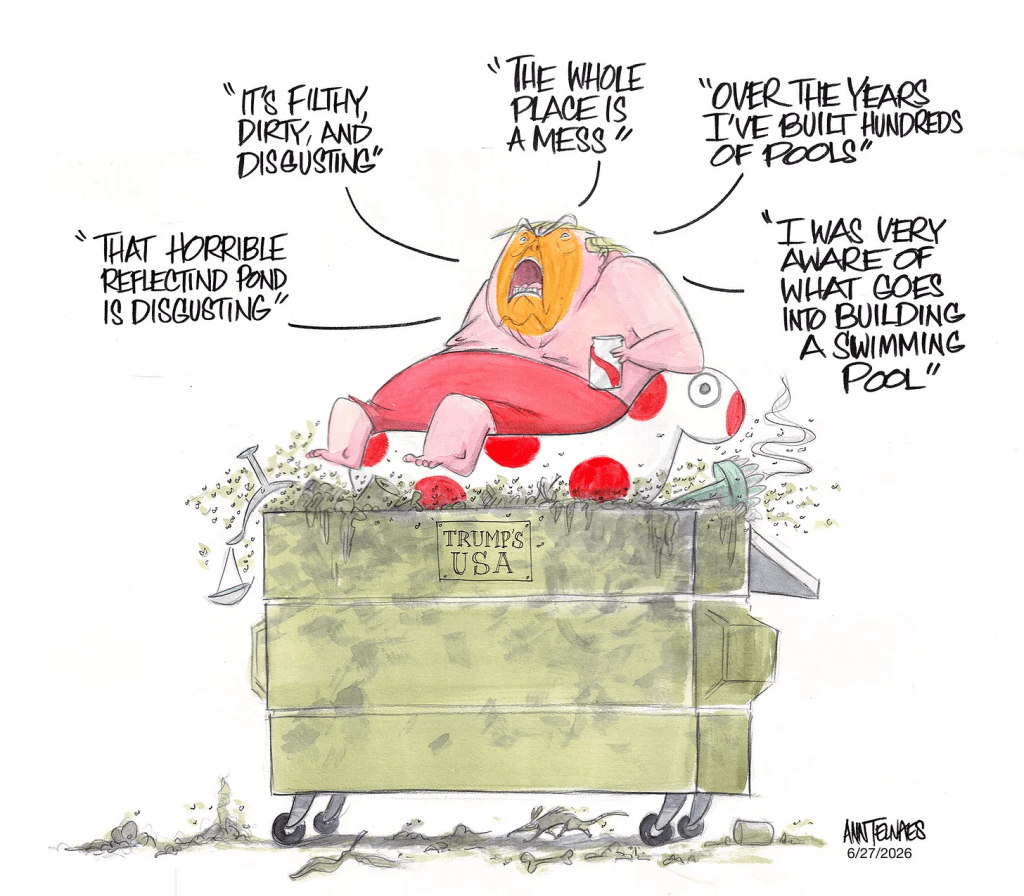
Trump and the Lincoln Memorial Reflecting Pool
Trump brags about all the pools he’s built
During this morning’s Cabinet meeting, Trump drones on and on about how he’s done such a spectacular job fixing the Reflecting Pool.
Data Centers
Doesn’t everyone love a data center?
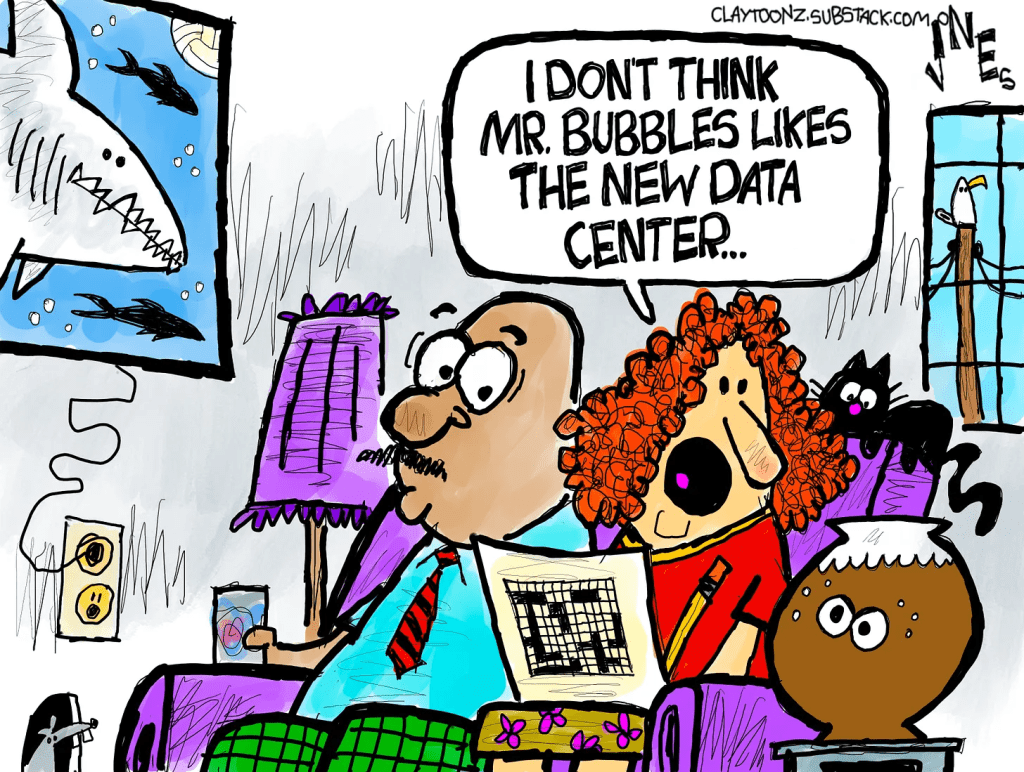
There are over 5,381 data centers in the United States, which is more than the rest of the planet. And the state with the most data centers is Virginia. Oddly enough, my voice dictation wrote “data sinners” instead of “data centers.” That’s not far off.
Data centers pollute and are bad for the environment. They drain water resources. They raise energy costs for the average consumer. They bring noise pollution. They occupy vast amounts of land. A single hyperscale data center can consume as much electricity as 100,000 homes. And city governments love them because they bring in revenue. What they don’t bring are a large number of jobs.
In Virginia, the General Assembly is threatened with a government shutdown over tax breaks for data centers. The state offers over $2 billion in tax breaks to these technological warehouses, and some senators believe that they don’t need them. They don’t. Even though most positive spin and gaslighting for data centers comes from right-wing think tanks like the Goldwater Institute (which is like arguing why you want a nuclear power plant in your backyard), the argument in the Virginia General Assembly isn’t partisan. Democrats are in control, and they’re arguing about this with themselves. (snip-MORE)
Eat Mor Cornyn
From one indicted, impeached, adultering, corrupt individual to another
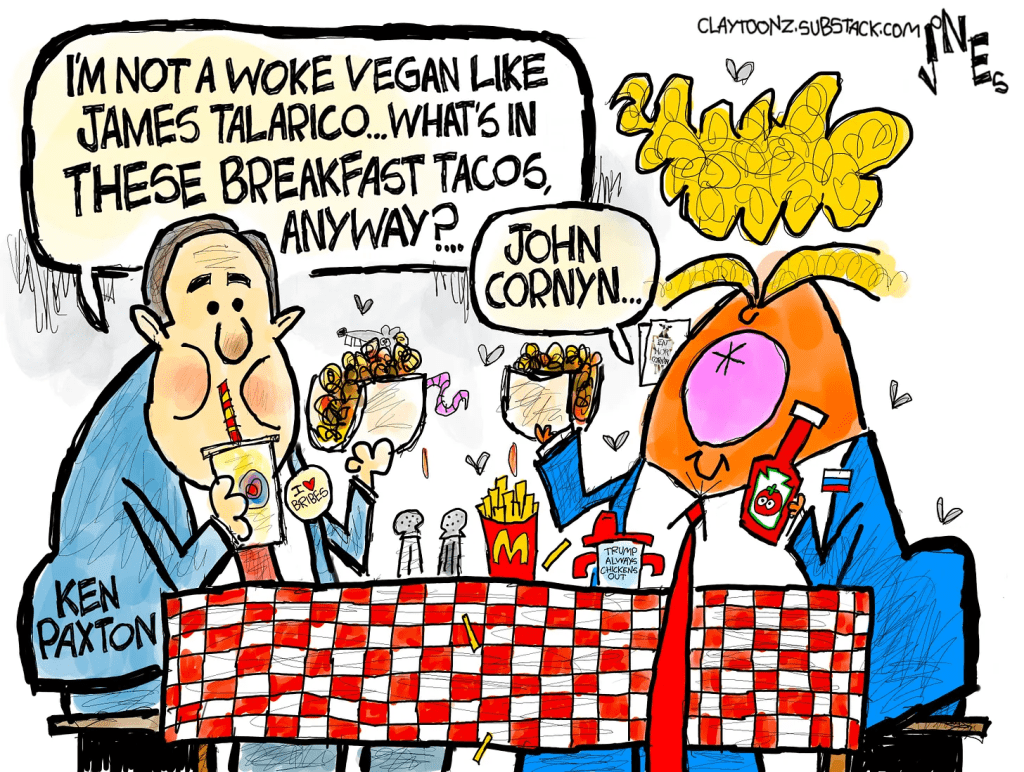
I have been drawing cartoons about Texas Attorney General Ken Paxton since at least 2020, as you can see here, when he filed a lawsuit challenging Pennsylvania’s electoral vote for Joe Biden. Did I mention that he’s the Attorney General for Texas, not Pennsylvania?
I did a cartoon about him in 2022 when he hid behind his wife from process servers. The reason he’s being served so much is that he is a criminal. Of course, this was before he was caught cheating on his wife.
One of my favorite cartoons about Paxton was drawn during his impeachment trial in 2023. Yes, he was impeached because of his corruption, but the Texas Senate saved his tiny corrupt balls. The party that impeached him was his own, Republicans. (snip-MORE)
That Public Notice About NDA’s for Government Workers:
We have 29 more days to make our views known in regard to the executive wishing all federal workers to sign a very broad NDA. This will crush transparency and notice of abuse, and there will likely be no more whistleblowing.
Anyway, here it is, along with the link so we can make our comments (of course it is not hyperlinked on the page, we need to copy it and paste it into our browser. WP has made it a live link in this post, but it doesn’t work.) It’s our duty and a right we still have; if we do not use it, we will most certainly use it. I found out about this yesterday on MPS’s post; it just took me a bit to get to this.
You can find this here. (This hyperlink is good; I made it myself and it works.) It is a .pdf. The NDA notice begins in the lower right-hand column.
From within the public notice, here is the info for submitting our comments:
ADDRESSES: You may submit comments
using the Federal eRulemaking Portal at
https://www.regulations.gov. Follow the
instructions for sending comments.
The general policy for comments and
other submissions from members of the
public is to make these submissions
available for public viewing at https://
http://www.regulations.gov without change,
and including any personal identifiers
or contact information. Before finalizing
the NDA, OPM will consider all
comments received on or before the
closing date for comments. OPM may
make changes to the NDA after
considering the comments received.
And a little more:
Request for Comment
OPM welcomes public comments on
all aspects of the draft NDA, including
whether the Privacy Act statement’s
description of the authority, principal
purposes, routine uses, and effects
provide sufficient notice to employees.
The draft NDA is available in the docket
for this notice on regulations.gov. See
https://www.regulations.gov/document/
OPM-2026-0100-0003. OPM specifically
requests comment on the following
issues.
- What scope of information should
be covered by the NDA? Should it cover
only unclassified information? How do
you understand the terms confidential
and confidentiality in the context of this
NDA? What customization of the NDA,
if any, may be necessary for agencies to
ensure it covers the appropriate
information? - Does the NDA clearly communicate
the types of information that would be
subject to non-disclosure requirements?
If not, how could OPM better describe
what information can or cannot be
disclosed to ensure employees have
appropriate notice of their
responsibilities? - Are there other statutes to which
OPM should cite in Appendix A of the
NDA when describing the nondisclosure
requirements applicable to individuals
working for or on behalf of the Federal
government? - Do you have suggestions regarding
the layout or formatting of the NDA? - Does the Privacy Act statement in
the NDA provide sufficient notice to
employees of the authorities, principal purposes, routine uses, and effects of - the form?
- Does the OPM/GOVT–1 system of
records notice provide sufficient notice
that the government-wide system of
records would maintain records related
to the signing of, or failure to sign, the
NDA? - What are the appropriate actions, if
any, for agencies to consider taking if
existing employees choose not to sign
the NDA? - What are the appropriate actions, if
any, for agencies to consider taking if
new employees choose not to sign the
NDA? - Does the NDA clearly communicate
the potential consequences of refusal to
sign the form for both existing and new
employees, along with whether signing
the form is voluntary or mandatory? - What else should OPM consider
with regard to the NDA??
OPM will consider comments
received before finalizing the NDA.
There are several other things there, if you have some time and want to see what the exec is doing besides trying to hide all they do and finally/fully cut off our representation, even as we are taxed for government work. I don’t believe we can let this slide, but maybe that’s only me. Anyway, if you also don’t like this, please go, read the bit, and write what your conscience tells you. I’m certain you will not be alone in doing so. The thing is, our government, for which we all pay, is not a business. The only parts that should not be public are those that actually shield the actual security of the country, things such as when we go after Osama Bin Laden, and locations of items that other countries might like to drone. There should be no covering of regular day-to-day government business-that is our business and we have the right to know.
Go Figure-Did They Cheat?
Maine Trans Sports/Bathroom Ban Referendum Invalid Over Signature Forgery Concerns And Improper Gathering
The initiative was funded by billionaire anti-trans donor, Richard Uihlein, and used out-of-state paid signature gatherers.
On Tuesday, Maine Secretary of State Shenna Bellows ruled that a proposed ballot initiative banning trans students from school sports and bathrooms will not appear before voters this November. The billionaire-funded campaign initially submitted 79,692 signatures—well over the 67,682 required to qualify—and the Secretary of State’s office certified the question for the ballot in March. But indications soon emerged that the signature-gathering process was riddled with improper procedures and, in at least one documented case and potentially many others, outright forgery. After a court remand, an evidentiary hearing, and a sworn-testimony review of the petitions, 12,542 signatures were invalidated, leaving the campaign 532 short of the threshold. Barring an appeal—which is likely though its success is far from certain—transgender students in Maine can rest a little easier this election cycle.
The infractions are striking. One out-of-state circulator left his petition forms unattended at a Topsham polling place on Election Day—twice—allowing voters to sign without a witness present, in direct violation of Maine law. Another circulator did the same at a Saco polling place, leaving her table for extended periods while crowds of voters signed unwitnessed petitions. When asked under oath whether she had destroyed the unwitnessed forms as required, she said yes—but a photograph submitted into evidence showed one of those forms was in fact turned in for validation. Most troubling of all, an out-of-state signature gatherer paid per signature submitted forms that appear to contain outright forgeries: one voter listed on her petition testified under oath that she had never signed it and had never even heard of the initiative. After the Oxford town clerk flagged additional suspicious signatures, an Elections Division review compared every name on the circulator’s forms against voter registration applications—and concluded that every single one of her validated signatures should have been thrown out as signed by another person.
Based on the evidence, Bellows ruled Tuesday that the initiative had failed to qualify for the November ballot. The decision marked a reversal of her own March certification, when her office initially determined that the petition contained enough valid signatures to move forward. That earlier ruling was challenged in Cumberland County Superior Court by three Maine voters, who alleged that thousands of signatures had been collected in violation of state law. In April, Justice Deborah Cashman agreed that the original review had been incomplete and remanded the case back to the Secretary of State’s office for further factfinding, ordering a new determination of validity within thirty days. That process produced the May 12 evidentiary hearing—where witnesses, including town clerks and voters whose names appeared on petitions, testified under oath—and ultimately the decision invalidating thousands more signatures than the initial review had caught. Bellows adopted that recommendation in full.
The initiative would have done far more than what its sports-focused branding suggested. It would have defined a person’s sex for school purposes as “a person’s biological status as male or female recorded at birth on the person’s original birth certificate”—a definition that would have stripped transgender students of legal recognition in Maine schools. It would have required public schools to “maintain separate restrooms, locker rooms, shower rooms, and other private spaces for each sex,” extending the ban well beyond athletics and into every gendered space in a school building. It would have created a private right of action allowing any student to sue their school for “direct injury” suffered from a violation of the act, effectively turning every transgender student’s presence in a bathroom or on a sports team into potential litigation. And it would have specifically carved transgender students out of the Maine Human Rights Act.
The anti-trans signature drive was not a grassroots effort. It was bankrolled by Illinois billionaire Richard Uihlein, the co-founder of Uline office supplies, who donated $800,000 to fund the entire effort. Uihlein has given more than $250 million to political causes since 2016, and is a major funder of the American Principles Project, which routinely spends tens of millions on anti-trans campaign ads during election years. He is not alone: an independent analysis published by Atmos and HEATED found that 80% of 45 major anti-trans organizations in the U.S. have received funding from fossil fuel companies or billionaires. The Maine initiative was part of that broader pattern—an attempt by a small handful of extraordinarily wealthy donors to use direct democracy as a workaround in states where elected legislatures have refused to engage in anti-trans legislation.
The decision was greeted with relief by the LGBTQ+ coalition that has fought the initiative since the day it was filed. “Maine has strict rules in place to protect the integrity of our elections and our system of direct democracy. The paid, out-of-state signature gathers and the billionaire who paid to try to put this question on the ballot failed to follow the rules,” said David Farmer, campaign manager for the Campaign for Free and Fair Schools, the coalition led by EqualityMaine, GLAD Law, and the Maine Women’s Lobby. “We believe that the appeals process and the reviews by the Secretary of State are working as the law intends. They are protecting the integrity of our elections.”
The Maine ruling is not the end of fight. Similar billionaire-backed initiatives have been certified for the November ballot in Washington and Colorado, where voters will decide whether to bar transgender students from sports as well as medical care restrictions. Both efforts are also funded by conservative megadonors, and both are part of the same strategy that produced the Maine initiative: use ballot initiatives to roll back trans rights in states whose elected legislatures have refused to do so. The Maine anti-trans campaign is expected appeal Bellows’ decision to Maine Superior Court within the ten-day window the law allows.
Your Josh Day, Next Day!
Weekly Skews With Trae
Remember A Couple Of Weeks Ago,
the story about brands trying to disalign themselves from the results of the politics they support a little heartier than they do the other side? Well, here are legislators working on the same thing, again, and if the companies do it, it could work. We’ve been saying we need this for a couple of years, at least. It would be a good time for we the people to increase our pressure on companies, as well.
Congressional Black Caucus presses companies in the US to oppose Republican redistricting push
By MATT BROWNUpdated 11:27 AM CDT, May 26, 2026
WASHINGTON (AP) — The Congressional Black Caucus on Tuesday called on major corporations across the U.S., including those that previously expressed support for voting rights and racial justice, to oppose redistricting efforts by Republican-led states that seek to eliminate majority-Black U.S. House districts.
In a letter sent to more than 250 companies, members of the Black Caucus urge them to condemn the redistricting efforts, which the lawmakers describe as “coordinated efforts to silence Black voices at the ballot box.” Some of the companies had co-signed their own message to Congress five years ago urging lawmakers to pass the John Lewis Voting Rights Act, a Democratic proposal to restore and update the Voting Rights Act.
That 2021 coalition, Business for Voting Rights, was backed by many of the country’s most valuable and influential companies, including Apple, Amazon, Google, Meta, Microsoft, Tesla, Salesforce, Target, PayPal, Intel and Starbucks.
Tuesday’s letter is the latest effort by the Congressional Black Caucus and its allies to gather support for preventing more Republican-led states from redrawing their legislative maps in ways that would dilute Black political representation. Several states have moved to eliminate congressional districts represented by Black Democratic lawmakers after a U.S. Supreme Court ruling last month that severely weakened a key provision of the Voting Rights Act.
“Corporations that have profited from Black consumers, relied on Black workers, and amassed wealth in part from Black communities cannot look away while Black political power is dismantled in plain sight,” Rep. Yvette Clarke, chair of the Black Caucus, said in an interview.
Clarke described the letter as “putting corporate America on notice,” but she said the caucus was not seeking an adversarial relationship with corporations. Among those receiving Tuesday’s letter were companies based overseas that have a significant presence in the U.S.
The caucus last week called for Black athletes to boycott public universities in states that are gerrymandering their congressional maps to eliminate districts held by Black lawmakers. The 59-member Congressional Black Caucus consists entirely of Democrats, including more than a third from Southern states.
Some lawmakers have said mass protests and federal legislation might be necessary to undo the efforts underway in Republican-led states. Any new federal voting rights law would almost certainly require Democrats to secure majorities in both chambers of Congress and win the presidency.
It is unclear how companies will respond to the demands. The Associated Press reached out for comment to dozens of companies that were sent a letter by the caucus, but has not recieved a response.
“Many companies that previously issued statements after the murder of George Floyd, pledged billions toward racial equity initiatives, and spoke forcefully in defense of democracy following January 6 now face a defining test of whether those commitments were rooted in principle or convenience,” the caucus’ letter states.
It also represents the latest instance of the caucus expressing frustrations with corporate America. A 2024 Black Caucus report noted that lawmakers were “troubled that some corporations that made pledges in 2020 have taken several steps in the opposite direction,” such as rolling back or failing to follow through on pledges to diversify their workforces.
“We understand who the occupant in the White House is and the reality of Republicans being in charge,” Democratic Rep. Steven Horsford of Nevada said of the caucus’ message. “But what corporate America also understands is that there will be a shift at some point.”
The letter calls on companies to publicly condemn the redistricting plans, meet with Black Caucus members to discuss corporate America’s role in protecting voting rights and disclose their political donations to Republican politicians in states that are redistricting their congressional maps.
President Donald Trump last year kicked off the unusual mid-decade round of congressional redistricting when he pushed Texas lawmakers to redraw their maps in a way that would add Republican seats. Democratic-led California responded, but it has been mostly Republican states redrawing their lines since as the party tries to maintain its majority in the U.S. House during this year’s midterm elections.
The effort was supercharged by the Supreme Court decision, which allowed even more Republican states to redraw congressional maps that previously had protected minority communities.
Horsford, who chaired the Black Caucus during President Joe Biden’s Democratic administration, said the caucus is demanding that companies “stand on the side of democracy, fairness and equal representation.”
“This is about power, who holds it and what it’s used for,” he said. “And when you’re diluting Black economic and political power, we need to know where these companies stand in this moment, and what side of history they’re on.”

DOJ v. Trans Kids’s Medical Care:
DOJ has escalated its attack on trans care for minors. Where could it be headed next?
As Rhode Island Hospital begins turning over documents to a far-right judge in Texas, a number of grand jury subpoenas have been issued and DOJ settled with one hospital.
Three weeks ago, on April 29, lawyers for Rhode Island Hospital responded to an email from a Justice Department lawyer in Washington, D.C., sent the day before, asking for a conference on next steps in addressing an outstanding administrative subpoena issued by DOJ to the hospital nearly a year earlier about its provision of gender-affirming care for transgender minors.
The next day, DOJ shifted tactics without even initially telling the hospital — going to court across the country to try and get an order enforcing the subpoena.
At least seven challenges to the invasive subpoenas had previously resulted in federal court rulings quashing the subpoenas or, at least, the parts of the subpoenas seeking identifiable patient information. In the wake of those losses — and as Acting Attorney General Todd Blanche took over the Justice Department — the strategy, as Law Dork has covered, began to shift to more aggressive tactics on multiple fronts.
The change has had at least one tangible effect already with regards to Rhode Island Hospital.
Beginning Tuesday night, at least some records responsive to the administrative subpoena were sent to a far-right federal judge in Texas who on Monday ordered the hospital to provide the records to him — although, for now, not to DOJ — while the hospital appeals his earlier ruling that the records need to be turned over to DOJ.
Any action on that earlier ruling, however, would appear to conflict with a later ruling from a federal judge in Rhode Island quashing the subpoena in full and barring DOJ from receiving any such records from the hospital — although the U.S. Court of Appeals for the First Circuit late Tuesday denied a request to take further action immediately to enforce that order.
This latest dispute, which has now involved four courts across the country, as well as related discussions in court filings and before a federal judge in Rhode Island, serve as a warning for transgender people, their allies, and the parents of trans kids about how aggressively the Trump administration is acting to advance President Donald Trump’s anti-trans policies and then-Attorney General Pam Bondi’s implementation of them — and where the administration could be going next in this attack.
That April 28 DOJ email to Rhode Island Hospital’s lawyers — in which David Gunn, a DOJ lawyer, referenced having been out of office for the past few weeks before asking for a conference to discuss the subpoena production — was a DOJ response to a February 4 email from lawyers from the hospital.
The hospital’s lawyer responded simply the next day: “We are happy to connect. Would Monday of next week work?”
The conference never happened because, on April 30, DOJ went to a friendly forum for them in the Northern District of Texas seeking to enforce the administrative subpoena, which, to be clear, was issued in D.C. to a Rhode Island entity. Going there meant the case had a good chance of and was, in fact, assigned to U.S. District Judge Reed O’Connor, a far-right judge with a history of anti-LGBTQ rulings.
Within hours, and before the hospital even had a chance to file any response, O’Connor granted the request — ordering the hospital to turn over the records within two weeks.
Over the past three weeks, there have been daily developments — and often multiple developments — shining an alarming light on what is happening.
Grand jury subpoenas
In addition to the order to enforce the subpoena in the Northern District of Texas, one of the two other most significant other development was the news — acknowledged by NYU Langone Health in accordance with New York law on May 11 — that it had received a grand jury subpoena for similar records that was issued in the Northern District of Texas.
Ethan Womble is listed as the person who sought the grand jury subpoena. He is, as of last month, an Assistant U.S. Attorney in the Northern District of Texas. (He was previously listed — as recently as February — as a trial attorney in the DOJ Criminal Division’s Fraud Section, although that health care fraud work does appear to have been based out of Texas.)
Womble and Ryan Raybould, the U.S. Attorney for the Northern District of Texas, were the only two lawyers on the DOJ petition to enforce the Rhode Island Hospital subpoena. They are both former O’Connor clerks.
The grand jury subpoena — which does not require judicial approval — was received by NYU Langone on May 7 (although dated May 6), and the date for compliance is June 10.
There is also evidence that other grand jury subpoenas were issued. In addition to NYU Langone stating that it was “one of several institutions that received a grand jury subpoena,” Law Dork previously reported that DOJ’s decision to withdraw its appeal of one of its administrative subpoena losses — as to Children’s Hospital of Philadelphia (CHOP) — came the same date that the NYU Langone grand jury subpoena was issued.
In a filing later on May 6 before the district court that had heard and granted the Philadelphia hospital’s initial request, the lawyers for CHOP were direct:
Just this morning, DOJ attorneys reached out to counsel for CHOP indicating that DOJ intended to dismiss its appeal, which has been proceeding in the Third Circuit since January and in which DOJ’s brief was due today. That development, along with DOJ’s unexplained effort to compel compliance by a Rhode Island hospital in the Northern District of Texas, suggest that DOJ may seek to end-run this Court’s jurisdiction over additional issues that arise involving the Subpoena.
Unlike the administrative subpoenas, which were challenged in the locations where the hospitals were located, challenges to the grand jury subpoena(s) would generally be in the Northern District of Texas — although lawyers will be looking for other paths.
It also should be noted that it is not yet clear what, if any, action beyond the issuance of the grand jury subpoenas has actually happened in the Northern District of Texas.
The Texas Children’s Hospital settlments
The grand jury subpoenas aren’t the only new development.
On May 15, DOJ announced it had reached a “resolution” with Texas Children’s Hospital in conjunction with a long-running investigation against the hospital by the Texas Attorney General’s Office.
Although DOJ presented the development as “the first resolution secured under the Department’s ongoing national investigation into violations of federal law in connection with” provision of gender-affirming medical care for transgender minors, Texas Attorney General Paxton only mentioned DOJ in one sentence and instead stated, “After a years-long investigation by the Healthcare Program Enforcement Division, Attorney General Paxton has negotiated a historic settlement that will help protect Texans.“ DOJ does cite agreements reached by the hospital with both federal and Texas governments.
In addition to ending the provision of such care, Paxton’s news release stated that Texas Children’s Hospital has agreed to “the creation of the country’s first-ever Detransition Clinic” and “pay $10 million for billing Texas Medicaid for unallowable and illegal ‘gender-transition’ interventions, including by using false diagnosis codes.“
In the DOJ news release, which only quotes Main Justice senior officials from D.C., it noted, “These matters and the investigations into sex-rejecting procedures (sic) on minors are being led by the Justice Department’s Civil Division Enforcement and Affirmative Litigation Branch and Commercial Litigation Branch, Fraud Section.”
There was no mention of the U.S. Attorney’s Office for the Northern District of Texas — or any district in Texas, for that matter — but the fact that the news releases are about a Texas hospital, DOJ’s release referenced what appears to be the same investigation at issue in both the administrative and grand jury subpoenas, and Texas’s release referenced one of the topics raised by DOJ in defending its subpoenas as allegedly supporting its investigation (improper billing codes) should not be glossed over.
For its part, Texas Children’s Hospital, in a statement to Law Dork, sounded a significantly different note than DOJ and Paxton’s office:
Over the last three years, we have cooperated fully with the Texas Attorney General and Department of Justice, navigating an unconscionable campaign of mistruths and mischaracterizations related to gender affirming care. We produced over 5 million documents and conducted multiple internal and external investigations. These efforts have required significant staff time and financial resources to defend ourselves. All reviews and investigations continue to support the facts – we have been compliant with all laws.
Today, we made the difficult decision to settle with the Texas Attorney General and the Department of Justice, closing a chapter that has been wrought with falsehoods and distractions. To be clear – we are settling to protect our resources from endless and costly litigation. This settlement will allow us to redirect those precious resources to focus on the life-saving care and groundbreaking discoveries of our exceptional clinicians and scientists.
Nonetheless, if DOJ proceeds with a grand jury investigation in the Northern District of Texas, these settlements could quickly become very relevant to DOJ’s claims.
What happened with Rhode Island Hospital
All of which brings us back to Rhode Island Hospital.
After O’Connor issued his initial order three weeks ago Thursday, the Rhode Island Child Advocate — responsible for oversight of children under the care of Rhode Island’s youth services — sought to quash the subpoena in Rhode Island.
U.S. District Judge Mary McElroy, a Trump appointee who had initially been nominated during the Obama administration, was assigned the matter. She denied DOJ’s initial request to move the matter to O’Connor and set a quick timeline for consideration of the request.
The hospital, meanwhile, sought to stay O’Connor’s order — first before O’Connor and then at the U.S. Court of Appeals for the Fifth Circuit. (Both were denied.) The hospital also joined the Rhode Island Child Advocate’s request, intervening and filing its own motion to quash the subpoena.
On May 12, McElroy held an explosive hearing — accusing DOJ of having misled the hospital; the court in Texas; as well as, potentially, the court in Rhode Island.
Highlighting the incredibly invasive plans potentially involved in DOJ’s effort, McElroy told the relatively new DOJ lawyer before her, Brantley Mayers, counsel to the Assistant Attorney General, “[I]t is ridiculous to say that you’re going to find 14- and 15-year-olds who are undergoing gender reassignment or gender treatment and question them about what was told to them by their doctor. How invasive is that?”
An amicus brief submitted by Lambda Legal Defense and Education Fund addressed the improper ways DOJ is employing the Federal Food, Drug, and Cosmetic Act and other “healthcare offenses” to attempt to justify this investigation, but every judge has, again, found the effort to be an “improper purpose” under the laws at issue — or, at the least, the patient-specific documents requested not to have been appropriately sought.
Regarding the timing of the filing in Texas to enforce the Rhode Island Hospital administrative subpoena in conjunction with the emails earlier that week, McElroy told Mayers:
I take a very negative view to playing fast and loose by telling people one thing and filing other things with the court, and then taking the position like, oh, well, we didn’t tell you, but we did tell you afterwards. That is dirty pool, in my opinion, and the Department of Justice have willfully done that in this case.
Mayers had joined DOJ in November 2025 after three clerkships and with virtually no prior practice experience, a fact highlighted by McElroy, who repeatedly suggested that she believed the new lawyer was set up to defend the actions without having hardly any actual knowledge of the underlying investigation.
Sitting at his side, however, was Deputy Assistant Attorney General Jordan Campbell, a more senior Texas lawyer who joined DOJ in June 2025 after having co-founded a law firm that states it is “proudly seeking justice for the detransitioner community nationwide.“
Specifically as to the grand jury subpoena, which was discussed because NYU Langone’s statement had come out the day before, McElroy warned:
[T]he problem I’m having here is that it’s pretty clear to me that this was shopped to Texas, that’s fine, you have the right to investigate wherever you want, but these indictments that come out of Texas, if they ever come, because every person has signed an affidavit in this court and is going to be before me to explain it if they don’t.
Mayers insisted there were reasons for the investigation being in the Northern District of Texas — and acknowledged part of the content of a secret declaration that was filed ex parte (meaning just with the judge) in DOJ’s opposition to Rhode Island Hospital’s request that O’Connor stay his order enforcing the subpoena.
This secret declaration from Lisa Hsiao, the acting director of the Enforcement & Affirmative Litigation Branch — who has filed declarations in most if not all of DOJ’s efforts defending the administrative subpoenas and which have drawn questions previously — was later provided to McElroy as well. Of that, Mayers acknowledged:
[H]ere were many reasons why the investigation is being carried on in the Northern District of Texas. As the affidavit that you received yesterday ex parte indicates, there are potential targets, potential witnesses there.
The reference to “potential targets” of the investigation being in the Northern District of Texas appears to be a significant piece of information as that proceeds.
In any event, the next evening, on May 13, McElroy issued her ruling, quashing the administrative subpoena in full and blocking DOJ from receiving the requested documents. She also repeatedly questioned DOJ’s actions in the opinion, writing at one point that “the discrepancy between the honorable conduct expected of federal prosecutors and DOJ’s tactics in this case is unsettling.”
DOJ, however, did not let it go — appealing the order the next day and informing O’Connor of the ruling. O’Connor, on May 15, ordered an in-person hearing in Texas on May 18.
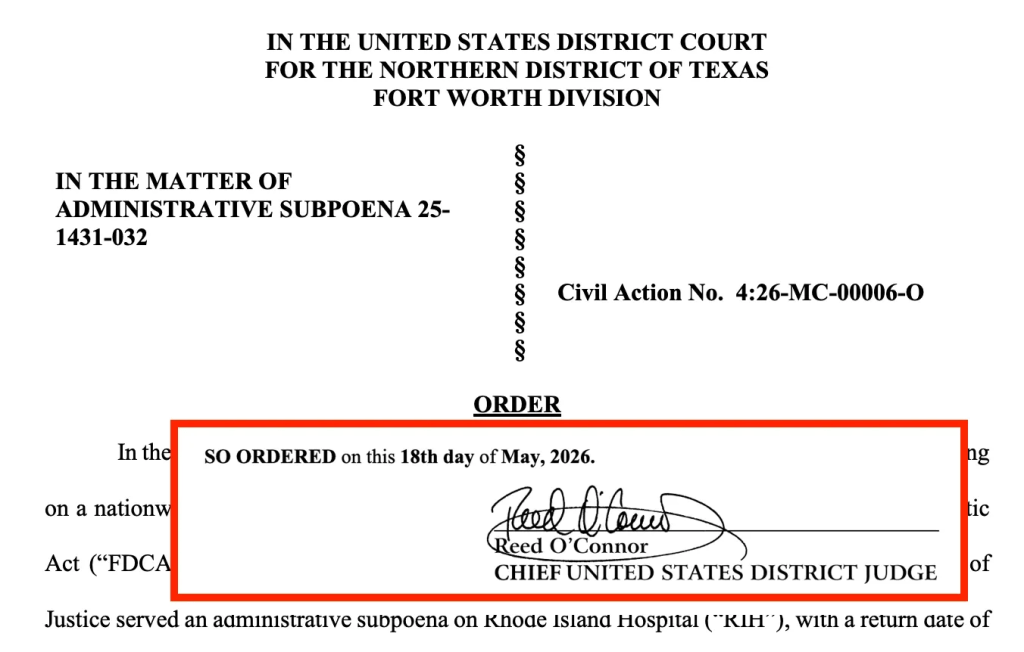
Following that hearing came the May 18 order from O’Connor, concluding that “RIH has also sought to circumvent the authority of this Court and the Fifth Circuit and attempted to collaterally attack the Enforcement Order“ and ordering the hospital to turn over to the court “all materials that it would have turned over to the Government in compliance with this Court’s Enforcement Order“ on the condition that the materials would be “secured and held in camera, inaccessible to the Government for the pendency of the appeals.“
Additionally, O’Connor — responding to his conclusion about the alleged circumvention — purported to bar Rhode Island Hospital from seeking relief from his order in any court aside from his court, the Fifth Circuit, or the U.S. Supreme Court and from “cooperat[ing] with others in seeking relief“ from his order.
The First Circuit
That led to one last effort to hold things off, with the Rhode Island Child Advocate filing a motion in the First Circuit — where DOJ had appealed McElroy’s order — on May 19 seeking an injunction ordering Rhode Island Hospital “not to produce patient-identifying information or protected health information” in response to the administrative subpoena “to any person or entity pending resolution of this appeal or until further order of this Court.”
DOJ opposed the request, and later highlighted the fact that, in Rhode Island Hospital’s notice about its production, “RIH represents that, ‘[t]o the extent that records RIH intends to produce contain any patient information, RIH will anonymize and de-identify this information.’“ DOJ stated that “RIH’s stated plan to anonymize any documents filed in the Northern District of Texas today further undercuts the Child Advocate’s claim of imminent irreparable harm.“
In a short order issued a few hours later, the First Circuit essentially agreed, denying Rhode Island Child Advocate’s request because, the court stated, “We detect no such irreparable injury.“
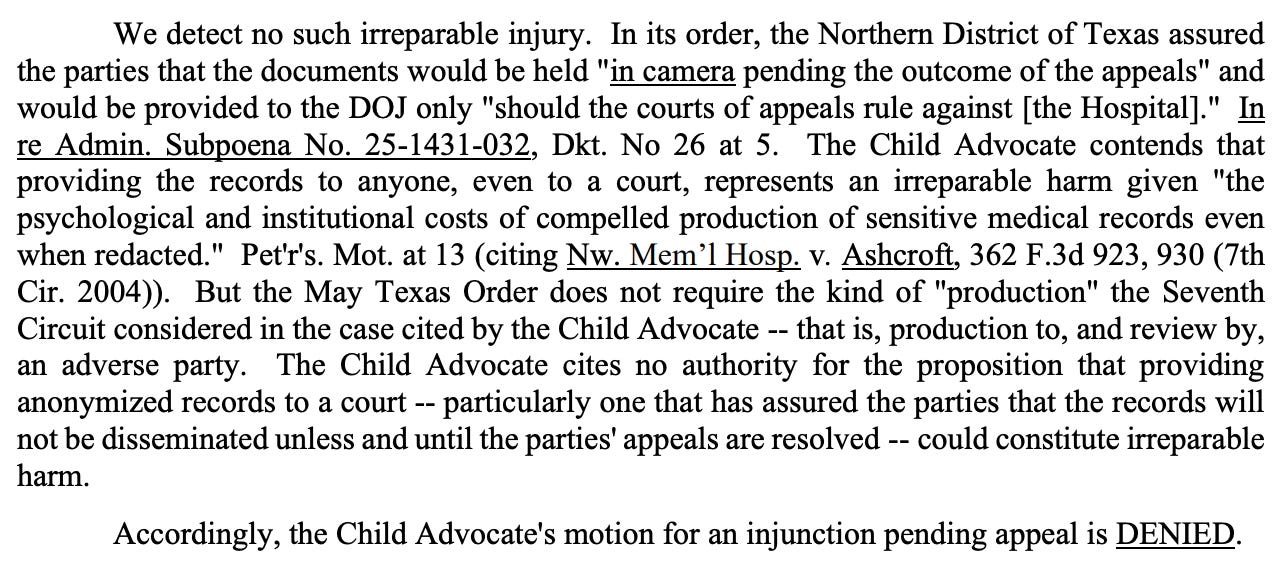
The panel consisted of Judges Gustavo Gelpí and Lara Montecalvo, both Biden appointees, and Judge Joshua Dunlap, a Trump appointee who took the bench in 2025.
Notably, Dunlap issued a concurring opinion, highlighting “additional concerns regarding the request for an injunction pending appeal“ — including, he wrote, “serious questions about the merits of the district court’s decision.” This is contrary to the seven other federal judges to have ruled on the question and was an aside, but it is nonetheless notable coming from the one Republican appointee on the First Circuit.
The bigger problem, however, with the First Circuit’s ruling is what was missing.
The paragraph highlighted above seems to run counter to and with an almost blind ignorance to all that McElroy got on the record in her May 12 hearing.
This is a situation where DOJ has questionably, and without providing public evidence, claimed that it has moved an investigation to the Northern District of Texas, justifying invoking the court’s jurisdiction there to enforce an administrative subpoena issued many months before the investigation had a connection to the district and against an entity across the nation that had been in discussion with DOJ the day before the enforcement action was filed. Then, a far-right judge there granted the request sought by his former clerks and now has ordered the hospital to provide him with the information that every other judge has decided medical providers should not need to provide.
No awareness of that reality comes through in the First Circuit’s order. Although the caveats in the order do mean that renewed requests could follow and it certainly means nothing as to the hospital or Rhode Island Child Advocate’s chances on appeal in quashing the subpoena (Dunlap’s concurrence aside), the First Circuit’s presumption of regularity is particularly ill-suited here.
As McElroy wrote specifically in her order, quoting an Oregon colleague:
The Court cannot help but share the sentiment that “[t]he presumption of regularity that has previously been extended to [DOJ] that it could be taken at its word—with little doubt about its intentions and stated purposes—no longer holds.” United States v. Oregon, No. 6:25-CV-01666-MTK, 2026 WL 318402, at *11 (D. Or. Feb. 5, 2026). It is regrettable that this is now the case.
As DOJ continues with these escalations of its attacks on trans people — and the provision of medical care specifically — courts need to keep their eyes opened to the reality as McElroy saw and detailed it, not to the image of courts as they would wish things to be.
Law Dork covers LGBTQ legal developments in depth. Consider becoming a free or paid subscriber.
Been Wondering About Kat Abughazaleh? Here Is News:
Kat Abughazaleh shows us how to fight fascists
Q+A with one of the Broadview Six, who had all charges dropped against them after grand jury misconduct.
Marisa Kabas
For the last seven months, Kat Abughazaleh wasn’t allowed to go to Alaska. It’s not that she had any particular reason to, but being under felony indictment meant that she was only allowed to travel throughout the lower 48 United States. And forget leaving the country. But on Thursday, those restrictions were suddenly lifted when all charges against her were dropped.
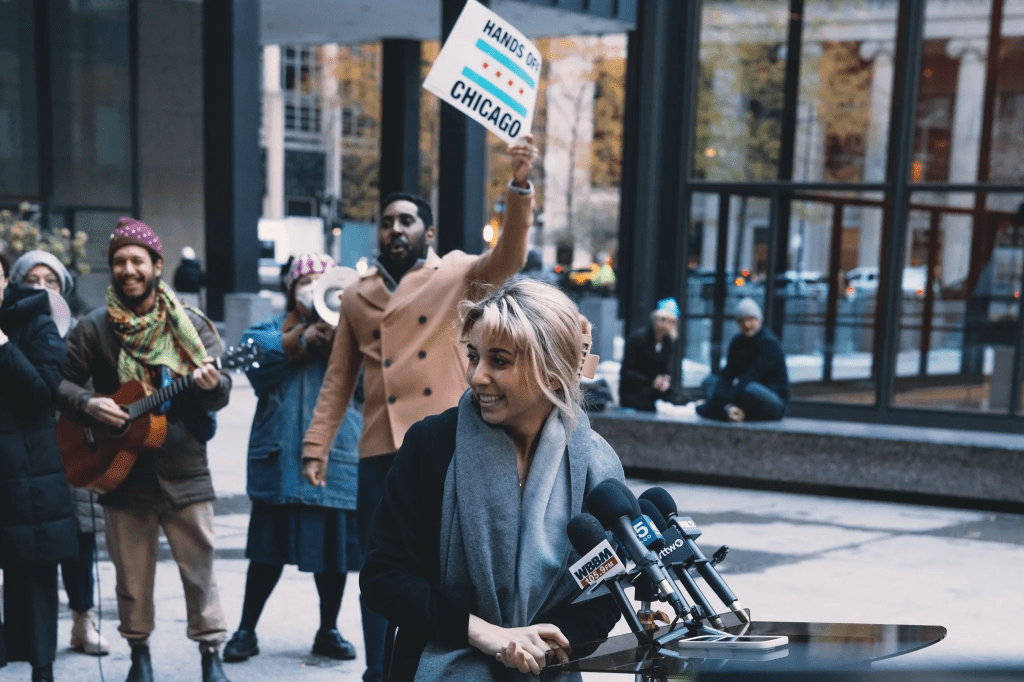
Abughazaleh, 27, woke up Friday a free woman. The former Illinois congressional candidate was charged in October along with five others for conspiring to impede an officer near the Broadview ICE facility just outside of Chicago. In reality, Abughazaleh and her co-defendants were there to protest the federal government’s increasingly public cruelty and the human rights abuses happening inside Broadview specifically, and broadly by ICE. The Trump administration, not surprisingly, did not appreciate their very public pushback and responded with brutality and violence. But with all charges against them now dropped, the only thing they’re an example of is why fighting fascists is good.
With the trial scheduled to begin just after Memorial Day, US district judge April Perry called an emergency hearing Thursday to discuss missing pieces of the trasncript from the grand jury proceedings where DOJ lawyers convinced jurors to indict Abughazaleh, her campaign field director Andre Martin, Michael Rabbitt, Brian Straw and two others who had the charges against them dropped earlier.
The case was already on the decline, with prosecutors dropping the felony charges against the remaining four in April as questions about the grand jury transcripts popped up. They still faced a full trial on misdemeanor charges and up to one year in jail. But Judge Perry ruled the DOJ’s handling of the grand jury and subsequent redactions constituted grave misconduct, making it impossible to move forward.
I spoke with Abughazaleh by phone Friday morning about right wing fuckery, ridiculous rumors, and how she plans to reclaim her life after the federal government tried to destroy it. Our conversation has been edited and condensed for clarity.
MARISA KABAS, THE HANDBASKET: How did it feel waking up this morning?
KAT ABUGHAZALEH: I had to get up at like 5am to go on Morning Joe, but I woke up and I was like, oh yeah, I don’t have to go to trial this week—which is not a statement I thought I’d have to say ever in my life.
KABAS: Walk us through what you thought the next week or so was supposed to be like before yesterday’s hearing.
ABUGHAZALEH: I was supposed to have not just trial prep with my lawyers, but having to get my clothes dry cleaned. Going to get a manicure because my nails always always look awful. I spent way too long at a Nordstrom Rack picking out shoes that I thought looked fashionable but also modest and wouldn’t make jurors think I was a bitch. On Tuesday we were supposed to have jury selection. On Wednesday we were supposed to have opening arguments, which is a shame that we don’t get to hear our lawyers spit absolute fire. But yeah, it’s nice not to do it in the first place.
KABAS: Absolutely. So what do you think you’re gonna do instead?
ABUGHAZALEH: I have a 12-hour live stream tomorrow to raise money for our legal funds because, despite not having to go to trial, we’re still picking up the pieces of our lives both emotionally and financially. Every single one of us as co-defendants, we have very real fears of bankruptcy and being in debt for the rest of our lives because of this. And then, I don’t know, sleep a bunch. Get my passport renewed, something that I couldn’t do for the last seven months. I couldn’t even go to Alaska.
KABAS: Are you serious? Could you go to Hawaii?
ABUGHAZALEH: No, just the lower 48. Couldn’t even go to Puerto Rico.
KABAS: So this has really restricted your movement as a human being for the last seven months.
ABUGHAZALEH: Yeah, and it’s something that’s really scary, especially as the government gets more and more aggressive, just being like, oh, you’re stuck here no matter what happens.
KABAS: So when did you get a sense that things might be changing this week?
ABUGHAZALEH: So we’ve been requesting to see the grand jury transcripts or just have the judge look at them for months. And ahead of trial Chris Parente—Brian Straw’s lawyer—just asked the judge, “Can you just look at the unredacted version?” And her understanding was that the redactions were referring to some IT issues, and the prosecution had never corrected her. So she looked at the unredacted transcript and then called a hearing the next morning. And it was sealed. Now the transcript is public.
She was saying “I’m not sure that the charge will get dismissed without prejudice because there’s not a lot of precedent for that, especially for a misdemeanor.” And then we broke for an hour for the government to talk it over, and then they came in. I remember one of my lawyers looking at me as one of the government’s lawyers [Andrew Boutros] started talking, and she just turns to me and says, “Congratulations.” And I went, “What?” And then Boutros said, “dismissed with prejudice.” [Meaning the case was permanently closed.] And it was just surreal. Absolutely surreal.
KABAS: Did you have a sense of where things were heading or were you totally shocked by the outcome?
ABUGHAZALEH: I truly did not think it would get dismissed yesterday. I did not want to get my hopes up. I thought that we were going to trial for sure, just because it’s very unusual to try a federal misdemeanor. I knew we would win in that case, but I was completely shocked.
KABAS: How do you think this will change or impact anti-ICE protests and prosecutions in the future?
ABUGHAZALEH: I hope that it does have impact. It was meant to intimidate us into silence, and none of us took a deal. None of us sold each other out (not that there was anything to sell each other out on.) But, you know, we were charged with conspiracy. We were facing like 10 years in prison.
(snip-there is MORE, but this is already a long post, and I’m a free subscriber to Handbasket, and don’t want to just lift their work. Click on through!)
Looking At The Week Ahead With Joyce Vance
The Week Ahead
May 24, 2026
It’s 1984 again.
We have read George Orwell since the beginning of Trump’s first administration. Studied him through the eyes of experts like Ruth Ben-Ghiat, whose scholarship is in the field of authoritarianism. But nothing makes his relevance as plain as living through history in 2026.
“Every record has been destroyed or falsified, every book rewritten, every picture has been repainted, every statue and street building has been renamed, every date has been altered. And the process is continuing day by day and minute by minute. History has stopped. Nothing exists except an endless present in which the Party is always right.”
― George Orwell, 1984
On Friday, NBC’s Ryan J. Reilly and Kyla Guilfoil reported that “The Justice Department has removed press releases detailing the charges against hundreds of individuals who participated in the Jan. 6, 2021 Capitol riot from its website.”
DOJ was not ashamed of the reporting on this development; instead, they responded to a tweet claiming they were “quietly” deleting the information by bragging:
Nothing “quiet” about it.
We are proud to reverse the DOJ’s weaponization under the Biden administration. We will do everything in our power to make whole those who were persecuted for political purposes. This includes stripping DOJ’s website of partisan propaganda.
As acting Attorney General Todd Blanche continues his long, slow audition to get the nomination for the permanent job, there is apparently no service the Justice Department he leads will refuse Donald Trump. That includes the effort Trump launched on day one of his second term in office to erase the insurrection. It began with the pardons of Rudy Giuliani and the fake slates of electors. As Ed Martin put it, “No MAGA left behind.” It went on to include virtually everyone who was present at or involved with the January 6 attack on the U.S. Capitol, including those charged with insurrection, some of whom received clemency because even Trump, apparently, didn’t believe he could get away with outright pardons.

Blanche was in place at DOJ as Pam Bondi’s number two, overseeing the firing of prosecutors and agents assigned to work cases and leads in the January 6 investigation. Then, as we discussed last week, he signed off on Trump’s $1.776 billion “anti-weaponization fund,” the repurposing of taxpayer dollars Congress allocated to DOJ’s judgment fund as reward payments to Trump friends and allies who “suffered weaponization and lawfare.”
Blanche declined to exclude even defendants convicted of violent offenses in connection with January 6 from eligibility for payment out of Trump’s slush fund. The crescendo of outrage that began with Democrats swelled to include a handful of Republicans. But not all of them. In a mark up meeting before they left town for Memorial Day, every Republican member voted against a measure proposed by California Democrat Mike Levin that would have excluded members of Congress from filing to receive a payout from the fund.
Lawsuits have been filed, and we will be watching to see how quickly the federal judiciary might move to block the payouts from going into effect. Among the lawsuits so far:
- A lawsuit filed by Citizens for Responsibility and Ethics in Washington (“CREW”), which alleges that “The Slush Fund is a jaw-dropping act of presidential corruption. And it is brazenly illegal. Unlike prior victim compensation funds, it was not authorized by Congress. Nor was the Fund the product of a judicially approved, arm’s length legal settlement.” The complaint is here.
- A lawsuit alleging that the “anti-weaponization” fund discriminates against a group of plaintiffs who were mistreated by Republican officials, because it only permits redress of conduct by the Biden administration. You can read the complaint here.
- A lawsuit filed by current and former Washington, D.C., police officers who defended the Capitol on January 6, arguing the plan should be enjoined because the payouts are illegal and could potentially finance violent insurrectionists and paramilitary groups. You can read the complaint here.
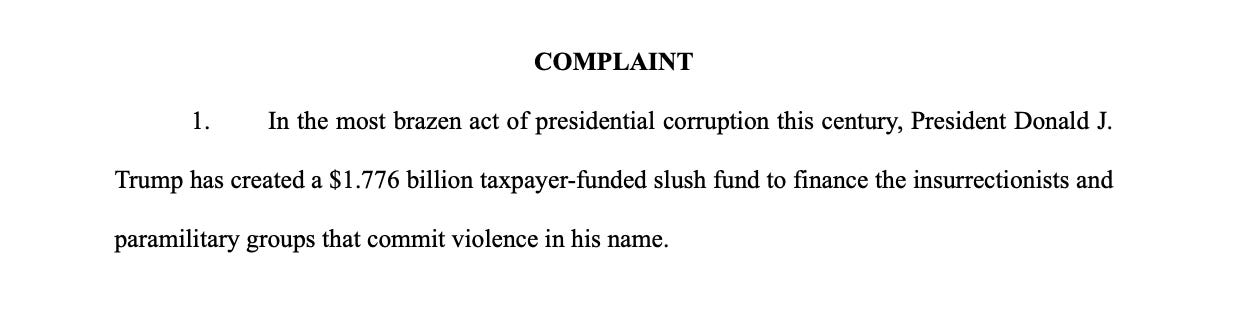
The success of Trump’s effort to rewrite history is not a foregone conclusion. But pushback will require our focus. In January of 2025, the Brennan Center’s Michael Waldman, author of The Briefing with Michael Waldman wrote, “It was an insurrection. Pardoning the perpetrators won’t change that.”
On Friday, former Attorney General Pam Bondi will testify before the House Oversight and Government Reform Committee. Although the topic at hand is her mishandling of the release of the Epstein Files, Bondi could easily face questioning about the origins of the slush fund plan and will undoubtedly be asked about Trump’s single-minded effort to rewrite history to repaint his own efforts to take down democracy.
It’s up to us to make sure Trump doesn’t get away with rewriting our true history. This is an important awareness to carry with us into the weeks and months ahead, especially as we approach the 250th Anniversary of the day the Declaration of Independence was signed, this July 4. In the words of Orwell, “Who controls the past controls the future. Who controls the present controls the past.”
As I wrote to you last week on the day we first learned about Trump’s creation of a slush fund he could use to divert taxpayer funds into rewards for his friends, we are at a crisis point. It’s a crisis for many reasons, among them the president’s comfort with outright abuse of public funds and his party’s unwillingness to step in and outlaw their use in the absence of a congressional designation of them for this purpose. Trump, the would-be autocrat, is again trying to enlarge the circle of presidential power he can exercise and it will be up to the judicial branch to tell him no, for now, and the voters to do it resoundingly in November. It’s time to pay close attention to developments this week.
We’re in this together,
Joyce

