I’ve been away a bit, but am back, and just finished reading this great Guardian piece about The Boss. Enjoy!
Steven Greenhouse
His recent concerts are a thunderous call to fight for democracy. The nation could use more like him
The Bruce Springsteen concert I went to in Brooklyn last week was unlike any concert I’ve attended in decades. It was far more than a fabulous, joyous concert; it was also an inspiring resistance event.
From the get-go, the Boss made clear that this concert would be part of the anti-Trump resistance. It was a three-hour-long ode to the resistance and a thunderous call to Springsteen fans to step up and do more to fight for democracy and against authoritarianism. In this way, Springsteen is serving as a model for how celebrities can stand up against Trump and fight for what’s right.
As in the other concerts in his Land of Hope and Dreams tour, Springsteen began his Brooklyn concert with some uncontroversial, patriotic words: “We begin tonight with a prayer for our men and women in service overseas. We pray for an end to this conflict and for their safe return.” But in his very next sentence, the Boss plunged into full-scale resistance mode: “The E Street Band is here tonight in celebration and defense of the American ideals and values that have sustained our country for 250 years. We call upon the righteous power or art, of music, of rock’n’roll in these dangerous times.
How do we get more men to join the anti-Trump resistance?Read more
“Our democracy, our constitution, our rule of law,” he continued, “are being challenged right now as never before by a reckless, racist, incompetent, treasonous president and his ship of fools administration. So tonight we ask all of you to join with us in choosing hope 0ver fear, democracy over authoritarianism, the rule of law over lawlessness, ethics over unbridled corruption, resistance over complacency, truth over lies, unity over division and peace over war.”
As soon as Springsteen uttered the word war, the E Street Band began blasting Motown’s leading anti-Vietnam war song, War (What Is It Good For). Immediately came the roaring answer: “absolutely nothing.” It was Springsteen’s not-so-subtle way of dissing Trump’s disastrous war against Iran. Next, to immense applause, Springsteen belted out his great anti-war anthem, Born in the USA.
One of the concert’s final numbers was another in-your-face song to our authoritarian president: Bob Dylan’s Chimes of Freedom. Springsteen sang of those chimes flashing “for the refugees on the unarmed road of flight” and “for the rebel”, “the outcast” and the “underdog”. To an arena filled with young and old fans, he also delivered some of the oldies but goodies they hungered for: Born to Run, Hungry Heart and Dancing in the Dark. In a special bonus, Tom Morello raged against the Trump machine by joining Springsteen in an amped-up version of The Ghost of Tom Joad, about a depressing “new world order” with “families sleeping in [their] cars”. Throughout the turbocharged concert, Springsteen had phenomenal, unflagging energy, seeming more like 26 than 76.
If anyone harbored doubts about whether this was a night of resistance, Springsteen said, in a direct slap at Trump: “Honesty, honor, humility, character, truth, compassion, humanity, thoughtfulness, morality, true strength and decency – don’t let anybody tell you that these things don’t matter any more – they do… So many of our elected leaders have failed us that this American tragedy can only be stopped by the American people – by you. So join us and let’s fight for the America that we love.”
Then he shouted: “Are you with us? Are you with us?” The crowd thundered back with thousands of yeses.
In another jab at Trump, Springsteen said: “Our museums are being told to whitewash American history of any unpleasant or inconvenient facts, like the full history of the brutality of slavery. You want to talk about snowflakes? We have a president who can’t handle the truth.”
Springsteen seemed totally comfortable as he laid into Trump, who has childishly (and preposterously) called him a “total loser” and “not a talented guy”. From his early days in Asbury Park, Springsteen has championed the working class, singing about “broken heroes” who “sweat it out”, Vietnam vets who “ain’t got nowhere to go”, and twentysomethings for whom there “ain’t been much work”. While Trump has delivered to billionaires, Springsteen has been fighting for working men and women, for those who get the short end of the stick. That has given him extraordinary cred with average Americans.
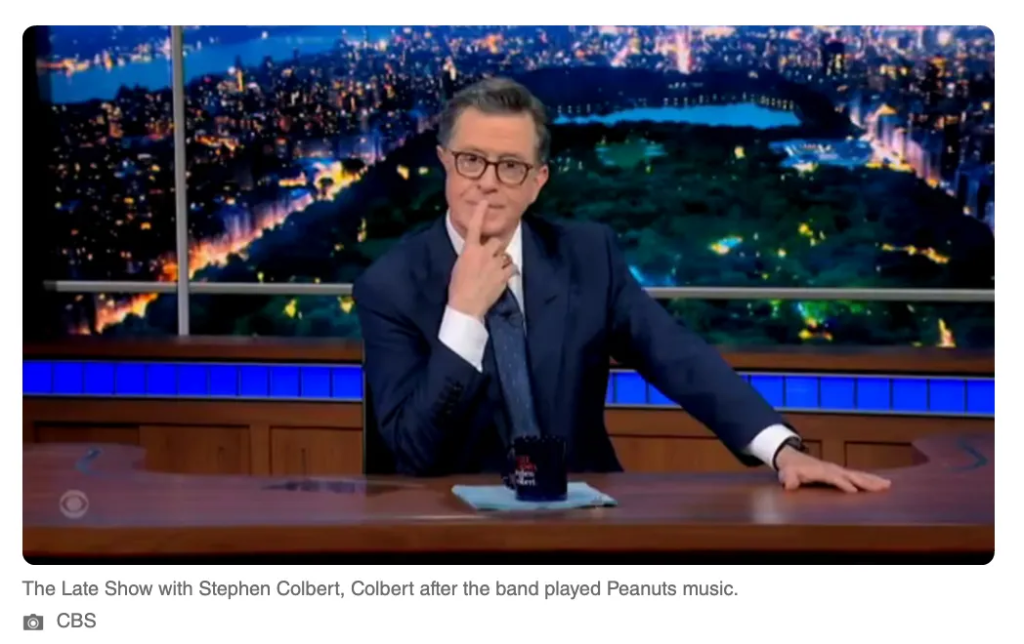
To be sure, many other celebrities have stood up to Trump, among them Stephen Colbert, John Legend, Jimmy Kimmel, Robert De Niro, Lady Gaga, the country superstar Zach Bryan, and the Chicks’ Natalie Maines. Unfortunately, the courageous Mr Colbert has seemingly been punished for criticizing the thin-skinned president. His last show was on Thursday (Springsteen appeared on Wednesday’s episode). Perhaps because Springsteen knows there are hundreds of thousands of Americans willing to pay $100 or more to see him perform, he takes on Trump with less hesitation and greater abandon than other celebrities. The Boss doesn’t have any corporate overlords watching his every word.
His resistance is unflinching. In Brooklyn and at each concert, he gives a variation of this broadside: “So many American families struggle while our president and his family enrich themselves by billions of dollars trading on the people’s office in corruption unmatched in American history … This White House is destroying the American idea and our reputation around the world. We stood as a beacon for hope and liberty as an imperfect, but strong defender of democracy– standing for the global good, and to many now we are just America, the reckless, unpredictable, predatory, untrustworthy, rogue nation that is this administration and this president’s legacy.”
Every resistance movement needs an anthem, and Springsteen has obliged by writing The Streets of Minneapolis, which denounces Trump’s deployment of thousands of masked agents to intimidate that deep blue city, to essentially step on its neck.
When he began singing Streets of Minneapolis, the crowd went wild. I excerpt it:
Oh, our Minneapolis, I hear your voice
Singing through the bloody mist
We’ll take our stand for this land
And the stranger in our midst
Here in our home, they killed and roamed
In the winter of ‘26
We’ll remember the names of those who died
On the streets of Minneapolis …
At song’s end, he led an earsplitting chant: “ICE out now!” and gigantic photos of Renée Good and Alex Pretti suddenly appeared behind the stage.
Springsteen has carried his resistance message across the nation. At the flagship No Kings rally in St Paul in late March, he told the immense crowd: “The power and the solidarity of the people of Minneapolis and Minnesota was an inspiration to the entire country … You gave us hope. You gave us courage. And for those who gave their lives, Renée Good, mother of three, brutally murdered, and Alex Pretti, VA nurse, executed by ICE and left to die in the street without even the decency of our lawless government investigating their deaths. Their bravery, their sacrifice, and their names will not be forgotten.”
At his Minneapolis concert on 31 March, he poignantly told of Good’s last words: “To the man who she was protesting against, the man who would take her life, she said: ‘That’s fine, dude, I’m not mad at you. I’m not mad.’ God bless her.
“So tonight, when you go home,” Springsteen continued, “hold your loved ones close. And tomorrow, do as Renée did, find a way to take aggressive, peaceful action to defend our country’s ideals. And as the great civil rights leader John Lewis said, ‘Go out and get into some good trouble.’
“God bless Alex Pretti, God bless Renée Good, God bless you and God bless America.”
What’s giving me hope now
I, along with many others at the Barclays Center concert, came away jazzed and inspired. I imagine that hundreds of thousands of fans who have seen Springsteen in concerts across the US in recent weeks felt the same way. That gives me hope. That many young people are attending the Boss’s resistance concerts also gives me hope.
Springsteen does what celebrities should do. He uses his star power to fight the good fight. He talks to people. He doesn’t talk at them or down to them or lecture them. He voices common concerns, he rallies, he inspires. It’s perhaps easier for the Boss to do this than it is for other stars because he has a tremendous, decades-old fan base and is widely embraced as a man of the people. Let’s hope that his hugely successful Land of Hope and Dreams tour inspires other celebrities to do more to speak out and resist.
I wish that Springsteen would give dozens of free, outdoor concerts across the US over the next year or two or three, but that might be too complicated and expensive to pull off. I don’t doubt that those concerts would attract hundreds of thousands of people each, and that might help turn the tide further against Trump, the most corrupt authoritarian president in US history.
Springsteen is an unarguable leader of the resistance. The nation could use more like him.
Long live the Boss.
- Steven Greenhouse is a journalist and author, focusing on labor and the workplace, as well as economic and legal issues