The 2025 law forbade any flags on public property other than the flags for US America, Idaho, cities and tribes, military services, and a few other official flags of “a governmental entity.” The bill’s Republican sponsor insisted that this wasn’t culture war, heavens no, it was about promoting unity, and America, and “stuff that we can all agree on.”
The Boise City Council promptly turned right around and passed a resolution adopting the Pride flag as one of three official City of Boise flags, and ran the rainbow colors up the flagpole again. Hooray!
Unwilling to accept such rampant disrespect to their edict, Republicans in the Lege this year passed a whole new flag law, this one adding a new rule saying that only official city or county flags “designated prior to 2023” will be allowed. The new law also added a $2000 per day / per flag fine, to show Boise what serious business this flag war is. The bill’s sponsor, state Rep. Ted Hill (R), explained the fine was absolutely necessary to force compliance from “insubordinate government officials. […] It sets a tone of anarchy.” He too said that we must have “unity” under the stars and stripes, orelse.
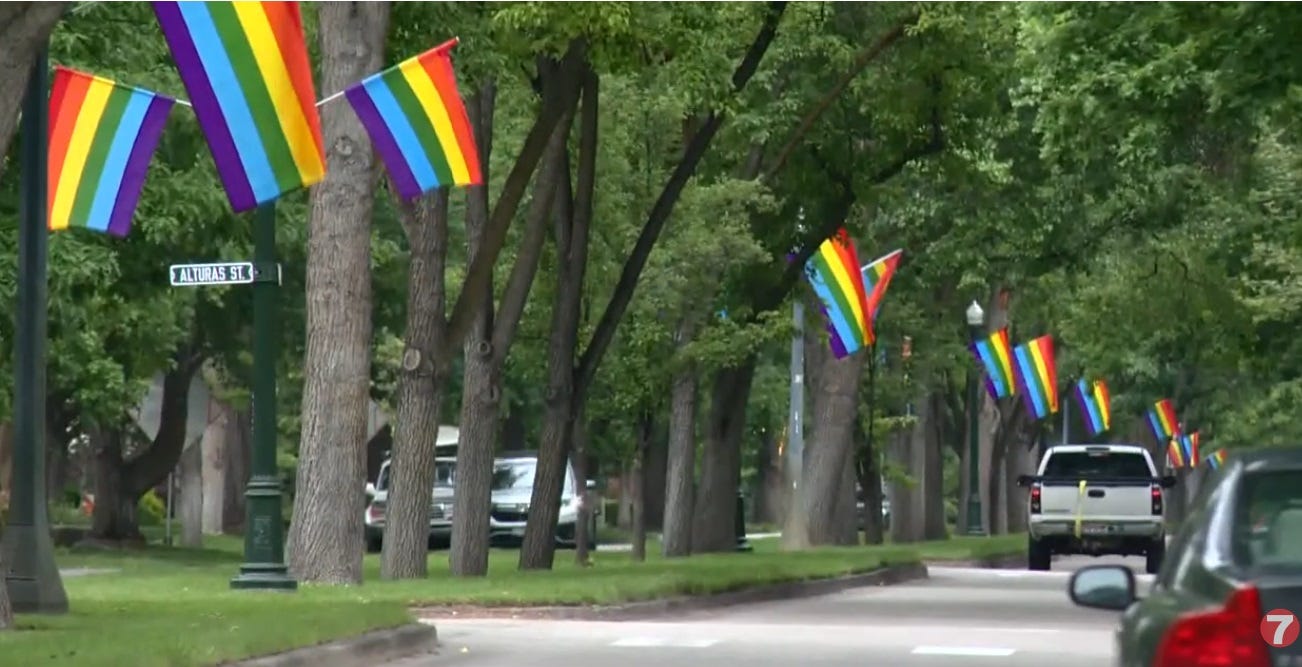
Pride flags along Harrison Blvd. in Boise, 2023. Since Trump’s first term, assholes have stolen and even burned multiple flags each year. They’re then replaced by the volunteers who put ‘em up in the first place. Screenshot, KTVB-TV on YouTube.
In an extra little kick at Boise, where light poles on the median of one major residential street have long displayed Pride flags throughout June, the bill specifically applies to land along “parks, roads, and boulevards.” No nice things for you, Boise.
Just to be a real prick about it, Gov. Brad Little signed the bill on March 31, the Trans Day of Visibility. Little also signed another far worse bill criminalizing trans people who use bathrooms or locker rooms that match their gender identity, not only in schools and public buildings, but also in “public accommodations,” like private businesses. First offense is a misdemeanor, with up to a year in prison, and a second offense would be a felony, with up to five years in prison. The Idaho affiliate of Planned Parenthood Alliance Advocates called it “the most extreme anti-transgender bathroom ban in the nation.”
In response to the two new laws, Boise Mayor Lauren McLean ordered the Pride flag lowered outside City Hall, but also presided over a special session of the City Council to honor the Trans Day of Visibility. Choking back tears, McLean said to the Council and an audience of about 60 Boiseans, “Many people in this state and around this country are seeking to divide us. They’re seeking to divide us by targeting the most vulnerable among us. I want the people in this room to know that I see you. We see you. You are wanted, important, and unique members of our community.”
That night, City Hall was lit in the colors of the transgender flag.
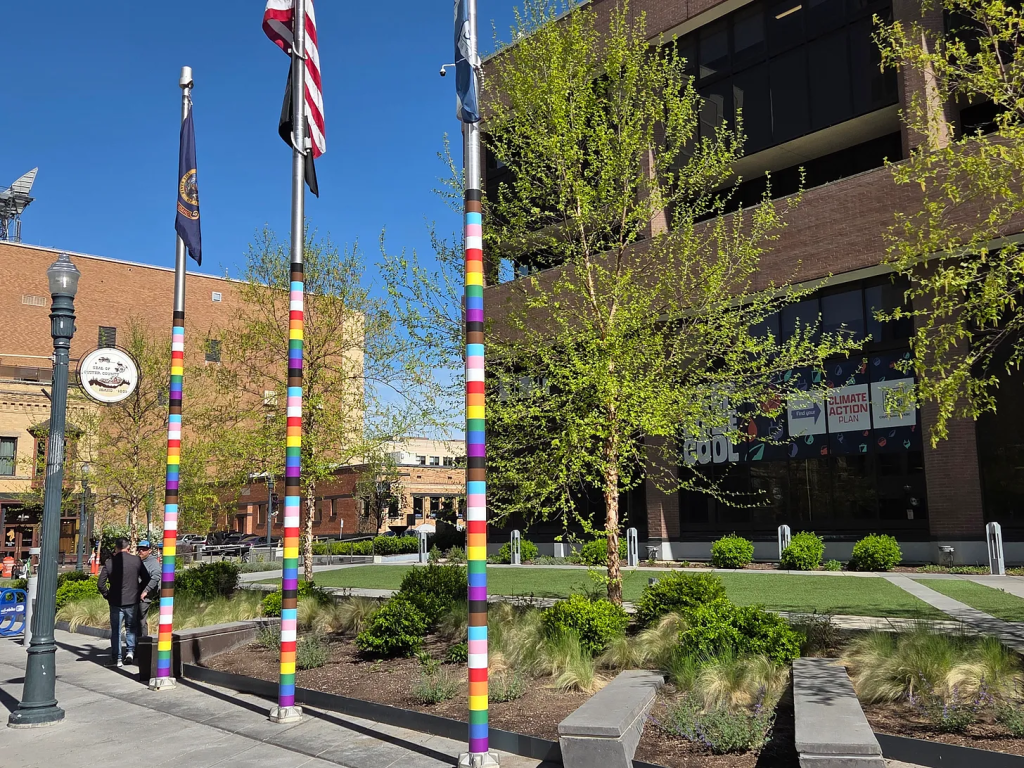
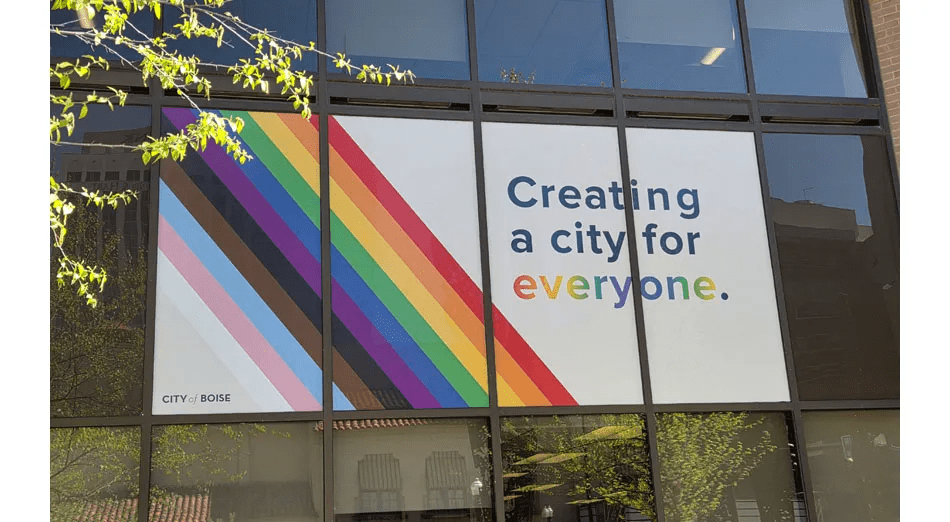
Then, a week after the Pride flag came down, the three flagpoles in front of City Hall sported new vinyl wraps in the colors of the Pride/Progress flag, and a big new banner was visible in the building’s windows, with the rainbow and the slogan, “Creating a city for everyone.” Yr Dok Zoom went downtown to take some photos, and damn right he plugged in his EV at one of the two free EV chargers at City Hall (still hadda feed the meter, though, so that explains the $1.50 on my company card, Rebecca).
You can see the poles up top, and here’s that nice new sign:
And now at nighttime, City Hall is lit up in rainbow colors as well. Gosh I like my city a lot!
City Council President Meredith Stead told local TV station CBS2 that the city is observing the new state law to the letter, and joyfully at that. “The law was based on the flag and we are using rainbows, and it’s not at all a flag,” Stead explained, and I hope she was grinning. “So I would say we are in full compliance of the law, that’s certainly the most important thing to us. So we’re going to be sure that we always are, and this was just a different way to celebrate our diversity and values.”
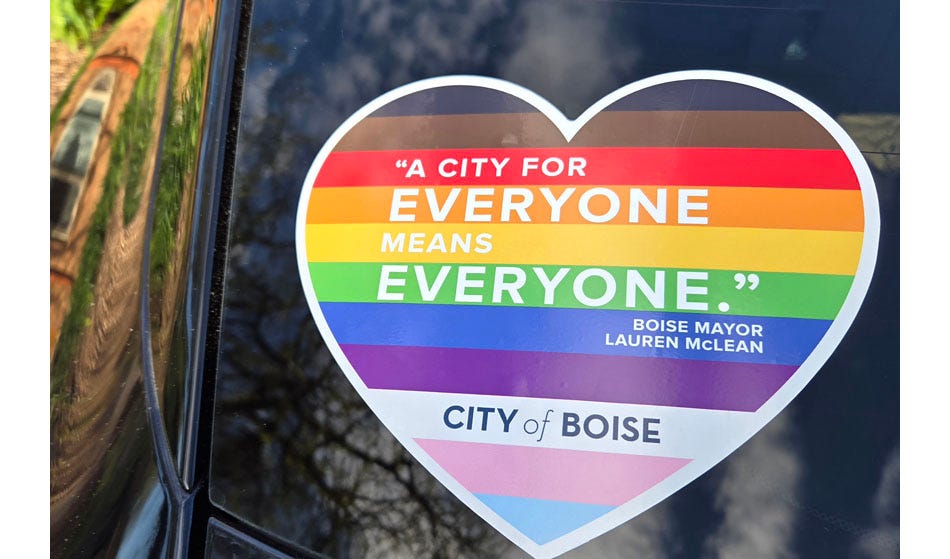
The cost of the flagpole wraps and new banners was $5,931.87, from the city’s operating budget. We think that may also have included the printing costs for these spiffy new stickers you can pick up at City Hall; I got a nice big one that looks great in the rear window of my EV:
We like this “everyone” thing the mayor is going on about! Photo: Dok Zoom.
Needless to say, while all the folks you’d like to hang out with in Boise are delighted by the city’s latest reply to the Lege, the Usual Suspects are big mad about this latest besmirch statement by the city, and we can only imagine what sort of stupid crap law the Idaho Lege will pass next year in another futile attempt to control the wayward capital city. We’ll close with this line from the very timely second season of Andor, which Dallas ally, former Obama official, and teamonger Brandon Friedman says nicely sums up Boise’s Rainbow Battle: “Tyranny requires constant effort. It breaks, it leaks. Authority is brittle.”
Leading off: Very liberal Americans, who have rated the Democratic Party poorly relative to other partisans since 2024, have swung sharply back toward congressional Democrats over the last few months. A new poll also finds voters who dislike both parties now prefer Democrats by 31 points. These gains should reassure a party that has faced internal strife since Trump’s second term began, but look less due to renewed faith in the Democrats and more like anti-Trump consolidation. That might not matter for the midterms — a vote won is a vote won — but it will matter for 2028 and beyond.
On deck this week: Tuesday’s Deep Dive will cover some new research on the level of ideological thinking in the electorate and the value (or not) of ideological moderation by the Democrats, and Friday’s Chart of the Week will respond to whatever’s in the news. I’m also finalizing questions for our April Strength In Numbers/Verasight poll this week — so subscribers, send in your question recommendations if you haven’t already! (Email or comments are fine.)
On with the data.
1. Anti-Trump sentiment, not pro-Democratic enthusiasm, is uniting Democrats again
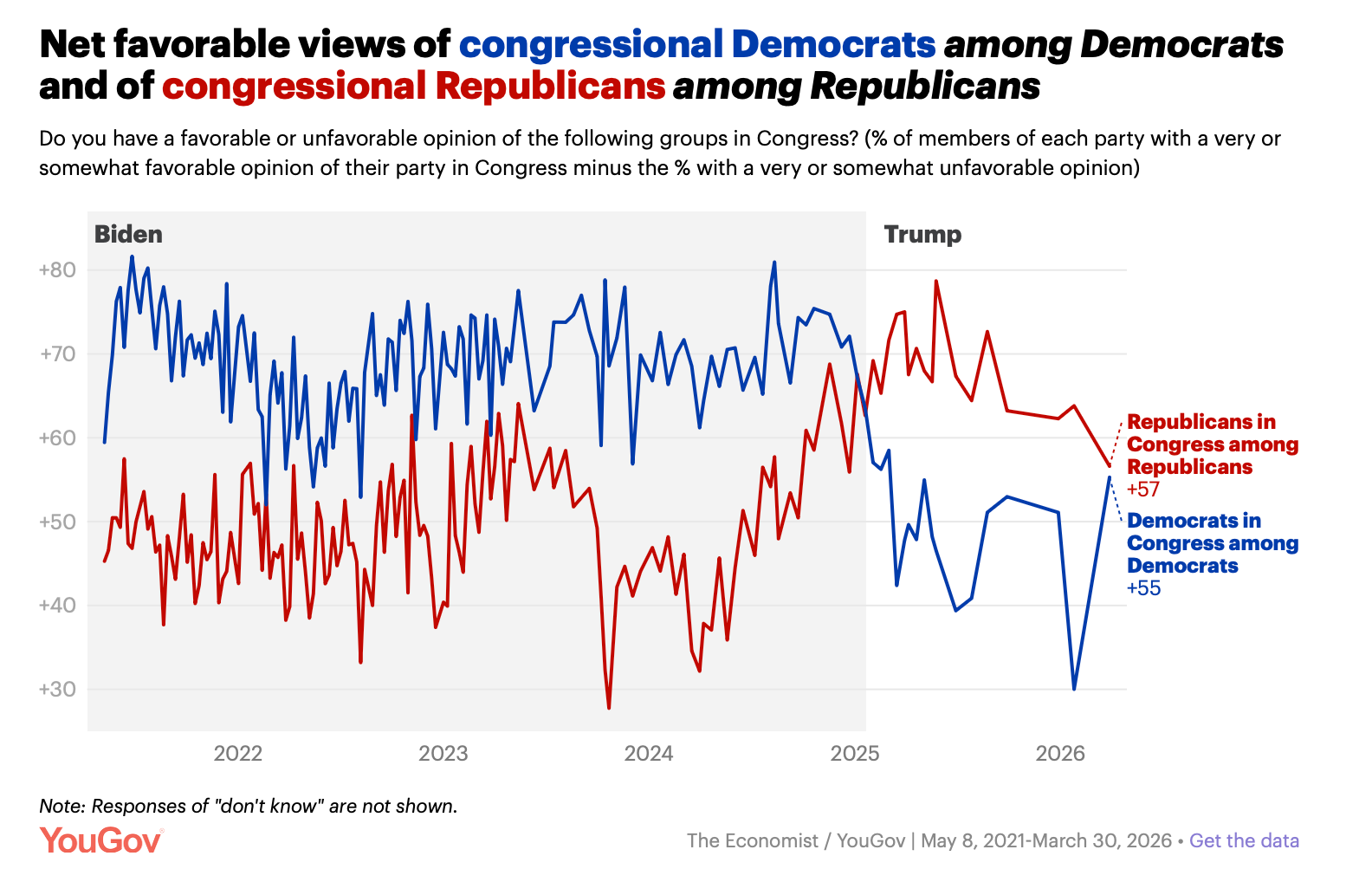
A new YouGov/The Economist poll, fielded from March 27 – 30, finds that Democratic voters have grown significantly warmer toward their members of Congress over the last few months. Earlier in 2026, Democrats said their party’s MOCs were favorable at a rate just 30 points higher than the rate they said their party was unfavorable. That gap has now grown to +55 — rivaling the favorability of Republican MOCs among Republican voters.
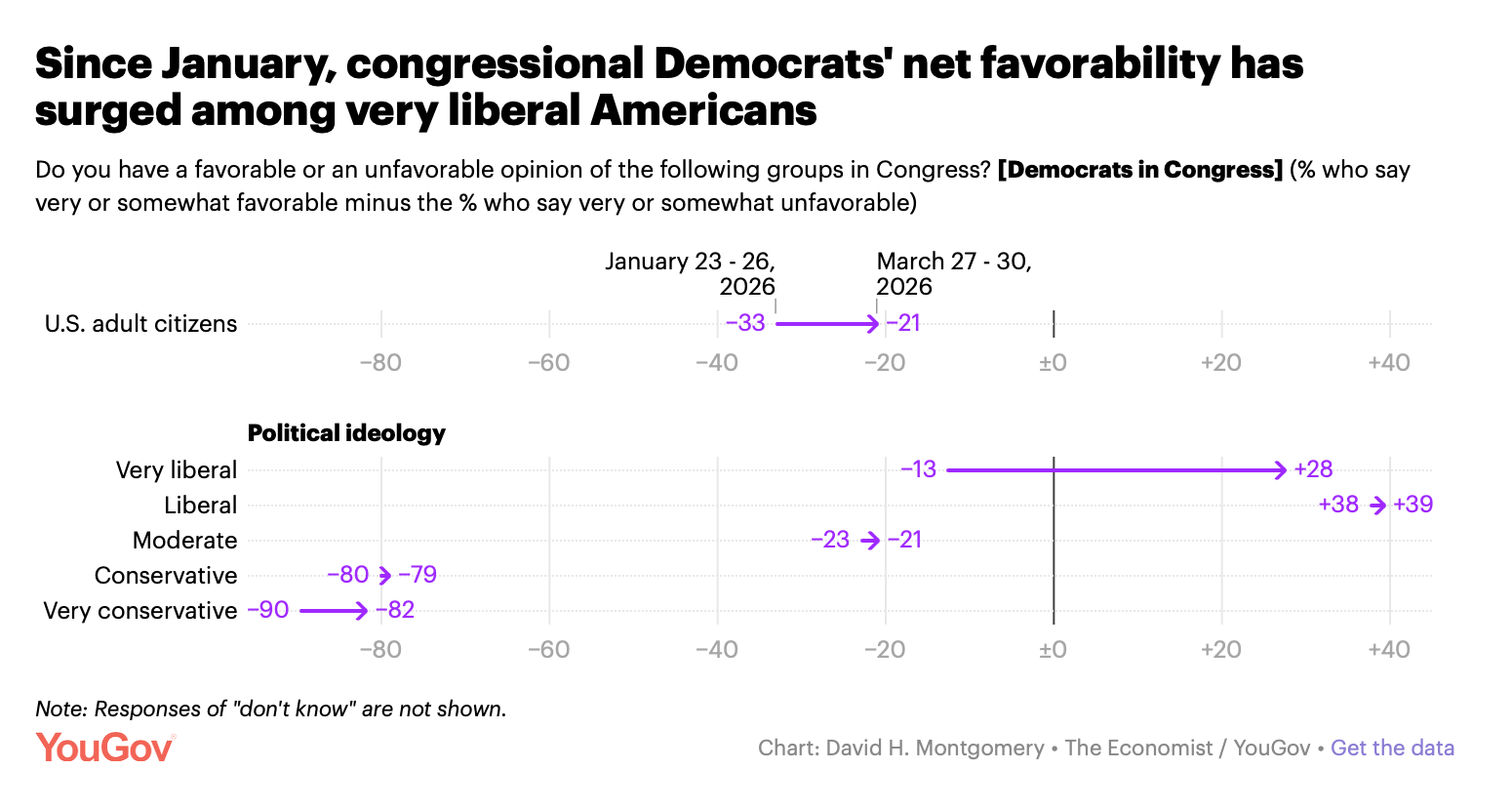
Aggregate Democratic views have increased because very liberal Americans have become sharply more favorable toward congressional Democrats since January. This group evaluated the party’s members of Congress favorably by a net +28 points margin — up from a -13 deficit in January. That’s a 41-point shift in two months:
Among Americans who are liberal but not very liberal, moderate, or conservative (basically everyone else), views of congressional Democrats barely budged.
Overall, U.S. adults give the Democrats a favorability rating of -21, 5 points higher than the rating they currently give Republicans.
That is a meaningful change. Last summer, Strength In Numbers documented that Democratic party favorability was unusually weak even as the party remained competitive on the generic ballot. We dug into the survey microdata and found out that this was because many left-leaning Americans were frustrated with their own side after the 2024 loss. Charles Franklin, who conducts the Marquette University Law School Poll, has been tracking the same dynamic in both national and Wisconsin polling. Among Democratic identifiers in Wisconsin, his data shows a net +56 favorability rating for their party, compared to +74 among Republican identifiers for the GOP.
Franklin finds that while Democrats still disagree about what they’re for, they are virtually unanimous in what they’re against: Donald Trump.
The simplest explanation for Democrats’ gains is that politically active party members on the left — who have had a lot of complaints about how the party is handling Trump 2.0 — are now responding to the same thing many other Americans are right now. That is, the president has moved public policy on many issue domains far to the right and up on the authoritarian axis (certainly far past the policy temperature “set point,” to use the language of the thermostatic model), and progressives are setting their differences with the Democrats aside for the moment as they focus on defeating an increasingly unpopular Republican president. This looks more like anti-Trump unity than pro-Democratic enthusiasm.
But it’s not just the base
The Democrats’ consolidation of left-wing liberalism is one piece of a broader backlash to Trumpism that shows up in the polling data right now. Another notable finding this week is from a new CNN/SSRS survey that found that about one-quarter of the public holds an unfavorable view of both parties. These are the so-called “double haters.” This group prefers Democrats on the 2025 generic ballot by 31 points.
This is a big deal for two reasons. First, that’s a massive shift; Double haters broke for Trump in 2016 and again in 2024. Now they’re swinging hard the other way.
Like Franklin’s polling, the CNN report also finds that Democrats’ gains are driven largely by opposition to the GOP, not enthusiasm for Democrats themselves. When asked what they dislike about Democrats, 22% of double haters called the party “do-nothing” and 11% said they aren’t standing up enough to Trump and the GOP, while 10% said they’re too liberal.
Will 2026 be a Democratic fake out?
So we’ve got two layers of anti-Trump consolidation happening at once. YouGov’s data shows the Democratic left is coming home, and the CNN poll shows voters who dislike both parties — a swing group that has been decisive in recent elections — are breaking heavily toward Democrats for the first time in years. Neither group is necessarily enthusiastic about Democrats. But both are currently heavily voting against Republicans. According to the CNN poll, 79% of voters who plan to support Democrats say their vote is a message of opposition to Trump. (Only 46% of Republican voters say they’ll vote to show support for the president.)
This could make for a big electoral win for Democrats in November, despite the division in the party and its overall nominally unpopular rating. According to CNN, Democratic-aligned voters are 17 points more likely than Republicans to call themselves “extremely motivated” to vote in 2026 — even though they’re 14 points less likely to view their own party favorably. Meanwhile, the Democrats have opened up a large lead in the U.S. House generic congressional ballot for 2026. They are up +6 in both the CNN and YouGov surveys, and closer to +5 on average.
This is the pattern I’d expect in a midterm environment that favors the out-party. But with many Americans (including the vaunted “double-haters”) still viewing the Democrats as weak and ineffectual, a big electoral victory will not completely solve their deeper problems of identity and division.
The trend in this data is good for the Democrats, in other words — but don’t misread a positive trend for a positive level.
2. What Strength In Numbers published last week
Readers of Strength In Numbers got three articles last week — a lighter load, since I was out sick Monday and Tuesday.
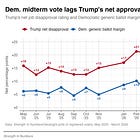
This week’s Deep Dive asked a question I’ve been getting a lot lately: if Trump is 20+ points underwater, why aren’t Democrats leading the generic ballot by 20?
2. Each of the following moves would consolidate a candidate’s base, except:
A. Expressing agreement with the great replacement theory
B. Expressing solidarity with the Proud Boys and January 6 insurrectionists
C. Expressing enthusiasm, which was a big no-no in 2004 Iowa, apparently
3. Which violation of American values would cause the electorate to doubt the candidate’s fitness for the presidency?
A. Violating the human rights of families by tearing children away from their parents at the border
B. Violating the bodies of twenty-six women
C. Violating the unspoken decibel limit on cheering at an event meant for cheering, which is definitely a good rule that applies equally to everyone
4. If exposed to the public, which revelations would instantly decimate campaign fundraising?
A. The candidate being caught with boxes full of state secrets next to their toilet
B. The candidate being caught sleeping with a porn star just after his wife had a baby
C. The candidate being caught up in a moment, just a fleeting moment, which at the time seemed normal, not the end of everything the candidate had ever worked for since the candidate was twelve
5. Which of the following statements warrants being aired 633 times by national news outlets in a span of four days?
6. Which of the following audio recordings would be so damaging that it becomes a years-long political meme and defines the candidate for the rest of their life?
A. A recording where the candidate extorts Ukraine for election assistance
B. A recording where the candidate brags about grabbing women “by the pussy”
C. A recording where the mics picked up the candidate but not the roar of the crowd, which, if you were there, was really loud and made screaming much more normal in context, actually
7. Which action would cause an immediate, double-digit drop in the polls?
A. Starting a movement to hang the vice president
B. Starting a coup d’etat attempt against the United States of America
C. Starting to say “yee-haw” because it felt so right after rattling off the upcoming state primaries, but then realizing halfway through the first syllable that, dammit Howard, someone from Vermont can’t pull off “yee-haw,” and then panicking and switching to “yeah!” or “yay!” all at once, but it was too late and a lump in your throat made it come out like the death knell of a tortured bobcat
8. True or False: It makes perfect sense that the twenty-five-year abortion record of the presidential candidate who ended Roe v. Wade has less Wikipedia content than the three-second audio record of a candidate who just, you know, was pumped up in the face of a setback in the Iowa caucuses, so pumped that he lost control of his body in a burst of unvarnished optimism:
A. True
B. False
C. There has not been a difference between truth and falsehood, right and wrong, or sanity and insanity since early 2004
9. Which charges would provoke widespread calls to suspend a campaign?
A. Being charged in New York with thirty-four felony counts for covering up sex with a porn star
B. Being charged in Florida with forty felony counts for stealing state secrets and lying to the FBI
C. Being charged in Georgia with ten felony counts for conspiring to steal an election
D. Being charged in DC with four felony counts for trying to stop the electoral vote certification in Congress in order to seize power from the lawful president-elect, Joe Biden, in violation of the US Constitution and the peaceful transfer of power
E. Being charged with all eighty-eight felony counts above, all in a five-month period
F. Being charged with a zeal to oppose the invasion of Iraq and establish universal health care, which looks pretty good these days if you ask some people but was apparently too sincere for the petty, vindictive shitheads who actually vote in this country.
10. Which of the following statements would make voters question a presidential candidate’s mental capacity?
The idea behind these laws seems to be if they can hide that LGBTQ+ people / kids exist they can prevent the acceptance and tolerance of LGBTQ+ kids / people. In the minds of the haters who write these bills hopefully that will force people who are not straight or cis to stay hidden from society. They are desperate to return to the 1950s when LGBTQ+ people had to stay hidden or risk losing everything they had, their job, housing, and friends. They are pathetic in their need for everyone to be the same as they are, feel the same as they do, and to live as they do. Why I did not know or understand. The irrational hate for LGBTQ+ kids is really weird. That they would rather have kids hurt, harmed, assaulted, ostracized, and possibly driven to suicide rather than give them acceptance or simply tolerance. I don’t undestand what their gain is in this? Hugs
The appeals court vacated two separate injunctions against the law, but advocates promise to keep fighting.
John Russell (He/Him)April 7, 2026, 1:00 pm EDT· Updated on April 8, 2026
Shutterstock
The U.S. Court of Appeals for the Eighth Circuit has ruled that Iowa can enforce a 2023 law restricting classroom instruction on LGBTQ+ topics and access to certain books while legal challenges against the law proceed.
On Monday, the three-judge panel overturned injunctions previously issued by lower courts in two separate lawsuits challenging aspects of the Senate File 496, according to the Associated Press and The Des Moines Register.
Passed by the Iowa state legislature and signed by Republican Gov. Kim Reynolds in 2023, the law prohibits “any program, curriculum, test, survey, questionnaire, promotion, or instruction relating to gender identity or sexual orientation” in kindergarten through sixth grade. It also bans materials featuring “descriptions or visual depictions of a sex act” from school libraries and classrooms — a provision which critics say is intended to ban books featuring LGBTQ+ characters and themes.
The law went into effect on July 1, 2023. The following November, the ACLU of Iowa and Lambda Legal sued the state on behalf of LGBTQ+ advocacy organization Iowa Safe Schools and seven students and their families, challenging SF 496’s classroom instruction ban.
Last May, a federal judge issued a split decision, upholding the law’s ban on discussion of gender identity and sexual orientation in K–6 classrooms, but blocking its ban on school “promotions” and “programs” that acknowledge the existence of LGBTQ+ people. U.S. District Judge Stephen Locher also blocked a provision of the law banning schools from providing “accommodation that is intended to affirm the student’s gender identity” without notifying their parents, writing that S.F. 496 was impermissibly vague about what constitutes an “accommodation.”
Writing for the Eighth Circuit on Monday, Judge Ralph Erickson held that the state’s interpretation of the law as requiring school “programs” and “promotions” to only encompass curricular activities does not violate the U.S. Constitution. However, the court did not address whether it is constitutionally permissible for the state to ban specific groups and extracurricular programs, such as Gender & Sexuality Alliance groups, because the Iowa Safe Schools lawsuit did not challenge specific applications of the law, according to the Register.
The court also disagreed with Judge Locher’s ruling that the law’s language around “accommodations” was too vague, restoring S.F. 496’s ban on schools accommodating students’ gender identities without outing them to their parents.
In a separate November 2023 lawsuit, the Iowa State Education Association was joined by publisher Penguin Random House and several prominent authors of banned books in a challenge to S.F. 496’s book-banning provision. Last March, Judge Locher sided with the plaintiffs, issuing a preliminary injunction preventing schools from removing books it considers “obscene” from classrooms and libraries.
Again, writing for the Eighth Circuit in a separate decision Monday, Judge Erickson disagreed w ith Locher’s ruling that school library books are not part a school’s curriculum. Erickson wrote that a school’s library catalogue constitutes government speech and can be restricted by state law, according to the Register.
The decisions on both cases send them back to the district court. But as the Register notes, the Eighth Circuit indicated in both rulings that the plaintiffs could not show a “likelihood of success on the merits” in their challenges to S.F. 496.
At the same time, in a joint press release the ACLU of Iowa and Lambda Legal noted that the rulings narrow “where and how the law may be applied.”
“The prohibition regarding sexual orientation and so-called gender theory applies only to specific, mandatory instruction on these topics during class time. The law, as currently interpreted, does not require schools to prohibit student expression of LGBTQ+ identity nor does it limit the sponsorship or promotion of GSAs,” ACLU of Iowa Senior Staff Attorney Thomas Story said.
“The court’s interpretation of the provision on banning books is that it applies only to those that specifically describe or depict one of those sex acts defined in Iowa’s criminal law. And with the forced outing provision, a report would be made to parents or guardians only if a student specifically requests a school accommodation for the stated purpose of affirming a gender identity different from their registration forms,” Story added.
In a statement responding to the court’s decision, Iowa State Education Association president Joshua Brown told the Register that the case was “about much more than legal technicalities.”
“It is about protecting the freedom of speech and the right to share ideas — values guaranteed by the First Amendment,” Brown said. “Our schools should be safe spaces where students are free to learn, teachers can use their professional expertise without fear, and families can trust that education is based on open inquiry rather than government censorship.”
A spokesperson for Penguin Random House indicated in a statement to the Register that the company intends to keep fighting against S.F. 496. Similarly, Lambda Legal Senior Attorney Nathan Maxwell called the ruling “a setback,” but noted that “it is not the end of this fight.”
“Iowa’s SF 496 is a cruel and unconstitutional law that silences LGBTQ+ children, erases their existence from classrooms, and forces educators to expose vulnerable students to potential harm at home,” Maxwell said in a statement. “We will continue to use every legal tool available to protect these young people. They deserve nothing less.”
Subscribe to the LGBTQ Nation newsletter and be the first to know about the latest headlines shaping LGBTQ+ communities worldwide.
NASA’s Earth Observatory brings you the Earth, every day: sharing images, stories, and discoveries about the environment, Earth systems, and climate that emerge from NASA research, including its satellite missions, in-the-field research, and models.
The crew of Artemis II set a record for the farthest-traveled humans from Earth, and they still could not get away from Donald Trump. The mission had a 45-minute blackout from communication with Earth while flying over the dark side of the moon, and Donald Trump was waiting for them when they came out of it.
The astronauts had a very uncomfortable and awkward 12-minute Earth-to-space call, facilitated by NASA administrator and Trump acolyte, Jared Isaacman. During the call, Trump told the astronauts how they would be honored if he got their autographs. They were also honored by Trump blowing smoke up their asses and telling them that he had saved NASA from extinction when, in reality, he tried to cut their budget by 24% when he returned to office for his second term. Not just that, (snip-MORE)
And now, this brilliant story from a friend of the blog:
There are many ways in which the world feels uncertain, and with every news update, we ask ourselves questions: What role do we play? How can we help? We know many readers turn to Mooch and Earl for a daily dose of comfort and joy. Recently, someone told us MUTTS is their “place to go for a warm hug each day.” Will raising a particular issue interrupt that sense of refuge that readers value here?
Not long ago, we received a letter from a reader named Tyla. With her permission, we’re sharing part of it below.
“With recent ICE raids impacting Minneapolis and communities across the country, some families are being separated very suddenly, and in many cases this has meant pets are left without caregivers. Animal shelters and rescues have shared that they’re seeing more animals being taken in or surrendered unexpectedly, and in some situations, people have stepped in to foster or adopt pets whose families were detained.
“The health and well-being of both people and animals isn’t always part of the conversation when issues like this come up, even though both are affected. Animals, especially, rely entirely on their families for care and stability, and sudden disruptions can be very hard on them.
“I was wondering if this is something the [MUTTS] team might feel comfortable acknowledging this, specifically from the perspective of how animals are affected.
“I understand this is a sensitive and complicated topic … I also know that many readers, including myself, turn to MUTTS as an escape from the real world, and I truly respect that. I just wanted to offer this suggestion thoughtfully, since when people are affected in situations like these, animals are often affected too, and their needs can easily be overlooked.”
Tyla’s letter moved us. We’d been thinking about this, too. We started drafting a blog post based on one specific concern: What happens to pets when their families are detained or deported? We were discussing this internally, and considering ways to help, when the scope widened. The news headlines, unfortunately, have not slowed down.
The world feels increasingly uncertain, but one thing we know for sure is that pets depend on the humans who love them. They don’t understand geopolitics or political parties. And the truth is, preparing for any unexpected event — from a natural disaster to a family emergency or something else — is an act of love and responsibility.
At MUTTS, we believe in compassion for all creatures. With that spirit, here are practical ways we can all help our human and animal neighbors.
If You’re a Pet Parent: Plan Ahead
Choose a backup caregiver. Identify a trusted friend, neighbor, or family member who could step in temporarily if you can’t be home. Make sure they’re willing and understand what would be involved. Share basic care information in advance so nothing is left to guesswork. If you’re comfortable with it, you may even want to give them a spare key to your home (or tell them where one is hidden).
Keep identification current. Ensure your pet’s tags and microchip records are up to date. Consider listing a secondary contact (such as your backup caregiver) on file with your vet.
Prepare a small “just in case” kit. Put together a bag with essentials: medications, vaccination records, feeding instructions, favorite comforts like a blanket or toy, and a short written profile of your pet’s personality and needs. Think of it as something you’d want ready in any unexpected situation.
If you currently need assistance caring for your pet, know that there are many community resources around the country that may be able to help. You can start your search with PetHelpFinder.org, which allows you to search for pet pantries, affordable veterinary services, and other resources in your area. You might also contact your local animal shelter for guidance. Many shelters offer community assistance — and even if yours does not, it’s very possible they can help point you in the right direction.
If You Want to Help In Your Community
Volunteer at a local shelter. Many animal shelters are already stretched thin, and shelters across the country are receiving pets whose guardians were detained or unexpectedly displaced. Time, donations, and supplies all help.
Consider fostering.This is an incredibly impactful way to help pets in your community, especially right now. Fostering gives an animal stability during a time of upheaval. In some cases, it provides time and space for an eventual reunion with their family. It also helps shelters by freeing up room so they can care for more animals.
Offer to be a backup pet caregiver for friends, family, or neighbors. You don’t need a specific reason to make this offer. You can simply say you’ve been thinking about family preparedness and realized how comforting it would be to know someone nearby could step in for your own pet if needed. Sometimes people hesitate to ask for help, and by offering proactively (and gently), you can remove that barrier and replace it with reassurance.
Create or strengthen local support networks. If your area doesn’t have a pet food pantry, consider starting one. Offer to deliver pet food or walk dogs for families facing temporary hardship. Some communities have organized quiet grocery or supply deliveries for neighbors who are unable to leave home. No pet should go hungry because their family is going through a difficult time.
Build Real Connections In Your Community
This may sound simple, but it really matters. Support systems don’t appear overnight. They grow from familiarity and trust. If you don’t already have a close-knit community, consider planting the first seed. For example:
Start a “take one, leave one” table or box. This could include books, baked goods, even extra apples or herbs from plants in your own yard.
Bring back front-yard or porch time. Read or drink your coffee outside. Smile and wave at anyone who passes. This invites casual conversation without any pressure.
Check on neighbors during extreme weather. A quick knock before a storm or heat wave can go a long way.
Remember that when communities feel connected, pets are safer too.
Share Your Ideas to Help Pets and People
If you have ideas we haven’t mentioned, we would love to hear them. In the spirit of MUTTS, we ask that comments remain friendly and constructive, aimed at helping animals and strengthening compassion. That’s something we can all stand behind.
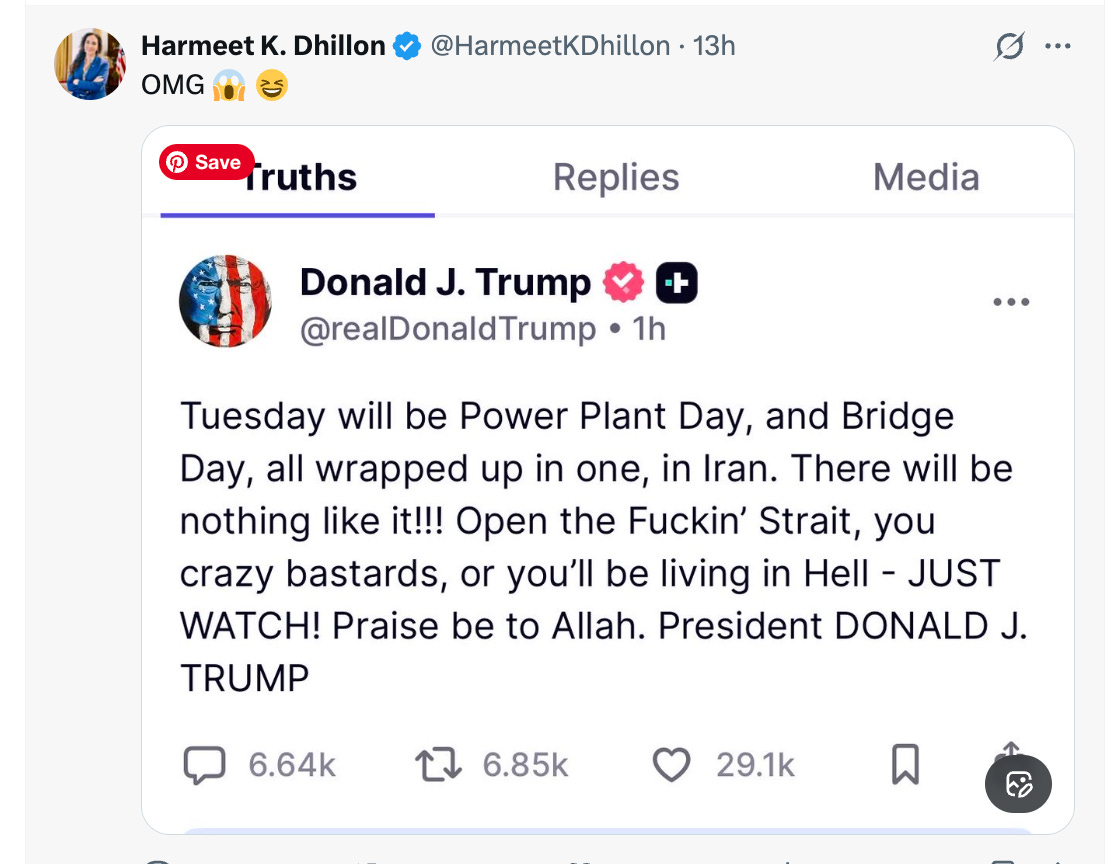
The president of the United States greeted the country with this Truth Social post about his intentions in Iran on Easter Sunday: “Tuesday will be Power Plant Day, and Bridge Day, all wrapped up in one, in Iran. There will be nothing like it!!! Open the Fuckin’ Strait, you crazy bastards, or you’ll be living in Hell – JUST WATCH! Praise be to Allah. President DONALD J. TRUMP
No one seems to have got so far into the post as to notice that he said “Praise be to Allah,” which he would most certainly say was a jest, if asked. But imagine Joe Biden, or worse still, Barack Obama, saying that “in jest” and how Republicans would have responded. Trump is completely off the rails and Republicans are turning a blind eye, pretending it’s not happening.
Earlier this week, Trump’s “spiritual advisor” Paula White-Cain compared him to Jesus. Trump, too, was “betrayed and arrested and falsely accused,” she said. No one in the Republican Party seems to have believed they need to strenuously resist that characterization.
And so, we enter the new week with an unstable president at the helm in wartime. Meanwhile, at home, there are plenty of issues mounting. But Trump seems to have largely gotten away with knocking his connection to Jeffrey Epstein and allegations about his personal conduct off the front burner.
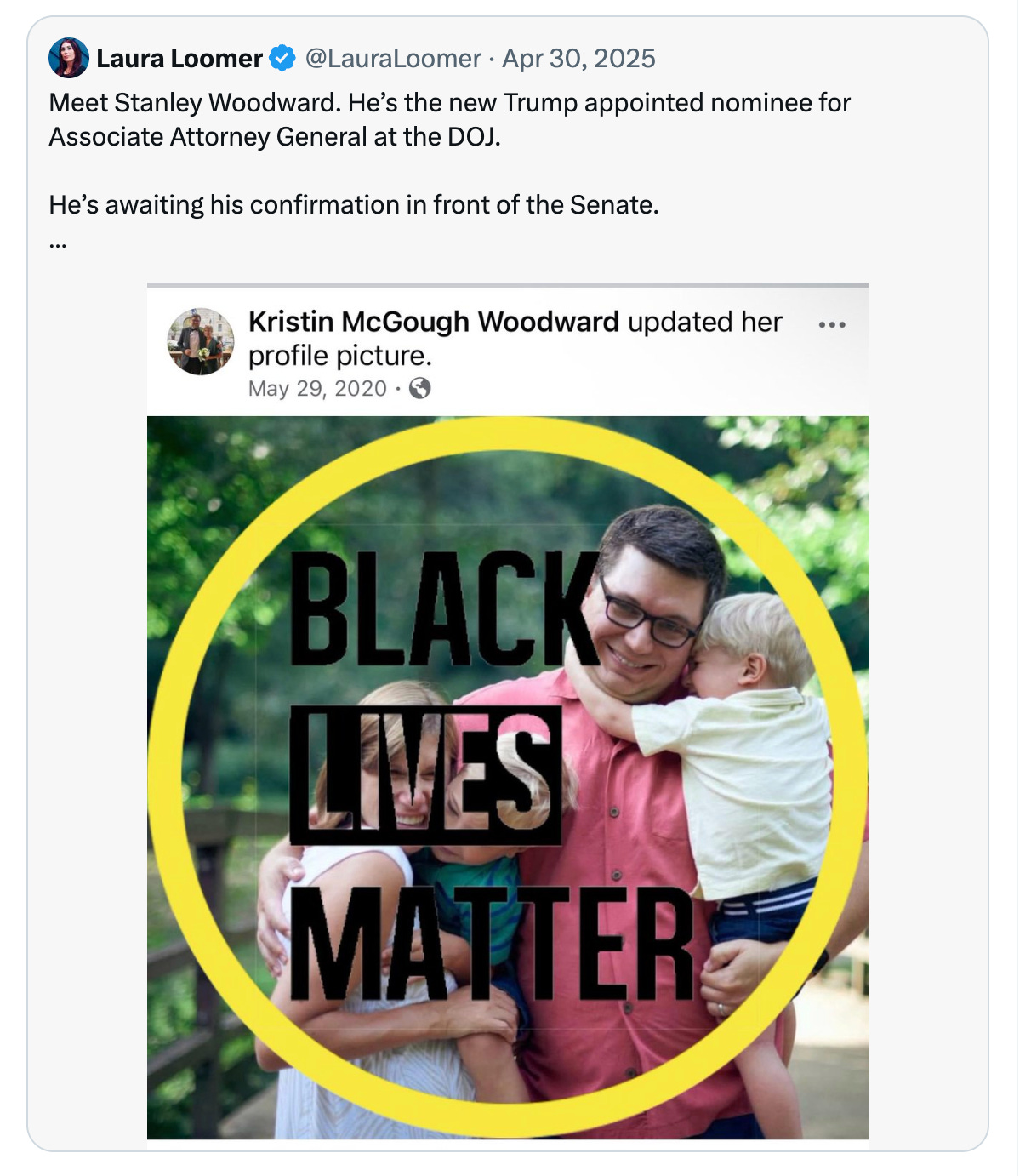
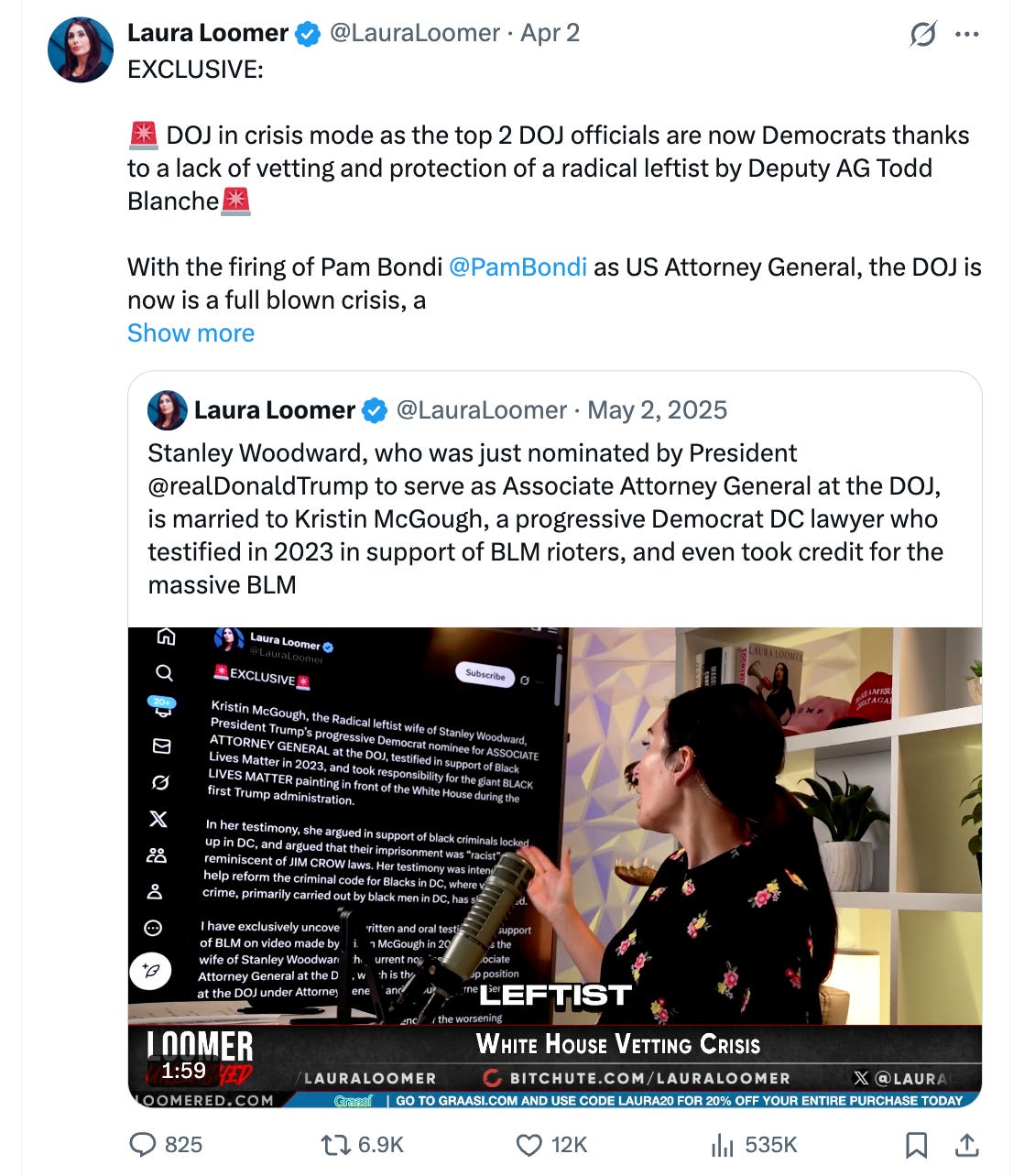
Laura Loomer is influencing policy changes at DOJ
After Trump fired Attorney General Pam Bondi, there appears to be another significant personnel change in the works at DOJ, this one inspired at least in part by Laura Loomer’s dislike of the number three official at DOJ, Associate Attorney General Stanley Woodward. Trump appears to be on the verge of replacing him with the current Assistant Attorney General for the Civil Rights Division, Harmeet Dhillon, who has upended its work and overseen a mass exodus of career personnel.
Woodward was the defense lawyer for one of Trump’s co-defendants in the Mar-a-Lago case, Walt Nauta. His client hung in there with Trump, instead of flipping and offering testimony against him in exchange for a deal. That worked out well for Nauta, but only because Trump won the election. Most lawyers acting in the client’s best interests in that type of situation would have worked toward a plea. Lost in the plot from that case was the conflict of interest Woodward had that could easily have kept him from representing Nauta and might have resulted in another lawyer voluntarily stepping aside. Woodward had previously represented one of the witnesses who decided to cooperate with the prosecution after receiving advice from a lawyer who wasn’t connected to other defendants. Judge Cannon permitted Woodward to represent Nauta despite that conflict, after Nauta waived it. Woodward has also represented White House adviser Peter Navarro, who was prosecuted for obstructing Congress when he ignored a subpoena from the January 6 committee, FBI Director Kash Patel when he testified before a grand jury about Trump’s retention of classified documents, and one of the defendants in the Oath Keepers prosecution.
All that to say, Woodward was a known quantity for Trump when he appointed him. But that doesn’t seem to have been enough to save his job, just over a year into it.
There’s been some suggestion on social media that Laura Loomer is, at least in part, responsible for the change. Loomer is a conservative activist and online influencer who has claimed the ability to impact Trump’s hiring and firing decisions in the past. Last August, Trump was asked about that and said, “She makes recommendations on things and people. And sometimes I listen to those recommendations, like I do with everybody. I listen to everybody. And then I make a decision.” Loomer has never been a fan of Woodward’s.
Her concerns center on Woodward’s wife, apparently, not Woodward. She has had them since before he was confirmed.
Woodward’s wife apparently has the audacity to have her own views on issues, and they are…not racist. Loomer reiterated her take just before Trump made his move at DOJ, also attacking Todd Blanche, the former Trump criminal defense lawyer who is now in charge of the Justice Department in an acting capacity. Blanche and Woodward may have been surprised to learn that, according to Loomer, they’re now Democrats.
That’s a lot of maneuvering, that benefits Dhillon, who has overseen the dismantling of much of the Civil Rights Division’s work, including voter and election protection, and gone on the attack for the administration. That might have made her an attractive candidate for the position to Trump without more. If confirmed by the Senate as “the Associate,” as the number three position at DOJ is called, Dhillon would supervise her old division, Civil Rights, as well as the Civil Division, the Antitrust Division, the Environment and Natural Resources Division, and an administrative division that oversees grant funding. It’s a substantial role and could be a stepping stone to a still higher office.
This is more than a personnel squabble within DOJ and warrants our close attention. Since taking over the Civil Rights Division, Dhillon has made a number of decisions with significant consequences that run contrary to the history of the Division, including:
Setting priorities for the Division that included putting an end to DEI, supporting gun rights, protecting religious liberty by filing lawsuits challenging what DOJ views as anti‑Christian discrimination, and opposing transgender participation in women’s sports.
Pressuring colleges and universities over DEI programs and allegations of antisemitism. In one notable instance, the president of the University of Virginia was forced out for failing to move quickly enough to end DEI.
Ending, as her predecessor Jeff Sessions did, consent decrees with Police Departments. In her case, it was Minneapolis (George Floyd) and Louisville (Breonna Taylor), in cases involving systematic misconduct. She ended investigations in other jurisdictions, changing the environment to one that is far more tolerant of police misconduct.
Abandoning employment discrimination cases, as well as the work of the disability section to protect access, and work combating housing discrimination.
Countermanding early work in the U.S. Attorney’s office in Minneapolis to investigate ICE agent Jonathan Ross, who fired the shots that killed Renee Good. Much of the career leadership in that office resigned in the wake of that decision.
We don’t yet know who Trump will nominate to be the next Attorney General. Dhillon was confirmed 52-45 for the Civil Rights job, garnering no votes from Democrats but mustering support from every Republican. She’s been effective at pushing her priorities, which are Trump’s priorities, and at pushing career people out the door. A Justice Department under her leadership might make people long for Bondi’s simpering incompetence.
To come full circle, this was Dhillon’s response to Trump’s “Fuckin’ Strait” post this morning:
The Trump Administration appeals Anthropic’s victory.
Thursday morning, the government filed its notice of appeal after Anthropic won a victory against it in the lower court. That means it will try to overturn Judge Lin’s injunction, which prevents Trump/Hegseth’s designation of Anthropic as a supply-chain risk. We’ll likely see an effort to get an order from the Ninth Circuit to set that injunction aside while the litigation is underway this week
The federal civil rights investigation and prosecution we won’t see.
The Buffalo Medical Examiner ruled that the death of a legally blind elderly Burmese refugee dropped off by Border Patrol at a closed shop late at night in winter was a homicide. The facts of the case are terrible. And there’s a federal criminal law designed to address this kind of civil rights violation by federal agents acting “under color of law.”
NBC reported that Nurul Amin Shah Alam died of a burst ulcer caused by severe stress brought on by dehydration and hypothermia, which was brought on by the agents’ abandonment of him. The statute permits prosecution of agents who deprive a person of their rights because they are an alien. If DOJ were operating properly, there would be an open investigation. The potential charge is a serious one, based on the denial of rights, not a homicide. The punishment under the law, “if death results” from agents’ actions, can be life imprisonment or even the death penalty. Any other DOJ would be focused on getting this case and doing justice.
The DHS shutdown is still on.
The House failed to take action to pass the Senate’s bipartisan funding deal to reopen the Department of Homeland Security last week. That means the shutdown will continue at least until Monday, when Congress is back in Session. The Senate compromise withhold money the administration wanted to push Trump’s immigration agenda, but would fund DHS until the end of the fiscal year.
TSA workers in the Portland, Maine, airport cheerfully told me last week that they had received some back pay, but had no assurances of receiving paychecks going forward. Hard-working TSA employees are being forced to bear the brunt of Trump’s inability to run the government. It’s surprising Democrats aren’t driving this message every day. And, with hurricane and fire seasons approaching, FEMA funding is sure to be an issue soon, as well.
And, DOJ still hasn’t released all of the Epstein Files.
I have no intention of forgetting that there is more to that story.
Thank you for being here with me at Civil Discourse. It’s going to take all of us, staying informed and working together, to keep the Republic. If you’ve been enjoying the free posts, upgrading to a paid subscription is a great way to help keep the newsletter coming and to contribute to the time and resources it takes to stay on top of law, politics, and this administration.
I wish! 😄 Leading Kansas writes this time in regard to data centers, and about addressing our local governments in our own behalf.It works the same in every state.
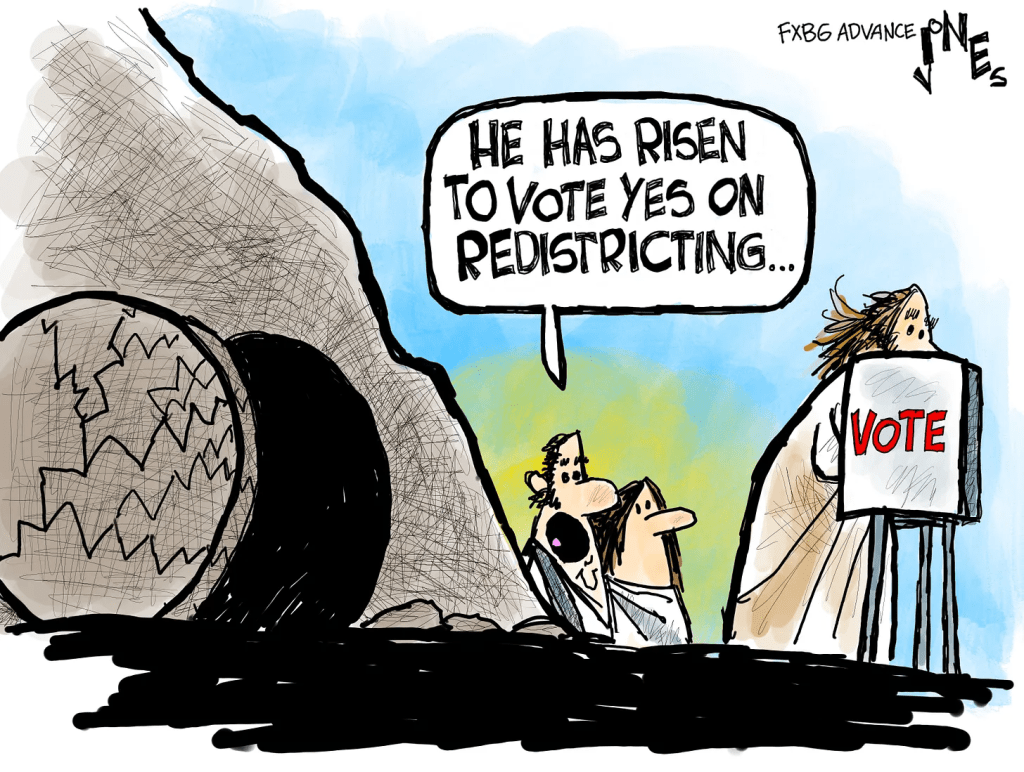
This cartoon was drawn for the Fredericksburg Advance. But don’t yell at them for it; you can yell at me.
If you live in Virginia, you have been bombarded with flyers about the special election on redistricting. And it’s not just flyers but also TV commercials, which are also popping up online. We are getting these things from both sides.
There is a special election in November on a state constitutional amendment that would give Democrats as many as four seats in Congress. The measure would also temporarily bypass the state’s redistricting commission to redraw maps in the middle of the decade.
The state’s Supreme Court approved the measure to be on the ballot less than a week before early voting began. State Republicans repeatedly tried to stop Democrats from moving forward with the referendum. The irony here is that Republicans claim that voting yes will disenfranchise voters, while they literally tried to keep this off the ballot so people couldn’t vote on it.
This is a direct response to Donald Trump and Republicans redistricting mid-decade to give themselves more seats. Donald Trump even said he was entitled to have more congressional seats. This is one reason why we need to No Kings protest. Donald Trump already believes he’s entitled to win elections he’s lost. (snip-MORE, and it’s on point)
Energy company Deep Fission is in the process of building a new and untested type of underground nuclear reactor in Parsons, KS
The Trump administration has reduced regulations to encourage nuclear power production
The reactor will likely power data centers for artificial intelligence
Large data centers consume huge amounts of water and energy and produce different types of pollution, leading to health risks for nearby residents
In November 2025 a two-year-old energy company called Deep Fission broke ground in Parsons, Kansas. They hope this project will enable them to install the second ever energy producing nuclear reactor in the state, after Wolf Creek, potentially with more reactors on the way in the future. If the early “characterization” drilling goes to plan, they claim the reactor could begin pumping electricity into the grid in the near future.
Parsons is a city of 10,000 in southeastern Kansas, near the Oklahoma border. I’ve lived in Kansas for most of my life and I had not heard of Parsons until last week. So, why is Deep Fission in Parsons, Kansas, and why now? Not coincidentally, the Great Plains Industrial Park, also located in Parsons, has lately been advertised as a prime location for new data centers to power the trillion-dollar (yes, trillion with a T) artificial intelligence boom forced upon us by large technology corporations and their venture capitalist backers. Which means the Parsons nuclear reactor project would likely come as a package with one or more new data centers, along with potential economic prosperity and a host of legitimate concerns that community members have already raised.
Part 2: The New Nuclear Power
While the Department of Energy set a goal for the Parsons reactor to go online in July of this year, Deep Fission themselves are aiming to connect to the grid by 2027 or 2028. Two years is still an unusually rapid rollout for a nuclear power plant, which usually takes 6-10 years from groundbreaking to full operation.
Nuclear energy is typically labeled as “clean” energy compared to coal, oil, and natural gas, meaning that it releases fewer pollutants into the air and water than fossil fuel consumption. Still, there are two main concerns. First is the disposal of nuclear waste, which ranges from the lightly contaminated clothing of plant workers to the lethally radioactive spent fuel a plant produces over time. This latter “accounts for just 3% of the total volume of waste, but contains 95% of the total radioactivity.”
A relatively new method in the US and Europe for disposing of our most dangerous nuclear waste is to bury it very deep underground, so that it can be surrounded by solid rock to provide the same level of pressure containment as required at structure at a surface nuclear reactor facility. The father-daughter team that eventually founded Deep Fission originally created Deep Isolation to dispose of nuclear waste. Deep Fission takes their concept a step further by placing the entire reactor, and therefore its most dangerously radioactive elements, into a borehole drilled one mile underground.
The second main concern related to nuclear energy production is, of course, accidents or attacks. It is true that large-scale nuclear accidents are very rare, but when they happen, they become instant, globally recognized disasters whose names we all know: Chernobyl, Three Mile Island, Fukushima. The effects are so widespread as to be practically impossible to quantify. The reactor explosion and meltdown in Chernobyl, for example, caused several dozen deaths directly related to radiation exposure, but various studies have predicted anywhere from thousands up to a million eventual additional cancer deaths. Not to mention the environmental and economic cost to the entire region around Chernobyl. And radioactive boars still terrorize people and farmland in the region around the Fukushima plant in Japan.
But those issues are known, and regulations have historically attempted to shore up potential dangers posed by new plants. In contrast, nothing like the underground nuclear reactor in Parsons, Kansas has ever been attempted before, and thanks to Executive Order 14301, will not need to go through long established design and testing phases that other types of nuclear reactors have been subject to in the past. John Young, a mining environmental regulatory specialist who lives in Sedgwick County, asks, “Why abandon the current regulatory process for something created out of whole cloth with no public input? And no one can define the current regulatory pathways for Federal and State authorizations.
“What,” Young asks in frustration, “could possibly go wrong?”
Part 3: Data Centers and Artificial Intelligence
So that is a glimpse into the nuclear energy side of things. Next we must address concerns around data centers and artificial intelligence. Data centers come in different sizes, like the smaller center being proposed in Wellington, KS, which would reportedly “use roughly 30% of the city’s electrical capacity while generating an estimated $1.3 million in annual electric utility revenue” while consuming only two gallons of water per day. Larger data centers consume resources less modestly. “Around the country, and the world, there is a land race among the big tech companies for sites for their data centers,” claims a November 2024 investigative report by Rolling Stone. Data centers are much newer than nuclear energy technology, yet the ways in which they harm communities near them have already become apparent.
Water: “Large data centers can consume up to 5 million gallons per day, equivalent to the water use of a town populated by 10,000 to 50,000 people,” according to a June 2025 study by the Environmental and Energy Study Institute (EESI). And data centers built explicitly to power AI represent the fastest growing portion of the market.
Last year, researchers at the University of California, Riverside calculated that ChatGPT—one of several popular Large Language Models (LLMs) vying for marketplace dominance—answered about 10,000 queries per second. The processing load to do so guzzled about 6,000 liters (or about 1,000 toilet flushes) of fresh water per second, all day, every day. That is only generating written text. AI photos require more water, and still more for AI video. “The extraction process is permanent,” explains the University of Alabama at Birmingham Institute for Human Rights. Water used to cool data centers evaporates as it cools hot components, meaning it can no longer be used by people in the region who need water for drinking, cooking, bathing, laundry, and general survival.
Pollution: Unfortunately, it is not only consumption of water to worry about. The evaporation of water cooling data centers leaves behind higher concentrations of nitrates and other contaminants leaked through agricultural fertilizers and pesticides into local water supplies, drastically increasing incidents of “rare cancers, muscle disorders, and miscarriages” among people who live nearby. Geographically, Parsons, Kansas sits atop the Alluvial and Ozark Aquifers.
Reports of noise pollution have increased near data centers as well. Residents in different Virginia towns experienced disturbing high and low frequency humming in a wide radius around two new data centers.
These same experts predict that the disempowerment will not only come at the individual level, but also at the societal level, as lawmakers turn their attention and favor even more toward tech companies and AI services that increasingly take over tasks that used to be performed by human beings.
The purpose of this article is not to overwhelm with doomsaying or inevitability. If the Deep Fission underground reactor works as advertised, it could genuinely provide cleaner energy than fossil fuel and mitigate some of the effects of climate change. But to get there safely, we need to demand transparency and regulatory protections from political and corporate leaders. If enough of us speak up in place like Parsons, Topeka, Sedgwick County, and every corner of our town, state, country, and world, we embolden those watching, each other, and ourselves to continue building the world we want and deserve.
tRump couldn’thelp himself but he had to attack Obama making claims of how bad Obama’s library is. Then Sam describes tRump’s grift / scam on his library, using tax free dollars to build a hotel that he will make money from. Then Sam talks about the citizenship birthright case. Hugs



 Shutterstock