There is a video at the link below showing the restraint. Because of being restrained during abuse as a child I can not stand anything pinning my legs or arms down. When I had my left hip done the doctor required patients to be strapped into an immobilizing device. When I woke up in the hospital with it on I totally lost my shit and they had to remove it. But the doctor wouldn’t allow anyone to lay flat or sleep without it. So for weeks I slept upright in Ron’s recliner. There is no need for a torture device such as this used by ICE. It is designed to be punitive and cause people harm. Hugs
The Nigerian man described being roused with other detainees in September in the middle of the night. U.S. Immigration and Customs Enforcement officers clasped shackles on their hands and feet, he said, and told them they were being sent to Ghana, even though none of them was from there.
When they asked to speak to their attorney, he said, the officers refused and straitjacketed the already-shackled men in full-body restraint suits called the WRAP, then loaded them onto a plane for the 16-hour-flight to West Africa.
Referred to as “the burrito” or “the bag,” the WRAP has become a harrowing part of deportations for some immigrants.
“It was just like a kidnapping,” the Nigerian man, who’s part of a federal lawsuit, told The Associated Press in an interview from the detainment camp in which he and other deportees were being held in Ghana. Like others placed in the restraints interviewed by the AP, he spoke on the condition of anonymity for fear of reprisals.
The AP identified multiple examples of ICE using the black-and-yellow full-body restraint device, the WRAP, in deportations. Its use was described to the AP by five people who said they were restrained in the device, sometimes for hours, on ICE deportation flights dating to 2020. And witnesses and family members in four countries told the AP about its use on at least seven other people this year.
The AP found ICE has used the device despite internal concerns voiced in a 2023 report by the civil rights division of its parent agency, the U.S. Department of Homeland Security, in part due to reports of deaths involving use of the WRAP by local law enforcement. And the AP has identified a dozen fatal cases in the last decade where local police or jailers around the U.S. used the WRAP and autopsies determined “restraint” played a role in the death.
The WRAP is the subject of a growing number of federal lawsuits likening incorrect usage of the device to punishment and even torture, whether used in a jail or by immigration authorities during international flights. Among advocates’ concerns is that ICE is not tracking the WRAP’s use as required by federal law when officers use force.
DHS has paid Safe Restraints Inc., the WRAP’s California-based maker, $268,523 since it started purchasing the devices in late 2015 during the Obama administration. Government purchasing records show the two Trump administrations have been responsible for about 91% of that spending. ICE would not provide AP with records documenting its use of the WRAP despite multiple requests, and it’s not clear how frequently it has been used in the current and prior administrations.
The WRAP’s manufacturer says it intended the device to be a lifesaver for law enforcement confronting erratic people who were physically attacking officers or harming themselves.
But ICE officials have a much lower threshold for deploying the WRAP than the manufacturer advises, the AP found. Detainees interviewed by the AP said ICE officers used the restraints on them after they had been shackled. They said this was done to intimidate or punish them for asking to speak to their attorneys or expressing fear at being deported, often to places they fled due to violence and torture.
The West African deportee described a terrifying, hourslong experience that left his legs swollen to the point where he walked with a limp.
“They bundled me and my colleagues,” he said, “tied us up in a straitjacket.”
ICE and DHS would not answer detailed questions from the AP and refused a request for the government’s policy for when and how to use the WRAP.
“The use of restraints on detainees during deportation flights has been long standing, standard ICE protocol and an essential measure to ensure the safety and well-being of both detainees and the officers/agents accompanying them,” Tricia McLaughlin, DHS’ spokesperson, said in an email to AP. “Our practices align with those followed by other relevant authorities and is fully in line with established legal standards.”
The agency would not specify those authorities or describe its practices.
“The use of these devices is inhumane and incompatible with our nation’s fundamental values,” said Noah Baron, an attorney for the West African deportees.
Charles Hammond, CEO of Safe Restraints Inc., said his company has made a modified version of the device for ICE, with changes meant to allow people to be kept in it during flights and long bus trips.
ICE’s version includes a ring on the front of the suit that allows a subject’s cuffed hands to be attached while still allowing for limited use to eat and drink, he said. In addition, the ICE version has “soft elbow cuffs,” Hammond said, which connect in the back so a person can move for proper circulation but can’t flip an elbow out to hit someone.
This photo provided by Safe Restraints Inc., in October 2025, shows a custom version of the WRAP restraining equipment made for the U.S. Immigration and Customs Enforcement agency. (Safe Restraints via AP)
This photo provided by Safe Restraints Inc., in October 2025, shows a custom ICE version of the WRAP with soft elbow cuffs that keep the arms against the body but allow relatively free use of the hands. (Safe Restraints via AP)
An AP reporter recounted for Hammond some of the allegations made by people who had been placed in the WRAP for long flights. All of those interviewed by AP said their hands and feet were already restrained by chains. All denied fighting with officers, saying they were either crying or pleading against their deportation to countries they deemed dangerous.
Hammond said that, if true that some people were not being violent and simply protesting verbally, putting them in the WRAP could be improper use.
“That’s not the purpose of the WRAP. If (the deportee) is a current or potential risk to themselves, to officers, to staff, to the plane, restraints are justified. If it’s not, then restraints aren’t.”
‘Please help me’
Juan Antonio Pineda said he was put into “a bag” in late September and driven by immigration officers to the Mexico border. It was black with yellow stripes and had straps that immobilized his body and connected over his shoulders — the WRAP.
Pineda, who is from El Salvador, was in the U.S. legally, he said in a video from an ICE detention center in Arizona. On Sept. 3, he went to an appointment in Maryland to get permission for another year, his wife, Xiomara Ochoa, said in an interview from El Salvador. Instead, he was detained by ICE and told he’d be deported to Mexico, but the documents he was shown had someone else’s name, he said. Even so, he was sent to the Florence Service Processing Center detention facility in Arizona.
In this image from video provided by Xiomara Ochoa, Juan Antonio Pineda shows a cast for his arm as he speaks during an interview from the ICE detention center in Florence, Ariz., on Sept. 29, 2025 .(Xiomara Ochoa via AP)
Early morning on Wednesday, Sept. 24, he said officers tied his hands and legs, placed him into the “bag” and drove him four hours to the border. When he refused to sign the deportation papers, Pineda alleges officers broke his right arm and gave him a black eye before driving him back another four hours in the “bag.” The AP was unable to independently confirm how he was injured. Pineda’s video shows him with a cast on his arm and bruising on his face.
The next day, Thursday, Sept. 25, they tied him up again, put him in the bag and drove him to the border, where Mexican immigration officials turned him away, he said.
“Eight hours there and back and they don’t give me food or water or anything,” he said in the video, which his wife shared with the AP. “Please help me.”
He was ultimately deported to Mexico, Ochoa said.
ICE did not respond to multiple requests for comment from the AP regarding Pineda’s case.
In addition to the Nigerian man flown to Ghana, four others interviewed by AP said they were placed in the WRAP and carried onto deportation flights since the first Trump administration.
As U.S. immigration officials move aggressively to meet the president’s deportation goals, advocates and attorneys for immigrants are echoing the concerns of the government’s own civil rights inquiry that ICE officers aren’t trained on how to use the restraints.
“This should be a last resort type of restraint after they’ve already tried other things,” said Fatma Marouf, a Texas A&M law professor who has sued ICE over its use of the device. “Just being bound up like that can inflict a lot of psychological harm.”
Some deportees said they were left in the WRAP for an entire fight. A lawsuit filed on behalf of the Nigerian man and four others currently detained in Dema Camp, Ghana, included the allegation from one that ICE left the restraint suit on him for 16 hours, only once undoing the lower part so he could use the bathroom.
“No one should be put into a WRAP. I don’t even think they strap animals like that,” recalled a man who said he suffered a concussion and dislocated jaw being placed into the device in 2023 before a deportation flight to Cape Verde, an African island nation. AP’s review of his medical records confirmed he suffered those injuries in 2023.
“It was the most painful thing I’ve been through,” said the man, adding he was restrained most of the 10-hour flight. “Forget the assault, forget the broken jaw. Just the WRAP itself was hurtful.”
Also, the man said, the metal ring his cuffed hands were attached to — one of the ICE modifications to the WRAP designed to increase comfort — injured him. “When they slammed me face forward on the floor, that metal ring dug into my chest causing me bruising and pain which was part of my injuries that I complained about.”
ICE’s current use of the WRAP comes amid an unprecedented wave of masked federal immigration officers grabbing suspected immigrants off the street, and mounting accusations that the Trump administration has dehumanized them, including by subjecting them to cruel and unusual detention conditions.
ICE’s use of the WRAP has continued despite a 2023 report by DHS’s Office for Civil Rights and Civil Liberties, or CRCL, that raised serious concerns over the lack of policies governing its use.
ICE agreed with the internal findings on some points, a then-DHS official involved in the review said, but challenged the notion that the WRAP should be classified as a “four-point restraint,” a designation that would place more limitations on its use. The person spoke on condition of anonymity because they weren’t authorized to discuss the inquiry.
DHS largely dismantled the office that produced the 2023 report earlier this year amid widespread government firings, calling it a roadblock to enforcement operations.
“Without changes to the current training, and the lack of policy, CRCL has serious concerns about ICE’s continued use of the WRAP,” wrote the report’s authors, who cited a news article mentioning lawsuits claiming the device had led to deaths.
Use by police and in jails
Last year police officers in Virginia Beach, Virginia, placed Rolin Hill in the WRAP, saying he was being combative during an arrest at a convenience store. The officers left Hill in the device when they dropped him at the jail. Video from the jail shows deputies punching the WRAP-immobilized Hill in the head and back. Hill died in a hospital, and while the WRAP’s exact role is unknown, Hill’s death was ruled a homicide by “positional and mechanical asphyxia due to restraint with neck and torso compression.” Three of the deputies are now charged with his murder, and five were removed from their jobs.
Also last year, in Missouri, prosecutors charged five jailers in the death of Othel Moore Jr., who according to an autopsy asphyxiated in the WRAP. Jailhouse footage showed Moore, who’d also been sprayed with tear gas and placed in a “spit mask” covering his face, repeatedly told officers he couldn’t breathe.
In this image from surveillance video provided by Jefferson City Correctional Center, jailers examine Othel Moore Jr., at the Jefferson City Correctional Center in Jefferson City, Mo., on Dec. 8, 2023, who according to an autopsy asphyxiated in the WRAP restraint. (Jefferson City Correctional Center via AP)
While Hammond insists the WRAP has never been determined as the cause of death when used properly, the AP identified 43 times in which the WRAP was used by police or correctional officers in a case in which someone died. In 12 of those cases the official autopsy determined that “restraint” played some role in the death.
It was often impossible to determine the exact role the WRAP may have played, as deaths often involved the use of other potentially dangerous force on people who in several cases were high on methamphetamine.
The WRAP first appeared in law enforcement in the late 1990s, presented as an alternative to tying a subject’s hands and feet together in a practice known as “hog-tying.” It first found widespread use in California jails and today is used by more than 1,800 departments and facilities around the country, according to the manufacturer, which says it has sold more than 10,000 devices.
Many of these cases have drawn little media attention, such as the 2020 case of Alberto Pena, who was jailed on a misdemeanor criminal mischief charge after getting drunk and damaging the walls and doors at his parents’ home outside Rio Grande City, Texas. The 30-year-old became erratic on the way to the Starr County Jail, beating his own head against the inside of the patrol unit and, later, the wall of his cell.
Deputies placed Pena in the WRAP for more than two hours, where he repeatedly cried out for help and complained he could not breathe. But he was left unattended in the device for significant periods of time, court records show, and no medical attention was provided for his self-inflicted head injuries.
An autopsy ruled Pena’s death “accidental,” but a forensic pathologist hired by the family attributed Pena’s death in part to the WRAP’s “prolonged restraint” and said it “could have been averted” with proper medical care.
“The WRAP should have never been used in this situation. It was a medical emergency and he should have been taken to the hospital,” said Natasha Powers-Marakis, a former police officer and use of force expert who reviewed the case on behalf of Pena’s family as part of their wrongful death lawsuit against the county and officers who placed him in the device. The arresting officers had been told Pena suffered from bipolar disorder.
The Starr County Sheriff’s Office has denied wrongdoing and maintained Pena did not require medical care. Robert Drinkard, an attorney for the county, told AP the use of the WRAP “was neither improper nor caused Mr. Pena’s tragic death.” He added that each deputy involved in placing Pena in the WRAP had been trained in its application.
A federal judge recently dismissed the Pena family’s lawsuit, ruling the deputies were shielded from liability.
‘Carrying me like a corpse’
In the context of an ICE deportation flight, the use of restraints like the WRAP can be justified, Hammond, the manufacturer’s CEO, argues.
ICE officers have to ensure that they secure anyone who could pose a fight risk on a long flight, he said. Given the high stakes of a violent confrontation on an airplane, Hammond believes cases like those described to the AP can warrant the WRAP’s use, even if the person is already in chains.
However, properly trained agents are supposed to loosen the straps and allow enough movement so the subject can eat and drink, as well as use the bathroom.
“With the WRAP, when it is used properly, it’s a shorter fight, which is good for everybody. It prioritizes breathing, which is good for everybody. And you have no more fight and can provide medical care or mental health care or de-escalation efforts,” Hammond said.
Those placed in one of Hammond’s restraint suits, however, recount the experience as traumatic.
One of these people was first put into five-point shackles when he became dizzy and tripped while ascending the stairs to board the ICE flight to Cameroon in November 2020. The officer mistook his stumbling as resistance, he said. Immediately, camouflage-clad ICE officers quickly pushed him to the tarmac and onto a WRAP device, he said.
Soon, he felt the straps cinching around his legs and upper body.
“They bundled me like a log of wood from all the sides and they were just carrying me like a corpse,” he said.
Another man interviewed by the AP said ICE officers put him in the WRAP after he initially resisted efforts to move him onto a deportation flight in Alexandria, Louisiana, in 2020. He’d fled political violence and persecution in his native Cameroon, and was afraid to go back. He said officers took him out of his cell in front of the other detainees and put him in the WRAP, leaving him for hours in view of the others as a warning to them not to speak up.
“I told him ‘I can’t breathe,’” the man said. “He responded, ’I don’t care, I’m doing my job.’”
___
Dearen and Pineda reported from Los Angeles and Mustian reported from New York. AP journalists Ope Adetayo in Abuja, Ghana, Obed Lamy in Indianapolis and Ryan J. Foley in Iowa City, Iowa, contributed to this report. Dan Lawton also contributed.
This is the same Bari Weiss that is rabidly anti-trans and a religious racist bigot. She is often used as a warrior to get the crimes against trans kids out, and Teldeb that used to come here and spew Weiss’s lies. No matter who many times I debunked and showed that everything Weiss had reported was lies and misinformation rabid trans haters like Teldeb kept pushing her lies. Because the truth doesn’t matter to them, making sure no child can be who they really are or fit the mold they demand children fit in. Now it is trans kids but as we have seen in the US they are coming for every not straight cis kid demanding they fit into the regressive world they demand everyone live in. Weiss is also a Jewish person who is an Islamophobe. She supports the genocide in Gaza. Hugs
Sakler says she was white knuckling it, trying to get through life as a “shell of a person.” She began cutting, hitting and hating herself because of the rejection from her church community.
He was given a treatment plan that involved limiting time with LGBTQ affirming friends, reading articles designed to redirect his attractions, and practicing what the therapist called “male characteristic activities,” such as taking charge and asserting control. He told his therapist that his marker of when things would be better was “life [going] back to normal.”
The therapist also worked with his parents, telling them they had failed by allowing the “gay agenda” to threaten their family and “let the devil get into the house.”
Editor’s note: This article includes mention of suicide and self-harm. If you are having thoughts of suicide or are concerned that someone you know may be, resources are available here.
“You don’t feel secure in your masculinity,” Sam Nieves remembers his licensed therapist telling him at Brigham Young University in Provo, Utah. “Go grab a Playboy and find a way to enjoy it,” the Mormon therapist told him.
“He told me I can’t be straight if I don’t go fishing with my dad,” says Nieves, who was 20 at the time. “He told me I needed to play more sports, listen to country music, stuff like that. He told me something was wrong with me.”
After these sessions, which lasted about a year and a half, Nieves started experiencing crippling shame and self-loathing. He eventually developed excruciating migraines and memory loss.
“My therapist just helped me find better ways to help me to hate myself,” Nieves, now 41 and living in Seattle, Washington, told Uncloseted Media.
Sam Nieves as a young adult. Photo courtesy of Nieves.
Fourteen countries have a national conversion therapy ban, while many more have state or provincial bans. In the U.S., religious leaders can practice nationwide, though licensed therapists are not allowed to apply it to kids in 23 states.
While research around torture and mental health consistently suggests the practice should be banned, almost 700,000 LGBT adults have received conversion therapy at some point in their lives, including about 350,000 who received it as adolescents.
Despite all of this, on Oct. 7 the Supreme Court heard arguments in Chiles v. Salazar, a case that challenges Colorado’s conversion therapy ban and—if overturned—would have implications for the rest of the states with bans in place.
While the verdict will likely not be announced until June, the court seems poised to overturn it, suggesting that restrictions on therapists might violate the First Amendment’s free-speech clause.
“I’m emotionally devastated for the children who will lose the protections we fought so hard to give them,” says Nieves.
Conversion Therapy and Self-Hate
Unlike many young Americans who are forced into the practice by their parents, Nieves—who was raised Mormon—opted to see a conversion therapist because his church community said that if he didn’t change his sexuality, he was letting them down.
“I actively didn’t want to be attracted to guys,” he says. “And so it was always this confusing, gaslighting situation where they would tell me to stop being gay, even if I wasn’t doing anything. I was trying really hard not to. That’s when [the church] referred me to conversion therapy.”
Sam Nieves in his 20s. Courtesy of Nieves.
Nieves’ therapist insisted that his mom was too overbearing and his dad was not actively parenting, causing him to be gay. As his therapist continued to recommend that he engage in stereotypically masculine activities, he began to withdraw, cutting off friendships and avoiding community gatherings. His Mormon upbringing had taught him to feel shame, but conversion therapy solidified it.
“Conversion therapy gave me validation for why I hate myself. It was just building on top of what the church had already taught me,” he says.
Subscribe
Links to Dissociative Identity Disorder
Nieves became depressed and eventually developed a mild type of dissociative identity disorder (DID), where he experienced one persona that carried shame and recognized he was gay, and another that tried to act straight. Headaches and mental fog were persistent. Thoughts of ending his life flickered through his mind.
“It was just nonstop, massive disassociation,” he says. “There was the Straight Sam and the Gay Sam. And the whole time, everyone was telling me Satan was working on me because something inside me was trying to be gay. So it was insane making. They were making me clinically insane.”
According to medical experts, repeated trauma like medical procedures, war, human trafficking, conversion therapy and terrorism can cause DID when it overwhelms a child’s ability to cope, causing their sense of self to fragment into distinct identity states as a survival mechanism. The trauma disrupts the normal integration of self, leading to symptoms like memory gaps, dissociation and distinct personality states.
When Hunter Moore, a 29-year-old queer woman now living in Washington, was subjected to conversion therapy from her church and parents, she developed DID.
Raised in rural Idaho and immersed in an Independent Fundamental Baptist church that condemned queerness as sinful, the constant fear and shame brought on by her church’s conversion therapy program fractured her sense of self. She attributes her condition to repeated trauma that caused her brain to wall off painful memories.
“I didn’t know how to handle it other than just to check out,” Moore told Uncloseted Media. “I still have a lot of memory gaps from the conversion therapy because of how intense it was. … Once I didn’t have the restraints of that church anymore, the memories started to return.”
Fear, Shame and Suicidal Ideation
Similar to Nieves and Moore, Addy Sakler, who grew up in a conservative Protestant community in Ohio, says conversion therapy was “slowly killing” her.
“I figured I liked girls in kindergarten but did not have the language to describe it,” she told Uncloseted Media.
Sakler knew she wouldn’t be accepted at her church, so she put herself in conversion therapy throughout her young adulthood.
But it didn’t work. Sakler remembers the first sneaking moments of affection between grad school classes with her first crush. But after each kiss, the joy was followed by shame.
“We’d feel a lot of guilt and break up and immediately go repent,” she says. Both women were part of a church ministry that promised to “pray away the gay,” a 12-week program of lessons and deliverance sessions meant to convert them to heterosexuality. Instead, Sakler says, it nearly destroyed her.
Addy Sakler and her boyfriend before she came out. Photo courtesy of Sakler.
“I felt like a zombie walking around. I was depressed and I tried to commit suicide,” she says. “I was in the hospital for a month, two different times. It created a lot of trauma.”
Sakler says she was white knuckling it, trying to get through life as a “shell of a person.” She began cutting, hitting and hating herself because of the rejection from her church community.
Addy Sakler as an adult. Courtesy of Sakler.
“You believe what they’re saying. They’re telling you you’re broken and to be right with God you have to be heterosexual and if you’re not changing, then you’re being attacked by Satan.”
For nearly 15 years, Sakler attended conversion therapy conferences across the country, including one put on by the now dissolved Exodus International.
According to the Williams Institute, LGBTQ adults who have undergone conversion therapy have nearly twice the odds of attempting suicide and 92% greater odds of lifetime suicidal ideation compared to those who haven’t. Among LGBTQ youth, the numbers are higher, with 27% of those who experienced conversion therapy attempting suicide in the past year.
In addition, survivors experience disproportionately high rates of depression, PTSD and substance abuse. According to the findings from one Stanford Medicine study, the psychological harm caused by conversion therapy mirrors that of other severe traumas known to cause PTSD—like sexual or physical assault, the loss of someone close, or even experiences of war and torture.
Isolation and Families Torn Apart
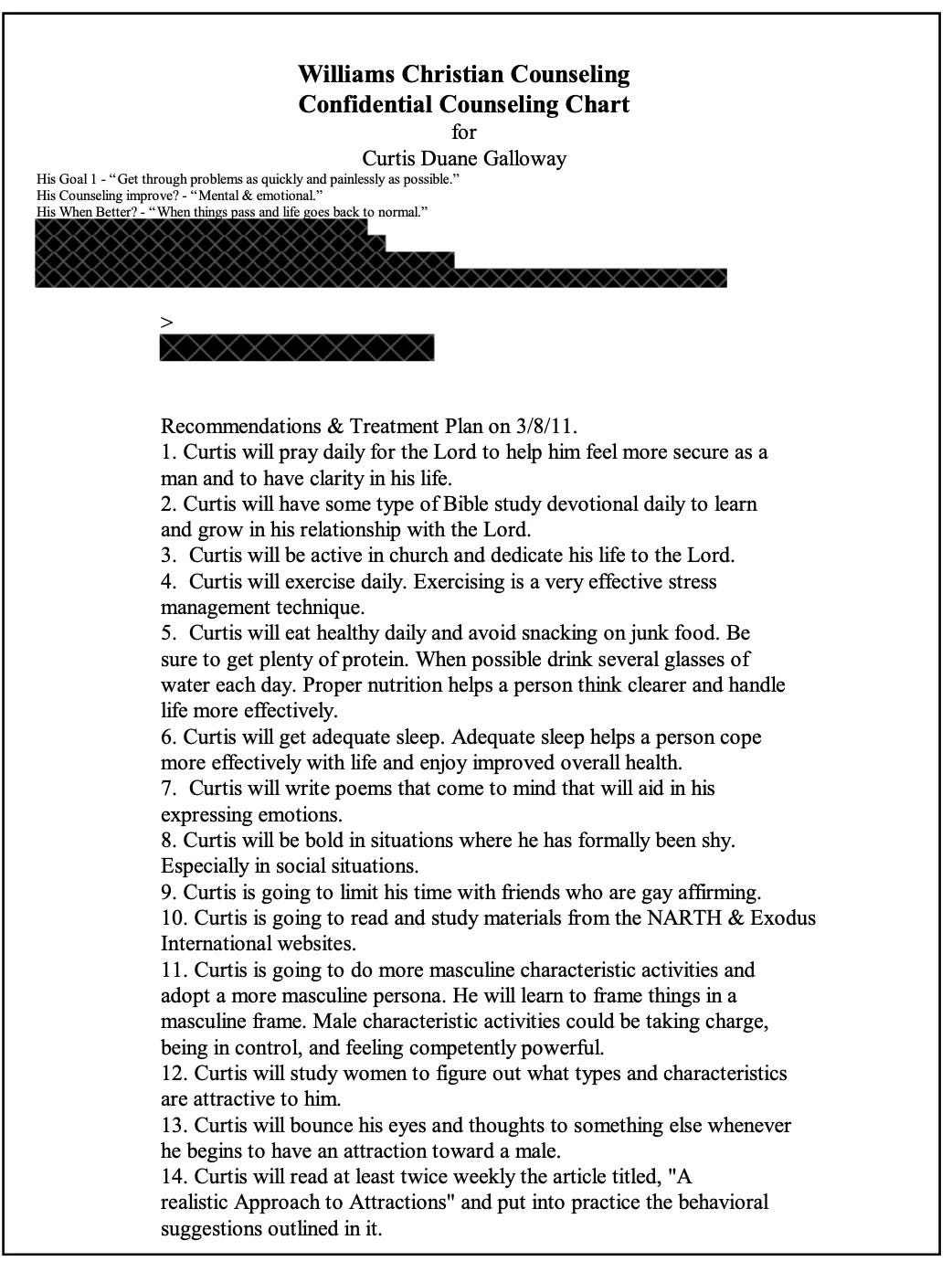
When Curtis Lopez-Galloway told his parents he was gay at 16, they drove him two hours away from his house in southern Illinois to a conversion therapist who used the sessions to berate him for not trying hard enough to change into “the man that God wanted” him to be.
Curtis Lopez-Galloway as a teenager. Photo courtesy of Lopez-Galloway.
Lopez-Galloway remembers being told that his attractions to other men were a symptom of a deeper lack of masculinity, that he needed to “study women to understand what kind of man he was supposed to be” and that he should “bounce his eyes, and change his thoughts to something else whenever he begins to have an attraction toward a male.”
Curtis Lopez-Galloway’s treatment plan, courtesy of Lopez-Galloway.
He was given a treatment plan that involved limiting time with LGBTQ affirming friends, reading articles designed to redirect his attractions, and practicing what the therapist called “male characteristic activities,” such as taking charge and asserting control. He told his therapist that his marker of when things would be better was “life [going] back to normal.”
The therapist also worked with his parents, telling them they had failed by allowing the “gay agenda” to threaten their family and “let the devil get into the house.”
Lopez-Galloway, who now runs the Conversion Therapy Survivor Network, a nonprofit that connects survivors of the practice, recalls frustration and shame spilling into screaming matches that tore his family apart. “My parents were miserable, I was miserable, and we would just take it out on each other,” he says. “I went to [my therapist] for six months, and he just abused me and made life worse. It pushed me deeper into the closet and made me anxious and depressed.”
Curtis Lopez-Galloway as a teenager. Courtesy of Lopez-Galloway.
“[My therapist] would use therapeutic ideas but twist them in a way that was trying to change sexuality. … He would try to manipulate me in that sort of way and really broke me down as a person,” says Lopez-Galloway.
We reached out to the center Lopez-Galloway went to for treatment but they did not respond to a request for comment. Lopez-Galloway says his parents now acknowledge the harm the therapy caused, and he says their relationship has improved.
Subscribe
Life After Conversion Therapy
For many survivors of conversion therapy, the trauma can last a lifetime.
Even 21 years later, Nieves still gets triggered. He dropped out of college during his last semester of counseling school because the practices were too similar to those manipulated and weaponized by his therapist. “The hardest part was fighting … to no longer be suicidal every single day,” he says. “I would say that’s the hardest part. … It’s the suicidality that you fight with once it’s over.”
Nieves and Moore have both found support in Lopez-Galloway’s survivor network, where they meet weekly and heal together in community. Sakler has found healing in therapy for PTSD, and has found acceptance with her wife and her queer community in Sacramento, California.
Despite this, the trauma often requires undoing self-hatred and discovering self-worth.
“[We’re] constantly saying, ‘We don’t know who we are,’” Nieves says. “We don’t know how to enjoy life. We don’t know what the meaning of life is. We’re like The Walking Dead. Because just like how you break a horse, they broke our spirits. They told us everything about us was wrong and we needed to conform. But no matter what we did, we couldn’t conform.”
Even with these survivors’ experiences, along with countless testimonies from other Americans over decades, the Supreme Court looks poised to overturn Colorado’s ban, with multiple justices describing it as “viewpoint discrimination.”
Nieves strongly disagrees and advises kids who are experiencing conversion therapy right now to stay strong and ask for help when possible. “This may very well be the most difficult time of your life. For many of you, it’s going to feel like a living hell, and you may even pray for death every night. I know this, because this is how [I] felt too,” he says. “Often, [conversion therapists] break other laws. If you think someone might be breaking the law during your conversion therapy, please seek out a trusted adult and let them know,” he says.
Above all, Nieves tells kids to push through no matter what. “It can and will get better if you promise yourself that you deserve authentic joy, free of lies and coercion. Community is out there waiting for you, if you can just hold on for one more day, one more hour, or even just for one more minute.”
If objective, nonpartisan, rigorous, LGBTQ-focused journalism is important to you, please consider making a tax-deductible donation through our fiscal sponsor, Resource Impact, by clicking this button:
Telling of the Scuba Spider & the Slow-Motion Climate Crisis Storm by Jerileewei
How a French Quarter Phantasm Teaches Writers to Stop Drowning Their Audience Read on Substack
Recently some of the Cajun Chronicles Podcast Corporation writer staff enjoyed a well attended writers conference at a ritzy island resort about as far away from Louisiana as you can get. Some of us were aware of the show Mother Nature was putting on there. Not only in terms of their native flowers and fruits, but also the job certain natural Apex Micro-Predators play around the world in the grand scheme of pest control and climate change globally.
Once home, those lessons and lessons about writing creative technical content were sources of wonderment and inspiration. Louisiana is no stranger to all things buggy, nor the climate change side-effects we have always been experiencing with rising waters all around us. Similarly, those among us struggle with solutions to writing and broadcasting the messages we all need to heed on such important topics.
A Fishing Spider Story Exercise In Creative Nonfiction Oddity
The thing about the Louisiana bayou country is that its weirdness is not just for show, cher. It’s a matter of absolute, high-stakes survival. It is an ecosystem that has perfected the art of the improbable. Take the Dark Fishing Spider,Dolomedes tenebrosus, the one whose leg span can cover half your hand. She is one of the largest spiders in North America, yet she operates with the silent precision of a naval scout.
You’re floating placidly in the moss-draped gloom of the Atchafalaya Basin, and there she is, perched carrément (directly) on a gnarled bald cypress knee. Her nickname is Scuba Spider. Unlike her cousin, the Six-spotted Fishing Spider (D. triton), who is a permanent waterside resident, D. tenebrosus often wanders about. She’s basically a French Quarter phantasm land tourist with aquatic superpowers. Uniquely, her front four long legs still rest on the water like silent radar antennae.
Here’s the first oddity: She doesn’t spin a trap-web to catch supper. She uses the very surface of the water as a vast, vibrating, liquid snare. That surface tension, which allows a single droplet of dew to hold its perfect sphere, is her hunting ground. To your amazement, a Yellow Fever (Aedes aegypti) mosquito lands, an unlucky Cocahoe Minnow (Fundulus grandis) minnow surfaces, or you see a mayfly struggling.
Those water disturbances, even a tiny ripple, are all the information she needs. She bolts across the water, comme ça (like that), defying gravity and the laws of physics with a waxy-haired gait, grabs her prey, and retreats just as swiftly. She is an apex-predator extraordinaire! As an Eight-Legged Lagniappe
The truly bizarre part of her story happens when danger comes. If a hungry Great Heron swoops too close, or a massive Alligator Gar glides by, this spider doesn’t run toward the shore. She, as we say in Cajun French, simply plonges (plunges/dives). Happily, for her, she’s not drowning. She’s engaging in a peculiar act of biological brilliance.
Her entire body is covered in fine, dense hairs. As she slips beneath the surface, these hairs trap a thin, glistening layer of air, her personal silvery scuba suit, that surrounds her like a portable bubble. She becomes a living submarine. She can cling to an underwater root, or the submerged bark of a Bald Cypress tree.
There she sits, breathing her little pocket of swamp-air, and waiting out the trouble for up to half an hour. She makes the L’Affaire Fini threat simply disappear. That fact, c’est vrai (that’s true), is a mighty fine trick.
Now, here is where the bayou’s natural spider oddity connects to a deeper, more human reality. She shows how to tell scientific facts about climate change and its effect on nature factually without putting your audience to sleep. That’s because the constantly-evolving existential crisis of the climate often feels a lot like that of the ol’ White Heron. It’s a huge bad case of the vois-là, an inevitable danger that you can’t run away from.
The way some creative technical writers are trying to capture that reality is just as strange as a certain spider species’ scuba dive. When you can’t outrun the misère (misery/trouble), you have to find a new way to tell the story.
This is so much like very act of writing creative nonfiction through the climate crisis has its own set of odd, profound, and fun facts:
Odd Fun Facts of Writing the Existential Reality
1. The “Slow Violence” Problem Demands New Forms
The climate crisis rarely involves a neat, dramatic explosion. It’s mostly “slow violence.” The gradual, almost invisible rising of the water, the creeping salinity, the erosion of the marsh. The odd challenge for the Louisiana writer, is that they have to invent entirely new, often experimental, narrative techniques just to make a slow-motion disaster feel as urgent as a gunshot.
This is why you sometimes see writers like us using techniques like fractured chronology, list-memoirs, or braided essays. They are desperate attempts to make the un-dramatic and continuous nature of environmental trauma feel viscéral (visceral) to the reader.
2. The Rise of the “Carrier Bag Narrative”
Forget the epic traditional story of the single hero conquering the storm. Many climate writers are advocating for author Ursula K. Le Guin’s concept of the “Carrier Bag Theory of Fiction.” The odd fun fact here is that the best climate stories shouldn’t have a single, satisfying plot arc (a triumph!). They should be a messy “bag” full of diverse voices, ongoing processes, small acts of loss, and fragments of hope.
Strive for mirroring the complex, non-linear reality of the crisis. This form rejects the idea that a single person can ‘solve’ the problem, instead emphasizing the power of collective, ongoing endurance. (snip)
Though neurodivergent people tend to love the world of academia and absorbing information, the systems and structure of higher education is often antithetical to the needs of differently abled people, both mentally and physically. Author Courtney Floyd expands on this in the Big Idea for her newest novel, Higher Magic, as she recounts her experience with earning her PhD and seeing how the world of education wasn’t designed with inclusivity and accessibility in mind.
COURTNEY FLOYD:
When I first sat down to write the first draft of Higher Magic, I was two years out of my PhD program and still trying to balance the sum of my time there. My sense of the possible had shifted profoundly as I studied literature, learned to research, traveled to conferences and archives, and honed my analytical and interpretive skills. My life had changed for the better. But I was still discovering the many ways my program had taught me to ignore my body and push through exhaustion and anxiety, no matter the cost.
In higher education, you’re supposed to act as though you’re nothing but a floating brain. Oh, nobody ever says that outright. Especially not when you’re a first generation student who slid sideways into the academy and, to everyone’s bewilderment, stuck around. But the expectation is there. Lurking.
I learned to see it sidelong, in the way I was expected to write without using the first person and also in the lack of understanding some professors showed when I couldn’t attend office hours or study groups because I was juggling several jobs to pay my tuition. It reared its head in my mentor’s office, when she snapped impatiently at me because I got jury duty, and couldn’t defer it. It showed up with the brain fog and intense hand cramps after two-hour midterms in which I had to handwrite entire essays.
I came to see it even more clearly as an instructor, in the way boilerplate attendance policies penalized students who were late because of health issues or irregular bus schedules. It haunted me, one term, when one of my students––a veteran who’d recently undergone major surgery––apologized for every single essay he turned in, not because it was late but because he was worried his medication had made him incoherent.
By the end of my time in grad school, I saw the floating brain edict at work every day. In the exam prep or the job search eating up my own and my peers’ lives, turning us into bleary-eyed shadows. In the exhausted way my officemate staggered back from her two week maternity leave, which we’d gone on strike only a year earlier to get. In the student in my cohort who weighed the cost on her mental health and withdrew from the program.
Mind over matter is a brutal either/or.
Either you’re smart enough to figure it out, or you’ll drop out. Either you’ll burn your candle at both ends, or you’ll snuff yourself out trying.
In her book Teaching to Transgress, Black feminist scholar and educator, bell hooks, writes that in classrooms and other institutionalized spaces, “the person who is the most powerful has the privilege of denying their body,” of becoming the invisible default. The cog at the center of the complicated machine. But, as we’ve seen in the past couple of years, when our bodies become too inconvenient–too vocal or visible or vexing–the people in power (in and beyond the ivory tower) can decide to deny our bodies, too. Or make them disappear.
In SFF, we love a good literalized metaphor. When I first had the idea for Higher Magic, graduate students weren’t being literally disappeared for protesting, but students were being quietly pushed out of the academy for needing access and inclusion. For needing systems built to support white, male, nondisabled scholars to change, just a little, so that others could participate.
Fresh out of PhD school in 2019, I knew I wanted to write about that kind of disappearing. Because bell hooks didn’t just pinpoint a problem, she shared a solution, too: “Once we start talking in the classroom about the body, and about how we live in our bodies, we’re automatically changing the way power orchestrate[s] itself.”
Enter Dorothe Bartleby, a first-generation, neurodivergent grad student who is trying her best to be a floating brain at the start of Higher Magic. She quickly learns it’s not sustainable, and spends the rest of the book slowly figuring out how to be a body and a brain at the same time. While tracking down her disappearing students. And getting ready for her last attempt at passing her qualifying exam. (snip-go finish the rest on the page!)
People say I’m crazy. I don’t really know if I am; I just know that my brain doesn’t work like most people’s… so if that means I’m crazy, then I guess maybe I might be.
I was happily married, once upon a time, but it soured fast, and he didn’t stick around very long. Not that I can really blame him. I know that I’m hard to live with, but it hurt, because I couldn’t figure out what I’d done wrong.
Like the last time I wound him up: It was the day he left. I guess he couldn’t take it any longer. He marched out, screaming, “You’re driving me insane,” just before he slammed the front door… the very last words I would ever hear from his lips.
You know, he really should have known better than to have made me watch the election results that night. He knew how I hated politics, all that jibber jabber that makes no sense. People should be learning how to love, but instead the world is filling with hate. Crazy, crazy talk! I know now that it was wrong to throw the television out the window, but I’m sorry, I just snapped.
I mean, the television was evil. It blathered on and on, and millions of people just sat there, staring, drinking up whatever the media spooned out. So, yeah, it had to go. And Harry followed right after the telly — though he didn’t go flying out the window, he just slammed the door and walked away.
No, I’m not crazy! Our generation has inherited a nuclear arsenal that could easily destroy the world many times over. So yeah, I’m worried about it, but I figure that that’s a perfectly appropriate defense response. If you were to tell me that you’re not worried, I would figure that you’re mad, drunk, or lying… or maybe that you’d become just plain numb to everything.
Life isn’t fair. I can’t unknow what I’ve learned, and what I’ve learned has destroyed my faith in everything. It’s all lies. I know that I’m going off the rails, but there’s nowhere else to go. No. No, there’s no hope for me. My mind was too fragile and was cracked by watching evil people rule the world. But you… maybe your mind is made of sterner stuff. Please, listen to me. Please, help. We need to teach the world to love… before it’s too late.
Well I guess that’s it. Thanks for listening. I gotta go. The orderly is telling me that it’s time to go back to my room because it’s television time… and I’m not allowed near televisions anymore. And please remember: When you tell the others about this, make sure you tell them… I’m not the one who’s crazy. (snip-a bit more on the page. This writer is talented!)
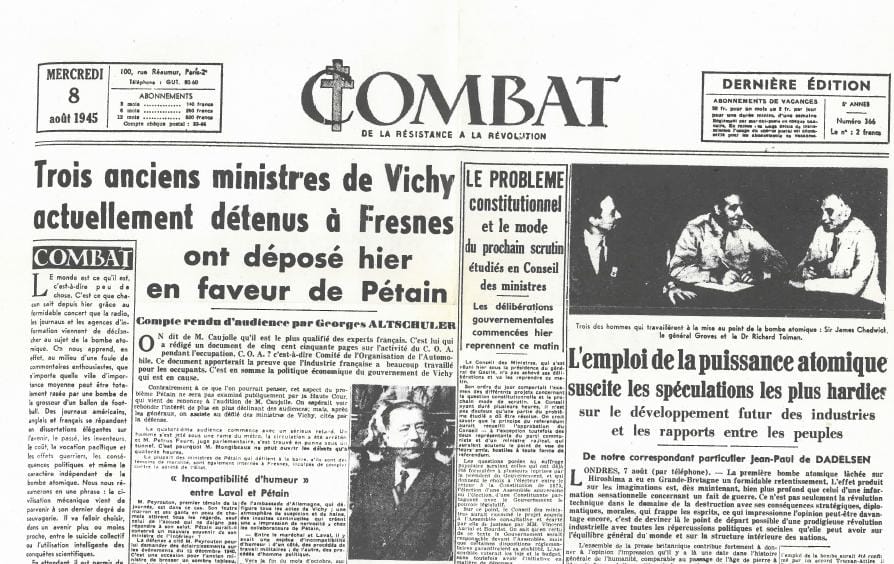
Combat, the underground paper edited by Albert Camus during the French Resistance
Jimmy Kimmel returned to the air on Tuesday and delivered a 28-minute monologue that set the record straight and sharply criticized the Trump administration. Sinclair and Nexstar, two TV networks whose affiliate stations collectively represent 25% of ABC’s broadcast audience, refused to transmit the show, pre-empting it with extended news programming instead. Trump, who is only increasing his authoritarianism, took to Truth Social to threaten ABC with new legal action for bringing it back.
If you believe that public service journalism is a load-bearing prerequisite for democracy, as I do, these are scary changes. These changes are particularly alarming because they’re happening just as the news industry overall has been contracting for decades, leaving fewer resources to fill the gaps. Other, larger, newsrooms could theoretically help fill the content and funding gaps, but there are fewer and fewer resources to share around.
The irony is that local news is the one place where this erosion of trust hasn’t been happening: local newsrooms know how to build community and are disproportionately trusted as a result. It’s also the one place where the broadcast medium is still important; in an emergency, or in a broadband desert, a radio signal can be the last source of real information. You can’t, yet, take a closed rural station and move it to YouTube without losing a large proportion of its audience. Around 90% of Americans have access to broadband internet, but that last 10% really matters.
Of course, if all the shuttered public media stations did move to YouTube, the government would go after that, too. As a service owned by a single corporation, it’s a central point of failure. Publishing on the open web would remove that risk, but the internet itself has been repeatedly under attack. In some areas, legislation has passed that effectively bans certain kinds of content (Bluesky is unavailable in Mississippifor this reason) and net neutrality has been decimated nationwide, making it far easier for an ISP to cut access to a particular service, perhaps in response to pressure from the government. With the government flexing severe restrictions to broadcast media, and nothing stopping severe restrictions to streaming media, there’s nowhere left for information to go.
In Cuba, the internet was legalized in 2019, although you need a permit to have a home connection, and connection quality is still intermittent. Starting long before that, people with access would download content to flash drives and then distribute them through a vast, illicit network called El Paquete Semanal, or The Weekly Package. You could think of it as a magazine: every week there would be a new issue of media that couldn’t be obtained any other way. It became so popular that the government tried to release its own competing USB drop containing approved media; unsurprisingly, it didn’t catch on.
We’ve become very reliant on the internet, but we may need to prepare for a post-broadcast, post-open-internet era. Ironically, newspapers, long the poster-child of media’s death throes, are semi-distributed and would be more resilient to this more restrictive media landscape, as the French resistance example demonstrates. (Of course, a newspaper that relies on a centralized printing press can always be shut down.) These are things that might happen, not things that definitely will, but it doesn’t hurt to consider this as a potential future that we might need to react to.
In a world where we succumb to truly authoritarian control over the media, I think there may be something to learn from El Paquete. A discrete bundle of digital media can be transmitted in multiple forms. It can be accessed via the web; consumed via an app that downloads the new bundle every week; transmitted over peer-to-peer networks; stored on resilient alternative file systems like IPFS; and even through sneakernet networks like Cuba’s. The bundle could contain archives of entire websites in the Internet Archive’s WARC format, downloads of video podcasts, and so on, linked with a web-based interface that would be somewhat akin to a DVD menu.
Such a bundle would probably not be collated inside the US. Instead, a group might be established in safe third-party countries like Switzerland, who could communicate securely with journalists on the ground in the US and elsewhere. They would bundle the release, publish it to various networks (the open social web, IPFS, p2p networks), publish a checksum hash, and publicize it in Signal channels.
It would be paid for in various ways. The central newsroom would need to be funded by international non-profits oriented towards re-establishing media freedom in the US (for example, the Committee to Protect Journalists and Reporters Without Borders). Individual journalists and creators in the US would need to be supported by communities more local to them and would likely take the form of mutual aid as much as direct support. Because traditional payment and crypto networks are both highly traceable, direct donations or subscriptions might not be feasible or safe.
I think it’s important to establish this ahead of time. By the time the internet is locked down and major restrictions have been applied to broadcast media, it’s too late. The good news is that it’s kind of cool in itself: the form of an online magazine that carries submissions from multiple news and media creators has a lot of scope for experimentation at every level, from content to design. It’s offline-first, which means you can interact with it on a plane and in other situations where internet is not an option. That’s neat in itself!
It also solves the problem of how this would be found by new readers to begin with. After a democratic collapse, discovery would need to be through word of mouth; before it, though, such a product could be promoted through more traditional channels (emphasizing the innovative nature of its issue-based format rather than its resiliency to authoritarian control). Early adopters who are attracted to the initial product would form the backbone of the word-of-mouth network later on. Just as newsrooms today thrive if they successfully build community, building trusted networks of people becomes vital for distributing underground material in an authoritarian environment. Historical underground media networks took years to establish, as all communities do; building community would need to begin immediately.
Our entire software stack — our content management systems in particular — are designed to be accessed through a functioning internet. Luckily, thanks to tools created by organizations like the Internet Archive, we can simply build websites locally on our own devices and create an archived version to distribute. The tools are there; the work to be done is all at the human level.
















 Scottie's Playtime