Painter William Merritt Chase opened an art school for a new generation of women, teaching them how to draw as well as how to advocate for themselves.
William Merritt Chase with Parsons School of Design studentsvia Wikimedia Commons
The story of the establishment of the Chase School of Art, forerunner of the Parsons School of Design in New York, offers an unlikely object lesson in what happens when you seek to realize your creative aspirations in an era of political and cultural upheaval. In 1896, the Impressionist painter William Merritt Chase was ready to declare independence from the rigid hierarchies of the New York art scene and its dependence on European masters and methods. He dreamed of establishing what he considered an explicitly American school of art, one that encouraged artists to embrace and portray the unique character and energy of the young nation and its people, and he needed money. To get it, he founded an experimental new school for painting in Manhattan that would, ironically, thrive on the burgeoning hopes of women in an era of their growing liberty and opportunity.
Best remembered for society portraits, plein air paintings, pastel seascapes, dead fish still lifes, and depictions of dancing white clouds, Chase suddenly found himself in an unfamiliar role: he was, if not quite an equal rights leader, then an ambitious artist who, in pursuing his own interests, opened avenues for women artists and played a part in establishing a new era of American art beyond his own envisioning.
As June L. Ness writes in Archives of the American Art Journal, Chase stood among the most influential artists and art teachers in the country at the turn of the twentieth century. He was on the faculty at the Art Students League, the Brooklyn Art Association, and the Pennsylvania Academy of the Fine Arts; he instructed a cadre of private students in his home studios and abroad; he lectured in Connecticut, Chicago, and elsewhere; and he oversaw a summer art school outside the Long Island town of Southampton.
A man of his times, Chase and his wife, Alice Gerson, an amateur photographer, ran at the limits of their finances. In 1896, as parents to four children, they faced a turning point. Chase wanted to quit teaching altogether and devote himself to painting. Yet the couple also wanted to maintain luxury residences in both the city and the country while traveling extensively but lacked the resources to sustain such a lifestyle. (snip-MORE, plus art!)
==========
Cadged these snippets from my Naked Pastor email:
So when someone says, “You’re okay,” it can feel naive. Or rebellious. Or even offensive. But what if it’s neither naive nor rebellious? What if it’s simply true? Cartoon: You’re not broken Dad Joke: I’m confused Quote: The illusion Original: My Strength That Is Within Me Merch of the Week: Jesus Eraser Sticker
I keep saying “It is what it is,” but what even is it???
Quote
I recently saw a clip from a Leonard Cohen interview. She asked him about him spending time with Roshi in a Zen monastery. He said it was like a hospital, and Roshi was the doctor. The interviewer asked what he cured him from. Cohen replied, “The illusion that you are sick. He cured me of the illusion that I needed his teachings.”
You’re Okay!
Let’s make this one short and sweet. I agree with Cohen. I also agree with Sinéad O’Connor’s therapist, who told her the whole point of therapy was to help her realize she didn’t need therapy. The same with Gabor Maté, who said that I am not broken, but just wounded. Underneath the wounds and pain is wholeness. A wholeness already there, just waiting to be embraced. These all ring true to me. When I share cartoons like the one here, The Best Healing, I get some positive comments, but also a lot of angry and offended ones.
And I understand why. I, too, was raised to believe that I was born a sinner, deeply broken and flawed and depraved, in need of a saviour to redeem me. The whole theological system and enterprise is founded upon the assertion that I am a vile sinner who needs to be saved by a divine being.I know how difficult it is to walk away from this belief, because it’s not just a belief, but a whole worldview, an entire paradigm, complete with its religion, institution, scriptures, and priests. It’s like leaving the universe to start over in a new one. One that says you’re okay. It’s a radical step, and maybe you have taken it. I’m proud of you for that.
This report is terrifying. This country doesn’t have money to feed or give healthcare to the people, but we can spend billions arming and militarizing a secret masked unrestrained force with the power to detain, restrain, and kill the public with no consequence. The report explains how in other cases these groups take on a power and lawlessness of their own. They are the Taliban of the US. How soon until they show up with military vehicles not just in our cities but at our places to vote? What do ICE and border patrol need with high powered rifles, military armaments, and ar-15 style weapons for anyway, they are arresting the easy low hanging fruit from court rooms and hearings, school teachers, and kids. Plus remember they have ramped up public survaence, facial recognition, and databases on everyone. Hugs
In addition to staffing up at a furious rate, ICE and CPB are acquiring a vast cache of weapons from private contractors, new data reveals. This will not end well—or anytime soon.
The “forever wars” abroad and the global war on terror after the September 11 attacks left behind a long trail of failure, disillusionment, and death—but they also funneled huge sums of taxpayer money to companies that supplied the equipment that made all that destruction possible. That resulted in windfalls for GOP-connected companies, and fueled a massive public-private bureaucracy that grew harder to rein in as it metastasized to monstrous proportions.
Something like this is happening again in a different theater of operations: Donald Trump’s campaign of violent mass deportations. It’s becoming its own forever war: It could drag on for years or decades without success. It’s producing misguided military occupations of restive local populations. It has launched a huge arms buildup. And it also has what might be termed its very own war profiteers.
To wit: A handful of private companies that manufacture weaponry and ammunition have already inked very lucrative contracts with the Department of Homeland Security, which will provide it with enormous stockpiles of military-style equipment, some to the tune of tens of millions of dollars, according to data from Senator Adam Schiff’s office, which is probing DHS contracts.
The pileup of all that equipment hints at a major long-term problem. Just as we saw in the long aftermath of September 11, this new and evolving MAGA terror bureaucracy will expand in grotesque ways. It too will grow less constrained as it amasses more troops—and more firepower.
A harrowing glimpse of this future lies in a new report by Schiff that has gotten surprisingly little notice: It finds that Immigration and Customs Enforcement and Customs and Border Protection have formally approved contracts for at least a whopping $144 million in weapons, ammunition, and other accessories during Trump’s first year. The analysis—based on government contracting data—documents at least a fourfold increase for ICE and a doubling for CBP, relative to 2024, concluding that this will “build a heavily-armed domestic police force.”
It’s eye-opening stuff. One ICE contract is with Geissele Automatics for millions of dollars’ worth of “precision long guns and accessories” to support “armed agents” and other ICE operations, Schiff’s report says. This involves an unknown number of Geissele Border Patrol rifles, the report notes, describing this weapon as an “AR-style rifle with military specifications.” CBP contracted for millions of dollars more in rifles, as well.
ICE and CBP also contracted with Glock for millions of dollars in handguns and accessories, the report says. Taking all these contracts together, the report starkly concludes: “ICE and CBP have together placed orders to purchase thousands of new high-powered lethal weapons at taxpayer expense.”
There’s still more. The report documents ICE and CBP contracts totaling more than $30 million in ammunition and more than $25 million in contracts for the “non-lethal” weapons. That’s not a reassuring description: They include Tasers, pepper spray, and tear gas canisters.
In short, we’re looking at a massive stockpiling of weapons that will be in ICE’s and CBP’s possession for years to come. And someone is supplying all that equipment.
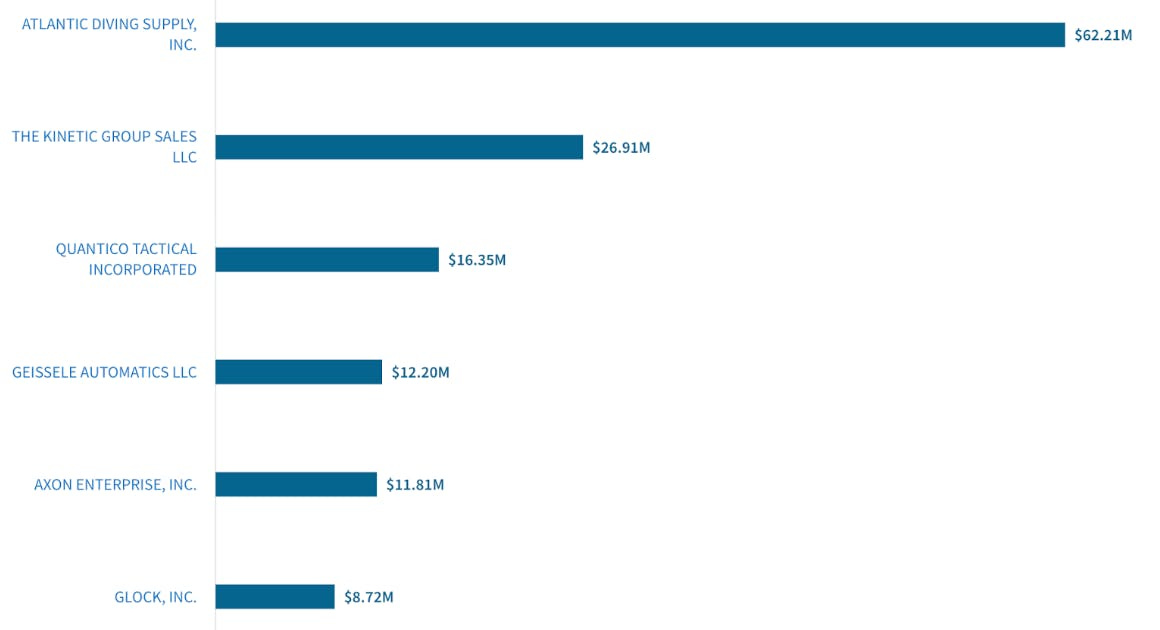
At my request, Schiff’s office analyzed the contracting data it collected to determine which companies are the top ICE and CBP contractors. Here are the results, per a chart provided by Schiff’s staff:
These particular contracts are mostly for small arms (including AR-style rifles), ordnance, ammunition, and related accessories like gun sights and suppressors, Schiff’s office says. A subcategory includes pepper spray, Tasers, tear gas, and other “non-lethal” weaponry.
“These contracts expose how DHS has set in motion a massive surge in spending to put even more dangerous weapons in ICE and CBP’s arsenal,” Schiff told me in an emailed statement. “This misuse of taxpayer dollars to maximally arm federal immigration agents, including those with questionable vetting and insufficient training, must end.”
In a sense, we’re seeing yet more cancerous growth of the post-September 11 national security bureaucracy, but with a more intensified inward focus. DHS, which was created after September 11, has long had a domestic anti-terror component. But now Trump has supercharged its role as a mass immigrant-expulsion operation that is unleashing violence toward U.S. citizens—and even killing them—while operating with near-total impunity among American populations, which Trump officials openly describe as a good thing.
“It’s the transformation of DHS from an entity that protected the homeland from external threats to one increasingly policing American society,” Donald Moynihan, author of an excellent Substack on state capacity, tells me. With this ramped-up stockpiling, Moynihan says, the endgame will be “filling those warehouses with people and using those guns and that technology to control American cities.”
The war on terror also teaches us that expanding bureaucracies like these only grow harder to control over time. “Trump is building up a well-funded, poorly trained paramilitary force that could easily take on a life of its own,” says Georgetown national security law expert Rosa Brooks. “Once you have a massive moneymaking machine ginned up, it’s hard to reverse course and turn off the spigot.”
The folly and waste of the forever wars, we are endlessly told, enabled Trump to successfully campaign against elites who foolishly sank unlimited blood and treasure into misguided imperial adventures abroad. Yet Trump’s mass deportations constitute their own forever war.
This is not meant glibly: Measured in political years, Trump’s mass expulsions actually will seemingly go on forever. Deporting an estimated 14 million people, if it continues at current rates, will take longer than this Trump term followed by two terms of President JD Vance. The scaled-up prison camps, if they materialize, will seemingly have to be packed for years, constituting an ever-expanding immigrant carceral state.
Meanwhile, just like the forever wars, this fiasco is also birthing its own captive constituencies and internal political momentum. This includes everyone from the private contractors supplying it to the large population of MAGA-adjacent young (and not so young) men signing up for ICE, which writer John Ganz describes as “an employment program for the Trumpenproletarian mob.”
Any entity this hypermaterialized—especially one simultaneously aimed at immigrants—will inevitably attract white nationalists and evolve into a political paramilitary force in thrall to ideologically aligned leaders, as Substacker Brian Beutler explains. This is borne out in ICE recruitment messaging, which explicitly seeks to get recruits invested in the mission of achieving national rejuvenation by employing cleansing ethno-nationalist violence.
The stockpiling of weapons underscores the point unnervingly. Now that Trump is feinting toward winding down in Minneapolis, what will be done with all that ideologically fired-up ICE manpower—and all that heavy weaponry? Even a relatively benign answer is alarming. It means more operations like the one in Minneapolis, but packaged with a sheen of new constraints that will simply be shrugged off by the force of this machine’s internal momentum—with more horrors awaiting us.
This is a quagmire for Trump, even if he doesn’t know it. Appropriately enough, it has also been created by unprincipled elite folly—only MAGA elites support it, while the American people verymuchdo not. Trump’s approval on immigration, once a foundational political strength, has deteriorated rapidly at moments when ICE dominates our attention. If his forever war continues in its current form—with its bureaucracy metastasizing in unpredictable directions—it will further cripple his presidency. And it’s darkly fitting that it may take down the presidential ambitions of Vance, also a self-proclaimed critic of forever war follies, along with him.
This is total white supremacy Christian nationalism and an attempt to both roll back all civil rights of minorities and project a fake white Christians were the only good people in the country mentality. Propaganda in other words to support fragile white men’s egos and prop up declining church attendance. This is driven by people who don’t want to share the country equally with others but want everything for their group only. They want to remove an entire group of people from society, the LGBTQ+ community and go back to the pre1960s civil rights for nonwhites. Hugs
An internal government database first reported, by the Washington Post and posted on two public on Monday revealed the scope of the Trump administration’s effort to revise or remove information on African-American history, LGBT rights, climate change and other topics at hundreds of national park sites.
“The narrative being advanced is false and these draft, deliberative internal documents are not a representation of final action taken by the department,” an Interior Department spokesperson said. The National Park Service is part of the Interior Department.
United States Department of the Interior logo and U.S. flag are seen in this illustration taken April 23, 2025. REUTERS/Dado Ruvic/Illustration
The U.S. Interior Department said a database revealing how President Donald Trump’s administration planned to revise information on key phases of American history at national park sites was deliberative and the employees who released it “will be held accountable.”
An internal government database first reported, by the Washington Post and posted on two public on Monday revealed the scope of the Trump administration’s effort to revise or remove information on African-American history, LGBT rights, climate change and other topics at hundreds of national park sites.
“The narrative being advanced is false and these draft, deliberative internal documents are not a representation of final action taken by the department,” an Interior Department spokesperson said. The National Park Service is part of the Interior Department.
Trump has targeted cultural and historical institutions – from museums to monuments to national parks – to remove what he calls “anti-American” ideology.
His declarations and executive orders have led to the dismantling of exhibits on slavery, the restoration of Confederate statues and other moves that civil rights advocates say could reverse decades of progress.
The Interior Department spokesperson alleged the internal working documents were edited in a misrepresenting way before being released. The spokesperson also labeled the release as inappropriate and illegal, without specifying the law it allegedly violated.
“Employees who altered internal records and leaked in an effort to hurt the Trump administration will be held accountable,” the spokesperson added.
The Trump administration has sought to stifle internal dissent within government agencies and taken action against employees who have criticized its policies.
Last year, some employees at the Federal Emergency Management Agency were put on leave after they signed an open letter against the agency’s leadership, while some Environmental Protection Agency employees were fired after they signed a letter critical of the government’s actions.
Reporting by Kanishka Singh in Washington; Editing by Thomas Derpinghaus
ICE has spun a massive surveillance web. We talked to people caught in it
The Department of Homeland Security, which oversees ICE and Border Patrol, is using a broad web of surveillance tools — purchased as its budget has ballooned under this administration — to monitor, apprehend and intimidate the people it seeks to deport and the U.S. citizens critical of its policies.
Federal judge says Trump administration can’t terminate NYC congestion-pricing tolls
The order undermines President Donald Trump’s 2024 campaign promise to “TERMINATE” congestion pricing.
Again Christian fundamentlist rehtoric and constant attacks on LGBTQ+ people by religious leaders lead to the gullible doing actions like this. He knew demons would be there and he needed to be the hero and slay the evil man living in a way that made his god un happy. Every church leader who preaches hate against other communities should be held responsible for the actions of those who listen to their ridiculous, hateful claims and then act on them. Hugs
McGee told detectives they met on Grindr, and that he went to his apartment because he knew “demons would be there,” according to court documents. He also told detectives he intended to “slay” and “get rid of” the victim.
Investigators discovered that McGee planned the attack ahead of time, and including searching the internet for violently homophobic material, purchasing the weapon and searching for how to get away with murder, as well as how to dispose of a body.
Daniel McGee, 26, was sentenced to just over 12 years in prison, along with five years of supervised release.
“The right to live safely in one’s community is a fundamental civil right. The District of Oregon remains committed to combating hate crimes and protecting that right for all,” said U.S. Attorney for the District of Oregon Scott E. Bradford. “While no conviction can undo the harm caused, we hope this sentence will bring some measure of justice to the victim and our community.”
“Hate crimes impact not just individuals, but entire communities,” added FBI Portland Special Agent in Charge Matt Torres. “The FBI works together with our partners to prevent hate crimes from impacting our communities, and every attack on someone because of who and what they are deserves to be acted on by the full extent of the law.”
McGee made national news in 2021 when he was charged with attacking a man he met on Grindr, a dating app for gay men.
In court documents, prosecutors said he used the screen name “str8 curious” and arranged to meet the man at his apartment. He said he had just turned 18 and wasn’t ready to kiss yet, but wanted to make sure they would be alone.
But when McGee arrived at the apartment, he attacked the man. He struck the victim over the head repeatedly using a small wooden club known as a tire thumper. Multiple callers told emergency dispatchers they could hear someone screaming for help.
When police arrived, they found both men inside the victim’s apartment. The victim had life-threatening injuries, including multiple lacerations to the sides and back of his head, and a large portion of his scalp was missing.
McGee told detectives they met on Grindr, and that he went to his apartment because he knew “demons would be there,” according to court documents. He also told detectives he intended to “slay” and “get rid of” the victim.
Investigators discovered that McGee planned the attack ahead of time, and including searching the internet for violently homophobic material, purchasing the weapon and searching for how to get away with murder, as well as how to dispose of a body.
In November 2021, McGee was charged with a federal hate crime involving an attempt to kill. He pleaded guilty in federal court in Nov. 2025.
Montana elected Republican Jeannette Rankin as the first woman to sit in the U.S. House of Representatives three years before American women nationwide could legally vote.
A persistent advocate for women’s rights, particularly suffrage, Rankin voted in Congress against American entry into both world wars, and late in life led marches against the Vietnam war.
Rep. Jeannette Rankin with her colleagues in the 61st Congress.
Jeannette Rankin was the first woman ever elected to the U.S. Congress, and a native of Missoula, Montana. She was elected in 1916, before women nationwide had the right to vote. In 1917 she joined a handful of representatives who voted against entry into World War I asserting, despite harsh criticism and certain damage to her career, that, “the first time the first woman had a chance to say no against war she should say it.” In 1941 she bravely stood alone in Congress in voting against entry into World War II, but she did not stand alone in society in her opposition to institutional violence and war. Her stand against war as a viable resolution to international conflicts provoked questions on the basic assumptions about peace, war, and conflict, which we continue to grapple with today. Rankin’s staunch opposition to war made her a spokesperson for veteran’s rights, as well, since she recognized them as pawns in the games of politicians. It was she who first introduced the GI Bill to Congress, which guaranteed post-discharge education and other benefits to those who served in the military. Her long career was also distinguished by her deep commitment to the country’s women, poor, and its children. She put forth an alternate vision for this country as one which championed peace and justice. She worked tirelessly in opposition to war and oppression by attending rallies, and by giving speeches in person and on television into her 90s.
The Jeannette Rankin Peace Center is proud to carry the name of this pioneer Montanan whose life’s work exemplified a steadfast devotion to peace, justice, and democratic equality. Jeannette Rankin was, in many ways, the first lady of U.S. politics. Her legacy lives on today through those who carry on her work and honor her memory. University of Montana’s Archives and Special Collections houses a collection of oral history interviews that were conducted by Dawn Walsh for the Jeannette Rankin Peace Center. The interviewees were former and current members of the Missoula Women for Peace and detail their interest and activities related to peace activism. These interviews are available in both audio and text format through University of Montana Scholar Works. (snip-MORE)