
Right-wing media hacks use two recent shootings to label trans people as mass shooters.
It is a fact that most mass shooters are males, mostly white males. But right wing media are so desperate to slander and smear trans people the same way it was tried to before the internet with other media against gay people. The know what they are creating is false but they don’t care because they know that others will believe it and repeat it everywhere. It is a sickness and curse to want to create that much hate and chaos against the most vulnerable communities in society. Hugs
Daughters of Time, The Woman’s Bank
So I’m Reading This,
and wondering about the little internet anomalies that happened here after I sent a very nice letter to Sec. Noem about a young woman being detained for protesting, who’s starving to illness because halal food is not provided in her detention facility. You all know me; of course I made it very polite and non-confrontational. I had a few concerns for a bit, then let it go, slept, did yesterday only wondering a bit now and then, but nothing happened. Then this morning, I see this article. sigh I really hate posting this because I’m always encouraging people to write and direct our government, and this is certainly dis-encouraging. And discouraging. But necessary for people to know.
He Sent One Email. Then Federal Agents Came To His Door.
Trump’s Department of Homeland Security is weaponizing a little-known legal tool to crack down on free speech — and Big Tech is complying.
n October, a Philadelphia man sent an email to the Department of Homeland Security criticizing a government policy. Hours later, federal agents and local police were banging on his door to interrogate him without a warrant. It feels like something out of a movie, but it’s real.
Today on Lever Time, David Sirota sits down with ACLU attorney Steve Loney, who’s now representing the man involved, to ask some big questions: How are federal agencies obtaining your private data without a warrant? How are tech giants like Google enabling them? And what should you do if the feds come knocking on your door?
LISTEN: https://megaphone.link/TPG5560517715
Or read the transcript (as I’m doing.) Part of it below, then the rest on the page.
TRANSCRIPT
Following is an automated, unedited transcription of this episode. The text may contain grammatical or spelling errors, especially for proper nouns, or attribute text to the wrong speaker. If you plan to quote any part of this transcript, please first confirm that it is correct by listening to the audio.
[00:00:00] David Sirota: From The Lever’s reader, supported newsroom, it’s Lever Time. I’m David Sirota. The idea of civil liberties can seem abstract. Civil liberties are your basic right to speak out, criticize the government and feel free from state sponsored censorship or intimidation. And it’s easy to take civil liberties for granted as if they just exist.
That is, until they become less abstract and more concrete when the government goes full authoritarian against you. In recent months, we’ve seen the Trump administration deploying immigration enforcement agents to violently invade US cities. Killing people is an obvious violation of their civil liberties, to say the least.
But there’s a quieter assault on civil liberties also happening right now. One that can start with you just sending an innocuous email expressing opposition to a government policy, and then end up with federal agents banging on your door and big tech companies threatening to turn all of your digital data over to federal police.
Now, this may sound like science fiction or something happening in a far away country, but today on Lever Time, you’re gonna hear how it’s happening right here in America at a potentially massive scale, and I have some very big questions for the lawyer right in the middle of this battle.
How can a federal agency subpoena your personal data without a judicial warrant? Why are giant tech companies that once sold themselves as protecting customer’s privacy from government intrusion? Why are they now apparently working with the Trump administration to destroy that privacy? And what can you do if you find one of these subpoena threats in your own email inbox? Coming up, my discussion with ACLU attorney, Steve Loney, who tells the harrowing tale of one man being threatened by the government for sending an email opposing ICE’s policy and what they discovered when pushing back against the Trump administration and Big Tech.
Why don’t we start with, um, just who you are, uh, what you do, and anything you think the audience should know. Uh, for purposes of this conversation.
[00:02:22] Steve Loney: My name is Steve Loney. I’m the senior supervising attorney at the A CLU of Pennsylvania. Um, the senior attorney in the Alus Philadelphia office. I am a civil rights attorney, um, one of the last of the generalists.
So if, uh, people’s civil rights are being violated in Pennsylvania, then um, I may be on the case. I have a pretty significant First Amendment docket, which is how I got involved in cases involving people. Having their data subpoenaed by the federal government, and a couple of the most significant or high profile cases have come out of Pennsylvania and activists, uh, in suburban Philadelphia.
[00:02:58] David Sirota: So the story that we’re talking about today starts with a Washington Post article, and I want you to tell me about this article published in late October. Of 2025 detailing how the Trump administration decided to deport a man, a father of two to Afghanistan, where he expected the Taliban to kill him.
Just set the scene here with this article coming out.
[00:03:26] Steve Loney: It started with a man who ended up being our client sitting in the suburbs of Philadelphia reading. This post article in October about the government sort of stripping status for an asylum seeker, somebody who was trying to stay in the United States legally.
Um, so to the extent that all of this debate around immigration is about, you know, trying to find a path to be here illegally, this individual apparently was seeking a path to be here illegally. He had a live asylum application. His asylum claim was based on his legitimate fear that if he returned. To Afghanistan after having helped the United States while he was there.
Then he would suffer retribution, maybe even be killed by the Taliban. So the post published an article about his case where the government was essentially revoking his status and attempting to deport him imminently. And the men ended up being our client. John, and I’ll avoid using his last name because part of the First Amendment issue here is DHS piercing the bail of anonymity for people who are trying to express their abuse anonymously.
John is a naturalized citizen in Pennsylvania who is very politically interested, very upset about what’s happening. Right now, especially as it pertains to immigration. As somebody who was born in another country and worked to become a United States citizen, he read this article and was appalled by the position the government was taking.
In that article, a government lawyer, a United States lawyer from the DOJ was identified as the lawyer identified by name. It’s this is a public servant doing the business of the government in public. So this is not a doxing situation, however people might try to use that term. This is somebody who publicly signed the papers in the Afghanistan refugees case and was identified by the Post.
Our client did a quick Google search, found the government lawyer’s email address listed publicly. Again, I think he found it on his state bar’s website, so he decided to send an email to the government lawyer. It was a very innocuous, non-threatening, just plea for. The government to do the right thing and not let this individual from Afghanistan go home to face torture and death.
[00:05:38] David Sirota: So at this point in, in this story, the Washington Post publishes a story that’s, uh, a pretty tragic story of the Trump administration deporting a guy potentially sending him back to a country where he could get killed. Somebody else reads this story. Sees the, uh, public official quoted emails, the public official, a plea for a different, a different decision.
[00:06:04] Steve Loney: I believe his words were a plea for decency. Apply human decency. That was this. This was the guy’s crime, was to ask a government official to be decent,
[00:06:12] David Sirota: and that gets to this next part, which is a crime, right? That apparently in doing this, the response was to treat the. Guy who sent the email almost as a criminal, what happened next?
[00:06:28] Steve Loney: What happened next was that the government investigated him or started to investigate him as a criminal. Within hours of hitting send on the email, he used his Gmail account to send this email to the government official, and within hours he received a notice on his Gmail account sort of form. Notice from Google saying that we’re waiting to notify you that your data has been requested by a government agency and you have seven days to seek a court order stopping this or else we’re gonna comply and hand over your data to the government.
[00:06:56] David Sirota: This is hours later.
[00:06:57] Steve Loney: Hours
[00:06:57] David Sirota: later, like not, not a few days later, not caught in the spam filter. It’s like sends the email, maybe goes out, does some errands, comes back, checks his email, and he gets this email in his Gmail precisely saying. The government is like knocking down our door. Google’s door demanding your data,
[00:07:13] Steve Loney: right?
And Google’s not gonna step up and try to resist this. Google’s not gonna look into whether this is a legitimate government inquiry. Google is putting the onus on this individual who all he did was send a two line email to navigate federal courts and figure out what motion to file on his own dime. To stop this train or else Google’s gonna comply with the subpoena.
[00:07:34] David Sirota: This subpoena, to be clear, is known as an administrative subpoena. So just for people who hear this term, it’s not like the government went to a judge, got a judge to sign off on a warrant, like in a couple of hours, and then sent something to Google. This is something. Different. And I think it’s important for people to understand what an administrative subpoena is as distinct from a, a judicial warrant,
[00:08:00] Steve Loney: right?
And, and a judicial warrant is what you would normally expect to be sought by a prosecutorial entity trying to prosecute or investigate a crime. So, as I said before, they treated him like a criminal, but they didn’t follow the procedures and the guardrails that are in place to protect our rights. In the event that.
A prosecutor wants a warrant to search your stuff. So what they’re doing instead is trying to shoehorn these kinds of requests into administrative subpoenas. So administrative subpoenas are authorized to some extent by statute. So DHS has statutory authority to investigate, essentially, I’m gonna oversimplify, but essentially violations of immigration law or interference with immigration functions.
So if DHS is legitimately. Investigating a violation of the immigration laws. It can issue its own subpoena. It doesn’t have to go to to a judge because it’s not, that is not a criminal process. That or it’s not yet a criminal process, right? So the agency can do agency things through an administrative subpoena, but there are still guardrails and, and a bygone, quaint era of Trump won.
We might’ve expected the tech companies who are under no obligation. This is, this is a big distinction between a criminal search warrant signed by a judge and an administrative subpoena. The recipient of the administrative subpoena, the tech company can actually say no. They can say thanks. No thanks.
And in that past era when tech companies seemed to be more interested in kind of marketing how good of a job they were doing at protecting their users’, privacy would kind of tout that we will push back on these subpoenas. And they did. And there were some cases like this, that back and forth, the administrative subpoena goes to Google or any tech company, they look at it, they realize it’s not a judicially signed warrant.
They say, no thanks. Then the onus is on the government to go to court and they know how to file things in federal court. The onus is on the government to go to court and justify why their investigation is tied to that statutory authority. Right. And it’s so then it’s not on the end user. But things have shifted now in a couple of different ways.
One is we’ve learned that. DHS is overusing these administrative subpoenas.
[00:10:16] David Sirota: How much, like what are we talking about overusing?
(snip-more)
THE NEW YORKER: The Chaos of an ICE Detention
The Chaos of an ICE Detention
When Manuela’s husband texted her that he’d been apprehended on the street, her life in New York instantly capsized.
Read in The New Yorker: https://apple.news/AuFYZrbrjTvqhkN0ROHlM2w
Shared from Apple News
Best Wishes and Hugs,Scottie
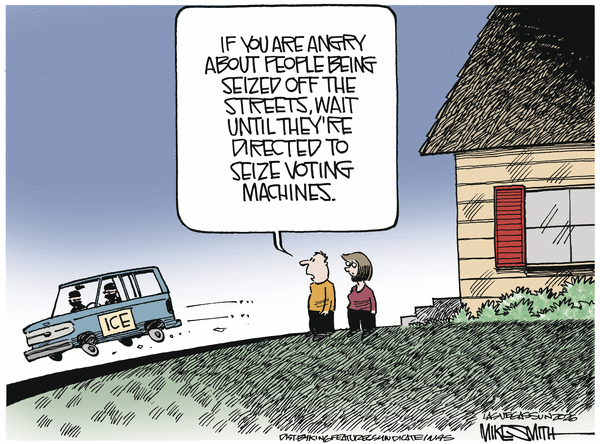
Political cartoons / memes / and news I want to share. 2-19-2026


I finally made a comic strip about fall (but without any references to pumpkin spice lattes).
This is me during high school in a nutshell btw


I have been here. No means no, stop means don’t argue just stop and change activites, consent can be withdrawn at any time during sex. Hugs

“Our flag is red, white, and blue, but our nation is a rainbow—red, yellow, brown, black, and white—and we are all precious in God’s sight.”










Many people have requested such wearable designs lately, so I was happy to oblige. Just a bunch of funny, silly, lighthearted designs, yes, such as:
-“Sorry babe, I can’t make it to the function tonight, I have fascists to punch” (my personal favorite);
-“Abolish ICE” but in a beautiful gradient from the future;
-“Nerds against ICE” with a natural 20 (they are messing with the wrong DnD party);
-“I thought we agreed that concentration camps were BAD”;
-“ICE OUT” but in trans colors for added conservative nightmares.
There’s also a few variants and other new stuff! Check them out here.







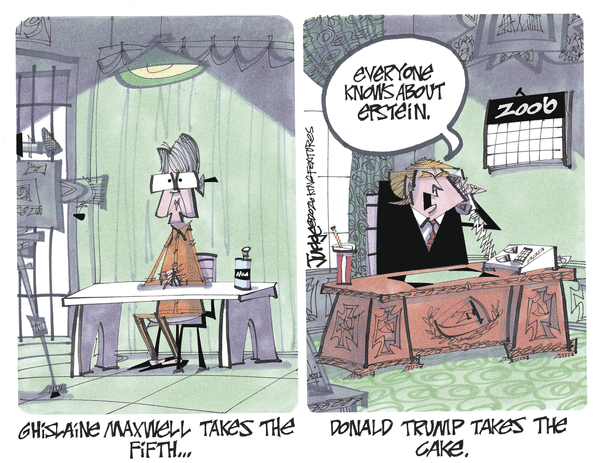
We know from testimony that there were abuse videos made and sent to Epstein. Trigger warning the meme below is very graphic and difficult to read. Hugs





Protesters Are Trump’s Next Target
No SAVE America Act:
I know; it’s always something, and it’s always call/write our lawmakers (which is no more than what we ought to be doing, anyway, but still.) Maybe a reader hasn’t decided what to stand up for, or stand up to. Might as well be this, then:
 Scottie's Playtime