watch-woman-arrested-mid-interview-after-protesting-against-trumps-venezuela-strike/#:~:text=WATCH%3A%20Woman%20Arrested%20Mid%2DInterview%20After%20Protesting%20Against%20Trump%E2%80%99s%20Venezuela%20Strike

In some places in the US cops are maga not enforcers of public peace and honoring the constitution.   We have the right in the constitution to address the government with protests of their actions.  How far have we moved to a fascist nation where the rule of law is simply might be delivered by thugs makes right.   Agree with us or else … A horrible place we are in.  Hugs


WATCH: Woman Arrested Mid-Interview After Protesting Against Trump’s Venezuela Strike

WATCH: Woman Arrested Mid-Interview After Protesting Against Trump’s Venezuela Strike

https://youtu.be/dNxc8YKHlpw

A Michigan protest organizer was arrested on camera while giving a TV interview criticizing President Donald Trump’s actions in Venezuela on Saturday.

Jessica Plichta, a 22-year-old preschool teacher and Grand Rapids Opponents of War organizer, was speaking to local ABC affiliate WZZM about a weekend protest condemning the capture of Venezuelan President Nicolás Maduro when police officers moved in behind her and placed her in handcuffs. The patrol car had been visible in the background moments earlier, its presence unremarked upon until the interview abruptly ended.

“It’s not just a foreign issue, it’s our tax dollars that are being used to commit these war crimes,” Plichta said on camera. “It is also the duty of us, the people, to stand against the Trump regime, the Trump administration, that are committing crimes both here in the U.S. and against people in Venezuela.”

As she was escorted to the police vehicle, she could be heard saying, “I am not resisting arrest.”

The clip quickly went viral, with WZZM later reporting that police said Plichta was arrested for “obstructing a roadway and failure to obey a lawful command from a police officer.”

Prior to her detention, Plichta told WZZM she had recently returned from Venezuela, where she attended the People’s Assembly for Peace and Sovereignty of Our America summit.

A police department spokesperson issued the following statement to AlterNet following the arrest:

A group was marching in the roadway. Over 25 announcements were made from the PA system of a marked police cruiser for the group to leave the roadway and relocate their activities to the sidewalk. Blocking traffic in this manner is a direct violation of city and state law,” the spokesperson stated. “The group refused lawful orders to move this free speech event to the sidewalk and instead began blocking intersections until the march ended. Patrol officers consulted with their sergeant and the watch commander who informed the officers that if the individuals could be located, they were subject to arrest. The adult woman who was arrested was positively identified by officers, and the lawful arrest was made.

After her release from jail, Plichta spoke with Zeteo about the incident.

“I don’t think it’s a coincidence that as soon as I finished an interview speaking on Venezuela, I was arrested – the only person arrested out of 200 people,” she told the outlet.

Watch above via WZZM.

Get the Facts: Is Venezuela a primary drug trafficker to the United States?

It was all a lie.  Rubio has always pushed for regime change in Cuba, and may experts say it should start with Venuzalia.  Rubio doesn’t care about the oil, he wants all support for Cuba stopped so the US can go into Cuba and return it to what his family fled so many years ago when they were abusing the locals for profit.  It is all a personal agenda he hopes will lead him to the presidency.  Hugs


https://www.wtae.com/article/venezuela-drug-trafficking-cocaine-fentanyl/69676930

WTAE logo

Updated: 4:23 PM EST Jan 3, 2026

The Trump administration has set its sights on Venezuela in its latest campaign against illegal drugs, but data shows that the country is responsible for just a sliver of drug trafficking directly to the United States.

The Get the Facts Data Team analyzed data on cocaine and fentanyl trafficking. While Venezuela is a player in cocaine manufacturing and trafficking, drug seizure data shows that it’s not as prominent a supplier of cocaine to the U.S. as other South American and Latin American countries.

There is also no evidence that any significant level of illegal fentanyl — the primary killer in U.S. overdose deaths — is produced in South America, according to the United Nations Office on Drugs and Crime (UNODC).

UNODC analyzes global drug trafficking based on reporting from its member states, open sources and drug seizure information.

Most illegal fentanyl enters the U.S. from Mexico, per UNODC and the U.S. Drug Enforcement Administration. Illicit fentanyl can also be diverted, or stolen, from legal sources as medical professionals use the drug.

Yet President Donald Trump has linked his administration’s attacks on drug vessels in Latin America to the fentanyl crisis, among other drugs.

After the Sept. 19 attack on a boat in the Caribbean that killed three people, Trump posted on Truth Social, claiming that the boat was carrying drugs and headed for America. “STOP SELLING FENTANYL, NARCOTICS, AND ILLEGAL DRUGS IN AMERICA,” his post said.

The next day, in a speech, Trump said that thousands are dying because of “boatloads” of fentanyl and drugs. He’s also repeatedly said that each boat strike would save 25,000 lives.

As of Friday, the number of known boat strikes was 35, and the number of people killed stands at least 115, according to the Trump administration.

Previously, Trump said that the U.S. is engaged in an “armed conflict” with drug cartels and has justified the boat strikes as necessary to stem the flow of drugs into the U.S. Hearst Television’s partner PolitiFact labeled that 25,000 number mathematically dubious.

Maduro’s capture on Jan. 3

On Saturday, the Trump administration struck Venezuela in a new, stunning way, capturing its leader, Nicolas Maduro, and his wife. Both are being taken to the United States to face charges related to drug trafficking.

The strike followed a monthslong Trump administration pressure campaign on the Venezuelan leader, including a major buildup of American forces in the waters off South America and attacks on boats in the eastern Pacific and Caribbean accused of carrying drugs. Last week, the CIA was behind a drone strike at a docking area believed to have been used by Venezuelan drug cartels — the first known direct operation on Venezuelan soil since the U.S. began strikes in September.

Venezuela’s role in cocaine trafficking

Venezuela is not among the primary direct traffickers of cocaine to the U.S.

Like fentanyl, most cocaine enters the U.S. from Mexico and typically gets to Mexico via maritime transportation on both the Pacific and Caribbean sides, according to UNODC research officer Antoine Vella. Some also arrives in Mexico via land transportation.

While the Trump administration’s early September attacks targeted Venezuelan boats, there is no known direct cocaine trade route from Venezuela to the U.S. via sea. The only known direct Venezuela to U.S. trafficking route is via air, according to drug seizure data from UNODC. Cocaine could still arrive from Venezuela to the U.S. through intermediary countries.

Colombia, Ecuador and Panama are among the main direct traffickers of cocaine to the U.S. via boat.

From harvest to production

Coca, the plant that cocaine is made from, is grown primarily in Colombia, Peru and Bolivia.


Once coca is harvested, the cocaine in the leaf needs to be extracted. That processing occurs at illegal manufacturing facilities around the globe.

The three coca-growing countries also have the most illegal processing facilities. Colombia had by far the most of any country at about 26,400 detected and dismantled from 2019 to 2023, according to UNODC data. It’s followed by about 3,200 processing facilities in Bolivia and 2,400 in Peru.

Venezuela, which neighbors Colombia, had about 260 illegal processing facilities detected and dismantled from 2019 to 2023, according to UNODC data. It’s ranked fifth among countries with the most processing facilities.

“Every country that borders Colombia has an issue with cocaine in terms of cocaine trafficking,” Vella said.


Trump says the U.S. government may reimburse oil companies for rebuilding Venezuela’s infrastructure

No healthcare subsidies, no money to feed poor people or kids who need government help to have lunch.  As a kid often the only meal I got was lunch at school.   No one monitored if I paid or not I was given food to eat like every other kid.   In Jr / Senior high school, say from 13 to 18 again my only meal was lunch or snacks at school.  But yes the tRump admin was cutting every safety net program and even halting child care so it hurts Walz, and stopping FEMA funds to states run by democrats among other cuts to already congress approved funding.   All illegally I will add but the republicans in congress are too scared of tRump to object to his being a tyrant.   But we have plenty of money for companies and businesses to extract oil.   

On The Majority Report I am listening to an oil person saying that the price of oil has fallen below $50 a barrel because of a glut on the market, and that Venezuelan oil is “sour oil” meaning it is hard to refine.  He says that to make a profit on that prices have to be over $80 dollars a barrel.   Which means this demented daydream of Rubio’s and Miller’s is not about oil so much as territorial control over other countries and Rubio has long wanted Cuba to fall to the US so his parent’s lands and money can be claimed from the rightful owners of it now.   Rubio’s family fled Cuba as refugees and lost all their holdings in Cuba, he has made a career of wanting it all back and toppling Castro.  But … well Rubio and the neocons claim that if we can make Venzualia fall into line then all the other Latin American countries will fall in line also and Cuba’s government will be destroyed.  Just like if we take out Saddam Hussein then the entire Middle East will embrace democracy.   Same story different location.   And it is all lies.  Just an excuse to use the US military might and have a reason to deny any public relief or safety nets at home.   Hugs


https://www.nbcnews.com/business/energy/trump-venezuela-oil-companies-reimburse-rcna252434

Big oil firms will either “get reimbursed by us or through revenue,” Trump told NBC News in an exclusive interview.

President Donald Trump said he believes the U.S. oil industry could get expanded operations in Venezuela “up and running” in fewer than 18 months.

“I think we can do it in less time than that, but it’ll be a lot of money,” Trump told NBC News in an interview Monday.

“A tremendous amount of money will have to be spent, and the oil companies will spend it, and then they’ll get reimbursed by us or through revenue,” he said.

Whether the U.S. government ultimately agrees to reimburse the oil industry’s costs in Venezuela, or alternatively, decides that future revenue is sufficient repayment, will likely be a key factor for the oil companies as they consider their options.

Trump declined to say how much money he believes it would cost companies to repair and upgrade Venezuela’s aging oil infrastructure.

“It’ll be a very substantial amount of money will be spent” by the oil companies, Trump said. “But they’ll do very well.”

“And the country will do well,” he added.

Despite Trump’s optimism, oil companies have appeared skeptical of quickly entering, expanding or investing in Venezuela. A history of state asset seizures, the ongoing U.S. sanctions and the latest political instability all feed into this caution.

Trump said he believed that tapping Venezuela’s oil reserves is “going to reduce oil prices.”

Gas prices are already at multiyear lows. The average retail gas price on Monday was $2.81, according to AAA. That’s the lowest since March 2021.

“Having a Venezuela that’s an oil producer is good for the United States because it keeps the price of oil down,” Trump also added.

While lower oil prices could make gas cheaper at the pump, it would likely also mean lower revenues for the same big oil companies that Trump is counting on to bankroll the rebuilding of Venezuela’s oil industry to the tune of billions of dollars in foreign investment.

Asked if the administration had briefed any oil companies ahead of Saturday’s military operation to capture deposed Venezuelan leader Nicolás Maduro, Trump said, “No. But we’ve been talking to the concept of, ‘what if we did it?'”

“The oil companies were absolutely aware that we were thinking about doing something,” Trump said. “But we didn’t tell them we were going to do it.”

Trump told NBC News it was “too soon” to say whether he had personally spoken to top executives at America’s three largest oil producers, Exxon Mobil, Chevron and ConocoPhillips.

“I speak to everybody,” he said.

ConocoPhillips declined to comment Monday on Trump’s plans for Venezuela’s oil reserves. Chevron told NBC News it does not comment “on commercial matters or speculate on future investments.” Exxon did not immediately respond to questions.

Energy Secretary Chris Wright plans to meet with executives from Exxon and ConocoPhillips this week about Venezuela’s oil industry, Bloomberg News reported Monday, citing people familiar with the matter.

Wright will be a point person for the Trump administration’s broader campaign to rebuild Venezuela’s oil infrastructure, a White House official said Monday.

The Trump administration has repeatedly claimed that the U.S. oil industry is eager to return to Venezuela, nearly two decades after the country last nationalized billions of dollars’ worth of oil company assets.

“They want to go in so badly,” Trump told reporters Sunday evening.

Despite Venezuela’s massive reserves of crude oil, large U.S. oil firms have a good reason to pause before committing to expand operations in Venezuela.

In the 1970s, the Venezuelan government nationalized energy assets there, including those owned by Exxon Mobil and ConocoPhillips. In the years since, the companies have tried unsuccessfully to recover billions of dollars.

In 2006 and 2007, the Venezuelan government nationalized even more assets. Then-President Hugo Chávez allowed foreign oil firms to remain, but on less favorable terms, leading to the full departure of Exxon and Conoco.

Chevron, however accepted the terms and remains to this day, thanks in large part to a limited waiver exempting it from U.S. sanctions on Venezuelan oil.

Exxon Mobil CEO Darren Woods recently expressed caution about re-entering Venezuela.

“We’ve been expropriated from Venezuela two different times,” he told Bloomberg News in November, replying to a question about whether Exxon would be interested in Venezuela’s oil or gas. “We’d have to see what the economics look like.”

This Is EXACTLY How Trump Wanted Schumer To React…

Let’s talk about Trump, chess, Venezuela, Ajax….


Political cartoons / memes / and news I want to share. 1-6-2026

Image from Assigned Male

Image from Assigned Male

Image from Assigned Male


#Samwise Gamgee from What Are You Really Afraid Of?


#ManChildTrump from What Are You Really Afraid Of?


#DOGE from Progressive Power


#public libraries from Library Journal


image

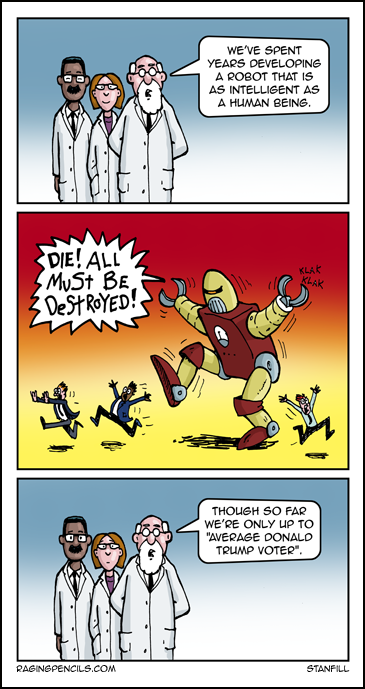
The progressive comic about Trump's idiot voters


Image from What Are You Really Afraid Of?


#cat from Catasters


Image from Making Donald Drumpf Again


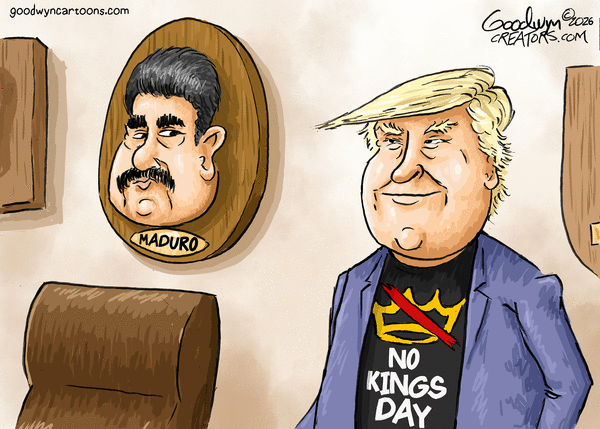
Al Goodwyn for 1/5/2026


image
image

A curtained off section of a larger room is NOT a SCIF. The incompetence of this administration knows no bounds.

And the fact that X is pulled up on the screen behind them is just…embarrassing.

Who thought this was a good photo to release?

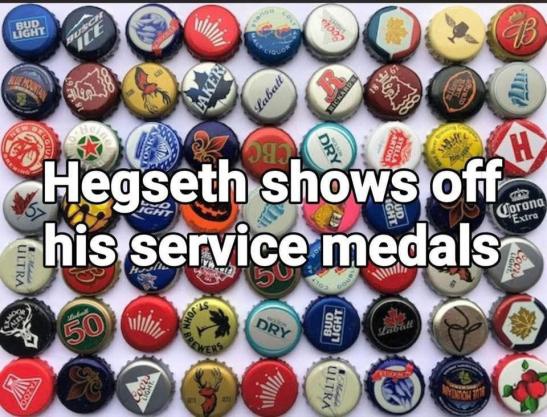
Looks like Pete Hegseth is either checking the online cocktail menu or lurking for exes on Facebook. Both can be true.


#politics from Cartoon Politics


image


THE HISTORY OF RELIGIOUS CONFLICT IN THE UNITED STATES: REVOLUTION TO SEPTEMBER 11TH

Roger sent this to me and I thought it was so grand and important that I want to share it before I shut down my blogging computer.    Hugs

https://web.stanford.edu/class/e297a/The%20History%20of%20Religious%20Conflict.htm

 Throughout its history, the United States has characteristically remained a country of two things: a country of immigrants, and a country of unmatched religious diversity.  And yet when compared with the rest of the world – where these two very factors alone have so often engendered horrible religious wars and decades of enduring conflict – the history of religious conflict in the United States seems almost nonexistent.

That is not to say the United States has been immune to its share of conflict explicitly rooted in religion.  This paper explores the various manifestations of religious conflict throughout the history of the United States, from the Revolutionary War to the attacks of September 11th and their fallout.  A distinction is drawn between religious intolerance, which is not the focus of this paper, and outright religious persecution or violence.  Similarly, the paper reflects efforts made to de-conflate religious conflict from ethnic and racial conflict, which has been much more prominent throughout the history of the United States.  In examining the history of religious violence, intolerance, discrimination, and persecution in the United States, we arrive at some possible explanations for why the United States has seen such minimal religious conflict despite being so religiously diverse.

The Revolution

It has been said that the United States is a nation founded on religious conflict.  The colonies were settled by those escaping religious persecution in Europe.  There is even some evidence that religion played a major role in the American Revolution and that revolutionaries believed it was willed by God for the Americans to wage war against the British.[1]

As the Church of England was striving to establish one, uniform religion across the kingdom, colonial America was divided, each of the colonies being dominated by their own brand of Christianity.  Due to the distance from England and the room in the colonies, many religions were able to establish themselves in America, colony by colony.  For example, Anglicans, who conformed to the Church of England, populated Virginia. Massachusetts was home to the Puritans.  Pennsylvania was full of Quakers.  Baptists ruled in Rhode Island.  And Roman Catholics found a haven in Maryland, where they could establish themselves amid the other colonists’ protestant majority.  Each of these colonies maintained a distinct religious character and favored one religious denomination’s power.

The American colonists saw the revolution not only as a war for political independence, but to protect the religious diversity of the thirteen colonies.  Put in other terms, it was a war for religious independence and freedom.  To sever ties with Mother England would be to ensure that the various Christian denominations could co-exist on the American continent.  The conflict was, in part, a conflict that pitted the various American religious denominations against the Church of England, who wanted to impose a uniform, Anglican religion on the colonies.

Early Religious Persecution

The period after the Revolutionary War saw a lot of infighting between the various states and Christian denominations.  Virginia, which was home to the largest portion of Anglicans loyal to the Church of England, was the scene of notorious acts of religious persecution against Baptists and Presbyterians.  Anglicans physically assaulted Baptists, bearing theological and social animosity.  In 1771, a local Virginia sheriff yanked a Baptist preacher from the stage at his parish and beat him to the ground outside, where he also delivered twenty lashes with a horsewhip.  Similarly, in 1778, Baptist ministers David Barrow and Edward Mintz were conducting services at the Mill Swamp Baptist Church in Portsmouth, Virginia.[2]  As soon as the hymn was given out, a gang of men rushed the stage and grabbed the two ministers, took them to the nearby Nansemond River swamp, and dunked and held their heads in the mud until they nearly drowned to death.

The period during and soon after the Revolutionary War also saw abundant political manifestations of religious conflict.  At the time, some states abolished churches, while supporting others, issued preaching licenses, and collected tax money to fund and establish state churches.  Each state constitution differed in its policy on religious establishment, or state-supported religion.  It would not be until well after the adoption of the Constitution of 1789 and the First Amendment religion clauses that the disestablishment for which the United States is so recognized became the de facto practice.

1800s

The early part of the 19th Century was relatively quiet in terms of religious conflict in America.  The religious conflict that stands out in this period involves tensions between Catholics and Protestants, culminating in violence directed at Irish Catholic immigrants.  The surge in immigration from Europe during the 19th Century coincided with and influx of Catholics and the rise of activist Protestantism in the U.S.  As strong Protestant values permeated the country, immigrants who were Catholic also became viewed as outsiders and undemocratic.  These views are separate from, but on top of, the harsh anti-Irish sentiment that also spread during the period.

In the 1830s and 1840s, anti-Catholic violence broke out in the Northeast and elsewhere.  In 1835, one incident was ignited by a speaking tour by Lyman Beecher, who published Plea for the West, a book about a Catholic plot to take over the U.S. and impose Catholic rule.  After Beecher’s speaking tour passed through Charlestown, Massachusetts, a mob set fire to the Ursuline convent and school.[3]  In Philadelphia in 1844, pitched gun battles broke out between “native” Americans and mostly Irish Catholics.  Martial law had to be declared in order to end the violence.[4]

The Mormon War, the Utah War

Around the same time as anti-Catholic violence broke out in the Northeast, another religious group was being chased out of the same area.  The Mormons, who emerged after the 1830 discovery of The Book of Mormon, were a religious community chased out of New York, out of Ohio, out of Missouri, and out of Illinois, to Utah, where they finally settled.

In Illinois in 1839, the Mormons settled Nauvoo and built a thriving Mormon town there, complete with a large Mormon temple.  In the short period of three years, the Mormons prospered, announced the doctrine of polygamy, and founder Joseph Smith announced his candidacy for president of the United States.  Locals were intimidated and envious.  Smith and his brother Hyrum were arrested on morals charges and held in jail.  On June 27, 1844, an anti-Mormon mob attacked Nauvoo and burned it to the ground.[5]  They also invaded the jail cells where Smith and his brother were being held, and executed them.

Shortly after the sacking of Nauvoo, Brigham Young announced his leadership of the Mormons and led them to Utah, where they flourished.  In 1857, fears of a religious state of Mormons grew and the president ordered federal troops to enforce the installation of federal judges and a new non-Mormon governor.  At some point in the interim, this is still a subject of debate, the infamous Mountain Meadow Massacre happened – in which local Mormons slaughtered a group of 120 California-bound pioneers who were openly hostile toward their religion and making threats to return from California to attack them.[6]

The massacre only fueled anti-Mormon sentiment.  Tensions escalated. The Mormon army, also known as the Nauvoo Legion, was called out to respond to the imminent arrival of 2,000 U.S. Army troops.  Salt Lake City was evacuated on standing orders to burn the city should an invasion occur.  No violence was to break out, as attention was diverted to the Civil War.

As the federal government focused its energies on fighting the Civil War, legal sanctions and political oppression of the Mormons continued that virtually dissolved the church by 1887.  It wasn’t until the 1890s, when the Mormons ended the practice of polygamy, that Utah finally achieved statehood in 1896.[7]

The Jewish Experience

At the end of the 1890s, the U.S. began seeing the first wave of anti-Semitism, just as the federal government began restricting immigration from Europe.  While concentrations of Jews have lived in America since colonial times, they were largely tolerated and discriminated against in localized incidents.  By the 1920s, immigration quotas had taken effect and limits on the basis of national origin.  These quotas were not repealed during the Holocaust, even as Jewish refugees were fleeing Hitler’s Europe.

Between 1933 and 1939, the period of the Great Depression, anti-Semitic fervor reached heights never before seen or later seen in entire the history of the Jewish experience in America.  In urban areas such as New York and Boston, Jews were violently attacked.[8]  Most anti-Jewish sentiment was manifested in social and political discrimination.  Assaults, propaganda and intimidation were mostly carried out by special societies, such as the Silver Shirts or the Ku Klux Klan.

Overall, the experience of Jews in America has been encouragingly free from the violent persecution seen elsewhere in the world.  Indeed, racial and social intolerance persisted since the colonial days until the 1950s, as Jews were not allowed membership in country clubs, excluded from colleges, banned from practicing medicine, and from holding political office in many states.  However, religious conflict rooted in anti-Semitism has been largely non-violent.

Hate Crimes as Religious Conflict

The incidents of violence against individual Jews that characterized the anti-Semitism of the Great Depression would have fallen under the category of religious hate crimes if the FBI, then known as the Bureau of Investigation, were collecting those statistics at the time.  Despite the diversity of the United States, in all aspects such as race, national origin, religion and sexual orientation, the federal government (by way of the FBI) did not start keeping tabs on hate crimes until 1992.  Religiously speaking, anti-Semitic hate crimes have always dominated the national hate crime statistics gathered by the FBI for the past ten years.  However, the current numbers paint a changing landscape.

According to the ACLU, the U.S. is home to more than 1,500 religions and 360,000 religious centers.[9]  Christianity has long dominated the country’s religious make-up, followed by Judaism.  According to the latest statistics released by the Harvard University Religious Pluralism Project, Islam has surpassed Judaism and is the country’s Number Two religion.[10]

Following the terrorist attacks of September 11th, the FBI found that anti-Muslim sentiments spiked and verifiable, religiously motivated hate crimes against Muslims in the U.S. increased 1,600 percent in 2001 from the prior year.[11]

In fact, the FBI, which has tracked hate crimes since 1992, reports that Anti-Muslim hate crimes had previously been the second-least reported.  But in 2001, they became the second-highest reported, second only to anti-Jewish hate crimes.  It should be noted that these statistics are separate from crimes motivated against race, national origin or ethnicity – these are crimes against person and property in which religion was a motivating negative factor.

Conclusion

The U.S. has been fortunate in that it has not witnessed religious war and conflict of the scale seen in the Middle East and Europe.  Although the number of different religions in the U.S. has steadily grown over the decades, this diversity has not let to conflict.  Some propositions for why this may be:

The United States as a country of immigrants

This factor defuses historical and religious claims to territory, which are not as strong as they are in places such as the West Bank and Ireland.  It also may explain a greater likelihood for a system of conflict to eventually resolve itself in favor of tolerance rather than further conflict, as each new group of immigrants to America has generally shared a story of persecution.

Constitutional protections and religious disestablishment

The American tradition of the separation of church and state cannot be overlooked in mediating and possibly preventing religious conflict to erupt.  In many other parts of the world, religion is still highly influential and, in some cases, sponsored by the state.  However, in a country with such religious diversity, religious disestablishment has proved necessary so that the government could not take sides in a religious conflict.

Diversity creates tolerance

The argument also exists that the immense diversity in and of itself has promoted tolerance among religions.  Religious pluralism inspires attitudes that homogeneity is a natural part of the religious environment and that there is room for each religion to exist in America.

As the United States enters the 21st Century, these important factors will prove to be influential in the face of catastrophic events, and economic, social and political changes that challenge the level of religious tolerance the nation has maintained for over two centuries.

[1] Religion and the American Revolution. “Religion and the Founding of the American Republic.” Ed. James H. Huston.  1998.  http://lcweb.loc.gov/exhibits/religion/rel03.html

[2] Ibid.

[3] Encyclopedia of American Religious History, Revised Edition, Vol. II.  “Religious violence.” Edward L. Queen II. Page 601. 2001.

[4] Ibid.

[5] Queen, 602.

[6] Emily Eakin. “Reopening a Mormon Murder Mystery.” The New York Times, section B, page 9, Oct. 12, 2002.

[7] Queen, 605.

[8] “Antisemitism in the Depression Era (1933-1939),” Leonard Dinnerstein. Religion in American History, A reader.  Page 413. 1998.

[9] “Religious Liberty.” American Civil Liberties Union.  http://www.aclu.org/ReligiousLiberty/ReligiousLibertyMain.cfm

[10] “Geographic Distribution of Religious Centers in the U.S” Committee on the Study of Religion. Harvard University, Jan. 2002. http://www.plurarlism.org/resources/statistics/distribution.php

[11] “Foreword.” Department of Justice, Federal Bureau of Investigation. http://www.fbi.gov/ucr/01hate.pdf

Political cartoons / memes / and news I want to share. 1-5-2026


Image from Assigned Male

Image from Assigned Male


#healthcare from AZspot


Political cartoon.

#OurProgressive from Progressive Power

Image from A sudden, violent jerk....

#OurProgressive from Progressive Power


Political cartoon


The cartoonist's homepage, citizen-times.com/voices-views


The cartoonist's homepage, news-press.com/opinion


Image from Liberals Are Cool


Political cartoon.


Political cartoon.


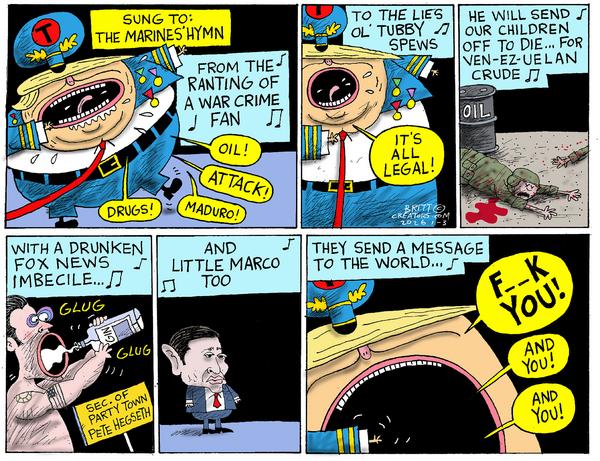
Chris Britt for 1/3/2026


image

The Trump administration wants it both ways.

On Saturday, it tells us that Nicolás Maduro is such a uniquely dangerous despot — so criminal, so destabilizing, so irredeemable — that the United States had no choice but to remove him from power by force. Maduro, we are told, is a narco-dictator, a human rights abuser, a menace to his own people and to regional stability.

On Sunday, the same administration will continue putting Venezuelan asylum seekers on planes and deports them back to the country that, according to its own rhetoric, was so dangerous it required regime change.

This is not just hypocrisy. It is a logical impossibility masquerading as policy.

Julie Roginsky


Political cartoon.


Political cartoon.


The cartoonist's homepage, knoxnews.com/opinion/charlie-daniel


US can’t deport hate speech researcher for protected speech, lawsuit says

https://arstechnica.com/tech-policy/2025/12/us-cant-deport-hate-speech-researcher-for-protected-speech-lawsuit-says/

On Monday, US officials must explain what steps they took to enforce shocking visa bans.

Ashley Belanger – 
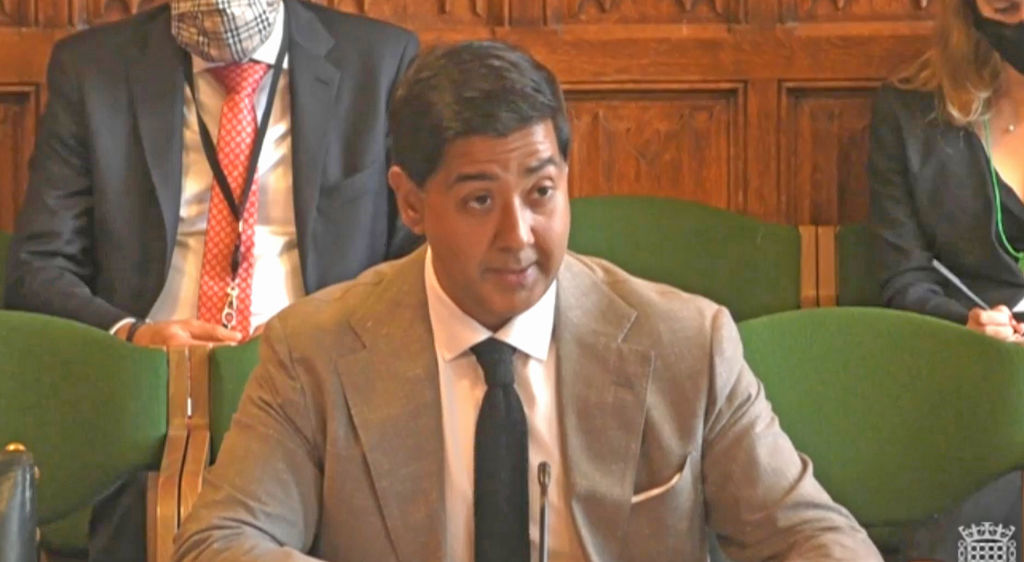
Imran Ahmed, the founder of the Center for Countering Digital Hate (CCDH), giving evidence to joint committee seeking views on how to improve the draft Online Safety Bill designed to tackle social media abuse. Credit: House of Commons – PA Images / Contributor | PA Images

Imran Ahmed’s biggest thorn in his side used to be Elon Musk, who made the hate speech researcher one of his earliest legal foes during his Twitter takeover.

Now, it’s the Trump administration, which planned to deport Ahmed, a legal permanent resident, just before Christmas. It would then ban him from returning to the United States, where he lives with his wife and young child, both US citizens.

After suing US officials to block any attempted arrest or deportation, Ahmed was quickly granted a temporary restraining order on Christmas Day. Ahmed had successfully argued that he risked irreparable harm without the order, alleging that Trump officials continue “to abuse the immigration system to punish and punitively detain noncitizens for protected speech and silence viewpoints with which it disagrees” and confirming that his speech had been chilled.

US officials are attempting to sanction Ahmed seemingly due to his work as the founder of a British-American non-governmental organization, the Center for Countering Digital Hate (CCDH).

“An egregious act of government censorship”

In a shocking announcement last week, Secretary of State Marco Rubio confirmed that five individuals—described as “radical activists” and leaders of “weaponized NGOs”—would face US visa bans since “their entry, presence, or activities in the United States have potentially serious adverse foreign policy consequences” for the US.

Nobody was named in that release, but Under Secretary for Public Diplomacy, Sarah Rogers, later identified the targets in an X post she currently has pinned to the top of her feed.

Alongside Ahmed, sanctioned individuals included former European commissioner for the internal market, Thierry Breton; the leader of UK-based Global Disinformation Index (GDI), Clare Melford; and co-leaders of Germany-based HateAid, Anna-Lena von Hodenberg and Josephine Ballon. A GDI spokesperson told The Guardian that the visa bans are “an authoritarian attack on free speech and an egregious act of government censorship.”

While all targets were scrutinized for supporting some of the European Union’s strictest tech regulations, including the Digital Services Act (DSA), Ahmed was further accused of serving as a “key collaborator with the Biden Administration’s effort to weaponize the government against US citizens.” As evidence of Ahmed’s supposed threat to US foreign policy, Rogers cited a CCDH report flagging Robert F. Kennedy, Jr. among the so-called “disinformation dozen” driving the most vaccine hoaxes on social media.

Neither official has really made it clear what exact threat these individuals pose if operating from within the US, as opposed to from anywhere else in the world. Echoing Rubio’s press release, Rogers wrote that the sanctions would reinforce a “red line,” supposedly ending “extraterritorial censorship of Americans” by targeting the “censorship-NGO ecosystem.”

For Ahmed’s group, specifically, she pointed to Musk’s failed lawsuit, which accused CCDH of illegally scraping Twitter—supposedly, it offered evidence of extraterritorial censorship. That lawsuit surfaced “leaked documents” allegedly showing that CCDH planned to “kill Twitter” by sharing research that could be used to justify big fines under the DSA or the UK’s Online Safety Act. Following that logic, seemingly any group monitoring misinformation or sharing research that lawmakers weigh when implementing new policies could be maligned as seeking mechanisms to censor platforms.

Notably, CCDH won its legal fight with Musk after a judge mocked X’s legal argument as “vapid” and dismissed the lawsuit as an obvious attempt to punish CCDH for exercising free speech that Musk didn’t like.

In his complaint last week, Ahmed alleged that US officials were similarly encroaching on his First Amendment rights by unconstitutionally wielding immigration law as “a tool to punish noncitizen speakers who express views disfavored by the current administration.”

Both Rubio and Rogers are named as defendants in the suit, as well as Attorney General Pam Bondi, Secretary of Homeland Security Kristi Noem, and Acting Director of US Immigration and Customs Enforcement Todd Lyons. In a loss, officials would potentially not only be forced to vacate Rubio’s actions implementing visa bans, but also possibly stop furthering a larger alleged Trump administration pattern of “targeting noncitizens for removal based on First Amendment protected speech.”

Lawsuit may force Rubio to justify visa bans

For Ahmed, securing the temporary restraining order was urgent, as he was apparently the only target currently located in the US when Rubio’s announcement dropped. In a statement provided to Ars, Ahmed’s attorney, Roberta Kaplan, suggested that the order was granted “so quickly because it is so obvious that Marco Rubio and the other defendants’ actions were blatantly unconstitutional.”

Ahmed founded CCDH in 2019, hoping to “call attention to the enormous problem of digitally driven disinformation and hate online.” According to the suit, he became particularly concerned about antisemitism online while living in the United Kingdom in 2016, having watched “the far-right party, Britain First,” launching “the dangerous conspiracy theory that the EU was attempting to import Muslims and Black people to ‘destroy’ white citizens.” That year, a Member of Parliament and Ahmed’s colleague, Jo Cox, was “shot and stabbed in a brutal politically motivated murder, committed by a man who screamed ‘Britain First’” during the attack. That tragedy motivated Ahmed to start CCDH.

He moved to the US in 2021 and was granted a green card in 2024, starting his family and continuing to lead CCDH efforts monitoring not just Twitter/X, but also Meta platforms, TikTok, and, more recently, AI chatbots. In addition to supporting the DSA and UK’s Online Safety Act, his group has supported US online safety laws and Section 230 reforms intended to protect kids online.

“Mr. Ahmed studies and engages in civic discourse about the content moderation policies of major social media companies in the United States, the United Kingdom, and the European Union,” his lawsuit said. “There is no conceivable foreign policy impact from his speech acts whatsoever.”

In his complaint, Ahmed alleged that Rubio has so far provided no evidence that Ahmed poses such a great threat that he must be removed. He argued that “applicable statutes expressly prohibit removal based on a noncitizen’s ‘past, current, or expected beliefs, statements, or associations.’”

According to DHS guidance from 2021 cited in the suit, “A noncitizen’ s exercise of their First Amendment rights … should never be a factor in deciding to take enforcement action.”

To prevent deportation based solely on viewpoints, Rubio was supposed to notify chairs of the House Foreign Affairs, Senate Foreign Relations, and House and Senate Judiciary Committees, to explain what “compelling US foreign policy interest” would be compromised if Ahmed or others targeted with visa bans were to enter the US. But there’s no evidence Rubio took those steps, Ahmed alleged.

“The government has no power to punish Mr. Ahmed for his research, protected speech, and advocacy, and Defendants cannot evade those constitutional limitations by simply claiming that Mr. Ahmed’s presence or activities have ‘potentially serious adverse foreign policy consequences for the United States,’” a press release from his legal team said. “There is no credible argument for Mr. Ahmed’s immigration detention, away from his wife and young child.”

X lawsuit offers clues to Trump officials’ defense

To some critics, it looks like the Trump administration is going after CCDH in order to take up the fight that Musk already lost. In his lawsuit against CCDH, Musk’s X echoed US Senator Josh Hawley (R-Mo.) by suggesting that CCDH was a “foreign dark money group” that allowed “foreign interests” to attempt to “influence American democracy.” It seems likely that US officials will put forward similar arguments in their CCDH fight.

Rogers’ X post offers some clues that the State Department will be mining Musk’s failed litigation to support claims of what it calls a “global censorship-industrial complex.” What she detailed suggested that the Trump administration plans to argue that NGOs like CCDH support strict tech laws, then conduct research bent on using said laws to censor platforms. That logic seems to ignore the reality that NGOs cannot control what laws get passed or enforced, Breton suggested in his first TV interview after his visa ban was announced.

Breton, whom Rogers villainized as the “mastermind” behind the DSA, urged EU officials to do more now defend their tough tech regulations—which Le Monde noted passed with overwhelming bipartisan support and very little far-right resistance—and fight the visa bans, Bloomberg reported.

“They cannot force us to change laws that we voted for democratically just to please [US tech companies],” Breton said. “No, we must stand up.”

While EU officials seemingly drag their feet, Ahmed is hoping that a judge will declare that all the visa bans that Rubio announced are unconstitutional. The temporary restraining order indicates there will be a court hearing Monday at which Ahmed will learn precisely “what steps Defendants have taken to impose visa restrictions and initiate removal proceedings against” him and any others. Until then, Ahmed remains in the dark on why Rubio deemed him as having “potentially serious adverse foreign policy consequences” if he stayed in the US.

Ahmed, who argued that X’s lawsuit sought to chill CCDH’s research and alleged that the US attack seeks to do the same, seems confident that he can beat the visa bans.

“America is a great nation built on laws, with checks and balances to ensure power can never attain the unfettered primacy that leads to tyranny,” Ahmed said. “The law, clear-eyed in understanding right and wrong, will stand in the way of those who seek to silence the truth and empower the bold who stand up to power. I believe in this system, and I am proud to call this country my home. I will not be bullied away from my life’s work of fighting to keep children safe from social media’s harm and stopping antisemitism online. Onward.”

Photo of Ashley Belanger
Ashley is a senior policy reporter for Ars Technica, dedicated to tracking social impacts of emerging policies and new technologies. She is a Chicago-based journalist with 20 years of experience.

Trump’s DHS pushes for new ‘emergency’ demolitions of D.C. historic buildings

Everyone in tRump’s admin can see him failing and each one is pushing hard to get their personal desire / goal / profit done before he gets so bad the public can see he is not really making the decisions.  This is one of these.   Plus tRump is driven to put his name on every thing, every building, every aspect of government because he is terrified that people will realize how failing / stupid / bad / and scared he is of being forgotten because he never really accomplished anything naming worthy.  But we have to remember that each member of his cabinet and inner circle have their own goals and things they want to do under tRump’s name.   They realize they are fast running out of time.   Hugs


Trump’s DHS pushes for new ‘emergency’ demolitions of D.C. historic buildings

The Trump administration is extending its wrecking ball to yet more historic buildings in Washington as the president’s pet projects — including his golden ballroom and triumphal arch — press forward.

Kristi Noem.
Homeland Security Secretary Kristi Noem appears before the House Committee on Homeland Security on Capitol Hill on Dec. 11, 2025.Mark Schiefelbein / AP Photo