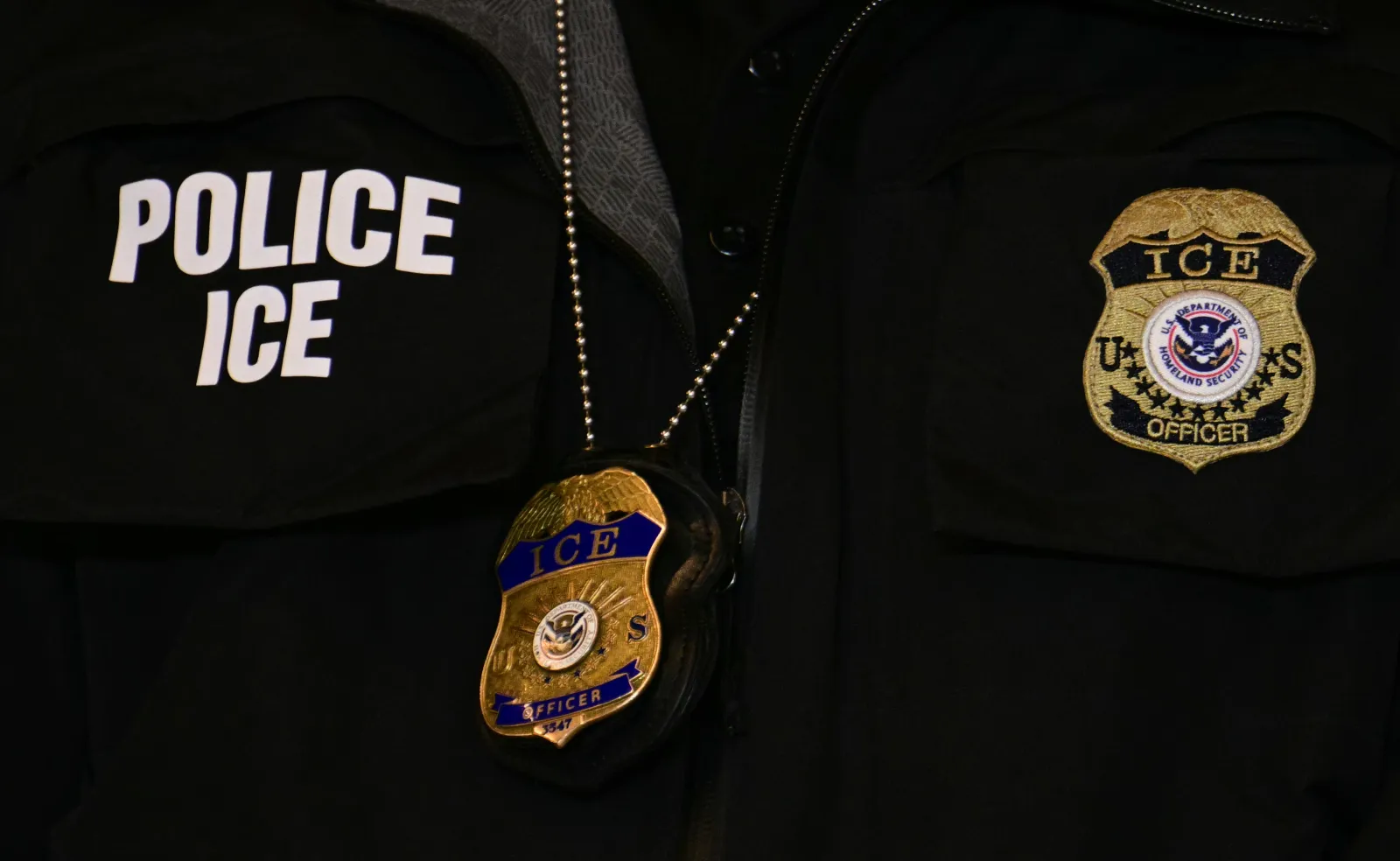
ICE agents violently restrained a woman in Minneapolis on Monday, dragging her through the snow and pinning her face down as onlookers shouted that the woman was pregnant.
During what was supposed to be a “targeted vehicle stop,” according to ICE officials, protesters swarmed the agents. Esme Murphy, a WCCO reporter, was on the scene, where she saw ICE holding a woman on the ground.
“Please let her go! She’s pregnant!” one onlooker shouted.
“Get her off of her fucking stomach,” another said.
In response to this, one agent fired a Taser into the crowd. “Who wants more?” he taunted, according to WCCO.
“We kept yelling, ‘She is pregnant, she’s pregnant,’” resident Tonika Deutch told Murphy. “They put their knees on her. We kept telling them, ‘She can’t breathe, let her up, let her up.’”
The woman was then dragged by one arm, as the crowd continued to yell and plead with the ICE agents. Bystanders threw snowballs, and ICE agents fired pepper spray into the crowd—hitting Murphy, the reporter, as well as her photographer.
ICE called the Minneapolis Police Department for backup. Once they arrived, the officers determined there was “no violence occurring” against the agents. “We have been training our officers for the last five years very, very intensely on de-escalation, but unfortunately that is … often not what we are seeing from other agencies in the city,” Minneapolis Police Chief Brian O’Hara told WCCO.
According to ICE, they succeeded in arresting the targets of their operation: a young Ecuadorian couple who were abducted from their car, its windows shattered by agents. The woman is currently in custody in Illinois, and it’s not known where her husband is being held. Two U.S. citizens were also arrested for assaulting federal officers, according to CBS.
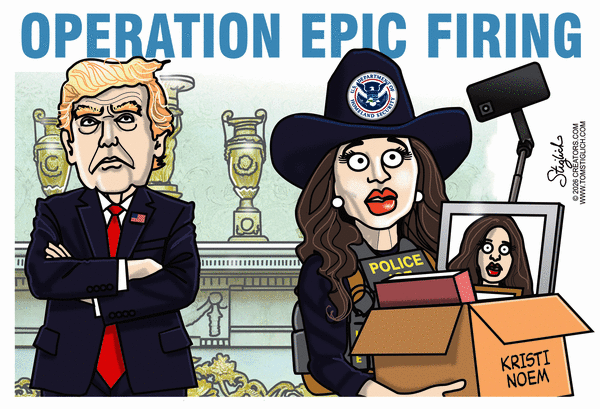
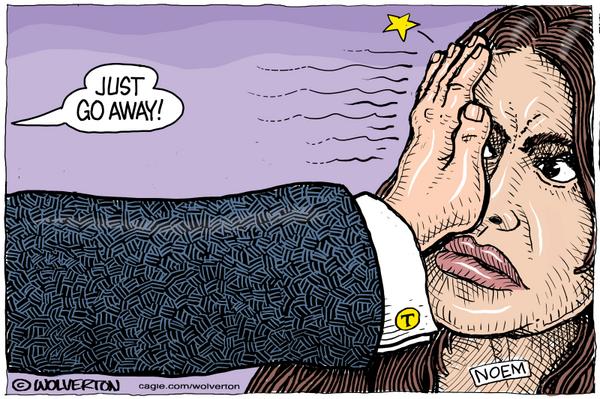
Homeland Security Secretary Kristi Noem | Steven Spearie/The State Journal-Register / USA TODAY NETWORK
Rep. Robert Garcia (D-CA) confronted Homeland Security Secretary Kristi Noem about the administration sending a gay man to a prison camp in El Salvador and not even knowing if he’s still alive. Noem said that it wasn’t her problem.
Noem, who has bragged in the past about shooting her dog to death, appeared before the House Homeland Security Committee for a hearing yesterday, where Garcia asked her about Andry Hernandez Romero, a gay hair dresser from Venezuela who came to the U.S. legally to escape anti-LGBTQ+ violence and who was sent to the CECOT camp in El Salvador, which is known for torturing inmates, earlier this year.
The administration, which sent immigrants to the CECOT without letting courts determine if they were in the country illegally or if they had committed any crimes, has refused to try to bring anyone back from the camp.
“Would you commit to just letting his mother know – as a mother-to-mother – if Andry is alive?” Garcia asked Noem. “He was given an asylum appointment by the United States government. We gave him an appointment, we said, Andry, come to the border at this time and claim asylum, he was taken to a foreign prison in El Salvador.”
“His mother just wants to know if he’s alive. Can we check and do a wellness check on him?”
Noem said she doesn’t “know the specifics” of Hernandez Romero’s case but said that since he’s in El Salvador, Garcia should be asking El Salvador’s government about him.
“This isn’t under my jurisdiction,” Noem said.
Garcia reminded her that she said that the Salvadoran prison is a “tool in our toolkit” for fighting crime.
“You and the president have the ability to check that Andry is alive and not being harmed,” he said. “Would you commit into at least looking and asking El Salvador if he is alive?”
“This is a question that is best asked to the president and the government of El Salvador,” Noem responded drily.
Hernandez Romero is a Venezuelan immigrant who trekked to the U.S. and entered legally last year at San Diego. There, he asked for asylum, saying that he was being targeted in Venezuela for being gay and due to his political beliefs. He was held in a CoreCivic detention center, where he was screened by Charles Cross Jr.
“The government had found that his threats against him were credible and that he had a real probability of winning an asylum claim,” his lawyer, Lindsay Toczylowski, said.
In March, he, along with over 200 other immigrants, was taken in shackles to the CECOT camp in El Salvador. Even his lawyer said she didn’t know what happened to him until he was gone and missed a hearing in his immigration case.
In a video from the CECOT, Hernandez Romero could be heard saying, “I’m not a gang member. I’m gay. I’m a stylist,” as he was slapped and had his head shaved.
It was later revealed that the evidence Immigration and Customs Enforcement (ICE) had against Hernandez Romero was his tattoos, which came from a report from the contractor CoreCivic, specifically from former police officer Charles Cross Jr., who lost his job with the Milwaukee police after he drunkenly crashed into a house and allegedly committed fraud. His name was subsequently added to the Brady List, a list of police officers who are considered non-credible for providing legal testimony in Milwaukee County.
Cross claimed that Hernandez Romero had crown tattoos associated with a gang. The tattoos are labeled “Mom” and “Dad” and are common symbols associated with his hometown of Capacho, Venezuela. Capacho is known for its elaborate festival for Three Kings Day, and a childhood friend, Reina Cardenas, told NBC News that it was that festival that awakened Hernandez Romero’s desire to be an artist.
“Andry dedicated his life to arts and culture, and he worked hard to better his craft,” Cardenas said.
Subscribe to the LGBTQ Nation newsletter and be the first to know about the latest headlines shaping LGBTQ+ communities worldwide.
A same-sex female couple in Pennsylvania is suffering through a “Kafkaesque nightmare” after one of the women was detained by Immigration and Customs Enforcement (ICE) when she showed up for a regularly scheduled immigration check-in.
ICE agents detained her and shipped her to a detention center in California.
Xiomara Suarez, 28, arrived in the U.S. in 2022 seeking asylum after fleeing Peru, where she was stalked and endured a violent sexual assault based on her sexual orientation. In a sworn declaration to U.S. Citizenship and Immigration Services officials reviewed by Advocate, Suarez said Peruvian police refused to acknowledge her complaints or offer protection, and she feared for her life.
Suarez was admitted to the U.S. on “parole” as her request for permanent status was processed.
In February, Suarez married her then-girlfriend, Grazi Chiosque, 29, an American citizen. The couple hoped to adjust Suarez’s immigration status and smooth the way for her to obtain a green card. They filed the required documents in May.
Before that request was processed, however, Suarez was swept up in a wave of detentions by ICE at courthouses targeting immigrants scheduled for hearings — only to be arrested and shipped to detention centers despite their legal non-criminal status.
Suarez was now one of them.
Chiosque says her wife is enduring degrading and isolating conditions at the Adelanto ICE detention facility in Southern California, where she’s been detained since September.
“There’s mold in the food,” Chiosque said. “You don’t have any privacy.”
“She was put into shackles,” Suarez’s wife added. “She told me that crying because it really made her feel like she did something that was wrong, and she didn’t.”
Far from expediting Suarez’s immigration status, the couple’s decision to marry may have only complicated Suarez’s legal claim.
Earlier this month, she was scheduled for back-to-back appearances with government officials. The first was with U.S. Citizenship and Immigration Services to adjudicate her spousal petition. The second was before an immigration judge related to her detention and status in the country.
Chiosque flew from Pennsylvania to help Suarez through the process.
At the first appointment, a supervisor with Citizenship and Immigration Services told Chiosque, referring to her wife, “USCIS does not have jurisdiction because she’s detained.”
“The immigration judge would have to adjudicate on both,” Chiosque was told.
But at that hearing, the explanation flipped, Chiosque said.
“‘No, I don’t have jurisdiction on the I-130,” the judge told Suarez, referring to her spousal petition. “There’s nothing I can do.”
“If USCIS does not want to give you an interview,” he added, “contact your congressman.”
The couple had hoped their marriage claim would help expedite Suarez’s permanent residency. Now it was keeping her behind bars.
“USCIS says it’s not them because she’s detained. And the judge says it’s not them, it’s USCIS,” Chiosque said.
Suarez was returned to detention. Her next immigration hearing is scheduled for January 28.
The couple’s legal limbo is indicative of a broader, and intentional, pattern by ICE and the Trump administration, said Álvaro M. Huerta, director of litigation and advocacy at the Immigrant Defenders Law Center.
“This administration is separating and trapping families like Xiomara and Grazielli in a Kafkaesque nightmare, with the clear intention of making life so unbearable that they abandon all hope,” Huerta said. “It’s not only a policy failure, but also a betrayal of LGBTQ immigrant families who deserve dignity, safety, and the chance to thrive.”
“It feels like we’re begging,” said Chiosque, whose wife sits in detention a continent away.
Subscribe to the LGBTQ Nation newsletter and be the first to know about the latest headlines shaping LGBTQ+ communities worldwide.
Leonardo Garcia Venegas was detained by immigration agents while filming a raid on his worksite, despite having a REAL ID on him and telling the officers he was a citizen.
Reporting Highlights
Americans Detained: The government doesn’t track how many citizens are held by immigration agents. We found more than 170 cases this year where citizens were detained at raids and protests.
Held Incommunicado: More than 20 citizens have reported being held for over a day without being able to call their loved ones or a lawyer. In some cases their families couldn’t find them.
Cases Wilted: Agents have arrested about 130 Americans, including a dozen elected officials, for allegedly interfering with or assaulting officers, yet those cases were often dropped.
These highlights were written by the reporters and editors who worked on this story.
When the Supreme Court recently allowed immigration agents in the Los Angeles area to take race into consideration during sweeps, Justice Brett Kavanaugh said that citizens shouldn’t be concerned.
“If the officers learn that the individual they stopped is a U.S. citizen or otherwise lawfully in the United States,” Kavanaugh wrote, “they promptly let the individual go.”
About two dozen Americans have said they were held for more than a day without being able to phone lawyers or loved ones.
Videos of U.S. citizens being mistreated by immigration agents have filled social media feeds, but there is little clarity on the overall picture. The government does not track how often immigration agents hold Americans.
So ProPublica created its own count.
We compiled and reviewed every case we could find of agents holding citizens against their will, whether during immigration raids or protests. While the tally is almost certainly incomplete, we found more than 170 such incidents during the first nine months of President Donald Trump’s second administration.
Among the citizens detained are nearly 20 children, including two with cancer. That includes four who were held for weeks with their undocumented mother and without access to the family’s attorney until a congresswoman intervened.
Immigration agents do have authority to detain Americans in limited circumstances. Agents can hold people whom they reasonably suspect are in the country illegally. We found more than 50 Americans who were held after agents questioned their citizenship. They were almost all Latino.
Immigration agents also can arrest citizens who allegedly interfered with or assaulted officers. We compiled cases of about 130 Americans, including a dozen elected officials, accused of assaulting or impeding officers.
These cases have often wilted under scrutiny. In nearly 50 instances that we have identified so far, charges have never been filed or the cases were dismissed. Our count found a handful of citizens have pleaded guilty, mostly to misdemeanors.
Among the detentions in which allegations have not stuck, masked agents pointed a gun at, pepper sprayed and punched a young man who had filmed them searching for his relative. In another, agents knocked over and then tackled a 79-year-old car wash owner, pressing their knees into his neck and back. His lawyer said he was held for 12 hours and wasn’t given medical attention despite having broken ribs in the incident and having recently had heart surgery. In a third case, agents grabbed and handcuffed a woman on her way to work who was caught up in a chaotic raid on street vendors. In a complaint filed against the government, she described being held for more than two days, without being allowed to contact the outside world for much of that time. (The Supreme Court has ruled that two days is generally the longest federal officials can hold Americans without charges.)
George Retes, an American combat veteran, at the site of his arrest by immigration agents on California’s Central Coast. Retes was detained for three days without access to a lawyer and missed his daughter’s third birthday.
In response to questions from ProPublica, the Department of Homeland Security said agents do not racially profile or target Americans. “We don’t arrest US citizens for immigration enforcement,” wrote spokesperson Tricia McLaughlin.
A top immigration official recently acknowledged agents do consider someone’s looks. “How do they look compared to, say, you?” Border Patrol chief Gregory Bovino said to a white reporter in Chicago.
The White House told ProPublica that anyone who assaults federal immigration agents would be prosecuted. “Interfering with law enforcement and assaulting law enforcement is a crime and anyone, regardless of immigration status, will be held accountable,” said the Deputy Press Secretary Abigail Jackson. “Officers act heroically to enforce the law, arrest criminal illegal aliens, and protect American communities with the utmost professionalism.”
A spokesperson for Kavanaugh did not return an emailed request for comment.
An immigration raid on 79-year-old Rafie Ollah Shouhed’s car wash left him with broken ribs.Courtesy of Rafie Ollah Shouhed. Compiled by ProPublica.
Tallying the number of Americans detained by immigration agents is inherently messy and incomplete. The government has long ignored recommendations for it to track such cases, even as the U.S. has a history of detaining and even deporting citizens, including during the Obama administration and Trump’s first term.
We compiled cases by sifting through both English- and Spanish-language social media, lawsuits, court records and local media reports. We did not include arrests of protesters by local police or the National Guard. Nor did we count cases in which arrests were made at a later date after a judicial process. That included cases of some people charged with serious crimes, like throwing rocks or tossing a flare to start a fire.
Experts say that Americans appear to be getting picked up more now as a result of the government doing something that it hasn’t for decades: large-scale immigration sweeps across the country, often in communities that do not want them.
In earlier administrations, deportation agents used intelligence to target specific individuals, said Scott Shuchart, a top immigration official in the Biden, Obama and first Trump administrations. “The new idea is to use those resources unintelligently” — with officers targeting communities or workplaces where undocumented immigrants may be.
When federal officers roll through communities in the way the Supreme Court permitted, the constitutional rights of both citizens and noncitizens are inevitably violated, argued David Bier, the director of immigration studies at the libertarian Cato Institute. He recently analyzed how sweeps in Los Angeles have led to racial profiling. “If the government can grab someone because he’s a certain demographic group that’s correlated with some offense category, then they can do that in any context.”
Cody Wofsy, an attorney at the American Civil Liberties Union, put it even more starkly. “Any one of us could be next.”
The video Garcia Venegas made of an immigration raid on a construction site shows him walking away from the officer while trying to film and then stating that he’s a citizen before being detained.Courtesy of Garcia Venega
When Kavanaugh issued his opinion that immigration agents can consider race and other factors, the Supreme Court’s three liberal justices strongly dissented. They warned that citizens risked being “grabbed, thrown to the ground, and handcuffed simply because of their looks, their accents, and the fact they make a living by doing manual labor.”
Leonardo Garcia Venegas appears to have been just such a case. He was working at a construction site in coastal Alabama when he saw masked immigration agents from Homeland Security Investigations hop a fence and run by a “No trespassing” sign. Garcia Venegas recalled that they moved toward the Latino workers, ignoring the white and Black workers.
Garcia Venegas began filming after his undocumented brother asked agents for a warrant. In response, the footage shows, agents yanked his brother to the ground, shoving his face into wet concrete. Garcia Venegas kept filming until officers grabbed him too and knocked his phone to the ground.
Other co-workers filmed what happened next, as immigration agents twisted the 25-year-old’s arms. They repeatedly tried to take him to the ground while he yelled, “I’m a citizen!”
Officers pulled out his REAL ID, which Alabama only issues to those legally in the U.S. But the agents dismissed it as fake. Officers held Garcia Venegas handcuffed for more than an hour. His brother was later deported.
Leonardo Garcia Venegas told agents he was a citizen both times he was detained. His REAL ID was dismissed as a fake.
Garcia Venegas was so shaken that he took two weeks off of work. Soon after he returned, he was working alone inside a nearly built house listening to music on his headphones when he sensed someone watching him. A masked immigration agent was standing in the bedroom doorway.
This time, agents didn’t tackle him. But they again dismissed his REAL ID. And then they held him to check his citizenship. Garcia Venegas says agents also held two other workers who had legal status.
DHS did not respond to ProPublica’s questions about Garcia Venegas’ detentions, or to a federal lawsuit he filed last month. The agency has previously defended the agents’ conduct, saying he “physically got in between agents and the subject” during the first incident. The footage does not show that, and Garcia Venegas was never charged with obstruction or any other crime.
Garcia Venegas’ lawyers at the nonprofit Institute for Justice hope others may join his suit. After all, the reverberations of the immigration sweeps are being felt widely. Garcia Venegas said he knows of 15 more raids on nearby construction sites, and the industry along his portion of the Gulf Coast is struggling for lack of workers.
Kavanaugh’s assurances hold little weight for Garcia Venegas. He’s a U.S. citizen of Mexican descent, who speaks little English and works in construction. Even with his REAL ID and Social Security card in his wallet, Garcia Venegas worries that immigration agents will keep harassing him.
“If they decide they want to detain you,” he said. “You’re not going to get out of it.”
Men building a home in rural Baldwin County, Alabama. Garcia Venegas was detained by immigration agents twice while working on homes in the area.
George Retes was among the citizens arrested despite immigration agents appearing to know his legal status. He also disappeared into the system for days without being able to contact anyone on the outside.
The only clue Retes’ family had at first was a brief call he managed to make on his Apple Watch with his hands handcuffed behind his back. He quickly told his wife that “ICE” had arrested him during a massive raid and protest on the marijuana farm where he worked as a security guard.
Still, Retes’ family couldn’t find him. They called every law enforcement agency they could think of. No one gave them any answers.
Eventually, they spotted a TikTok video showing Retes driving to work and slowly trying to back up as he’s caught between agents and protestors. Through the tear gas and dust, his family recognized Retes’ car and the veteran decal on his window. The full video shows a man — Retes — splayed on the ground surrounded by agents.
George Retes’ family noticed his car in a compiled video posted to TikTok. This clip from that longer video shows his white vehicle surrounded by tear gas. Immigration agents later pinned him on the ground.nota.sra/TikTok
Retes’ family went to the farm, where local TV reporters were interviewing families who couldn’t find their loved ones.
“They broke his window, they pepper sprayed him, they grabbed him, threw him on the floor,” his sister told a reporter between sobs. “We don’t know what to do. We’re just asking to let my brother go. He didn’t do anything wrong. He’s a veteran, disabled citizen. It says it on his car.”
Retes was held for three days without being given an opportunity to make a call. His family only learned where he had been after his release. His leg had been cut from the broken glass, Retes told ProPublica, and lingering pepper spray burned his hands. He tried to soothe them by filling sandwich bags with water.
Retes recalled that agents knew he was a citizen. “They didn’t care.” He said one DHS official laughed at him, saying he shouldn’t have come to work that day. “They still sent me away to jail.” He added that cases like his show Kavanaugh was “wrong completely.”
DHS did not answer our questions about Retes. It did respond on X after Retes wrote an op-ed last month in the San Francisco Chronicle. An agency post asserted he was arrested for assault after he “became violent and refused to comply with law enforcement.” Yet Retes had been released without any charges. Indeed, he says he was never told why he was arrested.
Retes said that agents knew he was a citizen. “They didn’t care.”
The Department of Justice has encouraged agents to arrest anyone interfering with immigration operations, twiceordering law enforcement to prioritize cases of those suspected of obstructing, interfering with or assaulting immigration officials.
But the government’s claims in those cases have often not been borne out.
Daniel Montenegro was filming a raid at a Van Nuys, California, Home Depot with other day-laborer advocates this summer when, he told ProPublica, he was tackled by several officers who injured his back.
Bovino, the Border Patrol chief who oversaw the LA raids and has since taken similar operations to cities like Sacramento and Chicago, tweeted out the names and photos of Montenegro and three others, accusing them of using homemade tire spikes to disable vehicles.
“I had no idea where that story came from,” Montenegro told ProPublica. “I didn’t find out until we were released. People were like, ‘We saw you on Twitter and the news and you guys are terrorists, you were planning to slash tires.’ I never saw those spike tire-popper things.”
Officials have not charged Montenegro or the others with any crimes. (Bovino did not respond to a request for comment, while DHS defended him in a statement to ProPublica: “Chief Bovino’s success in getting the worst of the worst out of the country speaks for itself.”)
The government’s cases are sometimes so muddied that it’s unclear why agents actually arrested a citizen.
Andrea Velez was charged with assaulting an officer after she was accidentally dropped off for work during a raid on street vendors in downtown Los Angeles. She said in a federal complaint that officers repeatedly assumed she did not speak English. Federal officers later requested access to her phone in an attempt to prove she was colluding with another citizen arrested that day, who was charged with assault. She was one of the Americans held for more than two days.
DHS did not respond to our questions about Velez, but it has previously accused her of assaulting an officer. A federal judge has dismissed the charges.
Other citizens also said officers accused them of crimes and suddenly questioned their citizenship — including a man arrested after filming Border Patrol agents break a truck window, and a pregnant woman who tried to stop officers from taking her boyfriend.
“The often-inadequate guardrails that we have for state and local government — even those guardrails are nonexistent when you’re talking about federal overreach,” said Joanna Schwartz, a professor at UCLA School of Law.
More than 50 members of Congress have also written to the administration, demanding details about Americans who’ve been detained. One is Sen. Alex Padilla, a California Democrat. After trying to question Noem about detained citizens, federal agents grabbed Padilla, pulled him to the ground and handcuffed him. The department later defended the agents, saying they “acted appropriately.”