‘Drawdown’ of MN immigration agents in the works: Trump border czar

Another lower ranked Democrat going on media to hammer the lefts talking points that we need to stress to the public.  Leadership?  Hugs

Proposals on immigration enforcement flood into state legislatures, heightened by Minnesota action

The public doesn’t like the lawless gang thugs actions of racist Christian nationalist ICE and is demanding action from their elected representatives, many of whom are either racists or Christian nationalists themselves, to act to stop the actions of illegal assault ICE is making on the civil rights of the US public.  We can see both the right and the left elected members don’t really want to and I can only think it is something to do with big money donors, many of whom are highly racist and make a great profit off the situation we have currently.  Hugs


https://apnews.com/article/immigration-ice-legislatures-democrats-trump-9984b67b048c4c8610ab03f16d209c0e

Updated 8:45 PM EST, January 15, 2026

 As Democrats across the country propose state law changes to restrict federal immigration officers after the shooting death of a protester in Minneapolis, Tennessee Republicans introduced a package of bills Thursday backed by the White House that would enlist the full force of the state to support President Donald Trump’s immigration crackdown.

Momentum in Democratic-led states for the measures, some of them proposed for years, is growing as legislatures return to work following the killing of Renee Good by an Immigration and Customs Enforcement officer. But Republicans are pushing back, blaming protesters for impeding the enforcement of immigration laws.

Democratic bills seek to limit ICE

Democratic Gov. Kathy Hochul wants New York to allow people to sue federal officers alleging violations of their constitutional rights. Another measure aims to keep immigration officers lacking judicial warrants out of schools, hospitals and houses of worship.

Oregon Democrats plan to introduce a bill to allow residents to sue federal officers for violating their Fourth Amendment rights against unlawful search and seizure.

New Jersey’s Democrat-led Legislature passed three bills Monday that immigrant rights groups have long pushed for, including a measure prohibiting state law enforcement officers from cooperating with federal immigration enforcement. Democratic Gov. Phil Murphy has until his last day in office Tuesday to sign or veto them.

California lawmakers are proposing to ban local and state law enforcement from taking second jobs with the Department of Homeland Security and make it a violation of state law when ICE officers make “indiscriminate” arrests around court appearances. Other measures are pending.

“Where you have government actions with no accountability, that is not true democracy,” Democratic state Sen. Scott Wiener of San Francisco said at a news conference.

State Sen. Scott Wiener speaks during the San Francisco Congressional District 11 candidate forum in San Francisco on Wednesday, Jan. 7, 2026. (Scott Strazzante/San Francisco Chronicle via AP)

State Sen. Scott Wiener speaks during the San Francisco Congressional District 11 candidate forum in San Francisco on Wednesday, Jan. 7, 2026. (Scott Strazzante/San Francisco Chronicle via AP)

Democrats also push bills in red states

Democrats in Georgia introduced four Senate bills designed to limit immigration enforcement — a package unlikely to become law because Georgia’s conservative upper chamber is led by Lt. Gov. Burt Jones, a close Trump ally. Democrats said it is still important to take a stand.

“Donald Trump has unleashed brutal aggression on our families and our communities across our country,” said state Sen. Sheikh Rahman, an immigrant from Bangladesh whose district in suburban Atlanta’s Gwinnett County is home to many immigrants.

Democrats in New Hampshire have proposed numerous measures seeking to limit federal immigration enforcement, but the state’s Republican majorities passed a new law taking effect this month that bans “sanctuary cities.”

Georgia state Sen. Sheikh Rahman, D-Lawrenceville, speaks during a news conference at the Georgia State Capitol in Atlanta, Tuesday, Jan. 13, 2026. (Matthew Pearson/WABE via AP)Georgia state Sen. Sheikh Rahman, D-Lawrenceville, speaks during a news conference at the Georgia State Capitol in Atlanta, Tuesday, Jan. 13, 2026. (Matthew Pearson/WABE via AP)

Tennessee GOP works with White House on a response

The bills Tennessee Republicans are introducing appear to require government agencies to check the legal status of all residents before they can obtain public benefits; secure licenses for teaching, nursing and other professions; and get driver’s licenses or register their cars.

They also would include verifying K-12 students’ legal status, which appears to conflict with a U.S. Supreme Court precedent. And they propose criminalizing illegal entry as a misdemeanor, a measure similar to several other states’ requirements, some of which are blocked in court.

“We’re going to do what we can to make sure that if you’re here illegally, we will have the data, we’ll have the transparency, and we’re not spending taxpayer dollars on you unless you’re in jail,” House Speaker Cameron Sexton said at a news conference Thursday.

Trump administration sues to stop laws

The Trump administration has opposed any effort to blunt ICE, including suing local governments whose “sanctuary” policies limit police interactions with federal officers.

Federal immigration officers confront protesters outside Bishop Henry Whipple Federal Building, Thursday, Jan. 15, 2026, in Minneapolis. (AP Photo/Adam Gray)

Federal immigration officers confront protesters outside Bishop Henry Whipple Federal Building, Thursday, Jan. 15, 2026, in Minneapolis. (AP Photo/Adam Gray)

States have broad power to regulate within their borders unless the U.S. Constitution bars it, but many of these laws raise novel issues that courts will have to sort out, said Harrison Stark, senior counsel with the State Democracy Research Initiative at the University of Wisconsin Law School.

“There’s not a super clear, concrete legal answer to a lot of these questions,” he said. “It’s almost guaranteed there will be federal litigation over a lot of these policies.”

That is already happening.

California in September was the first to ban most law enforcement officers, including federal immigration officers, from covering their faces on duty. The Justice Department said its officers won’t comply and sued California, arguing that the laws threaten the safety of officers who are facing “unprecedented” harassment, doxing and violence.

The Justice Department also sued Illinois last month, challenging a law that bars federal civil arrests near courthouses, protects medical records and regulates how universities and day care centers manage information about immigration status. The Justice Department claims the law is unconstitutional and threatens federal officers’ safety.

Targeted states push back

Minnesota and Illinois, joined by their largest cities, sued the Trump administration this week. Minneapolis and Minnesota accuse the Republican administration of violating free speech rights by punishing a progressive state that favors Democrats and welcomes immigrants. Illinois and Chicago claim “Operation Midway Blitz” made residents afraid to leave their homes.

Homeland Security spokesperson Tricia McLaughlin accused Minnesota officials of ignoring public safety and called the Illinois lawsuit “baseless.”

___

Bauer reported from Madison, Wisconsin. Associated Press writers John O’Connor in Springfield, Illinois; Sophie Austin in Sacramento, California; Mike Catalini in Trenton, New Jersey; Anthony Izaguirre in Albany, New York; Claire Rush in Portland, Oregon; and Jeff Amy in Atlanta contributed.

SCOTT BAUER
Bauer is the AP’s Statehouse reporter covering politics and state government in Madison, Wisconsin. He also writes music reviews.

‘ICE is not a law unto itself’ | Judge says ICE has violated nearly 100 court orders this month

There is a video at the link below.  But when the law breaks the law is there a rule of law?  In nearly 100 court cases ICE just ignores the rulings against them.  But nothing changes, no contempt.  Do you think you could just ignore the orders of a court?  But ICE and DHS / tRump admin have been doing this since they were told during the Cecot issue to just say fuck you to the courts.  Total dictatorship authoritarian rule.  The only recourse the people have is the US court system and the republican right along with Stephen Miller  say to their thugs, Ignore court rulings you don’t like as they restrict your the civilian’s personal civil rights / liberties. Hugs


https://www.kare11.com/article/news/local/ice-in-minnesota/judge-ice-violated-nearly-100-court-orders-this-month/89-3e95803b-952f-4383-b09d-fc289cd9c21b

In a court order, Judge Patrick Schiltz wrote that 96 court orders were violated in 74 cases.

MINNEAPOLIS — In a court order, Minnesota’s chief judge wrote that the U.S. Immigration and Customs Enforcement (ICE) has violated nearly 100 court orders this month. 

Judge Patrick Schiltz filed a court order Wednesday, canceling Acting Director of ICE Todd Lyons’s Thursday hearing. In the order, Schiltz provided a list of 96 court orders that he says were violated in 74 cases.

“The extent of ICE’s noncompliance is almost certainly substantially understated, ” the order reads. “This list is confined to orders issued since January 1, 2026, and the list was hurriedly compiled by extraordinarily busy judges. Undoubtedly, mistakes were made, and orders that should have appeared on this list were omitted.”

Lyons was scheduled to appear in court to face contempt charges after he failed to provide a bond hearing for a man who was detained. Schiltz, who was appointed by George W. Bush in 2006, ordered Lyons to testify unless the man was released. The man was released late Tuesday, and the hearing was canceled.

Schiltz wrote, however, that it didn’t end the court’s concerns.

“This list should give pause to anyone—no matter his or her political beliefs—who cares about the rule of law,” Schiltz’s order reads. “ICE has likely violated more court orders in January 2026 than some federal agencies have violated in their entire existence.”

He continued: “The Court warns ICE that future noncompliance with court orders may result in future show‐cause orders requiring the personal appearances of Lyons or other government officials. ICE is not a law unto itself.  ICE has every right to challenge the orders of this Court, but, like any litigant, ICE must follow those orders unless and until they are overturned or vacated.”

Political cartoons / memes / and news I want to share. 1-30-2026

Image from Assigned Male

Image from Assigned Male

Image from Assigned Male


#cats from The cats must be crazy


Image from What Are You Really Afraid Of?


A Cure For The News


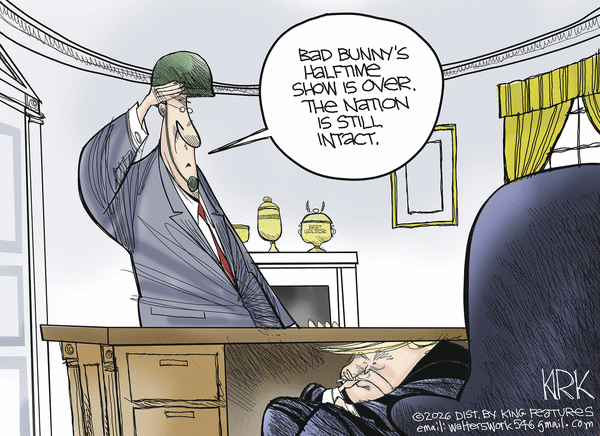
Kirk Walters for 1/16/2026


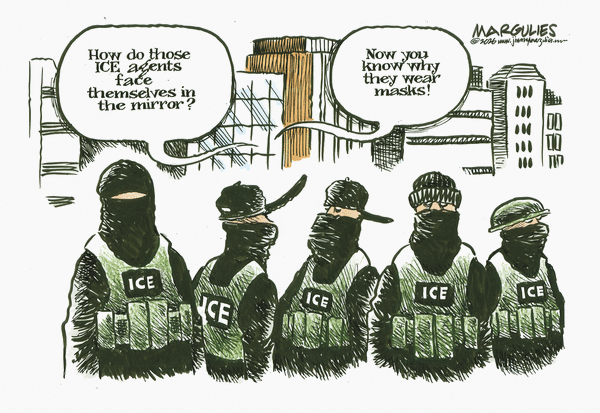
Jimmy Margulies for 1/27/2026


#news from In4 Newz


Image from What Are You Really Afraid Of?


Image from What Are You Really Afraid Of?


Image from What Are You Really Afraid Of?


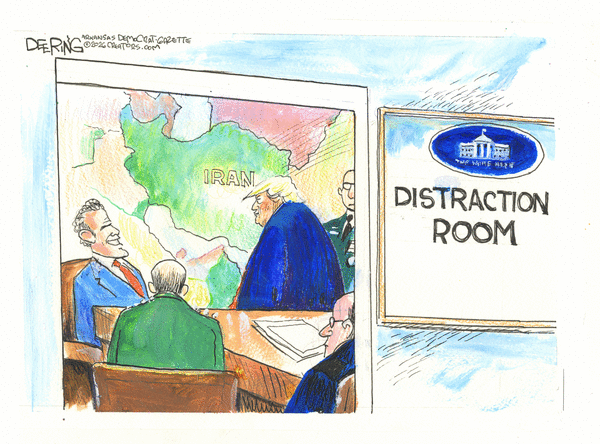
John Deering for 1/29/2026


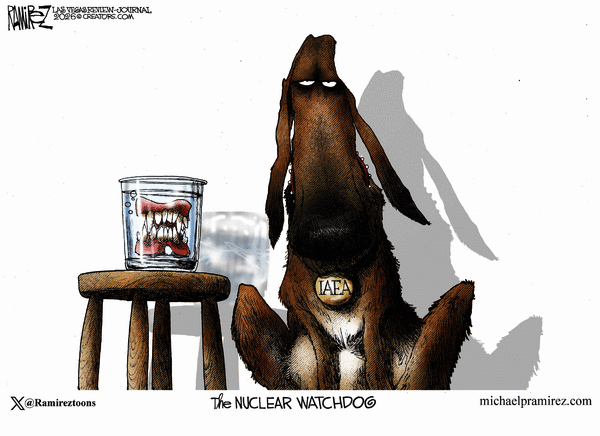
Michael Ramirez for 1/29/2026


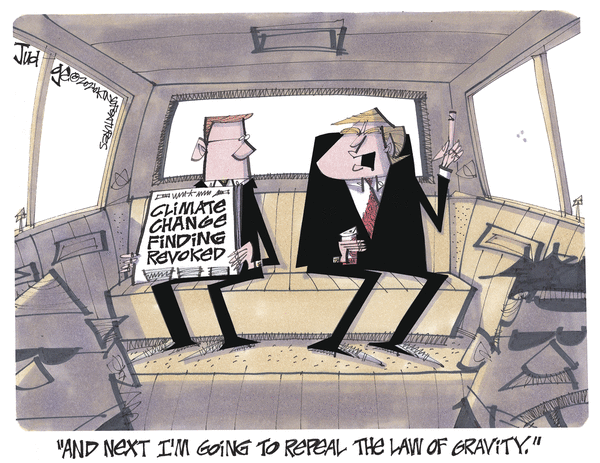
Lee Judge for 1/28/2026


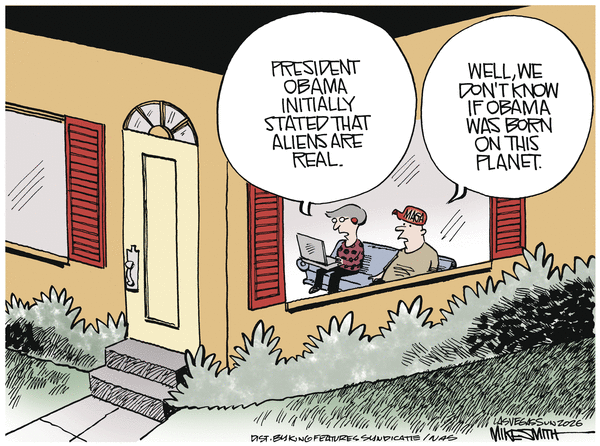
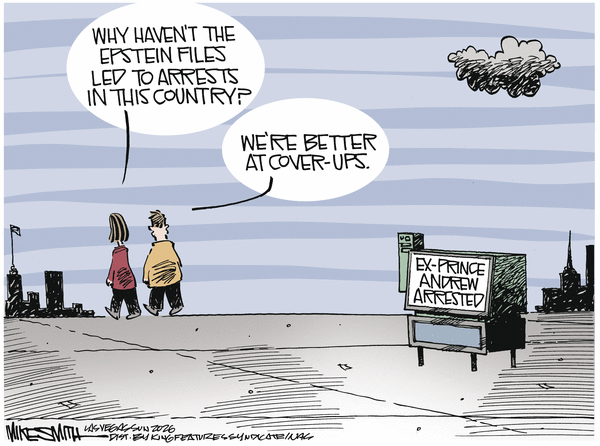
Mike Smith for 1/27/2026


Steve Breen for 1/28/2026


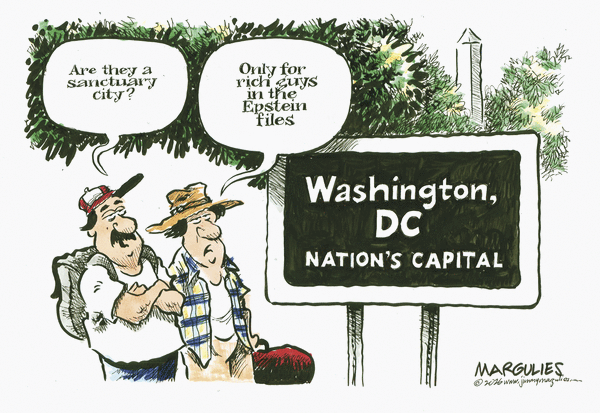
Jimmy Margulies for 1/28/2026


Mike Luckovich for 1/29/2026

#politics from Cartoon Politics


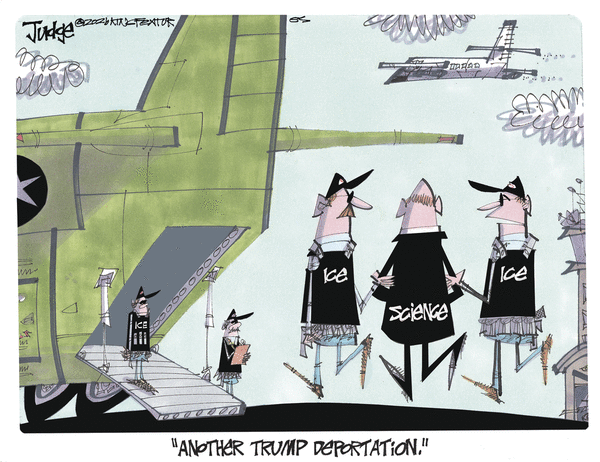
Lee Judge for 1/27/2026

image


Kirk Walters for 1/28/2026


Lisa Benson 1/29/2026


Mike Smith for 1/28/2026

Mike Smith for 1/20/2026


Kirk Walters for 1/22/2026


Some news stories links I wish to share.

Senate Minority Leader Chuck Schumer (D-N.Y.) on Wednesday laid out his party’s demands for voting for Homeland Security funding: End roving patrols by Immigration and Customs Enforcement (ICE); tighten rules governing use of warrants by officers targeting migrants; establish a universal code of conduct governing federal law enforcement officers’ use of force; prohibit federal officers from wearing masks; and require officers to wear body cameras and proper identification.


More congress critters on MS Now. I even found one of Schumer posted 26 minutes before I checked again.

Well I had hoped to hear from Schumer but at least he is demanding the reforms be in writing.   He is getting a lot of pressure to do something this time.  But he wanted to end the last shut down with a loss because he was afraid the republicans would destroy the filibuster.   He settled for a vote that meant nothing and was totally performative.  Will he do the same here?  Hugs

Well at least he can articulate the points that need to be made in a strong manner.  I liked him better clean shaven.  My view on a beard is either grow one big, bushy, and long or don’t grow it.  Scruffy is a sad look I think and reminds me of teenagers getting their first facial hairs.    I wonder what political job he will run for next.  I think Senate, or governor.  Hugs


Political cartoons / memes / and news I wasnt to share. 1-29-2026


Image from Assigned Male

Image from Assigned Male


Harley Schwadron CagleCartoons.com


Liberty Bell Crack


A man and a woman stand at an apartment window gazing out at a snowy cityscape.

“The app says it’s twenty degrees outside, but, with the wind chill and the general state of the world, it feels much worse.”


image


Mike Luckovich for 1/28/2026

10 Bullets

ICE operation perspectives


Ignoring the evidence of your own eyes

ICE agents

Monster under the bed

Bovino leaves Minneapolis


image


Greenback Green Greenland


Image from Neither Here Nor There....


Manual Typewriter


Michael Ramirez for 1/28/2026


ICE Thug: “If You Raise Your Voice, I Will Erase Your Voice”

A Supreme Court ruling confirms that ICE agent Jonathan Ross can be charged with murder in Minnesota


https://www.dailykos.com/stories/2026/1/14/2363435/-A-Supreme-Court-ruling-confirms-that-ICE-agent-Jonathan-Ross-can-be-charged-with-murder-in-Minnesota?pm_campaign=front_page&pm_source=trending&pm_medium=web

Screenshot2026-01-12at3.49.15PM.png

Courts provide extraordinary protection to the police. Courts provide extraordinary protection to agents of the federal government. Is it still possible to prosecute ICE agents for assault and murder?

For anyone who has watched the many videos showing ICE agent Jonathan Ross shooting and killing Minnesota mom Renee Nicole Good, the conclusion is obvious: This is murder.

Under ordinary circumstances, the Department of Justice would be investigating this incident, and Ross would be suspended awaiting the outcome of that investigation. But we are nowhere near ordinary circumstances. Instead, Department of Homeland Security Secretary Kristi Noem has labeled Good a “domestic terrorist” and blessed Ross’s shooting without bothering to conduct any review, talk to any witnesses, or apparently watch any of the videos clearly showing that Ross was never under any conceivable threat.

Instead of investigating Ross’s clearly unjustified action, they’re going after Good’s window.

Both Donald Trump and J.D. Vance have issued statements that are completely at odds with what happened on January 7. Noem has also stated that Ross “followed his training protocol” and was justified in his actions.

As far as the White House is concerned, Good is a dead terrorist and Ross is a hero. Fortunately, Noem and Trump don’t have the final say on who gets prosecuted.

Good’s tragedy—a young mother killed for no reason after dropping off her 6-year-old at school—is not a solitary event. Since Trump reentered the White House and began his immigrant pogrom, ICE agents have fired their weapons at civilians at least 16 times. As The Trace notes:

Renee Good was one of four people who have been killed. Another seven people have been injured.

At least 15 other civilians have been held at gunpoint. In addition, ICE has routinely brutalized both protestors and bystanders. That includes incidents such as shooting a priest in the head with pepper balls and teargassing infants.

Every day, ICE agents seem determined to show that they sincerely believe American citizens have no recourse but to submit to their abuse.

What’s most disheartening about all this is that so far … ICE is right. While several agents have been arrested for off-duty crimes, abusive behavior and deadly force have earned only praise from Trump, Noem, Vance, and other Republicans. Attorney General Pam Bondi has taken up none of these cases for review, and Trump has made it clear that he expects Americans to surrender their First Amendment rights … or else. 


Q: "Do you believe that deadly force was necessary?"Trump: "It was highly disrespectful of law enforcement. The woman and her friend were highly disrespectful of law enforcement…Law enforcement should not be in a position where they have to put up with this stuff."

The Bulwark (@thebulwark.com) 2026-01-12T02:14:26.775Z

But if no one in the Justice Department will stand up for the Constitution—and they won’t—what’s left? Can state and local officials bring a rogue agency to heel?

Minnesota Attorney General Keith Ellison and Hennepin County Attorney Mary Moriarty have announced that they are investigating Good’s death. This is being made much more difficult because the FBI has taken apparently unprecedented action to block access to any evidence collected by federal officers.

Moriarty is soliciting additional videos and statements from witnesses. Ross or other ICE agents do not appear to have been made available to speak to state or county officials. How likely is it that charges will be leveled against Ross, or any of the other ICE agents involved in incidents of deadly force, assault, and abuse? What are the odds of any of them being convicted?

This is seriously difficult to determine.

First, there’s the question of whether or not an ICE agent involved in an immigration raid qualifies as a “peace officer.” It may seem like an obvious question, but relevant case law is pretty thin on the ground. ICE agents are federal officers, but the Venn diagram of their authority doesn’t cover the general enforcement powers of FBI agents or federal marshals. Their training is on immigration enforcement, and doesn’t include general public safety or community policing. They are not agents under the Department of Justice, but facilitators under DHS.

As an employee of ICE, Ross’s role is limited to carrying out immigration arrests. He’s certainly not empowered to stop or arrest people for partially blocking a street for a few minutes. The whole initial basis of the encounter is unjustifiable.

Best guess? No. ICE agents are not “peace officers,” no matter how many times they stencil “POLICE” on their vests. However, in any case against Ross or another ICE agent, the “peace officer” status is likely to draw a fresh review from the courts. That question will get definitively resolved, but probably only after working its way to the Supreme Court.

Even assuming that Ross is a peace officer under Minnesota state law, that doesn’t cut off the chance of prosecution.

In general, to bring charges against any law enforcement officer for using deadly force, the State has to show that the officer’s use of force was not justified. Justification can include any circumstance where the officer is under threat, or others may be under threat without immediate action. This alone is an enormous hurdle, because courts have repeatedly ruled that this doesn’t just protect officers who were genuinely under threat, but also those who felt threatened.

However, in a rare instance of the current Supreme Court not making things worse, last year’s Barnes v. Felix ruling tossed a decision from the hyper-conservative Fifth District. This ruling restricted the circumstances in which an officer can apply deadly force—or, at least, kept those circumstances from ballooning absurdly.

The description of the case by the Cato Institute makes it clear why Barnes may be very relevant to Good’s shooting.

In 2016, Ashtian Barnes was killed by Harris County, Texas, Deputy Constable Roberto Felix, following a traffic stop for unpaid tolls. As Barnes apparently tried to drive away, Felix jumped onto the moving car and indiscriminately opened fire, killing Barnes instantly.

The Fifth Circuit cleared Felix’s actions, writing that in the “moment of threat,” the officer was clearly in danger and was justified in shooting Barnes. However, the Supreme Court reversed that ruling.

Last spring, the Supreme Court unanimously held that a full review of the “totality of the circumstances,” including the nature of the offense and the events leading up to the incident, is relevant to determining the reasonableness of force.

In Barnes, the initial charges were barely sufficient to warrant a traffic stop in the first place, and Felix was under no threat until he placed himself in peril by grabbing onto Barnes’ car. He may have been frightened in the moment, and for the Fifth Circuit, that was enough, but in the totality of circumstances, it’s not enough.

That “totality of circumstances” requirement also happens to align with Minnesota law.

The circumstances in Barnes seem to almost perfectly overlap with what happened with Renee Good. As multiple videos have shown, Good’s car had only partially obstructed a residential street for a handful of minutes. Other vehicles were still getting by. She was already in the process of moving completely out of the way when Ross and other ICE agents approached the car, and would have been gone had she not stopped to wave another vehicle to pull around her. Her last exchange with Ross was, at worst, snarky, but non-confrontational and contained no threats.

It’s hard to believe that an actual police officer, authorized to deal with traffic situations, would have retained Good.

Assuming Ross was in front of her vehicle at all, he was only there because he violated DHS procedures by placing himself in front of the vehicle after Good was already attempting to leave the area. Good was traveling at low speed, was turned away from Ross and other officers, and had barely begun to move when Ross opened fire.

Good’s offense, if any, was minor. The threat against Ross, if any, was of his own making. The totality of circumstances in this case is not in Ross’s favor. That’s especially true of additional shots he fired at Good from beside or behind the vehicle. There are no reasonable grounds for these shots.

Hennepin County police, like those in many other jurisdictions, are actually forbidden from shooting into a moving vehicle in any circumstance. under the very reasonable understanding that a vehicle in motion doesn’t automatically stop if the driver is dead. The DHS issues these same guidelines to its agents.

This doesn’t mean that a Grand Jury might not still determine that Ross had a reason for his action. The number of cases in which officers have walked away from the use of deadly force seems almost limitless.

Another potential complication comes from the discovery that this is not the first time Ross has been involved in an incident with a car. Federal court records show that last June, Ross approached a car driven by a Guatemalan man, Roberto Carlos Muñoz, and attempted to apprehend him.

According to court testimony, Ross arrived in an unmarked vehicle, approached Muñoz, and ordered him to exit his car. When Muñoz didn’t respond, Ross punched through the side window and attempted to wrest control of the car. Muñoz responded by hitting the gas. As NBC News reported, Ross claimed to have used a taser in an attempt to stop Muñoz.

“I was yelling at him to stop,” Ross testified of Robert Muñoz-Guatemala, who was found guilty last month of assault on a federal officer with a dangerous or deadly weapon. “Over and over and over again at the top of my lungs.”

Ross said in his testimony that he feared for his life and fired his Taser repeatedly at Muñoz-Guatemala.

“It didn’t appear that it affected him at all,” Ross said.

Vance raised this incident as a defense of Ross.

“That very ICE officer nearly had his life ended, dragged by a car six months ago with 30 stitches in his leg, so he’s a little sensitive about being rammed by an automobile,” Vance said at the White House on Jan. 8.

However, what this testimony actually shows is that Ross already had a history of dealing poorly with people inside vehicles and of violating DHS guidelines. He either didn’t know how to properly and safely deal with such a situation or deliberately ignored the rules. If he was truthful in his claim that he attempted to use a taser in the earlier incident, this also shows an agent primed to skip over any attempt at non-lethal force and go straight for his gun.

Videos show that Ross pulled his gun before Good had begun to move forward, and fired even as he was still holding up his phone in his other hand. This could indicate that he was traumatized, or simply infuriated, by the earlier incident. In effect, he was primed to kill Good as retribution for the perceived wrong he had suffered from Muñoz.

In addition to murder, there are additional charges that could be levied against both Ross and other ICE agents on the scene—and these charges apply equally to peace officers and civilians.

Videos show that ICE agents refused to allow a doctor who was on the scene to approach the vehicle and blocked ambulance access to the area. Both of these are felony violations of Minnesota law with penalties up to five years imprisonment. If Good’s death was found to be connected to the delay of treatment, all involved could face additional charges of manslaughter.

However, there’s still one more hill to climb before charging Ross, and it’s a steep one.

Whether or not Ross is a peace officer, he certainly is a federal agent. Vance and others have claimed this gives him “absolute immunity” from state prosecution.

This is, in legal terms, utter bullshit.

Federal officers are broadly immune from state prosecution for taking actions specifically authorized by federal law in a case that goes back to an 1890 incident in which a federal agent shot a man who was threatening a member of the Supreme Court.

Neagle established a two-prong test for this type of immunity from state criminal law: (1) Was the officer performing an act that federal law authorized him to perform? (2) Were his actions necessary and proper to fulfilling his federal duties? If the federal officer satisfies this test, he or she is immune from prosecution for violation of state law.

The DOJ would certainly argue that Ross was acting to perform his duties as an ICE agent. Any State prosecution would need to show that Ross’s actions were excessive or unjustified.

This could be much harder than getting past the leeway given to police use of deadly force. Like the question of whether or not an ICE agent is a peace officer, there are few recent cases to reference, especially when it comes to an agent who was on duty. In short, States simply haven’t done much to test the immunity of federal officers, even when those officers have performed unnecessary acts of violence.

The murder of Good was clearly not required to enable the immigration enforcement actions of the ICE officers. That doesn’t mean a judge, jury, or federal court might not see a way to grant Ross his magic get-out-of-everything card.

Is Ross a peace officer? Probably not. Was this a justified shooting? No. Can he be prosecuted? Yes.

Will those charges survive federal challenges? Let’s find out.


What to Do if ICE Invades Your Neighborhood

Ali sent me some links and I thought they were worthy of posting.   Thank you Ali.    Hugs


https://www.wired.com/story/what-to-do-if-ice-invades-your-neighborhood/

With federal agents storming the streets of American communities, there’s no single right way to approach this dangerous moment. But there are steps you can take to stay safe—and have an impact.

Image may contain Clothing Glove Adult Person Car Transportation Vehicle Accessories Bag Handbag Gun and Weapon
Photographer: Victor J. Blue/Getty Images

If federal immigration agents are coming to your area—or have already arrived—you may be frantically making plans to lay low at home, or perhaps grabbing your whistle and lacing up your sneakers to join a neighborhood watch. It’s a terrifying situation for undocumented residents and all American immigrants, and the climate has even become fraught for US citizens too. There are no simple answers for how to protect yourself and others in every scenario, but there are frameworks you can use for weighing your options.

The presence of immigration agents in cities and towns around the country has starkly increased in recent months, and tensions have escalated in step. On Wednesday, a federal agent shot and killed 37-year-old Minneapolis resident and US citizen Renee Nicole Good in her car during an Immigration and Customs Enforcement (ICE) operation. Having already deployed 2,000 agents to Minnesota, DHS reportedly planned this week to send 1,000 more. “There are now more ICE agents in Minnesota than there are combined in Minneapolis police force and St. Paul police force,” Minnesota Senator Amy Klobuchar said on Friday. “So they are outnumbering our own local police officers out on the streets.” (Minnesota and Illinois have since filed lawsuits in federal court to end the ICE “invasion” in those states.)

Elsewhere, Customs and Border Protection agents shot two people in a car in Portland, Oregon, on Thursday, hospitalizing both. These tragedies are just the latest in a series of violent incidents involving immigration agents that have escalated since US president Donald Trump took office a year ago with a sweeping anti-immigration agenda. In addition to intense activity in Minneapolis and Portland, ICE and CBP have carried out deportation operations across the US.

“The number of ICE agents has dramatically increased, the sheer presence in people’s communities is larger,” says Jennifer Whitlock, senior policy counsel at the National Immigration Law Center. “And this means that the risk of encountering an ICE officer has really increased for people, even if you’re not in any way attached to immigration.”

Pause

Problems have persisted for years with ICE and CBP actions—including arrests and detentions—that accidentally ensnare US citizens and other documented residents. Additionally, the agencies’ operations have a history of aggression and mistreatment in dealing with suspects. Immigration infractions are typically civil, not criminal offenses. Over the last year, though, the Department of Homeland Security’s budget for immigration enforcement has expanded substantially at the same time that public unrest about the activity has grown. The result is a charged climate in which standard interactions can quickly, and dangerously, escalate.

“We’re surging operations because of the dangerous situation we see in this country,” homeland security secretary Kristi Noem said in a press conference on Wednesday. “We should all work together to protect our citizens.”

Many see immigration enforcement’s track record and current activity very differently, though.

“For its entire existence, ICE has been a very violent agency and a very unaccountable agency without a lot of oversight or transparency,” says Nithya Nathan-Pineau, policy attorney and strategist at the Immigrant Legal Resource Center.

She notes that as immigration officers have been involved in more and more violent incidents in recent months, it has become harder than ever to offer simple, definitive advice to people about assessing risk in interactions with federal agents.

Numerous sources told WIRED that their trainings and materials about interacting with federal immigration agents are actively evolving to reflect the current moment. For example, one core point has long been to explain the difference between a judicial warrant signed by a judge that gives law enforcement the right to, say, enter a person’s home versus the administrative warrants that ICE agents often carry that do not give them that right. “Don’t open the door for ICE” is a common refrain. But this type of information, while still accurate, does not fully account for the chaotic intensity of current US immigration enforcement.

In short, there is some risk inherent in any interaction with federal immigration officials, whether you’re a US citizen or not. Even if you aren’t willing to expose yourself in that way, though, you can still take action to meaningfully and concretely help people in your community affected by the Trump administration’s policies.

Plan Ahead

Depending on your situation, you should make a plan in case you end up interacting with immigration enforcement while out and about.

In its online guidance, the nonprofit National Immigrant Justice Center says individuals and communities can create a “safety plan” to help be best prepared in case ICE operatives arrive in the area. Such a plan could involve identifying trusted family members, friends, or colleagues who can act as emergency contacts for people who could be the target of federal immigration actions, or anyone who could come into contact with agents. Memorize their phone numbers and also make sure that your child’s school or daycare has emergency contacts on file. If you know you are at specific risk of deportation, you may consider additional steps, too, related to establishing an emergency guardian for children and a power of attorney for yourself.

Given that US citizens are not safe from violence or arrest at the hands of federal immigration agents, immigrants with an established status, visa, or permanent residency are potentially at even higher risk if they participate in community safety efforts or other activities that put them near immigration agents.

In December, DHS vehemently denied to WIRED that its agents engage in racial profiling as part of immigration operations. Multiple sources emphasized to WIRED, though, that nonwhite Americans should consider being extra cautious about proximity to immigration agents. This is particularly true in light of a September 2025 US Supreme Court decision in which Justice Brett Kavanaugh concluded that someone’s apparent ethnicity may be a “relevant factor” that could justify detaining someone during an immigration enforcement action—something now derisively known as a “Kavanaugh stop.”

You should consider taking precautions to protect yourself against potential digital surveillance if you know you are going to be proximal to immigration authorities. CBP and ICE both have digital surveillance capabilities that are increasing all the time. You can’t always anticipate when you might encounter federal agents, of course, but people who could specifically be the target of an immigration enforcement action should consider taking extra digital precautions if they can.

Looking broadly, sources told WIRED that political polarization and rising tensions across the US are key contexts in assessing potential risks.

“It’s no longer Officer Friendly out there,” Whitlock says. “This is not to give any excuse, but I can imagine there is a mindset within the field ICE agents and CBP where they really do think they’re under attack and being threatened. And no one is above the law, but I think it’s important for people to understand that there are going to be limited forms of trying to hold these officers accountable in practice.”

On the Scene

If you find yourself witnessing an immigration enforcement action, there are some things to keep in mind if you want to stick around.

“The goal is to be an observer and to document what is happening,” says Nathan-Pineau of the Immigrant Legal Resource Center. “The goal is not to go and try to intervene in the law enforcement action.”

Training materials from Siembra NC, a North Carolina–based grassroots organization working to defend its local communities from exploitation, say that the priority when ICE is present is letting agents know they are being observed and reminding people of their right to remain silent, while deescalating whenever possible and promoting safety. The group advises that if ICE operatives are conducting an arrest or traffic stop, responders should try to approach within their line of sight and identify themselves in the process.

You can also report immigration enforcements sightings in many areas without getting involved by calling a local ICE watch tip line. Many immigration advocacy and human rights groups suggest using the “SALUTE” acronym to guide the information you give in these reports. Size: How many agents or officers you see. Activity: What are they doing? Has anyone been detained? Location: Where exactly did you see them and what direction are they heading in? Units: What types of officers are they or what words and markings can you see on their uniforms? Time: What time was the sighting? Make reports as quickly as possible. Equipment: What do the agents have with them, such as types of weapons, vehicles, crowd control methods, and other details?

Filming ICE behavior can let agents know they are being watched, potentially creating some accountability for their actions, as well as a digital evidence trail for any legal cases or proceedings that may occur at a later date. When interacting with federal agents as part of a group effort responding to ICE, Siembra NC recommends identifying yourself as a volunteer, and asking agents who they are, what they are doing, and what agency they work for. Then you can state that you will remain present to observe, while also recording any models of vehicles, license plates, and operatives at the scene.

“We always advise people that if the law enforcement officer that you are filming tells you to step back, you should step back and you should say it out loud—‘I’m stepping back, I’m stepping back.’ That way you’re recording that you’re complying with their order,” Nathan-Pineau says.

Multiple sources reiterated that recording federal agents has a dual purpose, because if your own behavior and that of the people around you is appropriate to the situation, this will be captured in your documentation as well as any officer misconduct. The fact remains, though, that peacefully filming interactions can be interpreted as aggressive or escalatory precisely because it is an accountability mechanism.

Proximity is one of the most important risks to assess when on the scene, says Xavier de Janon, director of mass defense at the National Lawyers Guild. “The closer people have been to federal agents or property, the more likely they’ve been charged, tackled, or arrested,” he says.

More and more, federal prosecutors are seeking criminal charges against people for allegedly assaulting federal officers, even if the cases ultimately don’t succeed and later get dropped. The NLG recently published a guide on how protesters and observers can assess risks related to the federal assault law.

Work From Home

Even if you can’t risk hitting the streets, there are other important ways to contribute to community safety efforts.

Civil liberties groups have been campaigning nationwide to ban real-time surveillance platforms and end lucrative contracts that feed information to ICE. You can contact the offices of your local officials and tell them to cancel surveillance contracts and stop information-sharing and other law enforcement cooperation that fuels ICE operations.

“It’s good that local officials in cities targeted by ICE are speaking out and condemning their brutal tactics—but talk is cheap,” says Evan Greer, director of the digital rights activist organization Fight for the Future. “ICE violence is enabled by ICE surveillance, often with help from local police and city-run surveillance systems. If local leaders want to protect their residents from ICE’s gestapo tactics, one of the most immediate things they can do is roll back and limit surveillance by canceling contracts with surveillance vendors like Flock and banning the use of facial recognition and other forms of biometric surveillance, either through executive action or city ordinance.”

For those who are not direct targets of the federal immigration crackdown, Kathy O’Leary, a member of the Catholic peace organization New Jersey Pax Christi, recommends listening to neighbors who are directly affected and figuring out what they need. Every week, she and other volunteers go to Delaney Hall Detention Facility in New Jersey to support families who are visiting their loved ones in detention. The volunteers bring chairs and water for the visitors—who are forced to wait outside—and help visitors navigate the rules of the facility.

For example, she said, her group started bringing extra clothing because they realized that visitors were being turned away because of dress code violations. She said it started when a woman who had traveled all the way from Boston to visit her father in detention was turned away because she was wearing ripped jeans. A volunteer realized she was the same size and offered to switch pants.

“That was a serious act of resistance,” O’Leary says. “The system was creating a hurdle to see her father. The system tries to limit contact with families; it’s about stealing people’s hope and trying to break people.”

O’Leary and other volunteers also give out gift cards to grocery stores to visitors, since many families’ breadwinners are the ones in detention. O’Leary says that people who want to figure out how to get involved in their communities can see if they live near a local member of the Detention Watch Network. If there isn’t a member in their state, sometimes groups in neighboring states will know who’s active in their area.

Working with local mutual aid organizations, food pantries, and other humanitarian support groups contributes to overall community strength and safety. And simply contributing to digital ICE watch trackers as you go about your regular activities can give others valuable information.

“It’s about what lever matches your risk tolerance, matches the resources that are available to you,” says Matt Mitchell, CEO of the risk-mitigation firm Safety Sync Group. “Not everyone has the same privileges. Some people want to donate money, some people want to write letters, some people want to read up on what law enforcement and CBP and ICE can and can’t do. Some people want to put their bodies in the space and assemble because that is our right, some people want to document. There are many different levels.”

Updated 9 am ET, January 13, 2026: Added details about ICE watch tip lines.

Updated 2:45 pm ET, January 13, 2026: Corrected Xavier de Janon’s professional title.