Again this is about wiping first the trans out of public society and then the rest of the LGBTQ+ community. It is the Russian / Nazi playbook. It is part of their plan to return the country to a 1950s white straight cis ethnostate. We must not let it happen. Hugs
Providing objective, nonpartisan, rigorous, original journalism that investigates America’s anti-LGBTQ landscape and elevates everyday American heroes. Expect two rigorously reported stories every weekend.
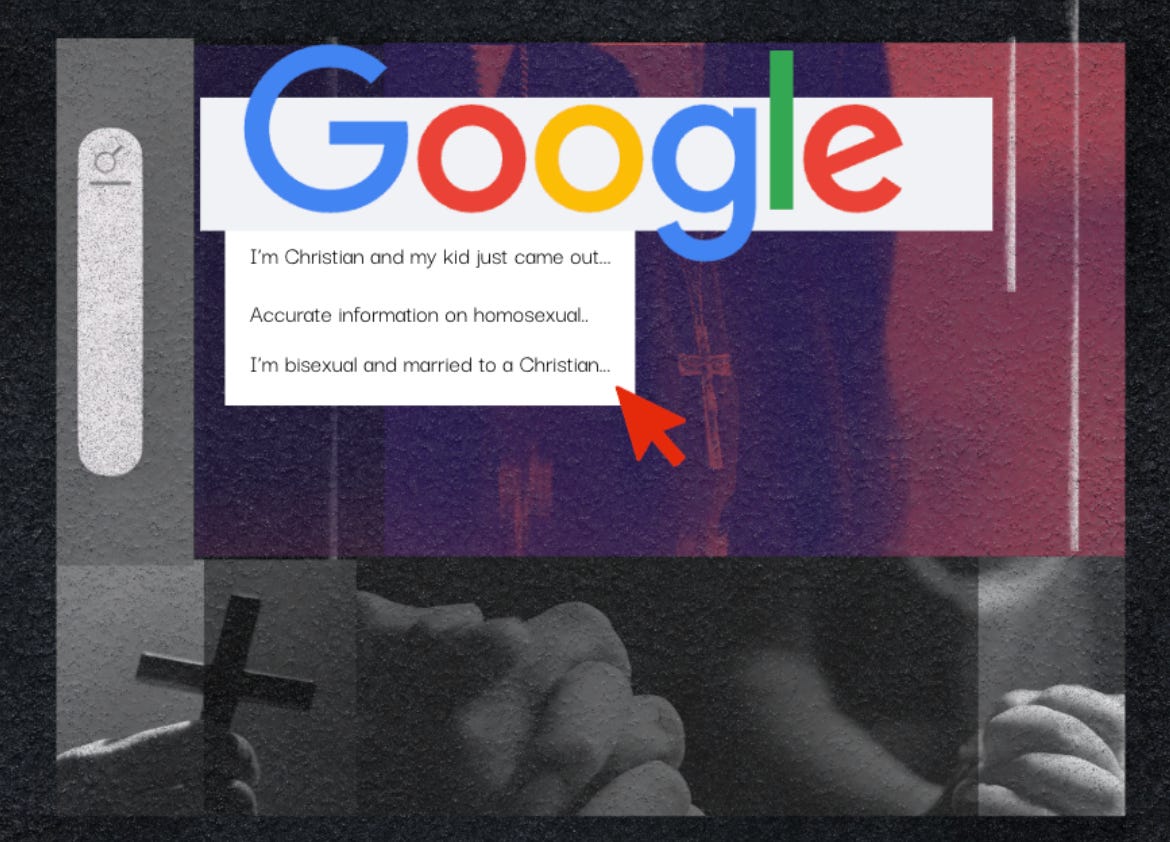
But how does Google’s algorithm decide which results show up? And how do these results influence LGBTQ kids, their parents and Americans at large who are searching for help?
Uncloseted Media asked five Americans from around the country to Google five common queries related to LGBTQ identity, religion and parenting.
The results were alarming and raised an urgent question: With nearly 40% of LGBTQ youth seriously considering suicide just last year, what happens when a queer teen or the parent of a gay kid in crisis turns to Google?
Photos courtesy of participants Mark Just, Genna and Melanie Brown, April Samberg, Tommy O’Neil. Photo of Genna and Melanie by Kaoly Gutteriez.
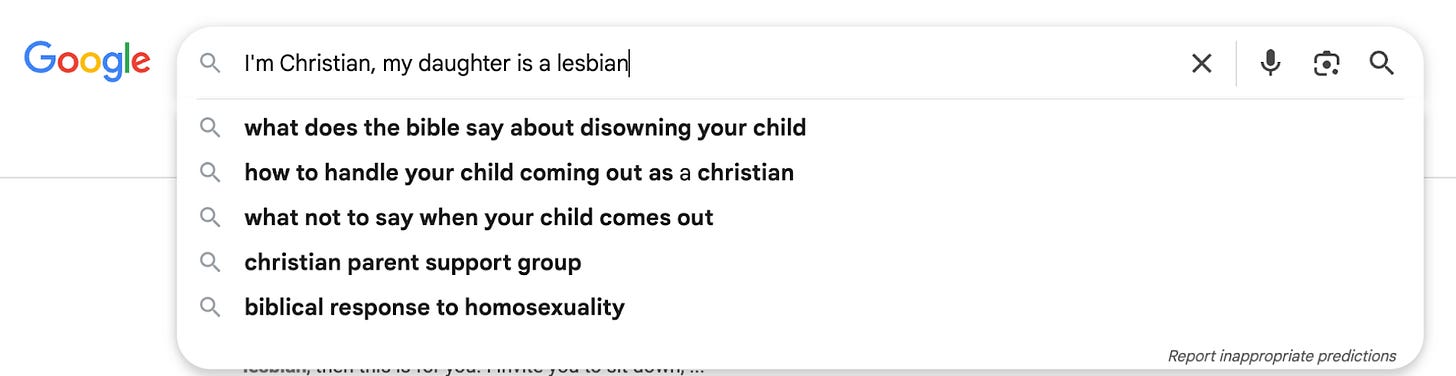
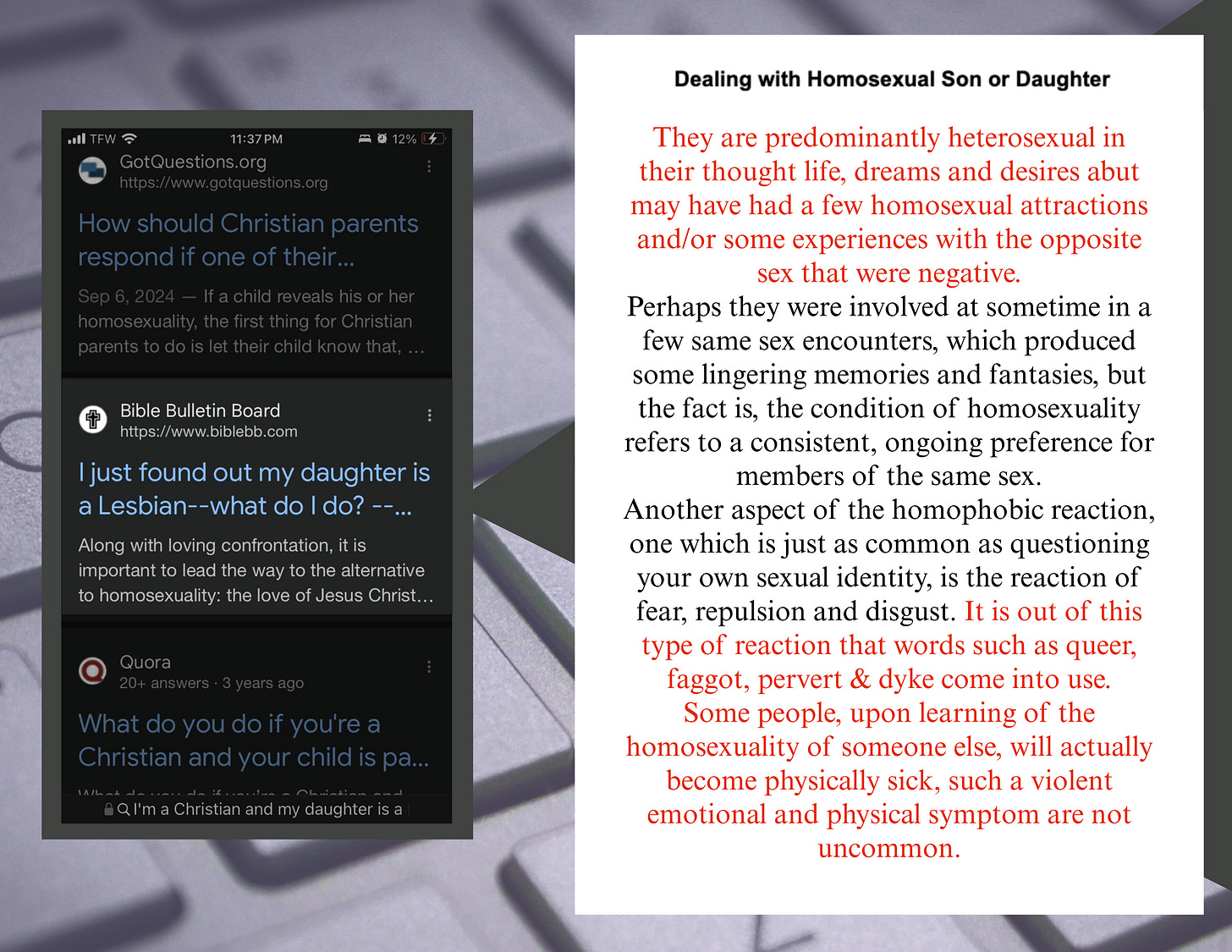
“I’m Christian, my daughter is a lesbian,” Melanie Brown, a Southern Baptist from High Point, North Carolina, types into Google.
When Brown presses enter, Bible Bulletin Board comes up as the third result, with the suggestion of “offering hope for change,” and “lead[ing] the way to the alternative to homosexuality.” It goes on to explain that “homosexuality is contrary to God’s Word. It is sin and as always results in sin’s destructive effects on the individual and on those close to them.”
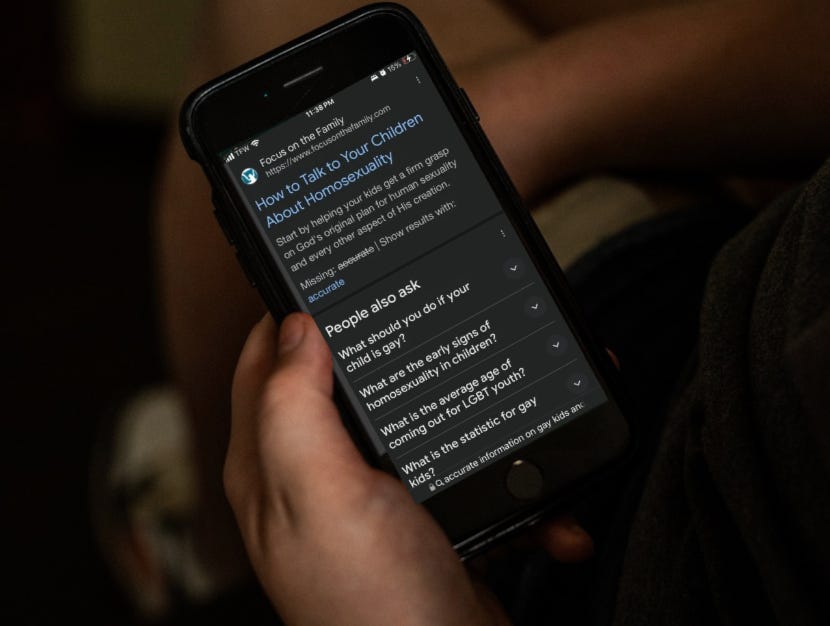
In the living room, Brown’s 15-year-old daughter Genna, with her dog on her lap, Googles “accurate information on gay kids and what to do.”
Focus on the Family (FOTF) is the first result. She clicks the link and lands on the platform of a hyper-religious organization known for promoting conversion therapy and labeling her sexuality as sinful.
The site, which presents itself as a reputable religious source, features a tab titled “Understanding Homosexuality” and a section under their resources for “Homosexuality.” It states: “[FOTF] is committed to upholding God’s design for the expression of human sexuality: a husband and wife in a marriage.”
It offers suggested reading on “redemption” from a gay lifestyle, along with 11 counseling resources aimed at changing sexual orientation, including The Alliance for Therapeutic Choice and Scientific Integrity, which guarantees “professional assistance … for persons who experience unwanted homosexual attractions.”
The language is intentionally padded, which means Genna and her mom—and many of the other millions of Christian parents of queer kids—may never know that Google led them to a Southern Poverty Law Center-designated anti-LGBTQ hate group. FOTF is known for its long-standing opposition to LGBTQ rights, for spreading anti-LGBTQ disinformation and for framing homosexuality and transgender identity as sinful and disordered.
Screenshot courtesy of Genna Brown. Photo by Kaoly Gutierrez.
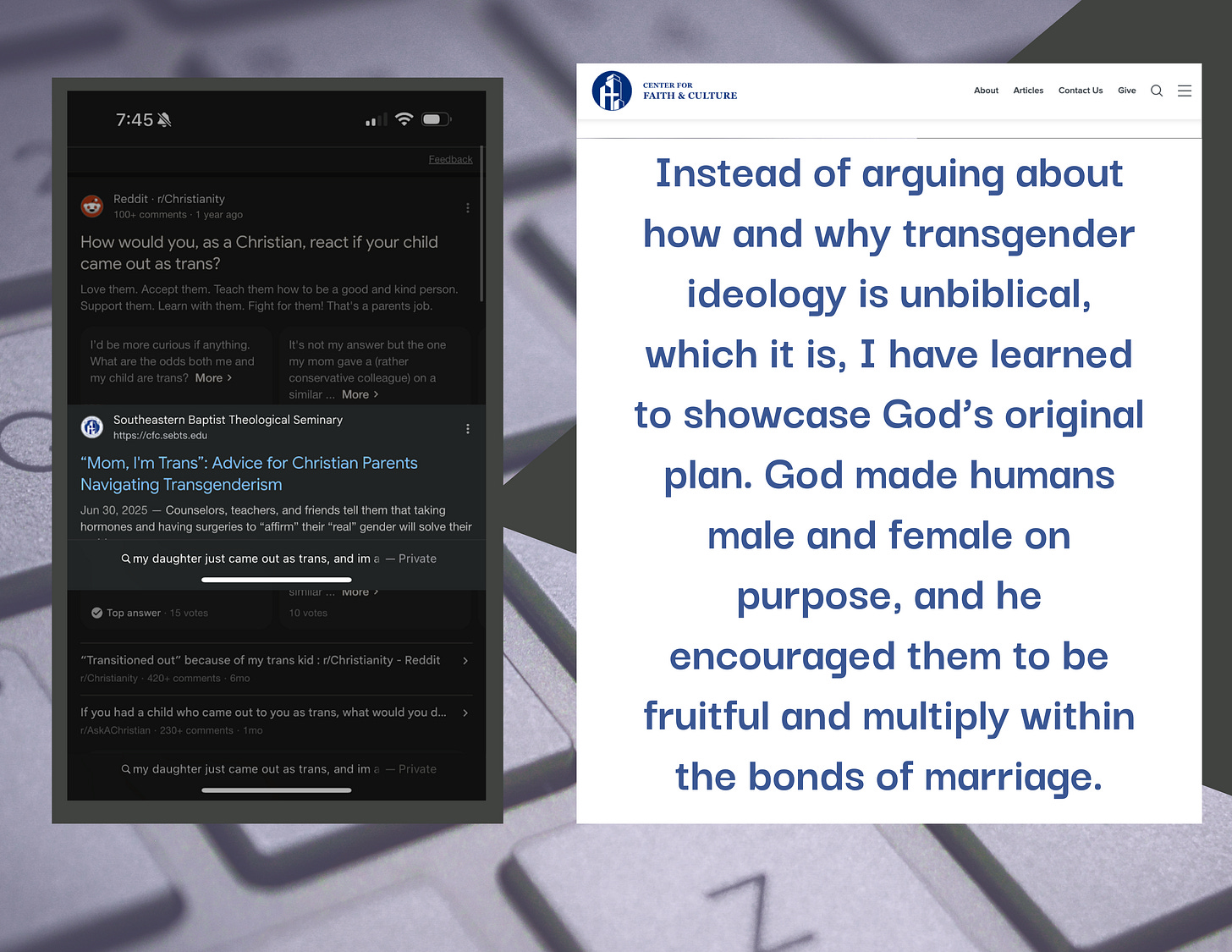
In South Boston, Virginia, Tommy O’Neil Googles, “My daughter just came out as trans and I’m a Christian.” As a father of two, he wants what’s best for his kids. According to Southeastern Baptist Theological Seminary, Google’s second result, O’Neil should recognize that God doesn’t make mistakes when assigning sex and give sympathy for those who are indoctrinated in the “transgender cult.”
Thousands of miles away in Anchorage, Alaska, 38-year-old bisexual woman April Samberg Googles, “I am bisexual and have a husband who is Christian, am I going to hell?”
The third result is once again an article by FOTF that tells April that “same-sex-attracted strugglers” and “transgender and homosexual lust and behavior are wrong.”
In Cincinnati, 44-year-old Mark Just Googles, “accurate information on homosexual kids and what to do.” FOTF is the top search result.
“I don’t feel good about it,” Just told Uncloseted Media. “It’s disturbing because if there are people out there who want to accept and understand their children or loved ones, this is what they’re being pointed to.”
“[I feel] fear for the queer kids with Christian parents who will be seeing that and thinking it’s good advice, and sorrow for the kids with parents who already have,” says Genna Brown, who was a “self-loathing, suicidal kid” who thought God would punish her for being gay before she came out to her now accepting parents. “It’s pretty awful that this is what’s being pushed for advice. This has no doubt harmed people.”
Uncloseted Media also asked folks in Taiwan, Lebanon, China, Hong Kong, Canada and India to Google similar queries. All of them had FOTF turn up as a top search result.
Subscribe
Why Does Google Allow This?
Google, like other search engines, compiles information and directs users to various websites by referencing the titles of web pages that it judges to be most reflective of what was searched.
“Google’s algorithm is notoriously a black box,” says Jesse Ringer, founder of Method and Metric, a search engine optimization (SEO) growth company. “That’s intentional to keep their competitive advantage.”
What we do know is that Google ranks search results by first crawling the web with an automated program called “spiders” to follow links from page to page and collect data.
It uses text matching to identify documents that it thinks are relevant to a query and then ranks them based on a combination of popularity, freshness, location and previous links clicked.
But for people searching for reliable information, its process can be problematic.
“Google doesn’t rank based on accuracy, but on popularity and query matching,” says Dirk Lewandowski, professor of information research and retrieval at the Hamburg University of Applied Sciences. “This is based on clicks and a network of how many other links are directed to this website. … Of course, users click what is shown in the first position. So we have kind of a rich get richer.”
How to Get a High Ranking
As websites with the highest rankings continue to receive more clicks, websites like FOTF can also employ other tactics to keep their prominent placement.
Backlinking—the process of having other web pages hyperlink back to your site—is one of the ways to maintain your high ranking.
“Backlinks are a big part of popularity. So the relationship between other websites linking to this source is a big part of Google’s algorithm,” says Ringer. “There are SEO businesses that build link farms so that the content of their clients can go higher. They create a network effect and they link to each other. It is not unreasonable to think that [FOTF] has hired either an SEO person or they’ve hired an external agency to contribute to that.”
According to Francesca Tripodi, assistant professor at the University of North Carolina School of Information and Library Science, ranking can also be gamed by matching keywords to content. Tripodi looked at the metadata of progressive and conservative companies and found that conservative content creators “are much better at doing this.”
“They are savvy at creating new sets of words and tagging their content with them,” she says. “That’s not something I’m seeing with progressive content creators.”
Tripodi says that not only does conservatism thrive online, it might be the only perspective returned.
Subscribe
“They are well-funded companies with large production budgets and effective digital marketing teams,” she wrote in a 2019 testimony about conservatism and Google searches. “This is why when you search for liberal phrases like ‘gender identity’ or ‘social justice’ the top returns … are conservative content creators.”
Google declined to speak on record with Uncloseted Media for this story.
In an email, a spokesperson said: “Like any search engine, Google indexes the content that’s available on the open web, relying on systems like keyword matching to surface relevant results. We are largely guided by local law when it comes to removing pages from search results.”
What If It’s Harmful or Illegal?
The United States notoriously protects harmful or misleading content—including anti-LGBTQ hate speech—under the First Amendment.
“The situation in [other countries] is a bit different than in America,” Lewandowski says. “For instance, Holocaust denial is illegal in Germany. So Google bans these sites, but they don’t ban them in the U.S.”
Section 230 of the U.S. law protects Americans’ freedom of expression online by implying that we should all be responsible for our own actions and statements on the internet. This law largely takes legal pressure off of Google.
And in 2003, an Oklahoma court ruled that Google’s rankings are subjective opinions and thus constitutionally protected.
Google’s policies for tamping down on harmful content “don’t apply to web results.” Thus, there is little moderation on the web pages that pop up for Americans who use the search engine.
The spokesperson for Google says that “[they] hold themselves to a high standard when it comes to legal requirements to remove pages from Google search results” and that “they don’t remove web results except for child sexual abuse, highly personal information, spam, site owner requests, and valid legal requests.”
But according to the company, “determining whether content is illegal is not always a determination that Google is equipped to make.”
Tripodi says this might be why groups like FOTF are still showing up, even though conversion therapy is illegal in 23 states. She says these groups may have found a loophole in Google’s policy by “tricking” the search engine into thinking they are providing “resources” and not simply a recommendation for conversion therapy.
Subscribe
What Can Google Do to Fix This?
“Google has a responsibility for what is coming up in their results because people trust [them],” says Lewandowski. “They think something is correct or accurate because it is number one in Google.”
Fifteen-year-old Genna Brown is one of the 85% of Americans who feel this way, according to a 2025 study.
“Isn’t the first result typically ranked most credible?” she says. “Because I typically trust the first result more.”
“It’s pretty concerning what comes up when you search for these things,” Ringer says. “There needs to be more done to educate the people who are doing the searches on understanding news and information.”
But vulnerable groups, like LGBTQ kids who are living in households where they are told they are going to hell and parents who are often confused and in crisis themselves, are being led by Google’s algorithm to believe that being queer is wrong.
“1000% yes, these results concern me,” says Genna Brown. “We’re talking about organizations that promote practices like conversion therapy, which is insane. … I wish there was some disclaimer. Like, ‘Google has determined this to be a subjective query. As such, we can’t verify the following results. Proceed with caution.’”
Tripodi says she thinks consumers are responsible for about 20% of the burden by researching and verifying the sources they learn from. But she agrees with Brown in that Google carries an ethical responsibility for the content it chooses to rank and promote.
“As a global corporation that gobbles up all other possibilities for information, Google has a responsibility to ensure that its content is accurate and not harmful,” Tripodi says. “[It’s their job] to ensure that the information that they surface is accurate and reliable because we know people trust that information.”
Uncloseted Media reached out to Focus on the Family, Southeastern Baptist Theological Seminary, and Bible Bulletin Board. They did not respond to our request for comment.
Additional reporting by Sophie Holland and Spencer Macnaughton.
If objective, nonpartisan, rigorous, LGBTQ-focused journalism is important to you, please consider making a tax-deductible donation through our fiscal sponsor, Resource Impact, by clicking this button:
This article is long but worth the read. This expert refuses to talk to trans people and has never treated a trans person. His knowledge is from what he believes to be true color by his biases, so he also ignores the views of the majority of medical societies opinions and views. The so called expert refuses to accept that anyone at any age felt they were trans without someone putting the idea in their head someway. To him it is not natural so it can’t exist. He thinks being gay is wanting to be the other sex, so a gay male wants to be female and he questions if they can be any happier as the other sex. And he is a gay man himself. This is who the anti-trans Christian haters hire to lie about trans issues so that they have cover to make bans on needed gender-affirming medical care. Plus he is a real prima donna wanting the center stage and being the star. Hugs
No. See? It’s not either one. The tiny fraction of repris- One in tens of thousands who, at this point, kind of essentially born gay, but so gay, they really are happier living as the other sex. Won’t know it until later in life, but they exist.
No 8-year-old ever said that. Eight-year-olds repeat what they’re told, and what they are getting told are from activists. It’s not credible to say that all of this existed, this was so extreme and obvious, and nobody ever noticed it, including the experts doing the research on it who could have gone either way. But everybody all of a sudden noticed it at exactly the same time when smartphones got invented and hit 15 percent. That’s just a coincidence that the demographic who is doing this the most are exactly the same demographic most given to other social contagion issues. Usually young adolescent females, the same group most likely to report suicidality. Not actual suicide, but suicidality. Most likely to report eating disorders. Most likely to dislike their bodies. All sheer coincidence!
But what about so there’s 8-year-olds can’t say that? Sure, I understand that argument. But there’s 14-year-olds, 17-year-olds, 25-year-olds, 40-year-olds. There are people of every single age.
JC:Find me one who didn’t get it from the website.
SM: Who didn’t get being transgender from a website?
JC: Ah ah ah.The “my rights, you’re hurting us,” the “suicide.” Verbatim they are all saying the same thing. None of these are their words. These are words that they’re repeating because of everybody else in their social group.
SM: I want to be clear, because I want to make sure we characterize everything accurately. Do you believe that all transgender people are trans due to social contagion?
JC: No.
SM:. So you believe a lot of people are born trans and feel that way from birth?
JC:
SM: But you said one in 10,000—
JC:We also have a cluster who, until they’re in their 40s or 50s, are just turned on by the idea of being female. They’re attracted to women. They’re not gay. They’re always men. So we have one in tens of thousands and one in tens of thousands. And then we have this 5% of the entire population which came out of nowhere when smartphones were invented. They are dominating the conversation. They, except for one in ten thousand, they are not trans. They just hate their own bodies and here’s a narrative that’s close enough that says, “It’s not me, it’s everybody else on the planet and somebody else, no effort to me, I just have to lie there, the doctor will come and fix me. It’s not that I have issues to work on because I hate my body.” Taking the easy way out.
Editor’s note: This interview was originally conducted on August 7, 2024.
James Cantor is a Canadian psychologist and sexologist who has been hired by Alliance Defending Freedom—a Southern Poverty Law Center-designated anti-LGBTQ hate group—and by Republican states to serve as an expert witness in defense of laws that ban or restrict gender-affirming health care.
Last year, Uncloseted Media interviewed Cantor for a larger investigation into expert medical witnesses paid to defend restrictions on trans kids’ access to health care.
Since then, attacks on gender-affirming care have escalated—121 anti-trans bills have been passed in state legislatures this year and a recent Supreme Court decision upheld the constitutionality of bans on gender-affirming health care for minors nationwide. Cantor, who has never treated a trans kid and whose primary research centers around pedophilia, kink and BDSM, has had his expertise called into question by some judges.
Despite this, he’s remained active since we published our article, testifying in support of gender-affirming care bans in South Carolina and North Dakota. And while Cantor didn’t speak at the Supreme Court, his expert testimonies were cited by the defendants.
Since Cantor continues to influence trans health care policy in the U.S., we decided to share a longer cut of our interview to provide more context on one of the most prolific faces in the fight over trans health care.
Watch the full interview above or read the transcript here:
Spencer Macnaughton: Tell me how you came to know Alliance Defending Freedom. How did they get to you? Or did you get to them?
James Cantor: No, they came to me. I never, in any of these controversies that I’ve been [in]—this is, I guess, the biggest one now. But I’m a sex researcher, I’ve been through several controversies.
SM: Sure.
JC: They came to me. In 2018, I guess it was, the American Academy of Pediatrics came out with a policy, essentially saying, “Do whatever the kid wants.” And I’m just reading and reading. As I went, I [knew] these papers he’s citing. This isn’t what they say. So all I did is take the policy and go through the reference list, every single one, and say, “This is what you said they said,” and then I quoted them directly. Here they are saying the opposite.Just, again, because somebody who obviously doesn’t know this field was grossly misrepresenting the science of it.
SM: So then how did they find you? Because you’re in Canada.
JC: So I published that paper as a peer-reviewed study. So when the Alliance Defending Freedom had its first couple of lawsuits on the topic, they, of course, in any issue like this, need experts to testify to what the content of the science was. They were already working with Stephen Levine, very, very well-established and well known in my field. And so he suggested to ADF, “There’s this guy who always follows the science no matter what and isn’t afraid of the politics.” So then they came to me. We did our first case together. Josephson, freedom of speech case, essentially was a professor who said what a bunch of activists didn’t want to hear. He got disciplined for it. He didn’t let them get away with it. He started his lawsuit challenging his treatment. That was the first one. Then when they say, “Oh, this guy knows how to talk.” So it was networking since then.
SM: And do you actually go? Do you zoom in or do you go? How many cases have you worked with them on?
JC: For them, just that one. All the others, I’ve been hired by the state directly. As I say, it’s really just kind of networking amongst those, and there are not many people willing to do it at all.
SM: Did they like you because of the expert testimony you gave for Alliance Defending Freedom and then they would find you? Cause it’s random to me that you’re from Canada being thrown into the mix in all these states. Is it not or no?
JC: Oh, no, not really. It’s just there are very, very few people able to talk about this and have a mastery of the science at all. But yes, so the Canadian thing really just doesn’t matter. [I’m] just a person who is well spoken, can get an idea across under pressure on the stand, [I have] experience at it. And the state AG offices are networked together in a bunch of different ways and they often have similar kinds of cases. This person knows that person who knows the other person. They’re always looking for experts for whatever their cases are. So when they start looking for someone, I was one of the first people with a peer reviewed paper on the topic. So that very quickly put me on their radar screen. And then it’s just case after case. The ADF—again, although they only hired me for that one case—they also hold events and conferences and so on. And this is one of the topics where they asked me to speak. And so many people from many offices in conservative states are also attending. So when they get a case [they think,] “Oh, I saw this guy who…”
SM: Okay, so the AG offices could go to a conference that the ADF puts on, Dr. Cantor speaks, the AG office says, “I like that,” they reach out and then could have you testify in their state. But it’s the AG officers, with that exception of the one, that would be the ones reaching out to you.
JC: Yes, exactly. So the ADF are assisting with networking like any group. They’re politically conservative. But like any other group, including the ACLU on the other side, sponsor conferences and people network. And so when they need somebody on whatever topical issue like this one, they assist the networking. But they don’t have any direct financial or other connection.
SM: How much do you get paid? How much do they pay you for that?
JC: Same as experts on the other side, 400 an hour U.S.
SM: And they pay for all flights and everything, obviously that would be paid for?
JC: Yeah, the state, yes. That’s part of their usual expert budget.
SM: And how many hours would you spend on a case typically?
JC: Uh, generally anywhere between 15 and 80.
SM: Can you make a salary off it?
JC: It’s ended up pretty much that way for me, which was an unexpected surprise.
SM: Like over 150?
JC: It varies year by year, but somewhere around there per year. But I wouldn’t call it… Again, it’s just dumb luck on my part. I’m towards the end of my career. I’m within five, six years of retiring. So I don’t have a lot to lose. As I say, this was not a plan. It just kinda happened.
SM: What’s your experience treating trans kids? Like how many have [you treated?] I’m assuming, [because] you’ve taught like you’ve treated dozens.
JC: No, I don’t treat kids at all. I’m a sex therapist. If you wanna know if whatever procedure works, you can’t ask the people who use the procedure. Easiest to understand by analogy: You will never find out if astrology works if you only ask the astrologers. If you want to know if Childhood Transition works, you can’t ask the people whose careers and practices depend on the answer being yes. You’re just going to get yes!
SM: Do you talk to kids? I’m assuming you at least talk to trans kids to learn their perspective a little bit given your expert testimony on all these cases. Like do you sit down with them? Do you try and learn—
JC: No.
SM: From them to learn about their—no?
JC: Nope.
SM: Why not?
JC: Because that is exactly the source of bias.
SM: To learn from the people who… I would disagree with that. Don’t you want to learn from the people you’re speaking on?
JC: I learn from the research about the people. An 8-year-old telling me that they were born in the wrong body? They didn’t come up with that themselves. They were told that narrative as a way to help understand themselves. What I am hearing is the accumulation of what the 8-year-old has been told.
SM: So your strategy is literally actually the opposite. Don’t talk. It’s important not to talk to trans kids about it?
JC: Along those lines. Again, it’s because the exception is really easy to exaggerate on the other side. Either side can, at least in theory, be correct. But people are taking, as the definition of expert, the one who has spoken to the most 8-year-olds, but da-da-da. They can color the picture, they can be compelling narratives, they can provide ideas for things to do research on. But the answer is going to come from the neutral, can go either way, does not have an emotional investment in what’s going on. It’s, “What would Mr. Spock say?”
SM: There’s a whole narrative from one subset of the media, mainly the right media, they’ll say, “Transgenderism, it doesn’t exist,” that kind of thing. So do you believe that transgender people exist?
JC: Again, it’s a bit of a loaded question. In the way that they’re saying it as a phenomenon doesn’t exist, that’s a bit of an overstatement. But the very concrete way the opposite extreme is discussing it isn’t exactly true either. You can’t prove things don’t exist. You can only fail to find evidence that it does exist.
SM: Do you believe that it should exist? Would our world be better off if we just didn’t have trans people?
JC: I don’t know if there is a way to answer that question.
SM: Alliance Defending Freedom’s background is alarming, not just for trans stuff but for gay issues, right? The guy who founded it coined a book called The Homosexual Agenda. They passed laws against gay marriage, against gays in the military. They’ve gone to Africa, to Eastern Europe, to promote laws against the entire umbrella of the LGBTQ community. Why affiliate yourself with a group like that, especially as an openly gay man?
JC: That’s an excellent question. First, the way they came to me was exactly the right way. Hand extended, “Dr. Cantor, we disagree probably on every single other issue but this one, but we can work together on this one.” That’s what a liberal is supposed to say. If they’re willing to overlook and work with the gay Jew, who’s the bad guy if I’m saying, “No, I’m sorry, your religious views, I won’t tolerate.” The shoe was on the other foot. I am willing to work with people I disagree with on the other issues. We will be on the opposite side on that issue. We will be on the same side on this issue. So if anybody ever, for any issue asks, “Why is Cantor on whatever side,” there’s gonna be a stack of science behind it.
SM: You mentioned earlier that we shouldn’t be listening to people who are getting paid to have their livelihood like pediatricians make these decisions, right?
JC: That’s standard medical ethics, it’s in every conflict of interest policy, including the associations who have disregarded their own conflict of interest.
SM: Right. But you’re getting paid almost $150,000 to argue against it. So isn’t that the same thing?
JC: No, as I said, that’s what I was saying, has been the same for 20 years. Now it’s associated with money for me to say—
SM: Right, but your argument is that we shouldn’t be listening to those people, but you’re still getting paid to make the argument.
JC:I’ve been expressing these issues for no money in my original paper before any of these laws, never mind lawsuits, existed. It was just the money and the cases came because of the opinion I had already expressed rather than the other way around. And then, I developed an opinion that was convenient because it was marketable. I gave it away for free. Really at this point, my plan for the money was that there would be a couple of cases for a little while so I could take a couple months off afterwards to do the writing that I don’t get to do as much as I used to. That was the plan. Then when there was this flood of cases, I don’t have time to do that and that’s when I mostly shut down my private practice.
SM: Marketable is an interesting word. What do you think makes your opinion so marketable?
JC: A combination of things. One is just my knowledge of science. Their Jedi mind tricks don’t work on me. A lot of lawyers’ questions are loaded questions or come down to people’s fundamental understanding or misunderstanding of science. And because I have a mastery of it, their subtle illogic that other people would not notice or let slide don’t affect me. I’m able to correct it. And part of it, I’m just a natural communicator. I’m good with audiences. I don’t mind being on stage. My adrenaline, let’s say, is under control.
SM: I bet you could bring it in a courtroom.
JC: I look like an expert.
SM: Right, what do you mean you look like an expert?
JC: They tell me that. I just have the right amount of age, gray hair, bit of an accent. I look like an expert. Ohio, oh, they just announced we won the Ohio case. There was a television camera for the news back here and then the courtrooms up here. The next day on social media, all I kept hearing was what a good hair day I was having.
SM: Do you like the feeling of, it feels like a star a little bit, maybe?
JC: I was president of the RPI Players when I was an undergrad. I’ve always enjoyed theater. If I could sing, I’d be on Broadway. So no, I do enjoy a stage. I do enjoy the media. If I could wave a wand, my real career goal was to be the Carl Sagan of sex.
Subscribe for LGBTQ-focused, accountability journalism.
Subscribe
SM: Oh, wow. Okay. And when you go to the courtroom, do you crank it up a little bit? Like, what do you do to kind of bring it in the courtroom?
JC: It’s a subtle part to be cast in, in that overdoing it, the overacting doesn’t help. I have be in character as Dr. Cantor.
SM: Hmm, okay.
JC: So clear, succinct, direct, confident, but not overdoing it either. Not effusive. The hardest part for me is suppressing jokes. I become the Lord of the pith.
SM: Ooh, what does that mean?
JC: Oh, pithy, short, succinct, and I am indeed much more oriented towards being pithy. To get the idea across in a concrete way that gives people the “aha!” Even if they don’t agree with me, they understand what I am thinking and saying. For example, one of the ones that came together in my head relatively recently when you were asking before about what boils down to conflict of interest. I started out by explaining the relevant policies, what’s in it, what’s not in it, why they are the way they are, all of which was absolutely true. And after reading a couple of pages, people went, “Oh, okay.” But when it hit me to say, “You can’t find out if astrology is real by just asking astrologers,” that’s when people went, “Oh, duh! Of course!”
SM: There was obviously a theater kid in you when you were younger. Is this kind of, it feels camp a little bit, going into American courtrooms and kind of like testifying. Is there a part of that that it’s a bit of fulfilling a dream in that respect?
JC: In an unexpected way. It wasn’t a dream in a way that I ever went, “I wish I could.” If anything, it was the opposite. I don’t know about fun, but I enjoyed the challenge and it was a very, very different kind of a thing to do. But being the, loud mouthed New Yorker theater queen that I am, oh, that’s another one of the jokes I used. Whenever they set up a deposition for me, I always kind of have to say, “I’m the most deposed queen in the world.” The first time I was going in court, we were just laughing. Oh, I’ve forgotten her name. My Cousin Vinny. Right, when she comes in, big New York accent.
SM: Yes.
JC: So we replayed that in my head a lot. And the more recent one, do you watch Schmigadoon?
SM: No.
JC: She was in Ally McBeal. She played the lawyer and she comes down in a trapeze and she’s now doing the bells and whistles is the performance she’s giving in the courtroom.
SM: And you felt like her a little bit, like Ally?
JC: “Felt like her.” It was just teasing about a performer on stage, enjoying an audience. And here I’m doing it in a courtroom. So I’m not afraid of it. I’m not intimidated by it. Where most scientists are not like that.
SM: How many trans-related cases in the U.S. have you testified for as expert witness? There was the one with ADF and then how many from their respective states?
JC: I could send you the whole list, it’s about 30-ish.
SM: When you speak for ADF, how much do they pay you? If I can ask.
JC: Oh, it’s not paid to me. It’s like a conference presentation to bring together lawyers, you know, on similar sides.
SM: What’s the biggest one you’ve ever spoken at? Like, how many people go to these things?
JC: The largest ADF one was their Summit, they call it. I guess that was 500-ish?
SM: They’re obviously a legal behemoth, right? So they know what’s up when it comes to the law. What kind of legal tips and tricks do they give you before you go in and Ally McBeal testify?
JC: The particular person that they had me working with is the Yoda to my Ben Kenobi. He has been absolutely wonderful to work with. His training, his knowledge of the strategizing and of the performance aspects in court have been—his advice has been dead on from the beginning.
SM: What are the best points of advice?
JC: It’s really more about his description of the points of view of the several different audiences. The judge, the jury, the other officers, the experts on the other side, and the mindset I need to be in in testimony, in the different kinds of testimony at the different phases of the case. For example, before anything goes to trial, each expert gets deposed. The point is, and it’s a full day, eight hour day, where the lawyers for the other side get to ask you whatever they want for eight hours. And the way that my trainer was explaining that to me was to help me appreciate that I’m not going to counter-argue. There’s no point to it. There’s nobody to convince. There’s no audience here. The judge isn’t going to see or read every word of it. The judge is only going to the parts the other side wants them to see. So a deposition is the portion at which I can lose ground, but not gain any. So once I was aware that, oh, okay, so this is deflecting. This is not counter-attacking. This isn’t making my argument. This is my defending my argument or, what it largely came out to be, untwisting their trick questions. So even if they weren’t testing me, they come out of it with, “Nothing’s gonna work on this guy.” And then the other one for a lot of the cases, the mindset he described to me was the judge is never going to be an expert on this.
It’s not the judge’s job to be an expert on this, and usually it just boils down to experts on the one side, experts on the other side, and everybody else knows they don’t know. So really the job is [to] tie myself up with dynamite and throw myself on the other expert and neutralize us both.
SM: What does that mean?
JC: It’s really probably not going to happen, that the judge listens to me and decides, “Oh, that’s the scientifically superior argument.” That’s not what happens. In a lot of ways, my favorite part of it is rebutting the arguments of the other side. Here’s what they said, here’s what the citation they’re referring to actually says, oh gosh, it’s the opposite. From the judge’s point of view, it’s just expert versus expert. It’s a mutually assured destruction. They destroy each other. And then from the judge’s point of view, let’s just get back to the legal issue.
SM: Right, because the judge isn’t necessarily going to be able to infer what’s methodologically sound evidence-based research versus what’s not.
JC: Typically not on their own.
SM: What would you say to the many many trans kids and their families across the United States who say, “You’re hurting us, you are hurting us, this is essential care, we need this.”
JC: No 8-year-old ever said that. Eight-year-olds repeat what they’re told, and what they are getting told are from activists. It’s not credible to say that all of this existed, this was so extreme and obvious, and nobody ever noticed it, including the experts doing the research on it who could have gone either way. But everybody all of a sudden noticed it at exactly the same time when smartphones got invented and hit 15 percent. That’s just a coincidence that the demographic who is doing this the most are exactly the same demographic most given to other social contagion issues. Usually young adolescent females, the same group most likely to report suicidality. Not actual suicide, but suicidality. Most likely to report eating disorders. Most likely to dislike their bodies. All sheer coincidence!
SM: But what about so there’s 8-year-olds can’t say that? Sure, I understand that argument. But there’s 14-year-olds, 17-year-olds, 25-year-olds, 40-year-olds. There are people of every single age.
JC: Find me one who didn’t get it from the website.
SM: Who didn’t get being transgender from a website?
JC: Ah ah ah.The “my rights, you’re hurting us,” the “suicide.” Verbatim they are all saying the same thing. None of these are their words. These are words that they’re repeating because of everybody else in their social group.
SM: I want to be clear, because I want to make sure we characterize everything accurately. Do you believe that all transgender people are trans due to social contagion?
JC: No.
SM:. So you believe a lot of people are born trans and feel that way from birth?
JC:
SM: But you said one in 10,000—
JC: We also have a cluster who, until they’re in their 40s or 50s, are just turned on by the idea of being female. They’re attracted to women. They’re not gay. They’re always men. So we have one in tens of thousands and one in tens of thousands. And then we have this 5% of the entire population which came out of nowhere when smartphones were invented. They are dominating the conversation. They, except for one in ten thousand, they are not trans. They just hate their own bodies and here’s a narrative that’s close enough that says, “It’s not me, it’s everybody else on the planet and somebody else, no effort to me, I just have to lie there, the doctor will come and fix me. It’s not that I have issues to work on because I hate my body.” Taking the easy way out.
I have been waiting for the show to clip this interview. I watched it live when he was interviewed. I was blown away by Frost. He is the kind of Democratic elected members we need and the kind of candidates we should vote for. Please give the interview a watch. Hugs


 Scottie's Playtime