It used to be that once a National Institutes of Health grant award hit “status 19,” the money was about to go out the door.
That’s not the case anymore. The Trump administration has enacted an unprecedented political review process, pushing hundreds of awards into limbo. Status 19 — an administrative code describing awards with senior leadership sign-off — is being used as the holding cell.
Current and former career staff say this extra review by senior leaders is occurring after grants have undergone peer review, been approved by multiple offices in NIH, and screened for red-flag words around race, gender or other behavioral and social sciences. The extra political reviews are required not only for newly funded grants but also for annual payment installments for previously awarded projects.
As a result, some grants are lingering in status 19 for weeks or even months, gumming up the works as grant officers try to get awards out the door ahead of the new fiscal year starting in October. Flagged grants reviewed by NOTUS had to do with maternal health, contraceptive use, aging, dementia and opioid abuse.

“The notion that Francis Collins or Mike Lauer would ever have reviewed individual grants like this is so beyond the realm of comprehension,” a senior career staffer said, referring to the former directors of NIH and its Office of Extramural Research. “It’s laughable to me.”
A second senior NIH official called status 19 a “graveyard for grants.” The NIH staffers were granted anonymity because they weren’t authorized to speak to the media.
As one of the largest grant funders in the federal government, NIH’s process is a prime example of how the Trump administration is implementing more political oversight of grants across a wide swath of agencies, even as its efforts to formalize those reviews face pushback.
Senate Republicans voted to temporarily block a White House regulation to formalize political review, which has already led to delays in posting and awarding grants at the Centers for Disease Control and Prevention, the Substance Abuse and Mental Health Services Administration, the Department of Interior and other agencies.
Researchers, patient advocates and biotech companies are outraged by the proposed regulation, which the White House is seeking to implement by Oct. 1 but could be blocked until December if the House also approves a delay.
Senior NIH leaders sent around a new agency review flowchart in May outlining additional steps once an award hits status 19. The flowchart, viewed by NOTUS, mandates a review by the NIH Office of Extramural Research (OER) and an HHS counselor before grantees are given a notice of award. There are no political appointees at OER, but its director reports to NIH Director and Trump appointee Jay Bhattacharya.
As a result of the extra reviews, the number of grants sitting for weeks in status 19 have surged. Around 8% of new grant awards are sitting in status 19 for anywhere from two to seven weeks, according to internal data shared with NOTUS.
In past years, around 11% of first-time awards had been released to the recipients within a week. This year, it’s 2%.
The delays are even more pronounced for annual payment installments for ongoing grants. The vast majority previously left status 19 within three days; now it takes 53 days to get 90% of payments out the door.
Lauer, who served as NIH’s extramural research director from 2015 to February 2025, said he couldn’t recall a time when a political appointee — including the NIH director — halted awarding of a research grant after it had gone through the review and approval process.
“Status 19 was not something I thought about,” Lauer told NOTUS.
NIH career staff stress that by the time grant awards reach status 19, they have been through dozens of editing and review steps. They’ve undergone peer review and a second look by an advisory council. Grant officers have gone through a checklist, including confirming that women and racial minorities have been appropriately included, something required by statute.
In grants reviewed by NOTUS, HHS or EOR staff flagged words including “diverse,” “equity,” “structural” and “underrepresented” and asked for clarification about what the researchers meant by them. In one project, a staffer wrote that the word “structural” could include concepts that are inconsistent with NIH priorities.
They asked for more clarification in projects that focused on health disparities or racial groups. Officials wrote that focusing on specific racial groups required more justification. In one project that expressed support for scholars and researchers from a variety of backgrounds, an official responded that the language could raise legal concerns if interpreted as targeting people based on demographics.
In multiple flagged grants, officials expressed concerns that they weren’t worth funding because their only practical use might be to support the writing of new laws.
HHS spokeswoman Emily Hilliard disputed the notion that status 19 is being used to hold up grants under extra political reviews. She said grants can remain in status 19 for five to 10 days while they are given final review by the Office of Extramural Research.
“There is no political appointee review stage in the NIH grant review process,” Hilliard said in a statement. “OER’s review is a longstanding part of NIH’s grant review process.”
Lauer said releasing grant money might face occasional delays, but it was almost always because Congress had failed to pass a budget for NIH, leading to uncertainty about how much total grant funding would be available.
Trump appointees are also conducting extra layers of review to the notices posted by the government to let researchers know money is available for specific projects or programs. Researchers say they’ve seen more delays in posting those notices — another obstacle in getting grant funding out the door.
“It’s this black box of HHS review,” said Colleen Kelley, an associate dean for research at Emory University.
A couple of weeks ago, I was contacted by an Amazon representative because they wanted to recruit me as one of their “Amazon influencers”. I’ve been thinking about it seriously since then, considering that it’s a lot of money and visibility, and as an independent underground artist, I’m never really sure what tomorrow will be made of. Well I just decided to decline, as the thought of taking an active part in promoting this company was making me physically ill. I am aware that I’m saying no to a big opportunity, but staying true to myself and what I stand for is more important to me. My books will remain out of Amazon, even if that means less sales. I hope you understand – I know how easy Amazon makes it and I’m not judging anyone for buying there. I’m guilty as well. Anyway, if you’re looking for my books, they’re still on www.serioustransvibes.com or on Etsy. And if you think my independence is valuable and worth a bunch of dimes or more, please consider subscribing to my Patreon account, that’s what keeps the ship afloat : www.patreon.com/assignedmale ❤
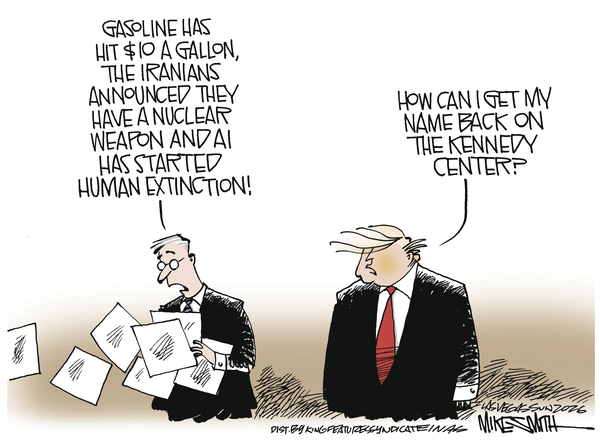
Some points I wish to make. First tRump couldn’t take not having his name seen on a building that was to honor the Kennedy family so he kept the tarps up. But why is this building and its prominence that attracts him? The way our society sees and has seen the Kennedy family has long been an issue and sore spot for tRump. In his mind his own family should be the US fake royalty not a war hero president and classy first lady. He raged against predient Kennedy’s son constantly angered that the press never covered his kids the same way. Well that is because while the Kennedy’s were doing good works for the public the tRump kids were ingaged in crimes and money laundering. tRump is fully consumed by his stature and standing with the public and how he is perceived because he is a poor man in a wealthy situation and he is a weak man pretending to be the model strong man. Remember he told Queen Elisabeth that his kids were equal to her kids because he was US royalty like she was British royalty. Hug
Attorneys for Beatty said in a statement that the new naming effort appears to defy a judge’s ruling this year that the center’s board does not have the authority to rename what was intended as a “living memorial” for an assassinated president.
The board voted to change the name of the building to “The John F. Kennedy Center for the Performing Arts Restored and Renovated by President Donald J. Trump.”
Scaffolding and tarps cover the building name at the John F. Kennedy Center for the Performing Arts in Washington on June 30.Al Drago / The Washington Post via Getty Images file
The Trump-appointed Kennedy Center board voted Thursday to partially close the iconic arts center for up to two years during renovations and to re-add President Donald Trump’s name to the building’s facade, according to a person who attended the virtual board meeting and a second person familiar with the meeting.
The decision would close the Kennedy Center’s main building and keep a smaller addition, known as the Reach, open for some events in response to a May court order requiring the board to maintain the center as a memorial to President John F. Kennedy.
After an almost two-hour Zoom meeting, the board voted 20-3 to change the name of the building to “The John F. Kennedy Center for the Performing Arts Restored and Renovated by President Donald J. Trump” and the physical location to “President Donald J. Trump Plaza.” Commerce Secretary Howard Lutnick proposed the name change.
Trump, who appointed himself chairman of the board last year, joined the call for several minutes, according to the source who attended the meeting.
The three people voting against it are the ex officio members from Congress, Rep. Joyce Beatty, D-Ohio; Sen. Sheldon Whitehouse, D-R.I.; and Rep. Rick Larsen, D-Wash.
“This latest development is a transparent effort to circumvent the Court’s ruling, and flies in the face of the statutes that Congress passed,” Beatty, who was one of the plaintiffs in a lawsuit challenging the Kennedy Center’s renaming, said in a statement. “I will continue to fight for this treasured national monument.”
Attorneys for Beatty said in a statement that the new naming effort appears to defy a judge’s ruling this year that the center’s board does not have the authority to rename what was intended as a “living memorial” for an assassinated president.
“A federal judge already rejected the board’s unlawful attempt to rename the Kennedy Center, and told Donald Trump’s handpicked board that its last closure vote was ill-informed and preordained. Today’s vote is more of the same, and a show of blatant disrespect to the courts,” said the lawyers, Norm Eisen of Democracy Defenders Action and Nathaniel Zelinsky of Washington Litigation Group.
U.S. District Judge Christopher Cooper’s order in May, which temporarily blocked the Kennedy Center’s planned closure last month, also asked that the board provide a financial plan to justify the decision to close it. Keeping the smaller venue open would allow ticket sales for some events, including performances by the National Symphony Orchestra, which is the Kennedy Center’s chief tenant.
The orchestra has performed there since the early 1970s, when the center — conceived by Jaqueline Kennedy as a memorial to her slain husband — opened.
In recent years, under the baton of music director and principal conductor Giancarlo Noseda, it has been rising in stature — but its future is now uncertain because the Kennedy Center’s Concert Hall will not be available. A search for other venues in the area has been underway.
The Kennedy Center’s future has been in limbo for months as Trump moves to reshape the iconic art institution in his image, one of several major Washington renovation projects.
After Trump named himself the Kennedy Center’s chairman last year and filled its board with allies, the board voted unanimously in March to close the center for two years for renovations.
Cooper’s order temporarily blocked the construction work and ordered that Trump’s name be removed, which it was in June.
He also said the board could still ultimately close the center “should it come to this decision anew after independently balancing its multiple obligations to the Center in a prudent fashion.”
Cooper also found the board did not have the authority to rename the center or add a name to it without the approval of Congress, which initially named it.
“The Kennedy Center’s organic statute makes crystal clear that the Center is to be named for President Kennedy, and it cannot bear any other formal name or public memorial based on the Board’s unilateral say-so,” Cooper said in his May decision.
“May the John F. Kennedy Center for the Performing Arts be renamed absent Congressional authorization? The answer, plain from the face of the statute, is no. Nor can any other individual be memorialized on the front portico of the building. Congress gave the Kennedy Center its name, and only Congress can change it.”
The decision to close the center and add Trump’s name to the building has sparked outrage from the administration’s critics, as well as members of the Kennedy family.
Former Rep. Joseph Kennedy III, a grandnephew of the late president, said in a statement last year that the center “is a living memorial to a fallen president and named for President Kennedy by federal law. It can no sooner be renamed than can someone rename the Lincoln Memorial, no matter what anyone says.”