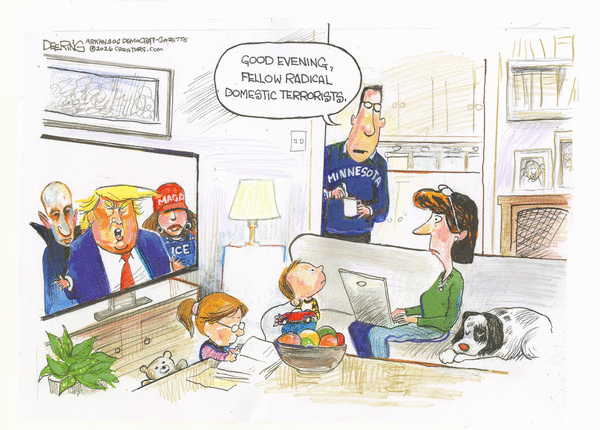
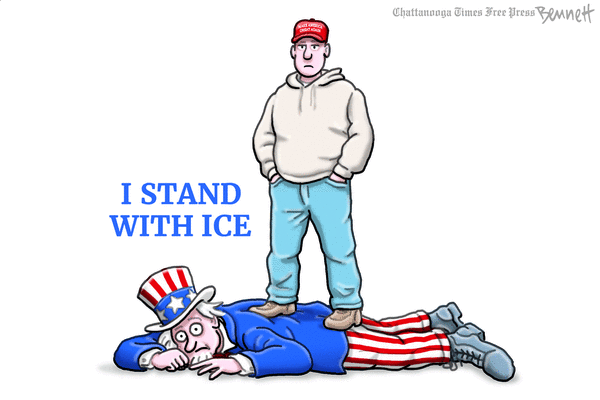
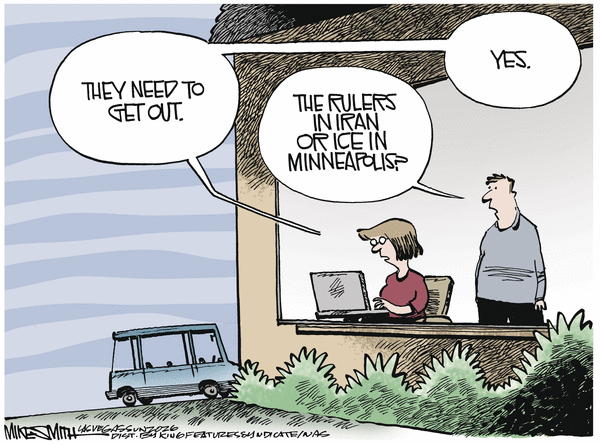
ICE white supremacist gang thugs getting even more agressive attacking people. They no longer care about skin color. The gang has reverted to gang tactics of intimidation. They think might makes them right. The ones with the guns are in charge is what they have been taught. And the administration is OK with this as it helps their cause to have a frightened public unwilling to stand up to them. They are covering their faces because they understand they are breaking the laws and that if a police officer tried this they would be in prison. They know that Stephen Miller will not always be there to protect them. And tRump can not pardon people found guilty of state crimes. In this clip a woman rushes into another woman’s home. The police dispatch incorrectly tells her she must hand the woman over and she almost does, but then gains courage as ICE thugs draw closer on her property. Her neighbors come out and give her strength and support. Hugs
Again we see the institutionalized casual racism in the US. This was the basis of the CRT higher education classes were about. All the media latched on to and went into great detail over a white woman’s shooting by ICE but only report vaguely and sporadically on the shooting of the black / brown people shot by ICE. But when you read the report below think on how racist ICE gang thugs are, the fact that they have broken other laws and assaulted other people with impunity as they are defended by the power of the US government. One last thing to think on. The ICE thug was clearly angry and he had his gun out, ready, and pointed in front of him allowing him to shoot the man without raising his gun. The reported statements from the government never mention him drawing his gun nor raising it, just that he fired his weapon defensively. If he felt threatened why openly approach the man with the long gun? Why no call for back up? Depending on the time was the ICE thug wakened up by the noise of gun fire? Hugs
Friends and family of the 43-year-old man who was fatally shot by a Department of Homeland Security agent in Northridge on New Year’s Eve gathered on Sunday to demand accountability and hold a candlelight vigil for their lost loved one.
They identified the victim as Keith Porter, who they say was a well-known and well-liked person in the community.
“If I could say anything to the ICE agent, it’s that you’re a murderer,” said Jasané Tyler, Porter’s cousin. “You stole my cousin from me. You stole their father from them. You stole Francine’s son from her.”
Porter’s loved ones are demanding justice after the father of two died on New Year’s Eve. He was shot by an off-duty U.S. Immigration and Customs agent at the apartments where they both lived.
Keith Porter, the 43-year-old man fatally shot by a DHS agent in Northridge on New Year’s Eve. Porter Family
His family contends that he was shooting a gun in the air to mark the new year. A statement from DHS on the incident contends that it was an “active shooter situation.”
“On December 31st, an off-duty ICE Officer bravely responded to an active shooter situation at his apartment complex,” the statement said. “In order to protect his life and that of others, he was forced to defensively use his weapon and exchanged gunfire with the shooter.”
Another statement from DHS Assistant Secretary Tricia McLaughlin provided further details. She said that the agent was “in his apartment, when he heard what he suspected were multiple gunshots. The suspected gunfire grew progressively louder, indicating to the officer that whoever was firing a gun was approaching his apartment. The officer took his ICE-authorized firearm and left his apartment to investigate. He moved to the ground level and went outside, where he believed the suspected gunfire was coming from.”
McLaughlin’s statement says that the officer rounded the corner of the building, where he encountered Porter, who they said was allegedly armed with a long rifle.
“The ICE officer identified himself as law enforcement. In response, the individual pointed his weapon at the ICE officer. The officer ordered the subject to put the weapon down, McLaughlin said. “When the subject refused to comply, the officer fired defensively with his service weapon at the subject to disarm him. The subject fired at least three rounds at the officer.”
Porter’s friends and family don’t buy it, especially with members of law enforcement in their own family.
“Every one of them says this is not standard, this is not protocol,” Tyler said.
Black Lives Matter leaders, who hosted the Sunday night vigil, are outraged by what happened.
“Were this anyone else, there would’ve been an arrest,” said Dr. Melina Abdullah, with BLM. “You don’t get to just murder people because you don’t like what they’re doing or how they’re celebrating.”
Los Angeles Police Department officers tell CBS LA that their investigation into the shooting is still ongoing. They also told the LA Times on Sunday that they haven’t yet spoken with the ICE agent due to protocol on how deadly force investigations are conducted when they involve federal law enforcement officers.
Russia has compromised each and every Republican in Congress. Not one of them stands up for the US or our NATO/EU allies.
All things they tried to use to bludgeon the Democratic Party members and presidents. It is all gone when a thug mob boss wannabe of their own threatens them with the loss of their elected positions that gives them personal wealth. Hugs
Jonathan Ross was not going to let an LGBT mother just drive away without submission. He performed the ‘scared cop’ persona for a few seconds, then code switched back with “fcuking bitch” and walked away.
This is an important story of growth and rejection of your core identity. The fact that those closest to you can not accept you and that which makes up who you are. I have not changed the text of the story in any way as I want the voice of the author and his agony of his childhood to shine clearly. This is the way the right wing Christian Nationalist bigots want every family member to be and all children raised. Remember this was only the 1990s. In the 30 years since great progress was made in acceptance, tolerance and education of / about LGBTQ+ kids and how to raise them in loving acceptance of how they feel inside themselves. The Christian hate groups that make their living trying to return the country to a much more regressive hateful time rolling back all rights gained by minorities. And in a very short time they have had a huge effect on how LGBTQ+ people especially LGBTQ+ kids are treated. They stated their goal of driving these kids back into hiding terrified of being outed for fear of being beaten, harassed, and ostracized. That is what they want. Several Christian lawmakers who are trying to make being an out LGBTQ+ kid illegal along with showing any media that represents the LGBTQ+ community have said that when they were kids in school they used to gang up and beat the shit out of LGBTQ+ kids. I know in the 1970s I was not out but targeted as a “faggot” and constantly harassed and attacked. How any adult would want to return to such a time, to having any kid or adult be treated that way is horrendous. Especially from those trying hard to force the country to follow their idea of a Christian lifestyle. Hugs
At 30, I’m finally living as myself. But the man whose acceptance I wanted most still can’t say the word gay.
Jan 10, 2026
Content warning: This story includes mentions of homophobia, childhood trauma and suicidal ideation.
By CorBen Williams
The seventh time I came out to my father wasn’t dramatic. It didn’t happen at a kitchen table or in a parking lot or after he’d found one of my journals. It happened casually, slipped into a conversation like it was nothing:
“As a gay man—” I began.
“You’re not gay,” he interrupted.
“Dad,” I replied. “We’ve done this too many times before.”
Even now, at 30 years old, married to the man I love, fully myself in ways I once thought impossible, my dad still can’t say who I am out loud. It hangs there, suspended between us, as though acknowledging my homosexuality would unravel something he’s built his entire life around.
I’m not sure what exactly. Control? Image? Masculinity? Maybe he simply doesn’t have the language.
Photo courtesy of CorBen Williams.
I grew up in North Pole, Alaska, in a red-sided house at the end of a gravel turnaround. It was the kind of home where the winter light never quite reached the living room and silence carried through the walls like a second language.
North Pole felt like its own universe. A 2,500 person military town where there’s snow on the ground for up to 187 days a year and the Christmas lights never come down. About 70% of the town is white and roughly 30% of the voters are registered Republican, with almost half listed as “undeclared,” which in Alaska is usually just Republican without saying it out loud.
Most families were tied to the church or the base, so you learned fast what was considered normal and what was not. People knew your parents and your business.
Growing up Black and queer made me stand out without trying and forced me to learn early how to tuck parts of myself away.
My parents had both served in the military, and even though my mother had the warmth and softness to move past it, my father emulated parental rejection. Dad demanded respect and expected excellence in the way a man shaped by the military does: loud and without room for negotiation.
You could feel his energy before you heard his footsteps because there was always a tension that entered the room with him. He yelled more than he spoke, and as a kid I was told to listen to what he was saying, not how he was saying it, even when he was screaming in my face.
My father didn’t know what to do with a son who felt things deeply, and before I ever came out to him—the first of seven times—he had already shown me exactly which parts of myself were unsafe to reveal.
But that didn’t stop me from trying. The first time I came out, I was in first grade, sitting in the parking lot of a McDonald’s on Geist Road, right beside my future high school.
“Dad, I think I’m bisexual,” I said.
I knew my ass was gay. But I also knew enough about my father to try to ease him into it. He asked if I knew what that meant, and even though I did, I told him “no.”
“It means you like sucking penis,” he spat harshly.
I was six.
People think kids don’t understand things, but children clock everything. That moment didn’t confuse me about who I was. It clarified who he was. It showed me that there were parts of me he couldn’t handle and wouldn’t protect. I didn’t leave that day understanding my sexuality better. I left understanding the risk of telling the truth.
The second time, I was forced out when my father found my journal. I was 10 years old, and in those pages, I’d written unpolished thoughts about men, about how I felt around them, questions I didn’t yet know how to ask anyone.
He burst into my bedroom and tore the journal up in front of me, little pieces of paper flying around me as I sat in my bed. I tried not to cry.
“As long as you’re a kid in my house, you don’t get privacy,” I remember him barking. It showed me that I need to be wary about how much I trust people and what information I give them.
This rejection led me to the darkest part of my childhood.
“I am tired of living,” I remember muttering to my sixth grade teacher.
I was exhausted by my dad, exhausted from hiding, exhausted from feeling wrong in my own skin.
I should have stopped writing after that, but writing was how I survived. When you don’t have anyone to talk to, you talk to the page.
By 13, I had another journal. This one had drawings of a classmate and fantasies about kissing him. When my dad found it, he brought it up on the car ride home from school, saying “the correct way” to feel about other boys was “brotherly love” and nothing else.
But the third journal set off the biggest explosion.
It was filled with details, drawings and fantasies about my first hookup with a boy. The way I wrote about them, at 15, was more adult. The kind of writing he didn’t want to believe his son was capable of.
“I fucking told you about this shit,” he shouted, with the journal gripped tightly in his hand. “This isn’t appropriate. This isn’t what we do.”
My mom was sitting next to me, shocked, both of us caught off guard by how quickly he had gone from discovery to explosion. I almost cried, but I swallowed it down. My mom guided him into the other room to calm him down.
He didn’t speak to me for seven days. He couldn’t look at me. Each day felt like another nail in the coffin.
Photo courtesy of CorBen Williams.
I kept coming out to my dad anyway. At 17. At 22. At 24. Nothing changed.
Part of me used to think that I was an embarrassment to my family. I felt for so long that I needed to apologize for being the mistake. But in my late teens, I started to see it differently. I realized I just wanted his acceptance and his love in a way that I was never gonna get.
Because of this, I don’t think I ever really got to be a child. Even in first grade, when other kids were talking about Barbies and Legos, I felt like I was always bracing for impact, performing a version of boyhood that never fit. My childhood was spent preparing for adulthood and a career. People would always say to me, “You seem so much older. You seem so mature.”
I left North Pole for good and moved to New York City when I turned 19. I became a performer, a traveler, someone who learned to build softness and resilience, where my childhood had taught me to live in fight-or-flight mode. And then, almost when I wasn’t expecting it, I met Travis.
He was older. Wisconsin-born. A wildlife biologist. Patient in a way I didn’t even realize I needed. My mother said he softened me, brought grey into my black-and-white worldview. With him, I don’t brace for criticism. I don’t edit myself. I don’t shrink. I don’t hide my journals.
We’ve been together five years now, married for three. He’s met everyone in my life, except for my dad.
Photo courtesy of CorBen Williams.
Now, when I think about my upbringing in North Pole, I think about the path through the woods that led to my house, hoping someone on the other side would understand me. I think about how many times I tried to hand my father my truth, and how many times he handed it back to me with rage.
Even now, with the life I’ve built and the love I’ve chosen, acceptance is still complicated. I wish I could say that learning to love myself erased the sting of not being understood, but the truth is I still wrestle with where I fit—inside my family, inside Black spaces, inside queer spaces, inside the places that were never built with someone like me.
I’ve learned to be confident, to be gracious, to be the person who makes others feel seen, maybe because I know exactly what it feels like not to be. But some days, even as a grown man, I feel an instinct to shrink.
I’m learning that acceptance is a practice, one I have to return to again and again. I don’t have it all figured out. But I’m trying. And maybe that’s the real truth at the end of all this: I haven’t just been coming out to my father all these years—I’ve been slowly, steadily learning how to come home to myself.
Uncloseted Media and GAY TIMES reached out to CorBen’s father for comment, but he did not respond.
Sam Donndelinger assisted with the writing and reporting in this story.
If objective, nonpartisan, rigorous, LGBTQ-focused journalism is important to you, please consider making a tax-deductible donation through our fiscal sponsor, Resource Impact, by clicking this button:
The lawless tRump and criminal gang Gestapo thugs in ICE do not want to be held accountable. They are demanding they have the right to lie and you must believe it. They think they would be allowed to get away with everything and anything to harm and terrorize people if no can see what they do. So they try to convince you it is a crime to record them. It is not a crime. But remember how racist cops tried to do the same thing after the George Floyd murder? We must not let them take our rights away from us and we must fight against the tyrannical dictatorship of a lawless government ruling a powerless public. Hugs
The Trump Administration Says It’s Illegal To Record Videos of ICE. Here’s What the Law Says.
The Trump administration believes you don’t have the right to record Immigration and Customs Enforcement (ICE) officers in public. This stance is both factually wrong and an attempt to chill free speech by conflating it with violence.
At a July 2025 press conference in Tampa, Florida, Department of Homeland Security (DHS) Secretary Kristi Noem said, “Violence is anything that threatens them and their safety, so it is doxing them, it’s videotaping them where they’re at when they’re out on operations, encouraging other people to come and to throw things, rocks, bottles.”
In September 2025, DHS Assistant Secretary for Public Affairs Tricia McLaughlin called “videotaping ICE law enforcement and posting photos and videos of them online” a form of doxing. She added, “We will prosecute those who illegally harass ICE agents to the fullest extent of the law.”
These aren’t idle threats. The Trump administration strong-armed Apple into removing an app from its mobile store that tracked ICE activity and threatened criminal investigations into its creators.
The most aggressive application of this policy has come in Chicago under “Operation Midway Blitz,” where ICE officers have relentlessly targeted protesters, reporters, and clergy engaged in protected First Amendment activity.
In October, a group of journalists and protesters filed a lawsuit alleging “a pattern of extreme brutality in a concerted and ongoing effort to silence the press and civilians.”
In court filings, the plaintiffs stated that federal officials’ own testimony illustrated their point. For example, when ICE field director Russell Hott was asked if he agreed “that it’s unconstitutional to arrest people for being opposed to Midway Blitz,” he answered “No.”
“Similarly, [U.S. Customs and Border Protection Commissioner Greg] Bovino testified that he has instructed his officers to arrest protesters who make hyperbolic comments in the heat of political demonstrations, even though such statements—which do not constitute true threats—are protected speech,” the motion argued. (Hott and Bovino’s depositions were filed under seal, and those comments were later redacted in a corrected filing by the lawsuit plaintiffs, but not before others took screenshots of them.)
Based on voluminous evidence that feds in Chicago ignored her previous orders to curb their use of force, U.S. District Court Judge Sara Ellis issued a preliminary injunction against DHS in early November 2025, saying the government’s conduct “shocked the conscience.”
Ellis found much of the officials’ testimony not credible. Bovino, for instance, testified that he never used force against a protester he was filmed tackling, and in another instance, Ellis said, he lied about being hit with a rock before firing tear gas at demonstrators. Nor did evidence support the government’s claims that federal officers issued warnings before firing less-than-lethal projectiles at those protesters.
“Describing rapid response networks and neighborhood moms as professional agitators shows just how out of touch these agents are, and how extreme their views are,” said Ellis.
The Trump administration responded by calling Ellis an “activist judge,” but it is squarely wrong when it comes to recording and protesting the police. Cato Institute senior fellow Walter Olson points out that, “While the Supreme Court itself hasn’t yet faced the issue squarely, the sevenfederalcircuitsthathavedoneso…all agree that the First Amendment protects the right to record police performing their duties in public.”
Likewise, federal circuits have upheld the right to use vulgar language to oppose police without fear of retaliation, and to warn others of nearby police checkpoints or speed traps.
As Olson writes, the administration’s “attempt to alter reality by establishing new legal facts on the ground” ultimately serves as a green light for informal repression. “If the agents come to believe that they have blanket immunity [for] whatever they do, or that citizens have no right to record them, they are more likely to take aggressive informal action, such as grabbing phones or taking news reporters into custody on charges of obstruction (perhaps later quietly dropped).”
It’s not hard to find examples of this rotten agency culture in practice. In late October 2025, ICE officers broke out the window of a U.S. citizen’s car and detained her for seven hours after she followed and photographed their unmarked vehicles. DHS accused her of reckless driving, attempting to block in officers with her car, and resisting arrest—all claims that she and her lawyer deny. Prosecutors did not charge the woman with a crime.
Recording government agents is one of the few tools citizens have to hold state power accountable. Any attempt to redefine observation as “violence” is not only unconstitutional—it’s authoritarian gaslighting. When a government fears cameras more than crimes, it isn’t protecting the rule of law. It’s protecting itself.
Paul Eaton in Baghdad in June 2004. Eaton spent 37 years in active service. Photograph: Brent Stirton/Getty Images
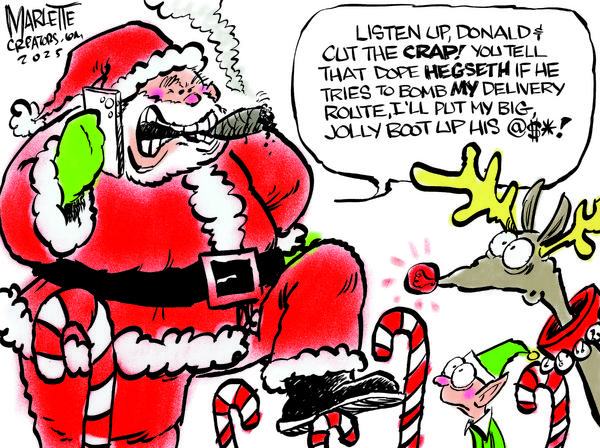
Donald Trump and his defense secretary, Pete Hegseth, are mounting an aggressive push to politicise the top ranks of the US military – a push that smacks of Stalinism and could take years to repair, the former infantry chief who trained troops to invade Iraq has warned.
Maj Gen Paul Eaton has sounded the alarm, saying in an interview with the Guardian that the effort to bend the higher echelons of the military to the US president’s will was unparalleled in recent history and could have long-term dire consequences. He warned that both the reputation and efficiency of the world’s most powerful fighting force was in the balance.
“There is an active effort to politicise the armed forces,” Eaton said. “Once you infect the body, the cure may be very difficult and painful for presidents downstream.”
He added that the actions of Trump and his chosen head of the Pentagon were putting the standing of the military as an independent entity, free from party politics, at risk. “As the phrase goes, reputation is built a drop at a time and emptied in buckets.”
Eaton, 75, has spent his entire life in military circles, including 37 years in active service. His father was an air force pilot whose B-57 bomber was shot down over Laos in 1969, when Eaton was 18.
Air force Col Norman Eaton’s remains were found and identified in 2006.
Eaton himself trained at West Point, the US military academy in New York that trains commissioned officers, graduating soon after the end of the Vietnam war. He rose through the ranks of the US army to infantry chief and then, after the initial invasion of Iraq in 2003 was completed, was sent to that country to rebuild the Iraqi armed forces.
In recent years Eaton has been a sharp critic of Trump’s manipulation of military structures. In the summer of 2024 he participated in war games conducted by the Brennan Center for Justice thinktank, that sought to anticipate the then Republican nominee Trump’s most dangerous authoritarian moves were he to return to the White House.
Many of the actions predicted in those tabletop exercises – including politicisation of the military and other key government institutions, and deployment of the national guard into Democratic-controlled cities – have already come to pass under Trump’s second presidency.
In Eaton’s analysis, Trump’s first step towards compromising military independence was the act of appointing Hegseth as secretary of defense. The former Fox & Friends host had been an adviser to Trump and had supported his first presidential run in 2016.
“Hegseth not only swears loyalty to Trump, he swears fealty to Trump – whereas the military swears an oath to the constitution,” Eaton said.
Soon after Hegseth was ensconced in the Pentagon the firings began. Within a week of Trump’s inauguration the military inspector general who acted as an independent watchdog was dismissed, followed by the top military lawyers (judge advocates general) who advise on the laws of armed conflict.
Out, too, went the top officers. Charles Brown, chair of the joint chiefs of staff, was ousted in February and replaced by Lt Gen Dan Caine who Trump claimed had express his love for the president and would “kill for him” (Caine denied ever saying such things). The top officers in the navy and air force were ditched in quick succession.
The Pentagon purge sent a clear and chilling message that reverberated throughout the military services, Eaton said. “Toe the line, or we will fire you. You’re in a different world now. This is Trump’s world, and by God, this is what we’re going to do.”
The dismissals also sowed doubt throughout the ranks. Would senior officers kowtow to Trump and his defense secretary? Or would they stand up for following the military rules of engagement?
Eaton said the effect reminded him of Joseph Stalin’s 1940s purges of the top officers in Soviet forces. “Stalin killed a lot of the best and brightest of the military leadership, and then inserted political commissars into the units. The doubt that swept the armed forces of the Soviet Union is reminiscent of today – they are not killing these men and women, but they are removing them from positions of authority with similar impact.”
The end result, Eaton said, was that “you’ve got a 1940s Stalin problem inside the American military right now”.
The furor over the lethal US military strikes on boats in Latin American waters is for Eaton a sign of the damage that is being wrought. The administration claims the strikes have been targeted on “narco-terrorists” who are in “armed conflict” with the US by bringing illegal drugs into the country.
The first of more than 20 strikes that have occurred took place on 2 September. It involved a controversial second strike that killed two survivors who had been clinging to the bombed wreck of the boat.
The Washington Post revealed that Hegseth had given an order to “kill everybody”. Under the Department of Defense manual on the laws of war, it is forbidden to order that every combatant must be killed irrespective of whether they pose a threat.
Eaton has no doubts about the illegality of the 2 September second strike. “It was either a war crime or a murder. So we have a real problem here. This decision looks a whole lot like a U-boat commander machine gunning victims in the water during world war two.”
Hegseth sought to drive home the new way of doing things in a bizarre summit in September in which he gathered military commanders to Quantico in Virginia. He berated them about so-called wokeness, liberal thinking, and the presence of “fat generals and admirals in the halls of the Pentagon”.
For Eaton, the meeting was “disgusting” and “antithetical to the US military. The senior leadership of our armed forces are sober people who do not speak in terms of fatness or ‘kill them all’ or ‘the gloves are off’.”
Looking ahead to 2026, Eaton is profoundly concerned that the violations of rules of war that have arguably been committed by the Pentagon outside US territory might soon become a reality domestically. The Trump administration has federalised national guard troops and sent them into numerous cities against the wishes of Democratic mayors and state governors.
The presence of national guard soldiers in Los Angeles, Washington DC, the Chicago area and other locations has been challenged in federal courts, where cases continue to play out.
In October Eaton took part in a delegation that included the organisation Vote Vets, to which he acts as an adviser, to see the Democratic governor of Illinois, JB Pritzker. The retired two-star general said they counseled Pritzker to stand firm in countering troop deployment to Chicago.
“We told him: you have a requirement to protect your citizens from federal assault.”
Eaton’s biggest fear is at some point a dramatic clash of forces might take place, with the federalised national guard facing off against state and local police. He conjured up the imaginary scenario of the Texas national guard being federalised – ie ordered out of state control into national control – and imported into Baltimore, Maryland, contrary to the city and state’s wishes.
“What could go wrong?” Eaton said. “You can very easily see an escalation in which both sides think they are right, obeying orders that they believe were given legally.”
Sooner or later, he warned, a “memorable event” was likely to take place. “There are going to be people getting hurt who really don’t need to get hurt.”