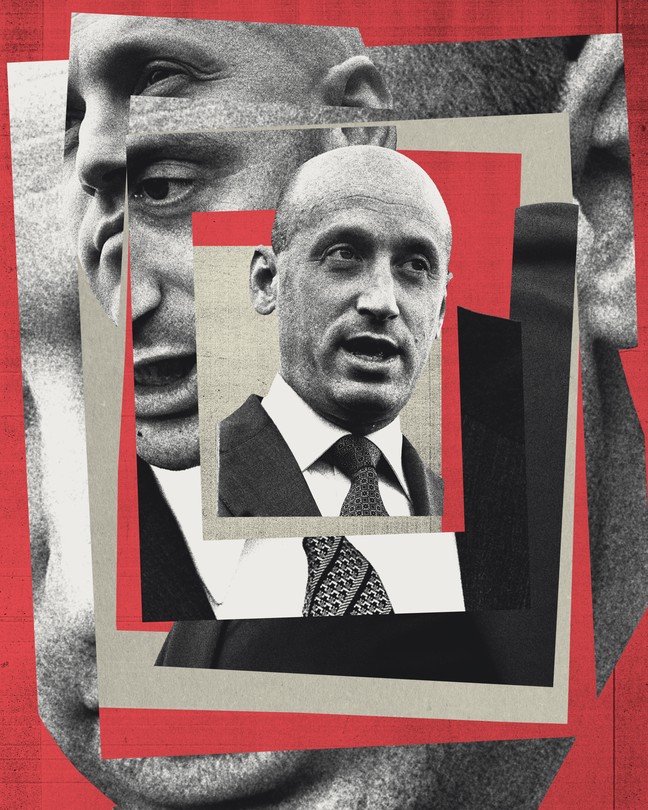
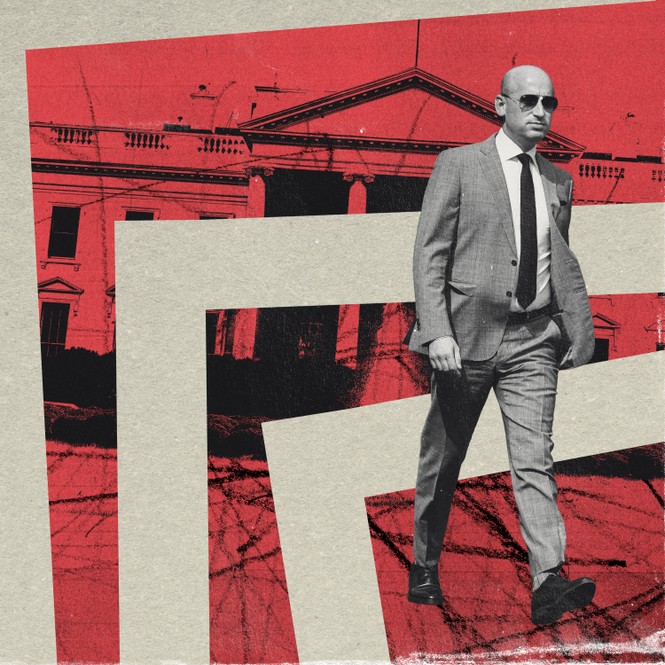
Illustration by Ben Kothe / The Atlantic. Sources: Demetrius Freeman / The Washington Post / Getty; Kayla Bartkowski / Getty; Samuel Corum / Sipa / Bloomberg / Getty.
January 7, 2026
Stephen Miller runs his daily 10 a.m. conference calls—yes, even on Saturdays—less like a government adviser and more like a wartime general. His is the dominant voice, as he plays the role of browbeater, inquisitor, and bully. He accepts no excuses, entertains no dissent.
Donald Trump’s deputy chief of staff for policy ruthlessly pursues the president’s vision, especially when it comes to pushing immigrants out of the country, and he runs a tight, efficient meeting. Consensus is not the goal.
Instead, Miller demands progress reports on his mass-deportation campaign and issues orders to the full alphabet soup of federal enforcement agencies, including the FBI, CBP, ICE, HHS, and the DOD. One senior official who has participated in the calls told us that the intensity and urgency often veer into hectoring. “He pushes everybody to the absolute limit because he knows that the clock is ticking,” this person said. “He gets on the phone and he yells at everybody. Nobody is spared from his wrath.”
In May, Miller told Immigration and Customs Enforcement officials that he wanted 3,000 immigration arrests a day, a nearly tenfold increase over the number they’d arrested on U.S. streets in 2024. He demands daily updates on the ICE hiring surge too; the administration had pledged to deploy 10,000 new deportation officers by this month—more than doubling the agency’s workforce. And Miller expects regular updates on detention capacity, deportation flights, and border crossings.
Miller publicly shames bureaucrats he feels are falling short or resisting orders. “If there’s a problem and you’re the owner, you have to fix it quickly,” another frequent conference-call participant told us. “It’s not a place where you can say, ‘I have to get back to you.’”
A third official told us that the calls are unlike any other government meetings they’ve attended. “If you say something stupid, he’ll tell you to your face. You are expected to perform at a certain level, and there’s no excuse for not meeting those expectations,” this person said.
In Trump’s inner circle—even with the president himself—Miller is known as a dogmatic force whose ideas are sometimes too extreme for public consumption. “I’d love to have him come up and explain his true feelings—maybe not his truest feelings,” the president joked at an Oval Office briefing in October. But in Trump’s second term, Miller finds himself at the height of his powers—the pulsing human id of a president who is already almost pure id.
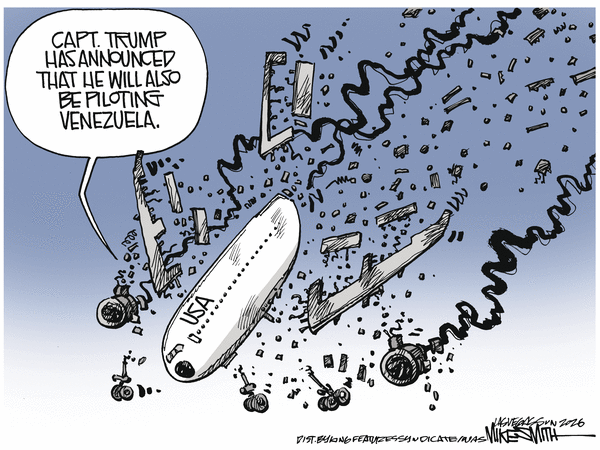
Miller has tried to recast the nation’s partisan political disagreements as an existential conflict, a battle pitting “forces of wickedness and evil” against the nation’s noble, virtuous people—a mostly native-born crowd that traces its lineage and legacy “back to Athens, to Rome, to Philadelphia, to Monticello.” He accuses federal judges of “legal insurrection” for ruling against Trump’s policies, describes the Democratic Party as a “domestic extremist organization,” and dismisses the results of even legal immigration programs as “the Somalification of America.” And he has declared an end to the post–World War II order of “international niceties” in favor of a world that rebukes the weak, “that is governed by strength, that is governed by force, that is governed by power,” as he put it this week when discussing recent military action against Venezuela.
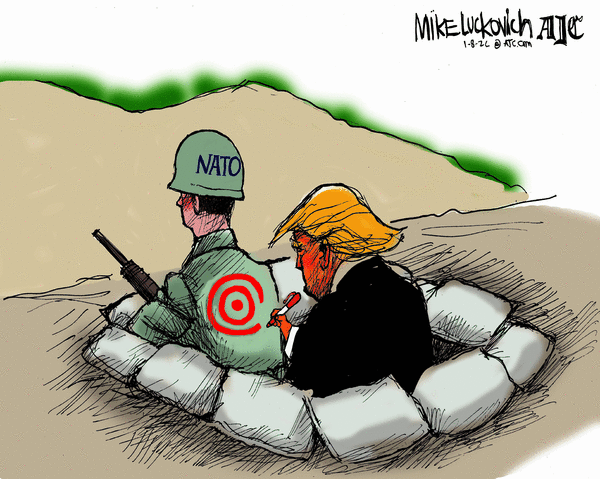
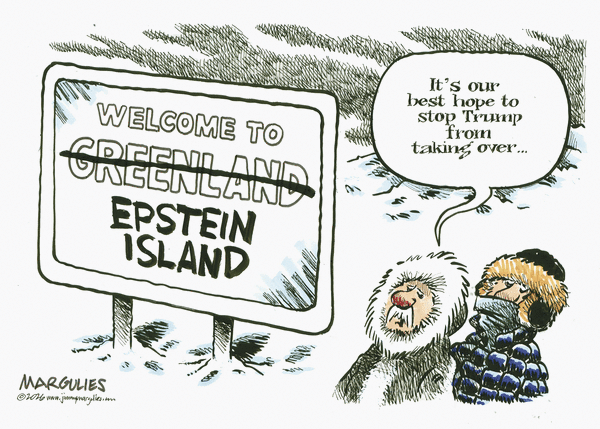
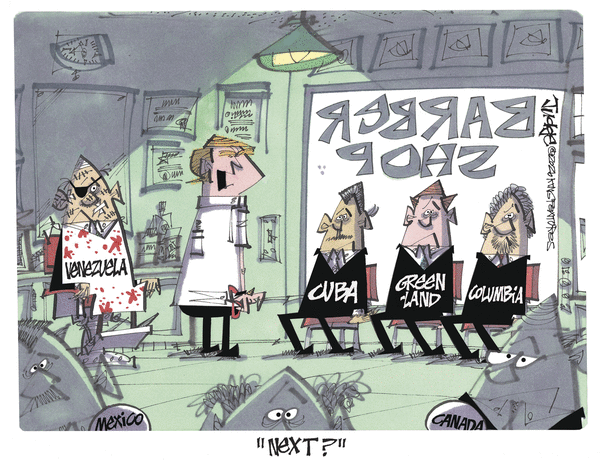
Along with Secretary of State Marco Rubio, Miller was the chief force behind Trump’s decision to capture the Venezuelan strongman Nicolás Maduro. “We are a superpower, and under President Trump, we are going to conduct ourselves as a superpower,” Miller told CNN’s Jake Tapper on Monday, articulating a worldview that started with the fear of immigration but has gradually expanded to a broader national-security and rule-of-law argument. (In this Darwinian vein, Miller also declared that the U.S. military could seize Greenland without a fight, echoing a social-media post that his wife, Katie Miller, had made two days earlier, showing an American flag superimposed on a map of the icy landmass alongside the word: SOON. NATO leaders have nervously affirmed Denmark’s claim to the territory.)
Miller’s official titles—he is also the director of the interagency Homeland Security Council—understate the full sweep of his purview. Steve Bannon, a former Trump adviser and a Miller ally, describes him as Trump’s “prime minister.” Miller has a role in nearly every area about which he cares deeply: immigration and border security, yes, but also national security, foreign policy, trade, military action, and policing. He may draft a flurry of executive orders one day, lead a meeting on lowering domestic beef prices the next, and travel to deliver a fiery speech of his own—think Trump at his angriest and most dystopian, without any of the president’s impish humor—the following week. (Miller declined to comment for this story.)
Early in Trump’s second term, he invoked the Alien Enemies Act of 1798 to treat migrants as part of a foreign invasion, directed Congress to pass $150 billion in new funding for homeland-security enforcement, and captained the administration’s assault on elite universities such as Harvard and Columbia. Late last year, he helped orchestrate Trump’s authorization of military strikes on suspected drug-smuggling boats in the Caribbean Sea and eastern Pacific Ocean, setting the stage for the military operation against Maduro.
The force behind Miller’s directives became clear during Signalgate—in which the Trump administration accidentally included The Atlantic’seditor in chief, Jeffrey Goldberg, on a private Signal chat about a bombing campaign in Yemen. It was Miller—not Trump’s national security adviser, Pentagon chief, or even vice president—who ended the debate and directed the group to move forward with the strikes. Trump has described Miller as sitting “at the top of the totem pole” inside the White House.
“He oversees every policy the administration touches,” White House Press Secretary Karoline Leavitt told us. “I can’t tell you the number of times a policy matter is discussed in the Oval and Trump will say, ‘Where’s Stephen? Tell him to get that done.’”
To critics, Miller is the smirking embodiment of everything they view as dangerous and authoritarian about the Trump administration. He has been called a Nazi, a neo-Nazi, a white supremacist, a kapo, and Lord Voldemort. Posters of Miller—pursed lips, furrowed brow—have been plastered around the nation’s capital, stamped with CREEP and FASCISM AIN’T PRETTY. His own uncle has denounced him, writing at one point that if Miller’s immigration policies had been implemented a century ago, their family—which fled anti-Jewish pogroms in Europe—“would have been wiped out.”
Yet if Miller has internalized any of the criticism, or acknowledged the parallels to his own lineage, he has not shown it, even among friends or colleagues. Miller is now acting as an accelerant for the president’s most incendiary impulses and shaping the lives of individual Americans in nearly every realm. He has demonstrated neither the interest nor the ability to moderate his views—even for tactical purposes. He is apt to overreach. And he has shown that he’s not afraid to use the power of the government to go after those who try to stand in his way—even his liberal neighbors, whom he has accused of threatening his family.
During Trump’s first term, Miller pushed the family-separation policy at the southern border, a measure long considered too extreme to implement. It triggered such a massive backlash that Trump’s wife and eldest daughter urged him to stop it. The separations became the defining immigration policy of Trump’s first term, undermining his ability to run on the issue in 2020. Now that he’s back in office, the latest polling shows eroding support for the president’s immigration crackdown, especially among the Latino voters who helped carry him to victory in 2024.
But Miller has continued to push not just for the deportation of people in the country illegally but also for narrowing or closing legal immigration pathways, especially for people from poor, not-majority-white, non-Christian nations. His actions have struck many Americans as racist and xenophobic. (In 2019, for instance, the Southern Poverty Law Center reported on leaked emails in which Miller urged the conservative Breitbart News to promote ideas from The Camp of the Saints, a 1973 French novel popular in white-nationalist and neo-Nazi circles.) Colleagues who have worked with him for years say they have never heard him utter a racist slur, even in private. His devotion is not to white supremacy per se, they insist, but to the political and intellectual thesis he has been pushing since before he arrived in Washington. He wants to halt and reverse America’s post-1960s immigration boom, and he pursues that goal with a fervor that has made him the public face of Trump’s restrictionist immigration policies.
During debate prep for the 2024 campaign, Miller found himself in a contentious back-and-forth over immigration with a more moderate Trump ally. Finally, a frustrated Trump interrupted the two men: Stephen,he said, if you had it your way, everyone would look exactly like you, someone familiar with the exchange told us.
“That’s correct,” Miller said, before turning back to continue sparring.
The nexus of Miller’s power is a vestige of President George W. Bush’s War on Terror. Weeks after the attacks of September 11, 2001, Bush established the Homeland Security Council to coordinate the government’s domestic response to the new threats from abroad. More than two and a half decades later, Miller has attached that rubric of national emergency to a new target, turning the council into a daily war room to track and fine-tune Trump’s campaign to deport 1 million people a year.
The September murder of the right-wing activist Charlie Kirk, who was close to many in the administration, including Miller, plunged Trump’s already single-minded martinet into a maximalist frenzy. A portrait of Ronald Reagan hangs prominently in the Oval Office—just over Trump’s left shoulder when he’s seated at the Resolute Desk—but Miller has made it abundantly clear that this is no longer Reagan’s Republican Party.
Former Senator Jeff Flake, the Arizona Republican who retired during Trump’s first term, told us that he has noticed a clear shift from one Trump administration to the next. “Before, it was more subtle, more nuanced, but now it’s pretty plain. He wants to see more immigration from the Nordic countries, and not so much from the Third World countries. It’s just a clear break from the huddled masses yearning to breathe free,” said Flake, who, as a senator, worked unsuccessfully to pass a bipartisan immigration overhaul. “It’s not the Reagan vision. It’s not the traditional Republican vision.”
Flake said that although the immigration system has serious problems, Trump and Miller’s goal seems to be “to change the nature of who we are as a country.”
Beyond immigration, Miller specializes in turning the president’s whims and rantings into government policy. As Trump griped about the homeless encampments near the State Department one day, Leavitt recalled that he turned to Miller and said: “Get it done.” “And within six hours,” she said, “I looked at Twitter, and there were cranes cleaning them up.”
“Stephen is the most effective political aide of this generation—and probably since James Baker,” the former Trump adviser Cliff Sims told us in a text. “No one is more deft at moving the levers of government to turn the President’s policies into action.”
May Mailman, who last year worked closely with Miller to punish elite universities that the administration claims are rife with anti-Semitism and “woke” ideology, explained to us how Miller approaches a problem. In March, for instance, upset with Columbia University for several reasons—including prominent pro-Palestinian protests on campus—Trump posted a message on social media that began, “All Federal Funding will STOP for any College, School, or University that allows illegal protests.” Miller told Mailman to come up with some options, but, with Trump’s buy-in, Miller was ultimately the one who approved pulling federal funding from the school.
Then he carefully watched for the reaction. “If taking money from Columbia was a bad idea and backfired in some way, then Stephen would be the one to demand a course correction,” said Mailman, who first worked with Miller during Trump’s first term. “But because that worked out pretty well, he then tries to figure out: How can we use that tool in other areas?”
Close observers of Miller say that his total command is a marked contrast to his role during the first Trump term, when, despite being a senior adviser, he was limited in his ability to direct others. David Lapan, a retired Marine Corps colonel and aide to former Homeland Security Secretary John Kelly, told us that he remembers attending a 2017 meeting at which Miller urged officials to send him examples of crimes committed by immigrants so he could publicize them. The difference then, Lapan said, is that Miller had an advisory role, and the other meeting attendees could disregard requests that they felt were too outlandish. “We came out of that meeting and said, Yeah, we’re not doing that,” Lapan recalled. “We knew that Kelly would cover for us.”
“Are there stories like that out there? Sure,” Lapan said. “But they’re the exception, not the rule. Cherry-picking a few bad cases to paint all immigrants in a negative light is not something that we were willing to do.”
Although Miller views himself as the president’s loyal servant, Trump’s stances appear to have shifted under Miller’s direction. The president used to speak favorably about certain immigrant groups he liked, such as DACA recipients and the employees at his golf resorts. But lately, his occasional pro-immigrant chatter has quieted. “‘America First’ is becoming ‘Americans Only,’” Lapan said.
Illustration by Ben Kothe. Sources: Getty; Jim Watson / AFP / Getty.
Miller turned 40 in August and celebrated with a surprise party at the Ned, a chic members-only club blocks from the White House. The president did not show up, but just about everyone else did: White House Chief of Staff Susie Wiles, House Speaker Mike Johnson, conservative influencers, nearly every Cabinet secretary. Miller did not have a speech prepared but spoke self-deprecatingly, thanking Wiles for putting up with his ideas and suggestions. The turnout was a show of not just Miller’s immense power but also his popularity in an administration that has been rife with infighting and backstabbing, especially during Trump’s first term.
The gleeful brawler Miller plays on TV is no act, his colleagues told us, and he behaves similarly in private (although often with a dash of deadpan humor). Several people told us that they appreciate how dogmatic he is, for a possibly surprising reason: They always know where he stands on the issues, and where they stand with him. As Trump’s speechwriter during the first administration, he built goodwill with colleagues by warning them when the president was about to say something contrary to their plans, so they had time to try to convince him otherwise.
“The lazy and clearly false hit on him is to call him these disgusting names,” White House Communications Director Steven Cheung told us, about the accusations that Miller is a Nazi or a fascist. “If you dig deeper and aren’t suffering from Trump Derangement Syndrome, he’s not what the media portrays him as. He’s actually a very nice and cordial person who cares about this country and wants to do a good job. He’s very easy to work with. I’ve been in Trump world a long time, and he’s probably the easiest to work with.”
Several people described Miller as an exacting boss, even a micromanager, but one who looks out for his team—including younger aides. In Trump’s first term, he was not yet married, and he spent many of his nights out, grabbing drinks or dinner with everyone from Cabinet secretaries to more junior staff, who were eager to get time with him. When Trump’s first term wound down, Miller helped ensure that everyone on his staff (and even some not on his team) had a job lined up.
Friends and colleagues say he has rarely seemed hurt by the criticism and caricatures. But he can be vain about his appearance; in Trump’s first term, he once showed up to Face the Nation with what was roundly mocked as spray-on hair. (In Trump’s second term, the hair is gone.) And after a recent Vanity Fair photo shoot of senior West Wing staff, the photographer—whose close-up, often unflattering photos went viral—recounted to The Washington Postthat Miller “was perhaps the most concerned about the portrait session,” asking whether or not he should smile. Colleagues also describe a proud sartorialist who regularly debated fashion and traded menswear tips with another West Wing fashionista, Hogan Gidley, a deputy press secretary during Trump’s first term.
“We would talk about the difference in fabrics for seasons, and lapel size and width of ties and these types of things,” Gidley told us, before describing Miller’s style as “sophisticated and smart and chic but also daring at times.”
In a recently resurfaced 2003 video, a 17-year-old Miller—prominent sideburns and tightly coiled brown hair—sits in the back of a moving school bus, opining on the war in Iraq. In the video, Miller smirkily suggests that the “ideal solution” for “Saddam Hussein and his henchmen” would be “to cut off their fingers”; he argues that torture is the proper punishment in a nonbarbaric society. (In a barbaric society, he implies, death would be the appropriate punishment.) “Torture is a celebration of life and human dignity,” he continues, briefly unable to hide his delight as his latest outlandish proclamation illicits titters from his peers—his mouth widens into a toothy grin, and he emits an audible chuckle before taking a breath and continuing.
This is Miller the troll, who has confided in friends that he enjoys starting a fire, then dousing it with gasoline. But after more than two decades relishing his role as the gleeful contrarian, the persona has now become more true character than occasional outlandish caricature. “He has a flair for the dramatic, and you can tell that now with the way he comports himself on TV,” Bannon told us. “He plays the character well, knowing he always wants to have the libs’—the progressives’—heads blow up.”
After graduating from Duke in 2007—where he vigorously defended white lacrosse players who were falsely accused of rape by a Black stripper—Miller landed a job with newly elected Republican Representative Michele Bachmann of Minnesota. As young Capitol Hill aides, he and Sergio Gor—who recently became Trump’s ambassador to India—helped launch the supernova ambitions of Bachmann, a right-wing darling whose then-fringe ideology presaged the rise of MAGA. By the time Bachmann’s 2012 presidential bid flamed out, Miller was already firmly ensconced with then-Senator Jeff Sessions of Alabama, who shared his hard-line obsession with immigration, and Bannon, who provided a broader nationalist, populist scaffolding.
As Sessions’s aide-de-camp, Miller helped his boss sabotage the bipartisan “Gang of Eight” immigration bill, which passed the Senate by a wide margin in 2013. At the time, a post-2012 Republican autopsy was calling for a gentler, more inclusive GOP, and the proposed immigration overhaul had the support of business and tech leaders, interest groups, and wealthy donors. But Miller was undaunted, buttonholing reporters in the hallways of Congress to press his anti-immigrant case, and calling them later at home to talk—for hours, if they’d let him—about the bill’s minutiae and why it would harm American workers. The bill died in the House, where it never came up for a vote.
Miller pushed colleagues to keep the same round-the-clock hours as he did, including calling meetings on Friday afternoons, when most Hill staffers were eager to skip out early to happy hours. Instead, Republican staffers sullenly reported to messaging meetings to talk about immigration.
Working with Bannon, Miller made Breitbart News the communications arm of his effort. And, understanding that data and statistics, however dubious, could lend their cause the sheen of legitimacy, they elevated obscure anti-immigration groups—the Center for Immigration Studies, NumbersUSA—into prominent sources. “The more outrageous the headline, the better,” Bannon said.
By the time Miller joined Trump’s 2016 campaign—officially launched with claims that Mexico was sending “rapists” and criminals across the border—his immigration bona fides were well established, and he learned to channel Trump’s voice into policy prescriptions. The baby-faced Miller quickly moved from the back of Trump’s plane to the inner circle at the front.
By March 2016, Miller was Trump’s opening act, riling up crowds across the country with an anti-immigrant, anti-Washington populism that sometimes threatened to overshadow Trump himself. “I said, ‘Listen, the point of an introduction is that Trump doesn’t have to top it,’” Bannon said. “He was so insane over-the-top. But of course the MAGA base can’t get enough of him.”
In Trump’s first White House, Miller made quick use of the various levers available to him, no matter how buried in the bureaucratic bowels. He took a particular interest in the office of the staff secretary, a little-known but powerful team that vets any memo or speech or policy before it reaches the president. Not a lawyer himself, he nevertheless leaned on creative and expansive interpretations of statutes to push the president’s agenda. In the early days of COVID, for instance, he successfully urged the administration to invoke a 1944 emergency public-health law to shut down the border and rapidly expel migrants to Mexico or their home country. In a White House staffed partly by amateurs, he also benefited from his deep understanding of policy issues, which he’d been honing since high school. He coached Trump and others into even more extreme immigration positions, explaining why, for instance, he believed that giving merit-based green cards to promising foreign students was problematic.
Even his allies find Miller to be something of an “acquired taste,” as one put it. Another quipped that he has the bedside manner of Heinrich Himmler, one of Adolf Hitler’s earliest followers and a key architect of the Holocaust. But Mailman said that Miller could be strategic when making a policy pitch. On immigration, he instinctively understood if someone was a “type person” (who cared about the type of immigrant coming to the country) or a “numbers person” (who cared simply about the sheer number of immigrants) and often tailored his message accordingly. “He thinks about the rationale of how someone is approaching something,” she said.
Because Miller’s views—especially on immigration—were so well known, he earned Trump’s trust despite also, at times, vigorously disagreeing with him. “Miller is 100 percent firm in every conviction and feeling he has, and he just says it the way he believes it, and if it aligns with what the president wants to do, then great,” a first-term Trump aide told us. “And if it’s nuanced or different, then Miller stakes out his position—he doesn’t care if it’s different from what other people think or what the president wants—but then once the president makes his position clear, Miller executes on it, whether or not he agrees with it.”
Despite his years as Sessions’s protégé, Miller quickly distanced himself from his longtime mentor, several people told us, when Sessions, then Trump’s first attorney general, recused himself from the investigation into Russian interference in the 2016 election, angering the president. In fact, the rupture was more acute than was publicly known; Miller was enraged by what he viewed as Sessions’s unforgivable betrayal of Trump.
During the first term, Miller aligned himself with Ivanka Trump and her husband, Jared Kushner, once it became clear that they held tremendous sway with the president. The pairing was unusual, given that the president’s daughter and son-in-law were seen as misguided “globalists” by much of the far-right base. One person familiar with the dynamic described Miller spending hours with Ivanka Trump on her key initiatives—paid family leave and tax credits for parents. The charitable explanation, this person continued, is that Miller was being generous with his time and expertise; the more cynical one is that Miller understood that Ivanka Trump was less likely to complain to her father about Miller’s hard-line immigration policies if the two had a good relationship.
“He always understood where power lies,” Bannon said. “No matter what—he can be coaching a Little League team—Miller can very quickly analyze.”
Miller’s fealty to his boss was on display right up until the end of Trump’s first term. On January 6, 2021, Miller’s wife—who had worked as Vice President Mike Pence’s communications director—was on maternity leave but still employed by Pence. But when Trump called Miller that morning to discuss adding lines to his speech attacking Pence, Miller—ever the good soldier—did as he was told.
Later that day, angry Trump supporters marched to the Capitol, calling for the vice president to be hanged for treason.
The enemy arrived at the Millers’ doorstep on a warm September morning in the form of a retired gender and peace-studies professor in a loose striped dress. Barbara Wien, who had been protesting the family’s presence in Arlington, Virginia, pointed her index and middle fingers at her own eyes, then directed those fingers at Katie Miller, who was on the front porch.
Stephen Miller took the gesture at his wife, which was captured on video, as a call to violence—an offense that he uniquely had the power to punish.
The Millers had already felt under siege, facing threats and fearing that the entire family was being surveilled by sophisticated actors. A Rhode Island man had been indicted in August for publicly threatening to kill Miller and other officials. A law-enforcement official told us that Katie Miller had been surreptitiously photographed in her neighborhood—while going to the gym, and at least once while walking with her kids—and said that there was a “coordinated” and “malicious” effort to, at the very least, intimidate them. Someone had also posted flyers at neighborhood parks where their kids played, revealing their home address and calling him a Nazi. The Millers had stopped allowing their children to play in front of the house or in the backyard.
But they were not going to be intimidated by a 66-year-old activist.
“You want us to live in fear? We will not live in fear,” Miller said days later, in an appearance on Sean Hannity’s Fox News program. He had gone on the program to discuss the federal response to Kirk’s recent assassination, but although he was focused on “domestic terrorists,” he included doxxing on the list of related offenses. For those familiar with the Millers’ personal lives, it sounded less like he was talking about Kirk’s assassin than about Wien, who’d distributed flyers with his address.
“You will live in exile,” he continued, “because the power of law enforcement under President Trump’s leadership will be used to find you, will be used to take away your money, take away your power, and, if you have broken the law, to take away your freedom.”
Miller set about drafting a series of executive orders, later signed by Trump, that directed federal law enforcement to refocus counterterrorism efforts on people with “anti-fascist” ideas, such as “extremism on migration, race, and gender” and “hostility towards those who hold traditional American views on family, religion, and morality.”
This fall, Miller also began describing a central divide in the country, pitting “legitimate state power” against what he termed left-wing “street violence.” His definition of the latter was broad. He accused Democratic politicians who called him or Trump “authoritarian” of “inciting violence.” (Never mind that he had repeatedly called the Biden administration “fascist.”) He placed doxxing—what his family faced—on the continuum that leads to violence. (Also never mind that Vice President J. D. Vance encouraged calling out those who celebrated Kirk’s murder, including at their place of employment.)
As Miller announced federal policies aimed at combatting the threat, he was also fighting a private battle against the very enemy he described. In the weeks after Wien made her gesture in front of his wife, the Millers decided that they were no longer safe in their six-bedroom, roughly $3 million Northern Virginia home. They sought out military housing at a nearby base, arguing to friends and allies inside the administration that their safety depended on it.
But the legitimate powers of the state repeatedly declined to fully cooperate with the Millers’ attempt to turn their own situation into a catalyst for the sort of crackdown they claimed was necessary. The FBI was initially hesitant to take a major role in the investigation of Wien, prompting the Millers to demand its involvement, according to a person briefed on their efforts. A Democratic Virginia state prosecutor became concerned about the federal involvement in a search warrant on Wien, and sought to narrow its scope. A federal magistrate judge refused to approve federal search warrants, according to a report by Axios.
Katie Miller, who hosts her own podcast, recently appeared on Piers Morgan’s YouTube show and accused a progressive guest, Cenk Uyger, of attacking her Jewish children by merely having a difference of opinion with her. She then offered a veiled threat to have Uyger’s citizenship revoked. (Uyger is a naturalized citizen; in a text message, he described Katie Miller’s threat as “not an attack on me as much as it’s an attack on America.”) When the investigation against Wien appeared to stall, Miller’s longtime ally Jim Jordan, the House Judiciary Committee chair, announced that he had opened an inquiry into the Democratic prosecutor in Virginia who had sought to narrow the search warrant and raised concerns about federal involvement.
“This is so cool,” Katie Miller said on social media. “Thank you.”
Days later, the prosecutor said that she would not cooperate with Jordan’s inquiry, because the investigation was ongoing and Congress lacked the ability to intervene in a state law-enforcement matter. There were still some powers of the state that Miller did not control.
I wish to thank Ten Bears for the link to this article. We are in a really bad time in this country driven my a dementia addled president that is driven by greed and an unhinged Nazi wannabe man who felt powerless over anyone most of his life Stephen Miller. He has felt less than the women and men around him. Miller has hated brown people since he was a teen and his goal is a white ethnostate. Hugs
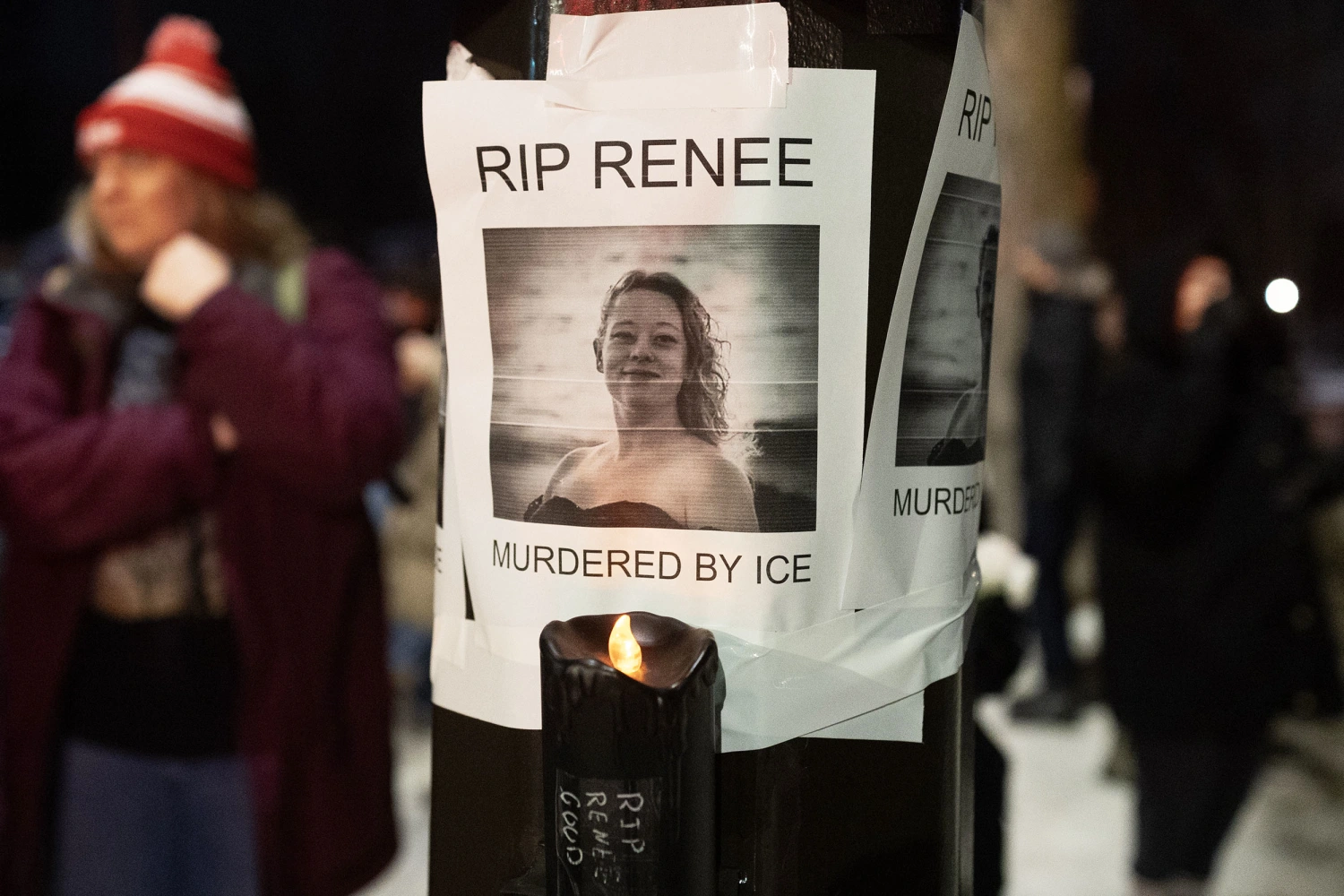
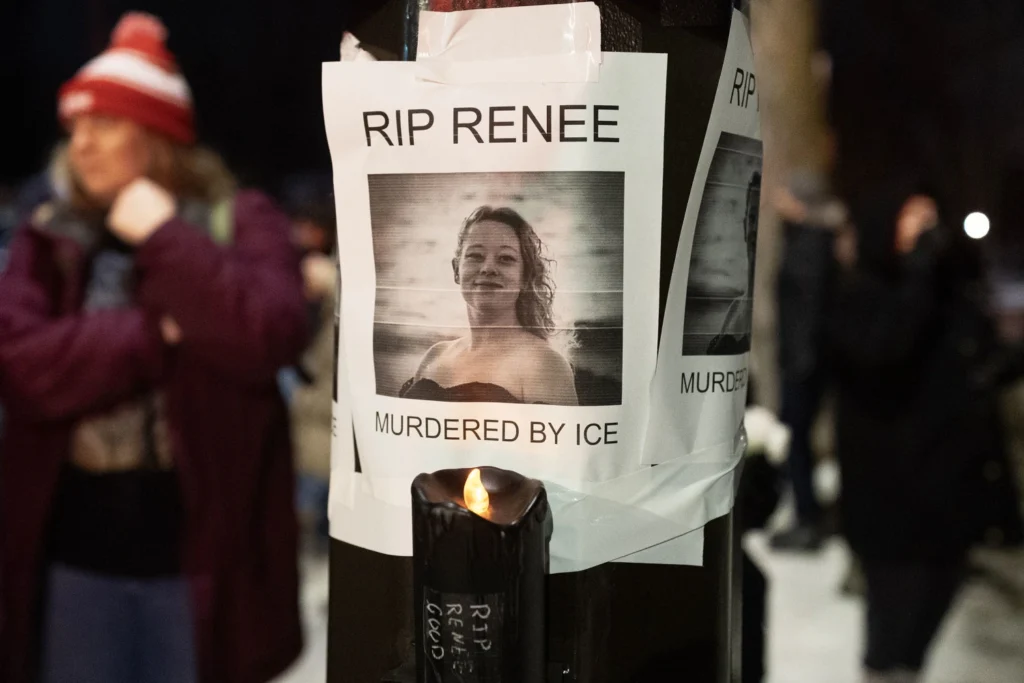
The murder of Renee Good was an intentional act in several senses.
First, it was a murder in the classic legal sense, in that the ICE agent who shot and killed her was in no danger — the video clearly shows Good trying to drive away as masked armed men shout contradictory orders at her — so the use of deadly force had no justification. Of course the entire right wing is lying about this, recalling a famous quote from 1984:
The Party told you to ignore the evidence of your eyes and ears. It was their final, most essential command.
Closely related to this is the fascist fellow traveler move of invoking some utterly phony Rashomon metaphor about “multiple perspectives” or some such dime store postmodernist bullshit. There are multiple perspectives here, but only because half the country is fascist or enablers and tolerators of the fascist movement that is Trumpism. The perspectives are the truth — Renee Good was murdered by ICE — and a lie: The fascist scum who murdered her was acting in self-defense.
But this was an intentional act in a more abstract and attenuated sense, in that Stephen Miller has created a set of circumstances in which it was inevitable that this sort of murder would happen in this way, so he could pursue his sadistic fantasies of a violent crackdown on protest against the regime (note here that Good wasn’t even protesting; she may have been observing ICE’s activities for evidentiary purposes, but even that is unclear). The local Democratic authorities are asking for calm, so that a proper investigation of the murder can take place, but of course there can be no proper investigation when any such investigation needs to take place in the shadow of a fascist federal government, that quite consciously put into place the policies and practices that would make such a murder, as well as future such murders, inevitable.
Meanwhile Donald Trump, whose brain is turning to mush in real time, is apparently serious about invading Greenland, while Denmark is promising to resist such an invasion with whatever military resources it can muster. All of this is total madness. all of this presages the descent of the nation into pure authoritarianism, and all of this is something that the leadership of the Democratic party is utterly unable to even begin to deal with, as illustrated by these remarks from senior Democratic senators about Marco Rubio and his role in the quarter-baked let’s not even bother to pretend there’s any legal defense for this coup in Venezuela:
“Although I may disagree with him on a day-to-day or hour-to-hour basis … he has shown extraordinary competence,” Sen. Dick Durbin of Illinois, the No. 2 Democratic leader, said in an interview. “I voted for him in this position; I still have confidence in his abilities.”
Others said they respected his particular expertise on issues in Latin America while also raising doubts about the strategy for Venezuela he is laying out in public and in private briefings — which for now involves propping up interim president Delcy Rodriguez as a de facto U.S. puppet.
“You can talk to Marco about — ‘Tell us about Delcy.’ … He knows all of that, and he can give you a sense of who they are and what they’re up to,” said Sen. Tim Kaine (D-Va.), a former colleague on the Foreign Relations Committee.
Kaine complimented Rubio for putting a renewed focus on the Americas, while quickly adding that Trump’s self-proclaimed “Donroe doctrine” is the “wrong kind of attention.”
Compare this attitude toward the Trump administration to Alexandria Ocasio Cortez’s straightforward response to the federal government’s murder of Renee Good:
Ultimately, there are “multiple perspectives” on things like the murder of Renee Good and the invasion of Venezuela because half the country is fascist, or fascist-enabling. The essence of Trumpism — in all but textbook fascist movement at this point — is to both deny Renee Good was murdered and at the same time enthusiastically approve of her murder (see Holocaust denial for the classic template).
Half the country are enemies of liberal democracy, and they have to be crushed by its defenders. That the political opposition is not currently capable of this even if it should manage to win actual future elections is too obvious for words.
“Never believe that anti-Semites are completely unaware of the absurdity of their replies. They know that their remarks are frivolous, open to challenge. But they are amusing themselves, for it is their adversary who is obliged to use words responsibly, since he believes in words. The anti-Semites have the right to play. They even like to play with discourse for, by giving ridiculous reasons, they discredit the seriousness of their interlocutors. They delight in acting in bad faith, since they seek not to persuade by sound argument but to intimidate and disconcert. If you press them too closely, they will abruptly fall silent, loftily indicating by some phrase that the time for argument is past.”
I would like to thank https://personnelente.wordpress.com/2026/01/08/causing-problems-on-purpose/ for the link to the story. I am listening to congressional republicans drown on about the US being the apex predator so our country has the right to do what ever we wish to on the world stage. Our country has the right to take what we want because Nazi Stephen Miller who seems to be running the country because that might makes right and the US has the military might. Every time I listen to Miller punch his words out like a poor imitation of Hitler and his entire mocking of anyone in the media or that disagrees with his stance I get a sick horrible feeling in my core being. He is unhinged and the most powerful person next to tRump. Hugs
Protesters clash with law enforcement outside an Immigration and Customs Enforcement (ICE) facility on January 8, 2026. (Photo by Mostafa Bassim/Anadolu via Getty Images)
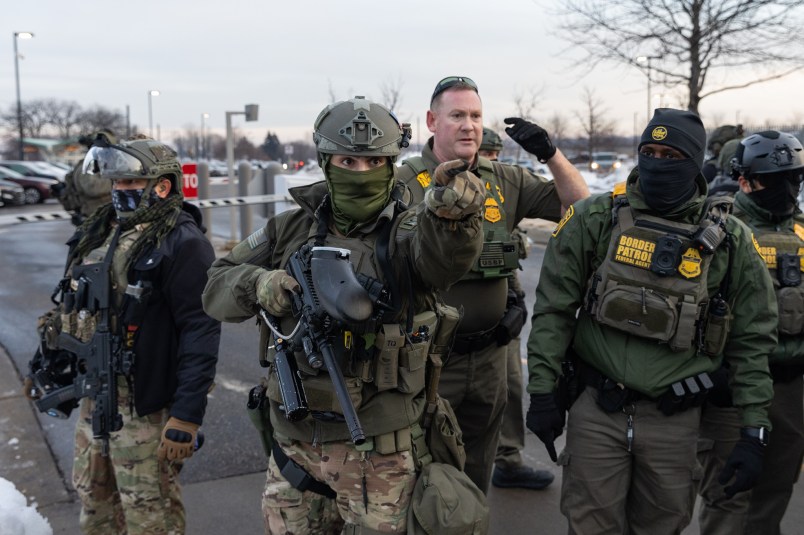
More than 2,000 U.S. Immigration and Customs Enforcement agents are on the ground in Minnesota in what President Donald Trump’s administration officials have called the “largest immigration operation ever.” Deployed just days ago by Trump, one agent has already shot and killed a person and federal law enforcement has deployed tear gas and pepper spray against protesters.
The massive operation and subsequent violence in Minneapolis comes against the backdrop of Trump’s announcement Tuesday that he’s freezing $10 billion in federal funds approved by Congress for child welfare programs, including Temporary Assistance for Needy Families, foster care, and childcare subsidies in Minnesota and four other blue states.
This sharp escalation in action has its roots in a yearslong law enforcement investigation into widespread fraud and misuse of federal funds in Minnesota that in late 2025 was seized upon by the right-wing misinformation machine and, this week, reached a screeching fever pitch. Minnesota Governor Tim Walz announced Monday he would not be running for reelection, in part so he could devote his time to addressing the crisis.
The journey from legitimate local and federal investigations into fraud to the so-called largest ICE operation in history, the pausing of federal funds to blue states and the end of Walz’s gubernatorial tenure is a long and tangled one. As has become common in the Trump era, a serious situation was dispersed throughout the unserious realm of right-wing media and content creation, catching the attention of the president and yielding very real consequences.
Here’s the backstory you need to understand these events.
How the Scandals Started
Amid the right-wing uproar, there are elements of truth: Minnesota has grappled with Medicaid fraud for more than a decade, which has been the focus of federal and state investigations and local news reporting. The schemes were further fueled by the COVID-19 pandemic, during which an influx of federal funding for social programs came with relaxed vetting standards in an effort to allow speedy access for vulnerable populations.
Republican furor over widespread fraud has also flared up periodically over the years. But it reached new heights in recent months after a wave of new claims — ranging from the well-founded to the baseless to the entirely histrionic — caught the attention of the president.
Some of the first claims of fraud arose in 2015, and focused on day care centers that local authorities accused of overbilling state welfare agencies. This gave rise to an early instance of right-wing outrage, when a local Fox affiliate in 2018 speculated that hundreds of millions of dollars were being stolen from the program and sent to terrorists in Africa. State officials found that claim to be baseless.
In 2021, feds began investigating fraud claims connected to a child nutrition program. By early 2022, the FBI seized property from a nonprofit called “Feeding Our Future.” The revelation of the investigation prompted bipartisan outrage toward the fraudsters; Rep. Ilhan Omar (D-MN), for example, questioned the U.S. Department of Agriculture about the misuse of funds, asking about the investigation and steps that could be taken to prevent “fraudulent misuse of federal funding meant to feed hungry children” in the future.
In September 2022, the Department of Justice announced federal criminal charges against a network of people connected to Feeding Our Future, alleging they defrauded the government of $250 million in federal child nutrition funding, using the funds instead for mansions, cars and other lavish personal expenses. Former Attorney General Merrick Garland said the indictments represented “the largest pandemic relief fraud scheme” to date. At the time, 47 people were indicted, many, but not all of whom, were members of the Minnesota Somali community. State Republicans began pointing a finger at the governor.
The scandal continued to unfold. Even the ensuing criminal proceedings were rife with corruption, with one juror dismissed after fraud defendants tried to bribe the juror with a literal bag of cash. The Feeding Our Future scheme has proven vast and deep. Between 2023 and 2025, more indictments came down connected to the case, with the 78th person indicted this past November. It has become the poster child for Minnesota’s tangled fraud network that has so far extended to autism services, Medicaid fraud, addiction services and housing..
The state has also investigated the network. In August 2023, Minnesota Attorney General Keith Ellison charged 18 people with defrauding Medicaid of $9.5 million with fake home health care businesses. Ellison in December 2023 announced charges in what his office called the largest Medicaid fraud case it had investigated. Three people were charged in an $11 million prosecution. A June 2024 state audit found the Minnesota Department of Education had received dozens of complaints about the nonprofit and failed to oversee the distribution of the $250 million at the heart of the case.
The Politics of the Scandals
State Republicans continued to use the fraud investigations and indictments as evidence of Walz’s unfit leadership. When Walz became Kamala Harris’s vice presidential candidate in August 2024, the governor became a punching bag for Republicans in the state running for local and national office. On the Hill, House Republicans subpoenaed Walz for information about his actions and responsibilities related to the Feeding Our Future scheme.
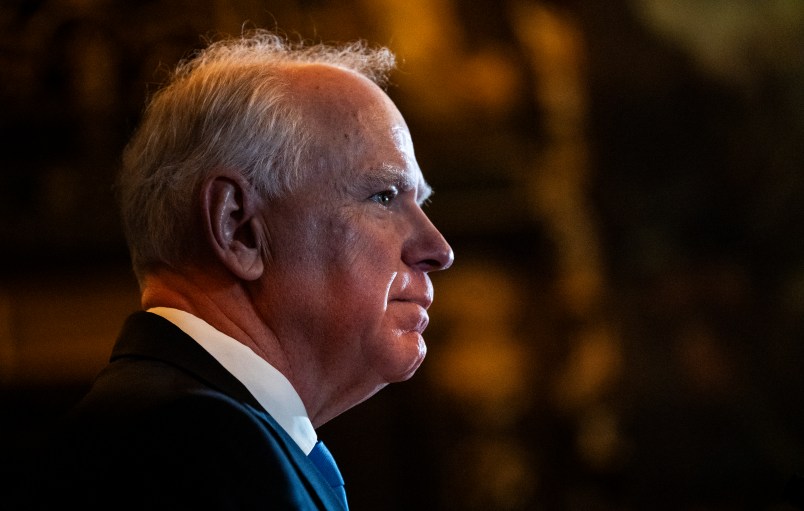
ST. PAUL, MINNESOTA – JANUARY 5: Minnesota Gov. Tim Walz speaks during a press conference at the State Capitol building on January 5, 2026 in St. Paul, Minnesota. Walz announced today that he is abandoning his re-election campaign for governor, blaming scrutiny from President Donald Trump for his decision. (Photo by Stephen Maturen/Getty Images)
In September 2025, eight people were charged in a multi-million dollar housing fraud scheme for a state program that used Medicaid funds for certain housing services. Then-Acting U.S. Attorney for the District of Minnesota Joseph Thompson called the indictments “the first wave of charges in a massive fraud” program. The abused housing program was dissolved in late October.
In addition to the political advantages of blaming the Democratic governor, some conservatives exploited the fact that most of the people implicated in each of the fraud investigations were members of Minnesota’s Somali community. That became paramount when Trump and prominent members of the MAGA-sphere got involved.
Trump Grabs the Story
On Nov. 19, City Journal, a publication produced by the conservative New York think tank The Manhattan Institute published a post co-authored by Chris Rufo, the notorious anti-woke crusader who is also a fellow at the think tank. The report alleged Minnesota fraudsters were wiring their spoils to a Somalia-based terrorism organization called Al-Shabaab, citing “federal counterterrorism sources.” Two days later, news website and television station The National News Desk — owned by the conservative Sinclair Broadcast group — covered the City Journal report. Those posts may have been what caught the president’s eye. Two hours after The National News Desk report was published, Trump posted about the Minnesota fraud investigations on Truth Social. “Minnesota, under Governor Waltz, is a hub of fraudulent money laundering activity,” Trump wrote, misspelling the governor’s name. In the same post, he said he was removing a special immigration status that covers about 700 Somalian people in the U.S., and introduced the idea that “Somali gangs are terrorizing” Minnesotans.
The Truth Social posts marked the beginning of a far-right frenzy that has seen the president and extremist influencers feed off of one another, spinning narratives and pushing policies pulsating with outrage, xenophobia and Islamophobia. On Nov. 29, the New York Times echoed Republican talking points blaming the Somali community for federal funds theft, saying that the “fraud took root in pockets of Minnesota’s Somali diaspora as scores of individuals made small fortunes.” On Dec. 1, the White House issued a one-pager about the Minnesota situation, repeatedly highlighting the ethnicity of most of the people who had been federally charged and blaming Walz.
Trump on Dec. 2 deployed a first round of ICE agents — about 100 — to Minneapolis and St. Paul to target the Somali community, an official told the New York Times. All the while, legitimate federal investigations continued to play out.
Prosecutor Thompson is now the First Assistant U.S. Attorney for the District of Minnesota. Appointed by Trump, Thompson has served as a longtime prosecutor. On Dec. 18, he charged five new people in the housing program Medicaid fraud scheme. Thompson said more than $9 billion in federal funds may have been stolen from Minnesota.
“The magnitude cannot be overstated,” Thompson said. “What we see in Minnesota is not a handful of bad actors committing crimes. It’s staggering, industrial-scale fraud.”
Following this announcement, the total number of people indicted in Minnesota fraud schemes reached 92. Eighty-two of those were of Somali descent, according to the U.S. Attorney’s Office for Minnesota, PBS reported. While a significant share of the scammers are Somali, the number is less than 0.1% of the entire Somali population in Minnesota, where the majority are U.S. citizens, and just about 0.03% of the Somali population nationwide, according to U.S. Census Bureau data cited by PBS.
Six days later, a 23-year-old content creator dropped a 43-minute YouTube video that had the effect of planting dynamite in a minefield. In a vague Dec. 26 video, former prankster turned anti-immigrant influencer Nick Shirley visited Minnesota day care and health care centers, demanded people who appeared to work at the centers show him children, and accused the businesses of fraud. Shirley in the video is flanked by two masked men, whom he identifies as his security, and is following a man called David who purports to have papers showing evidence of fraud. The Intercept identified David as 65-year-old David Hoch, an eccentric, far-right political operative in the state.
It doesn’t matter that claims made in Shirley’s video remain unfounded, and that it documents nothing untoward.
It also doesn’t seem to matter that the initial, 2018 report linking fraud in Minnesota to a Somalia-based terrorist group was debunked by the state, or that the only named source for the article told the Minnesota Star Tribune he was misquoted. (City Journal told the Star Tribune it stands by its reporting.)
Trump has since early December used the fact that the majority of the defendants in each of these fraud cases were members of the Minnesota Somali community as ammunition, opening a dark new chapter in his signature anti-immigration crackdown.
Layla A. Jones is a reporter for TPM in Washington, D.C., with experience covering government and economic policy, race, culture, and history. She has written for the Philadelphia Inquirer, Billy Penn, WHYY, NPR, and the Philadelphia Tribune, and participated in the Knight-Bagehot Fellowship at Columbia University. She attended Temple University for undergrad.
“O.K., I’ll put that on my calendar and we’ll just keep an eye on the weather and the fall of democracy.”
Peaceful tourists, even if Trump and his MAGA supporters try to whitewash over Trump’s violent history against his own people, will never be successful. Eyewitnesses, archives, and the internet preserve the memories – it is impossible to erase all the evidence. History remains.
ICE are killing blonde white women now. Every act of violence is a message meant to intimidate us. Trump and his ICE storm troopers first came for the people of color and immigrants while few resisted. Now they’re coming for anybody and everybody. Total fascism stage of the game where nobody has privilege anymore and it’s open season on anyone who resists or happens to be in the wrong place at the wrong time.
So much of what is reported is the tRump people trying to hide the truth. The fact is true it seems the US tRump government doesn’t want the truth to come out, they don’t want rogue officers investigated, they want to keep lying to the public and running illegal thug operation over the US people. There must be some way the local police can find evidence to send to a prosecutor over this event. Hugs
A day after an Immigration and Customs Enforcement officer shot and killed 37-year-old mother of three Renee Good as she tried to drive away on a snowy Minneapolis street, tensions remained high, with dozens of protesters venting their outrage outside of a federal facility that’s serving as a hub for the Trump administration’s latest immigration crackdown on a major city.
Homeland Security Secretary Kristi Noem has not publicly identified the officer who shot Good. But she spoke of an incident last June in which the same officer was injured when he was dragged by another driver’s fleeing vehicle. A Homeland Security spokesperson confirmed Noem was referring to an incident in Bloomington, Minnesota.
Court records from that case identify the officer who was dragged and injured as Jonathan Ross.
Court documents say Ross got his arm stuck in a vehicle’s window as a driver fled arrest in Bloomington, Minnesota. The officer was dragged 100 yards (91 meters) and cuts to his arm required 50 stitches.
The Associated Press wasn’t immediately able to locate a phone number or address for Ross, and ICE no longer has a union that might comment on his behalf.
Here’s what we know:
Videos of the shooting:Footage shows an officer approaching an SUV stopped across the middle of the road, demanding the driver open the door and grabbing the handle. The Honda Pilot begins to pull forward, and a different ICE officer standing in front of it pulls his weapon and immediately fires at least two shots at close range, jumping back as the vehicle moves toward him. It is unclear from the videos whether the vehicle makes contact with the officer, and there is no indication of whether the woman had interactions with ICE agents earlier. After the shooting, the SUV speeds into two cars parked on a curb before crashing to a stop.
Renee Good: She was a U.S. citizen born in Colorado and appears to have never been charged with anything beyond a traffic ticket. In social media accounts, Macklin Good described herself as a “poet and writer and wife and mom.” Public records show she had recently lived in Kansas City, Missouri, where she and another woman with the same home address had started a business last year called B. Good Handywork. Trump administration officials painted Good as a domestic terrorist who had attempted to ram federal agents with her car.
Who will investigate? The Minnesota agency that investigates officer-involved shootings said it was informed Thursday that the FBI and U.S. Justice Department would not work with the agency, effectively ending any role for the state to determine if crimes were committed. Noem said the state has no jurisdiction. Gov. Tim Walz pushed back against the Trump administration’s decision to keep the investigation solely in federal hands, emphasizing that it would be “very, very difficult for Minnesotans” to accept that an investigation that excludes the state could be fair. Mary Moriarty, the prosecutor in Hennepin County, which includes Minneapolis, said her office is “exploring all options” to determine if a state investigation can proceed.
While Mock Paper Scissors and my blog have many of the same viewers it is important to note that TenGrains site has a forensic breakdown that is very important to understand the misinformation and how badly these ICE thugs acted. I keep saying one thing everyone misses is how angry the driver of the ICE truck is and how he charges the car immediately trying to get in the car swearing at the woman driver. It would have caused concern in anyone when an angry armed masked man charges your car and starts yanking on the door handle while swearing at you. As the other videos at the above linked site show the ICE officers were never in danger and they only fired because they believe that anyone not instantly obeying them or blocking them in any way is a capital offense they can deal with anyway they want including killing the offender. We are in a very dangerous situation because the ICE thugs are soon to be the largest armed military police agency with no controls on their behavior in the US. They are the US brownshirts or Gestapo. They are made up of militias, Proud Boys, 3 percenters, Oath keepers, and Jan 6th riot insurrectionist. They feel no laws or rules apply to them, they are on a white supremacists mission to remove the brown breeders from the US to save the white people from becoming a minority. Why does that bother some white people? Because they are afraid that brown people will treat them the same way they treated brown people all these years before. It won’t happen but that is their fear, the loss of privilege they never earned and don’t deserve. Hugs




 By
By