From coast to coast, Americans are being harassed, assaulted, injured, and even murdered by sneering masked thugs hired to attack their countrymen as part of a vengeance presidency that is obsessed with hurting people for sport.
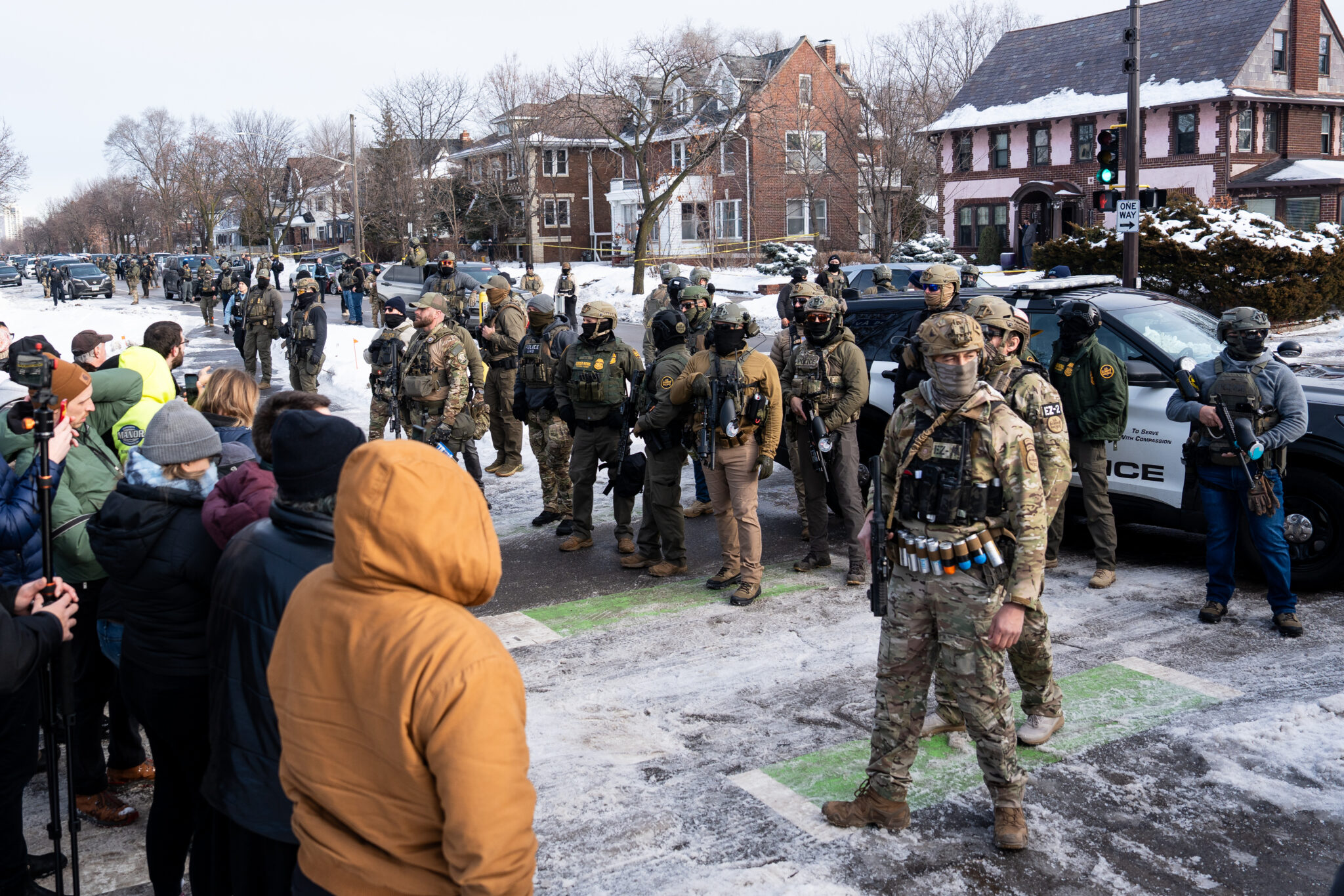
Portland Avenue and 34th Street in South Minneapolis where City of Minneapolis officials have confirmed an ICE agent shot an observer. A neighbor who saw what happened told local MPR news: “She was trying to turn around, and the ICE agent was in front of her car, and he pulled out a gun and put it right in — like, his midriff was on her bumper — and he reached across the hood of the car and shot her in the face like three, four times,” (Photo: Chad Davis)
Under wannabe dictator Donald Trump, the federal agencies of the United States tasked with keeping the nation safe are rapidly becoming a grave threat to the physical safety of the American people, as trigger-happy officers open fire on those they’re supposed to be protecting with increasing frequency in communities across the country.
Then, on October 5th, 2025, agents shot thirty-one-year-old Marimar Martinezin Chicago’s Brighton Park neighborhood. Martinez was not seriously injured and was thus able to drive away. Although she committed no crime, Trump’s minions charged her and a companion for assault and attempted murder. But prosecutors were forced to drop all charges against both of them only a few weeks later, with her attorney stating: “These agents jumped out and shot Ms. Martinez, a U.S. citizen, whose only crime was warning her fellow community members that ICE was in the neighborhood… That is not a crime. She didn’t deserve to be shot.”
Today, officials at Roosevelt High School in Minneapolis said that “armed U.S. Border Patrol officers came on school property during dismissal Wednesday and began tackling people, handcuffed two staff members and released chemical weapons on bystanders.” MPR News spoke to a school official about the incident, who related on condition of anonymity: “The guy, I’m telling him like, ‘Please step off the school grounds,’ and this dude comes up and bumps into me and then tells me that I pushed him, and he’s trying to push me, and he knocked me down… They don’t care. They’re just animals… I’ve never seen people behave like this.”
Also today, right here in the Pacific Northwest, CBP agents opened fire on a man and woman believed to be a married couple in the parking lot of Adventist Medical Center Pavilion in southeast Portland. Here’s more from The New York Times: “The driver of the vehicle that federal officials fired into drove off after the shooting, local officials said, and the victims were found by the police more than two miles away, with gunshot wounds. Emergency medical technicians who rushed the victims to hospitals described both as Spanish speakers in conversations captured by emergency radio broadcasts. The woman had a gunshot wound to the chest, an E.M.T. told a dispatcher. The man was described as having two gunshot wounds.
Details about this latest shooting in Portland are still coming into focus. The Federal Bureau of Investigation (FBI) posted a statement to Twitter about the shooting which was subsequently deleted — and that leads us to worry that the investigation may already have been compromised by political interference from Trump’s regime.
“This violence in our community is devastating,” Portland Mayor Keith Wilson said. “These are not statistics. These are human beings. Portland is not a training ground for militarized agents. When the administration talks about using ‘full force,’ we are seeing what that means on our streets. The consequences are not abstract. They are felt in hospital rooms, in living rooms, in the quiet moments when families try to make sense of what happened. We know what the federal government says happened here. There was a time when we could take them at their word. That time is long past.”
“That is why we are calling on ICE to halt all operations in Portland until a full and independent investigation can take place. Our community deserves answers. Our community deserves accountability. And most of all, our community deserves peace.”
“We are all shaken and outraged by another terrible, unnecessary violent event instigated by the reckless agenda of the Trump administration, this time in our own state, in our largest city, coming just one day after the tragedy in Minnesota,” said Governor Tina Kotek, the chief executive of Oregon.
“While details remain limited, one thing is clear: when a president endorses tearing families apart, and attempts to govern through fear and hate rather than shared values, he fosters an environment of lawlessness and recklessness.”
“I am aligned with Mayor Wilson: the priority right now is a full, completed investigation, not more detentions,” the governor added. “The Attorney General, district attorneys, and I have been clear about our concerns with the excessive use of force by federal agents in Portland, and today’s incident only heightens the need for transparency and accountability. Oregonians deserve clear answers.”
“There are those who want to cause chaos. But Oregonians know how to stand up and speak out, peacefully. We must remain united in peaceful opposition to efforts to tear our communities apart and turn against one another. We will not take the bait.”
“I am grateful to the first responders who have been on the frontline of today’s events. The state will continue to support Portland, and stand united with Minnesota.”
“Huge concern about a reported shooting of two individuals by federal agents outside Portland Adventist Hospital,” said Senator Jeff Merkley, Oregon’s junior United States Senator. “My team and I are closely monitoring this situation and are working hard to get answers. I will share any updates as I learn more.”
The Preamble to the United States Constitutions explicitly refers to “domestic tranquility.” That’s how important it was to the Framers that the people of this country be able to live peacefully and prosperously, without fear of social disorder or unrest. Domestic tranquility is a key objective of our plan of government, and the federal government is supposed to meet that objective by enforcing the laws with great care and discretion.
Obviously, that’s not happening right now.
And that’s fine with the people who worship Trump.
What happens when law enforcement officers attack the very people they’re supposed to protect? What then? People are trying to go about their lives in this country and they’re ending up killed or injured because trigger-happy agents full of testosterone have been told they can be as brutal, aggressive, and careless as they want to anyone they happen to come across — and they won’t be held accountable or punished.
This is not “law and order,” this is oppression and systemic violence. Trump has decreed it and Republicans at every level — federal, state, and local — are enabling it.
Renee Nicole Good was murdered on-camera. The footage is widely available. It’s ghastly and horrific. We can see with our own eyes and hear with our own ears that we are being lied to on repeat about yesterday’s tragic events.
That’s exactly what Trump-controlled federal agencies are doing.
With Trump’s kakistocratic regime, no American is safe. This is a government of the least qualified and most unscrupulous individuals in the land. It’s the worst government in modern American history by a lot, and the terrible people who are in it seem determined to staking a claim to being the very worst government of all time.
It is our patriotic duty and moral responsibility — all of us who are loyal to the Constitution and to the values of freedom, inclusion, peace, and tolerance — to fiercely oppose this regime and all the evils it is trying to inflict on our country.
In memory of Silvero Villegas-Gonzalez and Renee Nicole Good and everyone else who has died at the hands of the thugs working for Donald Trump, we will carry on.
When I first posted this I was rushing to do a lot of things. I failed to post the entire article. So this is try two to see if I can do it correctly this time. Here is the rest of the story. Hugs.
There are videos at the web page of the article linked below. Sorry I do not trust or give credit to the words / stories from the government. It is just sending the message to ICE thugs that the government have their backs when they terrorize, harass, and kill people. Instant obedience to their self created authority / power grab is what they want. Let’s not give it to them, but do try to stay safe when using your right to protest. Hugs
Federal immigration agents shot and wounded two people in a vehicle outside a hospital in Portland on Thursday, a day after an officer fatally shot a woman in Minnesota, authorities said.
The shooting drew hundreds of protesters to the U.S. Immigration and Customs Enforcement building at night, and Oregon Attorney General Dan Rayfield vowed to investigate “whether any federal officer acted outside the scope of their lawful authority” and refer criminal charges to the prosecutor’s office if warranted.
The Department of Homeland Security said the vehicle’s passenger was “a Venezuelan illegal alien affiliated with the transnational Tren de Aragua prostitution ring” who was involved in a recent shooting in the city. When agents identified themselves to the occupants during a “targeted vehicle stop” in the afternoon, the driver tried to run them over, the department said in a statement.
“Fearing for his life and safety, an agent fired a defensive shot,” it said. “The driver drove off with the passenger, fleeing the scene.”
There was no immediate independent corroboration of that account or of any gang affiliation of the vehicle’s occupants. During prior shootings involving agents from President Donald Trump’s immigration crackdowns in U.S. cities, including the fatal one Wednesday in Minneapolis, video evidence has cast doubt on the administration’s characterizations of what prompted the shootings.
Law enforcement officials work the scene following reports that federal immigration officers shot and wounded people in Portland, Ore., Thursday, Jan. 8, 2026. (AP Photo/Jenny Kane)
Trump and his allies have consistently blamed the Tren de Aragua gang for being at the root of violence and drug dealing in some U.S. cities.
According to the Portland Police bureau, officers initially responded to a report of a shooting outside Adventist Health hospital at 2:18 p.m. Thursday.
A few minutes later, police received information that a man who had been shot was asking for help in a residential area a couple of miles away. Officers went there and found a man and a woman with gunshot wounds. Officers determined that they were injured in the shooting with federal agents, police said.
Law enforcement officials work the scene following reports that federal immigration officers shot and wounded people in Portland, Ore., Thursday, Jan. 8, 2026. (AP Photo/Jenny Kane)
Their conditions were not immediately known. Portland police said officers applied a tourniquet to one of them.
City Council President Elana Pirtle-Guiney said during a meeting that “as far as we know, both of these individuals are still alive, and we are hoping for more positive updates throughout the afternoon.”
At a nighttime news conference, Police Chief Bob Day said the FBI was leading the investigation and he had no details about the events that led to the shooting.
Mayor Keith Wilson and the City Council called on ICE to end all operations in Oregon’s largest city until a full investigation is completed.
Multnomah County District Attorney Nathan Vasquez, center, speaks to the media following reports that federal immigration officers shot and wounded people in Portland, Ore., Thursday, Jan. 8, 2026. (AP Photo/Jenny Kane)
“We stand united as elected officials in saying that we cannot sit by while constitutional protections erode and bloodshed mounts,” they said in a statement. “Portland is not a ‘training ground’ for militarized agents, and the ‘full force’ threatened by the administration has deadly consequences.”
Wilson also suggested at a news conference that he does not necessarily believe the federal government’s account of the shooting: “There was a time we could take them at their word. That time is long past.”
Democratic State Sen. Kayse Jama, who lives near where it took place, said Oregon is a welcoming state — but he told federal agents to leave.
“You are not welcome,” Jama said. “You need to get the hell out of Oregon.”
The city officials said “federal militarization undermines effective, community‑based public safety, and it runs counter to the values that define our region. We’ll use every legal and legislative tool available to protect our residents’ civil and human rights.”
They urged residents to show up with “calm and purpose during this difficult time.”
Several dozen people gathered in the evening near the scene where police found the wounded people.
“It’s just been chaos,” said one, Anjalyssa Jones. “The community is trying to get answers.”
U.S. Sen. Jeff Merkley, an Oregon Democrat, urged protesters to remain peaceful.
“Trump wants to generate riots,” he said on the social platform X. “Don’t take the bait.”
___
Johnson reported from Seattle. Associated Press writer Audrey McAvoy in Honolulu contributed.
Annie at the link above has some grand information that we all should be aware of. She even included things people can do even if they can’t or are frightened to go to a protest. Please give the site a read, at this point we all need to do anything we can to stop the Stephen Miller’s out of control unrestrained untrained Gestapo gang thugs from terrorizing the public while demanding complete unquestioned obedience. Hugs
The report / written article has several sections with different versions. But it seems clear that Gestapo leader Stephen Miller is pushing everyone to send the message to ICE thugs and all right wing news media that the government would shield ICE gang thugs as long as they kept the harassment and terrorizing the brown people. The goal of ICE is to make brown people too scared for their lives to stay in the country or come here. The goal of the government is to force the public into instant obedience and to never protest anything the tRump people do or demand no matter how illegal, abusive, or scamming. Hugs
A third officer, positioned in front of her car on the left, drew his gun and fired three times while jumping back, with the last shots aimed through the driver’s window after the car’s bumper appeared to have cleared his body.
The video did not appear to show contact and the officer stayed on his feet, though Ms Noem said he was taken to a hospital and released.
US Vice-President JD Vance says an ICE officer was clearly justified in shooting a woman during an immigration enforcement surge.
Minnesota authorities have accused the FBI of seeking to block their access to an investigation into the death of Renee Nicole Good, 37.
What’s next?
Protesters have taken to the streets and some local schools have cancelled classes for the day.
US Vice-President JD Vance has defended the immigration agent who shot and killed a 37-year-old Minneapolis woman amid tensions between state and federal officials.
Renee Nicole Good was shot in the head in front of a family member on Wednesday, local time, during an immigration enforcement surge.
Mr Vance said the shooting was justified and that Ms Good was a “victim of left-wing ideology”.
“I can believe that her death is a tragedy while also recognising that it is a tragedy of her own making,” he said.
Mr Vance said the officer was clearly acting in self-defence.
There has been an outpouring of grief and anger in the community following the shooting. (AP: Mike Householder)
FBI ‘reversed course’ over joint probe
Minnesota’s Bureau of Criminal Apprehension (BCA) said it had been blocked by the FBI from taking part in a joint investigation into the shooting.
Following the shooting, the BCA initially said it had agreed to jointly investigate the shooting with the FBI.
But on Thursday, a day after the shooting, BCA Superintendent Drew Evans said the federal agency had “reversed course” and taken sole control over the probe.
He said that step meant the state bureau would no longer have access to the scene evidence, case materials or interviews.
“As a result, the BCA has reluctantly withdrawn from the investigation,” Superintendent Evans said.
The FBI and the office of US Attorney Daniel Rosen, the chief federal prosecutor in Minneapolis, did not immediately respond to questions about the BCA statement.
Keith Ellison, the state’s Democratic attorney general, told CNN the FBI’s decision was “deeply disturbing” and said state authorities could investigate with or without the cooperation of the federal government.
Renee Nicole Good was shot inside her car on Wednesday, local time. (Reuters: Tim Evans)
Ms Good’s death has left Minneapolis on edge, with protesters taking to the streets in anger and schools cancelling classes as a precaution on Thursday.
Minnesota and Trump administration officials have offered starkly different accounts of the shooting, with US President Donald Trump describing the slain woman as a “professional agitator”.
Democratic politicians and protesters have contested that claim, with the Minneapolis City Council saying she was “out caring for her neighbours” and died “at the hands of the federal government”.
Vance says officer deserves gratitude
Homeland Security Secretary Kristi Noem said on Wednesday, local time, that the officer who shot Ms Good had been “dragged” by a vehicle during a previous incident in June.
According to court documents, the officer was part of a team trying to apprehend a man in the country illegally.
JD Vance defended the shooting as self-defence during a press conference on Thursday. (Reuters: Kevin Lamarque)
He broke a window and reached into the vehicle, attempting to open the door when the driver sped off, dragging the officer the length of a football field in 12 seconds.
The officer’s right arm was bleeding, and an FBI agent applied a tourniquet.
He was transported to a hospital, where he received more than 50 stitches.
Prosecutors said he had “suffered multiple large cuts and abrasions to his knee, elbow, and face”.
Mr Vance said the ICE officer “deserves a debt of gratitude”.
“This is a guy who’s actually done a very, very important job for the United States of America,” he said.
“He’s been assaulted. He’s been attacked. He’s been injured because of it.”
City and state officials blame immigration surge for shooting
Federal authorities in Minneapolis used chemical agents on protesters during democrations on Thursday, a day after the shooting. (AP: Tom Baker)
The agent was among 2,000 federal officers that the Trump administration had announced it was deploying to the Minneapolis area in what the Department of Homeland Security described as the “largest DHS operation ever”.
But Wednesday’s shooting drew immediate condemnation from city and state officials who blamed Mr Trump’s immigration enforcement surge for sowing chaos in the city’s streets.
DHS officials, including Ms Noem, defended the shooting as self-defence and accused the woman of trying to ram agents in an act of “domestic terrorism”.
Minneapolis Mayor Jacob Frey, a Democrat, called that assertion “bulls**t” and “garbage” based on bystander videos taken of the incident that appeared to contradict the government’s account.
Videos showed two masked officers approaching Ms Good’s car, which was stopped at a perpendicular angle on a Minneapolis street.
As one officer ordered Ms Good out of the car and grabbed at her door handle, the car briefly reversed and then began driving forward, turning to the right in an apparent attempt to leave the scene.
A third officer, positioned in front of her car on the left, drew his gun and fired three times while jumping back, with the last shots aimed through the driver’s window after the car’s bumper appeared to have cleared his body.
The video did not appear to show contact and the officer stayed on his feet, though Ms Noem said he was taken to a hospital and released.
Oh how this cartoon resinates with me. A decade ago one of my main abusers contacted me. He told me he knew my siblings had abused me and let their boyfriends do so. But he wanted my help for something. When I informed him that he also was one of my main sexual abusers who used me for his own needs … he responded that I couldn’t blame him for that as he was a black-out drunk at the time. Yes I know his drinking was voluntary but mine was forced on me. A drunk kid is easier to maneuver and rape. He was the only one of “the family” that got some of the beatings I did. But it never caused him to draw closer to me but he took his hurts and rage on my little body. Sorry for this but right now my chained chest of bad memories are trying to overwhelm me. Hugs
I put these here in order as the author wrote them. I will say that many of the people I have read on Male Survivor were made to dress and act as female while they were male so their abusers got more thrills. That was never one of my issues. I wouldn’t have minded and the few times my “female siblings” dressed me up as a female only to be raped by the males the prepared me to be used by. I never felt unempowered or upset wearing skirts or other bits of their clothing. It was unimportant to me. I knew my place was to provide the best sexual experience of raping orally and anally as a preteen kid for who ever they had farmed me out to. For those who want to know why a 3 to 9 year old boy did not fight back, I would ask you to think of what the adults in my life were doing to me. Now about clothing. It means nothing. I was used no matter what I wore and I found skirts when I was dressed in them as feeling really great. I am not trans, but I fail to see how clothing makes a person one thing or another. Hugs