If you read the law it lets anyone claim to be offended by any media and that it doesn’t need to be declared obscene to be labeled obscene. Why is that? Because to a small group of very vocal haters just the existence of LGBTQ+ people is obscene. It offends their god so it offends them. But don’t try to claim the Bible is obscene or pushes offensive stuff it has special carve outs that make all the icky bad parts OK. I hope this will be appealed to the full appeals court as this attempt to errase an entire population of people based on bigotry must not be allowed to stand. I also just read where the education department under the hypermaga education secretary will not be enforcing or even recording the bullying and abuse of the LGBTQ+ kids at school. Her view is let the little fagots fend for themselves it seems. Remember she and her husband turned a blind eye to the many young boys being sexually assaulted by the wrestlers in their group.
Also the majority of the three judges panel said that the three patrons did not have standing to object because no books had been banned yet. They seem to have a wait and see if the victim is stabbed before taking the knife from the threatening person. That is stupid. Everyone knows what the law is intended to do and the writers of the law admit that openly. It seems the tRump appointed judges want to let attacks on the librarians and on the books that mention gay, lesbian, bisexual, transgender, non-binary, and questioning kids / people be removed as soon as possible knowing it is harder to put them back than to ban them in the first place. Hugs.
The “social section” in Crawford County Library’s Van Buren branch (Screenshot from court documents)
A federal appeals court ruled Thursday that Arkansas’ 2023 law restricting access to library materials can go into effect, three years after a judge blocked two sections of the law on First Amendment grounds.
The three-judge panel from the 8th U.S. Circuit Court of Appeals in St. Louis ruled that the 18 plaintiffs had no standing to challenge one section of Act 372 and failed to prove that the other section was unconstitutionally vague.
The two sections create criminal liability for librarians who distribute content that some consider “obscene” or “harmful to minors,” and give city and county governing bodies the final say over library content.
Republican Attorney General Tim Griffin praised the ruling, saying it “allows Arkansas to move forward in enforcing a law that protects children from obscene materials while increasing accountability for public-library curation decisions.”
The plaintiffs challenging the law include libraries, bookstores, advocacy groups and individual library patrons. Their lead attorney, John Adams, said in a statement that the legal team is “evaluating all available legal options, including further review by the courts,” after Thursday’s ruling.
“Libraries and bookstores should be places where people can freely explore ideas — not where booksellers and librarians face criminal liability for selling, checking out, or even just shelving constitutionally protected books,” Adams said. “The freedom to read is fundamental to a free society and has always been protected by the First Amendment.”
Griffin said Act 372 was meant to “to address legitimate concerns about minors’ access to obscene materials and to establish a process for reviewing challenged content.”
School and public libraries already had content challenge policies before Act 372. The law stalled in the Legislature in 2023 before it was amended to say library materials would be relocated to an area inaccessible to minors, not removed from the premises, if elected officials find them to be “obscene.”
Section 5 of Act 372 allows city and county governing bodies to relocate challenged material if a challenger disagrees with a library panel’s decision to keep it in its original section.
Another section of the law that gave school boards the same authority over school library materials had not been challenged.
Adams told the appeals court in June that Crawford County, a defendant in the case, showed what the law’s restrictions would look like in practice. The county’s five library branches separated LGBTQ+ children’s books from the rest of the collection after public outcry, and county officials cited Act 372 as a reason to maintain these “social sections,” even before the legislation became law.
Crawford County lost a separate federal lawsuit in 2024 after three parents alleged that the “social sections” violated the First Amendment.
The three library patrons who sued over the state law do not have standing because Section 5’s book challenge and relocation policies do not harm the plaintiffs, the appeals court panel said Thursday.
“Plaintiffs are speculating libraries might decide to segregate certain books as part of their curation policies, which they have not yet adopted, or in response to challenges, which have not yet been filed,” the panel wrote.
The librarian and bookstore plaintiffs have standing to challenge the other section of the law because they would be at risk of prosecution for noncompliance, according to the ruling, but the three judges disagreed with Adams’ claim that Section 1 of Act 372 was too vague.
This section makes “furnishing a harmful item to a minor” a Class A misdemeanor. Conviction would lead to a maximum prison sentence of one year.
U.S. District Judge Timothy Brooks wrote that the law’s lack of a definition for terms like “furnishing” and “harmful” could lead to violations of the First Amendment right to freedom of speech.
An unchallenged provision of Act 372 removes schools and public libraries from the part of Arkansas state code that previously exempted them from prosecution for disseminating obscene content. Another unchallenged provision made school and public library employees liable for a Class D felony if they “knowingly” distribute obscene material or inform others of how to obtain it. A Class D felony conviction carries a maximum prison sentence of six years.
However, the language of Section 1 “limit[s] its application to situations when a person knowingly furnishes an item to a minor knowing of the item’s harmful character” and therefore is not too vague, the appeals court ruled.
Chief Judge Steven Colloton wrote in a concurring opinion Thursday that he understood the plaintiffs’ vagueness claim but disagreed with it “because third-party library patrons have no constitutional right to receive unfettered access to books of their choice at taxpayer expense.”
Colloton was appointed to the court in 2003 by then-President George W. Bush and has been chief judge since 2024. President Donald Trump appointed the panel’s other two judges, Ralph Erickson and L. Steven Grasz, in 2017.
Erickson was on the three-judge panel in April that allowed a 2023 Iowa law to go into effect, requiring the removal of books containing “descriptions or visual depictions of a sex act” from Iowa public school libraries.
The removal of the injunction on Act 372 comes as the Arkansas Department of Education has been considering requiring public libraries to restrict children’s access to “sexually explicit materials” in order to receive state funding.
Dozens of Arkansans told the education department in June that they oppose requiring libraries to ensure patrons age 16 or younger cannot check out materials that depict or describe sexual contact and behavior.
The Arkansas State Library Board will meet Aug. 14 to consider sending the rules to a legislative panel for further approval. Republican Gov. Sarah Huckabee Sanders appointed all six board members.
Author Info
Tess Vrbin
Tess Vrbin came to the Advocate from the Arkansas Democrat-Gazette, where she reported on low-income housing and tenants’ rights, and won awards for her coverage of 2021 flooding and tornado damage in rural Arkansas. She previously covered local government for The Commercial Dispatch in Mississippi and state government for the Columbia Daily Tribune in Missouri.
Arkansas Advocate is part of States Newsroom, the nation’s largest state-focused nonprofit news organization.
*** personal note. Sorry these are late getting out. I do love them. Today I can’t walk again. I gave myself a shot last Saturday and something went wrong with it. Every two weeks I need to give myself an injection into one of my legs and each time I rotate which leg I do it into. However, I am not sure what went wrong with this shot; maybe I did not get all the air out of the injection syringe or what but my leg is swollen and very painful to bend or move. I take serious pain medications and even with them the pain is so mind-numbing that I struggle to function. I have never had one go this badly or be this painful. Hugs ***
“It seems it’s O.K. to wear shorts to the office, but definitely not socks with sandals.”
This Eagle Scout is ashamed of Scouting America once again for caving to Hegseth, who wouldn't know honor if it gave him the Scout handshake. It's BSA v. Dale all over againapnews.com/article/scou…
I do not think the punishment fits the crime here. These people tried to stop other people from exercising their civil rights simply due to the bigotry and hate of the oppressors. Hate doesn’t give people the right to stop people from gathering or enjoying legal activities. These haters got away with it. That will simply encurage others to do the same thing over and over until they drive those they hate underground and out of the public view. Which is what these haters want to accomplish: remove those they hate from society. Hugs
The group behind the incident, NSC-131, will be permanently barred from ‘unlawful discriminatory practices’ in the state, if a judge approves
By Steven Porter Globe Staff,Updated July 31, 2026, 25 minutes ago
In this file photo, Christopher R. Hood Jr. appears at West Roxbury Municipal Court on July 25, 2022, when he was 23 years old. Hood founded the Nationalist Social Club 131 in 2019.Jessica Rinaldi/Globe Staff
The founder of a neo-Nazi group that sent masked men to protest outside a 2023 drag queen story hour event in Concord, N.H., has admitted their anti-LGBTQ intimidation tactics amounted to a civil rights violation, the New Hampshire attorney general’s office announced Thursday.
Christopher R. Hood Jr. of Newburyport, Mass., and his group, the Nationalist Social Club-131, or NSC-131, will be permanently barred by court order from engaging in any further unlawful discriminatory practices, if a judge accepts the deal. Anyone who violates those terms could face further sanctions.
Hood, 27, will be required to complete 250 hours of community service and pay $2,500 in civil penalties, plus another $7,500 if he violates the terms of the court’s order, according to a motion filed by prosecutors. He’ll also be barred from coming within 250 feet of the eatery where this occurred or any other Teatotaller Café location.
The core allegation in this case was that Hood, his organization, and 19 unnamed co-defendants — who directed intimidating chants and homophobic slurs at those inside the establishment, performed Nazi salutes, and banged on the cafe’s glass windows — had sought to compel a place of public accommodation to engage in unlawful discrimination on the basis of sex, sexual orientation, or gender identity.
“No individual or organization has the right to threaten, intimidate, or coerce a New Hampshire business into violating the law or denying lawful access based on protected characteristics,” Attorney General John M. Formella said in a statement.
“This resolution delivers accountability and sends the message that organized hate group activity that violates the law will not be tolerated,” he added.
The attorneys who represented the defendants in this case, Bradford Ryan Stanton and William E. Gens, didn’t respond to requests for comment.
Formella said certain terms under the agreement apply to NSC-131 as an unincorporated association. For example, the group will be permanently barred from all unlawful discriminatory practices and will be prohibited from coming within 250 feet of any location that’s part of the Teatotaller Café business, which has since rebranded as Totally Tea and Coffee.
That means an individual who didn’t participate in the 2023 incident could theoretically be subjected to the terms of this agreement in the future, if there is evidence of their affiliation with NSC-131, he said.
The motion Formella’s office filed with the court indicates NSC-131 has disbanded and Hood has stated he intends to discontinue his involvement with that group and other organized hate activity.
Formella told the Globe that securing a victory in which the defendant admitted wrongdoing represents a significant achievement.
“It was worth it, I think, in the greater context of our civil rights efforts to get that admission,” he said.
This wasn’t Formella’s first attempt to clamp down on NSC-131’s activity. His office filed a complaint in early 2023 alleging the group had committed civil rights violations by hanging a “Keep New England White” banner from a Portsmouth overpass in 2022. But the New Hampshire Supreme Court ultimately ruled in early 2025 that the prosecution was unconstitutional on free-speech grounds.
Formella’s office filed the second case against Hood and NSC-131, regarding the Teatotaller incident, in late 2023.
Massachusetts Attorney General Andrea Joy Campbell also filed a complaintin late 2023 against Hood, NSC-131, and a group leader named Liam McNeil of Waltham, Mass., over incidents involving LGBTQ events and immigrants in emergency shelters. That case is still pending, according to court records.
Hood was formerly part of Patriot Front and the Proud Boys before he founded NSC-131 in late 2019. The members of his group disrupted or shut down several drag queen story events in Massachusetts in 2022, according to the lawsuit. Members of the group regularly wore khaki pants, black shirts or jackets, and ski masks, balaclavas, and neck gaiters to hide their identities.
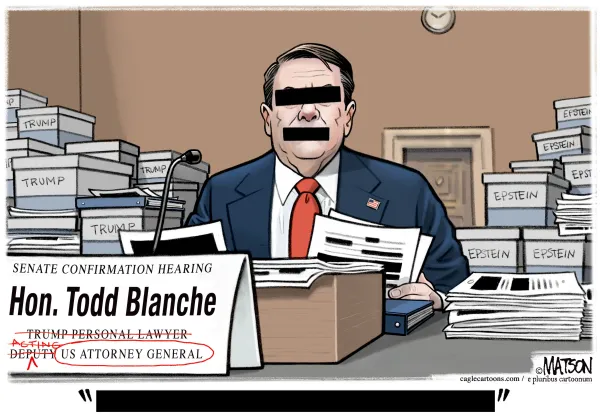
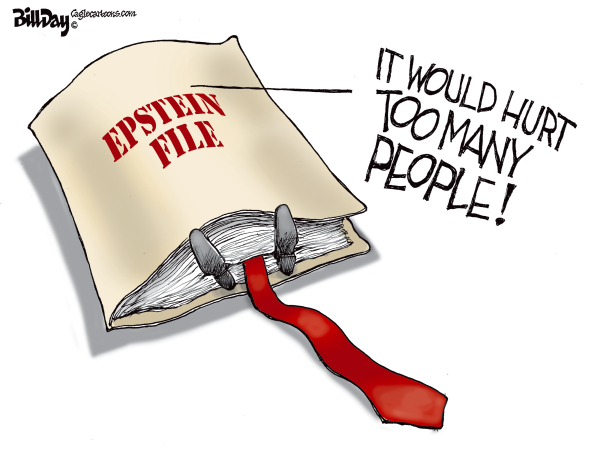
🚨 BREAKING: Trump’s DOJ has officially handed over UNREDACTED Epstein-related records directly to federal Judge Emmet Sullivan for private review following a court order in MeidasTouch host Katie Phang’s lawsuit.
JUST NOW — Schumer Interrupted: “What could be more corrupt than backing genocide? How dare you talk about corruption. It’s amazing you can show your genocidal face in public!”
I had my allergy shots this morning. I’m in agony right now. Not from the shots, but from the pain in my back muscles as they spaum. Every since I have had the operation on my lower back to reduce the pain in my right leg, the pain in my back from the rest of the back muscles spasuming is out of control. When I saw the surgeon this week, he looked and noticed how badly swollen the mucles were and agreed that I needed immediate relief from the situation I was in. He put in for mucle relaxing trigger point injections to relax the mucles. But other than lying down and taking muscle relaxers, there is little I can do at this point. I do have a hot tub, but if I push Ron to open it and get it ready to work, he will have to stop the work on the rest of the projects, including my new office, which I really need finished. So I suffer and often go to bed.
This video is a great way to talk about how to deal with Christian nationalist bigotry and the forcing of Christian religion on others who have different beliefs. In fact I read a post while waiting for my shots about a new trend of Christian evangelicals going on airplanes and forcing those in the plane to listen to sermons and preach about the Christian god. I don’t get this, but I experienced something similar in the military, where a sect of Christians would try to cornor me every time I sat down for a meal in the chow hall to eat they would swarm my table demanding I listen to them talk about their god. It did not make me feel better about their faith nor did it make me less gay, which was their real goal. In fact when I returned the gesture to talk to them about my beliefs, they got really offended. Strange how they think pushing their religion goes only one way in their minds. The thing is they know religion is a protected class where sexual orientation is not, but some friends and I came up with a good way to discourage them. We would listen to their spiel if they listened to ours first. We then spun them a made up religion on the house of Approditie, a religion based on having sex and being body worshippers. They got so grossed out over having to discuss the sex and nudity that they stopped pushing their shit on me. I wonder if it would work today on the religions and indiscretions you hear about in the news. Hugs.
BREAKING WSJ:The Trump admin plans to end a subsidy program that helped hold down premiums for Medicare drug plans — a move that could leave many seniors facing higher rates for their prescription coverage next year.
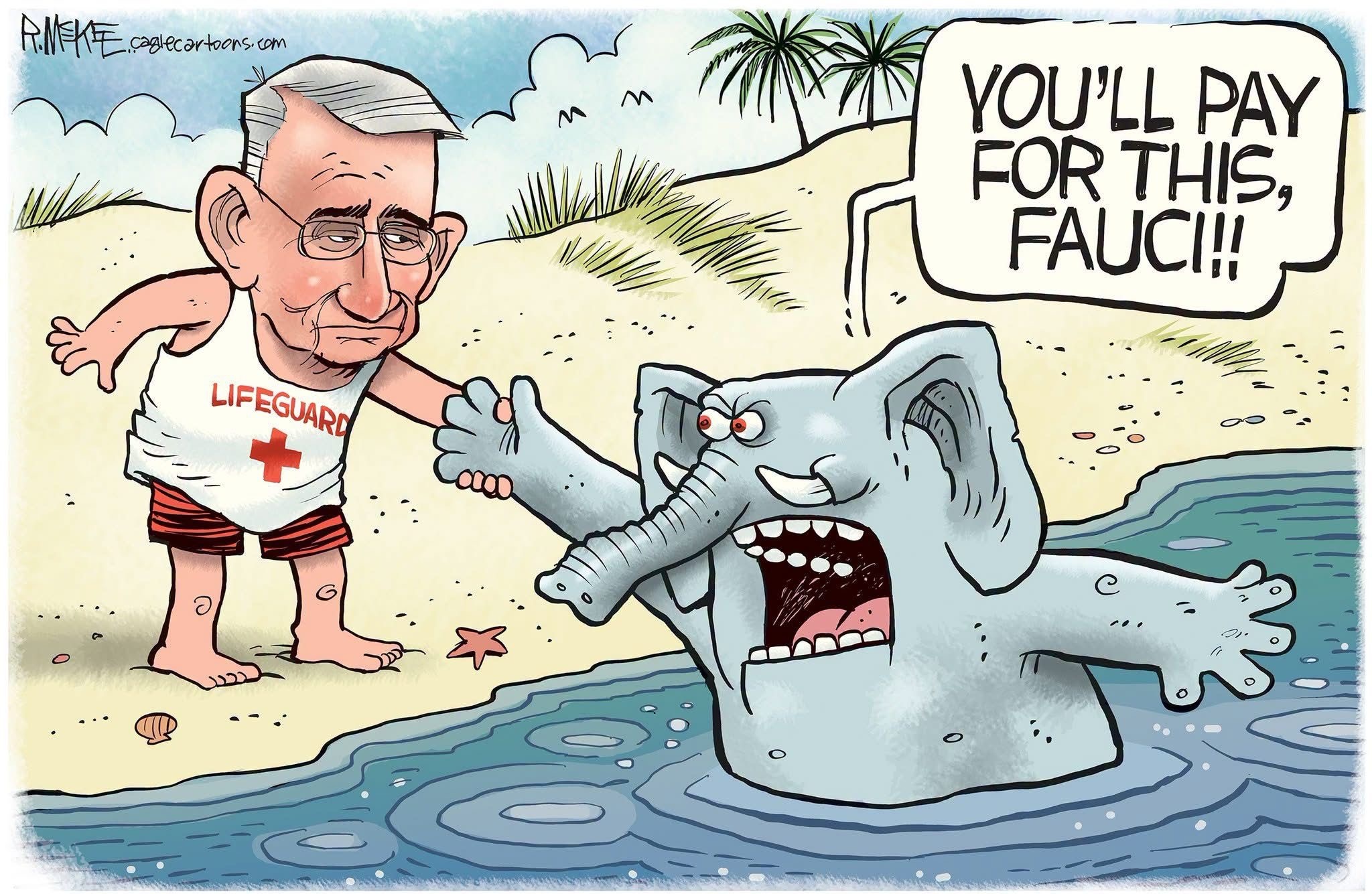
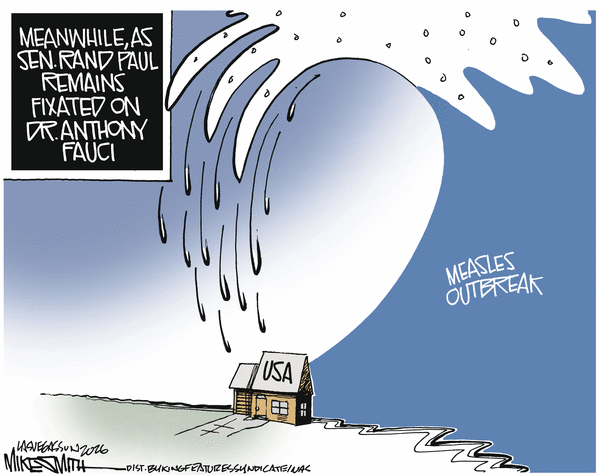
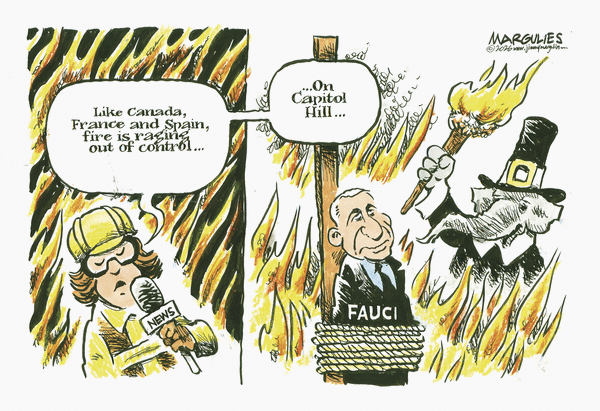
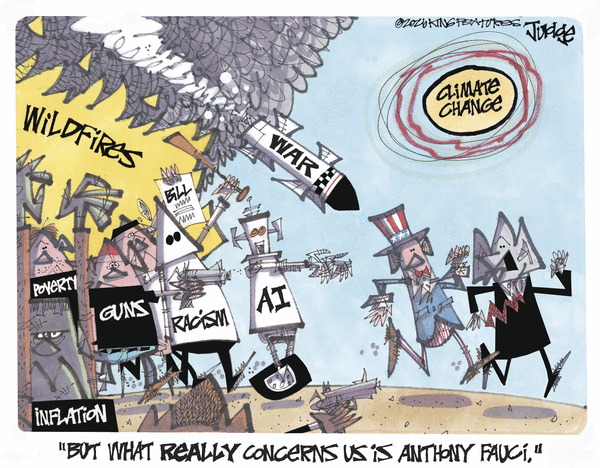
🚨WATCH: Rand Paul TORCHES Fauci for refusing to testify: "It's against the law to obstruct an investigation of Congress. There WILL be repercussions to your refusal to testify today."
Sen. Roger Marshall: "Who didn't have a friend who took this vaccine and had some time of complication? A stroke, a blood clot, a young man getting some type of heart inflammation. That's what destroyed the trust in the American people for our government."
FOX: Xi told you that China would not give or sell Iran any weapons. There's a new report that Iran is about to get 400 rocket launchers from China–TRUMP: Well, that would be surprising. Things like that happen.
The Trump administration plans to end a subsidy program that helped hold down premiums for Medicare drug plans, a move that could leave many seniors facing higher rates for their prescription coverage next year.
The move will eliminate a program that is giving insurance companies an estimated $3.6 billion in subsidies this year to blunt increases in premiums for the Medicare prescription plans, known as Part D. The program will end after 2026, according to administration officials.
High drug costs are a perennial issue—especially for seniors on fixed incomes—and healthcare affordability is expected to be a focus in the midterm elections. Roughly 25 million people have Part D plans, and they will learn about their 2027 rates in the fall. Medicare drug coverage premiums are rising because the plans have been hit by growing expenses for GLP-1 medications and other specialty drugs.
BREAKING WSJ:The Trump admin plans to end a subsidy program that helped hold down premiums for Medicare drug plans — a move that could leave many seniors facing higher rates for their prescription coverage next year.
NEW: UK journalists are self-censoring stories about Trump and the right over safety fearsGovernment-backed investigation finds risks are normalised in newsrooms.The abuse now means some journalists are changing what they write about…Grim findings:www.theguardian.com/media/2026/j…
Let me see if I have this right: The Qataris give the Defense Dept a 747. Our govt puts $400mm of upgrades into it. Trump gets to keep the plane where he leaves office.https://t.co/n18Spd6fLZ
Trump’s $400 million luxury jet turned Air Force One is the largest foreign bribe to an American president in history. It’s also a massive national security threat, as we’ve warned for months.
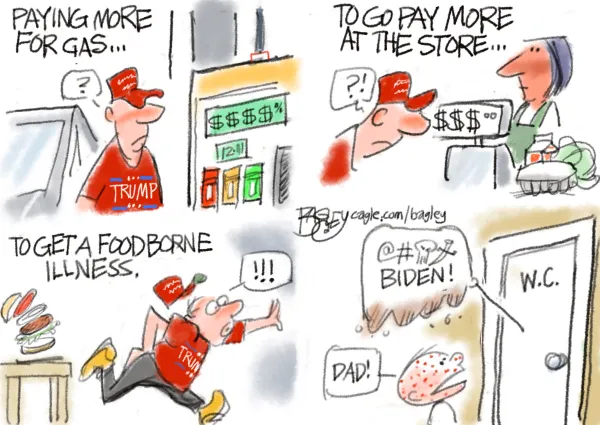
Taylor Farms representatives contacted the White House last week with an urgent plea: They wanted to delay announcing a recall tied to one of the largest foodborne illness outbreaks in U.S. history https://t.co/zMm75gD3v7
Taylor Farms contributed $2 million to Trump & Republicans as they postponed a rule to help the govt. limit the spread of foodborne illnesses.Read @premthakker.bsky.social's deep dive into how Taylor Farms' successful lobbying led to the current outbreak of cyclospora: zeteo.com/p/taylor-far…
Texas Attorney General Ken Paxton has yet to answer questions about why he voted multiple times using an address where he no longer appears to live, which experts say may violate state law.https://t.co/DrL7LCPWqS
By GEIR MOULSON BERLIN (AP) — German investigators were searching Sunday for a man suspected of driving a van into a crowd near Berlin’s Pride festival, killing one person and injuring several people before apparently stabbing…
A MAGA activist who is currently a Heritage Foundation staffer was stopped from entering a Senate office building after authorities say they found ammunition and suspected drugs in his briefcase. http://www.notus.org/congress/her…
HOMAN: I wouldn't say that mistakes were made. We'll see.BASH: Well, we've seen with our own eyes that mistakes were made. Deadly mistakes were made. At least 5 of them.
ICE is murdering people because the Trump regime wants ICE to murder people.If the regime didn't want ICE to murder people, it would publicly crack down on ICE agents who murder people.But the regime doesn't. Because it wants ICE to murder people.
AWFUL. Ordering ICE to target an ethnic group the president has repeatedly attacked is bigotry as official government policy.TPS recipients are the most vetted immigrants here. They have to pass background checks every 18 months. Most Haitians with TPS entered legally also!
WSJ’s Josh Dawsey got to see unreleased footage from years of a documentarian’s inside access to Lindsey Graham. It’s filled with giddy, war-hungry stuff like this:(Gift link below)
Breaking News: President Trump has set aside, at least for now, plans to sharply escalate the American military assault against Iran. https://t.co/qvWp4egLZd
More hate and bigotry enacted against all the medical safety data available. Guess I am just not being understanding today because these laws are not only not needed but also very harmful. They cause a lot more problems than the pretended harm they claim to solve. It is the attempt to regulate and restrict sexual / gender standards into the laws. It just causes kids and people problems for no reason and promotes anger / bigotry against a small minority of people. Hugs
The United Kingdom’s Department of Education has published its updated guidance for “Keeping Children Safe in Education 2026” (KCSIE) and it will take effect on September 1. However, the guidance is likely to put trans and gender-non-conforming children at greater risk.
“We criticise numerous aspects of the guidance, especially as to how schools should approach requests related to ‘social transition,’” The Good Law Project wrote in a statement responding to the draft guidance earlier this year. “We also emphasise its failure to properly explain how schools should accommodate the needs of trans pupils in accessing various aspects of school life, such as toilets, changing facilities, and sports.”
Last year, the United Kingdom’s Supreme Court ruled that, for the purposes of the 2010 Equality Act, the legal definition of “woman” is based on “biological sex.” In the aftermath, the Equality and Human Rights Commission released temporary guidance on barring trans people from single-sex spaces. They’ve now released their finalized plan, which says that businesses and institutions should prevent trans people using a single-sex spaces, and that if they allow trans people to use them, they will no longer be considered single-sex spaces.
The aggressive new schools guidance set out in KCSIE is set to comply with the EHRC’s updated policies around single-sex spaces, ruling that trans and gender-questioning children cannot use spaces aligned with their gender identity, even if they have socially transitioned.
Never Miss a Beat
Subscribe to our newsletter to stay ahead of the latest LGBTQ+ political news and insights.
Email Email Email
Email *
Frequency *
Daily Brief
Week in Review
Week in Good News
———————————————————————————————————————–
“Schools must not allow children into toilets designated for the opposite biological sex,” the guidance reads. “This includes where schools are responding to a request to support any degree of social transition for children who are questioning their gender.”
The same policy is applied to changing rooms for those over 11 years old, nor should the students “share overnight accommodation with a child of the opposite biological sex,” it states.
The guidance allows for single-use restrooms “if a gender-questioning child does not want to use the toilet designated for their biological sex.” However, there is no actual requirement for this, but only the suggestion that “schools and colleges should consider whether they can provide an alternative toilet facility—for example self-contained individual toilets—without compromising the provision of single-sex facilities.”
When it comes to all of these arrangements, the guidance clearly states, “These alternative arrangements should not compromise the safety, comfort, privacy or dignity of the child, or of any other children.”
However, such arrangements in their own right will challenge the safety and dignity of trans children. One plaintiff in a lawsuit challenging Idaho’s bathroom bill died by suicide earlier this year. Before her death she said of similar provisions, “It is scary having to look around before to see if anyone will see me going into the single-user restroom, as I worry about people gossiping and speculating about me being transgender.”
When it comes to social transition at school, the guidance advises against staff and teachers supporting it, citing concerns raised in the controversial Cass Review. The guidance sets out extensive hurdles before any member of staff at a school or colleges can be supportive of a social transition.
The guidance establishes that “parents and carers should be actively involved and their views treated with importance.” That rule alone amounts to a forced outing policy that could put trans children at risk of harm if their family are not supportive. While the guidance goes on to carve out an exception for “rare circumstances” where involving parents and carers could pose a “greater risk,” such a policy would require a lot of trust and a careful hand from school administrators who are inexperienced with such matters.
The possibility of the school deciding not to allow the social transition is not only laid out but encouraged. The guidance notes that “when considering a child’s request for support with social transition will be to consider what is in the best interests of the child and other children, and a decision relating to social transition may not be the same as a child’s wishes.” They also note that, for younger children, support for a social transition should be “agreed very rarely.”
More of the choice is taken away from trans children and their families with the note that for “pre-pubertal children” clinical involvement should be part of the decision-making process and that “should include advising on the risks and benefits of social transition as a planned intervention, referencing best available evidence. This is not a role that can be undertaken by staff without appropriate clinical training.”
Subscribe to the LGBTQ Nation newsletter and be the first to know about the latest headlines shaping LGBTQ+ communities worldwide.
This is what all the medical data and medical science shows which is why laws were passed to promote transgender acceptance. Then some people decided it was an insult to their god, some decided that they needed everyone to be the same as they are in life, and politicians realized it was a way to distract and get people to vote for them. There is no medical reason, no safety reason, and no social reason for hate towards trans people and other LGBTQ+. To be so dismissive of the needs of other people who cause you no harm is crazy and I do not understand the motivation of the bigots. Hugs
Good Law Project claims U.K. health secretary Wes Streeting’s department fought to block freedom of information requests for data on trans youth suicides.
John Russell (He/Him)February 12, 2026, 3:30 pm EST· Updated on February 13, 2026
The U.K. government appears to have covered up a dramatic rise in transgender youth suicides, according to data obtained by U.K.-based government accountability non-profit the Good Law Project.
As Erin in the Morning reports, data the non-profit obtained from the National Health Service (NHS)-funded National Child Mortality Database (NCMD) via a Freedom of Information request sharply contrasts with the government’s official report on trans youth suicides in the wake of the 2020 Bell v. Tavistock ruling.
As the Good Law Project notes, following the U.K. High Court of Justice’s initial ruling in Tavistock, which found that minors under 16 could not legally consent to receive puberty blockers for the treatment of gender dysphoria, the National Health Service (NHS) substantially limited access to gender-affirming care for minors. Those limits reportedly remained in place even after the Tavistock ruling was overturned in 2021.
The U.K. government commissioned its 2024 Appleby Report after the Good Law Project reported that two whistleblowers with the Tavistock gender clinic alerted the organization to a significant rise in suicides among young people on the NHS’s waitlist for appointments to begin gender-affirming care in the wake of the Tavistock case.
————————————————————————————————————————
Insights for the LGBTQ+ community
Subscribe to our briefing for insights into how politics impacts the LGBTQ+ community and more.
Frequency Email *
Email *
Frequency *
Daily Brief
Week in Review
Week in Good News
——————————————————————————————————————–
According to Good Law Project, the Appleby Report identified only 12 suicide deaths among current or former Gender Identity Development Service (GIDS) patients at the Tavistock clinic between 2018 and 2024. However, as Erin in the Morning notes, the report disregarded young people who were unable to access GIDS care due to long wait times, which, post-Tavistock, now last an average 25 years.
At the same time, Good Law Project submitted a Freedom of Information request with the NCMD, and has only just published the data it received.
“Good Law Project can confirm that in 2021–2022 suicides of trans children in England surged to 22, a marked increase from 5 and 4 the previous two years,” the organization wrote in a February 7 release. “This spike follows the decision by NHS England to pull down the shutters on gender-affirming healthcare for young trans people” following the Tavistock case.
In total, the NCMD data show 46 transgender children in the U.K. died by suicide between 2019 and 2025. In addition to the nine accounted for between 2019–2021 and the alarming spike to 22 between 2021–2022, the data also show 10 suicide deaths between 2022–2023. And, according to Good Law Project, NCMD added that “the numbers reported in more recent years will likely be underestimated, due to a higher proportion of child death reviews that have not yet been completed.”
Good Law Project said it was “appalled” that U.K. health secretary Wes Streeting “commissioned and published a report to reassure the public that there was no significant rise in suicide rates, when 22 children took their own lives in a single year: 2021-22.” The Appleby report, they said, “denied the reality of trans deaths, as Streeting’s ban on puberty blockers denied the reality of trans lives.”
The nonprofit claims that Streeting department “fought tooth and nail” to block its freedom of information requests.
“To silence those raising the alarm on rising trans suicides as ‘dangerous’ while ramping up the policies correlating with that rise is an act of grave moral wickedness,” the group said.
Trans journalist Erin Reed said of these findings, “More alarming is what appears to be an explicit attempt to cover up trans youth suicide deaths. Those who seek to restrict gender-affirming care also seek to restrict any information showing those restrictions may lead to harm. Among the far right, claims have emerged that transgender youth are in no danger of suicide from the withdrawal of gender-affirming care, but this could not be further from the truth.”
Editor’s note: If you or someone you know is struggling or in crisis, help is available. Call or text 988 or chat at 988lifeline.org. The Trans Lifeline (1-877-565-8860) is staffed by trans people and will not contact law enforcement. The Trevor Project provides a safe, judgement-free place to talk for youth via chat, text (678-678), or phone (1-866-488-7386). Help is available at all three resources in English and Spanish.
Subscribe to the LGBTQ Nation newsletter and be the first to know about the latest headlines shaping LGBTQ+ communities worldwide.




























 In this file photo, Christopher R. Hood Jr. appears at West Roxbury Municipal Court on July 25, 2022, when he was 23 years old. Hood founded the Nationalist Social Club 131 in 2019.Jessica Rinaldi/Globe Staff