
























All About That Shadow Docket

221. Chief Justice Roberts and the Clean Power Plan

Remarkable reporting from the New York Times provides a peek behind the curtain of the February 2016 rulings that ushered in the modern emergency docket. And what it reveals is pretty discouraging.

Steve Vladeck

Welcome back to โ€œOne First,โ€ a newsletter that aims to make the U.S. Supreme Court more accessible to lawyers and non-lawyers alike. Iโ€™m grateful to all of you for your continued support, and I hope that youโ€™ll consider sharing some of what weโ€™re doing with your networks.

(snip)

Back in February, I wrote about the tenth anniversary of the Supreme Courtโ€™s unsigned, unexplained February 2016 rulings blocking President Obamaโ€™s โ€œClean Power Plan,โ€ and how they ushered in what might be called โ€œthe modern emergency docket.โ€ In my earlier post, I raised a series of questions about what had led the Court to do something that, in 2016, was completely unprecedented (blocking an executive branch program then under review in the lower courts), and whether the justices had any idea of the Pandoraโ€™s Box they were opening. As I wrote, โ€œbecause the Court didnโ€™t write then, and hasnโ€™t explained itself since, weโ€™ll never know (at least, until our grandkids can read the justicesโ€™ internal papers from that time period).โ€

It turns out, thanks to some truly remarkable reporting from Jodi Kantor and Adam Liptak for the New York Times, that we didnโ€™t have to wait quite that long. On Saturday, Kantor and Liptak published 16 pages of (leaked) internal memoranda from six of the justices providing a window into how and why the Court did what it did on February 9, 2016. And the memos are, at least to me, a remarkable combination of eye-opening and sadly unsurprising. As I explain below, I think there are at least five significant takeaways from these materialsโ€”none of which paint the Court in an especially flattering light. And at the heart of most of them is Chief Justice Roberts.

Behind the scenes, Roberts led the charge for the Court to blaze a new trailโ€”relying on statements outside the record; invoking the wrong standard for the kind of relief the applicants sought; failing to even acknowledge the irreparable harm the government (and the environment) would suffer from the Court intervening; and pushing back aggressively when Justices Breyer and Kagan both urged a compromise that should have accounted for his ostensible concerns. Iโ€™ve suggested before that theย realย acceleration of the Courtโ€™s modern emergency docket behavior can be traced to 2018, right around when Justice Kavanaugh succeeded Justice Kennedy. But in the first major case in which the Court granted emergency relief as a means of shaping nationwide policy, it turns out that the justice who led the charge was the one who was doing quite a bit more than calling balls and strikes. (snip-the rest is on the page)

Open Windows & Clay Jones

Yes!

Virginia votes tomorrow

Clay Jones

Republicans are upset because tomorrow, they could lose at their own game.

After Texas redistricted in the middle of the decade to give Republicans more congressional seats, which Donald Trump demanded, Virginia decided to add more blue seats. This upset Republicans because, dammit, they invented this game.

Now, the same groups that want to add more red seats in Texas are spending big money to argue against adding more blue seats in Virginia. The commercials have been wild, with some of them warning that Richmond Democrats are engaged in a โ€œpower grab.โ€ Some of the ads warn that this disenfranchises Black voters. Others state that if you vote, yes, that means more โ€œillegalsโ€ will invade the state to commit crimes. It’s getting nasty, but Republicans don’t know how to win any other way. They use this information, and they cheat. (snip-MORE)


Kash Patel sues The Atlantic for defamation

F.B.I. director is seeking $250 million in damages

Ann Telnaes

Under the influenceย and unqualified.


The Book of Sam

I have been waiting since 2006 to get this movie quote into a cartoon.

Clay Jones

Last week in Cameroon (in case you are a Republican, that is a nation on the continent of Africa), Pope Leo quoted a Bible verse, which was, โ€œJesus told us, โ€˜Blessed are the peacemakers, but woe to those who manipulate religion in the very name of God for their own military, economic, or political gain, dragging that which is sacred into darkness and filth.โ€™โ€ And then, Defense Secretary Pete Hegseth, while claiming that God is on his side to wage war, quoted a fake Bible verse at a prayer breakfast.

The verse was inspired by Ezekiel 25:17 and comes from one of my favorite movies,ย Pulp Fiction. It was delivered brilliantly and forcefully by one of my favorite actors, Samuel L. Jackson. (snip-MORE, also deliberate and forceful!)

The 5-Year FISA Sec. 702 Vote:

In a dramatic scene that unfolded in the wee hours this morning, members of the House defeated a ploy by the administration and Speaker Johnson to ram through a 5-year reauthorization of FISA Section 702. Hereโ€™s what happened, and what will/should happen next. 1/20โ€” Liza Goitein (@lizagoitein.bsky.social) April 17, 2026 at 10:34 AM

Looking At This Week With Joyce Vance

The Week Ahead

Joyce Vance

We seem doomed to another week of war news. On Sunday, Trumpย announced on Truth Socialย that the U.S. military seized an Iranian-flagged ship that he said tried to run the U.S. blockade in the Strait of Hormuz. Marines boarded the cargo ship Touska after it was disabled. Trump posted that the USS Spruance โ€œgave them fair warning to stop,โ€ but that โ€œThe Iranian crew refused to listen, so our Navy ship stopped them right in their tracks by blowing a hole in the engineroom.โ€

But whatโ€™s happening with the president as he conducts his war is now completely out of bounds. This morning, just after 8 a.m., he had a longย rambling post on Truth Socialย that concluded, โ€œif they donโ€™t, the United States is going to knock out every single Power Plant, and every single Bridge, in Iran. NO MORE MR. NICE GUY!โ€

Notice how Trump speaks in the language of an all-powerful businessman, a CEO without a board to tell him what to do. He is sending โ€œMy Representativesโ€ to Pakistan and โ€œif they (Iran) donโ€™t take the DEAL,โ€ heโ€™ll do โ€œwhat has to be done.โ€ Itโ€™s crazy on steroids, and well past the point where even his own party should be giving him a pass. The president of the United States is threatening to bomb civilian targets and devastate a civilian population. War crimes, plain and simple.

All of this from the candidate who, in November of 2024, in the closing days of his campaign for the White House, said that โ€œIf Kamala wins, only death and destruction await because she is the candidate of endless wars. I am the candidate of peace.โ€

Every accusation is a confession. And the Truth Social posts happened after Trump called NATO and our allies โ€œabsolutely uselessโ€ at a Turning Point USA event Friday night. If youโ€™re exhausted, and honestly, at this point, who isnโ€™t, take a deep breath, plan for a little extra fellowship with friends (more on my plans at the end), and remind yourself that we cannot afford to put our heads in the sand and that the effort to overwhelm us in intentionalโ€”thatโ€™s how authoritarians do it. Itโ€™s a good week to talk with people about whatโ€™s going on, to encourage them to stop and think, and then to make sure theyโ€™re registered to vote.

The U.S. Ambassador to the U.N., Mike Waltz, was on ABCโ€™s โ€œThis Week,โ€ Sunday morning, and he chimed right in with the president. Host John Karl asked if Trump was prepared to go back to โ€œfull-on warโ€ and Waltz responded, โ€œall options are on the table. We could take that infrastructure out relatively easily. The Iranian air defenses have been absolutely decimated.โ€

He continued, without being prompted, โ€œAnd just to get ahead of a lot of the critics and hand-wringing, throwing out irresponsible terms like โ€˜war crimesโ€™, attacking, destroying infrastructure that has clearly and historically been used for dual military purposes is not a war crime.โ€

Then Waltz did it again on NBCโ€™s โ€œMeet the Press,โ€ where volunteering to Kristen Welker, who hadnโ€™t asked about it, that the U.S. could still target civilian infrastructure in Iran if a ceasefire deal wasnโ€™t reached, again claiming that wouldnโ€™t amount to war crimes. โ€œWe have a long history of taking down bridges, power plants and other infrastructure that is powering Iranโ€™s military,โ€ Waltz said, as though that somehow made it acceptable. โ€œIn the laws of land warfare and the rules of engagement, any type of infrastructure that is co-mingled is absolutely a legitimate target.โ€ He reiterated on CBS, appearing on โ€œFace the Nation,โ€ that because the IRGC is running bridges and power plants, they are โ€œlegitimate military targets,โ€ again rejecting the notions that bombing them would be โ€œsome type of war crime.โ€

So bombing civilian targets seems to be top of mind for the president and one of his key spokespeople on these issues, which should concern all of us.

Waltz is a former Army Special Forces Officer, decorated for his bravery. He graduated from Virginia Military Academy, according to his bio from his time in Congress, but he is not a lawyer. Apparently, concerns about launching attacks against civilian populations didnโ€™t stick. Waltz was Trumpโ€™s first National Security Advisor this term, but he resigned following Signalgate after serving for just 101 days. (Tonightโ€™s trivia: Thatโ€™s the second shortest tenure of any NSA. Mike Flynn, who was Trumpโ€™s first NSA in 2017, resigned after just 24 days, two Scaramuccis, and was ultimately convicted of lying to the FBI before Trump pardoned him.) Trump nominated Waltz to serve as the U.N. Ambassador the same day he stepped down.

Today, the United States struck yet another vessel in the Caribbean. Three people were killed. The U.S. Southern Command account on Twitter said they were narco-terrorists. These attacks used to be shocking. Now, they barely garner notice. As of the last strike, four days ago, Reuters reported the death toll was โ€œover 170.โ€ Three people were killed in that strike last Wednesday, as well.

Also appearing on the Sunday shows, FBI Director Kash Patel said he would file a defamation case on Monday against The Atlantic, which reported last week, in a story headlined, โ€œThe FBI Director Is MIA,โ€ that Patelโ€™s colleagues are โ€œalarmedโ€ by โ€œepisodes of excessive drinking and unexplained absences.โ€ Two dozen people interviewed for the story โ€œdescribed Patelโ€™s tenure as a management failure and his personal behavior as a national-security vulnerability.โ€

Nominees for important government positions, and Director of the FBI is among the highest because of access to national security information, are heavily vetted before they take office. But as with so many other norms in the time of Trump, Patelโ€™s questionable personal choices have continued to come to light since he took office. The report says that Patel is โ€œdrinking so heavily that meetings need to be rescheduled and his security detail has trouble waking him up. Among the reportโ€™s most chilling revelations, โ€œCurrent and former officials told me that they have long worried about what would happen in the event of a domestic terrorist attack while Patel is in office, and they said that their apprehension has increased significantly in the weeks since Trump launched his military campaign against Iran. โ€˜Thatโ€™s what keeps me up at night,โ€™ one official said.โ€

Screen grab of Patel โ€œcelebratingโ€ with the U.S. Menโ€™s Hockey team after their Olympic victory.

This morning, Fox host Maria Bartiromo asked Patel, โ€œSo youโ€™re gonna sue them?โ€ โ€œAbsolutely,โ€ he responded. โ€œItโ€™s coming tomorrow.โ€ He added that it would be for defamation.


Iโ€™m looking forward to discovery. Especially the part where Patel is deposed, under oath. Expect the lawsuit, which he probably has to file to look tough for the audience of one, to be dismissed before it gets that far. Patel would face questioning about his drinking and other misconduct while in office. And he would be exposed to penalties of perjury.

The Atlanticโ€™s report concludes with this story: โ€œPatel has publicly proclaimed that the FBI needs to demonstrate that it is โ€˜fierce,โ€™ and officials I spoke with said that he is fixated on that image in private as well.โ€ So what is he doing about that? Apparently, Patel โ€œrecently expressed frustration with the look of FBI merchandise, complaining that it isnโ€™t intimidating enough.โ€ The Atlantic explains that โ€œOfficials have grown accustomed to such behavior, and they have learned to roll their eyes at it. But they said that the absurdity masks real concerns about what Patelโ€™s leadership has meant for an institution that the country relies on for national security and the safety of its citizens. โ€˜Part of me is glad heโ€™s wasting his time on bullshit, because itโ€™s less dangerous for rule of law, for the American public,โ€™ one official told me, โ€˜but it also means we donโ€™t have a real functioning FBI director.โ€™โ€

Itโ€™s likely that Patel has little support inside of the building, and that could mean this is just one of many stories that get launched in an effort to ease him out before itโ€™s too late. When the โ€œthatโ€ in โ€œThatโ€™s what keeps me up at night,โ€ is the Director of the FBI, not a foreign terrorist or criminal threat, then it’s highly likely the career folks, and maybe even some of the politicos, want a โ€œreal functioning FBI directorโ€ in place.

I started out by saying weโ€™re entering this week already exhausted and itโ€™s important to keep taking care of ourselves. My plan this week involves spending time in person with my #SistersInLaw cohosts Kimberly Atkins Stohr, Barb McQuade, and Jill Will-Banks, when we do the podcast live in Denver on April 23rd. If youโ€™re in Denver, I hope Iโ€™ll see you there! If youโ€™re in Atlanta, weโ€™ll be live there on May 3. There is nothing as important as being with the people that we love right now.

Weโ€™re in this together,

Joyce

Monday, Back To It!

A Little Decent News

Montana Supreme Court Rules Its Constitution Entirely Protects Trans Citizens In Landmark Ruling

The ruling will have enormous impacts for transgender residents in the state.

Erin Reed

On Monday, the Montana Supreme Court issued a landmarkย 5-2 rulingย declaring that “transgender discrimination is, by its very nature, sex discrimination,” and that transgender people constitute a suspect class under the state’s equal protection clause. The ruling in Kalarchik v. State of Montana blocks a definition-of-sex law and related state policies that stripped all legal recognition from transgender people and barred them from obtaining accurate birth certificates and driver’s licenses. The decision rests on Montana’s constitution, whose Equal Protection and Individual Dignity clause has been repeatedly interpreted to protect transgender peopleโ€”and which the court made clear provides far greater protection than the federal constitution. Justices have now issued the clearest declaration ever that transgender people in the state will have enhanced protections of their rights, grounding the ruling in equal protection, sex discrimination, and privacyโ€”principles with broad applicability in a state that has become a major battleground for anti-trans legislation and resistance to it. (snip-MORE)


Colorado Supreme Court May Force Children’s Hospital To Resume Trans Youth Care

Several justices seemed to support the families of trans youth on the question of whether to force Colorado Children’s Hospital to discontinue capitulating to the Trump administration.

Erin Reed

On Tuesday, the Colorado Supreme Court heard oral arguments over whetherย Children’s Hospital Colorado can be forced to resume gender-affirming careย for transgender youth. The hospital was one ofย roughly 40 across the countryย that capitulated to Trump administration threats and shuttered their trans youth care programs. However, the hospital’s position has grown increasingly untenable, as hospitals in states likeย Minnesotaย andย Californiaย have begun reversing course and as the Trump administration has suffered mounting losses in federal courtsโ€”including anย Oregon ruling that vacated the very declarationย the hospital cited as justification for halting care. Hearing arguments on Tuesday, several justices appeared skeptical of the hospital’s rationale, questioning whether Colorado’s civil rights protections for transgender peopleโ€”among the strongest in the nationโ€”can simply be overridden by federal threats that do not constitute law. (snip-MORE)


They served their prison time. Then came deportation.

Apr 15, 2026 Candice Norwood

This story was originally reported by Candice Norwood of The 19th. Meet Candice and read more of their reporting on gender, politics and policy.

JJ had a five-year plan to turn his life around. 

After being released from prison in 2022, he completed an 18-month job training program with the Los Angeles-based organization Homeboy Industries and began working as a cook for the groupโ€™s onsite cafe. He enrolled in two different community college programs to study business administration and culinary arts. He volunteered with groups to help other trans Latinx and formerly incarcerated people get back on their feet. By the time he reached the five-year anniversary of his release date, JJ hoped he would have saved enough to buy a house with his sister.

He also wanted to travel more, and last April, JJ went to Thailand with his mom, sister and a friend. It was his first time outside the United States since he and his parents entered the country without legal documentation when he was a toddler. They later obtained permanent resident status, and his sister was born in the United States.

โ€œI always told myself, the moment I was able to come home, and if God permitted me to get my life together, that I would like to travel with my family,โ€ JJ told The 19th. โ€œBeing able to give that to both my sister and my mom โ€” even if I knew that this would be the end result, for me to get deported โ€” I would do it all over again, just to see them happy.โ€

JJ, who asked for The 19th to withhold his last name for privacy, was not particularly concerned when returning to Los Angeles International Airport (LAX) and going through the standard post-flight motions. He waited in line for customs, showed his passport and green card, and got his fingerprints taken. But then, the customs officer made a phone call and escorted JJ away from his loved ones.

The weeks that followed felt like a different kind of prison: five days in LAX sleeping on the floor and living off of vending machine food, he said. Then it was five months in Eloy Detention Center in Arizona, where it came down to two options: JJ could do a โ€œvoluntaryโ€ departure to Mexico, or he could challenge his case in court and risk staying in the custody of Immigration and Customs Enforcement (ICE) indefinitely. The Department of Homeland Security did not respond to The 19thโ€™s request for comment by the time of publication.

The choice was clear for JJ, he said, even if that meant returning to a country he hasnโ€™t known since age 2. โ€œI’ve been here since September, and I’m barely learning how to maneuver around. My Spanish is horrible,โ€ he said recently from Mexico. โ€œPeople notice that I’m not from here because of the way I speak.โ€ 

In the second Trump administration, people with JJโ€™s background โ€” a formerly incarcerated trans immigrant โ€” have three targets on their backs, and the power of the federal government aimed at them. Trump has repeatedly stated that ICE, under his administration, will detain and deport โ€œthe worst of the worst,โ€ particularly people who have committed crimes. A combination of anti-trans, anti-immigrant and tough-on-crime messaging by the White House depicts a country under siege. 

To carry out its mass deportation mission, the administration has ramped up partnerships with local law enforcement and correctional facilities that allow the federal government to take custody of people held in prisons who have already served their sentences. Even in states like California, which limit local law enforcement partnerships with ICE, federal law defines a broad list of criminal offenses that can make a noncitizen deportable, even if that person secured legal status like JJ.

The result is a system of โ€œdouble punishment,โ€ a prison-to-ICE pipeline that advocates told The 19th can be particularly detrimental for trans people. 

We just see trauma compounded on trauma compounded on trauma.”Lynly Egyes

Trans migrants often face rejection from family, abuse, job insecurity or homelessness as a result of their identity, which increases their risk of criminalization, advocates say. In ICE custody, they may be denied health care access, face sexual violence and be deported to countries that are hostile to their identity. Even for those who attempt to rebuild their lives after serving prison terms, โ€œICE could use that years later to target them, pull them into immigration detention and have them deported,โ€ said Lynly Egyes, the legal director at the Transgender Law Center.

โ€œWe just see trauma compounded on trauma compounded on trauma,โ€ Egyes said. โ€œWhen trans people are shuffled between systems such as prison into ICE custody, it completely strips them of any opportunity for freedom and connection with their loved ones and community.โ€

It took three attempts for Nataly Marinero to secure parole from the California Department of Corrections and Rehabilitation. It ultimately happened in 2023, and he was released after nearly 18 years of incarceration. The stateโ€™s parole approval rate was about 34 percent at the time.

During this process, the parole board assesses an incarcerated person’s behavior and activities while in custody and considers whether they will be a threat to the general public. The board considers a range of factors, including signs of remorse, past criminal history, age and plans for the future, according to the California department of corrections website. While in prison, Marinero took substance abuse courses, worked on getting his high school diploma, had a job as a clerk in the prison kitchen. He had not received a write up, an infraction in prison, in years, he said. Each of these factors help to build a stronger case for release.

Immediately after leaving prison, Marinero joined a reentry program in Los Angeles called A New Way of Life, where he received housing, a job and connections to other opportunities to help him transition to life outside.

Life felt good.

โ€œFreedom โ€” just to think about it makes me want to cry,โ€ the 40-year-old told The 19th. โ€œThat’s the best thing that ever happened to me.โ€

Marinero, who came to the United States without authorization at 17, was aware that ICE had put a โ€œholdโ€ on him at the beginning of his incarceration more than a decade ago. ICE โ€œholdsโ€ are requests asking jails or prisons to hold someone after incarceration so that they can be transferred to immigration custody.

“When you get to prison, your counselor would tell you when you have an ICE hold,” said Laura Hernandez, executive director of the California-based advocacy group Freedom for Immigrants.

“If you have an inkling that you may have an ICE hold, you tend to check every so often,” she added. “But sometimes ICE holds aren’t placed on anyone until right before they’re getting ready to be released. So people have to check like the entire time they’re inside.”

Whether the agency follows through on picking up immigrants with ICE holds on their accounts is largely a toss up. In Marineroโ€™s case, he was allowed to be released from prison; he was allowed to join a reentry program and to live his life for two years without being arrested by ICE.

In January 2025, he received a call from a woman who said she was his parole officer. This struck Marinero as odd, because this was a different officer from the man he had previously spoken with. The woman demanded Marinero come to the front of his reentry home, he said. When he obeyed, ICE agents were waiting outside and took Marinero into custody. 

His legal advocates at the California Coalition of Women Prisoners, who also serve trans people, moved quickly to assess whether Marinero could make an asylum claim as he was moved from an ICE holding facility to detention centers in California and Louisiana over the course of two months. Ultimately, his legal team was unable to file an asylum claim before his deportation. In April 2025, Marinero was placed in handcuffs and loaded onto a plane. He was back in El Salvador, a place he fled as a teenager and one of the most dangerous countries for trans people in Latin America.

Partnerships between federal immigration authorities, local law enforcement and state prisons have existed for three decades.

In 1996, fears about crime led to a wave of laws โ€” including the 1994 crime bill โ€” with more severe punishments and a historic expansion of law enforcement. President Bill Clinton signed into law two bills that created pathways to speed up the deportation of noncitizens with criminal records and broadened the list of crimes considered aggravated felonies. These crimes could range from murder and sexual assault to shoplifting and forgery. As a result, any noncitizens, including green card holders, with an aggravated felony record became eligible for deportation.

โ€œIt especially hit lawful permanent residents,โ€ said Juliet Stumpf, the Edmund O. Belsheim professor of law chair at Lewis & Clark Law School, whose research centers on whatโ€™s referred to as โ€œcrimmigration.โ€

โ€œWe used to see lawful permanent residents as being able to remain in the country if they committed a crime,โ€ she added. โ€œBut now, we’ve added a whole other level of penalty, for lawful permanent residents especially, because they’re the ones that are going to be most vulnerable to deportation based on those grounds.โ€

One of the 1996 laws also laid the groundwork for the 287(g) program, which can essentially turn local and state law enforcement into an arm of immigration enforcement. These 287(g) agreements fall into one of three categories, one being the โ€œJail Enforcement Model,โ€ designed to identify noncitizens held in local jails or state prisons who can be transferred to immigration custody.

At the time of Trumpโ€™s first term, his administration ushered in a high โ€” at that time โ€” of about 150 active 287(g) agreements of all types. In the last 15 months, that figure has increased tenfold. As of April 10, ICE has signed 1,645 agreements across 39 states and two U.S. territories, according to data from the Department of Homeland Security. That dataset indicates that 10 percent of these agreements, 171 total, fall under the Jail Enforcement Model.

One contributor to this growth is likely financial incentives built into Trump’s expansive 2025 so-called One Big Beautiful tax bill, said Karen Pita Loor, director of the criminal law clinical program at Boston University.

โ€œHistorically, 287(g) agreements were not financially profitable for these counties, localities, whatever jurisdictions. They weren’t making them money,โ€ Loor said. โ€œThe bill created really attractive financial incentives that make 287(g) agreements much more profitable.โ€ These benefits to local law enforcement agencies can include salary reimbursements, $7,500 for equipment and $100,000 for new vehicles.

Some states, like California, where JJ and Marinero lived, have laws limiting collaborations between local and federal law enforcement. But even in those jurisdictions, the more forgiving immigration policies often do not extend to migrants with criminal records.

Prior to Trumpโ€™s return to office, JJ and Marinero, who served their prison time and were on a path to rehabilitation, might have gone unnoticed by ICE, advocates said.

Now, for Marinero, โ€œI feel like going back to the same time when I was younger,โ€ he said. โ€œI can’t dress the way I want to dress. I canโ€™t be who I want to be. It’s kind of killing my self-esteem.โ€

I just want to be free.”Nataly Marinero

Growing up in El Salvador, Marinero did not have a specific word to describe how he felt about his gender. He just knew that people called him a girl, but he felt like a boy and preferred loose fitting shirts and pants rather than dresses. Marineroโ€™s religious family treated his self-expression like a curse that needed to be healed, he said. They told him he would go to hell if he didnโ€™t change. People called him a โ€œmarimacha,โ€ a slur for a lesbian or masculine girl. He was also repeatedly targeted for sexual violence.

โ€œIt was so bad that I wanted to try to kill myself so many times,โ€ Marinero said. โ€œI just want to be free.โ€ When his uncle offered to connect him with a group who could get him into the United States, Marinero jumped at the chance.

Being back in El Salvador 23 years later, Marinero mostly works and stays at home. He doesnโ€™t have friends, he said, though he recently found a boxing gym that is helping to relieve stress. In Mexico, JJ said he also keeps to himself and isnโ€™t open with people about his trans identity. He said it helps that he โ€œblends inโ€ as a man and doesnโ€™t get many questions or weird looks.

Next March will mark five years since JJ left prison. The five-year plan he mapped out for himself has changed quite a bit, but he hasnโ€™t lost all hope. 

โ€œI feel like I just came out of being in prison all over again, and I have to start all over again,โ€ he said. โ€œJust getting back on my feet; thatโ€™s really my fifth-year goal now.โ€

Some Toons From Clay Jones

Rocky Penis

At what point does Donald Trump say that he never knew RFK Junior?

Clay Jones

You know about RFK Jr. hiding the body of a dead bear cub in Central Park. You heard about him cutting off a whaleโ€™s head and tying it to the roof of his car. Now, get ready to hear about RFK Junior and the raccoon penis.

What?

Robert F. Kennedy Jr, the worst US health secretary in our nationโ€™s history, once cut the penis off a road-killed raccoon on the side of I-684 while his children waited in his car. I don’t know if this was during his cocaine addiction. (snip-MORE)


Hate Tax

Why should the United Daughters of the Confederacy and other organizations celebrating racist traitors be tax-exempt anyway?

Clay Jones

On Monday, Virginiaโ€™s Governor, Abigail Spanberger, signed into law a bill that eliminates tax exemptions for organizations connected to the Confederacy. Most people were not aware that these organizations were exempt from paying taxes, or that they were even still around.

The bill, passed by the House and Senate in the General Assembly, specifically removes the Virginia division of the United Daughters of the Confederacy, the Stonewall Jackson Memorial, the Virginia division of the Sons of Confederate Veterans, and the Confederate Memorial Literary Society, along with other groups, from the stateโ€™s list of organizations that are exempt from state property taxes. (snip-MORE)


Arc de Butt

The Arc’s got back

Clay Jones

The Commission of Fine Arts is scheduled on Thursday to consider Donald Trumpโ€™s plan to build a 250-foot arch on the other side of the Potomac River from the Lincoln Memorial. This huge sculpture will be at the foot of Arlington National Cemetery. Unfortunately, the Commission of Fine Arts is stacked with Trump appointees.

The original plans for this monument were for it to be 76 feet tall to symbolize the year of Americaโ€™s founding, which, in case you were educated in a red state, was in 1776. Soon after, Trump insisted that it be taller than the Arc de Triomphe in Paris (he must’ve been standing next to Emmanuel Macron at the urinals), which stands roughly 164 feet tall. Eventually, Trump decided that the arch should rise to 250 feet, to celebrate Americaโ€™s 250 years, making it what is believed to be the tallest triumphal arch in any of the worldโ€™s capital cities. (snip-MORE)

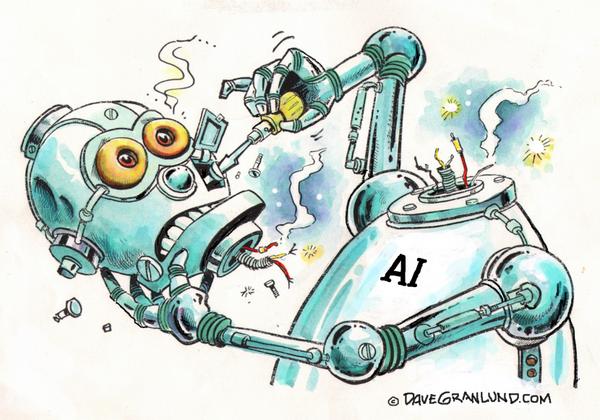
A P.S.A. About A.I., Brought To Us By KS A.G. Kris Kobach

Kansas Attorney General Kris Kobachโ€™s PSA meekly counters utopian AI promisesย 

Eric Thomas

Whether you are watching the Super Bowl on TV, scrolling make-up tutorials on Instagram or listening to a technology podcast, you are being fed advertising for artificial intelligence.

The commercials are everywhere. And they promise the world.

Since the release of ChatGPT in 2022, the companies that build AI have deployed advertising to recruit us as loyal users of their astronomically expensive software. Persuade us now, and perhaps we will be loyal customers later.

Meanwhile, Kansas Attorney General Kris Kobach โ€” with some help from a nebulous technology group โ€” has sounded an alarm about AI this week, releasing a PSA.

โ€œThe reports are very troubling,โ€ he says about threats posed by artificial intelligence.

Over the next few years, our culture will decide whether we are AI skeptics or fanatics. For that reason, the language that is used to sell AI โ€” or steer us away from it โ€” matters. Letโ€™s listen to what is being said about the technology that could define the 21st century.

From Silicon Valley

In their ads, technology companies describe AI as a wonderland: productivity at work, inspired hobbies at home and wellness nirvana at the gym. The word choices would make a spiritual guru proud.

In marketing AI app-building software, Base 44 urges us: โ€œConsider yourself limitless.โ€ Itโ€™s also described as โ€œthe next thing you canโ€™t live without.โ€ The company uses the language of religious cults swirled with rampant consumerism. โ€œEliteโ€ plans start at $160 per month.

Besides AI, what product from the past 50 years could have generated all of these promises in one commercial? In 78 seconds of advertising, Perplexity offers:

  • โ€œGet your time back.โ€
  • โ€œAccess to knowledge is easier than ever.โ€
  • โ€œDiscover something new every day.โ€
  • โ€œKnowledge on-demand anytime anywhere. For anything you wanna know.โ€

Thereโ€™s no modesty โ€” just hyperbole.

Judging by their advertising, tech companies agree on AIโ€™s greatest virtue: efficiency.

The YouTube description for a Copilot AI ad claims that โ€œMicrosoft 365 Copilot isnโ€™t just a better way of doing the same things. Itโ€™s an entirely new way of working.โ€ Press play on the video and watch a layered flurry of chatbot prompts, all written simultaneously and feverishly, including: โ€œWant to get a jump start on your day?โ€ The message envisions AI as hyperactive multichannel problem solving.

Other AI advertising promises are more direct. ChatGPTโ€™s advertisement, โ€œWhat Codex unlocks,โ€ features a technology CEO who boasts about what AI made possible. You donโ€™t need to understand his jargon to understand the promised efficiency.

โ€œWe were able to create a JavaScript runtime in just two weeks,โ€ says Syrus Akbary Nieto. โ€œWithout Codex, it would have taken us easily one year.โ€

For people outside Silicon Valley, ChatGPTโ€™s advertising shows tangible AI efficiencies, such as opening a new restaurant.

โ€œI found the perfect spot,โ€ someone types into the chatbot. โ€œHelp me write the business plan.โ€

In another ad, ChatGPT is the elixir for fixing the family car: โ€œDad said the truck is ours if we fix it. Help us get it running.โ€

The pitches implicitly promise success when you combine your ambition with AIโ€™s wisdom โ€” never mind the skills required to cook spaghetti bolognese or handle a wrench.

Elsewhere, two of Googleโ€™s recent AI commercials blend family values with problem solving. One commercial considers how to reassure a young boy about moving to a new house.

The adโ€™s answer: Open the Gemini chatbot and ask it to visualize his new bedroom, complete with the family dogโ€™s bed. The commercial closes with words carrying a double meaning: โ€œIt will be whatever we want it to be,โ€ the boyโ€™s mom says. Both the house and the Gemini chatbot, the script suggests, can be family dreams. (snip-MORE, including the ad transcript, and info about the organization behind the ads. It’s good, and not much more to read. I just don’t like lifting other people’s work.)

Some Peace & Justice History for 4/16 & 17:

April, 16, 1971
The Internal Revenue Service (IRS) estimated over 2,000 people openly refused to pay part or all of their income tax.
โ€œIf a thousand [people] were not to pay their tax bills this year, that would not be a violent and bloody measure, as it would be to pay them and enable the state to commit violence and shed innocent blood.โ€Henry David Thoreau on the Mexican War


National War Tax Resistance Coordinating Committeeย 
April 16, 2000
Between 10,000 and 20,000 activists blockaded meetings of the

World Bank and International Monetary Fund in Washington, D.C. Sitting down at intersections and locking arms to form human chains, the protesters were opposed to Bank and IMF policies that increased third-world indebtedness and did little to directly benefit the poor in those countries.


โ€œThe World Bank is subjugating our economic and social independence,โ€ Vineeta Gupta, a doctor from the Punjab in India, said in a letter he delivered to World Bank President James Wolfensohn at his home. โ€œIt is time that we shut the bank down, and this boycott is a great start.โ€

War Tax Resistance

What is War Tax Resistance?

War tax resistance means refusing to pay some or all of the federal taxes that pay for war. While you can refuse income tax legally by lowering your taxable income, for many people war tax resistance involves civil disobedience.

In the U.S. war tax resisters refuse to pay some or all of their federal income tax and/or other taxes, like the federal excise tax on local telephone service. Income taxes and excise taxes are destined for the governmentโ€™s general fund and about half of that money goes for military spending, including weapons of war and weapons of mass destruction.

People take many roads to war tax resistance. Most are motivated by a combination of reasons and actively work for peace in many other ways too. If you consider your motivations this will help you determine your method of resistance.

Refusing to pay federal income taxes is an act of civil disobedienceย withย a long historyย in theย U.S.ย Americaโ€™s most well-known war tax resister wasย Henry David Thoreau, whose refusal to pay his poll tax because of the Mexican-American War earned him an night in jail and the experience that led him to write his influential essay,ย Civil Disobedience. While those of us who refuse to pay war taxes believe our refusal is just and imperativeโ€‰โ€”โ€‰and some of us cite international law to back up this beliefโ€‰โ€”โ€‰the government considers the refusal to pay these taxes to be illegal, and there are potentialย repercussionsย through theย IRSย collection system. For most of us who resist, the dire consequences of voluntarily paying for war are far worse that what theย IRSย and government can do to us. (snip-MORE)


April 17, 1959
22 were arrested in New York City for refusing to take shelter
during a civil defense drill.
April 17, 1960
Inspired by the Greensboro sit-in of four black college students at an all-white lunch counter, nearly 150 black students from nine states formed the Student Nonviolent Coordinating Committee (SNCC). Meeting in Raleigh, North Carolina, with Ella Baker, James Lawson and Martin Luther King, Jr., the founders set SNCCโ€™s initial goals as overturning segregation in the South.

They also considered it important to give young blacks a stronger voice in the civil rights movement, as many had participated in sit-ins that had proliferated to dozens of cities over the previous three months.
At the Raleigh conference Guy Carawan sang a new version of โ€œWe Shall Overcome,โ€ an adaptation of an old labor song. This song would become the national anthem of the civil rights movement.People joined hands and gently swayed in time singing โ€œblack and white together,โ€ repeating over and over, โ€œDeep in my heart, I do believe, we shall overcome some day.โ€

What SNCC did to make change happenย 
April 17, 1961

Cuban leader Fidel Castro during the Bay of Pigs invasion.
An army of 1500 anti-Castro Cuban exiles, mercenaries equipped and trained at a secret Guatemala base by the CIA, landed at Bahia de Cochinos (Bay of Pigs) in an attempt to โ€œliberateโ€ Cuba from Communist rule. Within three days, the invasion proved disastrous with nearly 1200 members of Brigade 2506 (who had been trained in the U.S.) taken prisoner.ย 

Known as Operation Zapata, it was conceived by Vice President Nixon, planned and approved by the Eisenhower administration, and executed shortly after President John Kennedyโ€™s inauguration.

President Kennedy receives the Brigade 2506 flag in Miami
in 1962 and declares: “I promise to return this flag in a free Havana.”


Soviet General Secretary Nikita Kruschev sent a telegram to President Kennedy:
“Mr. President, I send you this message in an hour of alarm, fraught with danger for the peace of the whole world. Armed aggression has begun against Cuba. It is a secret to no one that the armed bands invading this country were trained, equipped and armed in the United States of America. The planes which are bombing Cuban cities belong to the United States of America, the bombs they are dropping are being supplied by the American Government . . . .”
What actually happenedย 
April 17, 1965

The first national demonstration against the Vietnam War took place in the nationโ€™s capital. Students for a Democratic Society (SDS), the organizers, had expected about 2000 marchers; the actual count was 15,000โ€“25,000. This was the largest anti-war protest ever to have been held in Washington, D.C. up to that time. The number of marchers approximately equaled the number of U.S. soldiers in Vietnam. Several hundred students in the protest broke away from the main march and conducted a brief sit-in at the U.S. Capitolโ€™s door.
An exam prepared by SDS about the Vietnam War (answers available)ย 
April 17, 1965

Gay rights advocate Jack Nichols
The first demonstration promoting equal treatment of homosexuals, Jack Nichols, Barbara Gittings and others picketed in front of the White House.

There were no media present.

Read more (Go-it’s interesting!)
April 17, 1986
Reverend Jesse Jackson, future congresswoman Maxine Waters and others co-founded the Rainbow Coalition, initially intended as a progressive public-policy think tank within the Democratic Party.


Representative Maxine Waters, Harry Belafonte,
John Sweeney, President of the AFL-CIO,
Reverend Jesse Jackson, and Willie Nelson
August 6, 2005-Atlanta, Georgia.


Brief history of Rainbow Push Coalition
April 17, 1992
On Good Friday morning, about 50 people accompanied Fr. Carl Kabat and Carol Carson to Missile Silo Site N5 at Whiteman Air Force Base in Missouri, the same silo that Carl and other members of the Silo Pruning Hooks (see below) disarmed in 1984. They cut through a fence and, once inside, Carol used a sledgehammer on the concrete lid of the silo while Carl performed a rite of exorcism.
Eventually, the police arrived and arrested Carl and Carol. They were jailed and held until their court appearance. At that time, they made a preliminary agreement with federal prosecutors wherein they would plead โ€œno contestโ€ to trespass in exchange for the property destruction charge being dropped; they were sentenced to six and three months, respectively, in a halfway house.

Carl Kabat
A History of Direct Disarmament Actionsย 
About the Silo Pruning Hooks actionย 

Open Windows & Clay Jones

Trump’s DOJ is trying to throw out Jan. 6 convictions

This seditious president is using the Dept. of Justice to rewrite history and keep his Sturmabteilung available

Ann Telnaes

Jeanine Pirro, U.S. attorney for the District of Columbia and Trump toadyย signed motions to vacate convictions of Jan. 6 rioters including Stewart Rhodes, founder of Oath Keepers and Proud Boys leaders Ethan Nordean and Joseph Biggs.


Dr. MAGA

Dr. Fucknut will see you now

Clay Jones

As you will recall, Donald Trump attacked the pope, and then he posted an AI-generated image of himself as Jesus Christ healing the sick.

The New York Timesย described it:ย The image had showed Mr. Trump dressed in white and red robes, with the presidentโ€™s hands emitting shining lights. His right hand was touching the forehead of a man lying on a bed in a hospital gown, evoking religious art that depicts Jesus healing the sick.

In the image posted on Sunday, the man in the bed is surrounded by figures looking up at Mr. Trump, including a medical worker with a stethoscope, a praying woman and a man in a camouflage uniform. The background of the image includes the Statue of Liberty, a building resembling the Lincoln Memorial, fighter jets, eagles, fireworks and a billowing American flag.
(snip-MORE, and it’s Hot!)