16-year-old Florida boy held in Israeli prison

Austrian CO Executed, Fatman Dropped, Rocky Flats, & More in Peace & Justice History for 8/9

August 9, 1943

Franz Jägerstätter, an Austrian conscientious objector who reported for induction but refused to serve in the army of the Third Reich, was executed by guillotine at Brandenburg-Gorden prison. An American, Gordon Zahn, wrote about Jägerstätter while researching the subject of German Roman Catholics’ response to Hitler.
Zahn’s book, In Solitary Witness, influenced Daniel Ellsberg’s decision to stand against the Vietnam War by bringing the previously secret Pentagon Papers to public attention.

Against the Stream by Erna Putz, the story of the courage of Franz Jägerstätter
August 9, 1945
The second atomic bomb, “Fatman,” was dropped on the arms-manufacturing and key port city of Nagasaki. The plan to drop a second bomb was to test a different design rather than one of military necessity. The Hiroshima weapon was a gun type, the Nagasaki weapon an implosion type, and the War Department wanted to know which was the more effective design.
Responsibility for the timing of the second bombing had been delegated by President Harry Truman before the Hiroshima attack to Colonel Paul W. Tibbets, the commander of the 509th Composite Group on Tinian, one of the Northern Mariana Islands in the western Pacific.

Scheduled for August 11 against Kokura, the raid was moved forward to avoid a five-day period of bad weather forecast to begin on August 10. English translation of leaflet air-dropped over Japan after the first bomb [excerpt]: “We are in possession of the most destructive explosive ever devised by man. A single one of our newly developed atomic bombs is actually the equivalent in explosive power to what 2000 of our giant B-29s can carry on a single mission. This awful fact is one for you to ponder and we solemnly assure you it is grimly accurate.”
Of the 195,00 population of the city (many of its children had been evacuated due to bombing in the days just prior), 39,000 died and 25,000 were injured, and 40% of all residences were damaged or destroyed.
What on earth has happened?” said my mother, holding her baby tightly in her arms. “Is it the end of the world?”
Hear an eyewitness account of this terrrible event
 Photographic exhibit of the aftermath
August 9, 1956

20,000 women demonstrated against the pass laws in Pretoria, South Africa. Pass laws required that Africans carry identity documents with them at all times. These books had to contain stamps providing official proof the person in question had permission to be in a particular town at a given time. Initially, only men were forced to carry these books, but soon the law also compelled women to carry the documents.
August 9, 1966
Two hundred people sat in at the New York City offices of Dow Chemical Company to protest the widespread use in Vietnam of Dow’s flammable defoliant Napalm
.
Napalm in use in Vietnam
Read more about Dow Chemical and the use of napalm 
August 9, 1987
Hundreds were arrested in an all-day blockade of the Rocky Flats nuclear weapons plant in Golden, Colorado. Protests at Rocky Flats had been going on for some years.

https://www.peacebuttons.info/E-News/peacehistoryaugust.htm#august9

VRA, 1st Electrocution, Hiroshima, & More In Peace & Justice History for 8/6

August 6, 1890
At Auburn Prison in New York state, William Kemmler became the first person to be executed in the electric chair, developed by the Medico-Legal Society and Harold Brown, a colleague of Thomas Edison.
William Kemmler received two applications of 1,300 volts of alternating current. The first lasted for only 17 seconds because a leather belt was about to fall off one of the second-hand Westinghouse generators. Kemmler was still alive. The second jolt lasted until the smell of burning flesh filled the room, about four minutes.

As soon as his charred body stopped smoldering, Kemmler was pronounced dead.
——————————————————————————-
August 6th, 1945 – 8:15 AM ANNIVERSARY OF HIROSHIMA

The United States dropped the first atomic bomb used in warfare on Hiroshima, Japan.

Hiroshima ruins
An estimated 140,000 died from the immediate effects of this bomb and tens of thousands more died in subsequent years from burns and other injuries, and radiation-related illnesses. President Harry Truman ordered the use of the weapon in hopes of avoiding an invasion of Japan to end the war, and the presumed casualties likely to be suffered by invading American troops.
The weapon, “Little Boy,” was delivered by a B-29 Superfortress nicknamed the Enola Gay, based on the island of Tinian, and piloted by Colonel Paul W. Tibbets.

Voices of the Hibakusha, those injured in the bombings
  <Hiroshima survivor 
Found watch stopped at the time of explosion>
Documents related to the decision to drop the atomic bomb
On August 6, 1995, up to 50,000 people attended a memorial service commemorating Hiroshima Peace Day on the 50th anniversary of the first atomic bombing.
——————————————————————————
August 6, 1957

Eleven activists from the Committee for Nonviolent Action (CNVA) were arrested attempting to enter the atomic testing grounds at Camp Mercury, Nevada, the first of what eventually became many thousands of arrests at the Nevada test site.
—————————————————————————–
August 6, 1965

The Voting Rights Act of 1965 was signed by President Johnson, making illegal century-old practices aimed at preventing African Americans from exercising their constitutional right to vote.

It created federal oversight of election laws in six Southern states (Alabama, Georgia, Louisiana, Mississippi, South Carolina, and Virginia) and in many counties of North Carolina where black voter turnout was very low. Black voter registration rates were as low as 7% in Mississippi prior to passage of the law; today voter registration rates are comparable for both blacks and whites in these states.
The laws has been re-authorized by Congress four times.

Introduction to the Voting Rights Act
——————————————————————————
August 6, 1990


George Galloway
The U.S. imposed trade sanctions on Iraq. As a result, the lack of much-needed medicines, water purification equipment and other items led to the death of many innocent Iraqis. According to British Member of Parliament George Galloway in his testimony to a committee of the U.S. Congress on May 17, 2005, these sanctions  “ . . . killed one million Iraqis, most of them children, most of them died before they even knew that they were Iraqis, but they died for no other reason other than that they were Iraqis with the misfortune to be born at that time . . . .”
When asked on U.S. television if she thought that the death of half a million Iraqi children (due to sanctions on Iraq) was a price worth paying, then U.S. Secretary of State Madeline Albright replied: “This is a very hard choice, but we think the price is worth it.” -60 Minutes (5/12/96)
Were Sanctions Worth the Price? by Christopher Hayes 
————————————————————————–
August 6, 1998

Nearly 50,000 people attended a memorial service commemorating Hiroshima Peace Day on the 50th anniversary of the first atomic bombing which killed nearly 200,000 Japanese with a single weapon.
The headlines when it happened
—————————————————————————
August 6, 1998

Calling themselves the Minuteman III Plowshares, two peace activists, Daniel Sicken [pronounced seekin], 56, of Brattleboro, Vermont and Sachio Ko-Yin, 25, of Ridgewood, N.J entered silo N7 in Weld County [near Greeley] in Colorado operated by Warren AFB, Cheyenne, Wyoming. With hammers and their own blood, they symbolically disarmed structures on the launching pad of a Minuteman III nuclear missile silo.


Sachio Ko-Yin and Daniel Sicken
Read about the Minuteman III Plowshares action 

https://www.peacebuttons.info/E-News/peacehistoryaugust.htm#august6

PATCO Crushed, & More, In Peace & Justice History for 8/5

August 5, 1963
The U.S., U.S.S.R. and U.K. signed the Limited Test Ban Treaty in Moscow, banning nuclear testing in the atmosphere, in space or underwater. Underground testing, however, was not prohibited. It has since been signed by more than 100 countries.
 
Text of the treaty, background and signatories
August 5, 1964
President Lyndon Johnson asked Congress ”for a resolution expressing the unity and determination of the United States in supporting freedom and in protecting peace in southeast Asia.” 
The president had already used the alleged incidents in the Gulf of Tonkin [see August 4, 1964 above] to mount major air strikes on the North Vietnamese navy. The resulting Congressional Resolution authorizing military force in Vietnam was the legal basis for the war there that lasted until 1975.
Only two members of the senate voted against the resolution: Ernest Greuning of Alaska and Wayne Morse of Oregon.


“Let’s go back to the war in Vietnam. I was here. I was one of the Senators who voted for the Gulf of Tonkin resolution. Yes, I voted for the Gulf of Tonkin resolution. I am sorry for that. I am guilty of doing that. I should have been one of the two, or at least I should have made it three, Senators who voted against that Gulf of Tonkin resolution. But I am not wanting to commit that sin twice, and that is exactly what we are doing here.
This is another Gulf of Tonkin resolution.”
Senator Robert Byrd (D-WV) in debate on the resolution to authorize use of military force on Iraq, October 4, 2002

August 5, 1981
President Ronald Reagan, having ordered striking air traffic controllers back to work within 48 hours, fired 11,359 (more than 70%) who ignored the order, and permanently banned them from federal service (a ban later lifted by President Bill Clinton). The controllers, seeking a shorter workweek among other things, were concerned the long hours they were required to work performing their high-stress jobs were a danger to both their health and the public safety.
Lessons from When Reagan Crushed PATCO Union 

https://www.peacebuttons.info/E-News/peacehistoryaugust.htm#august5

With Famine, No Electricity, Fuel, Water, No Family, How Are You Going To Survive?’ in Gaza

After over 21 months of Israel’s brutal assault on Gaza, the humanitarian crisis in the Strip has reached its worst point yet. 94% of Gaza’s hospitals have been destroyed or damaged. Dozens of children have died from malnutrition. And Israeli troops continue to kill scores of Palestinians as they try to receive food from the so-called “Gaza Humanitarian Foundation.”

In this second part of Zeteo’s live ‘Unshocked,’ Dr. Yasser Khan – a Canadian ophthalmologist and plastic surgeon who has traveled twice to Gaza since October 7, 2023 – describes to Mehdi and Naomi how Israel’s humanitarian assault on Gaza has turned injuries and disabilities in Gaza into, “a death sentence.”

Dr. Yasser Khan: “It was horrific, the most horrific things that I’ve ever seen.”

In the interview, Dr. Khan shares the stories of his many patients, the vast majority of whom he says were women and children.

Dr. Khan also discusses how upon returning from Gaza, many of his colleagues in the medical field refused to believe such stories, with some even going out of their way to tell him that, “‘he’s done nothing to be a hero.’”

Dr. Khan explains how he came to the conclusion that what he was seeing in Gaza was indeed a genocide and why he takes so much inspiration from the people in Gaza. Mehdi, Naomi, and Dr. Khan also take questions from a live audience.

Do consider becoming a paid subscriber so you can get early access to exclusive content like this.

Also, if you are interested in learning more about Israel’s assault on Gaza’s healthcare system, check out Zeteo’s most recently acquired documentary, ‘Gaza: Doctors Under Attack.’

U.S. Invades Puerto Rico, & More in Peace & Justice History for 7/25

July 25, 1898  
With 16,000 troops, the United States invaded Puerto Rico at Guánica, asserting that they were liberating the inhabitants from Spanish colonial rule, which had recently granted the island’s government limited atonomy. The island, as well as Cuba and the Philippines, were spoils of the Spanish-American War which ended the following month. Puerto Rico remains a U.S. commonwealth today.

N.Y. 17th Volunteer Regiment marching through Puerto Rico
Famed American poet Carl Sandburg saw active service in Puerto Rico, beginning with the invasion in Guánica. Sandburg wrote about these experiences in his book entitled “Always the Young Strangers” (New York: Harcourt, Brace, 1953).
More on the invasion 
July 25, 1946

The first underwater atomic device was detonated at Bikini Atoll, one of the Marshall Islands in the South Pacific. It was the second of two bombs, Able and Baker, that comprised Operation Crossroads; each weapon had a yield equivalent to 23,000 tons of TNT (23 kilotons).The U.S. Navy conducted the tests to determine the effect of such weapons on ships at sea.
More than 130 newspaper, magazine and radio correspondents from seven nations were present for the tests.

More on Operation Crossroads 
July 25, 1947
The National Security Act of 1947 was passed by Congress, uniting the armed forces under control of the National Military Establishment, which soon became Defense, the only cabinet-level military department, in place of separate ones for War, Army and Navy.
The law also created the National Security Council, the Central Intelligence Agency, and gave statutory responsibility to the Joint Chiefs of Staff.
July 25, 1963 
The Limited Test Ban Treaty was initialed following 10 days of intense negotiations among the the U.S.S.R.*, U.S. and United Kingdom. The treaty prohibits nuclear weapons tests “or any other nuclear explosion” in the atmosphere, in outer space, or under water; it does not ban underground tests. The nuclear powers (only three then, nine today) accepted as a common goal “an end to the contamination of man’s environment by radioactive substances.” 185 countries have signed the treaty so far but Israel, Pakistan, Iran and North Korea never signed or later withdrew.
* Union of Soviet Socialist Republics, commonly referred to as the Soviet Union, included Russia and 14 countries and was dissolved in the early ‘90s.
Status of Nuclear Weapons States and Their Nuclear Capabilities 
July 25, 1965
Martin Luther King, Jr., participated in protests against housing segregation in Chicago. His Southern Christian Leadership Conference (SCLC) joined with the Coordinating Council of Community Organizations (CCCO), led by Al Raby, a black schoolteacher, in the Chicago Freedom Movement. 
More on the CCCO 

Martin Luther King talks to Al Raby of Chicago’s Coordinating Council of Community Organizations (CCCO)as they lead the march down State Street.To King’s right is Jack Spiegel of the United Shoeworkers, and to Raby’s left is King assistant Bernard Lee.

https://www.peacebuttons.info/E-News/peacehistoryjuly.htm#july25

PRIDE In An Anniversary & More, in Peace & Justice History for 6/28

June 28, 1916
A one-day strike by 50,000 German workers was organized to free Socialist anti-war leader Karl Liebknecht, charged with sedition for his criticism of the government and the war later known as World War I. He was the first ever to be expelled from the Reichstag, the German parliament, voted out for his opposition to Germany’s role in the war.
———————————————————————————————————
June 28, 1969
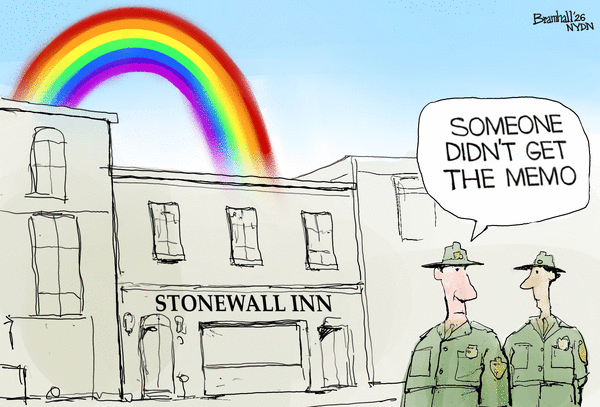
Patrons at the Stonewall Inn, a gay bar in New York City’s Greenwich Village, being subjected to routine anti-homosexual harassment by the New York City police raiding the bar, spontaneously fought back in an incident considered to be the birth of the gay rights movement.
Riot veteran and gay rights activist Craig Rodwell said: “A number of incidents were happening simultaneously. There was no one thing that happened or one person, there was just . . . a flash of group, of mass anger.”
About Craig Rodwel
A group of drag queens, who had been mourning the death earlier in the week of Judy Garland, mocked the police and threw things at them, and police were forced to retreat into the bar as the crowd of supporters grew; disturbances continued for days.
The bar is now on the National Register of Historic Places.


Stonewall and all it has inspired
—————————————————————————————————-
June 28, 1987

The Iranian Kurdish town of Sardasht was attacked by Iraqi aircraft with chemical weapons during the Iran-Iraq War. Saddam Hussein had started the war expecting an easy victory against the new Shiite Islamic republic, even though Iran had three times the population.

Victims of the mustard gas attack on Sarsasht, Iran
——————————————————————————————————-
June 28, 2005
Seen in New York City on June 28, 2005
   

https://www.peacebuttons.info/E-News/peacehistoryjune.htm#june28

Miscellaneous 6/24 Stuff On 6/25

The final story is posted in full because that’s how The 19th rolls. Enjoy! -A

Bombs Over Norway by Clay Jones

But his bucket came with a Peezy Prize Read on Substack

A Ukrainian lawmaker nominated Donald Trump for a Nobel Peace Prize, and has now withdrawn it, saying he had ‘lost any sort of faith and belief” in Trump and his ability to secure a ceasefire between Moscow and Kyiv. The mystery here is why ever had “faith” or “beliefe” in Donald Trump in the first place?

To believe in Donald Trump, you either have to be a cultist who does not live in reality, or have previously taken a tack hammer to the head.

The Ukrainian official, Oleksandr Merezhko, said Trump is “evading—he is dodging—the need to impose sanctions on Russia.” That’s because he’s Putin’s beyotch. Has Merezhko not been paying attention all these years?

Pakistan submitted a formal recommendation for Trump to receive the Nobel Peace Prize after saying his “decisive diplomatic intervention and pivotal leadership” stopped its recent military spat with India over Kashmir. Although India stated there was no need for external mediation on the Kashmir issue, playing down Trump’s role. Factor in that India’s leader is a Trump fan.

But now, just a day after recommending TACO for the Nobel Peace Prize, it’s condemning him for attacking Iran, saying the strikes “constituted a serious violation of international law” and the statute of the International Atomic Energy Agency. Pakistani Prime Minister Shehbaz Sharif, in a phone call Sunday with Iranian President Masoud Pezeshkian, expressed his concern that the bombings had targeted facilities that were under the safeguards of the IAEA.

Today, Georgia GOP Rep. Buddy Carter has formally nominated Trump for a Nobel Peace Prize, writing to the committee that it’s “in recognition of his extraordinary and historic role in brokering an end to the armed conflict between Israel and Iran.”

But, Buddy…you don’t negotiate peace by bombing somebody. Also, the peace deal isn’t working. Israel accused Iran of violating the deal, and Trump got upset, probably because further escalation would ruin his pretend chances of winning a Nobel Peace Prize. Also, you don’t win a Nobel Peace Prize by bombing a nation that’s never attacked you.

Trump said, “We basically — we have two countries that have been fighting so long and so hard that they don’t know what the fuck they’re doing.” Oh, and you do, TACO?

Buddy didn’t nominate Trump for the Nobel Peace Prize because he believes it would be deserved. Like Pakistan and the Ukrainian guy, Buddy is using the prize to kiss Trump’s ass. Pakistan and Ukraine both turned around and said Trump doesn’t deserve it, which they already knew. Maybe they should buy him planes. Buddy, I don’t know what you want from Trump, but can you buy him a plane?

Of course, Republicans are praising Trump for a peace deal with Israel and Iran, but why? There are no conditions or terms. Neither nation has given any concessions to the other. Has Iran agreed to abandon its nuclear program? No. Even if they did, why would it be more trustworthy than the deal Obama already made with Iran that Trump destroyed, which was working? Did Israel give Iran any concessions, like maybe abandoning its nuclear program that nobody wants to talk about?

Trump’s peace treaty is like the TEMU of peace treaties. It’s going to break just as soon as you start playing with it. (snip-MORE)

=============================

NATO Making Careful Preparations To Keep Baby Trump Entertained During Tomorrow’s Big Summit by Rebecca Schoenkopf

Wouldn’t want him to get bored or stomp out and demand to go home or anything! Read on Substack

This morning, Donald Trump was angry. One would imagine that after ending all wars forever with his flawless execution of the ceasefire between Israel and Iran, he just wanted to have a nice celebratory night, while SecDef Pete Hegseth drunked and belched around the White House residence in a sexy teddy singing “Nobel Peaaaaaaace Biiiiiiiiirthday, Missssteerrrrr [HIC!] Prezzzzdinint!”

Alas.

Instead it appears Israel and Iran stopped shooting long enough to let President Dumbass get on Truth Social and declare flawless victory, before they got right back to shooting at each other. It’s gotta be tough pretending to be the leader of the free world when none of the world, free or otherwise, has any respect for your leadership. (snip-MORE, and it is good!)

==================

Roe v Wade by Ann Telnaes

Overturned three years ago today Read on Substack

With Trump’s strikes on Iran and all the other shitstorms his administration has caused, the anniversary of American women losing their reproductive rights isn’t going to get a great deal of press. Here’s just one link to what abortion bans mean for women after the Supreme Court decision. There are plenty more.

============

Inside the queer pop-up parties you’ll never want to leave

Jun 18, 2025 Tara Pixley

This story was originally reported by Tara Pixley of The 19th. Meet Tara and read more of their reporting on gender, politics and policy.

Glitter sparkles across people and surfaces, rainbow-colored acrylic nails snap in time to the Afrobeat, and boisterous cheers egg on the occasional dance floor death drop. These are moments that make up spaces created for and by queer and trans people of color (QTPOC). From Los Angeles to Philadelphia, New York City to Atlanta, queer community organizers, DJs, musicians and artists are producing monthly pop-up events that attendees and organizers say are reimagining queer liberation through collective joy. 

Events range from underground warehouse raves like Hood Rave in Los Angeles to sunlit day parties and potlucks featuring patio yoga. Regardless of format, the trappings of queer life and culture are evident everywhere you look — necklaces made of popper bottles; chest harnesses as fashion; flags; fans; cheeky political statements across nails, hats and tees. The recognition of Black and Brown queer experiences is often apparent in event titles, like New York City’s notorious Papi Juice dance party and Los Angeles’ weekly Toxica event for sapphic Latine queers. 

These parties also frequently double as advocacy work, where they highlight mutual aid campaigns, promote queer causes and spread political awareness. In recent years, DJ shouts of “Free Palestine” are frequently met with affirmative cheers from dance floors dotted with keffiyehs and watermelon imagery. QTPOC parties are also changing the tunes of gay nightlife from the pop/EDM/disco variety to a musical mix of hip-hop, trap, house, reggaeton, soca and Afrobeats. 

“Everybody is able to see themselves in the music and feel safe here,” said Terri Flamer, who attended the Soulovely prom in Oakland, California, in May. “That’s probably the best thing about it, is you’re safe to be yourself, you can party, you meet people that don’t look like you and it’s all love.”

Queer dance parties also enable the ecstatic experience of group dance, which can be understood as its own form of activism. Maya Bhardwaj, a scholar studying the global influx of such parties in the last decade, called them queer utopias that center: “healing, mental health, ancestral faith practices, queer Black and Brown music and dance traditions, and spaces for activists and cultural workers to gather beyond mainstream bars and nightlife.” Mission statements from QTPOC dance party organizations often invoke terms like “affirmation,” “celebration” and “sustaining.“ 

While queer nightlife as a space of resistance isn’t new — it has its roots in AIDS activism of the ’80s — the intersectional community building and intention brought to crafting these spaces makes the current slate of QTPOC parties feel fresh. Often exclusionary White male gay spaces are frequently the only options for LGTBQ+ nightlife, and the pop-up event has become a go-to to address a lack of gatherings that feel welcoming to QTPOC folks.

There’s this sense of pain shared among QTBIPOC […] and therefore the joy that is experienced at these parties feels more necessary, more dire and more of a relief.”Nicole Prucha

Pop-up spaces provide “a feeling of safety in being able to trust that the people who are there have experienced or understand what it is like to be othered, in a sense apart from our sexuality,” said performance studies scholar Nicole Prucha about her experience attending Los Angeles QTPOC parties. As a queer Arab person who has often struggled to find places where she feels truly seen, Prucha said parties like Casual, Hot Pot and its sister event HabibiPot fill a vital need for queer people of color: “A place of refuge and queer world-building” at a time when LGBTQ+ rights are under attack.

The dance floor is reflected in Terri Flamer's sunglasses.
Terri Flamer attends Soulovely’s prom, held in the 14th season of Oakland’s QTPOC-centered monthly party. (Manuel Orbegozo for The 19th)

Event organizers are often working with limited resources amid challenging financial situations. Five queer BIPOC coordinators — Kike Ayorinde, Camryn Casey, Madi Dalton, dRi Guillén and Leslie Tellería — produce community-funded Lavender Evolutions (LE) events in D.C., and the ticket sales for each event contribute to the next event. In a collective statement, the organizers shared that they are largely unpaid but, “We do give core organizers small payments to cover things like gas, food during events, and the many hours of labor leading up to an event.” The LE organizers acknowledge that “money is a huge barrier and we could always use more of it, but for us, it’s more important that we have events that are financially accessible.” 

They keep ticket prices below $25 to achieve that aim but struggle with the financial load of creating these pop-up spaces. The organizers say they are often unable to meet the market rates of DJs and other collaborators due to tight budgets, while logistical support frequently comes from community members willing to volunteer their time to assist with check-in and ticketing. Another challenge they face is making their work in building queer community attractive to funders. “Grant makers don’t always understand the scope of the work that we do and why it’s so important, especially in this moment,” organizers said.

Despite the challenges, organizers said the work is worthwhile. “We do experience burnout but we rely heavily on the collective,” the organizers said. “More than anything, we prioritize people. For our core organizers, it’s a delicate balance because our time and energy is limited. We’re all balancing our full-time jobs, life and Lavender, but the love of community keeps us going.”

They need us, we need them. It’s not always about the bottom dollar, sometimes it’s about building community and the dollars come after.Sgt. Die Wies

The 19th sent photographers to queer pop-up parties and events in Oakland, Washington, D.C., and Atlanta to show these spaces of radical queer joy in action and highlight the work that queer organizers are doing to build QTPOC community across the country. 


OAKLAND

Soulovely has brought QTPOC-centered “cultural affairs” to the Bay Area for 14 years

A group of people hold onto each other in front of a sign saying Soulovely.
Many attendees of Soulovely’s prom said it was a first for them, providing queer and trans people of color (QTPOC) an opportunity to attend a prom in a safe and community-based setting. (Manuel Orbegozo for The 19th)

Soulovely is a beloved and long-lasting pillar of queer life in the Bay Area. Since 2011, its monthly events have served as a safe haven for a predominantly BIPOC queer community to celebrate their identities and bodies through music and dance. “I actually just found out that a loved one passed. So coming here was kind of like in honor of them as well, because they love to dance, I love to dance, we met out dancing — it brings people together,” said Mello-Jahlil Travis, who attended Soulovely in May.

A portrait of a woman wearing a white hat and dress.
Burlesque producer and performer Sgt. Die Wies attended the Soulovely queer prom on May 11 and says she thinks the space provides an opportunity to be “solution-based versus just focusing on the negativity. “ (Manuel Orbegozo for The 19th)

Attendees and organizers both are often quick to point out these spaces are not about excluding White, straight or otherwise non-QTPOC people. Rather they are about radical inclusion and belonging. Sgt. Die Wies, a burlesque producer and performer who attended the Soulovely queer prom in May, said that the party is all ages with a variety of ethnicities coming out to be together:“It’s beautiful to see because there’s so much division in the world right now.”

A person sits on a chair framed by a doorway.
Mello-Jahlil Travis (they/them) said the Soulovely Prom gave them an opportunity to have a different prom experience. “I’m stoked to be here amongst other beautiful queer people. It’s important to be able to see people who look like you be themselves and feel free. There’s not everywhere that I feel like I can have my nails painted and dress like this. It’s dope to be around people who can receive that.” (Manuel Orbegozo for The 19th)

While all are welcome, Jaycee Chang especially appreciates the way Soulovely centers queer and trans people of color. “It is both a space of joy and being a community but also, it’s a relatively politicized space where they’re very intentional about the artists that they bring in, the DJs, the themes,” Chang said.

And that can even extend to their families.

“One of the DJs who helped host HabibiPot [in Los Angeles], her mom was there to watch her first DJ set and she played Arab classics that my own mom had introduced me to,” Prucha said. “They’re both Palestinian, and her mom was there, standing on the tables with the rest of us, and she was crying because she was so happy that her daughter was there and had found community.”

A couple holds each other close for a portrait.
Tiara Reed (left) met her now-fiancée Chenelle Reed (right) at a Soulovely event and said “it’s so significant to have spaces where unapologetic joy and levity and freedom are welcome and everyone can just bask in it.” (Manuel Orbegozo for The 19th)

These spaces also provide opportunities for LGBTQ+ people to meet each other beyond dating apps. A 2020 Pew Research Center study reported that lesbian, gay and bisexual people were both more likely to use online dating and more likely to experience harassment through dating apps than their straight counterparts. 

Soulovely is always part of our story.”Chenelle Reed

Ahn Lee feels safe at Soulovely parties because harassment is far less likely. “I feel like no one’s gonna try to come at me in a way that doesn’t feel comfortable,” Lee said.

Several partygoers laugh and dance against a colorful mural backdrop.
Since 2011, Soulovely events have provided a safe haven for the queer BIPOC community in the Bay Area. (Manuel Orbegozo for The 19th)

And for others, like Tiara Reed and Chenelle Reed, Soulovely has become a character in their love story. Reflecting on the experience of meeting her now-fiancée, Tiara, at Soulovely and their future together, Chenelle said, “It’s going to be absolutely beautiful, because we have places like this … where you can connect and learn that anything is possible, family in all the ways is possible.”

A couple holds each other close and one kisses the cheek of the other.
Jaycee Chang (they/them, right) with their partner Ahn Lee (she/they, left), has been coming to Soulovely for over a decade. Chang said: “Even when the world is chaotic and there’s a lot of harm happening, we can come together as a community and create spaces that feel like refuge, like safety.” (Manuel Orbegozo for The 19th)

ATLANTA

Southern Fried Queer Pride builds QTPOC community through education and embodied healing

Grassroots collective Southern Fried Queer Pride (SFQP) — now in its 11th year — focuses its events toward “artivism” with a stated mission to fight narratives that confine Southern LGTBQ+ people to “stigma, statistics and struggle” instead aiming to uplift an “honest narrative of resilience, rich history and vibrance.” SFQP offers year-round programming, typically providing between 40 to 60 events that feature community education — like the upcoming trans health care workshop — as well as gallery shows, marches and dance parties, such as its June trans cabaret and open mic.

Two people hug each other against a backdrop of books and plants.
Maya Wiseman (left) and Magdalena (right) have both volunteered for SFQP for years and say organization offers a space of respite and community connection for them. (Piera Moore for The 19th)

Community organizer Maya Wiseman said the May 18 SFQP Community Potluck was an alcohol-free and masks-required event to further expand on their inclusiveness, which has become a hallmark of SFQP events. “Queer folks have been marginalized throughout time, but often queer folks, whether they know it or not, naturally end up creating safe spaces for everyone,” said Wiseman, who has worked with SFQP as a community organizer for six years. “We try to create spaces that say ‘come as you are,’ because we’re not having this at a club. If you want to come here in pajamas, in a tank top and shorts, it’s fine with us.”

Several people lay on yoga mats on the floor.
Southern Fried Queer Pride offered yoga at its May 18 community potluck in Atlanta. (Piera Moore for The 19th)

Atlanta’s queer community is very easy to navigate, and SFQP is a big reason why.”Magdalena


WASHINGTON, D.C.

Lavender Evolutions and Alphabet Soup make space for QTPOC joy at summer day parties

A group of people pose for the camera in swimwear.
Alphabet Soup Events uses a tiered ticket pricing system that recognizes the systemic financial issues queer and trans people of color face to increase racial diversity across its attendees. (Mariah Miranda for The 19th)

While not explicitly centering QTPOC, Alphabet Soup events, like the recent Daisy Dykes pool party, are “sapphic-focused” and find other ways to make their events inclusive and accessible for queer people of color. Tickets are available at different price tiers, with some lower-cost tickets allotted for BIPOC attendees. 

Closeup of a couple kissing on the dance floor.
A couple dances together at a pool party by Alphabet Soup Events. (Mariah Miranda for The 19th)

Adu Ogbagiorgis has witnessed a big shift in the racial makeup of Alphabet Soup parties after the organizer started this pricing practice, which they see as a welcome recognition that “Black queers have a different experience than White queers.” For Ogbagiorgis, this approach to ticketing shows they want people of color to come to the events. “So it’s really awesome to see that a lot of more predominantly White spaces are making space for Black queers,” they said.

Mackenzie Bolden said they can be themselves at Alphabet Soup events. “I feel like I can just embrace my skin, embrace my personality, embrace my queerness, embrace everything that is me. And that’s something I treasure and will never take for granted because of how often I don’t feel that way.”

A group of people surround two people shooting water guns at someone.
Lavender Evolution’s SWEAT party featured a wet t-shirt contest at on June 8 in D.C. (Mariah Miranda for The 19th)

Lavender Evolutions hosted a daytime beer garden pop-up called SWEAT on June 8 that featured a wet T-shirt contest, a water balloon toss and little cabanas filled with the sounds of multiple kikis. 

A person with blue hair fans themself while wearing a leather harness the same shade as their hair.
Ciara Bridges whips out their fan while attending Lavender Evolution’s SWEAT party in D.C. on June 8. (Mariah Miranda for The 19th)

Jojo Morinvil, who attended the SWEAT party, deeply values the way Lavender Evolutions has been intentional in their creation of space for queer BIPOC people to enjoy themselves. “They started out doing nature walks and book [clubs], then, as they grew, they really created safer spaces for folks to socialize, to get to know people and learn queer history, [along with] events where you can dance and party with your friends,” Morinvil said. 

Several people slow dance as the sun sets.
Couples and friends slow dance at Soulovely’s queer prom in Oakland on May 11. (Manuel Orbegozo for The 19th)

I truly believe that being whimsical will crush the patriarchy.”Sgt. Die Wies

Sgt. Die Wies points to the unabashed vibrance, love and joy experienced at parties like Soulovely as “things (that) are going to just crush the darkness. We’ve survived harder times than this. We’ve been bullied before. They ain’t got shit on us. There’s too many of us. There’s too much light and too much love and too much joy. We’ll be okay.”

Mariah Miranda, Piera Moore and Manuel Orbegozo contributed reporting. 

Peace & Justice History for 6/23

June 23, 1683

“Tamanend,” sculpture by Raymon Sandoval, 1995, Front & Market Street in Philadelphia.
Chief Tamanend (The Affable), leader of the Pennsylvania’s thirteen Lenni-Lenape tribes, and other chiefs went to Philadelphia to meet with William Penn. Penn wished to buy four parcels of land (most of current Montgomery County), and the chiefs agreed to the sale, each making their mark on the deeds which had been translated for them.
Soon thereafter, Penn met with Tamanend at Shakamaxon under a large tree later known as the Treaty Elm. Penn said, “We have come here with a hearty desire to live with you in peace . . . We believe you will deal kindly and justly by us, and we will deal kindly and justly by you . . . .” Tamanend offered, “We will live in love with William Penn and his children, as long as the creeks and rivers run, and while the sun, moon, and stars endure.”
June 23, 1963
Reverend Martin Luther King, Jr. led a massive march down Detroit’s Woodward Avenue followed by a speech to a rally in Cobo Hall. The speech was essentially the same as that he delivered from the steps of the Lincoln Memorial in Washington, D.C. two months later, known as “I Have a Dream.”
Photo of King speaking in Detroit from the Wayne State University’s Reuther Archive. 
June 23, 1966
High school students in Grenada, Mississippi, tried to purchase tickets in the downstairs “white” section of the local movie theatre. Black moviegoers had always been required to sit in the balcony under Jim Crow segregationist laws. When they were refused tickets, they sat down on the sidewalk in front of the theatre. Fifteen were arrested, including Jim Bulloch, a Southern Christian Leadership Council (SCLC) organizer, who was charged with “inciting to riot.”

Jim Bulloch, one of the SCLC organizers in Grenada, Mississippi
Grenada Mississippi, 1966, Chronology of a Movement 
June 23, 1972
Life magazine published a photo by Vietnamese photographer Nick Ut of children running from an attack with Napalm, an incendiary chemical weapon used widely by U.S. forces to burn out the jungle, thus eliminating cover (foliage) for North Vietnamese and Viet Cong troops. Napalm, a sticky mixture of gasoline, polystyrene and benzene that burns at very high temperature, had been used in WWII and Korea.

Read about the photograph 
June 23, 1972
The Education Amendments of 1972, commonly known as Title IX, became U.S. law, prohibiting sex discrimination at educational institutions.
More info  Text of the law 
June 23, 1973
The International Court of Justice granted an injunction, requested by the Australia and New Zealand governments, against French nuclear weapons testing in the South Pacific.

https://www.peacebuttons.info/E-News/peacehistoryjune.htm#june23

A History Worth Reading

because when the US does these things, they take place in all of our names whether we want it, or not. It’s part of why the power for these things lies in our legislature. The power does not rest with the executive unless the legislature votes to give it.

‘You don’t brag about wiping out 60‑70,000 people’: the men who dropped the atomic bombs on Hiroshima and Nagasaki

Stephen Walker Sun 22 Jun 2025 07.00 EDT

This summer will mark 80 years since the attacks stunned the world. Today, every one of the crew members who carried out the bombings is dead. Here, one of the last writers to interview them reopens his files

Stephen Walker

Sun 22 Jun 2025 07.00 EDTShare

‘It was a beautiful morning. The sun was shining on the buildings. Everything down there was bright – very, very bright. You could see the city from 50 miles away, the rivers bisecting it, the aiming point. It was clear as a bell. It was perfect. The perfect mission.”

I’m sitting in a Chinese restaurant in San Francisco opposite the navigator of the Enola Gay, the B-29 bomber that dropped the atomic bomb on Hiroshima on 6 August 1945. The year is 2004, and Theodore “Dutch” Van Kirk, aged 83, has agreed to be interviewed for a book I’m writing for the 60th anniversary of that fateful mission. Van Kirk informs me, with the trace of a smile, that this will probably be the last interview in his life.

We have spent the afternoon looking through wartime logbooks from his 58 overseas combat missions. Now, between servings of dim sum, he is telling me about the 59th, the one that wiped out a city, along with well over 100,000 people.

“The instant the bomb left the bomb bay, we screamed into a steep diving turn to escape the shockwave. There were two – the first, like a very, very, very close burst of flak. Then we turned back to see Hiroshima. But you couldn’t see it. It was covered in smoke, dust, debris. And coming out of it was that mushroom cloud.”

The crew of the B-29 bomber Enola Gay. Stephen Walker interviewed Theodore ‘Dutch’ Van Kirk, navigator (1); Tom Ferebee, bombardier (2); Paul Tibbets, pilot (3); Bob Lewis, co-pilot (4); George ‘Bob’ Caron, tail gunner (5); and Robert Shumard, assistant engineer (6).

The crew of the B-29 bomber Enola Gay. Stephen Walker interviewed Theodore ‘Dutch’ Van Kirk, navigator (1); Tom Ferebee, bombardier (2); Paul Tibbets, pilot (3); Bob Lewis, co-pilot (4); George ‘Bob’ Caron, tail gunner (5); and Robert Shumard, assistant engineer (6). Photograph: Photogquest/Getty Images

He stops a moment, awe visibly registering on his face. “The city was gone. It was only three minutes since we’d dropped the bomb.”

Van Kirk died in 2014. In the years since we met, all the other crew members who flew on the missions to Hiroshima, and to Nagasaki three days later on 9 August, have also died. Meanwhile, the numbers of hibakusha, those who survived the attacks, are rapidly dwindling. We are passing into a twilight of history. As we approach the 80th anniversary of the atomic bombings, this biological fact seems disturbingly relevant. Twenty years ago, the world was a dangerous place. Today, it’s more so. More nations are developing nuclear weapons with few, if any, effective international controls. Tactical nuclear strikes have been explicitly threatened by Vladimir Putin and Kim Jong-un. And, just in the last week, war has broken out in the Middle East over fears that Iran may be very close to having a bomb. In such times, perspective matters. The shocked testimony of those like Van Kirk needs to be heard. History has lessons to teach us.

It was this thought that prompted me to reopen my files, to reread the transcripts of interviews with some of the crew members of both attacks. Much of this material was untouched for two decades; nothing relating to the Nagasaki mission was published. Here were some of the last testimonies of those who did the unthinkable. They were in their 80s or 90s, nearing the end of their lives. How did they remember it?


On 4 August 1945, Charles “Don” Albury, a 24-year-old B-29 pilot, was summoned to a secret briefing on Tinian, a Pacific island 1,500 miles south of Japan. Then the biggest bomber base in the world, Tinian was a jump-off point for a conveyor belt of the almost daily destruction of Japan. About 300,000 people had already died and 9 million were now homeless.

But Albury’s outfit had yet to take part in the attacks. Known as the 509th Composite Group, they occupied a secret compound on a far corner of the base. “Security was very, very tight,” Albury told me when I met him at his home in Orlando, Florida. Then aged 83, he grinned mischievously. “I remember one time the base commander got too near one of our planes. A guard nearly shot him.”

Even the 509th’s crews knew nothing about their ultimate missions. And they had been training for almost a year. First in Utah, later on Tinian: “We kept dropping practice bombs and flying these crazy steep turns. We did it day after day. For months.” But nobody told them why, and few dared ask. Those who did could find themselves swiftly dispatched by their leader, Paul Tibbets, a battle-hardened bomber pilot, to hardship posts above the Arctic Circle. “You learned to keep your mouth shut,” said Albury.

But in that 4 August briefing a part of the secret was about to be revealed.

Nine days earlier, on 26 July, President Truman had delivered his ultimatum to Japan in the Potsdam declaration: either surrender unconditionally, or face “prompt and utter destruction”. The means of that destruction was not specified. And Japan had not surrendered.

If I live for 100 years I will never get these few minutes out of my mind

(snip-MORE)