being my final post for Halloween 2025. 🎃 🫥
And To All A Good Night,
being my final post for Halloween 2025. 🎃 🫥

being my final post for Halloween 2025. 🎃 🫥
I remember the 80s: my gay and trans friends threw the very most fun parties while keeping everyone safe, played the best dance music, and had the very best costumes!
“What do you mean you’re a transgender mouse?“
By Samantha Allen, Quispe López, Fran Tirado, Ludwig Hurtado, and Ana Osorno
Are you really gay if straight people can recognize your Halloween costume? The real indicator of someone’s sexual orientation is whether they go to a party as something recognizable — or whether they go as Chappell Roan in the crowd at Governors Ball. Why would you go as a sexy cat when you could be a transgender mouse — or a reference to an obscure arthouse movie only you and your mutuals have seen?
In all seriousness, I am a little torn on the practice of wearing incredibly obscure gay Halloween costumes: maybe there are better ways to communicate your niche interests than forcing everyone at the function to ask “…and what are you again?” But on the other hand, who does it really hurt when your friends dress up like George Santos’ alleged drag persona Kitara Ravache and the fishing rod with legs from Toy Story? Sure, maybe it turns all of us into the Spider-Man pointing at Spider-Man meme when we recognize each other’s fits, but it’s fine! We only get so many Halloweens in our lives, we might as well take some big swings!
Indeed, in the end, there is a certain beauty in our community’s intense love of obscure pop cultural moments and artifacts. So why not use the year’s spookiest holiday as an excuse to get hyperspecific? Forget witches and ghosts: find the deepest rabbit hole you know and leap to the bottom of it! And if you’re wanting for inspiration, we here at Them have curated a bevy of ideas, ranging from Barack Obama’s nonbinary friend to the concept of twink death. Enjoy all the confused looks on your way to the party. — Samantha Allen

Mice, Ranked From Least to Most Transgender
No matter gay straight or bi, lesbian, transgender mice.
As we established here at Them dot us, after Trump’s deranged claim about “transgender mice,” mice are indeed pretty damn transgender. If you want to be silly and gay, there luckily is an abundance of trans-coded mice to choose from. Some of our favorites include Pinky and the Brain from Animaniacs, labor union darling Scabby the Rat, and of course Remy from Ratatouille. — Quispe López
Get a jump start on Thanksgiving with this horrible pull from the TV archives. Put on a red dress, a brunette wig, and if anyone wonders who you are, just raise a finger to the sky and sing “It’s turkey lurkey time.” Confused expressions? That’s part of the experience. — Samantha Allen
Ava from Hacks on the escalator
(Snip; there is so much more it’d make a huge post; it’s fabulous, so have another cup, click through, and enjoy!)
The November Witch, sometimes phrased as “the Witch of November,” is a popular name for the frequent and brutal system of windy storms that come screaming across the Great Lakes from Canada every autumn.
Though termed “lakes,” North America’s Great Lakes are each large enough to create their own weather systems, making them, more accurately, inland seas. In fact, collectively, the Great Lakes chain makes up the Earth’s largest system of freshwater seas.
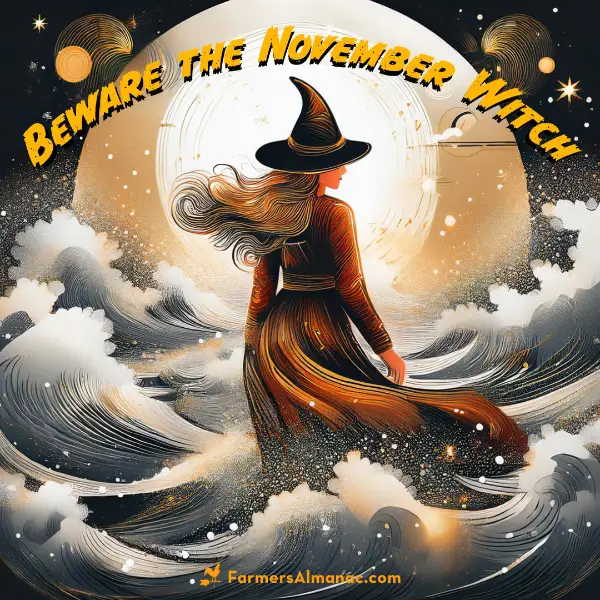
Each year, right around mid-November, violent gales occur when the low pressure from the frigid arctic air north of the lakes comes into contact with warmer fronts pulled up from the Gulf of Mexico.
These storms can be so severe that their force is equivalent to a low-level hurricane, with winds above 80 miles per hour and towering 20-foot seas.
The term “Witch of November” was famously used in the song, “The Wreck of the Edmund Fitzgerald,” by Canadian singer-songwriter Gordon Lightfoot, a poetic tribute to one of the most well-known Great Lakes shipwrecks in recent memory.
On November 10, 1975, the SS Edmund Fitzgerald, a massive ore freighter that had once been the largest in its class, sank to the bottom of Lake Superior during a particularly violent autumn gale, killing all 29 of its crew members.

Though one of the most infamous, Edmund Fitzgerald was far from the only ship to succumb to the Witch of November. The floors of all five Great Lakes are littered with thousands of wrecked vessels.
More than 6,000 ships were lost on the Great Lakes between the years 1878 and 1897 alone. Over the last 300 years, an estimated 25,000 mariners have lost their lives on the Great Lakes, with the vast majority of those casualties occurring within the icy grip of the November Witch.
Watch the following tribute to the Edmund Fitzgerald, with real news footage, set to Gordon Lightfoot’s famous tune:
The items don’t have to do with each other; they interested me or looked like something I ought to know about, so I read them and thought someone else might like to read one or another or maybe all of them.
=======================
=============
Snippet:
The 1947 partition of the South Asian subcontinent into India and Pakistan led to the world’s largest mass migration. Populations from both sides of newly formed demarcations suffered in heinous riots. Women in particular were subjected to extreme violence. Yet, the severity of gendered crime during Partition wasn’t caused by an arbitrary upsurge of madness. Systemic patriarchy in South Asia had long reduced women to male-owned property. They were objectified to such an extent that a woman’s sexual “purity” became a metonym of her husband’s and kinsmen’s honor (izzat). In other words, male respectability was gauged by how successfully women’s bodies were regulated. With Partition, this dynamic became a forum for contesting powers and prestige at the communal and national levels.
To assert manhood and symbolize triumphal power over the enemy, rivaling sides opted for sexually charged violence, grotesquely marking, mutilating, and branding the bodies of women. According to historian
“[T]housands of women on both sides of the newly formed borders,” writes historian Urvashi Butalia,
were abducted, raped, forced to convert, forced into marriage, forced back into what the two states defined as “their proper homes,” torn apart from their families once during Partition by those who abducted them, and again, after Partition, by the state which tried to “recover” and “rehabilitate” them.
In the guise of celebrating independence from British rule, official narratives of nationalism largely omitted female experiences of such violence during the divisive convulsions of 1947. Among the earliest Partition texts that documented gory details which would have otherwise slithered into oblivion is Pinjar (which can translate to both “Skeleton” and “Cage”), a novella by Amrita Pritam that captures the cataclysmic years of Partition via a series of abductions.

A writer celebrated for both powerful poetry and prose, Amrita Pritam (1919–2005) is a well-known figure in South Asian literature. Inspired by real life, much of her work serves as testimony. Pritam witnessed firsthand the horrors of Partition—communal riots forced her to migrate to India from Pakistan in 1947 with nothing but her two small children and a red shawl. She never returned home. (snip-MORE on their page linked above)
==========================
Designing Intersex History: Behind the Intersex Flag with Morgan Carpenter
The Intersex Human Rights Fund (IHRF) at the Astraea Lesbian Foundation for Justice is celebrating its 10th year of funding intersex liberation efforts across the globe. Join us in reflecting on the IHRF’s many accomplishments, intersex movement successes, and our vision for the future of intersex organizing.
Created in 2013 by Morgan Carpenter, an intersex man based in Australia, the intersex flag was intentionally designed to stand out, communicate values important to intersex communities, and be used widely and freely. The intersex flag has a simple design: a bold purple circle on a bright yellow background. The circle represents many things, including wholeness and bodily autonomy, while the colors yellow and purple both represent the strength and diversity of intersex communities while avoiding all references to gender.
(Snip-a bit MORE)
====================
Plenty of us are living back at home, adopting ‘traditional’ duties in exchange for free accommodation – Charlie Aslet
When I read the term “trad sons” on my phone, I spat the hot cocoa my mother had prepared for me out onto the screen. “What fresh torture will the live-at-home generation be subjected to next?” I cried. It only got worse when I scrolled to see that mothers were calling their stay-at-home sons “hubsons”, a play on the word husbands. “Has the whole world gone Oedipal?” I exclaimed in horror.
Following on from the trend of the “tradwife”, the internet has coined the term trad sons for children who stay at home with their parents and adopt “traditional” sonly duties in exchange for free accommodation. (Snip-MORE, it’s not long)
Cosmos Magazine has changed its online presence, while still providing the informational and neat articles they’re known for. Here are a couple for this week.
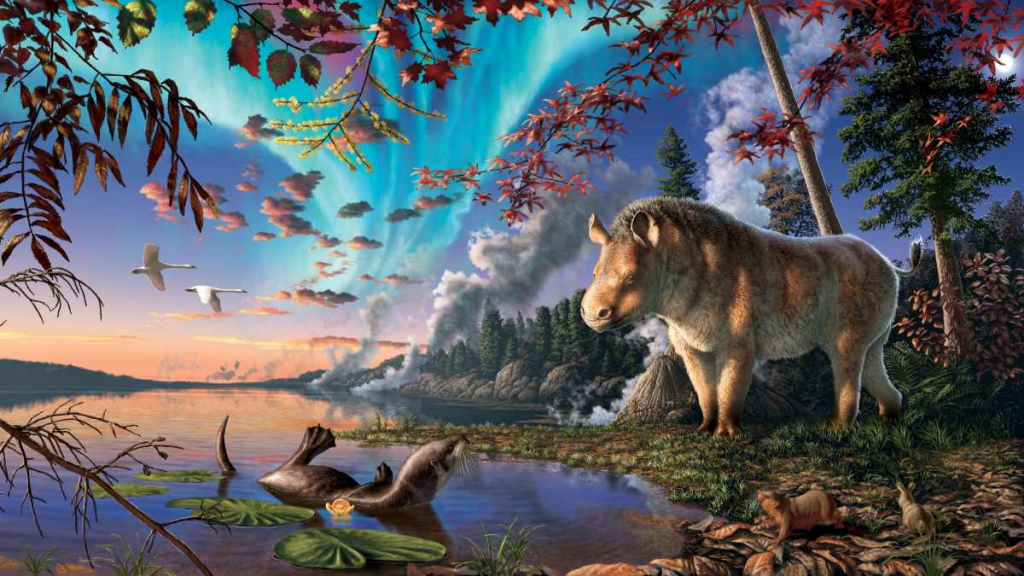
October 29, 2025 Evrim Yazgin Content Sub Type: Focus Topics:
A near complete fossil rhinoceros has been found on an Arctic Canadian island, making it the most northerly rhino species ever.
Epiatheracerium itjilik [eet-jee-look] is described for the first time in a paper published in the journal Nature Ecology & Evolution. The “Arctic rhino” lived about 23 million years ago during the early Miocene epoch.
The new species was found in fossil-rich lake deposits in Haughton Crater on Devon Island which is part of the northern-most Canadian territory of Nunavut. Devon Island lies at a latitude of about 75°N, well within the Arctic Circle. It is also the largest uninhabited island in the world. (snip-MORE)
====================

October 30, 2025 Imma Perfetto Content Sub Type: Focus Topics: Space
The largest low-frequency radio image of the Milky Way ever assembled has captured an unprecedented view of the galaxy, enabling astronomers to study the life stages of stars in new ways.
The data was captured by the Murchison Widefield Array (MWA) radio telescope at Inyarrimanha Ilgari Bundara, the CSIRO Murchison Radio-astronomy Observatory on Wajarri Yamaji Country in Western Australia.
“This low-frequency image allows us to unveil large astrophysical structures in our Galaxy that are difficult to image at higher frequencies,” says Associate Professor Natasha Hurley-Walker from the International Centre of Radio Astronomy Research (ICRAR). “No low-frequency radio image of the entire Southern Galactic Plane has been published before, making this an exciting milestone in astronomy.”
Hurley-Walker is principal investigator of one of the extensive surveys used to construct the image, the GaLactic and Extragalactic All-sky MWA (GLEAM) survey. (snip-MORE, and it’s interesting)
 Scottie's Playtime
