Commentary: The masking of ICE agents is indefensible

https://www.arcamax.com/politics/opeds/s-3886918

Amy Dru Stanley and Craig Becker, Chicago Tribune on 

Published in Op Eds

Commentary: The masking of ICE agents is indefensible

Amy Dru Stanley and Craig Becker, Chicago Tribune on Published in Op Eds

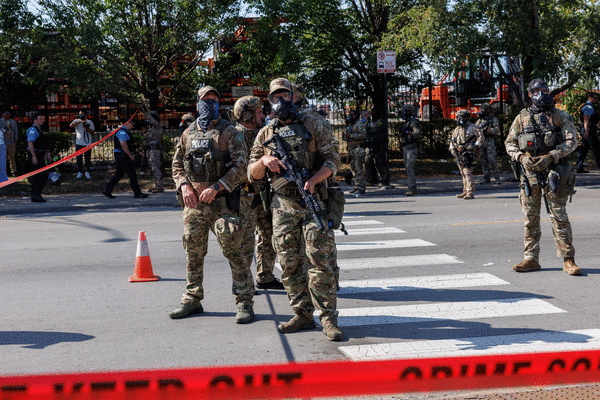
Last month, a federal judge observed that masked figures were creating terror on American streets — not criminals but agents of Immigrations and Customs Enforcement. “Law enforcement in the United States has usually been performed in the open,” wrote Judge William G. Young, a Ronald Reagan appointee to the U.S. District Court in Massachusetts.

“Images of plain-clothed, masked federal agents — faceless agents of the federal government — snatching a non-violent person off the streets” have created “fear in citizens and non-citizens alike.”

We’ve all seen the arrests in our neighborhoods and felt that fear. We’ve watched the raids unfold on the news: on the streets, on college campuses, in workplaces, in homes, outside courtrooms, in Home Depot parking lots. ICE agents wearing masks, violently detaining people, holding them captive, disappearing the suspects.

And we’ve heard the explanation that masking protects the ICE agents. “If you expose them,” President Donald Trump has said, “you put them in great danger, tremendous danger.”

But that rationale is indefensible, as it would apply to every public official and employee involved in the criminal justice system, all of whom face the threat of retaliatory violence. Moreover, severe penalties exist for attacking or intimidating law enforcement officers. Surely a judge who sentences convicted criminals to prison is as much at risk as ICE agents, yet the notion is absurd that judges should be anonymous or allowed to mask their faces in the courtroom.

Anti-masking bills have been introduced in Congress — including the “No Secret Police Act” and “No Anonymity in Immigration Enforcement Act”— but the measures have no chance of enactment under GOP control. Recently, Chicago and California banned masked arrests, but the U.S. Department of Homeland Security has stated: “We will NOT comply.”

What is needed is for the courts to act — to declare masked arrests unconstitutional, as unreasonable seizures barred by the Fourth Amendment. The U.S. Supreme Court has held that “reasonableness depends on not only when a seizure is made, but also how it is carried out.” Guarantees exist against seizures without probable cause or warrants, and the court has found that law enforcement agents violate the Fourth Amendment if they seize someone with unreasonable force or execute a warrant to search someone’s home without first knocking and announcing their presence. Such protections, essential in a democracy, should be extended to bar the carrying out of masked arrests. That ban is necessary to identify bad actors, and reduce the risk of harm and thereby uphold constitutional guarantees against unreasonable seizures and interference with freedom of expression.

ICE use of masks has spread more than fear. It has led to criminal impersonation: men pretending to be ICE agents carrying out kidnappings and sexual assaults. But threats to liberty and security lie in masked ICE policing itself — that faceless agents will use excessive force on immigrants or retaliate against witnesses who protest their raids by exercising free speech rights, and that no redress for the wrongs can be sought because the ICE agents can’t be identified. That masked men can act with impunity, as in authoritarian regimes.

Aggressive recruitment of new ICE agents, who are deployed with little training, heightens the risks of the masked raids. As the crackdown spreads — with the White House demanding 3,000 arrests by ICE a day— so, too, is protest against the masking. “More raids means more unidentified federal law enforcement intimidating and in some cases terrorizing our communities,” states the American Civil Liberties Union, noting the difficulty of distinguishing ICE arrests from kidnappings.

Masking also presents dangers for the ICE agents, who may be mistaken for imposters. Obscuring identity has long been a tactic used in certain undercover operations. But as former ICE official Scott Shuchart warned about the masked arrests, there is now “a kind of vigilante problem where people either don’t know, or at least aren’t sure, that these officers who are dressed up like bank robbers are actually law enforcement officers.” In such circumstances, violent self-defense might result.

Judicial prohibition of masked arrests is supported by trends toward greater transparency in policing nationwide. “In evaluating the reasonableness of police procedures under the Fourth Amendment,” the Supreme Court has, by its own account, “looked to prevailing rules in individual jurisdictions.” ICE agents’ masking is sharply discordant with rules requiring local police to wear badges and nameplates and barring them from preventing the public from reading the information. The increasing use of body-worn cameras similarly serves police accountability.


According to the U.S. Department of Homeland Security, however, assaults on ICE agents are up by more than 1,000% this year and masking has been informally tolerated to prevent doxxing, harassment and violence. Meanwhile, the U.S. Justice Department has begun to prosecute people who follow agents or publicize their addresses. Yet ICE has issued no policy requiring mask use to protect agents — nor any official guidelines on masking at all. Appearing on Fox News in July, the acting ICE director, Todd Lyons, equivocated. “I’m not a fan of the masks,” he said. “I think we could do better, but we need to protect our agents and officers.”

The unreasonableness of masked arrests is highlighted by state legislation outlawing the wearing of disguises by private individuals on public property. It reflects the understanding that masking promotes lawlessness — and as the Supreme Court has recognized, “Decency, security and liberty alike demand that government officials shall be subjected to the same rules of conduct that are commands to the citizen.”

Currently, some 22 states have anti-masking rules on the books, as do many local governments, rules now being enforced to suppress peaceful dissent rather than criminal activity. In extreme instances, felony charges have been threatened against masked students protesting the war in Gaza. No doubt the repressive use of the restrictions will broaden. Last June, Trump posted on social media: “From now on, MASKS WILL NOT BE ALLOWED to be worn at protests. What do these people have to hide, and why???”

Anti-masking rules governing private conduct are almost a century old, with most originating in efforts to quell the terrors of the Ku Klux Klan. With much to hide, the Klan has attacked anti-masking laws in the very terms now used by ICE to defend masked arrests: “Members wear their masks to protect their anonymity,” the Klan has argued, “because of the harassment, threats of violence, violence.”

The depth of community protest against ICE agents’ masking may well be rooted in historical memory of faceless Klansmen riding through the night, seizing their captives. As Judge Young warned recently, “Masks are associated with cowardly desperados and the despised Ku Klux Klan. In all our history we have never tolerated an armed masked secret police.”

We should not do so now.

____

Amy Dru Stanley is a history professor at the University of Chicago. Craig Becker is a lawyer with Democracy Defenders Fund.
We Found That More Than 170 U.S. Citizens Have Been Held by Immigration Agents. They’ve Been Kicked, Dragged and Detained for Days.

Please note that this is from October so a lot more US citizens have been detained and abused by ICE.   Hugs

We Found That More Than 170 U.S. Citizens Have Been Held by Immigration Agents. They’ve Been Kicked, Dragged and Detained for Days.

A man in jeans and a light hoodie stands at the entrance to a house, surrounded by bright red dirt.
Leonardo Garcia Venegas was detained by immigration agents while filming a raid on his worksite, despite having a REAL ID on him and telling the officers he was a citizen.

Reporting Highlights

  • Americans Detained: The government doesn’t track how many citizens are held by immigration agents. We found more than 170 cases this year where citizens were detained at raids and protests.
  • Held Incommunicado: More than 20 citizens have reported being held for over a day without being able to call their loved ones or a lawyer. In some cases their families couldn’t find them.
  • Cases Wilted: Agents have arrested about 130 Americans, including a dozen elected officials, for allegedly interfering with or assaulting officers, yet those cases were often dropped.

These highlights were written by the reporters and editors who worked on this story.

When the Supreme Court recently allowed immigration agents in the Los Angeles area to take race into consideration during sweeps, Justice Brett Kavanaugh said that citizens shouldn’t be concerned.

“If the officers learn that the individual they stopped is a U.S. citizen or otherwise lawfully in the United States,” Kavanaugh wrote, “they promptly let the individual go.”

But that is far from the reality many citizens have experienced. Americans have been draggedtackledbeatentased and shot by immigration agents. They’ve had their necks kneeled on. They’ve been held outside in the rain while in their underwear. At least three citizens were pregnant when agents detained them. One of those women had already had the door of her home blown off while Department of Homeland Security Secretary Kristi Noem watched.

About two dozen Americans have said they were held for more than a day without being able to phone lawyers or loved ones.

Videos of U.S. citizens being mistreated by immigration agents have filled social media feeds, but there is little clarity on the overall picture. The government does not track how often immigration agents hold Americans.

So ProPublica created its own count.

We compiled and reviewed every case we could find of agents holding citizens against their will, whether during immigration raids or protests. While the tally is almost certainly incomplete, we found more than 170 such incidents during the first nine months of President Donald Trump’s second administration.

Among the citizens detained are nearly 20 children, including two with cancer. That includes four who were held for weeks with their undocumented mother and without access to the family’s attorney until a congresswoman intervened.

Immigration agents do have authority to detain Americans in limited circumstances. Agents can hold people whom they reasonably suspect are in the country illegally. We found more than 50 Americans who were held after agents questioned their citizenship. They were almost all Latino.

Immigration agents also can arrest citizens who allegedly interfered with or assaulted officers. We compiled cases of about 130 Americans, including a dozen elected officials, accused of assaulting or impeding officers.

These cases have often wilted under scrutiny. In nearly 50 instances that we have identified so far, charges have never been filed or the cases were dismissed. Our count found a handful of citizens have pleaded guilty, mostly to misdemeanors.

Among the detentions in which allegations have not stuck, masked agents pointed a gun at, pepper sprayed and punched a young man who had filmed them searching for his relative. In another, agents knocked over and then tackled a 79-year-old car wash owner, pressing their knees into his neck and back. His lawyer said he was held for 12 hours and wasn’t given medical attention despite having broken ribs in the incident and having recently had heart surgery. In a third case, agents grabbed and handcuffed a woman on her way to work who was caught up in a chaotic raid on street vendors. In a complaint filed against the government, she described being held for more than two days, without being allowed to contact the outside world for much of that time. (The Supreme Court has ruled that two days is generally the longest federal officials can hold Americans without charges.)

A man with a mustache wears a white T-shirt and stands with his arms crossed on an empty road.
George Retes, an American combat veteran, at the site of his arrest by immigration agents on California’s Central Coast. Retes was detained for three days without access to a lawyer and missed his daughter’s third birthday.

In response to questions from ProPublica, the Department of Homeland Security said agents do not racially profile or target Americans. “We don’t arrest US citizens for immigration enforcement,” wrote spokesperson Tricia McLaughlin.

A top immigration official recently acknowledged agents do consider someone’s looks. “How do they look compared to, say, you?” Border Patrol chief Gregory Bovino said to a white reporter in Chicago.

The White House told ProPublica that anyone who assaults federal immigration agents would be prosecuted. “Interfering with law enforcement and assaulting law enforcement is a crime and anyone, regardless of immigration status, will be held accountable,” said the Deputy Press Secretary Abigail Jackson. “Officers act heroically to enforce the law, arrest criminal illegal aliens, and protect American communities with the utmost professionalism.”

A spokesperson for Kavanaugh did not return an emailed request for comment.

An immigration raid on 79-year-old Rafie Ollah Shouhed’s car wash left him with broken ribs. Courtesy of Rafie Ollah Shouhed. Compiled by ProPublica.

Tallying the number of Americans detained by immigration agents is inherently messy and incomplete. The government has long ignored recommendations for it to track such cases, even as the U.S. has a history of detaining and even deporting citizens, including during the Obama administration and Trump’s first term.

We compiled cases by sifting through both English- and Spanish-language social media, lawsuits, court records and local media reports. We did not include arrests of protesters by local police or the National Guard. Nor did we count cases in which arrests were made at a later date after a judicial process. That included cases of some people charged with serious crimes, like throwing rocks or tossing a flare to start a fire.

Experts say that Americans appear to be getting picked up more now as a result of the government doing something that it hasn’t for decades: large-scale immigration sweeps across the country, often in communities that do not want them.

In earlier administrations, deportation agents used intelligence to target specific individuals, said Scott Shuchart, a top immigration official in the Biden, Obama and first Trump administrations. “The new idea is to use those resources unintelligently” — with officers targeting communities or workplaces where undocumented immigrants may be.

When federal officers roll through communities in the way the Supreme Court permitted, the constitutional rights of both citizens and noncitizens are inevitably violated, argued David Bier, the director of immigration studies at the libertarian Cato Institute. He recently analyzed how sweeps in Los Angeles have led to racial profiling. “If the government can grab someone because he’s a certain demographic group that’s correlated with some offense category, then they can do that in any context.”

Cody Wofsy, an attorney at the American Civil Liberties Union, put it even more starkly. “Any one of us could be next.”

The video Garcia Venegas made of an immigration raid on a construction site shows him walking away from the officer while trying to film and then stating that he’s a citizen before being detained. Courtesy of Garcia Venega

When Kavanaugh issued his opinion that immigration agents can consider race and other factors, the Supreme Court’s three liberal justices strongly dissented. They warned that citizens risked being “grabbed, thrown to the ground, and handcuffed simply because of their looks, their accents, and the fact they make a living by doing manual labor.”

Leonardo Garcia Venegas appears to have been just such a case. He was working at a construction site in coastal Alabama when he saw masked immigration agents from Homeland Security Investigations hop a fence and run by a “No trespassing” sign. Garcia Venegas recalled that they moved toward the Latino workers, ignoring the white and Black workers.

Garcia Venegas began filming after his undocumented brother asked agents for a warrant. In response, the footage shows, agents yanked his brother to the ground, shoving his face into wet concrete. Garcia Venegas kept filming until officers grabbed him too and knocked his phone to the ground.

Other co-workers filmed what happened next, as immigration agents twisted the 25-year-old’s arms. They repeatedly tried to take him to the ground while he yelled, “I’m a citizen!”

Officers pulled out his REAL ID, which Alabama only issues to those legally in the U.S. But the agents dismissed it as fake. Officers held Garcia Venegas handcuffed for more than an hour. His brother was later deported.

A man with a small goatee seated on the steps of a single-wide home, wearing a blue shirt, jeans and a pair of sandals.
Leonardo Garcia Venegas told agents he was a citizen both times he was detained. His REAL ID was dismissed as a fake.

Garcia Venegas was so shaken that he took two weeks off of work. Soon after he returned, he was working alone inside a nearly built house listening to music on his headphones when he sensed someone watching him. A masked immigration agent was standing in the bedroom doorway.

This time, agents didn’t tackle him. But they again dismissed his REAL ID. And then they held him to check his citizenship. Garcia Venegas says agents also held two other workers who had legal status.

DHS did not respond to ProPublica’s questions about Garcia Venegas’ detentions, or to a federal lawsuit he filed last month. The agency has previously defended the agents’ conduct, saying he “physically got in between agents and the subject” during the first incident. The footage does not show that, and Garcia Venegas was never charged with obstruction or any other crime.

Garcia Venegas’ lawyers at the nonprofit Institute for Justice hope others may join his suit. After all, the reverberations of the immigration sweeps are being felt widely. Garcia Venegas said he knows of 15 more raids on nearby construction sites, and the industry along his portion of the Gulf Coast is struggling for lack of workers.

Kavanaugh’s assurances hold little weight for Garcia Venegas. He’s a U.S. citizen of Mexican descent, who speaks little English and works in construction. Even with his REAL ID and Social Security card in his wallet, Garcia Venegas worries that immigration agents will keep harassing him.

“If they decide they want to detain you,” he said. “You’re not going to get out of it.”

A plywood shell of a house with men on top of it adding roof framing.
Men building a home in rural Baldwin County, Alabama. Garcia Venegas was detained by immigration agents twice while working on homes in the area.

George Retes was among the citizens arrested despite immigration agents appearing to know his legal status. He also disappeared into the system for days without being able to contact anyone on the outside.

The only clue Retes’ family had at first was a brief call he managed to make on his Apple Watch with his hands handcuffed behind his back. He quickly told his wife that “ICE” had arrested him during a massive raid and protest on the marijuana farm where he worked as a security guard.

Still, Retes’ family couldn’t find him. They called every law enforcement agency they could think of. No one gave them any answers.

Eventually, they spotted a TikTok video showing Retes driving to work and slowly trying to back up as he’s caught between agents and protestors. Through the tear gas and dust, his family recognized Retes’ car and the veteran decal on his window. The full video shows a man — Retes — splayed on the ground surrounded by agents.

George Retes’ family noticed his car in a compiled video posted to TikTok. This clip from that longer video shows his white vehicle surrounded by tear gas. Immigration agents later pinned him on the ground. nota.sra/TikTok

Retes’ family went to the farm, where local TV reporters were interviewing families who couldn’t find their loved ones.

They broke his window, they pepper sprayed him, they grabbed him, threw him on the floor,” his sister told a reporter between sobs. “We don’t know what to do. We’re just asking to let my brother go. He didn’t do anything wrong. He’s a veteran, disabled citizen. It says it on his car.”

Retes was held for three days without being given an opportunity to make a call. His family only learned where he had been after his release. His leg had been cut from the broken glass, Retes told ProPublica, and lingering pepper spray burned his hands. He tried to soothe them by filling sandwich bags with water.

Retes recalled that agents knew he was a citizen. “They didn’t care.” He said one DHS official laughed at him, saying he shouldn’t have come to work that day. “They still sent me away to jail.” He added that cases like his show Kavanaugh was “wrong completely.”

DHS did not answer our questions about Retes. It did respond on X after Retes wrote an op-ed last month in the San Francisco Chronicle. An agency post asserted he was arrested for assault after he “became violent and refused to comply with law enforcement.” Yet Retes had been released without any charges. Indeed, he says he was never told why he was arrested.

The Department of Justice has encouraged agents to arrest anyone interfering with immigration operations, twice ordering law enforcement to prioritize cases of those suspected of obstructing, interfering with or assaulting immigration officials.

But the government’s claims in those cases have often not been borne out.

Daniel Montenegro was filming a raid at a Van Nuys, California, Home Depot with other day-laborer advocates this summer when, he told ProPublica, he was tackled by several officers who injured his back.

Bovino, the Border Patrol chief who oversaw the LA raids and has since taken similar operations to cities like Sacramento and Chicago, tweeted out the names and photos of Montenegro and three others, accusing them of using homemade tire spikes to disable vehicles.

“I had no idea where that story came from,” Montenegro told ProPublica. “I didn’t find out until we were released. People were like, ‘We saw you on Twitter and the news and you guys are terrorists, you were planning to slash tires.’ I never saw those spike tire-popper things.”

Officials have not charged Montenegro or the others with any crimes. (Bovino did not respond to a request for comment, while DHS defended him in a statement to ProPublica: “Chief Bovino’s success in getting the worst of the worst out of the country speaks for itself.”)

The government’s cases are sometimes so muddied that it’s unclear why agents actually arrested a citizen.

Andrea Velez was charged with assaulting an officer after she was accidentally dropped off for work during a raid on street vendors in downtown Los Angeles. She said in a federal complaint that officers repeatedly assumed she did not speak English. Federal officers later requested access to her phone in an attempt to prove she was colluding with another citizen arrested that day, who was charged with assault. She was one of the Americans held for more than two days.

DHS did not respond to our questions about Velez, but it has previously accused her of assaulting an officer. A federal judge has dismissed the charges.

Other citizens also said officers accused them of crimes and suddenly questioned their citizenship — including a man arrested after filming Border Patrol agents break a truck window, and a pregnant woman who tried to stop officers from taking her boyfriend.


The prospects for any significant reckoning over agents’ conduct, even against citizens, are dim. The paths for suing federal agents are even more limited than they are for local police. And that’s if agents can even be identified. What’s more, the administration has gutted the office that investigates allegations of abuse by agents.

“The often-inadequate guardrails that we have for state and local government — even those guardrails are nonexistent when you’re talking about federal overreach,” said Joanna Schwartz, a professor at UCLA School of Law.

More than 50 members of Congress have also written to the administration, demanding details about Americans who’ve been detained. One is Sen. Alex Padilla, a California Democrat. After trying to question Noem about detained citizens, federal agents grabbed Padilla, pulled him to the ground and handcuffed him. The department later defended the agents, saying they “acted appropriately.”


How Moms for Liberty Took Over One Florida County

I can’t understand living just to hate and harm others who are not doing anything that harms you.    To carry that bitterness and to work so hard to deny to others what you demand for yourself seems like poisoning one’s self.  With so much to enjoy in diversity and inclusion why work so hard to create a homogeny of everyone being the same.   Hugs

https://www.unclosetedmedia.com/p/how-moms-for-liberty-took-over-one

As the M4L annual summit kicks off this weekend, here’s how one of the group’s original chapters is sowing chaos and pushing anti-LGBTQ policies in Indian River County.

The GOP plot to gain 40 seats without winning any more votes

https://www.yahoo.com/news/articles/gop-plot-gain-40-seats-103002297.html

Russell Payne
6 min read
Steve Bannon, former advisor to U.S. President Donald Trump, arrives for a hearing at Manhattan Criminal Court on February 11, 2025 in New York City. Michael M. Santiago/Getty Images

With Republicans and Democrats embroiled in a fight over redistricting around the country, GOP operatives are beginning to openly discuss their plan to leverage institutional power — from statehouses to the Supreme Court — to usher in a near-unbreakable House majority.

In Texas, Republicans are pushing forward a plan to create five new GOP House seats, which alone could be enough to prevent Democrats from retaking the House in the 2026 midterms. The new Texas maps are part of a larger redistricting play, in which Republicans think they can squeeze out a dozen new GOP seats from states such as Texas, Florida, Missouri and Indiana.

The redistricting play from Republicans, however, is only part of a larger campaign to totally change the state of play in the House of Representatives. If successful, that effort could see Republicans pick up more than 40 seats without having to win any more support from voters, according to GOP operatives.

GOP strategist Alex deGrasse, an advisor to Rep. Elise Stefanik, R-N.Y., spoke about the emerging plan on Steve Bannon’s “War Room,” outlining three changes that Republicans are counting on to bail them out of potential democratic accountability: partisan gerrymandering; a Supreme Court ruling that guts the Voting Rights Act; and an unprecedented and unconstitutional mid-decade Census.

“You’ve got these three vectors,” deGrasse said. “Back of the envelope map this morning — when I woke up with a smile — was Democrats could lose 42 seats.”

Potentially the most important part of this plan hangs on the fate of Section Two of the Voting Rights Act of 1965. This section of the landmark civil rights law generally bans race-based discrimination in voting laws, and has been an important part of the legal framework that currently guarantees House districts where the majority of the voters are a minority group. This then allows members of that minority group the ability to elect their chosen representative.

The case before the court directly concerns one of Louisiana’s two majority-Black districts, with the group of voters who brought the case seeking to overturn the current map used in the state. Republicans, however, are hoping the Supreme Court will issue a maximalist ruling that would allow their party to dilute minority voters in the South, effectively eliminating Black representation in Congress in swaths of the country. This would also, in effect, eliminate many Democratic seats across the South.

The Republican dominated Supreme Court has steadily dismantled the Voting Rights Act in recent decades, with Shelby County v. Holder in 2013 allowing some states, mostly concentrated in the South, to change the rules and procedures around voting without a federal review.

The potential gains for Republicans here are huge. In 2024, there were 141 majority-minority House districts;119 of these districts elected Democrats to represent them.

The specific number of seats that Republicans would be able to pick up through a change in the Voting Rights Act would depend on the specifics of the ruling, as well as practical constraints on the GOP’s ability to gerrymander. Still,it’s clear Republicans are hoping to be given a free hand to eliminate majority-minority districts altogether.

“The other third aspect that we’re talking about here, Steve, is that voting rights are up in the Supreme Court; they said, ‘Hold on, do we need race-based seats? Does this go against the 14th and 15th Amendments? And does the Constitution supersede racial seat drawing?” deGrasse said.

The third part of the GOP plan, alongside the current round of redistricting and their hopes at the high court, has to do with President Donald Trump’s ordering of a new mid-decade Census.

Stephen Miller, Trump’s White House deputy chief of staff, signaled at the purpose of Trump’s mid-decade Census plan when he claimed on Fox News that “Democrats rigged the 2020 Census by including illegal aliens.” Miller made these claims despite the fact that Trump was president and in charge of the 2020 Census.

For context, non-citizens have been counted in every Census since 1790, and the framers of the Constitution explicitly included non-citizens in the Census by stating in Article One that it shall count the “whole number of persons in each state.” For the 2020 Census, Trump also pushed to have a question about citizenship included in the Census, acknowledging that the Census was meant to count all persons in the United States, including noncitizens.

Miller went on to reveal the goal of Trump’s mid-decade Census plan, saying that “20 to 30 House Democrat seats wouldn’t exist but for illegal aliens.”

Charlie Kirk, the right-wing activist who maintains a personal line of communication with Trump, indicated in an interview with the Daily Caller that the Census scheme would also help to lock Democrats out of the presidency and “potentially subtract 20 electoral votes from Democrats in the electoral college system, as congressional seat appropriation is directly correlated with Electoral College totals.” Kirk is a co-founder of Turning Point USA, an organization dedicated to indoctrinating high school and college-age students in conservative ideology. The organization was also among the groups Trump’s 2024 campaign delegated get-out-the-vote efforts to.

The GOP’s Census plan will almost certainly be challenged in court. Federal law holds that a mid-decade Census can be conducted, but not used for apportionment. And, since the country’s founding, the U.S. has conducted a Census once a decade for the purposes of apportionment.

Democrats in Texas say that this current push from the Republicans — to totally reconfigure American elections to retain power — should be a wake-up call.

Texas state Rep. Venton Jones, the House minority whip in Texas, told Salon that national Democrats need to realize that “there’s a bigger plan at play and we need to wake up and address that as a nation.”

“We have to continue to overperform to at least get back the majority and be ready for an electoral fight when that happens, because we’ve already seen what happens when this president, or even this Congress, doesn’t get what they want,” Jones said. “They don’t always play by the rules. They just change the rules to make it benefit them.”

The post The GOP plot to gain 40 seats without winning any more votes appeared first on Salon.com.

How Red-State Republicans Thwart the Left-Wing Desires of Their Voters

So much for the will of the voters and the desires of the public.   Republicans do not want democracy, they want a one party authoritarian rule with them in charge.   Hugs

https://newrepublic.com/article/199174/ballot-initiatives-republicans-thwart-progressive-policies

Voters in GOP-controlled states are passing progressive policies at the ballot—only to watch Republican legislators repeal them. Will it change how voters choose candidates?

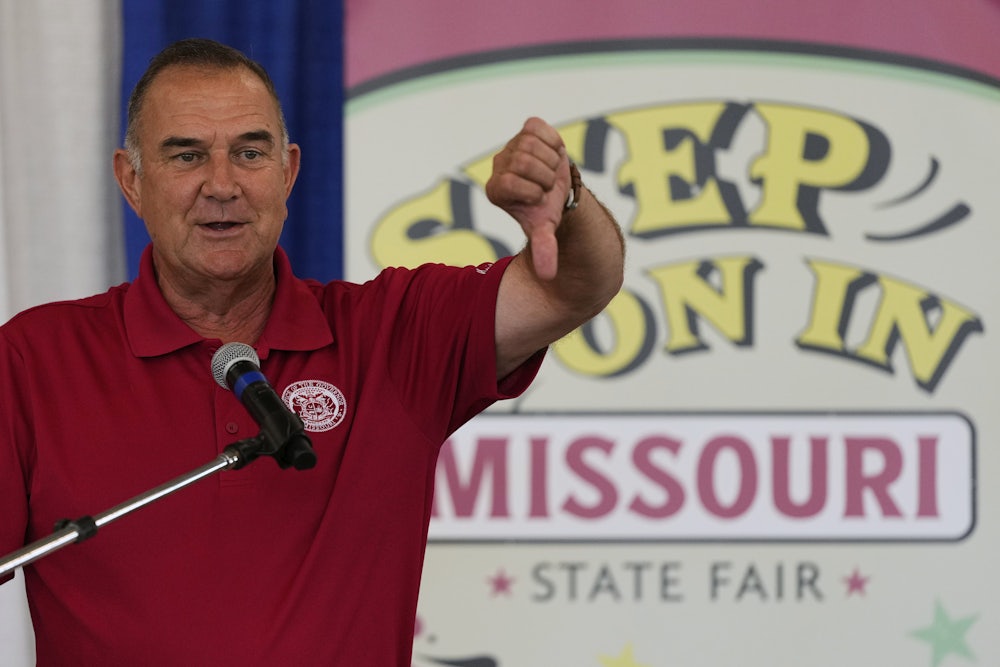
Missouri Gov. Mike Kehoe
ASSOCIATED PRESS
Missouri Governor Mike Kehoe

Last November, Missouri voters approved a ballot measure guaranteeing paid sick leave to workers in the state and raising the minimum wage, which will reach $15 an hour in 2026. It passed by a solid 58 percent.

But last month the Missouri legislature, where Republicans have a supermajority in both chambers, overturned the paid sick leave part of the law, as well as a provision that would have continued to automatically increase the minimum wage in the future. “Today, we are protecting the people who make Missouri work—families, job creators, and small business owners—by cutting taxes, rolling back overreach, and eliminating costly mandates,” Republican Governor Mike Kehoe said in a statement. That’s disingenuous, to say the least. They simply disagreed with the majority of voters—and were under pressure from industry groups like the Missouri Chamber of Commerce and Industry that called the law a “job killer.”

Completely overturning a ballot measure passed by a substantial margin is fairly new and bold, but it’s part of a more recent trend in red states to undermine the will of voters who have passed progressive initiatives at the polls. Increasingly, these approved initiatives are being challenged and weakened by their state legislatures, which may blunt ballot initiatives in general as a progressive policy tool. What happened in Missouri also illustrates the unusual nature of our current state of politics: We’re in the midst of a huge disconnect between what voters want and who they’re voting for to get it. Ballot initiatives make voters feel like they can have it all, choosing policies they like à la carte while voting for candidates based on completely unrelated criteria. It lets legislators off the hook while giving voters a false sense of control. But what’s happening to ballot initiatives in Missouri and other states could be a wake-up call for voters about how they choose candidates.

Twenty-six states allow some kind of ballot referendum process, usually either to amend the state’s constitution or pass new laws, or both. In the recent past, conservative ballot initiatives, like the same-sex marriage ban that passed in California in 2008 (and was overturned by the courts in 2013), were used to drive Republican turnout in an otherwise blue state and try to sway the presidential election. More recently, organizers have focused on passing popular progressive initiatives that legislatures were reluctant to take up, like increasing minimum wages, medical and recreational marijuana legalization, and expanding Medicaid. Many of these measures have proven popular even in majority-Republican states like Arkansas, Florida, Missouri, and Ohio. Last year, Nebraska and Alaska joined Missouri in passing referenda on paid sick leave and the minimum wage.

After the success of those initiatives, states with Republican legislatures hostile to those changes have been trying to find ways to undermine direct democracy. Most often, they pare back statutes so that the laws are less powerful than voters perhaps intended, as Florida has done with felon enfranchisement and gerrymandering initiatives, and Nebraska did with its own paid sick leave law. Other times, states try to revamp the ballot referendum process to make it more difficult to get through. The Arkansas legislature has tried in the past to require a supermajority of 60 percent to pass initiatives, and this year groups in the state are working to enshrine direct democracy rights into the state constitution to prevent more of these efforts. Florida voters passed a ballot initiative requiring a supermajority of 60 percent to amend the constitution in 2006, making a lot of popular changes harder to enact. (Notably, this initiative got 58 percent and wouldn’t have passed under the new rules.)

“We’re in a phase of pushback against the process right now, because the policies have been responding to one direction that the state legislatures have been going for about 15 years, which is in a more conservative direction,” said Craig Burnett, the chair of Political Science at Florida Atlantic University. Responding to the moment may limit conservative lawmakers’ tools in the future, though. “That does swing. You may think this is a good idea today, but you know, tomorrow it may work against you.”

Constitutional amendments are more resilient than new laws passed by referenda because state legislatures can’t tinker with them, and they’ve recently become a battleground over state-level abortion rights. When states try to implement voter-passed statutes, though, the legislatures generally have some authority to decide how they should be implemented, but it’s not always clear what the limits are. Efforts by Republicans to change a referendum that passed in Michigan raising the minimum wage, eliminating the tipped minimum wage, and requiring paid sick leave were overturned by the state’s Supreme Court, and there are questions about how some of those laws will be implemented.

This isn’t always nefarious. Deciding how to implement laws is the job of the legislature, and voters are essentially hiring legislators to do that job for them when they elect candidates. In some cases, asking voters to consider too many referenda, or overly complicated ones, could be seen as shirking their responsibility. In California, for example, voters are asked to weigh in on dozens of initiatives, some of them redundant and counterproductive. Many of these are complicated questions that are better left to legislators.

There’s also a lot of evidence voters don’t always know about the initiatives before they vote on them. That doesn’t mean they don’t realize what they’re voting for—protections like paid sick leave and even longer-term family leave are extremely popular, for example—but they’re not always researching how their elected officials feel about them or what the policies are in their states before Election Day. Practically, that means they might be casting votes in favor of measures while also voting for candidates who wouldn’t support them.

Initiatives also require organized campaigns to collect the signatures and other qualifiers necessary to make it to the ballot, which means the process can be hijacked by millionaires and billionaires who back those campaigns. State officials and campaigns also often wrangle over the language used on the ballot itself, leading to court fights and sometimes to language that is unnecessarily confusing. That can overwhelm voters, turning what is supposed to be direct democracy into another area of politics where big money can distort the process.

Outright repealing popular provisions, however, is new. “Missouri is very pro economic policy, and to see that, it definitely shows that there’s like a new resolve from Republicans to really dismiss the will of the voters and really not care about who they represent,” said Caitlyn Adams, executive director at Missouri Jobs With Justice, which supported the initiative. She said there were some districts where the initiative passed with more votes than the Republican candidates in those districts who later voted to overturn it had. The initiative also had support from small businesses in the state, but the state’s Chamber of Commerce lobbied against it anyway, she said.

Still, ballot initiatives give voters only limited power. Voters approve initiatives they support, but that doesn’t always mean they care enough about the issue they voted for—like paid sick leave—to later vote against a politician who helped to overturn it. Typically, voters have felt more strongly motivated by culture-war issues like abortion than by things like minimum wage laws. Missouri Jobs With Justice is in the early stages of trying to get a constitutional amendment guaranteeing paid sick leave, which would not be vulnerable to legislative tinkering, on the ballot next year. “Ballot initiatives were never a silver bullet,” Adams said. Referencing the Republicans who overturned paid leave, she added, “I think we are going to be spending time telling voters who did this to them; making sure they know who took this away.”

Voters will be impacted by the repeal in varying ways, of course. Many workers already have sick days and paid family leave available from their employers, and since the law had kicked in and some workers were already accruing sick days before its repeal, some businesses may decide to keep the benefits in place. It’s the lowest-paid, most vulnerable workers in the economy who are the least likely to have sick leave and are probably the most vulnerable without laws to enforce. And since the repeal also scrapped a provision that would have protected Missouri workers who actually used their sick leave from being retaliated against, the most vulnerable workers might be unable to actually use any leave they technically have.

We are in the middle of a huge partisan reshuffling. In the past three election cycles, non–college educated voters have shifted to the Republican Party, while the Democratic base, once full of blue-collar and union rank-and-file workers, is now full of college-educated, relatively well-paid white-collar workers. These are workers who already have access to benefits through work, but they are voting for the party with a platform that supports increasing the same benefits for others. At the same time, Republicans seem to have successfully painted Democrats as elite and culturally remote, even while they’re the ones passing tax cuts for the wealthy and generally catering to the whims of business interest groups.

It means that the values that drive people to vote aren’t neatly aligned with personal economic interests—though the degree of this disconnect is still in flux. “We’re not going to be marching to one side of the spectrum and staying there,” Burnett said. “It’s probably more likely to be how it’s been for the last hundreds of years in American politics, which is, we kind of go back and forth, but there is a reasonable expectation that we are going to reshuffle people.” We just don’t know what issue will be the big one that will make that reshuffling settle down a bit, at least until the next major issue upends politics again.

This is the big question hanging over the Democratic Party. For now, however, it’s clear that many of the people who benefited from Biden’s populist economic agenda had no hesitation in voting against him. Adams said future campaigns will also focus on educating voters on candidates who support the initiatives and those who don’t. “We do have to be able to do multiple things at the same time—pass really great statewide policies, and create consequences for elected officials who go against the will of the voters,” Adams said.

But given the Republican assault on ballot initiatives, perhaps it’s also time to educate voters on the problem with depending on these initiatives in the first place. Voters need to decide what policies they want from their political parties—and actually demand them, by choosing candidates accordingly. That remains the surest path to change in this rickety democracy.

ACLU, other groups sue to block Texas’ DEI ban on K-12 public schools

ACLU, other groups sue to block Texas’ DEI ban on K-12 public schools

The suit alleges the new state law unconstitutionally silences the viewpoints of students and teachers. The law’s supporters say DEI programs use public funds to promote political agendas.
The ACLU and a group of LGBTQ+ and student rights organizations are suing Texas to block the state's ban on diversity, equity and inclusion initiatives in K-12 public schools.The ACLU and a group of LGBTQ+ and student rights organizations are suing Texas to block the state’s ban on diversity, equity and inclusion initiatives in K-12 public schools. Ilana Panich-Linsman for The Texas Tribune
The American Civil Liberties Union of Texas and a group of LGBTQ+ and student rights organizations are suing to block a new state law that would ban diversity, equity and inclusion initiatives in K-12 public schools.
In a lawsuit filed last month in federal court, attorneys from the ACLU of Texas and Transgender Law Center argued that Senate Bill 12 violates the First and Fourteenth Amendments as well as the Equal Access Act. Gov. Greg Abbott signed the legislation last June, and it will go into effect Sept. 1 alongside an array of other transformative laws for public education in Texas.

“Senate Bill 12 is a blatant attempt to erase students’ identities and silence the stories that make Texas strong,” said Brian Klosterboer, senior staff attorney at the ACLU of Texas. “Every student — no matter their race, gender, or background — deserves to feel seen, safe, and supported in school.”

Supporters of SB 12 say DEI programs use class time and public funds to promote political agendas, while opponents believe banning those initiatives will disproportionately harm marginalized students by removing spaces where they can find support.

Here’s what you need to know about the effort to block the law.

What the ban would do: Authored by Sen. Brandon Creighton, R-Conroe, SB 12 prohibits public school districts from considering race, ethnicity, gender identity or sexual orientation in hiring decisions. The ban also bars schools from offering DEI training and programs, such as policies designed to reduce discrimination based on race or gender identity, except for when required by federal law.

The law requires families to give written permission before their children can join any school club, and prohibits school groups created to support LGBTQIA+ students. Parents will be able to file complaints if they believe their schools are not complying with the DEI ban, and the law requires school districts to discipline employees who knowingly take part in DEI-related activities.

Rep. Jeff Leach, R-Allen, said SB 12 builds on a 2021 state law barring public schools from teaching critical race theory, an academic discipline that explores how race and racism have influenced the country’s legal and institutional systems. While critical race theory is not taught in Texas public schools, the term has become a shorthand used by conservatives who believe the way some schools teach children about race is politically biased.

DEI advocates say initiatives that promote diversity provide support for marginalized communities in workforce development and higher education, while critics say DEI practices give preference to people based on their race and ethnicity rather than on merit.

What the lawsuit says: Attorneys from the ACLU and the Transgender Law Center are suing Texas Education Agency Commissioner Mike Morath and three school districts on behalf of a teacher, a student and her parent. They’re also representing the Genders & Sexualities Alliance Network and Students Engaged in Advancing Texas, two organizations that say they would be harmed by the ban. The ACLU amended the complaint in September, adding as plaintiffs the Texas American Federation of Teachers, another student and his parent.

The suit calls SB 12 an “overzealous” attempt to ban DEI in public schools and argues that it censors constitutionally protected speech and restricts students’ freedom of association. It’s also vague and overly broad, the suit says.

“S.B. 12 seeks to erase students’ identities and make it impossible for teachers, parents, and volunteers to tell the truth about the history and diversity of our state,” said Cameron Samuels, executive director at Students Engaged in Advancing Texas. “The law also guts vital support systems for Black, Brown, Indigenous, Asian, and LGBTQIA+ students and educators.”

As part of the lawsuit, the Genders & Sexualities Alliance Network claims SB 12 singles out the organization by explicitly restricting student clubs based on “sexual orientation or gender identity,” language the group uses to describe the student organizations it sponsors at schools. That restriction harms the freedom of speech of the group and its members, the suit says. The Genders & Sexualities Alliance Network has chapters in Texas at more than a dozen school districts, according to the filing.

Lawsuits against similar laws have had mixed results in the past.

Because of SB 12’s ban on discussions of sexual orientation and gender identity in classrooms, opponents have compared it to Florida’s “don’t say gay” law, which attracted widespread media attention in 2022 due to its far-reaching impacts in public schools. Civil rights lawyers sued to block it, saying the law violated free speech and the Fourteenth Amendment’s equal protection clause. But a federal judge dismissed the case and said the plaintiffs had no legal standing and had failed to prove harm from the law. The attorneys ultimately agreed to a settlement with Florida education officials that clarified the law to allow discussions of sexual orientation and gender identity in classrooms only if it’s not part of instruction.

The Texas Education Agency did not immediately respond to a request for comment.

The broader push against DEI: The DEI ban on K-12 schools comes two years after the Texas Legislature passed a similar ban for the state’s higher education institutionsSenate Bill 17 requires public universities to close their diversity offices, ban DEI training and restrict hiring departments from asking for diversity statements, or essays in which a job candidate expresses their commitment to promoting diversity in the workplace.

Creighton, who also authored that bill, has warned higher education leaders that they could lose millions of dollars in state funding if they fail to comply with the law. Earlier this year, Abbott threatened Texas A&M University President Mark Welsh III’s job after claims spread online that Texas A&M was sending students and staffers to a conference that limited participation to people who are Black, Hispanic or Native American.

At the national level, President Donald Trump has ordered all federal agencies to end “equity-related” practices and asked contractors to certify they do not promote DEI efforts. Trump also told schools and universities they would lose federal money if they do not eliminate diversity practices.

Over the last five years, Texas and other Republican-led states have also taken other steps to abolish and ban DEI efforts in public education and the workforce. Similar to Trump, Abbott issued an executive order in January mandating that Texas agencies end all forms of DEI practices.

“We must always reject race-based favoritism or discrimination and allow people to advance based on talent and merit,” Abbott said.

Disclosure: ACLU Texas and Texas A&M University have been financial supporters of The Texas Tribune, a nonprofit, nonpartisan news organization that is funded in part by donations from members, foundations and corporate sponsors. Financial supporters play no role in the Tribune’s journalism. Find a complete list of them here.

In Authoritarianism, Dictators Come for LGBTQ People First. Here’s Why

https://www.unclosetedmedia.com/p/the-latest-attacks-on-queer-rights

Digby clips from The Majority Report

Mike Johnson loses control over the House.


New headlines. It feels so good to be caught up.

tRump’s ego / tRump con artist / tRump steals from the taxpayers

WH Insisted FIFA “Peace Prize” Be As Big As World Cup


Trump: I’ll Give Myself $1B In My Lawsuit Against DOJ


Trump Boasts That He Can Identify A Giraffe [VIDEO]


WH Pitches Glitzy $112B Resorts On Gaza’s Rubble


Horrible people doing horrible things / Elections 

Bannon Gets Turning Point Crowd To Boo Rob Reiner


Stefanik Quit Race After Trump Withheld Endorsement


GOP Bill Would Authorize Pirates To Attack Drug Boats


Racism / Hate / DEI / Bigotry

Ramaswamy To Turning Point: Stop Being So Racist


State Dept Nominee Has Past Of Antisemitic Writings, Praise For Rioters, Call To Execute Teachers Union Chief

He has additionally espoused a view of the United States as a white, Christian nation, claiming that white people are undergoing a “cultural genocide” and deliberate replacement. 

Multiple Trump nominees have had histories of racist, violent, white supremacist, and even pro-Nazi tweets. But almost all of them still end up being confirmed by Senate Republicans.


Bessent Spits In Own Food And Storms Out Of DC Restaurant After Confrontation By CODEPINK Activist


The Ukrainian war 

Orban: “It’s Not Clear” Who Started Russia/Ukraine War


Epstein files / protecting tRump

At Least 550 Epstein Pages Are Entirely Blacked Out


Massie Blasts DOJ’s Partial Epstein Release As Illegal


DOJ Deletes Epstein Doc Containing Trump Photos

NPR identified more than a dozen files released by the DOJ on Friday that are no longer available Saturday afternoon, including one that shows President Trump’s photo on a desk among several other photographs. The removed files also show various works of art, including those containing nudity.


Health / US healthcare system

NYC Hit Hardest In Spreading “Super Flu” Outbreak

Trump: Lowering Drug Costs 800% Will Win Midterms

“Prices will be dropping by 300, 400, 500, 600, 700, and even 800%!


At USF Tampa, Christian supremacists mock, spit, and wave bacon at praying Muslim students

At USF Tampa, Christian supremacists mock, spit, and wave bacon at praying Muslim students


University of South Florida, TampaUSF logo. By Seán Kinane/WMNF News (Aug. 2015).

In Florida, maliciously disturbing a religious gathering is a first-degree misdemeanor, or a third-degree felony with hate crime enhancement.

by Valerie Smith – Creative Loafing; shared as part of the Tampa Bay Journalism Project

Composite image of three vertical panels: (Left) A man in a cap looking up in profile; (Center) A man with a beard wearing a white robe and turban, with the text "12th IMAM SAYS JESUS IS GOD" in large blue letters; (Right) A young man in a light blue shirt smiling over his shoulder.(L-R) Richard Penkoski, Christopher Svochak, and Ricardo.Credit: Screengrab via Warriors for Christ / YouTube

A video posted to Instagram by the University of South Florida’s Muslim Student Association (MSA) shows three men interrupting students during their morning prayer, spitting and yelling at them, and waving strips of bacon at them. USF said that their police department is currently gathering evidence and anticipates asking the state attorney to bring criminal charges.

Last Tuesday morning, Nov. 18, several MSA members gathered on top of a parking garage on USF’s Tampa campus for Fajr, Islam’s morning prayer. A livestream by Warriors for Christ—an organization recognized by the SPLC as a hate group—shows Muslim students kneeling in prayer as one of the men, identified in the video only as Ricardo, approaches with a painted cardboard box that reads “KAABA 2.0 JESUS IS LORD.” The Kaaba is a stone building at the center of the holiest site in Islam. While praying, Muslims face the geographical direction of the Kaaba.

The man sets up the box in front of the crowd while two other men, identifiable via their social medias (where they posted the video along with many other similar videos at other locations) as Richard Penkoski of Oklahoma and Christopher Svochak of Illinois, start to “insult” the Muslim prophet, Muhammad, in obscene and sexual ways. One of the men calls them all terrorists. “Go back to Mecca,” he shouts.

At one point, Penkoski brings out a small Wawa container with bacon in it and waves it around while snacking from it.

“We do care about you, so we brought you some bacon,” Penkoski says. “It’s really good. Bacon? Bacon? Anybody?”

Like all pork products, bacon is considered haram, meaning Islam’s rules forbid eating it. All of the students remain kneeling and continue on with their prayer.

“I spit on the grave of Muhammad,” the man identified as Ricardo says before spitting on the ground within a few feet of the students, who are still praying on the ground.

“Take that towel off of your head,” he says, pointing to a woman in the back wearing a religious head covering. At this point, after several minutes of the men shouting at the largely silent students, Ricardo lunges towards a student and points his finger in his face, prompting the student to briefly grab his wrist. Immediately, all three Christian men say this is evidence that Islam is a violent religion.

“This is not how you preach,” one of the students can be heard saying. “Brother, you’re harassing us,” he says to Penkoski.

“You’re not my brother,” Penkoski responds. “This isn’t harassment; this is free speech. But thank you for doing what you did to give us more ammo to prove you’re a bunch of violent psychopaths.”

The video continues like this until the students leave and the Christian content creators do the same. “That was awesome. That was fun,” one of the men can be heard saying as they walk away.

“By the way, don’t ever spit on the ground. It’s actually illegal,” one of the Christians says to the man identified as Ricardo. “What? Spitting on the ground?” “Yes, it’s illegal.” “Well, uh, I didn’t know that.”

Penkoski later posted a screenshot from the MSA group chat, in which one member gives an update on legal proceedings with the state attorney’s office.

“It’s not a hate crime,” Penkoski writes in the caption. “For a ‘hate crime’ to exist, there has to be an actual crime first.”

  • Florida Statute 871.01, which makes disrupting religious assembly a crime, reads: “Whoever willfully and maliciously interrupts or disturbs any school or any assembly of people met for the worship of God, … commits a misdemeanor of the first degree.” In Florida, a first-degree misdemeanor is punishable by up to a $1,000 fine and one year in prison.
  • Florida Statute 775.085 contains rules for hate crime enhancement when there is evidenced prejudice against “race, color, ancestry, ethnicity, religion, sexual orientation, national origin, homeless status, or advanced age of the victim.” This bumps first-degree misdemeanors up to third-degree felonies. Third-degree felonies are punishable by up to $5,000 in fines and five years in prison.
  • Florida Statute 784.0493 deals with harassment based on religious or ethnic heritage. It makes it illegal (first-degree misdemeanor) to “willfully and maliciously harass or intimidate another person based on the person’s wearing or displaying of any indicia relating to any religious or ethnic heritage.”

The man, identified as Ricardo repeatedly told two women with religious head coverings to “get that towel off your head,” and called one a “wicked woman” and a “Jezebel dog.”

As the men left the parking garage, Svochak spoke to the camera, saying Jesus helped him and Penkoski beat drug addiction.

“What did he save you from?” Penkoski asks Ricardo. “I used to be a heathen,” Ricardo replies.

The state attorney typically decides what initial charges to bring. The 13th Circuit State Attorney’s Office has plans to speak with Creative Loafing Tampa Bay this morning, but as a policy it waits to start a case until police send investigative information along.

statement issued by USF says that campus police are still trying to identify the men in the video. USF also said that it has reached out to the affected students, and will issue trespass warnings to the men who interrupted the prayer. They anticipate referring the perpetrators to the state attorney for criminal charges.

This wouldn’t be the first time Penkoski found himself in court over a stunt. The Christian content creator takes videos of himself and others “street preaching,” often insulting and demeaning nearby targets. Penkoski uploads the videos to his social media accounts and makes other targeted posts and includes a donation link through a Venmo account under his wife’s name.

In 2022, Penkoski was accused of targeting two leaders of Oklahoma for Equality, who later filed for a protective order against him. They were granted the protective order, but it was overturned on appeal by the Oklahoma Supreme Court in a 5-4 decision, since Penkoski was targeting organizations rather than individuals.

Penkoski has also been the plaintiff in several legal battles, including an attempt to overturn federal marriage equality for gay couples, a suit against the mayor of Washington D.C. for allowing a “Black Lives Matter” mural, and a lawsuit against a school district that sent his daughter home for wearing a shirt that said “homosexuality is a sin.”

CAIR Florida has called for a hate crime probe for this and another similar incident that took place in Florida. 

Svochak gave this reporter a statement about his religious beliefs over Instagram DM, but would not answer specific questions. Svochak, who is affiliated with the recognized hate group Warriors for Christ, said that he is trying to spread Jesus’ message of love.