With the SCOTUS overturning the usefulness of the voting rights act to protect minority voters and the push by Project 2025 to make the US an apartheid nation of white male dominated society non-whites across the entire US are suffering. Ice is targeting even citizens who are nonwhite. The white supremacists are so worried that they won’t be a powerful majority in the near future that they are doing everything possible to cement the dominance of the white people, specifically white males. It is like these white men are afraid that women and non-white people will treat them the way the white supremacists treat minorities now. Hugs
The change didn’t happen overnight in one historic Southern town, but it felt like it. It started with fewer farm engines turning over at dawn and a sudden, sharp decline in local Black farmers’ payrolls in Mound Bayou, Mississippi, as white men with thick accents were tapped to work the local fields, earning significantly higher wages than the residents they replaced.
In Mound Bayou—about two hours north of Jackson—the town’s soil carries a historic weight that few other places in America can claim. Founded in 1887 by former slaves and dubbed the “Jewel of the Delta,” the largest segregated African American town was a safe haven during the Jim Crow era where residents not only enjoyed independence, they governed themselves.
The town boasted thriving Black-owned businesses, the Taborian Hospital and the Bank of Mound Bayou, the only surviving historic commercial building in the Mississippi Delta.
Then came the newcomers. Under the federal H-2A via program, foreigners are supposed to be a last resort meant to fill seasonal gaps in the American workforce when domestic workers are unavailable. But in Mound Bayou, residents say the last resort has become the first choice. The previous decade relied on a steady stream of Mexican labor, that is until the Trump administration cracked down on immigration.
Between 2024-2025, some 25,000 South Africans have come to work on American farms alone, according to The Clarion-Ledger. Agricultural firms claim a labor shortage justifies the shift, yet for the Black families who have lived and worked the land for centuries, the math doesn’t add up.
Mound Bayou, Mississippi Rogers Morris, far right, grows sweet potatoes, soybeans and vegetables on about 500 acres in Mound Bayou. He hires workers (left to rt) Dora Roberson, Brenda Seals and Charles Montgomery. Small black farms struggle as major portions of federal crop subsidies are given to large industrialized farms. Agricultural towns like Shelby and Mound Bayou suffer from poverty, crime and high unemployment. (Photo by Carol Guzy/The The Washington Post via Getty Images)
Locals condemn the sudden pivot to white South African crews as blatant discrimination and intentional displacement. Some residents allege they have had to train their foreign replacements before being fired.
“I see it around here, I see these guys when I go to Walmart. They are usually wearing short pants and they speak in Afrikaans to each other. It doesn’t make sense to me economically,” Herman Johnson Jr., director of the Mound Bayou Museum of African American Culture and History said, The Clarion-Ledger reported.
He continued: “If you bring people in from another country to work on your farm and you’re paying them more, that means you have more going out from your pocket to them. A lot of things in a racial perspective that white supremacy does doesn’t make economic sense.”
Now, unemployment among Mound Bayou’s residents continues to soar, according to The Clarion-Ledger. While the H-2A program requires employers to prove they cannot find local workers before hiring internationally, critics allege misuse of this system—and they’re taking their complaints to court.
Five Black U.S. farmworkers from Mississippi sued Gregory Carr for allegedly discriminating against them in favor of white foreign workers and costing them thousands of dollars in unpaid wages, the Mississippi Center for Justice (MCJ) announced last May. In the federal lawsuit, they alleged Black farmhands were paid $10 while white South Africans earned more for the same work.
“The intentional underpayment and misclassification of Black farmworkers in favor of white foreign labor not only violates federal law but has become increasingly common in the Mississippi Delta, holding our communities back for generations and perpetuating the historical exploitation faced by Black agricultural workers in our community,” Kimberly Jones Merchant, President and CEO of the Mississippi Center for Justice, said.
The May 2025 lawsuit is the ninth case filed by the Southern Migrant Legal Services (SMLS) and the MCJ challenging alleged discriminatory practices of farmers in Mississippi. The MCJ said previous cases were settled with significant wage recoveries for local workers.
Mound Bayou, Mississippi Rogers Morris grows sweet potatoes, soybeans and vegetables on about 500 acres in Mound Bayou. Small black farms struggle as major portions of federal crop subsidies are given to large industrialized farms. Agricultural towns like Shelby and Mound Bayou suffer from poverty, crime and high unemployment. (Photo by Carol Guzy/The The Washington Post via Getty Images)
“This case shows how the H-2A program can be manipulated to exclude and underpay Black American workers,” said Marion Delaney of SMLS. “Federal protections are only meaningful if we enforce them– and that’s exactly what our clients are demanding through this lawsuit.”
This guest is an immigration attorney with expertise in ICE tactics and in ICE detention. She dispels the misunderstanding and the myths created by the tRump administartion. These detentions are civil detentions not criminal and entering the country with out inspection is a class B misdemeanor. Another thing she mentions is the ever-increasing costs for detention which is currently $200 a day per detainee and there are over 70 thousand detainees. She gives a lot of other useful to know information including the brutality in the detention centers. For example they are taking detainees out in the Everglades and forcing them to stand with hands shackled in the hot sun being eaten by misketoes and bugs. They are putting people in “hot boxes” and leaving them there in the hot Florida sun with no water or medical treatment when they are let out. She describes many more examples. Hugs
Katie Blankenship, an immigration attorney from Sanctuary of the South, a grassroots legal services organization that provides critical, affordable legal defense to immigrant families affected by detention, deportation, and abuse, joins Sam to discuss abuses at the Alligator Alcatraz ICE detention center in Florida. To find resources or ways to help those targeted by ICE in your area you can visit Freedom for immigrants, American Immigration Council or visit the ACLU to find your local affiliate.
Sam and Emma discuss Lindsey Graham and other republicans push to have the taxpayers pay for tRump’s vainity project ballroom. They play clips of tRump talking about how grand the ballroom is, how it is something that the public has demanded for over 150 years, and how originally Trump was saying it wouldn’t cost the tax payer anything. Remember this remaking of the White House into the president’s private Mar-a-Largo club will be only for the most wealthy privileged oligarchs and not for the use of the public in any way. Hugs
This is an important clip that exposes the fallacies that Maher and the right push about trans people and the democrats supporting the LGBTQ+ and progressive causes such as equality of religions and government working for the people. Maher tried to push the idea that kids become trans only due to being pushed into it by adults, but when corrected with facts and examples he has no retort except to make more debunked claims. The idea that simply buying a child the clothing they want is somehow making them transition. Every study indicates that cultural issues that republicans try to use against democrats make no difference to how people vote. Only die hard haters who were already going to vote republican care about the woke cultural issues supported by progressives. Yet many Democratic candidates run from even tepid support for protecting minorities due to the made up idea of courting the center that doesn’t exist in any large size now. People leaning right are not going to vote democrat who is republican lite when they can have the real full republican but any votes that are gathered by turning on the LGBTQ+ / Trans / minority communities are countered by the loss in left / progessive votes. Maher talks about how girls who were tomboys in the past would be “forced” today to become trans. Emma talks about how she was a tomgirl who wanted to wear boys clothing and was allowed to do so but no one tried to suggest she needed to change her gender. He mistakes allowing a kid to express themselves is some how forcing them to be trans. I love how completely supportive of trans people / trans children and up on the facts / reality the people on the show are. Hugs
*** Personal note*** I ran out of steam early yesterday. I only went back to bed for an hour in the morning, but by 3:30 pm, between the pain and being so tired I went to bed before 4 pm. I got up about 5:30 am. Hugs
Russia began the campaign against LGBTQ+ people by first targeting trans people as a threat to children. Then once the people got used to that line they claimed that any mention of non-cis non-straight way of living was sexualizing kids and so a threat to them. Mentioning or showing a gay person was equated with showing a kid hardcore porn. Fully nude bodies. It worked in their society. That is the play book the right wing haters / Christian nationalists have used against trans people here. How soon until they try to go the entire way to force the entire country / society to be straight and cis and that Christianity be the national religion enforced by white men who force those around them to follow their personal church doctrines. But what these nut jobs really want and understand is removing all mention and signs of being not cis or straight won’t stop LGBTQ+ people from existing. Gay, lesbian, bisexual, questioning / queer / nonbinary, and all others not straight or cis are born to straight cis parents. What these outstanding moral Christians like Congress person Randy Fine from Florida want is that non-straight and non-cis kids be harassed and assaulted like when he was in school making them afraid to come out or be themselves publicly. In other words these haters want the facade of a straight cis country such as when one of the presidents of Iran said they did not have any gay people in his country ignoring a well know community that was there. They want anyone not like them to be afraid to live their lives in case they are discovered. They think that will please their god. The god who they believe created all people also created the LGBTQ+ ones as well. They think that the all knowing god will not know people are faking it due to fear and that they will be rewarded for causing that fear in the LGBTQ+ community. Very Christian of them. Hugs
The designation could mean anybody associated with the group risks years behind bars for supporting an extremist organization — akin to terrorism charges under the nation’s criminal code.
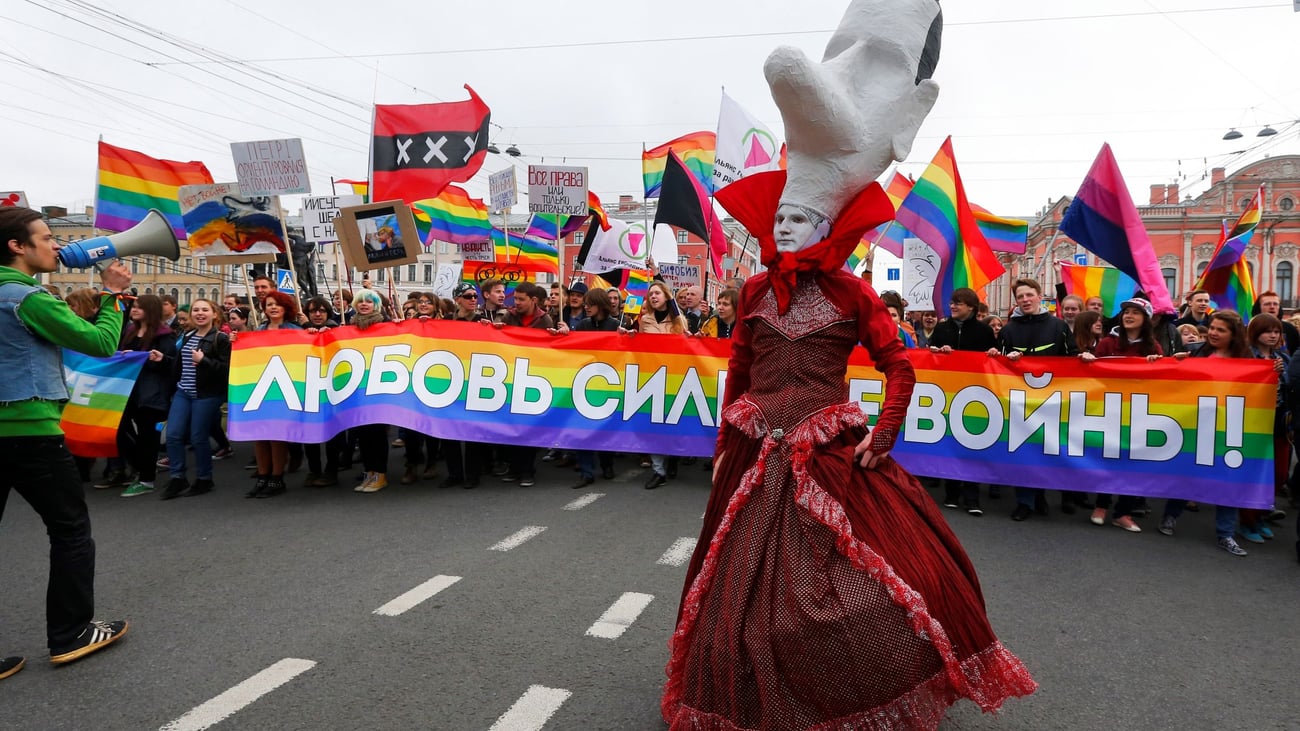
A gay rights activist wearing a headpiece walks ahead of a squad of gay rights activists, during a traditional May Day rally in St.Petersburg, Russia, Thursday, May 1, 2014. The poster reads : ‘Love is stronger than war!’ (AP Photo, File)
A Russian court on Monday labelled the country’s top LGBTQ rights group as “extremist,” effectively outlawing the organization and paving the way to prosecute its supporters.
Russia has for years targeted LGBTQ organizations but has become even more hostile since launching its full-scale assault of Ukraine in 2022, massively accelerating the country’s hardline conservative turn.
On Monday, a court in St. Petersburg ruled in favor of a case brought by the Russian justice ministry to brand the Russian LGBT Network — a top LGBTQ rights nonprofit — “extremist.”
“The public movement has been designated as an extremist organization, and its activities are banned in Russia,” the court’s press service said on Telegram.
The hearing was held behind closed doors.
The designation could mean anybody associated with the group risks years behind bars for supporting an extremist organization — akin to terrorism charges under Russia’s criminal code.
Amnesty International in February slammed the justice ministry’s move to seek the label.
“This move reflects a deliberate strategy by the Kremlin to legitimize and weaponize homophobia in its assault on dissent and equality,” said Marie Struthers, Amnesty International’s Eastern Europe and Central Asia director.
Russian President Vladimir Putin has for years denounced anything that goes against what he calls “traditional family values” as un-Russian and influenced by the West.
In 2023, Russia’s Supreme Court banned what it called the “international social LGBT movement” as an “extremist organisation”.
As part of the crackdown, Russia has in recent years targeted LGBTQ clubs and bars, raiding them and arresting owners.
Courts have also issued fines and short-term jail sentences to people displaying LGBTQ “symbols,” such as clothes, jewelry or posters featuring the rainbow flag.
Political violence is on the rise — making the job more dangerous for state lawmakers and posing new challenges for state law enforcement officials.
Every high-profile act of violence sets off new waves of threats and fears of more — the assassination of conservative activist Charlie Kirk in September sent chills down the spines of elected officials throughout the country. But Utah, where he was killed, was already ahead of the curve on addressing threats to lawmakers and high-profile public officials.
Nine years earlier, it had set up a new unit to track and prevent violence against public officials.
The unit follows a four-step process, said Taylor Keys, a spokesperson for the state Department of Public Safety: It receives and identifies reports of threats and concerning behaviors, gathers the facts, assesses the individual’s risk of posing a real physical threat, and then manages the risk with intervention and case management.
But many states aren’t as proactive and prepared as Utah. Most state legislatures are in session only part-time, and many of the state enforcement agencies charged with protecting them are stretched thin and lack standardized procedures for reporting threats, collecting data and conducting regular training.
A spate of high-profile violent attacks over the past year threw this reality into stark relief.
And for some lawmakers, the environment is becoming untenable: Two recent reports show that harassment, abuse and violence are leading factors driving women and younger legislators, especially, to exit office.
State legislatures shape consequential policy and serve as a critical pipeline for higher office. But serving in office and entering the pipeline to power poses increasingly high risks to personal safety, especially for groups already underrepresented in the halls of power. While being a state lawmaker is a part-time job with a part-time salary in most states, lawmakers can’t opt out of being a full-time public figure.
“Elected and appointed officials live in a risk environment by nature of their job and their outward, public-facing positions,” said former Lt. Col. Tim Cameron of the Wyoming Highway Patrol, who spoke to The 19th in 2025 before he retired from the agency after more than 46 years in law enforcement. “Within the last year and a half to two years, that’s moved into a threat environment.”
The 19th spoke with experts and reached out to state-level law enforcement agencies in all 50 states to capture a comprehensive picture of the scope of political violence against state lawmakers and how law enforcement is responding. Officials in a dozen states told The 19th how they identify and respond to threats, what data they collect, and how they’re adapting their responses and procedures to an ever-evolving landscape.
As political violence is on the rise, many states are scrambling to keep pace. Political violence, Cameron said, was a major topic of discussion at the International Association of Chiefs of Police conference he attended in 2025.
“Anyone charged with executive protection is really looking closely at what they’re doing, how they’re doing it, and looking to utilize technology to leverage that in every way they can,” he said. “So it is going to be a challenge moving forward. And nobody has enough people.”
A February report from the nonprofit organization Future Caucus, based on interviews and surveys with 89 young lawmakers in 31 states, found that threats of violence “have become a serious deterrent to both candidate recruitment and retention,” especially for women, lawmakers of color and LGBTQ+ lawmakers.
“This is a four-alarm fire,” said Layla Zaidane, the president and CEO of Future Caucus, which supports young state lawmakers in bridging divides and working on policy across the political aisle.
“They can stomach the low pay. They can stomach no staff. They can handle even trying to figure out the toxic polarization and transcending that,” Zaidane said of young lawmakers. “But political violence was the thing that, when you add it all together, was the decider of: ‘I don’t know if I’m going to run again, I don’t know if this is worth it.’”
The rise in violent incidents is having an outsized impact on women, who make up half of the United States population but account for only a third of state lawmakers; even fewer women of color are represented in the political arena.
And when it comes to hyperpolarization and the increasingly toxic and hostile climate in state capitols, “women bear the brunt of this, multi-fold, compared to their male peers,” said Aparna Ghosh, the founder and executive director of the Ghosh Innovation Lab, a nonpartisan organization that conducts research and builds tools to support diverse and representative state legislatures.
A report the Ghosh Innovation Lab published last summer, based on 60 interviews and a nationally representative survey of over 300 women legislators, concluded that the assassination of Hortman “exposed a crisis that has been building for years.” Women lawmakers, the report found, “face systematic harassment, threats, and violence that compromise their safety, well-being, and democratic participation.”
The report found that 93 percent of women lawmakers said they experienced some form of harm or abuse in office, 59 percent said it disrupted their legislative duties and 32 percent said it impacted their desire to stay in office.
“It’s not just about an incident, but it’s about the everyday things that add up that push them out of office,” Ghosh said. “This is a huge problem for democracy, because this constant harm that women are facing is eroding the intent to run for office, so it’s eroding democracy in some way.”
(Emily Scherer for The 19th)
In the wake of Hortman’s assassination, several states have weighed legislation that would allow lawmakers to have their home addresses and other identifying information removed from public records. And as federal campaign spending on security expenses has continued to climb into the millions, 25 states now officially or informally authorize state candidates to use campaign funds for personal security, according to an analysis from the nonpartisan Vote Mama Foundation.
The role of law enforcement has also come under scrutiny, with the Ghosh Innovation Lab report concluding that state capitols and law enforcement “systematically fail to protect women legislators.”
The top safety shortcomings identified by women legislators surveyed for the report were a lack of training in handling threats (53 percent), the absence of a panic button for reporting incidents (46 percent) and unclear reporting procedures (42 percent). They also cited inadequate technological solutions, insufficient legal support, buildings feeling overly exposed, too few security officers and poor coordination with law enforcement.
“Whatever training they’re getting is their own responsibility, and that’s part of where the system breaks down,” said Ghosh. “It’s two things: One is that we’re not a proactive system, we react to incidents, that is one huge thing. And the second is it feels like safety and security is a legislator problem, not an institutional problem.”
At the federal level, the U.S. Capitol Police (USCP) protects members of Congress, often in coordination with local law enforcement, and issues regular public assessments indicating that threats against federal lawmakers are on the rise.
But far less is known about the risk environment and security landscape for state lawmakers.
States have widely varying levels of security for their state capitol complexes and different open carry rules. A 2024 review from the Wisconsin Legislative Audit Bureau found that 39 states use metal detectors in their capitol buildings, 31 use X-ray machines to scan packages and belongings and 10 require visitors to have photo identification.
Many states have dedicated capitol police forces, specialized units within state police or highway patrols responsible for protecting lawmakers and executive officials, or both. Local sheriff’s offices and police departments also respond to reports of threats from state lawmakers.
“The big problem is that there’s no standardization in the protocols and processes, and this is the gray zone where the system breaks down,” Ghosh said.
To get a clearer picture of the protection landscape, The 19th asked these questions to state agencies responsible for protecting state lawmakers in all 50 states:
What steps should a lawmaker take if they receive a threat?
What are the agency’s processes for identifying and responding to threats?
Does the agency collect data or produce threat assessments on threats to public officials, including state lawmakers? If not, are there plans to start collecting that data and/or to make it public, as the U.S. Capitol Police does?
Has the agency implemented or plans to implement any additional security measures, safety plans or training for state lawmakers/capitol protectees in the wake of the Hortman and Kirk shootings?
Representatives of law enforcement agencies in 27 states responded to The 19th’s inquiries. Representatives of agencies in four states declined to comment, and 19 did not respond to requests for comment. Of the agencies that responded, many declined to share specific security plans or details but said they were committed to ensuring the security of state elected officials and those working at and visiting state capitol complexes.
The basics are the same: All agencies said lawmakers should immediately report a threat to a state, capitol or local law enforcement agency. But where lawmakers report threats can vary depending on whether the legislature is in session and the nature of the threat: a lawmaker might report a threat to the state capitol police or the highway patrol if the legislature is in session, or to their local police or sheriff’s department if they’re in their home county.
All the law enforcement officials emphasized that keeping evidence of threats is important.
Chris Loftis, a spokesperson for the Washington State Patrol, also said lawmakers should preserve “all evidence, including emails, voicemails, and social media posts” and are “advised not to engage directly with the individual making the threat.”
States use different methods to identify and trace threats. Many said they work with other agencies to monitor, identify and respond to threats. New York State Police spokesman Beau Duffy said the agency has a team of social media analysts who identify threats. Sgt. Ricardo Breceda of the New Mexico State Police said they use a variety of sources, including law enforcement databases.
“Our response depends on the nature and severity of the threat and can range from routine follow-up investigations to the activation of specialized tactical teams if necessary,” Breceda said.
Some officials and courts have found that some harassing and abrasive rhetoric directed at public officials falls under the First Amendment’s free speech protections, a finding that has at times frustrated lawmakers. Zaidane pointed to a 2021 case in which a man charged with making a threat to a Michigan state legislator’s office was acquitted after his lawyer said he was “just blowing off steam.”
“I think, at a minimum, better enforcement of laws and coordination with law enforcement would make lawmakers feel like the system has their back,” Zaidane said. “Like there are still bright lines that we should not cross in America and that we are committed to upholding those.”
Another thing lawmakers want more of, Ghosh said, is data.
For over 20 years, the U.S. Capitol Police has published annual public threat assessments detailing the number of threats they investigate. In new data released in January, the USCP’s Threat Assessment Section reported investigating nearly 15,000 “concerning statements, behaviors, and communications” against lawmakers, their families, staff and the U.S. Capitol complex in 2025, marking the third consecutive year the USCP has investigated more threats.
But most state law enforcement and state capitol security agencies either don’t collect or don’t publish such statistics. Utah is one of just a few states in the country that collects statewide data on threats to state lawmakers and produces assessments. The lack of comprehensive data from official sources makes it difficult to know the scope and scale of political violence against state lawmakers.
“They want that kind of tracking and monitoring system,” Ghosh said of women lawmakers. “They want security briefings annually.”
Some state agencies told The 19th they don’t have a full picture of how threats are reported and investigated across their states because jurisdictions respond differently to threat reports. Several others said they do centrally collect that data but don’t release it for security reasons.
“We collect data, but sometimes we’re not aware of the other complaints that potentially could be made to the sheriff of whatever respective county,” said Cameron of the Wyoming Highway Patrol.
Some state agencies share data with other law enforcement authorities, including through fusion centers.
Ghosh said women lawmakers also want more official safety training from law enforcement — many told her that they spend thousands of dollars out of pocket for self-defense and security training.
“They want systems to back them up and say, ‘We’re going to prepare you for what’s coming,’ even if it doesn’t happen,” Ghosh said.
Many states are working to expand security as well as training for lawmakers in the wake of the Minnesota shooting, though most declined to share specifics.
Cameron said that in Wyoming, the conversation about improving protective operations “never stops.” The state Highway Patrol has a trooper focused on protective intelligence who attended a threat intelligence course at the U.S. Marshals Service headquarters in Crystal City, Virginia, and investigates threats against lawmakers, he said.
“We’re constantly training our people. We recently instituted a special response team, more or less a SWAT unit, but they’re cross-trained to do executive protection,” he added. “Sometimes we’ll activate some of those members, so our [executive protection division] has additional personnel, either for advanced work or on site work or escort work.”
He said he’d like to see more adoption of drones and drone technology, an area where law enforcement in the United States is “behind,” to protect the state capitol and lawmakers.
Ghosh said the women lawmakers she’s spoken to need three things to carry out their work: to feel prepared, protected and nurtured.
“It’s simple things, right?” she said. “Their safety needs to feel well supported and ready to do the work that they’re meant to do. They want these three things, and when it breaks down is when they’re unable to do this work.”