


‘Nobody’s negotiating for the people here’: comedian Charlie Berens takes on AI datacenters
Sun 17 May 2026 07.00 EDT
Last summer, journalist turned comedian Charlie Berens started getting social media messages from concerned Wisconsin residents about plans for a massive datacenter campus in their state.
The developer, Vantage Data Centers, claimed the $8 bn project would largely run on zero-emission energy resources like solar, wind and battery storage. The company said the campus would bring thousands of temporary construction jobs and potentially more than 1,000 permanent jobs to Port Washington, a city of 13,000 people about a half-hour north of Milwaukee. Residents opposed the project for what they said was lack of transparency and criticized the lucrative tax incentives offered to Vantage. They worried about the strain on local water and energy sources from an enormous 1.3-gigawatt project that could ultimately span 1,900 acres.
Berens, who shot to internet fame with his “Manitowoc Minute” videos that play on midwestern quirks and stereotypes, had his own reservations about the artificial intelligence datacenter boom. A Milwaukee-area native who still lives in the city, he’d heard about the potential environmental hazards, the steep rise in energy costs for neighbors and noise pollution, among other risks.
When he Googled, he found that lawmakers in his state had paved the way to make the Port Washington project a reality. The deal between Port Washington and Vantage gave an estimated $458m in tax breaks to the developer over 20 years to fund infrastructure for the project, with the city not seeing any of that tax revenue during that period.
“It was shocking,” Berens said.
That’s when he decided to do something he had rarely done before: discuss politics in his videos. He used his platform to address one of the more polarizing issues in contemporary life: what AI portends for Americans.
In August 2025, Berens published his first “Manitowoc Minute” video on AI datacenters. The two-minute skit matched the typical style of Berens’s videos, where he intersperses facts with humor in the style of a TV news report. But he was remarkably direct in his critique of big tech. Sporting a Green Bay Packers tie, he lambasted Silicon Valley CEOs, accusing them of using Wisconsin as a “dumping ground” for datacenters at the expense of the state’s cherished natural resources while evading any type of public scrutiny.
“It is our civic duty to make sure the billionaires become trillionaires,” said Berens in a satiric bit.
He channelled his outrage at lawmakers in Port Washington, a historic city on the banks of Lake Michigan and once home to thriving fishing and shipping industries. In a contentious vote last August, officials there approved the initial $8bn datacenter campus despite strong resistance from residents. (The project later expanded to a $15bn joint venture with OpenAI and Oracle, one of the Trump administration’s showcase “Stargate” megaprojects.)
“I was shocked at how many people I saw speak against this [at public meetings he watched online] and then to see a unanimous vote for it,” Berens said. “It just felt like an imbalance of democracy.”
The video went viral, garnering more than 2.5m views on YouTube alone. Berens’s inbox was soon flooded with messages of support from Wisconsinites of all political stripes – self-declared Maga supporters, avowed socialists and everyone in between – sounding the alarm on datacenters.
“It was 99% positive comments, which doesn’t happen on anything these days,” said Berens. “From that point, I decided that I should do more because nobody’s negotiating for the people here.”
Berens has since thrown himself into the cause, routinely publishing videos and headlining well-attended events with field experts and anti-datacenter activists. He has quickly become the most famous face of a burgeoning movement in Wisconsin, where resistance to these projects – Port Washington is just one of seven hyperscale datacenter projects across the state – has risen dramatically in the last year. A March survey from Marquette University Law School found that nearly 70% of registered voters in Wisconsin say the costs of large datacenters outweigh the benefits they provide, a remarkable shift from last October when that figure stood at 55%.
The attention has placed the comedian in the crosshairs of most of the state’s labor unions, pro-business groups and much of its political establishment, who argue the badger state cannot afford to be left behind in the AI arms race.
In a series of interviews, Berens laid out why he decided to jump head-first into the movement; his case for how big tech destroyed public trust through hard-armed, often secretive tactics to push forward datacenters; and what he has learned as he has crisscrossed the state and toured the country.
“Every step of the way, the more people look, they’re seeing that this is not really a fair fight here,” said Berens.
On a late winter evening in March, hundreds of people packed a community center in Juneau, a tiny rural town about 45 miles north-east of the state capital, Madison.
The crowd had assembled for a “people’s town hall” to address a $1bn Meta datacenter that has pitted residents of nearby Beaver Dam against their elected officials. The featured speakers ranged from community activists to a former Meta employee. The main act was Berens, who squeezed in the appearance between stops in Iowa and Vermont on his standup comedy tour.
“This is the most bipartisan issue since beer,” he said in opening remarks.

In his roughly 15-minute speech, he called for more regulation of AI, pointing out that a beloved Wisconsin staple, bratwurst, was more heavily regulated than the trillion-dollar industry. Berens warned the audience of the risks of AI technology, running through a slideshow of news headlines that highlighted the potential, and very real, harm to children. He also addressed his critics.
“I will stick to comedy when our politicians stick to policy and stop protecting big tech and start protecting the people that put them into office,” said Berens, to applause.
As he turned his attention to the project in Beaver Dam, he attacked Meta’s use of a shell company and nondisclosure disagreements (NDAs) that required secrecy from some public officials in the process of getting to an approval. In April 2025, a report found Meta was the mystery tech company behind Degas LLC, the listed corporation on the development. By November, the company acknowledged they were behind the project.
Meta’s practices in Beaver Dam are part of a larger pattern across the state, where datacenter projects have often been developed in secrecy despite their huge price tags and massive footprint on communities. A recent investigation from Wisconsin Watch, a non-profit news site, found that NDAs have been signed in at least five cities in Wisconsin where AI datacenters are proposed or under construction.
Another panel speaker that night was Maily Kocinski, a lifelong Beaver Dam resident whose farm lies less than 2 miles from the 700,000 sq ft datacenter campus construction site. Last June, she posted a TikTok video after a creek that runs on her property had gone dry one morning. The water came back, but occasionally appeared milky white and gave off a toxic smell. Kocinski said she contacted the state’s department of natural resources on several occasions and was told the agency collected water samples but were not always able to reach her property in time before the water cleared up again.
She personally commissioned a water analysis in February from a lab at the University of Wisconsin-Stevens Point, which found metal levels in her well water above what was considered safe to drink, per recommendations from the Wisconsin department of health services. She questions whether the daily controlled blasts on the construction site led to disruptions in her water supply. Meta commissioned its own study in response, denying any link.
A spokesperson for the Wisconsin department of natural resources confirmed that the department collected a water sample at Kocinski’s creek last November. The results, shared with the Guardian, show elevated metal levels but the department did not speculate as to the potential cause.
“Without a site specific review, the DNR cannot speculate on the role of the blasting on the aquifer and Ms. Kocinski’s private water supply,” the spokesperson said in a statement.
Kocinski, an elementary school teacher, said since last fall, she has spent up to 15 hours a week researching the large-scale construction of datacenters and the potential environmental harms they can wreak in a community. In March, she testified in the Wisconsin senate in favor of a datacenter oversight bill that ultimately failed to reach a vote.
She said she had never met Berens before the event in Juneau but the two had been in regular contact for months after she cold-emailed him her story.
“Charlie has really put in the work to understand this issue,” said Kocinski. “Most people came to Juneau probably because he was there, but they stayed and maybe learned a bit about these things [datacenters] … That kind of education leads to action.”
As Berens’s critiques of datacenter projects in Wisconsin have gained traction with the public, he has faced pushback from the state’s trade unions, who welcome the thousands of temporary construction jobs that typically come with a project.
A major Wisconsin labor leader called out Berens in a December op-ed in the Milwaukee Journal Sentinel. “For us in the building trades, data centers aren’t some big, scary mystery,” wrote Emily Pritzkow, head of the Wisconsin Building Trades Council that represents nearly 50,000 workers in the state. “They’re high-skill, long-term work. The kind of work that feeds families, pays mortgages, and sends kids to college.”
Local governments have weighed in too. In Port Washington, city officials posted a “fact sheet” online to “clarify some lingering misconceptions” after Berens posted a second video urging residents to question officials about the datacenter project at an October council meeting.
Ted Neitzke, Port Washington’s mayor, expressed frustration with the attention that Berens’s videos had brought his city. He noted that more than 100 people began showing up at council meetings after the comedian published his first video last August, forcing the city to move them to a hotel conference center with an added police presence.
“After Charlie Berens’s video, things escalated very rapidly, very contentiously, and our city was besieged with people from outside of our town,” said Neitzke. “Charlie Berens created chaos for us.”
Neitzke also challenged some claims Berens has made in his videos, including those about the amount of jobs the project would create, its environmental impact and whether residents’ power bills would increase.
“I don’t know where the line gets drawn between factual and embellishment for him,” said Neitzke. “There’s a very gray area between the entertainment and the facts.”
Berens defended his videos and the people who showed up to council meetings in response, noting that a hyperscale datacenter affects not just one city but the surrounding communities and “they deserve a say too”. He maintained that his videos were well-researched and cited news articles to back up his claims.
“I informed people about a massive AI datacenter going up by adding some punchlines,” said Berens. “If the truth brings chaos, that seems like something the mayor would want to take accountability for.”
Neitzke met with Berens last fall in an attempt to find common ground. The mayor described the two-hour meeting as cordial but both left in disagreement. He has been the project’s greatest champion, referring to it as a “transformative” development for the Rust Belt city, one that has the potential to once again make Port Washington a hub in the midwest.
That stance has drawn some fierce public opposition, even leading to an attempted recall effort over the $458m tax incremental finance, or TIF, district with Vantage. Under the deal, Vantage will pay upfront costs for the development and the city will reimburse the company with new property tax revenues over a period up to 20 years. Neitzke said he was no fan of TIFs but called them a “necessary evil” in negotiations to win the contract over other cities chasing major developments to boost revenue.
“This is a save our city strategy,” said Neitzke. “[Berens is] doing what he does, and we’re going to do what we’re doing.”
Berens has also faced criticism online from those who say the comedian has built his career on tech platforms, while looking to close the door to their projects in Wisconsin. He said he “understands the irony” but wants to use his sizable platform to educate his audience on these types of developments that could remake their communities.

Advertisers, too, have noticed his shift to politics. Berens acknowledged that he lost a major brand deal with a company that did not want to appear alongside his anti-datacenter content, though he declined to name the business.
“I’m asking for transparency. I’m asking for honesty. I’m asking for people to get informed,” said Berens. “I’m trying to facilitate that and if that at the end of the day means I lose everything, then so be it.”
Berens was not always an AI pessimist.
A few years ago, he believed the utopian vision laid out by AI luminaries like OpenAI’s Sam Altman, who spoke of how the technology could be used to cure social ills, even to treat intractable diseases. Berens thought maybe it could also help Wisconsin deal with its Pfas contamination issue. “My interest in AI started with a lot of hope and optimism actually,” he said.
That sentiment eventually turned to cynicism as, he claims, the industry’s billionaire CEOs dispelled any virtuous use of the technology for the social good in favor of enriching themselves and their investors. He cited Altman’s recent efforts to create an Erotica feature in OpenAI’s ChatGPT chatbot, despite concerns even from the company’s advisers that such a tool could create a “sexy suicide coach”, according to a Wall Street Journal report.
“I thought this thing was supposed to cure cancer,” Berens said, referencing Altman’s past statements. “Is this what we’re giving our land for? Is that what we’re giving our water for? Is this what you’re asking to change our communities for?”
For him, the “tip of the iceberg” was the gold rush to build hyperscale datacenters in his state through secretive tactics and potentially exploitative agreements in post-industrial cities longing for an economic revival.
“Wisconsin created an environment that would please the billionaire tech companies,” said Berens of the tax incentives. “Billionaire tech companies took full advantage of that.”
Prescott Balch knows a bit about those types of corporate tactics. A former technology executive at US Bank turned anti-datacenter activist in retirement, Balch was on the frontlines of the successful effort to stop a major Microsoft AI datacenter project last fall in the picturesque eastern Wisconsin village of Caledonia, where he lives. In April, he won a seat on the town’s village board, beating an incumbent who supported the datacenter. He views the AI datacenter boom as akin to the dot-com bubble crash of the early 2000s, another chapter in the boom-and-bust cycles of the volatile tech industry.
“We got irrationally exuberant and built too much stuff,” Balch said of the dot-com period. “Maybe the company running your datacenter will go bankrupt. This big dollar amount that you’re chasing comes with significant risk.”
Balch’s insider expertise in the wonky world of municipal subsidies has been fundamental for Berens. Balch factchecked many of Berens’ videos on the issue, even appearing in one where he methodically crunched the numbers on these developments, referring to the Port Washington project as “up and down a horrible deal”.
The 62-year-old is, in many ways, the polar opposite of Berens. He is professorial in demeanor and careful to point out that he is not an AI alarmist. Where the two agree is a belief that there’s been an information vacuum around these projects, leaving the public largely uninformed about their size and scope. That’s part of the message they have taken on the road, appearing together at events in Wisconsin and Illinois. Berens’s celebrity has been the draw for people to turn out.
“[He] gets people interested in the topic and warms them up,” Balch said. “And I get to do the dry delivery of the financial perspective.”
On 7 April, Port Washington residents passed the nation’s first anti-datacenter referendum. By a roughly 2-1 margin, voters approved a measure that would require city officials to get approval from voters before approving tax incremental districts of more than $10m.

The effort came together after a group of residents called Great Lakes Neighbors United gathered more than 1,000 signatures in less than two weeks to get it on the ballot. The referendum does not stop the $15bn datacenter campus under construction, but would apply to all future projects above that $10m threshold. Industry advocates have warned the vote could set a dangerous precedent for municipalities across the country, potentially paralyzing AI datacenter developments.
Mayor Neitzke said the referendum makes the city less competitive and puts it at a disadvantage to vie for future projects. For Berens, the vote reflected the energy he has seen on the ground in Port Washington and in every corner of the state.
“The people who are the heartbeat of this movement are like people in Great Lakes Neighbors United,” said Berens. “These are people from all different walks and all different political stripes, but they all care about the same thing: [that] their community should have a voice.”
© 2026 Guardian News & Media Limited or its affiliated companies. All rights reserved. (dcr)

I can’t get the entire article here; I think I used up all my NYFT freebies for life back in 2004. However, I got a blurb, and because it’s pertinent to our interests, I’m still posting the link for anyone who’d like to see the story. It’s surprising, as is the story after this one.
TOPEKA — A few spaces are exempt from Kansas’ new bathroom law that requires people to use the facilities in government buildings that match their sex assigned at birth, Attorney General Kris Kobach said in an opinion he released Wednesday.
Kobach’s opinion, which carries no legal authority, exempted some government spaces — such as skilled nursing rooms at the Kansas Office of Veterans’ Services — from complying with the bathroom law that went into effect in February.
He issued the opinion in response to an April letter from Justin Whitten, Gov. Laura Kelly’s chief counsel, who asked for clarification on defining “multiple-occupancy private spaces” and “facilities” as written in Senate Bill 244.
“This was a poorly written and ambiguous law, which is why the governor’s office sought an attorney general opinion,” said Olivia Taylor-Puckett, spokeswoman for Kelly. “The AG’s opinion provides new clarity on the more limited scope of SB 244 as inapplicable to places that are more ‘residential in character’ like a cabin or hospital room.”
The bill became law in February after passing through contentious legislative debate, including a veto from Kelly that was overturned. At the time, Kelly questioned vague language in the bill and how it would apply to some state facilities.
The law sets high fines for agencies that fail to comply and smaller fines escalating to class B misdemeanors for those who violate the law. Critics said the law doesn’t specifically address implementation, leaving agencies statewide struggling to determine what to do to comply.
In an April letter, Whitten asked Kobach to render an opinion on whether spaces like hospital rooms, prison cells and bedrooms in public buildings are considered “multiple-occupancy private spaces” under the law.
The letter asked for definition of “facilities,” and whether Kansas Department of Wildlife and Parks cabins throughout the state and Kansas Office of Veterans’ Services nursing facility rooms must adhere to the law.
“SB 244 makes no distinction based on a ‘facility’s’ purpose and instead focuses on the existence of a mere possibility of whether an individual may be in a state of undress in front of another individual,” Whitten’s letter said.
Arguments that the hospital is the “facility” rather than the patient room are “untenable,” he said. The hospital building would fit under the law’s definition of a public building, while the room would be the private space, Whitten said.
“If your answer relies on finding an ambiguity in Senate Bill 244 with the term ‘facilities,’ we ask that you work with the Legislature in the 2027 session to clarify this ambiguity,” he said.
Citing a dictionary definition of “facility” and saying that “in the absence of a contrary definition, words in a statute should be given their ‘ordinary, contemporary, common meaning,’ ” Kobach said neither the skilled nursing rooms or the Kansas Department of Wildlife and Parks rental cabins meet the definition of “facility,” which exempts them from the law.
Kobach said SB 244 listed examples of rooms the bill applies to.
“The debate surrounding SB 244 focused on the types of rooms listed in the statute — restrooms, locker rooms, changing rooms, and shower rooms — and the risks to safety and privacy when individuals of one biological sex use facilities designated for individuals of the opposite biological sex,” his opinion said.
Kobach said the Legislature’s intent didn’t include stopping a married couple from sharing a nursing home or assisted living facility room or to prevent people in those facilities from receiving guests of the opposite sex.
Prison cells, however, more closely match the type of facilities addressed in the law, Kobach said, which means multiple-occupancy cells must only be shared by prisoners of the same sex.
Taylor-Puckett said attorney general opinions are generally given “persuasive but not binding weight in a courtroom.” She recommended that individuals and entities should consult with their attorney with regard to any decisions about complying with SB 244.
Harper Seldin, senior staff attorney for the American Civil Liberties Union, said he was glad to see some spaces exempted from the law but that the opinion reinforced what civil rights activists contended from the beginning: The vagueness of the law makes it difficult to enforce and understand.
“This uncertainty about whether people just living their lives are going to run afoul of this law, I think demonstrates both that the law was meant to terrorize and also that it’s poorly drafted,” he said.
Some Kansans and legislators objected to SB 244 being termed an “anti-trans” bill. But Seldin said the interpretation reinforces that it is a bill targeted at transgender and intersex people.
“These interpretations really continue to try to find ways to push transgender and intersex people out of public life, while making sure that people who aren’t transgender don’t feel any disruption whatsoever,” he said. “It does seem to very strongly suggest that this law was really targeted at transgender people and is not actually responsive to any concerns about safety or privacy.”
Seldin said any concerns about safety and privacy aren’t related to reality in Kansas.
Seldin is representing two Lawrence transgender men who are challenging the bathroom law in court, with the next hearing scheduled for Sept. 29 through Oct. 2. That will be an evidentiary hearing regarding the ACLU’s request for a temporary injunction of the law, Seldin said.












































NGC 1300: Barred Spiral Galaxy
Image Credit: NASAESA, Hubble Heritage
Explanation: Across the center of this spiral galaxy is a bar. And at the center of this bar is smaller spiral. And at the center of that spiral is a supermassive black hole. This all happens in the big, beautiful, barred spiral galaxy cataloged as NGC 1300, a galaxy that lies some 70 million light-years away toward the constellation of the river Eridanus. This Hubble Space Telescope composite view of the gorgeous island universe is one of the most detailed Hubble images ever made of a complete galaxy. NGC 1300 spans over 100,000 light-years and the Hubble image reveals striking details of the galaxy’s dominant central bar and majestic spiral arms. How the giant bar formed, how it remains, and how it affects star formation remains an active topic of research.
Jigsaw Universe: Astronomy Puzzle of the Day
Tomorrow’s picture: spiral unraveling
And any chance I get to listen to any Muse, I’m takin’ it; while I work the puzzle!

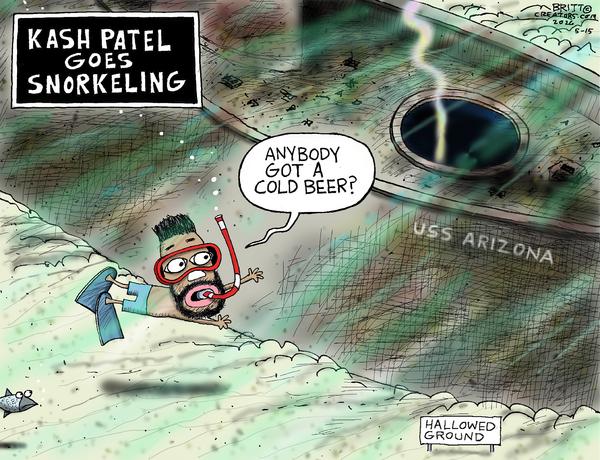
When Kash Patel visited Hawaii last summer, he participated in what government officials described as a “VIP snorkel” around the USS Arizona, the battleship that sits at the bottom of Pearl Harbor as a memorial, in an outing coordinated by the military. The battleship sunk at the battle of Pearl Harbor by the Japanese Empire entombs more than 900 sailors and Marines.
The swim, revealed in government emails obtained by The Associated Press, comes to light amid criticism of Patel’s use of an FBI plane and his global travels, which have blurred professional responsibilities with leisure activities. Patel has chosen to live in Las Vegas for a reason.
When the Patel made the visit to Hawaii, the FBI took pains to note the director was not on vacation, highlighting his walking tour of the bureau’s Honolulu field office and meetings with local law enforcement. But what they left out was the swim. If Kash, who prefers to spell his first name as “Ka$h,” wasn’t doing anything wrong or suspicious, then why did they leave it out?
The USS Arizona is considered one of the most hallowed sites in the United States. With few exceptions, snorkeling and diving are off-limits around the battleship. Marine archaeologists and crews from the National Park Service make occasional dives at the memorial to survey the condition of the wreck. Other dives have been conducted to inter the remains of Arizona survivors who wanted to rest eternally with their former shipmates. (snip-MORE)
A fine tribute by Charlotte Clymer.
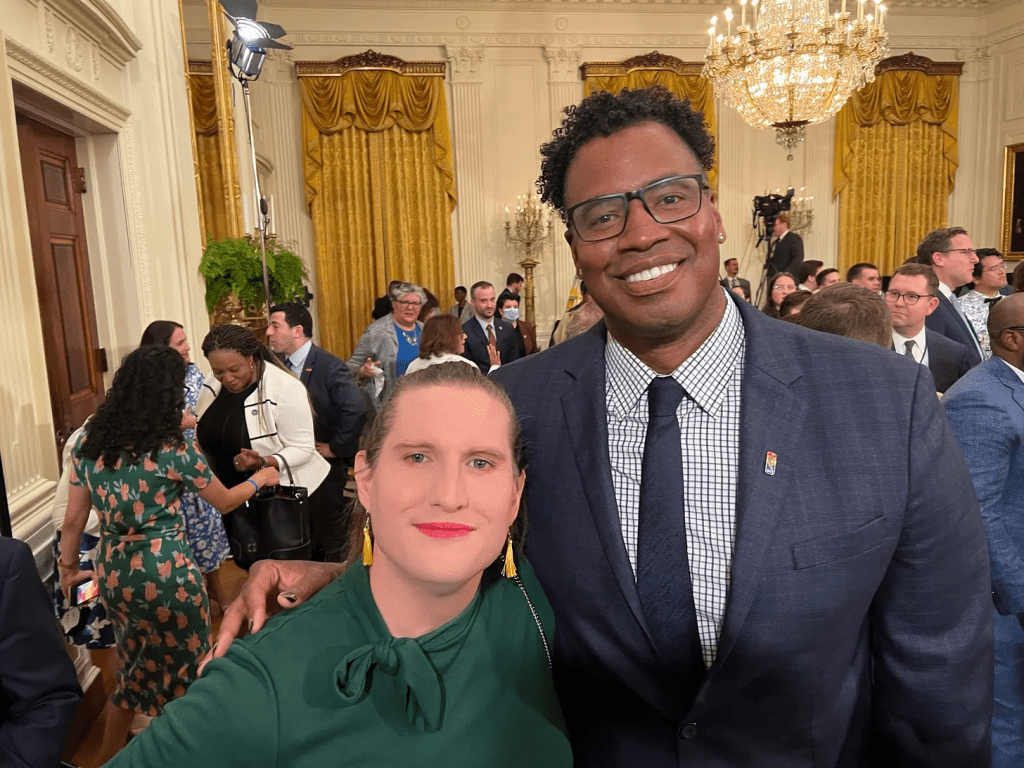
(Mr. Collins and me at the White House in 2022.)
We were eight, nine, ten-years-old, and we called it “Smear the Queer.”
The game went like this: there were a group of kids—nearly always all boys—and a football. The pigskin got tossed up, a boy would grab it, the rest of us would chase and tackle him, and either he would surrender the ball or one of us would take it, and the chasing and tackling would start all over again.
That was the whole game. It was basically freeform rugby with no points, but this was Central Texas in the mid-90s and none of us were aware of rugby, so we thought of it as reverse tag with violence.
We called it “Smear the Queer” because that’s what the older boys called it. They called it that because the boys older than them called it that. Or that’s what their older brothers called it. Or that’s what their fathers and uncles called it.
At that age, I don’t think there was any discussion on the etymology of the word “queer” or why the ball carrier was called “the queer.” That was just the name of the game, and if you had a group of young boys and a football and enough interest, a kid might say “Smear the Queer?” and the game would start.
We were conditioned to think of being gay as a bad thing before we knew what it meant to be gay. By the time we got to middle school, it was made crystal clear to us that there were two things it was absolutely wrong for a boy to be: either gay or a girl.
If another boy called you gay or a girl, it was either because they were being “friendly” (or what passed for “friendly” among boys then) and playfully teasing you with the easiest insult — or they really didn’t like you and were going for the jugular with the worst insult. The intent was based on context, but at the end of the day, being gay or being a girl were not good things.
By that age, homophobic and sexist language had seeped into casual conversations among most of our peers. “That’s gay” was the most common way of saying a situation sucked.
“Wanna come over and play video games after school?”
“Can’t. Got detention.”
“That’s gay.”
“Yeah.”
At the close of the ‘90s, the words “faggot” and “pussy” were at the center of teenage boy lexicon. And a lot of the teenage girls used them, too. These terms flew freely in the hallways of middle school and sometimes in the classroom. Some teachers and parents might put a stop to it, and some teachers and parents willfully ignored it.
I got called “faggot” so many times in those years that I was pretty much resigned to it long before high school.
I was called a faggot for being in choir. I was called a faggot for getting good grades. I was called a faggot for reading. I was called a faggot for listening to Mariah Carey. I was called a faggot for my girlish laugh. I was called a faggot for my mannerisms. I was called a faggot if I did something nice. I was called a faggot for being smaller than the other boys. I was called a faggot for not wearing the right clothing. I was called a faggot for the way I walked. I was called a faggot for the way I talked. I was called a faggot if I followed the rules. I was called a faggot because a boy just didn’t like me. I was called a faggot because a boy in my grade might just feel like saying “faggot” and I was conveniently there.
I never said “faggot” or “that’s gay” myself because it felt wrong. I had a gay uncle. He had a boyfriend. They would come over and hang out and drink and smoke with my mother and stepfather. They were always welcome. The four of them would have a grand ole time.
This did not stop my mother and stepfather from asking my uncle and his boyfriend to sit me down when I was nine or so and make it clear that I needed to act like a boy and never act like a girl because everyone could see the writing on the wall and they wanted to prevent me from getting my ass kicked by other boys.
I didn’t understand their intent at the time. I felt very confused. I thought I had been acting like a boy. Apparently not enough. I needed to try harder. I had no idea what “try harder” meant.
What I remember most is my uncle’s boyfriend giving me a serious look and saying the following: “Don’t be a faggot, kid.”
The world that was supposedly the opposite of “being gay” was professional sports. Football, basketball, baseball. Emmitt Smith, Troy Aikman, Michael Jordan, Kobe Bryant, Allen Iverson, Barry Bonds, Mark McGwire, etc.
These men were considered the opposite of gay. They were big and strong and famous and talented and handsome and all the girls loved them and all the boys wanted to be them.
At least where I grew up, the thought of gay men in professional sports was so far removed from rationality that it never came up in conversation. Male celebrities in music, film, and television? All fair game for speculation. But not sports. There was no way a man could be gay if he were a pro athlete. Impossible.
When Jason Collins came out 13 years ago this spring, you could have knocked me over with a feather. My peers and I had grown up, and the world had rapidly changed in such a short time. And yet, it was still a jarring, welcome surprise.
By then, homophobic language was largely frowned upon, even by many conservatives who opposed LGBTQ rights. It felt like everyone personally knew someone in their lives who were openly gay. And the vast majority of folks, regardless of politics, were then enjoying entertainment made by openly-gay celebs.
“Don’t Ask, Don’t Tell” had recently been repealed, which meant gay, lesbian, and bisexual folks could serve openly in the military. Tammy Baldwin had recently become the first openly-LGBTQ person elected to the U.S. Senate in Wisconsin, and she had seven openly-LGBTQ colleagues in the House, not including Barney Frank, who had retired from Congress on the same day she was sworn-in.
It felt at the time like same-sex marriage could possibly be legalized nationwide within the decade but maybe not. It wasn’t anywhere near certain. Possible, yes, but no guarantee. Yet, just that it was possible felt incredible.
But male sports? Many years away, it was assumed. Americans could accept gay and bisexual male soldiers dying on their behalf but openly-gay men in the NFL, NBA, MLB, and NHL? Not for a long time to come.
It wasn’t that most of us thought there weren’t closeted gay men in the leagues. We assumed there were. Statistically, how could there not be closeted gay men playing pro sports?
But they weren’t going to come out while still playing. Nope, not for a long time. Pro sports were (and remain) the last cultural bastion of American masculinity, the sole extracurricular distraction of tens of millions of American men who don’t want anything uncomfortable messing up their entertainment.
Make music. Make movies. Serve in the military. Run for office. Get married. Go be gay and live your life. Just stay away from male sports.
It mattered little to them that Sue Wicks and Sheryl Swoopes and other women had come out in the WNBA by then. It mattered little to them that lesbian and bisexual women were, by 2013, out in every major pro women’s sports league. All were courageous, all were leaders, all faced discrimination, and yet, a strange misogyny permitted Americans—particularly men—to have an uneasy, conditional acceptance of openly-gay women in major pro sports but not openly-gay men.
This was the environment in which Jason Collins came out. Everything about it astonished me. The cover of Sports Illustrated? Doing so while a free agent after the season had ended and making a huge gamble on his career? Doing so as a Black man in a country with a long history of diminishing and dehumanizing Black masculinity?
I was in awe of him. I remain in awe of him.
No teams signed him in the offseason. Maybe it was his production on the court. Maybe there were no teams who thought he’d be a good fit for their needs. Maybe—just maybe—even with the general support he received, it was because he was now an openly-gay man and no teams wanted that controversy.
Even with NBA superstars like LeBron James, Kobe Bryant, Dwayne Wade, Steve Nash, and many others praising his courage and saying all that mattered was the game itself and meeting the standard of excellence, he still got passed over.
It was ten months later when, finally, the Brooklyn Nets signed Mr. Collins to a ten-day contract. February 23rd, 2014. Jason Kidd—the coach of the Nets and a former teammate and good friend of Mr. Collins—pushed for the contract. He played that night for 11 minutes against the Lakers. The first openly-gay man to compete in any of the four major male pro sports leagues in North America.
He would eventually be signed for the remainder of the season with the Nets and retired from pro basketball that November.
But here’s what really gets me about Jason Collins: he never rested on his laurels, nor did he decide coming out while an active gay male pro athlete was enough, even though, I would argue, he’d have been well within his right to do so.
Jason Collins had that quality inherent in all great leaders: a heart for service. He always thought about others. He always wanted to lift up others.
It was only revealed after he came out that he had worn No. 98 on his jersey while with the Celtics and Wizards—when he was still closeted—in honor of Matthew Shepard, the 21-year-old, openly-gay man who was beaten, tortured, and murdered in Laramie, Wyoming in 1998.
He returned to No. 98 after coming out and signing with the Nets. It became the highest-selling jersey in the NBA for a time. He had that level of impact with his courage.
He consistently supported others in the broader LGBTQ community, even when he had no personal connection to us.
Several times over the years, Jason Collins—the retired NBA pro—reached out to me—a little-known trans woman political writer— over social media just to offer words of encouragement and make sure I felt supported and loved — because he saw the vile hatred trans folks were experiencing.
He would tell me he was proud of me. He would remind me that I should keep my chin up and be proud of myself. I remember one random occasion in 2020, as tired and stressed as I was during the presidential campaign, when I opened a DM from Jason that simply read: “Sending you a big hug today.”
Jason Collins went out of his way to be a big brother to queer folks he didn’t know just because he wanted to ensure we didn’t feel alone in tough moments. He felt protective of us because he knew, more than just about anyone, that sharp pang of loneliness in the public arena.
Many of us received an email this past Monday evening from Jason’s husband, Brunson Green, informing us that Jason was headed to hospice care and requesting we record a video offering words of love and what he means to us.
I cried after the reading the email and got to writing. It didn’t feel like enough. How do I tell this man how much he’s meant to me, meant to all of us? I decided to rewrite it (yet again) and film it and send it by the following evening. I wanted to do it right. He deserved at least that. He deserved way more than what I could offer.
Jason passed the next day before I could send it. I will forever regret not telling him all this, even though he likely wouldn’t have seen it in the mountain of videos his family received from countless people who loved and admired him.
What gives me comfort is knowing he was surrounded by those who loved him most, supported by millions who have thought about him this week, said a prayer for him, acknowledged his greatness and his humanity, given thanks for his selflessness and public service.
The world lost a great man on Tuesday.
Tennessee school district bans Alex Haley’s Roots under 2022 state law
With third-highest number of books banned, state removes renowned work about slave trade from library shelves
Read in The Guardian: https://apple.news/AIR6QM3g4RKS28g8M9SvNdg
Shared from Apple News
Best Wishes and Hugs,Scottie
From the Guardian: “Trump leaves China without breakthroughs on Iran, Taiwan or AI”
I’m sure the only fantastic deals would have been made for the Trump family’s benefit, not America’s.


I’ve seen countless memes about the Trump phone over the past week or so. You may have seen these yourself. Heck, you may have even shared them. I found them to be very annoying. Why did I find them annoying? Because they weren’t true. Well, they weren’t entirely true. (snip)
But what really annoyed me about these memes is what annoys me with social media in general. People shared them without fact-checking the claims in the memes. People were using the memes as a news source. I even saw a prize-winning colleague of mine share one of these memes. And if I were to go into the comments and point out the falsehoods in the meme, people would accuse me of defending Trump and of being one of his kool-Aid-drinking cultists.
When it comes to spreading bullshit, liberals can be just as bad as MAGAts, just so long as they want to believe the bullshit. How many fake photos have you seen that someone was claiming were from the Epstein files? I rest my case. (snip-MORE)

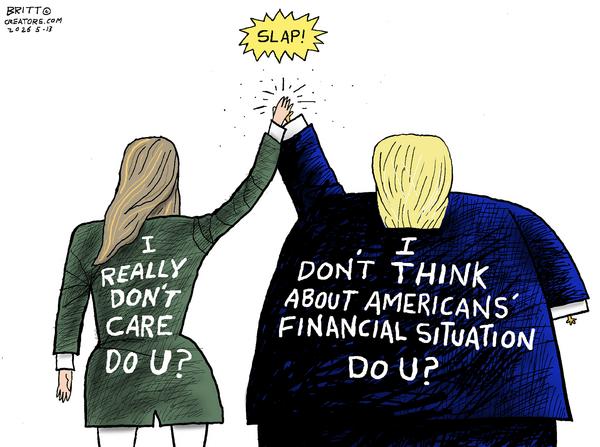
Trump is in China, where he is not thinking about our finances, but of the finances of the 17 megarich executives and Eric, who took the trip with him.
Trump landed in China on Wednesday night, where he was greeted at the airport by the vice president, Han Zheng, whose position is a ceremonial role. He was also sent to Trump’s inauguration. He is not a member of the elite Politburo Standing Committee, the apex of power in China’s ruling Communist Party. Zheng has little influence over policymaking.
Trump was also welcomed by a military band, an honor guard, and hundreds of Chinese youth waving flags. Experts on China believe the communist nation is sending a message to Donald Trump by sending a ceremonial figure to greet him and that they are choosing symbolism over substance. (snip-MORE)
Have some George Carlin, along with The Smothers Brothers, and Father Guido. The more things change …
And here’s one from another guy I’ve posted here before, after MDavis intro’d him elsewhere. This one’s simply fun. And the guy has a Grinch smile!


