Leading up to the 2024 presidential election, U.S. Army veteran Sae Joon Park kept in mind a warning from an immigration officer: If Donald Trump were elected, Park would likely be at risk for deportation.
Park was 7 when he came to the U.S. from Seoul, South Korea. He joined the Army at 19 and received a Purple Heart after being shot in Panama. After leaving the military, he lived with PTSD, leading to addiction issues.
After a 2009 arrest on a drug charge, Park was eventually ordered deported. But because he was a veteran, he was granted deferred action, allowing him to remain in the U.S. while he checked in with immigration officials annually.
For 14 years he did just that, while raising children and building a new life in Honolulu. Then in June, when Park went in for his appointment, he learned he had a removal order against him. Instead of facing extended time in detention, he chose to self-deport.
“They allowed me to join, serve the country — front line, taking bullets for this country. That should mean something,” he said.
Instead, “This is how veterans are being treated.”
During his first term in office, Trump enacted immigration policies aimed at a group normally safe from scrutiny: noncitizens who serve in the U.S. military. His administration sought to restrict avenues for immigrant service members to obtain citizenship and make it harder for green card holders to enlist — actions that were unsuccessful.
Now, military experts and veterans say service members are once again targets of the president’s immigration policies.
“President Trump campaigned on a promise of mass deportations, and he didn’t exempt military members, veterans and their families,” said retired Lt. Col. Margaret Stock, a lawyer who helps veterans facing deportation. “It harms military recruiting, military readiness and the national security of our country.”
Both policies barred enforcement actions against active-duty service members, absent aggravating factors. Under the new policy, noncitizen relatives of service members are not addressed.
Some service members, like Park, are choosing to self-deport. In other instances, immigrant family members of soldiers or veterans have been detained — including Narciso Barranco, a father of three U.S. Marines who was detained earlier this year in Santa Ana, California.
“The people being ripped from our communities are hardworking, honest, patriotic people who are raising America’s teachers, nurses and Marines,” Barranco’s son, veteran Alejandro Barranco, testified in July to a U.S. Senate subcommittee. “Deporting them doesn’t just hurt my family. It hurts all of us.”
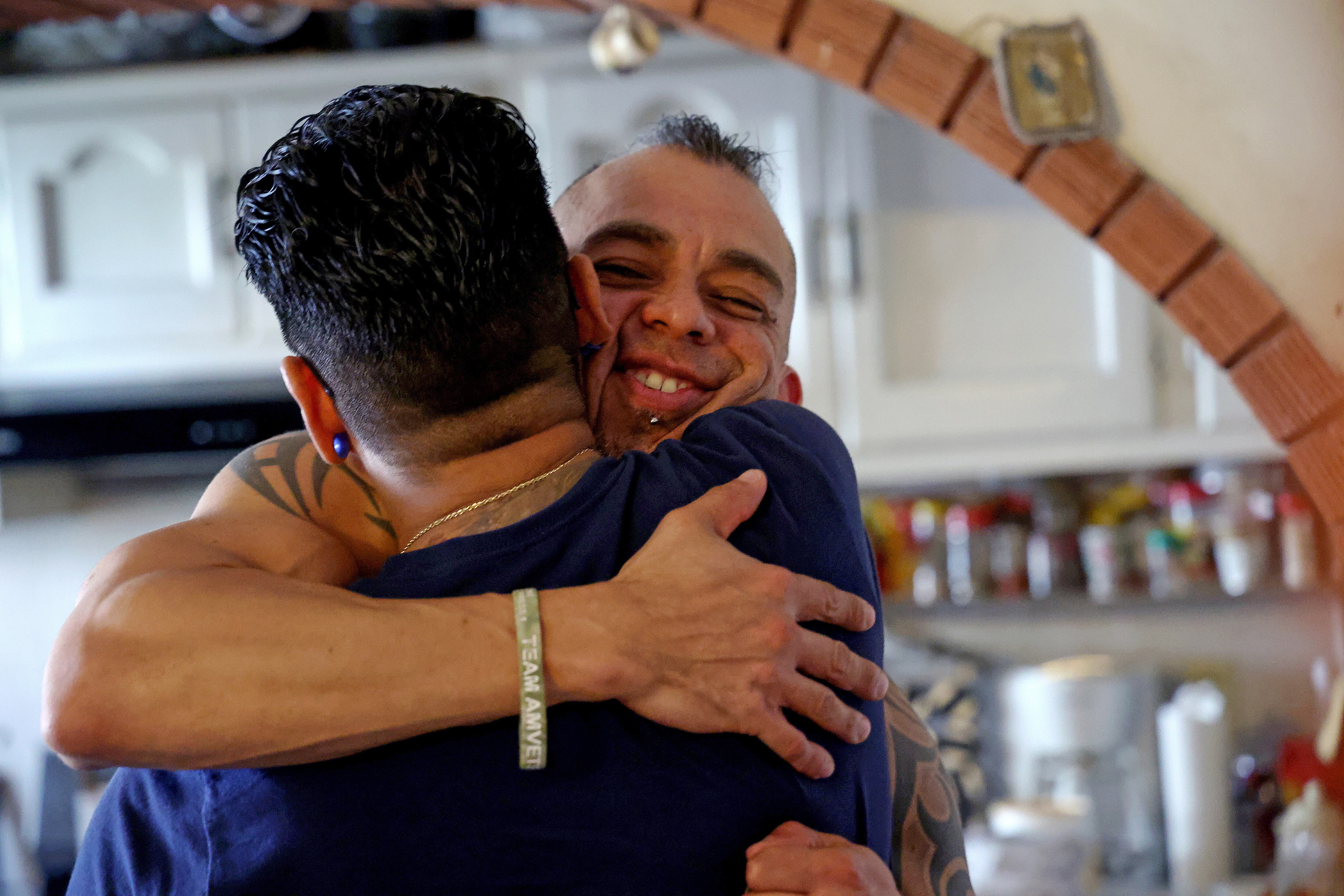
This image provided by News21 shows Michael Evans, a veteran who has been deported, hugging Diane Vega, a veteran and volunteer, at the Deported Veterans Support House on Saturday, June 28, 2025, in Ciudad Juárez, Mexico. (Sydney Lovan/News21 via AP)
There is no publicly available data on how many veterans are being affected, though ICE is supposed to track service member removals and the Department of Homeland Security is typically required to share that information with Congress.
A 2019 federal report found 250 veterans had been placed in removal proceedings between 2013 and 2018. News21 could find only two DHS reports tracking removals of veterans. One, covering the first half of 2022, said five veterans had been deported; another, for calendar year 2019, said three veterans had been deported.
In June, U.S. Rep. Yassamin Ansari, an Arizona Democrat, and nine members of Congress wrote to federal officials seeking the number of veterans currently facing deportation — noting “some estimates” put the overall number of deported veterans at 10,000.
Her office did not return messages. DHS and ICE also did not respond to questions.
Federal lawmakers have proposed several bills to protect immigrant service members and their relatives. One measure, introduced in May, would give green cards to parents of service members and allow those already deported to apply for a visa.
U.S. Sen. Tammy Duckworth, an Illinois Democrat and Army veteran, has sponsored some of that legislation. She told News21: “This is about the men and women who wore the uniform of our great nation, many of whom were promised a chance at citizenship by our government in exchange for their service. It’s about doing the right thing.”
As of February 2024, more than 40,000 foreign nationals were serving in active and reserve components of the Armed Forces, according to the Congressional Research Service. Another 115,000 were veterans living in the U.S.
Serving in the military has long been a pathway to citizenship, with provisions providing expedited naturalization dating back to the Civil War.
During designated periods of hostility, noncitizens who serve honorably for even one day are eligible to apply for naturalization if they meet all criteria. The U.S. has been in a period of hostility since 2001.
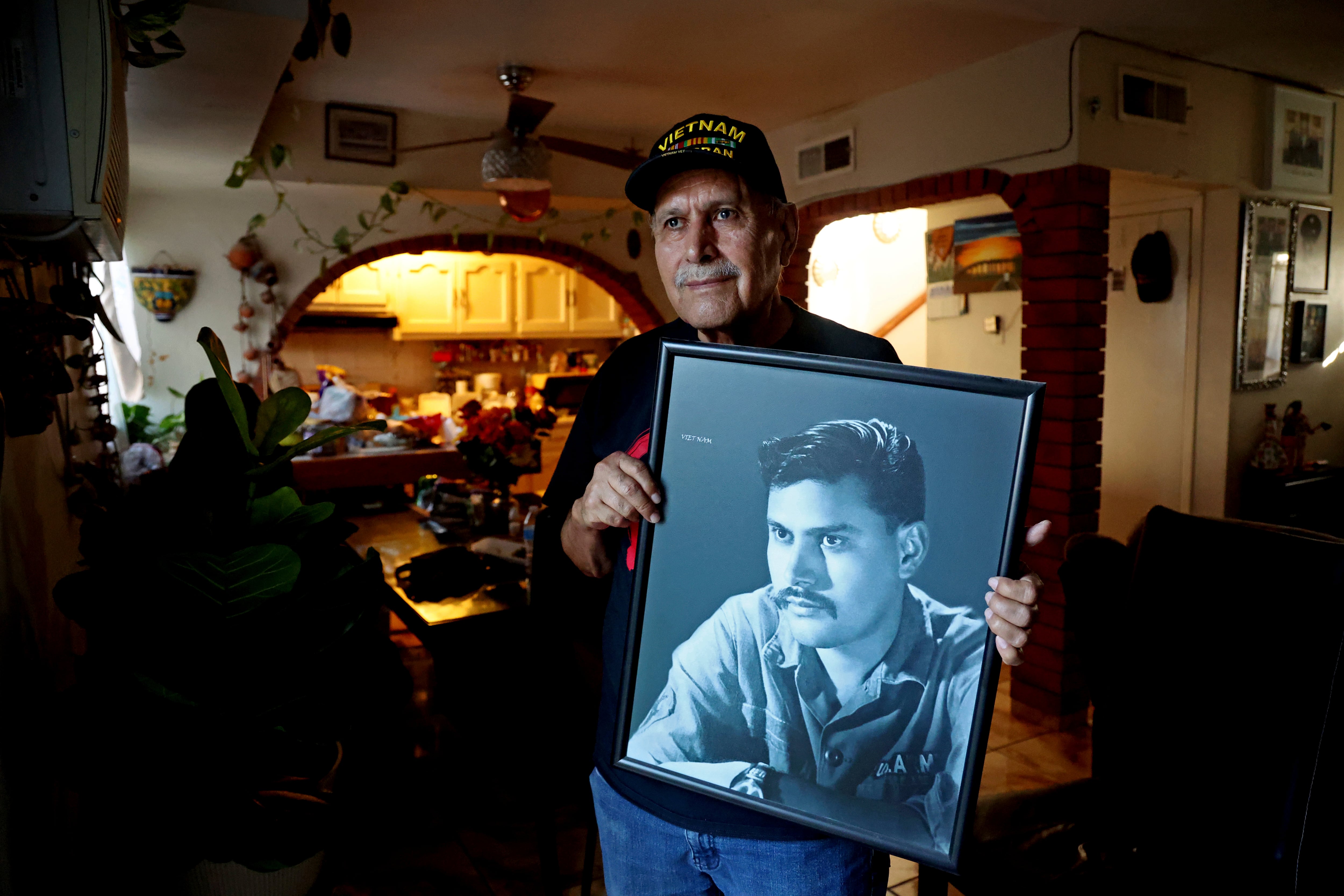
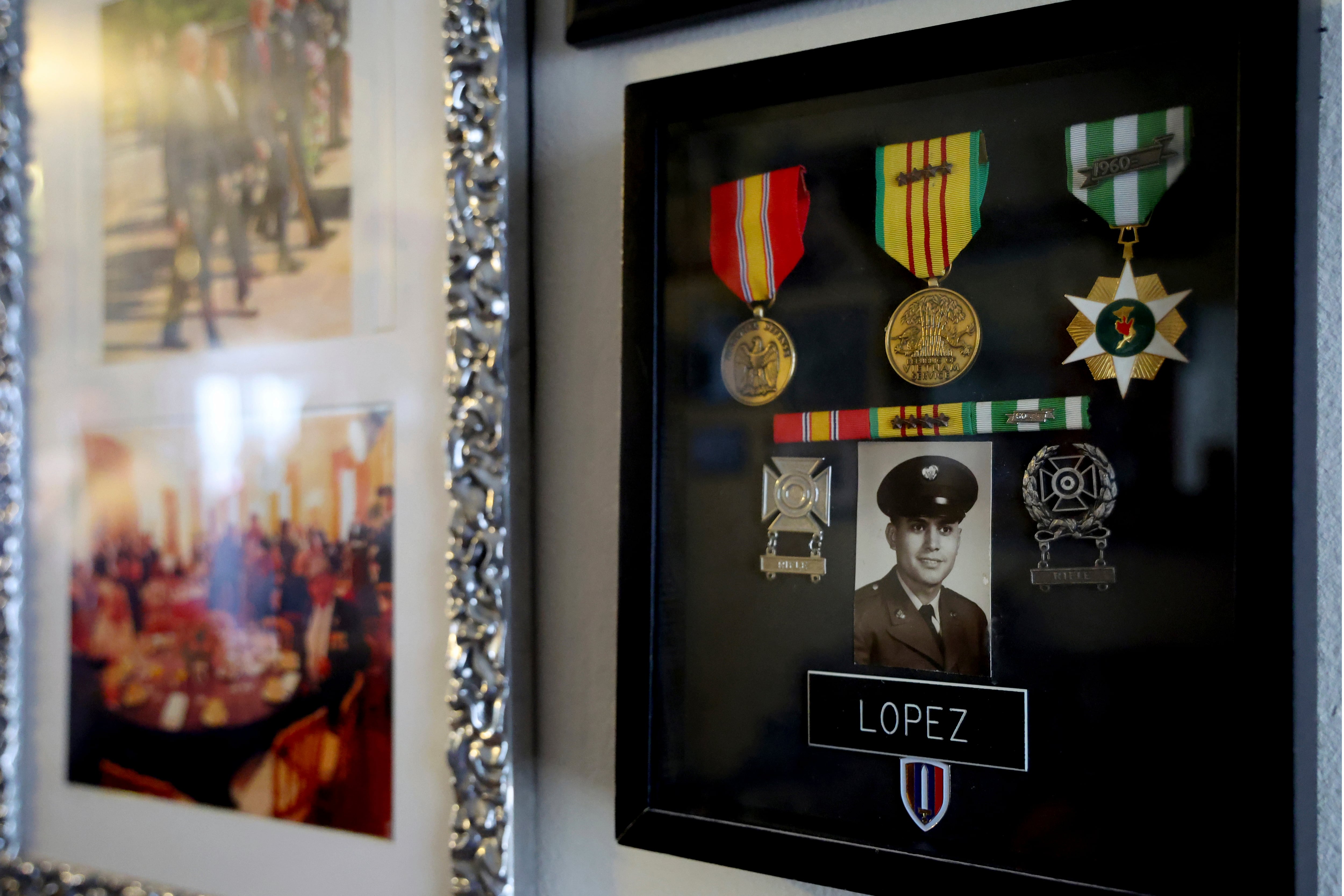
This image provided by News21 shows Army veteran Jose Francisco Lopez holding a portrait from his time in service on June 28, 2025, at the Deported Veterans Support House in Ciudad Juárez, Mexico. (Sydney Lovan/News21 via AP)
Despite that longstanding policy, the Department of Defense, during Trump’s first term, required service members to complete six months before obtaining military documents required to apply for citizenship.
The American Civil Liberties Union sued, and in 2020, a federal judge struck down the change. The Biden administration wound up rescinding the six-month policy.
Nevertheless, ACLU attorney Scarlet Kim said: “If you don’t get your citizenship while you’re serving and then you’re discharged … you can potentially become vulnerable to deportation.”
That’s the situation facing Army veteran Marlon Parris.
Parris, born in Trinidad, has been in the U.S. with a green card since the 1990s. He served in the Army for six years and received the Army Commendation Medal three times, according to court records.
Before his discharge in 2007, he was diagnosed with PTSD — which was cited when Parris pleaded guilty in 2011 to conspiracy to distribute cocaine and sentenced to federal prison.
Upon his release in 2016, the government assured him he would not be deported, according to the group Black Deported Veterans of America. But on Jan. 22, agents detained Parris near his home in Laveen, Arizona. In May, a judge ruled he was eligible for deportation.
His wife, Tanisha Hartwell-Parris, told News21 the couple plan to self-deport and bring along some of the seven children, ranging in age from 8 to 26, who are part of their blended family.
“I’m not going to put my husband in a situation to where he’s going to be a constant target, especially in the country that he fought for,” she said.
This image provided by News21 shows memorabilia from Jose Francisco Lopez’s service during the Vietnam War displayed inside the Deported Veterans Support House on Saturday, June 28, 2025, in Ciudad Juárez, Mexico. (Sydney Lovan/News21 via AP)
A report published last year by the Veterans Law Practicum at the University of California, Berkeley, School of Law noted that more than 20% of veterans with PTSD also have a substance use disorder, and that can result in more exposure to the criminal justice system.
That situation is “the most common scenario in terms of how deportation is triggered,” said Rose Carmen Goldberg, who oversaw completion of the report and now teaches in the Veterans Legal Services Clinic at Yale Law School.
The report stressed that even though deportation does not disqualify veterans from benefits earned through service, “Geographic and bureaucratic barriers may … stand in the way.”
In 2021, the Biden administration launched the Immigrant Military Members and Veterans Initiative (IMMVI) to ensure deported veterans could access Veterans Affairs benefits. The program offered parole to those needing to return to the U.S. for legal services or health care.
Jennie Pasquarella, a lawyer with the Seattle Clemency Project, said the biggest flaw of the program is that parole into the U.S. is temporary — a “dead end” if a veteran doesn’t have a legal claim to restore legal residency or to naturalize.
“We had asked the Biden administration to do more to ensure that there was a further path towards restoring people’s lawful status beyond parole,” she said. “Basically, we didn’t succeed.”
In the absence of aid in the U.S., more veterans are turning to help elsewhere.
José Francisco Lopez, a native of Torreón, Mexico, and Vietnam War veteran, experienced PTSD and addiction. He eventually went to prison for a drug-related crime and in 2003 was deported.
“I almost gave my life in Vietnam, and now they just throw me away like garbage,” he said.
For years, Lopez thought he was the only deported veteran in Mexico — until he met Hector Barajas, a deported Army veteran who in 2013 founded the Deported Veterans Support House in Tijuana.
Inspired, Lopez opened his own Support House in Ciudad Juárez.
Lopez, 80, is now a legal resident of the U.S. but splits his time between El Paso and Juárez, providing deported veterans housing, food and advice about how to apply for benefits. Since opening the support house in 2017, he’s helped about 20 people.
Back in Seoul, Park, 56, is adjusting to life in a country he hadn’t visited in 30 years. When he first arrived, he cried every morning for hours.
“It’s a whole new world,” he said. “I’m trying to really relearn everything.”
Park’s attorney started a petition to urge prosecutors to dismiss his criminal convictions, to help cancel his deportation order. More than 10,000 people have signed.
Park said he’s grateful for the support but has little faith he will ever be allowed to return to the U.S. He said: “This is not the country that I volunteered and fought for.”
News21 reporters Tristan E.M. Leach, Sydney Lovan and Gracyn Thatcher contributed to this story. This report is part of “Upheaval Across America,” an examination of immigration enforcement under the second Trump administration produced by Carnegie-Knight News21.
Abby Martin joins the program to discuss her new film, Earth’s Greatest Enemy which exposes the U.S. military as the world’s largest polluter. Live-streamed on November 6, 2025.
Top Democratic officials put out a new guide, entitled “Deciding to Win,” that encourages Democrats to be a little more like Republicans on “identity and cultural issues.”
Left: David Axelrod // Public domain, Middle: James Carville // JD Lasica // Wikimedia Commons, Right: David Plouffe // Noam Galai // Wikimedia Commons
Erin In The Morning is a reader-supported publication. To receive new posts and support my work, consider becoming a subscriber.
Subscribe
This week, the self-styled centrist group WelcomePAC released a document entitled “Deciding to Win”—advised on by some of the Democratic Party’s most prominent strategists, including David Axelrod, James Carville, and David Plouffe—urging Democrats to act a little more like Republicans on so-called “identity and cultural issues.” The 58-page memo reads like a compendium of the consultant class’s worst instincts, encouraging candidates to become little more than poll-tested avatars and walking focus groups, trading conviction for triangulation. While the document rarely defines which “cultural issues” it means, the few times it does make it clear: queer and transgender people stand to lose the most if this vision of the Democratic Party takes hold.
The document begins with five key pillars for the party. Some of them make a lot of sense, such as “messaging on an economic program centered on lowering costs, growing the economy, creating jobs, and expanding the social safety net,” critiquing “the outsized political and economic influence of” the “ultra-wealthy,” and support for a $15/h minimum wage. Others, though, encourage the party to abandon platforms that have been central to its identity and mission to protect the most vulnerable in society, calling for the party to “Moderate our positions where our agenda is unpopular, including on issues like immigration, public safety, energy production, and some identity and cultural issues.”
While the document rarely defines what “identity and cultural issues” means, the examples make its targets clear. Support for the Equality Act—legislation that would codify gender identity and sexual orientation as protected classes under federal law—is cited as proof the party has “moved left.” Another section lists “protecting the rights of LGBTQ+ Americans” as a priority voters supposedly don’t want Democrats to emphasize. Elsewhere, a discussion of how to mobilize voters “sitting on the couch” reveals that the most popular policy among them is “defining sex as binary and based on biology at birth across federal agencies.” Later in the document, it explicitly calls out transgender sports participation as an issue that the party should “moderate” on.
Screenshot of Deciding to Win Chart of “moderate” policies
Imagine a world where Democrats actually heeded this advice. The “define sex as binary” policy—already championed in Republican-led states and now embedded in everything the Trump administration does—has had devastating consequences for transgender Americans. It has stripped trans people of the ability to update their passports, creating serious barriers to travel; defunded organizations that affirm gender diversity; and fueled crackdowns on college campuses that allow trans students to use restrooms matching their gender identity. It’s a policy of bureaucratic erasure, one that threatens to undo decades of hard-won progress—yet it’s presented, almost casually, as a “moderate” position Democrats might adopt to win votes.
It’s a vision of politics that would turn Democrats into little more than Republican Lite—a “big tent” party spacious enough for those who despise us but not for those who most need protection. In that world, Democrats would lose not just the meaning of leadership but the very soul of why the party exists. And it’s a fantasy built on delusion: no amount of fine-tuned messaging or poll-tested calibration will ever transform the party into the perpetual winner these consultants imagine.
We don’t have to imagine what happens when Democrats follow this playbook — we’ve already seen it. In New Hampshire, Democrats capitulated on multiple anti-trans bills, including bans on youth sports participation and gender-affirming surgery, only to suffer one of the party’s worst defeats of the 2024 election cycle, losing 20 seats. By contrast, Democrats in Montana fought hard against similar measures and mounted some of the most visible resistance to anti-LGBTQ+ legislation in the country, picking up ten seats in the state House—one of the party’s strongest showings nationwide, in a state Trump carried easily. In Kentucky, Governor Andy Beshear vetoed anti-trans bills, including a sports ban, and still won reelection in a Trump +31 state. And in New York, a ballot measure enshrining gender identity protections outperformed Kamala Harris’s statewide margin by a wide margin.
Despite the evidence, a faction within the Democratic Party still treats queer and trans people as expendable—convinced that by trimming the edges of equality and tolerating “a little” discrimination, they can win back power. It’s a ruinous illusion. This kind of triangulation doesn’t blunt Republican attacks; it validates them. Every state that once embraced sports bans or “compromise” restrictions has since escalated to banning medical care, censoring books, and policing bathrooms. Capitulation has never advanced LGBTQ+ rights—not in policy, not in public opinion, not once. Democrats aren’t losing because they’ve been too loud or too firm in defending equality; they’re losing because the far right invests in its own moral narrative while Democrats second-guess theirs. The only way forward is to stand unapologetically on principle—as Andy Beshear did in Kentucky, citing it as the very reason for his success—not to chase the approval of consultants who mistake cowardice for strategy and appeasement for leadership.
Erin In The Morning is a reader-supported publication. To receive new posts and support my work, consider becoming a subscriber.
Photo Illustration by Victoria Sunday/The Daily Beast/Getty Images
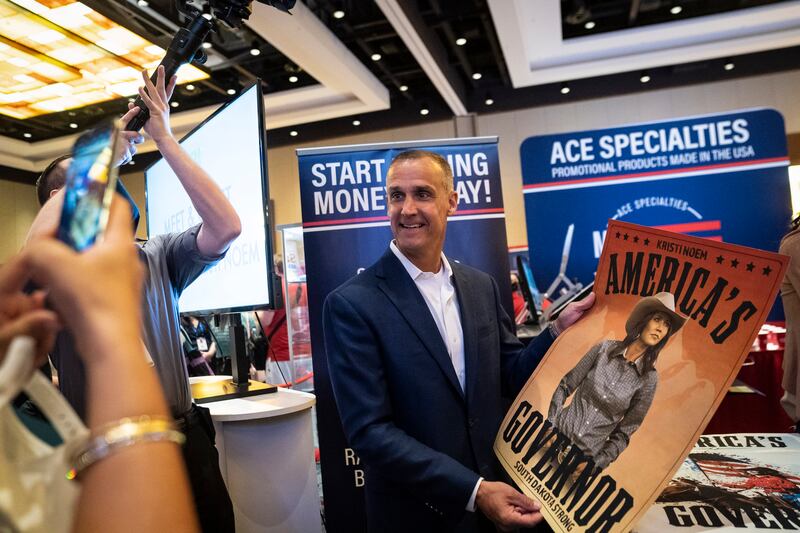
Homeland Security Secretary Kristi Noem and her alleged lover Corey Lewandowski ordered 10 Spirit Airlines jets before realizing the planes had no engines.
Officials warned the pair that purchasing the jets—which they said would be used to increase deportations and for their own travel—was impractical, and that simply hiring additional flight contractors would be far less costly, The Wall Street Journal reported
Corey Lewandowski and Kristi Noem, who are both married, deny reports that they are having an affair.Jabin Botsford/The Washington Post via Getty Images
But Noem and Lewandowski went ahead and blew through the funds allocated by Congress. Officials realized the pair’s blunder when they looked deeper into their spending spree and realized that Spirit—which has filed for bankruptcy twice—didn’t own the planes in the first place, and that the engines would have to be purchased separately, according to the Journal.
Noem and her shopping partner then purchased two Gulfstream jets for $200 million. However, shortly after, DHS notified the Democrats on the House Appropriations Committee that the project to increase deportation flights had been paused.
Noem looks pensive after a press conference held to discuss the “Midway Blitz” immigration enforcement operation in Chicago.Jamie Kelter Davis/Getty Images
Lewandowski—whose alleged relationship with Noem has been described as D.C.’s “worst-kept secret”—has been referred to as Noem’s “gatekeeper,” operating as a special government employee who travels with her, weighs in on personnel, and shapes enforcement.
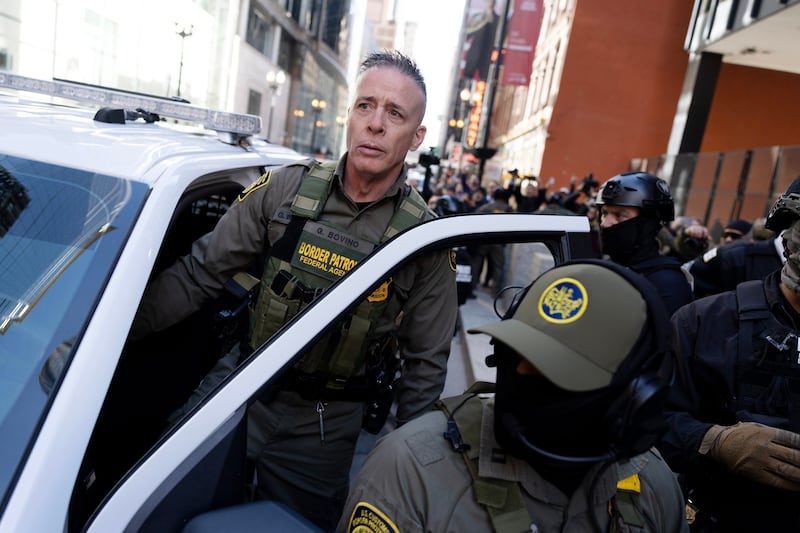
He has also spearheaded efforts to replace ICE leaders across the country with Border Patrol veterans to impose a more heavy-handed, military-style approach to Trump’s immigration crackdown, such as the hostile situation dubbed “Midway Blitz,” unfolding in Chicago.
Gregory Bovino has a background in chasing migrants and drug smugglers through border terrain.Chicago Tribune/Brian Cassella/Chicago Tribune/Tribune News Service via Getty Images
Led by Border Patrol Chief Gregory Bovino, the operation’s militarized enforcement tactics and aggressive approaches have sparked public outcry. Footage and testimony have shown federal officers firing pepper-ball rounds and tear gas—even near children—while clashing with protesters. ICE agents have also been spotted roaming quiet neighborhoods, questioning landscapers and decorators.
Still, the militant approach hasn’t appeased the White House or met its steep daily deportation quotas.
ICE and Border Protection agents had made 3,000 arrests in Chicago over two months as of late October—the same number the White House has demanded they make in a single day, the Journal reported.
Noem’s methods—and the mounting pressure from the White House—have sparked infighting among DHS officials as they grapple with Lewandowski’s informal authority.
Kristi Noem and Greg Bovino visit the ICE facility in Chicago in October.DHS photo by Tia Dufour
Border czar Tom Homan and ICE Director Todd Lyons favor an old-school, less hostile approach, including using police research to develop target lists and focusing on those with criminal histories, sources told the Journal. But while Homan is influential in the White House, Noem has the final say.
Trump, however, is on the side of aggression, saying in a 60 Minutes interview last week that ICE officials “haven’t gone far enough” in Chicago.
The Daily Beast has reached out to DHS and ICE for comment. A spokesperson for DHS denied there were divisions in the department in a statement to the Journal, adding that Trump’s administration is on pace to “shatter records and deport 600,000 people by the end of Trump’s first year.”
Noem’s shake-up comes even as a federal judge on Thursday accused Bovino, 55, of lying to her in court as she imposed sweeping limits on a hardline anti-migrant crackdown in Illinois.
Bovino previously claimed he was hit in the head with a rock before he lobbed gas at anti-ICE protesters in Chicago—a claim he later admitted was false after DHS could not produce evidence to support it.
In an oral ruling, U.S. District Judge Sara Ellis said, “I find the government’s evidence to be simply not credible,” after weeks of tear-gassings, pepper-ball strikes, and hard takedowns against journalists, clergy, and residents during “Operation Midway Blitz,” with excessive violence that, she said, “shocks the conscience.”
What I find deplorable is the fear they caused to the young children all to “capture” a woman who is working and has paperwork allowing her to be here. But the ICE thugs seem to get bounties for each person they snatch. She was a teacher there. How is this the going after the worst of the worst and removing dangerous criminals from the streets? Plus notice that the FBI is now warming of masked criminals pretending to be agents or officers to do crimes. As Emma says that was totally being predicted as kidnappings and trafficking’s of young people and children would start happening. Hugs
November 6, 1913 Mohandas K. Gandhi led 2500 ethnic Indian miners, women and others from South Africa’s Natal province across its border with Transvaal in the Great March. This was a violation of the pass laws restricting the movement of all non-whites in the country. Originally granted the rights of British subjects, Indians’ rights were steadily eroded beginning in the 1890s with the denial of the right to own property. Shortly before the March, a court in Capetown had invalidated all Muslim and Hindu marriages. Gandhi and many others were arrested and jailed after refusing to pay a fine. The Great March to Transvaal Mohandas Gandhi, 1915 Read about the early resistance in South Africa
November 6, 1962 The 17th session of the U.N. General Assembly passed Resolution 1761 condemning apartheid in South Africa and called on all member states to terminate diplomatic, economic and military relations with the country. The policies of the country embodied in apartheid, the strict racially separatist regime, were declared a threat to international peace and security. Apartheid was the racially separatist regime under which black and, to a somewhat lesser extent, so-called colored South Africans, were without political, civil or economic rights. All political power and wealth were held by the white population, approximately 15% of the country. “Apartheid” is the Afrikaans word for “apartness.” (Afrikaans is the language of the Boers, or [white] Afrikaners.) U.N pressure over the years on South Africa
November 6, 1965 2,500 people gathered in New York City’s Union Square to witness the burning of draft cards, a violation of recently passed federal law, as an expression of resistance to the Vietnam War. Dorothy Day, founder of the Catholic Worker movement, and pacifist leader A.J. Muste spoke, identifying with the “crime” about to be committed. Gordon Christianson, chairman of the Committee for Nonviolent Action and a World War II combat veteran, used his lighter to burn the cards. A counter-demonstrator shot a fire extinguisher at those ready to burn their cards, but they still ignited. And the counter-demonstrators shouted, “Burn yourselves, not your draft cards!” At trial, those who were arrested conceded the prosecution’s case, submitting footage of the action shot by a supporter. They made a defense under the First Amendment to the Constitution, arguing that the burning of draft cards in such a context was an act of symbolic speech. The trial judge found them guilty and sentenced them to six months in federal prison.
November 6, 1986 Although an American plane with supplies for the Nicaraguan contra insurgents had been shot down the previous month, and a Lebanese newspaper reported that the U.S. government had arranged for the sale of weapons to Iran, President Ronald Ronald Reagan denied involvement (“. . . a story that came out of the Middle East, and that to us has no foundation . . . .”) in what came to be known as the Iran-Contra scandal. Both the ongoing aid to the contras and the weapons sales to Iran were violations of U.S. law.

Left: David Axelrod // Public domain, Middle: James Carville // JD Lasica // Wikimedia Commons, Right: David Plouffe // Noam Galai // Wikimedia Commons
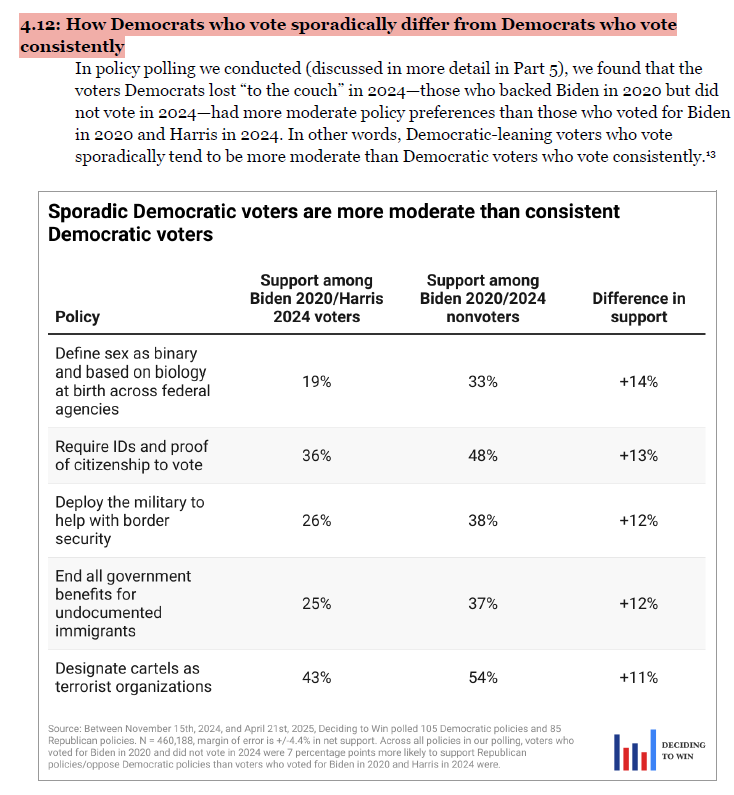
 Photo Illustration by Victoria Sunday/The Daily Beast/Getty Images