=====
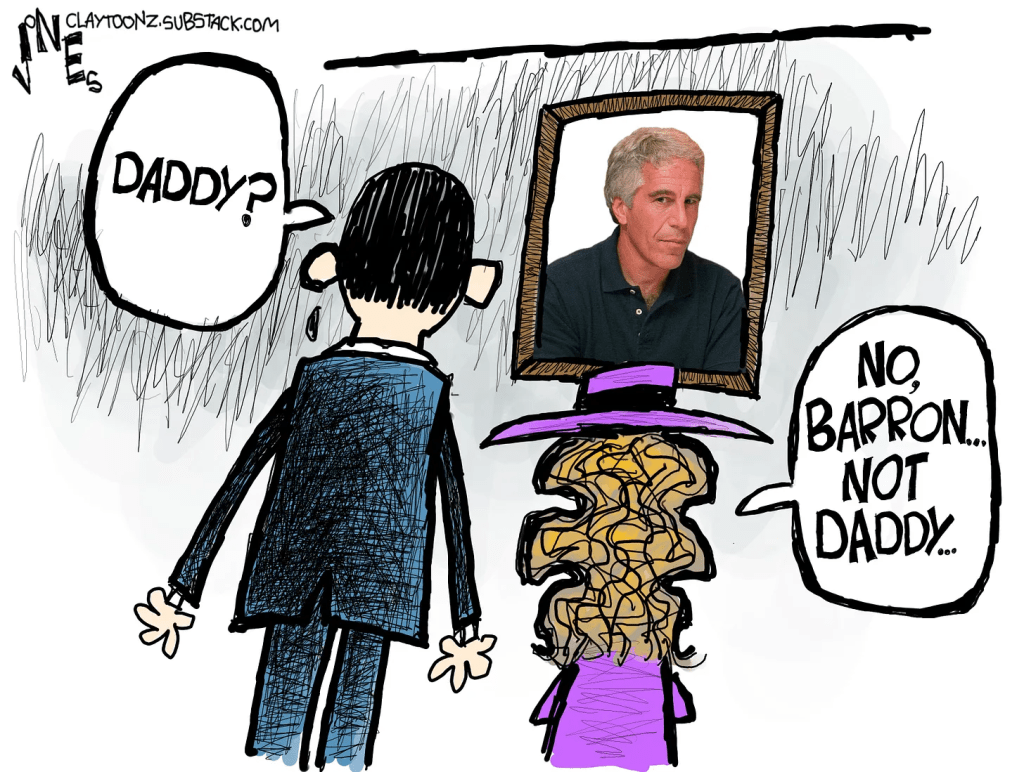
And In Lighter Presentation-
=====
=====
Seriously; if you read through these stories, both are part of the work of rightwing organizations operating in every state to get their missions accomplished. No state is safe from this sort of thing; people really need to keep their eyes on ALL of their legislators. Some of these groups even write ordinances and lobby county/municipal/local governing bodies.
TOPEKA — Melissa Sabin spoke officially on behalf of Little Lobbyists Kansas and personally in the name of her son, Logan, against a Kansas Senate bill aggressively expanding the state’s process of verifying eligibility for Medicaid, SNAP and other public assistance programs.
She was among dozens of organizations or individuals supplying opposition testimony Wednesday on Senate Bill 363. It would impose new state application and reporting requirements, some exceeding federal mandates, for programs serving children, elderly people, poor people, pregnant women and people with disabilities.
On Tuesday, the Senate Committee on Government Efficiency, or COGE, heard from the lone proponent of the bill — a conservative Florida organization that has sought for more than a decade to slash participation in Kansas public assistance programs.
“I oppose this bill because it creates an expensive, inefficient and legally questionable administrative structure that will predictably result in eligible Kansans — especially children — losing access to health care and food assistance,” Sabin said. “SB 363 does not improve program integrity or efficiency. It instead builds layers of red tape that state agencies are not equipped to manage or that federal law does not permit.”
Sabin, state outreach manager of Little Lobbyists, said the bill was inaccurately touted by its advocates as a means of improving accountability in terms of serving 325,000 Kansans taking part in Medicaid and 188,000 enrolled in the Supplemental Nutrition Assistance Program.
Sabin said requiring determinations of eligibility to be repeated monthly or quarterly would lead to additional paperwork errors, missed notices or administrative delays rather than documentation of alleged fraud or abuse.
She said a proposal for recipients of Medicaid to have eligibility reassessed every three months, rather than at 12-month intervals, could violate federal regulations. In terms of her son, she said the bill would compel the state to reconsider four times each year whether Logan, born with a genetic disorder characterized by intellectual disabilities, was eligible despite lack of change in his medical diagnosis.
“His condition does not fluctuate with paperwork cycles,” his mother said. “His need for skilled care does not disappear because the form is refiled or a verification is resubmitted.”
Sabin’s message of opposition was shared by representatives of Kansas Action for Children, Alliance for a Healthy Kansas, United Methodist Health Ministry Fund, LeadingAge Kansas, El Centro, United Way of Harvey and Marion Counties, Flint Hills Breadbasket, Kansas Appleseed Center for Law and Justice, InterHab, Reach Healthcare Foundation, Kansas Interfaith Action, Kansas Children’s Service League, United Community Services of Johnson County, the Disability Rights Center of Kansas and others.
Under the Senate bill, the Kansas Department of Health and Environment and the Kansas Department for Children and Families would be required to establish data-matching systems to automatically share personal information on Kansans with other state agencies. KDHE would have to submit data to the federal government on a monthly basis to determine if Kansans were enrolled in Medicaid in other states.
The bill would direct the Kansas Department of Labor to affirm employment status of beneficiaries, while the Kansas Department of Revenue would reveal details on household income. The Kansas Department of Corrections would track prison inmates who might be ineligible for benefits. The Kansas Lottery would be on alert for anyone winning more than $3,000 because the income bump could compromise eligibility for aid.
As written, the Senate bill would block state agencies from unilaterally requesting approval of exemptions to federal regulations. Instead, the Legislature would have to first endorse the request. The legislation also would block Kansas agencies from accepting as true an applicant’s statements on household size, age or residency — a provision that would require extensive document searches by state employees.
Sen. Cindy Holscher, an Overland Park Democrat running for governor, said she appreciated a recommendation from an opponent of the bill to convene a special committee of the Legislature to develop a better understanding of how Kansans dealt with the process of obtaining SNAP or Medicaid assistance.
Holscher said the House and Senate should do more than accept testimony from the only organization supporting the bill: FGA Action, which operates as an arm of the conservative Florida think tank Foundation for Government Accountability.
FGA was a proponent of the 2015 Kansas law restricting enrollment in SNAP and Temporary Assistance for Needy Families. Research subsequently showed the state law undercut low-income families in Kansas, made it more difficult to prevent child abuse and contributed to a record surge in the number of Kansas children in foster care.
“We have 40 opponents to this bill who are subject matter experts based in Kansas,” Holscher said. “One proponent with an organization based out of Florida.”
The fiscal note attached to the Senate’s bill indicated state agencies would need to hire about 300 new employees to handle the revised eligibility processes. The Kansas Department of Administration estimated the cost of complying with the law would be $17 million to $18 million annually.
Sen. Doug Shane, R-Louisburg, and Sen. Mike Thompson, R-Shawnee, challenged the fiscal note.
“Quite frankly the fiscal note is, I guess we could say, hogwash,” Shane said. “There are just some pure fallacies.”
Heather Braum, senior policy adviser for Kansas Action for Children, said the additional layers of government red tape contemplated in the Senate bill would disproportionately harm children. She said the reform was introduced at a time when nearly 20% of Kansas children didn’t know where their next meal would come from and about 50,000 children lacked health insurance.
“Bottom line,” Braum said, “this bill will result in families losing Medicaid and SNAP. Families will be unable to afford their child’s medical care and kids will have less food to eat in their homes.”
Braum urged the Legislature to work toward streamlining the process of applying for aid. She said House and Senate members need a good understanding of how parents, children, pregnant women, people with disabilities and the elderly navigated the Medicaid and SNAP application processes.
Erica Andrade, president and CEO of El Centro, said the state’s plan to spend more on eligibility checks would result in loss of benefits by people qualified to receive aid.
“From El Centro’s perspective,” she said, “the most troubling aspect of SB 363 is that it prioritizes bureaucracy over people.”
The Rev. Jessica Williams, a Merriam Baptist minister with the Kairos Center for Religions, Rights and Social Justice, testified on behalf of Kansas Interfaith Action. She said Interfaith Action opposed federal SNAP and Medicaid reform signed in 2025 by President Donald Trump and likewise objected to SB 363.
She said the legislation weaponized the bureaucracy to dismantle the Medicaid and SNAP safety nets. She said paperwork traps embedded in the bill were “certainly counter to God’s law.”
“In my faith tradition we regularly pray the only prayer that Jesus taught, which says, ‘Give us this day our daily bread,’ ” Williams said. “This prayer is not an abstract nicety, but a concrete demand for survival and an indictment of unjust systems which withhold food from families.”
=====
TOPEKA — Local government leaders want more details about how to enforce a “bathroom bill” passed by the Legislature that some city officials say could cost taxpayers “millions of dollars.”
Senate Bill 244, which is awaiting Gov. Laura Kelly’s signature, forces people to use facilities matching their biological sex at birth in government buildings.
Kelly has a 10-day deadline once receiving a bill to veto it. That deadline is Friday for SB 244, a spokesperson said. Kelly is expected to veto the bill, which passed both chambers with veto-proof majorities.
The bill says local governing bodies should take reasonable steps to ensure people use restrooms, locker rooms and other private spaces tied to their biological sex at birth, said Jay Hall, deputy director and general counsel for the Kansas Association of Counties.
The phrase that concerns Hall is “every reasonable step.”
“That’s really where our questions start,” he said. “What’s the expectation of local governments, and how are they supposed to handle the enforcement? That’s not something that we know at this point.”
Spencer Duncan, Topeka mayor and government affairs director for the League of Kansas Municipalities, said his organization is exploring what the bill means for its members. Initial determinations of changing signage and other steps could cost millions of dollars, some city leaders told him.
Duncan expressed frustration with the process that eliminated opportunity for public input when SB 244 was passed out of committee. The bill, originally House Bill 2426, addressed gender markers on driver’s licenses and birth certificates, which would stop the state’s practice of allowing transgender individuals to change their sex on those documents and would roll back markers that were previously changed.
Republicans on the House Judiciary Committee added the bathroom portion of the bill and then amended SB 244 by overwriting it with HB 2426, a process called “gut and go.” That allowed the Senate, which had already approved the unrelated version of SB 244, to concur with changes rather than hold hearings on the bill.
The only public hearing was in the House Judiciary Committee regarding gender markers — which received opposition from more than 200 people. During floor debate in the House, Democratic legislators spent more than five hours trying to add amendments that were repeatedly defeated. The bill passed along party lines, with one Republican, Emporia Rep. Mark Schreiber, voting against it.
The process meant no fiscal note was put on the bill for the bathroom portion, which concerned Democrats during the House debate and also worried Duncan and Hall.
(snip-a bit more)
OK MS Now has like 35 or 40 of these clips. They are difficult to stomach, but I am going to post a couple. MS Now posted clips of her attacking every democrat who had time at the hearings, so if you want to see the questions asked and her outright disrespect and trashing of the entire system in her performance for tRump all with the republicans on the committee’s approval. I sincerely hope the republicans remember how they acted when the democrats take power this fall and I hope democrats reamin strong enough to pay back the republicans in kind. Hugs
If you watch only one watch this one below. It has all the worst interactions. She acted like a spoiled bratty Karen. She came ready to accuse the democratic congress people of crimes instead of answering questions. She is a bitter entitled woman. Hugs
The conditions are on purpose to make people so miserable they give up their rights to asylum or any cases they have going. The ICE people / US government are already violating the rights of the people they kidnap off the streets. These are as bad as any concentration camp and the US government denies it all. When Democrats take power / authority back we need to investigate and punish all involved. The government flat out lies and gaslights the public as if they think nothing will ever be found out. Hugs
Hello everyone. I am looking for a meme / cartoon story I had a few years ago and can’t find again. It is of a kid going out in the morning with a sign hanging from their neck down to their chest. The sign said something like I am good and I am happy. Then through the day every insult and attack on the kid tore pieces of the sign off so when the kid got home the sign was destroyed being just a bit of what they started out with. I really want to find it again but every search I try to do fails to give me what I am looking for. Thanks. Hugs
I have put the videos I found below. Notice that the governor and the attorney general blame the kids and claim the schools have taught them radical left wing extremism. The kids see the news media about what ICE is doing and have friends who are not white. They are angry and they are future voters. That is what scares the republican leadership in Texas so much they are demanding schools push a hard right Republican bigoted racist agenda onto schoolchildren in the hopes of raising a new bunch of maga. They don’t blame te adult man who got out of his truck and walked into a group of minors with the intention to force his angry racist maga views on them. Note he shoved a girl. In his mind how dare she talk back to a male? That is who maga thugs have degenerated into. Hugs
Law enforcement say the 45-year-old man was the ‘primary aggressor’ in the fight that went viral
Names of the wealthy abusers still redacted. Hugs
The DOJ is making it as difficult as possible for the congress people to see the files. Only 4 computers are set up for hundreds of congress people. Plus they are still redacted not of the victims but of the names of the abusers. Hugs
By Jack Queen
18-month-old Amalia, who, according to a lawsuit filed, suffered a life-threatening respiratory illness while in U.S. Immigration and Customs Enforcement (ICE) custody, reacts, in this handout picture obtained on February 7, 2026. Elora Mukherjee/Handout via REUTERS
] Kheilin Valero Marcano and Stiven Arrieta Prieto, parents of 18-month-old Amalia, who, according to a lawsuit filed, suffered a life-threatening respiratory illness while in U.S. Immigration and Customs Enforcement (ICE) custody, pose for a photo, in this handout picture obtained on February 7, 2026. Elora Mukherjee/Handout via REUTERS
NEW YORK, Feb 7 (Reuters) – An 18-month-old girl detained for weeks by U.S. immigration authorities was returned to custody and denied medication after being hospitalized with a life-threatening respiratory illness, according to a lawsuit filed in Texas federal court.The child, identified in the lawsuit as “Amalia,” was released by immigration authorities in President Donald Trump‘s administration after her parents sued on Friday. The parents, who also had been detained, were released as well. The suit had sought the release of all three of them.In a statement provided on Monday following the publication of this story on Saturday, U.S. Department of Homeland Security spokeswoman Tricia McLaughlin said claims that Amalia did not receive proper medical treatment or medications were false.The family was detained during a check-in with immigration authorities on December 11 and held at a facility in Dilley, Texas, according to the lawsuit. Amalia was hospitalized from January 18 to 28, and returned to the Dilley facility in the midst of a measles outbreak, the lawsuit said.“Baby Amalia should never have been detained. She nearly died at Dilley,” said Elora Mukherjee, an attorney for the family.Mukherjee said hundreds of children and families detained at Dilley lack sufficient drinking water, healthy food, educational opportunities or proper medical care, and should be released.McLaughlin said in the statement on Monday that the child immediately received medical care after becoming ill, was admitted to a hospital for treatment and returned to the Dilley facility after being cleared for release by a pediatric doctor. Amalia was housed in the medical unit upon her return and received proper treatment and prescribed medicines, the statement said.“It is a longstanding practice to provide comprehensive medical care from the moment an alien enters ICE custody. This includes medical, dental, and mental health intake screening within 12 hours of arriving at each detention facility, a full health assessment within 14 days of entering ICE custody or arrival at a facility, and access to medical appointments and 24-hour emergency care,” McLaughlin said.Trump’s administration has been accused of heavy-handed and inhumane tactics as well as violating court orders while carrying out his mass deportation program.A federal judge in Michigan criticized the administration in a January 31 ruling ordering the release of a five-year-old boy – seen in a viral photo wearing a blue bunny hat outside his house as federal agents stood nearby – who was detained by immigration agents in Minnesota. The administration is now seeking to deport the boy.Amalia’s parents, originally from Venezuela, have lived in the United States since 2024 with their daughter, who is a Mexican citizen, according to the lawsuit. The lawsuit says all three intend to file asylum applications in the United States.Amalia developed a fever on January 1 that reached as high as 104 degrees Fahrenheit (40 degrees Celsius), started vomiting frequently and struggled to breathe, according to the lawsuit.She was taken to the hospital on January 18 with extremely low oxygen saturation levels and diagnosed with COVID-19, respiratory syncytial virus, viral bronchitis and pneumonia, according to the lawsuit. She was placed on supplemental oxygen.Amalia was given a nebulizer and a respiratory medication upon her discharge from the hospital, but these were taken away by detention center staff upon her return, according to the lawsuit. The girl has lost 10% of her body weight and was given nutritional drinks to help her regain it, but these were also confiscated by authorities, according to the lawsuit.Reporting by Jack Queen in New York; Editing by Sergio Non, Will Dunham and Daniel Wallis