Science And Wonder And Beauty

Whale filmed giving birth, with a little help from her friends

Paris (France) (AFP) – Scientists have managed to film a spectacular event rarely witnessed by humans: a sperm whale giving birth while other females worked together to support the mother and her newborn.

A team from Project CETI, an international effort seeking to understand how whales communicate, were in a boat near a pod of 11 whales off the coast of the Caribbean island of Dominica on July 8, 2023.

A 19-year-old female named Rounder was surrounded by family members and others as she was about to give birth to her second calf.

Over nearly five and a half hours, the scientists documented the group’s behaviour, watching them from the boat, filming them with drones and recording the sounds underneath the waves.

The data they collected, which was published in the journals Scientific Reports and Science on Thursday, represent an exceptional rarity in the history of science.

Out of 93 species of cetaceans — a group that includes whales, dolphins and porpoises — only nine have ever been observed giving birth in the wild.

Rarer still was that whales not related to the mother were helping out.

“This is the first evidence of birth assistance in non-primates,” Project CETI team member Shane Gero told the New Scientist.

“It is fascinating to see the intergenerational support from the grandmother to her labouring daughter, and the support from the other, unrelated females.”

Lifting up the newborn

The birth lasted 34 minutes, from their tails emerging from the water to the calf being born.

During labour, other adult females dove under Rounder’s dorsal fin, often on their backs with the heads facing her genital slit.

Immediately after the birth, the pod’s behaviour “rapidly changed” as every member became active, according to the study in Scientific Reports.

All the adults were “squeezing the newborn’s body between theirs, touching it with their heads”, the researchers wrote.

The whales pointed their noses towards the newborn, “pushing it around, under the water, and onto and across their bodies above the surface”.

The remarkable behaviour dates back more than 36 million years and is believed to be due to the unique history of cetaceans.

After their distant ancestors left the water and adapted to life on land, cetaceans are the only mammals that returned to the ocean.

This dive back into the water required some evolutionary tricks to prevent newborns from drowning.

For example, whale calves are born tail-first, rather than head-first like other mammals.

However, while newborn sperm whales become talented swimmers within a few hours, they still sink right after birth.

So other whales have to lift the calf up “to prevent the newborn from sinking while also facilitating its first breaths”, the researchers suggested.

Primates — including humans — are the only other mammals known to help assist each other out during birth.

Excited vocal sounds

The scientists also recorded the whales making many sounds, including significant changes in “vocal style” during key events, the study said.

This included when a group of pilot whales approached the pod after the birth.

The changes in vocalisation suggest that the group was coordinating to support the birth — or protect the newborn, the researchers said.

Sperm whales have one of the longest pregnancies in the animal kingdom, with a gestation period that lasts up to 16 months.

When calves are born they are already four metres (13 feet) long. They will rely on their mother’s milk for at least two years.

As they grow, the young become the centre of their pod’s social unit, with others helping out with babysitting while the mother searches for food.

After the birth was filmed in 2023, the pod was not spotted again for over a year. Then the newborn was spotted with Accra and Aurora — the other young members of the pod — on July 25 last year.

Surviving its first year is a good sign that the sperm whale will reach adulthood, the Project CETI team said.

© 2026 AFP

Federal court OKs Iowa’s “cruel” book ban law in stunning LGBTQ+ defeat

The idea behind these laws seems to be if they can hide that LGBTQ+ people / kids exist they can prevent the acceptance and tolerance of LGBTQ+ kids / people. In the minds of the haters who write these bills hopefully that will force people who are not straight or cis to stay hidden from society.  They are desperate to return to the 1950s when LGBTQ+ people had to stay hidden or risk losing everything they had, their job, housing, and friends.   They are pathetic in their need for everyone to be the same as they are, feel the same as they do, and to live as they do.  Why I did not know or understand.  The irrational hate for LGBTQ+ kids is really weird.  That they would rather have kids hurt, harmed, assaulted, ostracized, and possibly driven to suicide rather than give them acceptance or simply tolerance.   I don’t undestand what their gain is in this?   Hugs  

https://www.lgbtqnation.com/2026/04/federal-court-oks-iowas-cruel-book-ban-law-in-stunning-lgbtq-defeat/

April 2026

Photo of the author

John Russell (He/Him)April 7, 2026, 1:00 pm EDT· Updated on April 8, 2026
An empty classroomShutterstock

The U.S. Court of Appeals for the Eighth Circuit has ruled that Iowa can enforce a 2023 law restricting classroom instruction on LGBTQ+ topics and access to certain books while legal challenges against the law proceed.

On Monday, the three-judge panel overturned injunctions previously issued by lower courts in two separate lawsuits challenging aspects of the Senate File 496, according to the Associated Press and The Des Moines Register.

Passed by the Iowa state legislature and signed by Republican Gov. Kim Reynolds in 2023, the law prohibits “any program, curriculum, test, survey, questionnaire, promotion, or instruction relating to gender identity or sexual orientation” in kindergarten through sixth grade. It also bans materials featuring “descriptions or visual depictions of a sex act” from school libraries and classrooms — a provision which critics say is intended to ban books featuring LGBTQ+ characters and themes.

The law went into effect on July 1, 2023. The following November, the ACLU of Iowa and Lambda Legal sued the state on behalf of LGBTQ+ advocacy organization Iowa Safe Schools and seven students and their families, challenging SF 496’s classroom instruction ban.

Last May, a federal judge issued a split decision, upholding the law’s ban on discussion of gender identity and sexual orientation in K–6 classrooms, but blocking its ban on school “promotions” and “programs” that acknowledge the existence of LGBTQ+ people. U.S. District Judge Stephen Locher also blocked a provision of the law banning schools from providing “accommodation that is intended to affirm the student’s gender identity” without notifying their parents, writing that S.F. 496 was impermissibly vague about what constitutes an “accommodation.”

Writing for the Eighth Circuit on Monday, Judge Ralph Erickson held that the state’s interpretation of the law as requiring school “programs” and “promotions” to only encompass curricular activities does not violate the U.S. Constitution. However, the court did not address whether it is constitutionally permissible for the state to ban specific groups and extracurricular programs, such as Gender & Sexuality Alliance groups, because the Iowa Safe Schools lawsuit did not challenge specific applications of the law, according to the Register.  

The court also disagreed with Judge Locher’s ruling that the law’s language around “accommodations” was too vague, restoring S.F. 496’s ban on schools accommodating students’ gender identities without outing them to their parents.

In a separate November 2023 lawsuit, the Iowa State Education Association was joined by publisher Penguin Random House and several prominent authors of banned books in a challenge to S.F. 496’s book-banning provision. Last March, Judge Locher sided with the plaintiffs, issuing a preliminary injunction preventing schools from removing books it considers “obscene” from classrooms and libraries.

Again, writing for the Eighth Circuit in a separate decision Monday, Judge Erickson disagreed w  ith Locher’s ruling that school library books are not part a school’s curriculum. Erickson wrote that a school’s library catalogue constitutes government speech and can be restricted by state law, according to the Register.

The decisions on both cases send them back to the district court. But as the Register notes, the Eighth Circuit indicated in both rulings that the plaintiffs could not show a “likelihood of success on the merits” in their challenges to S.F. 496.

At the same time, in a joint press release the ACLU of Iowa and Lambda Legal noted that the rulings narrow “where and how the law may be applied.”

“The prohibition regarding sexual orientation and so-called gender theory applies only to specific, mandatory instruction on these topics during class time. The law, as currently interpreted, does not require schools to prohibit student expression of LGBTQ+ identity nor does it limit the sponsorship or promotion of GSAs,” ACLU of Iowa Senior Staff Attorney Thomas Story said.

“The court’s interpretation of the provision on banning books is that it applies only to those that specifically describe or depict one of those sex acts defined in Iowa’s criminal law. And with the forced outing provision, a report would be made to parents or guardians only if a student specifically requests a school accommodation for the stated purpose of affirming a gender identity different from their registration forms,” Story added.

In a statement responding to the court’s decision, Iowa State Education Association president Joshua Brown told the Register that the case was “about much more than legal technicalities.”

“It is about protecting the freedom of speech and the right to share ideas — values guaranteed by the First Amendment,” Brown said. “Our schools should be safe spaces where students are free to learn, teachers can use their professional expertise without fear, and families can trust that education is based on open inquiry rather than government censorship.”

A spokesperson for Penguin Random House indicated in a statement to the Register that the company intends to keep fighting against S.F. 496. Similarly, Lambda Legal Senior Attorney Nathan Maxwell called the ruling “a setback,” but noted that “it is not the end of this fight.”

“Iowa’s SF 496 is a cruel and unconstitutional law that silences LGBTQ+ children, erases their existence from classrooms, and forces educators to expose vulnerable students to potential harm at home,” Maxwell said in a statement. “We will continue to use every legal tool available to protect these young people. They deserve nothing less.”

Subscribe to the LGBTQ Nation newsletter and be the first to know about the latest headlines shaping LGBTQ+ communities worldwide.


John Russell is a writer and editor based in New York City. In addition to covering politics and entertainment for LGBTQ Nation, he has written for Vanity Fair, Slate, People, Billboard, and Out. He also writes about film, TV, and pop culture in his free newsletter Johnny Writes…

Sign The Card For Ron & Scottie!

Put whatever you’d like to inscribe with your sig. in a comment. Scottie is with Ron as Ron gets his stents today. Here’s to all the best from all of us, with positive and healing energy to you both!

Stupid Is As Stupid Does

How Trump’s Vulgar, Criminal Easter Threat Enriches Iran

Juan Cole 04/06/2026

Ann Arbor (Informed Comment) – On Easter Sunday, God’s chosen in the White House issued a vulgar and unbalanced posting on his “Truth Social” that epitomizes the insanity of his Iran War. Attending to it closely will help us understand how Trump has strengthened the government of the Islamic Republic and put it in control of global energy. Trump fondly imagines that he can dislodge Iran from this new ascendancy, but he is wrong, since it depends on sabotage, a sabotage that cannot be policed.


Piers Morgan

@piersmorgan·

Follow

This is embarrassing, Delete it, President ⁦@realDonaldTrump⁩ – unless you want everyone to think you’ve lost your marbles.

The foul language and clear mental imbalance visible in this announcement sparked a further round of calls for Trump’s removal under Article 25 of the Constitution, which is nothing more than an internet meme since Trump has surrounded himself on his cabinet with people even more certifiable than he is, and who wouldn’t dare move against him.

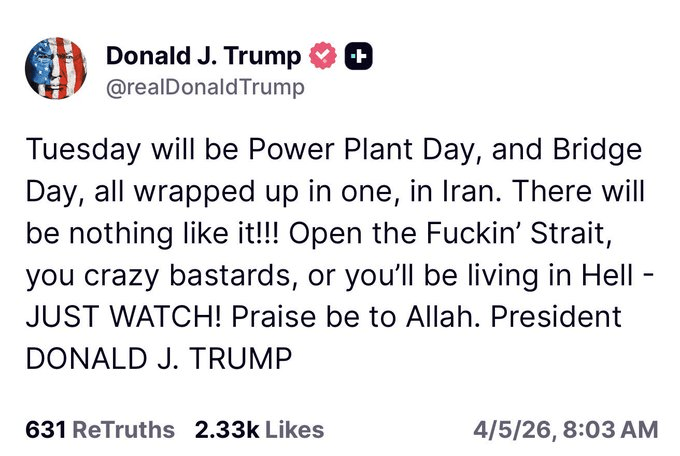
Trump, having imbibed whatever substance it is that makes him manic, announced that “Tuesday will be Power Plant Day, and Bridge Day, all wrapped up in one, in Iran. There will be nothing like it!!!”

He is repeating a threat he made previously, to bomb Iran’s civilian electricity-generating plants as well as its civilian bridges.

Iran has 98 major power plants fueled by fossil gas, which generate 85% of the country’s electricity. The largest, the Damavand power plant south of the capital, Tehran, has a generating capacity of over 2.8 gigawatts.

One of Iran’s power plants is nuclear, at Bushehr. If Trump or Israel bombs it, the consequent radiation pollution will deeply harm the Arab Gulf states, not only through airborne particles but also by contaminating sea water, which is drawn on by the region’s desalinization plants. This exposure to radiation would certainly increase cancer risk in the region. There are mountains between Bushehr and the Iranian interior, so the radioactive particles would be blown west toward other countries such as the United Arab Emirates, Saudi Arabia and Qatar.

Striking civilian power plants, and above all nuclear ones, endangers the noncombatant population of children, women and unarmed men and violates International Humanitarian Law.

In fact, the International Criminal Court in the Hague issued “warrants of arrest for two individuals, Mr Sergei Kuzhugetovich Shoigu and Mr Valery Vasilyevich Gerasimov, in the context of the situation in Ukraine for alleged international crimes . . .” on June 24, 2024. They were indicted for “for the war crime of directing attacks at civilian objects (article 8(2)(b)(ii) of the Rome Statute) and the war crime of causing excessive incidental harm to civilians or damage to civilian objects (article 8(2)(b)(iv) of the Rome Statute), and the crime against humanity of inhumane acts under article 7(1)(k) of the Rome Statute.”

Among the “civilian objects” that these Russian officials ordered attacked in Ukraine were power plants and structures such as the Kryukovsky Bridge.

So Trump is talking like a war criminal, which tells you why he has placed sanctions on International Criminal Court judges.

Trump already struck the unfinished B1 bridge linking Tehran to Karaj. Since it was not finished, it could not possibly have had a military purpose, contrary to the lies of the lying liars in the Trump administration who gave that as the excuse for hitting it.

Trump continued, “Open the Fuckin’ Strait, you crazy bastards, or you’ll be living in Hell– JUST WATCH!

It is not clear how a body of water such as a strait could copulate. However, it can engender revenue, and does so for Iran. A lot of revenue.

Iran has not actually closed the Strait of Hormuz entirely. It is exporting its own petroleum through that narrow aperture, mainly to China. Trump has been forced by the global oil shortage to lift sanctions on the Iranian tankers, and so Iran is also selling again to India. Before Israeli Prime Minister Benjamin Netanyahu rushed Trump into war on Iran on February 28, Iran was exporting about 1.4 million barrels a day to China. The price of petroleum was about $67 a barrel then, but Iran had to offer a steep discount to offset American sanctions, and so was probably only getting $57 or less a barrel. So Iran was getting something like $29 billion a year for its petroleum from China and a few other customers (90% goes to China).

China is now likely having to pay $110 a barrel for Iranian petroleum.

Iran’s oil income just went up to $55 billion a year if these prices and this volume of trade persists, which is plausible. So the “crazy bastards” in charge of Iran have nearly doubled their income off the Netanyahu-Trump war because of the fertility, under their control, of the “fuckin’ Strait.” The Iranian oil industry is state-owned, so all the money goes to the clerics and the Iranian Revolutionary Guards Corps, as well as to the conventional army and the elected institutions, the parliament and president. This extra income helps the government tamp down resistance, strengthening it against civil society. In any case, many Iranians under foreign attack are rallying around the flag. Of course there are also tax losses from the economic disruption of the war, but the vastly increased oil income helps make up for them as far as the government is concerned. If the price of oil goes to $200 a barrel, as it may well, Iran’s government could get $100 billion a year for its petroleum.

Not only that, but Iran has instituted a toll system, wherein countries that have good relations with Iran and pay a fee can transit the Strait without fear of an Iranian drone attack. In contrast, countries that Iran believes contribute to the American war effort against Tehran such as the Emirates and Kuwait, are blockaded by the threat of such strikes. These tolls could be an ongoing and lucrative source of income for the government. Before the war, 138 ships transited the Strait daily. If that traffic resumes but each has to pay Iran a $2 million toll, that would bring in $96 billion a year, i.e. four times what Iran was getting for its petroleum before the war.

So here’s the thing. With the advent of Iran’s Shahed drones, which can be manufactured inexpensively and of which it has tens and thousands, there is no way for anyone, including Trump and the US military, to stop Iran from sabotaging ships that won’t pay the $2 million. At least, I don’t see how it could be done. You’d need tens of thousands of interceptors, and we hardly have any left. Moreover, interceptors cost $1.5 million apiece, so it makes much more sense to allow each ship to pay Iran the $2 million.


Container ship in Strait of Hormuz. (U.S. Navy photo by Mass Communication Specialist 2nd Class Indra Beaufort).Public Domain. Via Picryl .

Trump has shown Iran how it can go into the protection business in the Gulf for the long term. Nice oil shipping industry you have here, it would be a shame if anything happened to it. And off that, Iran actually increases its GDP substantially.

If Trump takes out Iran’s electricity and bridges, he can interfere with its economy and its society in a big way. But he can’t stop the drones or the protection racket that way. Moreover, Iran has made it clear that its response will be to take out the power plants in the Gulf Arab states as well as in Israel. Since the US and Israel are running low on interceptors, and since even small Shahed drones have great range and can do a lot of damage, Iran’s threat is credible.

If Trump takes out Iran’s petroleum-production capability, Iran will crash oil production in the Gulf, taking 20 million barrels a day off the market for years to come. That would certainly be another Great Depression and likely would spell the end of the oil industry, since everyone in the world would migrate to electric vehicles quickly.

So although Trump meant the phrase ironically and blasphemously, the Iranian authorities may well end up saying “Praise be to Allah” over Trump’s monumental stupidity.

https://www.juancole.com/2026/04/trumps-vulgar-criminal.html

From The “MUTTS” Blog:

Helping Pets and People When the World Feels Uncertain

There are many ways in which the world feels uncertain, and with every news update, we ask ourselves questions: What role do we play? How can we help? We know many readers turn to Mooch and Earl for a daily dose of comfort and joy. Recently, someone told us MUTTS is their “place to go for a warm hug each day.” Will raising a particular issue interrupt that sense of refuge that readers value here?

Not long ago, we received a letter from a reader named Tyla. With her permission, we’re sharing part of it below. 

“With recent ICE raids impacting Minneapolis and communities across the country, some families are being separated very suddenly, and in many cases this has meant pets are left without caregivers. Animal shelters and rescues have shared that they’re seeing more animals being taken in or surrendered unexpectedly, and in some situations, people have stepped in to foster or adopt pets whose families were detained.

“The health and well-being of both people and animals isn’t always part of the conversation when issues like this come up, even though both are affected. Animals, especially, rely entirely on their families for care and stability, and sudden disruptions can be very hard on them.

“I was wondering if this is something the [MUTTS] team might feel comfortable acknowledging this, specifically from the perspective of how animals are affected.

“I understand this is a sensitive and complicated topic … I also know that many readers, including myself, turn to MUTTS as an escape from the real world, and I truly respect that. I just wanted to offer this suggestion thoughtfully, since when people are affected in situations like these, animals are often affected too, and their needs can easily be overlooked.”

Tyla’s letter moved us. We’d been thinking about this, too. We started drafting a blog post based on one specific concern: What happens to pets when their families are detained or deported? We were discussing this internally, and considering ways to help, when the scope widened. The news headlines, unfortunately, have not slowed down.

The world feels increasingly uncertain, but one thing we know for sure is that pets depend on the humans who love them. They don’t understand geopolitics or political parties. And the truth is, preparing for any unexpected event — from a natural disaster to a family emergency or something else — is an act of love and responsibility.

At MUTTS, we believe in compassion for all creatures. With that spirit, here are practical ways we can all help our human and animal neighbors.

If You’re a Pet Parent: Plan Ahead

  • Choose a backup caregiver. Identify a trusted friend, neighbor, or family member who could step in temporarily if you can’t be home. Make sure they’re willing and understand what would be involved. Share basic care information in advance so nothing is left to guesswork. If you’re comfortable with it, you may even want to give them a spare key to your home (or tell them where one is hidden).
  • Keep identification current. Ensure your pet’s tags and microchip records are up to date. Consider listing a secondary contact (such as your backup caregiver) on file with your vet.
  • Prepare a small “just in case” kit. Put together a bag with essentials: medications, vaccination records, feeding instructions, favorite comforts like a blanket or toy, and a short written profile of your pet’s personality and needs. Think of it as something you’d want ready in any unexpected situation.

If you currently need assistance caring for your pet, know that there are many community resources around the country that may be able to help. You can start your search with PetHelpFinder.org, which allows you to search for pet pantries, affordable veterinary services, and other resources in your area. You might also contact your local animal shelter for guidance. Many shelters offer community assistance — and even if yours does not, it’s very possible they can help point you in the right direction. 

If You Want to Help In Your Community

  • Volunteer at a local shelter. Many animal shelters are already stretched thin, and shelters across the country are receiving pets whose guardians were detained or unexpectedly displaced. Time, donations, and supplies all help. 
  • Consider fostering. This is an incredibly impactful way to help pets in your community, especially right now. Fostering gives an animal stability during a time of upheaval. In some cases, it provides time and space for an eventual reunion with their family. It also helps shelters by freeing up room so they can care for more animals.
  • Offer to be a backup pet caregiver for friends, family, or neighbors. You don’t need a specific reason to make this offer. You can simply say you’ve been thinking about family preparedness and realized how comforting it would be to know someone nearby could step in for your own pet if needed. Sometimes people hesitate to ask for help, and by offering proactively (and gently), you can remove that barrier and replace it with reassurance.
  • Create or strengthen local support networks. If your area doesn’t have a pet food pantry, consider starting one. Offer to deliver pet food or walk dogs for families facing temporary hardship. Some communities have organized quiet grocery or supply deliveries for neighbors who are unable to leave home. No pet should go hungry because their family is going through a difficult time.

Build Real Connections In Your Community

This may sound simple, but it really matters. Support systems don’t appear overnight. They grow from familiarity and trust. If you don’t already have a close-knit community, consider planting the first seed. For example:

  • Start a “take one, leave one” table or box. This could include books, baked goods, even extra apples or herbs from plants in your own yard.
  • Bring back front-yard or porch time. Read or drink your coffee outside. Smile and wave at anyone who passes. This invites casual conversation without any pressure.
  • Check on neighbors during extreme weather. A quick knock before a storm or heat wave can go a long way. 

Remember that when communities feel connected, pets are safer too.

Share Your Ideas to Help Pets and People

If you have ideas we haven’t mentioned, we would love to hear them. In the spirit of MUTTS, we ask that comments remain friendly and constructive, aimed at helping animals and strengthening compassion. That’s something we can all stand behind.

— Ali Datko

Along With A Thing We Can Do:

Some Shorts For A.M. Fun


The Word

The Bird’s The Word:

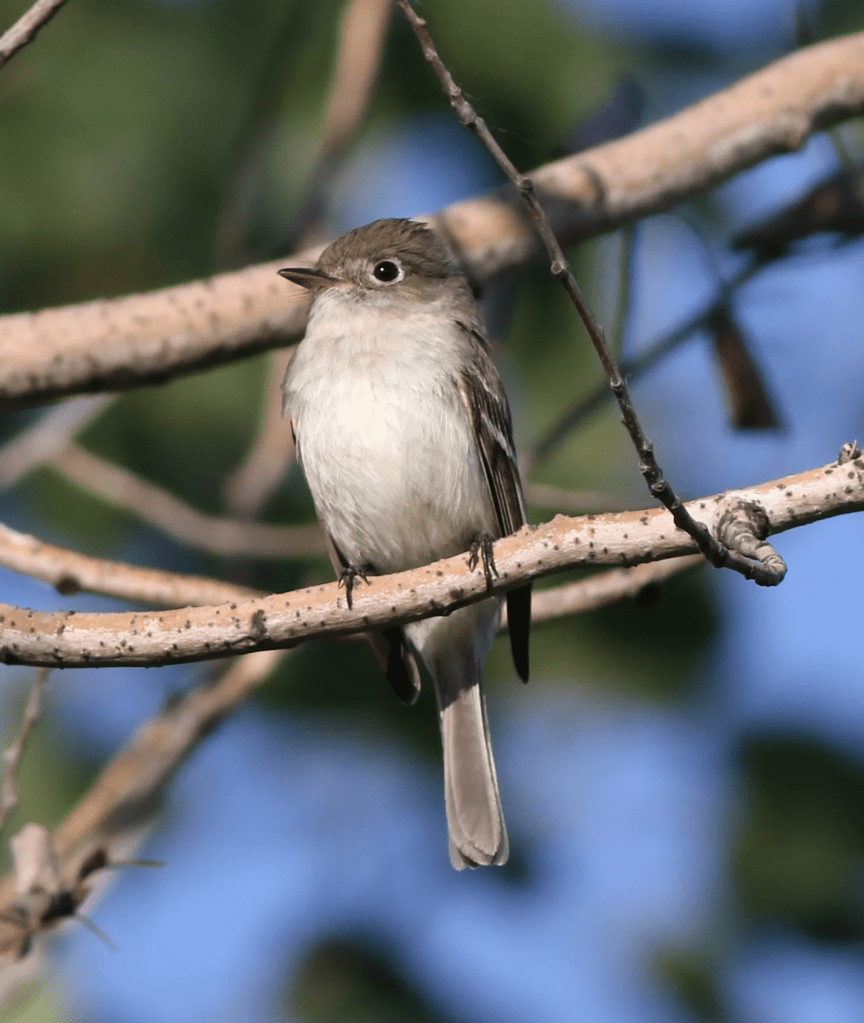
Least Flycatcher

Empidonax minimus

Also Known As:

  • Chebecker
  • Mosquero Mínimo (Spanish)
  • Mosquerito Chebec (Spanish)
  • Papamoscas Chico (Spanish)

About

The Least Flycatcher is a small but fierce bird of North American forests, known for its fearlessness in confronting birds much larger than itself, including formidable foes like Blue Jays and even hawks. They often share habitat and compete with American Redstarts, a fly-catching warbler, which they exclude from the best habitat through repeated chases and attacks. Of course, Least Flycatchers defend their territories from their neighbors as well.

However, despite their intense territoriality, these flycatchers are widely known to form dense clusters of breeding territories, even in areas with plenty of suitable habitat. Interestingly, the males closest to the center of a cluster are the healthiest, and the first to find mates. Conversely, birds that don’t join a cluster usually do not mate at all that season. While other factors may contribute to this pattern, the main influence seems to be that it facilitates birds mating with their neighbors in addition to their social mate.

Least Flycatchers are socially monogamous, pairing with a single bird during the breeding season with whom they defend a territory and raise young. But these birds are also quite promiscuous. More often than not, the nest of a mated pair will have at least one nestling sired by another male. “Spreading the love” in this way benefits both males and females — females end up with more genetic diversity in their nests, while males don’t have all their eggs in one “basket,” in case a nest fails. This breeding system, where territories are clustered together, females seek matings outside of the pair, and paired males compete for each other’s mates, has been described as a “hidden lek.” In some ways, this system is quite similar to the communal display areas, or leks, where birds like Lesser Prairie-Chicken and Greater Sage-Grouse defend small arenas to display for females.

One big difference between a classic lek and the so-called “hidden lek” of Least Flycatchers is that both the male and female in a pair are looking to mate with other birds without their own mate knowing about it. Also, the displays are a bit less dramatic. Rather than elaborate plumages, dances, and bizarre methods of sound production, these drab males instead opt to sing the same monotonous two-note song several thousand times an hour.

Threats

Though fairly common in appropriate habitat, Least Flycatcher populations have been declining since the 1970s. There are now a little over half as many Least Flycatchers as there once were. As such, Partners in Flight lists them as a Common Bird in Steep Decline. More research is needed to better understand the causes of this decline, but factors affecting the structure and health of forests probably play an important role. (snip)

Over $84,000 Raised So Far For Tennessee Librarian Fired For Refusing To Remove LGBTQ-Themed Books

Over $84,000 Raised So Far For Tennessee Librarian Fired For Refusing To Remove LGBTQ-Themed Books

Nashville’s NBC affiliate reports:

The library director who was fired for refusing to relocate LGBTQ children’s books has garnered substantial community support, with people donating over $84,000 to help her as she navigates the loss of her job. A GoFundMe launched by a community member says that the fundraiser for Luanne James is going “directly toward supporting her family’s basic living expenses during this time.”

James was the director of the Rutherford County Library until the board voted to fire her last week. The termination came after she refused to move 132 children’s books to another section of the library because the LGBTQ themes were deemed inappropriate for children. James said that she “had no choice” but to refuse the board’s request to move the books. She said that she believes librarians are being politicized and that “is not what we signed up for.”

Read the full article.

Check out the protest crowd in the video below!


About Conversion Therapy

A Christian ‘Conversion Therapy Dropout’ on the Supreme Court’s Decision

By Tyler Huckabee

On March 31, the Supreme Court sided with a Christian therapist in Colorado and tossed out the state’s ban on conversion therapy for minors. The therapist, Kaley Chiles, challenged the state’s ban on the grounds that it violated her First Amendment rights. The Court agreed with Chiles by an 8-to-1 vote.

Conversion therapy is a practice that generally involves treatment intended to “cure” same-sex attraction or gender dysphoria. Every major medical study has determined that conversion therapy does not work and often leads to serious mental health problems for patients who are subjected to it. Timothy Schraeder Rodriguez knows that from personal experience.

Rodriguez is the author of Conversion Therapy Dropout: A Queer Story of Faith and Belonging, which will be released on May 5. The memoir unpacks the eight years Rodriguez spent in conversion therapy, struggling to reconcile the tension between the version of Christianity he had been taught growing up and his sexual identity. For Rodriguez, the path to healing began when he accepted that there was no tension.

Rodriguez told Sojourners the Supreme Court’s decision is deeply personal and painful, and he hopes that his story will both help LGBTQ+ Christians feel a little less alone and help convince non-affirming Christians to rethink their convictions.

This conversation has been edited for length and clarity.

Tyler Huckabee, Sojourners: When critics talk about the harm that conversion therapy can cause, particularly for minors, what sort of harm are we talking about?

Timothy Schraeder Rodriguez: Where to begin? There’s documented research to show that anyone who experiences conversion therapy, especially as a minor, is subject to higher rates of depression and anxiety. The suicidal ideation rate nearly doubles for LGBTQ+ youth who have experienced conversion therapy, and then the long-term effect of it tends to show up in the inability to create lasting relationships, substance abuse, all those kinds of things. It’s a very devastating practice in the sense that it attacks body, mind, and spirit. When all three of those parts of yourself have been attacked, disengaging from the harm that that causes takes a lot of time and a lot of real therapy. But a lot of folks who have experienced conversion practices are untrusting of therapeutic spaces.

What arguments did conversion therapy advocates use that convinced the Supreme Court to side with them?

They were able to successfully reduce the idea of what the role of a therapist in a therapeutic setting is: that it’s just a space for conversation, that this is a free speech zone, that this is a space where we should all be allowed to say what we believe. Really, it shifted the definition of what happens in therapists’ office from approved therapeutic practices, to saying, “Well, actually, if a therapist has a different viewpoint, they should be allowed, with their First Amendment right and religious freedom, to be able to interject their own thoughts and go against what has been the conventional therapeutic practices.”

Tell me about your experience with this practice. You call yourself a conversion therapy dropout.

Yeah, I grew up in an evangelical Christian home in Illinois and was insulated in the evangelical Christian culture of the late 1990s and 2000s. Not much was said about homosexuality, but everything around me led me to believe that to be anything but straight was a problem.

So, when I was 19-years-old, I finally admitted for the first time that I was “struggling with same sex attraction,” as I called it back then. I was working at a church in Washington state and was dismissed on the spot for even admitting that it was a struggle that I had. I was told that I was broken and that there was no place for people like me in churches.

I was 19. 

No one forced me in [to conversion therapy]. I opted myself in because I thought that was the only option someone like me had to maintain my relationship with God, my family, my community, the church.

I first was involved with the organization under the umbrella of Exodus International. It was an online forum that existed for folks who didn’t have access to a local ministry in their area. I was a part of that for about a year. I did talk therapy with a therapist for eight years, and then when I moved to Chicago and had access to in-person ministries, I started going to in-person support groups. And then all throughout that, I also attended an annual conference put on by Exodus that was their flagship event. It took a lot of different forms over eight years. It was a wild journey.

When somebody like me hears about conversion therapy, we assume a lot of Jigsaw-type Saw torture traps with gay people being violently forced to recant their sexuality. But in reading your book, you describe it as a process that can be deceptively gentle and cloaked in the language of love and acceptance. You even found some community there.

The experiences that people see portrayed in movies or documentaries—just the lore of conversion therapy—those do exist. But when I encountered conversion therapy, it was much more insidious. I was in talk therapy. I thought I was talking to someone who was trying to help me process my past, but all the information that I gave my therapist was weaponized against me and used as proof as to why I was struggling with what I was struggling with.

And so, from that side, you know, I was trained to moderate myself, to police my mannerisms, to change my behaviors, to change my interests, to try to be more like a man, all those kinds of things. And then there was a spiritual component to it: Pray, seek God, do what all good Christians are supposed to do.

And there was a community component to it. I think it was probably the thing that I’m most grateful for that I got out of it, but also the most dangerous. Most of us were on our own little islands and had no one around us who knew what we were going through. And when we’d go to these groups or go to these events, we’d be around hundreds or thousands of people who were facing the same struggle. There was a camaraderie in the community that formed. Most of us didn’t realize it then, but that was the first time we were ever really, truly experiencing queer community and what it was like to be around others who are like us. Even though we were trying to do all we could to not be ourselves, there was still that underlying connection that bonded us all together. As harmful as all of it was, some of the closest friends that I have in my life today are people that I met in conversion therapy. We were in the trenches together.

But there was an underlying sense throughout all of it that I didn’t measure up, that something was wrong with me because I wasn’t experiencing the change that other people experienced. They were really good in those settings at bringing people out to share their testimonies: “Hey, I went from darkness to light, and here’s my wife and kids! God really can work miracles!” There was this whole system of shame, self-hatred, and self-doubt. But on the surface, it was hard to see that at first.

What was your breaking point with this process?

After eight years, I had done everything. I followed the rule book, and I was also working in evangelical Christian megachurches. I was becoming a rising star in that space for helping churches understand digital marketing and communication. The whole time, I never questioned the program. I was always taught to question myself. If there was something that I wasn’t experiencing, it wasn’t because the program was wrong; it was that there was something in me that wasn’t adding up.

So that was just this constant state of depression and anxiety and fear and all those things raging. I started drinking a lot. I was just a shell of a person. I threw myself into my work, and thought maybe if I just work hard enough, God will finally do the work that I wanted God to do in me.

I was at a big Christian conference—Catalyst—and there was a pastor speaking there, talking about how we needed to fight against gay marriage, that we needed real men, no more sissies, that we needed to fight the gay agenda. And I watched this whole stadium of people erupt and stand on their feet and cheer, knowing that they were talking about me. That led me to have a nervous breakdown.

It just came to a point where I thought I would rather end my life than keep going. But thankfully, I chose to end the way I had been living my life and decided to figure out how I could integrate my faith and sexuality, quit conversion therapy, and figure out what it could look like to become a gay Christian.

There were—especially during the late 2010s—not a lot of openly gay Christian blueprints to follow. Today, many parts of the church obviously remain very hostile to the LGBTQ+ community, and that feeling is often understandably reciprocated. What’s it like having a foot in both worlds?

It’s the weird experience that we carry. I understand why queer people leave the church when they come out, because they’ve been told their whole lives by this particular religious community that they’re broken, that God doesn’t love them, that there’s not a place for them. Why would you want to stay there?

Thankfully, right after I dropped out of conversion therapy, I was connected with Q Christian Fellowship—it was called the Gay Christian Network back then—but it’s one of the leading organizations that’s working with queer Christians to help them reconcile their faith and sexuality.

I went to one of those conferences in 2010, and it was such a weird experience, because it felt just like Exodus or any of the other conferences I had gone to, except it was OK for me to have a crush on other attendees and admit it [laughs]. 

It just exposed me to a whole new way of reading the Bible, understanding what scripture says, and just seeing other folks who were still engaged with their faith. It gave me the hope and courage that I could find affirming spaces where I could be loved and accepted just as I was as a gay man.

So, given all of that, tell me about how it feels to see this ruling come from the Supreme Court, largely on the pretext of religious freedom. I imagine this feels like the war that you experienced within yourself for so long made manifest in the legal system.

It’s disheartening, but it’s not surprising. As long as the church continues to other people and to draw lines around who is accepted, this will, sadly, be a fight we’ll have. I am grateful, though, for the churches that have made room at the table for queer people and that have courageously gone against the conventional wisdom.

But the Christian nationalism that we’re experiencing today is emboldening people to do a lot of horrible things in God’s name. I think people like me are very frustrating to them, because it would be a lot easier for their narrative if I were a person who had been in the church and left it because now I’m gay and hate the church.

But there’s a growing number of us where that’s not the case. We still love God. My relationship with God is stronger today than it ever was when I was in conversion therapy. I’m being fully honest with who I am and who God created me to be.

I hate that my story and my book are very relevant right now, but I’m grateful too. I didn’t have those mentors or those people or that guidebook to follow when I was on this journey early on. I can hopefully help others like myself—that younger version of myself—to know that you know who they are, loved just as they are.

For any queer people reading this—maybe they’re out, maybe they’re not—who are scared or alone, what would your message be?

Take care of yourselves, keep your chosen family close. There are affirming church communities out there. Church Clarity is a great resource that can help you connect with those if you feel like you need that kind of support.

But church can be complicated. Tony Campolo said at that Q Christian conference I went to that the church may be a whore, but she’s your mother. And so remember that what the church did to you is not how God feels about you, and it’s not the truth. Remember that God is love, and God loves you just as you are.

And for folks who have experienced conversion therapy, this is a time for all of us to be emboldened to share our stories. Our lived experience is the thing that can counter all the narratives that are out there now. We can bring a human face and voice to what this decision means, and hopefully, our experience can help the next generation.

I get the sense that there are a lot of Christians who, inside, wish they could be affirming, but don’t feel like they can, maybe because of their jobs, or their community, or just because they feel that the Bible doesn’t allow them to be. That’s a place I know that you yourself were in for quite a while as well. What would you say to them?

Listen to our stories. Talk to queer Christians who have walked this path. Matthew Vines’ book God and the Gay Christian is an excellent starting point just to understand how you can start to look at scripture in a different way and examine all the things that were shoved down all our throats about how we were taught to believe.

Also, look at churches that are affirming and learn from them. See what they’re doing and how they’ve chosen to read scripture and care for and love people.

I didn’t know that affirming denominations existed. I mean, I knew that they did in the ether, but it was a foreign world to me. And I think one of the challenges, particularly for those churches now, is to really become bold in their stance and in how they are speaking about these issues. It is a life-or-death issue, and I think many mainline denominations that have historically been affirming can tend to rest on their laurels. You just start thinking: “Hey, we’ve got this. We’re good. Everyone’s welcome.” But someone like me, who’d never set foot in a church like that, doesn’t even know how to even begin to navigate that space. We see your rainbow flags. We see the “All Are Welcome” signs. But I think that we need some love and coaxing in, just because it feels like we’re crossing an enemy line going into those churches. It felt that way for me at first.

https://sojo.net/sojoshare/MTUyNXwyMzgzOTl8MTc3NTI0MzM0M3w5