
(It dropped Nov. 4; I ran across it in my peace music search last night. 🤷 All the usual keyboard safeguards, please.)
Category: Children / Kids / Minors / Teens / Family
ICE Agents Invade School To Arrest Teacher In Front Of Kids
What I find deplorable is the fear they caused to the young children all to “capture” a woman who is working and has paperwork allowing her to be here. But the ICE thugs seem to get bounties for each person they snatch. She was a teacher there. How is this the going after the worst of the worst and removing dangerous criminals from the streets? Plus notice that the FBI is now warming of masked criminals pretending to be agents or officers to do crimes. As Emma says that was totally being predicted as kidnappings and trafficking’s of young people and children would start happening. Hugs
Eating On A Strict Budget
17 Great Depression recipes people still cook today during hard times
These recipes are resourceful and delicious.
The Great Depression, which lasted from 1929-1939, caused economic turmoil worldwide. Families struggled to feed themselves, and went to extreme lengths to stretch food and utilize all available ingredients.
Known as the Greatest Generation (those born between 1901 and 1927), their resourcefulness resulted in a number of creative (and delicious) recipes that remain relevant today. Home chefs and bakers shared their Great Depression recipes on Reddit that have been passed down and are still enjoyed today to help others get inventive and save money.
From soups and stews to cakes, these are 17 Great Depression recipes to try.
Soups, Stews and More
Beef and Noodles
“My grandmas go to: Bag of egg noodles 1 can of creamed corn 1 can Campbells chicken noodle soup 1 lb ground beef. Salt and pepper to taste. Brown ground beef, add all other ingredients, add enough water or light chicken stock to cover noodles if needed. Bring to boil, and reduce to a simmer for about 15 minutes, take off the heat and let it rest 10 minutes before serving with buttered white bread. I still make this to this day. My kids loved it too. Basically homemade Hamburger Helper.” – -__Doc__-
Hoover Stew (but we could call it Trump Stew, these days)
Ingredients
1 box noodles
A can of tomatoes
1 package of hot dogs, or 1 can of sausage or meat
A can of corn, peas or beans
2-4 cups water
Instructions
“Mix all ingredients together in a pot until boiling. Then simmer for 15-20 minutes until the noodles are tender. If you have aromatics, onion and garlic would be a great addition. If not, the recipe is great as is.” – Josuaross54
Zaprezna soup
“Depression soup… make a roux, add salt pepper and caraway seeds. Add water to make a thick soup texture. Use an egg or two mixed with flour and salt pepper and mix together to make dumplings.. drop into the soup to cook.. This was called zaprezna soup or depression soup. We ate it often in the 60’s after my dad abandoned us. Money was short but this soup was good.” – User Unknown
(snip-MORE on the page; SOS is next!)
Peace On Friday
As mentioned Wednesday, Bee observes the Global Strike for Gaza on Thursdays. So we had our Bee blog for Thursday then. And here is Peace Music from Scottie’s Playtime, for both today and yesterday, here.
For Thursday, enjoy some Three Dog Night:
Michael Seidel gave a great suggestion, so here it is for Friday: Rock On For Peace!
Music For Peace
From Bee:
Snippet From This Post:
“On Tuesday, I commented on Scottie’s Playtime that I believe we create what we focus on. I believe focusing so much on those who want to divide us the people to gain from the division we give them the power they think they deserve.
That’s why I feel that music, poetry & stories with a vision for a better world are so important.” (snip-go listen to Bob Marley, and read the provenance of “One Love”!)
=====
The above song was-maybe Dixie Chicked?-in my area, as I heard it for the first time last night on Bee’s blog. It’s good, and it should have been on the radio, but somehow, it just wasn’t. Interesting, no?
=====
Here is my own choice for this post. Peace & love! ✌ 🫶
The Great March To Transvaal, Apartheid Condemned by U.N., Draft Cards Ignited, & Iran-Contra Denied On This Date In Peace & Justice History
| November 6, 1913 Mohandas K. Gandhi led 2500 ethnic Indian miners, women and others from South Africa’s Natal province across its border with Transvaal in the Great March. This was a violation of the pass laws restricting the movement of all non-whites in the country. Originally granted the rights of British subjects, Indians’ rights were steadily eroded beginning in the 1890s with the denial of the right to own property. Shortly before the March, a court in Capetown had invalidated all Muslim and Hindu marriages. Gandhi and many others were arrested and jailed after refusing to pay a fine.  The Great March to Transvaal  Mohandas Gandhi, 1915 Read about the early resistance in South Africa |
| November 6, 1962 The 17th session of the U.N. General Assembly passed Resolution 1761 condemning apartheid in South Africa and called on all member states to terminate diplomatic, economic and military relations with the country. The policies of the country embodied in apartheid, the strict racially separatist regime, were declared a threat to international peace and security.   Apartheid was the racially separatist regime under which black and, to a somewhat lesser extent, so-called colored South Africans, were without political, civil or economic rights. All political power and wealth were held by the white population, approximately 15% of the country. “Apartheid” is the Afrikaans word for “apartness.” (Afrikaans is the language of the Boers, or [white] Afrikaners.) U.N pressure over the years on South Africa |
| November 6, 1965 2,500 people gathered in New York City’s Union Square to witness the burning of draft cards, a violation of recently passed federal law, as an expression of resistance to the Vietnam War. Dorothy Day, founder of the Catholic Worker movement, and pacifist leader A.J. Muste spoke, identifying with the “crime” about to be committed.  Gordon Christianson, chairman of the Committee for Nonviolent Action and a World War II combat veteran, used his lighter to burn the cards. A counter-demonstrator shot a fire extinguisher at those ready to burn their cards, but they still ignited. And the counter-demonstrators shouted, “Burn yourselves, not your draft cards!” At trial, those who were arrested conceded the prosecution’s case, submitting footage of the action shot by a supporter. They made a defense under the First Amendment to the Constitution, arguing that the burning of draft cards in such a context was an act of symbolic speech. The trial judge found them guilty and sentenced them to six months in federal prison. |
| November 6, 1986 Although an American plane with supplies for the Nicaraguan contra insurgents had been shot down the previous month, and a Lebanese newspaper reported that the U.S. government had arranged for the sale of weapons to Iran, President Ronald Ronald Reagan denied involvement (“. . . a story that came out of the Middle East, and that to us has no foundation . . . .”) in what came to be known as the Iran-Contra scandal. Both the ongoing aid to the contras and the weapons sales to Iran were violations of U.S. law.  |
https://www.peacebuttons.info/E-News/peacehistorynovember.htm#november6
Wednesday Music For Peace
Bee posted a couple of versions of a wonderful peace song. I’m going to re-post them underneath the reblog, because this song should be heard, and it’s very beautiful in another language. I recall the English version during the runup to and invasion of Iraq by the US, but never heard the German version until last night. Enjoy! ☮
A Couple From Waging Nonviolence
WNV linked each of these. Here are the original pages with snippets.
After No Kings, It’s Time to Escalate by Eric Blanc
We need bigger—and more disruptive—nonviolent campaigns that can go viral and peel away Trump’s pillars of support Read on Substack
American democracy is on the ropes. Trump and his billionaire backers are doing everything possible to transform our country into an authoritarian state like Hungary or Russia, where the trappings of institutional democracy mask brazen autocratic rule.
Our president’s sinking popularity numbers might not matter so much if his administration is either able to ignore electoral results or to distort the electoral map so badly that there’s almost no way to vote Republicans out.
Far too many Democrats and union leaders naively hoped that the courts would save us. But the Supreme Court has given a green light to Trump’s power grab, and it appears poised to overturn Section 2 of the Voting Rights Act, the last major legal roadblock to prevent Republicans from disenfranchising millions of Democrats and Black voters across the South.
Are we cooked? Trump would certainly like us to believe he’s unstoppable. Faced with the administration’s relentless offensive against immigrants, free speech, public services, and majoritarian rule, it’s normal to sometimes succumb to despair. But there’s no need to throw in the towel — and there are concrete next steps we can all take to win back the country through nonviolent resistance. As Chicago Teachers Union (CTU) president Stacy Davis Gates reminds us, Trumpism “won’t be stopped just in the courts or at the ballot box.” (snip-there is MORE on the page linked at “Read on Substack” above)
=====
The introvert’s guide to fighting for democracy by Protect Democracy
Six ways to protect democracy — without attending a protest Read on Substack
If you’re reading this, you’re concerned about our democracy’s slide into authoritarianism — and you want to do something about it. Wahoo! You’ve taken the first and most difficult step: committing to action.
Now come the fun parts.
I want to be really clear on a couple things to start out. First, there is no one-size-fits-all best way to exercise your First Amendment rights of speech and association. Every successful social movement has employed a wide variety of tactics and repeatedly adjusted to respond to facts on the ground. Opt for action over agonizing about optimal tactics.
Second, be realistic. We are all busy. Reflect on the commitments you can actually sustain with room to grow. It is far better to regularly move the ball forward on a smaller effort than to dive into and never complete an ambitious one.
Third, be unique! You have unique talents, skills, and passions. Let those guide your advocacy. Focus on projects that bring you joy, things you actually look forward to engaging with week after week. Lean into the comparative skills and expertise you bring to the movement.
With all that in mind, here’s a short list of six ways everyone can protect democracy — even (especially) if going to a protest or some other more public form of engagement isn’t for you.
1. Check in with your local library
Local libraries are the backbone of an informed democratic citizenry, and they provide crucial resources for underserved communities. But their funding is under attack by the administration, which has cut critical funds nationwide.
So, give the library in your neighborhood a call. See how they are doing in relation to funding cuts and if there are ways you can support them. Do they take book donations? Need volunteers? See if there are teach-in or reading groups you can join — or even lead. Offer to help curate pro-democracy reading lists for various ages. Many libraries are open to suggestions for books to add to the collection — here are some recommendations from our team.
2. Fill the gaps left by government programs
Taking care of one another is essential movement building. Check in on your food pantry and community kitchen — many of which have faced funding cuts — to see how you can help. (snip-MORE at the page linked above: “Read on Substack”)
=====
And more from Waging Nonviolence.org
For Peace!


“Community Care Starts With Us”
These are among the truest words ever spoken. From Momsrising’s blog, here are resources: we should share them far and wide so that people can at least get by. I write letters and make phone calls with Momsrising; this is good and vital information. And, you don’t have to be a mom to use, share, or help anyone with this info! It’s for all. -A
==========
We moms shouldn’t have to hold the nation together on empty.
Yet here we are in the middle of a government shutdown that has thrown families into chaos. SNAP benefits are being cut; air traffic controllers,
We moms shouldn’t have to hold the nation together on empty.
Yet here we are in the middle of a government shutdown that has thrown families into chaos. SNAP benefits are being cut; air traffic controllers, military school teachers, families in several states are losing child care as Head Start centers start to close; and other federal employees are facing another missed paycheck (while still showing up every day, keeping our country running!). WIC is barely hanging on by thread, and rising costs are pushing families past the brink.
Moms are holding it all together and we see you!!
We see your strength. We see your exhaustion. And we know that love shouldn’t have to come with this kind of struggle.
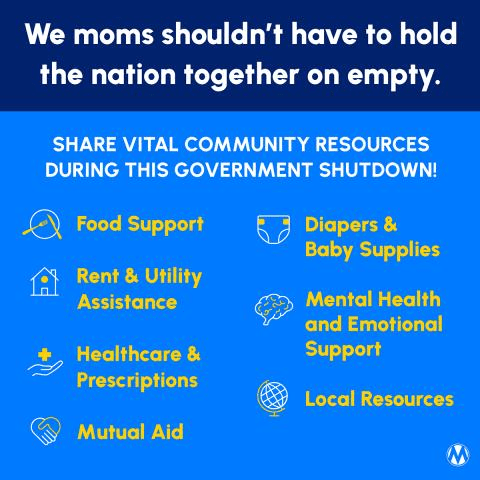
While the Trump Administration continues to play politics with families’ livelihoods, we want to make sure you have support right now while we keep up the fight.
- Food support: Feeding America food bank locator
- Diapers & baby supplies: National Diaper Bank Network
- Rent & utility assistance: 211.org
- Mental health & emotional support: Postpartum Support International or dial 988 for free, 24/7 support
- Healthcare & prescriptions: NeedyMeds.org or find a community health center
- Local resources at FindHelp.org; Discover free or reduced-cost housing, healthcare, and more!
- Community aid: MutualAidHub.org Connect with mutual aid networks near you
- Text HOME to 741741 for FREE, 24/7, confidential mental health support via text through Crisis Text Line
- Take action through mutual aid with NoKings
You are not alone. You are not invisible. And you should never have to carry this weight without care and community surrounding you.
We see you. We’re with you
Community care starts with us! Share this list so more families can find the help they deserve.
We know this shutdown is taking a toll. Your story matters. If you are being impacted by the shutdown, SNAP cuts, or rising costs, please share your story with us! When moms speak out, leaders listen!

