
Think I’ll go outside for a while, and just smile! And pick up the branches, put the bird feeders back out, etc., etc. I am so very thankful our storms were not nearly so bad as was forecast as possible-to-likely! I hope all of us are able to find beauty today!
Category: Climate / Environment
Someone Is Helping Control Data Center Development
‘Nobody’s negotiating for the people here’: comedian Charlie Berens takes on AI datacenters
Sun 17 May 2026 07.00 EDT
Last summer, journalist turned comedian Charlie Berens started getting social media messages from concerned Wisconsin residents about plans for a massive datacenter campus in their state.
The developer, Vantage Data Centers, claimed the $8 bn project would largely run on zero-emission energy resources like solar, wind and battery storage. The company said the campus would bring thousands of temporary construction jobs and potentially more than 1,000 permanent jobs to Port Washington, a city of 13,000 people about a half-hour north of Milwaukee. Residents opposed the project for what they said was lack of transparency and criticized the lucrative tax incentives offered to Vantage. They worried about the strain on local water and energy sources from an enormous 1.3-gigawatt project that could ultimately span 1,900 acres.
Berens, who shot to internet fame with his “Manitowoc Minute” videos that play on midwestern quirks and stereotypes, had his own reservations about the artificial intelligence datacenter boom. A Milwaukee-area native who still lives in the city, he’d heard about the potential environmental hazards, the steep rise in energy costs for neighbors and noise pollution, among other risks.
When he Googled, he found that lawmakers in his state had paved the way to make the Port Washington project a reality. The deal between Port Washington and Vantage gave an estimated $458m in tax breaks to the developer over 20 years to fund infrastructure for the project, with the city not seeing any of that tax revenue during that period.
“It was shocking,” Berens said.
That’s when he decided to do something he had rarely done before: discuss politics in his videos. He used his platform to address one of the more polarizing issues in contemporary life: what AI portends for Americans.
In August 2025, Berens published his first “Manitowoc Minute” video on AI datacenters. The two-minute skit matched the typical style of Berens’s videos, where he intersperses facts with humor in the style of a TV news report. But he was remarkably direct in his critique of big tech. Sporting a Green Bay Packers tie, he lambasted Silicon Valley CEOs, accusing them of using Wisconsin as a “dumping ground” for datacenters at the expense of the state’s cherished natural resources while evading any type of public scrutiny.
“It is our civic duty to make sure the billionaires become trillionaires,” said Berens in a satiric bit.
He channelled his outrage at lawmakers in Port Washington, a historic city on the banks of Lake Michigan and once home to thriving fishing and shipping industries. In a contentious vote last August, officials there approved the initial $8bn datacenter campus despite strong resistance from residents. (The project later expanded to a $15bn joint venture with OpenAI and Oracle, one of the Trump administration’s showcase “Stargate” megaprojects.)
“I was shocked at how many people I saw speak against this [at public meetings he watched online] and then to see a unanimous vote for it,” Berens said. “It just felt like an imbalance of democracy.”
The video went viral, garnering more than 2.5m views on YouTube alone. Berens’s inbox was soon flooded with messages of support from Wisconsinites of all political stripes – self-declared Maga supporters, avowed socialists and everyone in between – sounding the alarm on datacenters.
“It was 99% positive comments, which doesn’t happen on anything these days,” said Berens. “From that point, I decided that I should do more because nobody’s negotiating for the people here.”
Berens has since thrown himself into the cause, routinely publishing videos and headlining well-attended events with field experts and anti-datacenter activists. He has quickly become the most famous face of a burgeoning movement in Wisconsin, where resistance to these projects – Port Washington is just one of seven hyperscale datacenter projects across the state – has risen dramatically in the last year. A March survey from Marquette University Law School found that nearly 70% of registered voters in Wisconsin say the costs of large datacenters outweigh the benefits they provide, a remarkable shift from last October when that figure stood at 55%.
The attention has placed the comedian in the crosshairs of most of the state’s labor unions, pro-business groups and much of its political establishment, who argue the badger state cannot afford to be left behind in the AI arms race.
In a series of interviews, Berens laid out why he decided to jump head-first into the movement; his case for how big tech destroyed public trust through hard-armed, often secretive tactics to push forward datacenters; and what he has learned as he has crisscrossed the state and toured the country.
“Every step of the way, the more people look, they’re seeing that this is not really a fair fight here,” said Berens.
‘Protecting the people’
On a late winter evening in March, hundreds of people packed a community center in Juneau, a tiny rural town about 45 miles north-east of the state capital, Madison.
The crowd had assembled for a “people’s town hall” to address a $1bn Meta datacenter that has pitted residents of nearby Beaver Dam against their elected officials. The featured speakers ranged from community activists to a former Meta employee. The main act was Berens, who squeezed in the appearance between stops in Iowa and Vermont on his standup comedy tour.
“This is the most bipartisan issue since beer,” he said in opening remarks.

In his roughly 15-minute speech, he called for more regulation of AI, pointing out that a beloved Wisconsin staple, bratwurst, was more heavily regulated than the trillion-dollar industry. Berens warned the audience of the risks of AI technology, running through a slideshow of news headlines that highlighted the potential, and very real, harm to children. He also addressed his critics.
“I will stick to comedy when our politicians stick to policy and stop protecting big tech and start protecting the people that put them into office,” said Berens, to applause.
As he turned his attention to the project in Beaver Dam, he attacked Meta’s use of a shell company and nondisclosure disagreements (NDAs) that required secrecy from some public officials in the process of getting to an approval. In April 2025, a report found Meta was the mystery tech company behind Degas LLC, the listed corporation on the development. By November, the company acknowledged they were behind the project.
Meta’s practices in Beaver Dam are part of a larger pattern across the state, where datacenter projects have often been developed in secrecy despite their huge price tags and massive footprint on communities. A recent investigation from Wisconsin Watch, a non-profit news site, found that NDAs have been signed in at least five cities in Wisconsin where AI datacenters are proposed or under construction.
Another panel speaker that night was Maily Kocinski, a lifelong Beaver Dam resident whose farm lies less than 2 miles from the 700,000 sq ft datacenter campus construction site. Last June, she posted a TikTok video after a creek that runs on her property had gone dry one morning. The water came back, but occasionally appeared milky white and gave off a toxic smell. Kocinski said she contacted the state’s department of natural resources on several occasions and was told the agency collected water samples but were not always able to reach her property in time before the water cleared up again.
She personally commissioned a water analysis in February from a lab at the University of Wisconsin-Stevens Point, which found metal levels in her well water above what was considered safe to drink, per recommendations from the Wisconsin department of health services. She questions whether the daily controlled blasts on the construction site led to disruptions in her water supply. Meta commissioned its own study in response, denying any link.
A spokesperson for the Wisconsin department of natural resources confirmed that the department collected a water sample at Kocinski’s creek last November. The results, shared with the Guardian, show elevated metal levels but the department did not speculate as to the potential cause.
“Without a site specific review, the DNR cannot speculate on the role of the blasting on the aquifer and Ms. Kocinski’s private water supply,” the spokesperson said in a statement.

Kocinski, an elementary school teacher, said since last fall, she has spent up to 15 hours a week researching the large-scale construction of datacenters and the potential environmental harms they can wreak in a community. In March, she testified in the Wisconsin senate in favor of a datacenter oversight bill that ultimately failed to reach a vote.
She said she had never met Berens before the event in Juneau but the two had been in regular contact for months after she cold-emailed him her story.
“Charlie has really put in the work to understand this issue,” said Kocinski. “Most people came to Juneau probably because he was there, but they stayed and maybe learned a bit about these things [datacenters] … That kind of education leads to action.”
The risks of speaking out
As Berens’s critiques of datacenter projects in Wisconsin have gained traction with the public, he has faced pushback from the state’s trade unions, who welcome the thousands of temporary construction jobs that typically come with a project.
A major Wisconsin labor leader called out Berens in a December op-ed in the Milwaukee Journal Sentinel. “For us in the building trades, data centers aren’t some big, scary mystery,” wrote Emily Pritzkow, head of the Wisconsin Building Trades Council that represents nearly 50,000 workers in the state. “They’re high-skill, long-term work. The kind of work that feeds families, pays mortgages, and sends kids to college.”
Local governments have weighed in too. In Port Washington, city officials posted a “fact sheet” online to “clarify some lingering misconceptions” after Berens posted a second video urging residents to question officials about the datacenter project at an October council meeting.
Ted Neitzke, Port Washington’s mayor, expressed frustration with the attention that Berens’s videos had brought his city. He noted that more than 100 people began showing up at council meetings after the comedian published his first video last August, forcing the city to move them to a hotel conference center with an added police presence.
“After Charlie Berens’s video, things escalated very rapidly, very contentiously, and our city was besieged with people from outside of our town,” said Neitzke. “Charlie Berens created chaos for us.”
Neitzke also challenged some claims Berens has made in his videos, including those about the amount of jobs the project would create, its environmental impact and whether residents’ power bills would increase.
“I don’t know where the line gets drawn between factual and embellishment for him,” said Neitzke. “There’s a very gray area between the entertainment and the facts.”
Berens defended his videos and the people who showed up to council meetings in response, noting that a hyperscale datacenter affects not just one city but the surrounding communities and “they deserve a say too”. He maintained that his videos were well-researched and cited news articles to back up his claims.
“I informed people about a massive AI datacenter going up by adding some punchlines,” said Berens. “If the truth brings chaos, that seems like something the mayor would want to take accountability for.”
Neitzke met with Berens last fall in an attempt to find common ground. The mayor described the two-hour meeting as cordial but both left in disagreement. He has been the project’s greatest champion, referring to it as a “transformative” development for the Rust Belt city, one that has the potential to once again make Port Washington a hub in the midwest.
That stance has drawn some fierce public opposition, even leading to an attempted recall effort over the $458m tax incremental finance, or TIF, district with Vantage. Under the deal, Vantage will pay upfront costs for the development and the city will reimburse the company with new property tax revenues over a period up to 20 years. Neitzke said he was no fan of TIFs but called them a “necessary evil” in negotiations to win the contract over other cities chasing major developments to boost revenue.
“This is a save our city strategy,” said Neitzke. “[Berens is] doing what he does, and we’re going to do what we’re doing.”
Berens has also faced criticism online from those who say the comedian has built his career on tech platforms, while looking to close the door to their projects in Wisconsin. He said he “understands the irony” but wants to use his sizable platform to educate his audience on these types of developments that could remake their communities.

Advertisers, too, have noticed his shift to politics. Berens acknowledged that he lost a major brand deal with a company that did not want to appear alongside his anti-datacenter content, though he declined to name the business.
“I’m asking for transparency. I’m asking for honesty. I’m asking for people to get informed,” said Berens. “I’m trying to facilitate that and if that at the end of the day means I lose everything, then so be it.”
A personal evolution on AI
Berens was not always an AI pessimist.
A few years ago, he believed the utopian vision laid out by AI luminaries like OpenAI’s Sam Altman, who spoke of how the technology could be used to cure social ills, even to treat intractable diseases. Berens thought maybe it could also help Wisconsin deal with its Pfas contamination issue. “My interest in AI started with a lot of hope and optimism actually,” he said.
That sentiment eventually turned to cynicism as, he claims, the industry’s billionaire CEOs dispelled any virtuous use of the technology for the social good in favor of enriching themselves and their investors. He cited Altman’s recent efforts to create an Erotica feature in OpenAI’s ChatGPT chatbot, despite concerns even from the company’s advisers that such a tool could create a “sexy suicide coach”, according to a Wall Street Journal report.
“I thought this thing was supposed to cure cancer,” Berens said, referencing Altman’s past statements. “Is this what we’re giving our land for? Is that what we’re giving our water for? Is this what you’re asking to change our communities for?”
For him, the “tip of the iceberg” was the gold rush to build hyperscale datacenters in his state through secretive tactics and potentially exploitative agreements in post-industrial cities longing for an economic revival.
“Wisconsin created an environment that would please the billionaire tech companies,” said Berens of the tax incentives. “Billionaire tech companies took full advantage of that.”
Prescott Balch knows a bit about those types of corporate tactics. A former technology executive at US Bank turned anti-datacenter activist in retirement, Balch was on the frontlines of the successful effort to stop a major Microsoft AI datacenter project last fall in the picturesque eastern Wisconsin village of Caledonia, where he lives. In April, he won a seat on the town’s village board, beating an incumbent who supported the datacenter. He views the AI datacenter boom as akin to the dot-com bubble crash of the early 2000s, another chapter in the boom-and-bust cycles of the volatile tech industry.
“We got irrationally exuberant and built too much stuff,” Balch said of the dot-com period. “Maybe the company running your datacenter will go bankrupt. This big dollar amount that you’re chasing comes with significant risk.”
Balch’s insider expertise in the wonky world of municipal subsidies has been fundamental for Berens. Balch factchecked many of Berens’ videos on the issue, even appearing in one where he methodically crunched the numbers on these developments, referring to the Port Washington project as “up and down a horrible deal”.
The 62-year-old is, in many ways, the polar opposite of Berens. He is professorial in demeanor and careful to point out that he is not an AI alarmist. Where the two agree is a belief that there’s been an information vacuum around these projects, leaving the public largely uninformed about their size and scope. That’s part of the message they have taken on the road, appearing together at events in Wisconsin and Illinois. Berens’s celebrity has been the draw for people to turn out.
“[He] gets people interested in the topic and warms them up,” Balch said. “And I get to do the dry delivery of the financial perspective.”
Port Washington vote
On 7 April, Port Washington residents passed the nation’s first anti-datacenter referendum. By a roughly 2-1 margin, voters approved a measure that would require city officials to get approval from voters before approving tax incremental districts of more than $10m.

The effort came together after a group of residents called Great Lakes Neighbors United gathered more than 1,000 signatures in less than two weeks to get it on the ballot. The referendum does not stop the $15bn datacenter campus under construction, but would apply to all future projects above that $10m threshold. Industry advocates have warned the vote could set a dangerous precedent for municipalities across the country, potentially paralyzing AI datacenter developments.
Mayor Neitzke said the referendum makes the city less competitive and puts it at a disadvantage to vie for future projects. For Berens, the vote reflected the energy he has seen on the ground in Port Washington and in every corner of the state.
“The people who are the heartbeat of this movement are like people in Great Lakes Neighbors United,” said Berens. “These are people from all different walks and all different political stripes, but they all care about the same thing: [that] their community should have a voice.”
© 2026 Guardian News & Media Limited or its affiliated companies. All rights reserved. (dcr)
From “The White Pages”
I have appointments throughout today, so I’ve set up a few things to read. This one is interesting in that it ties several things together to show us how not only our government but our companies are selling us into thinking we might actually get some fair treatment. It piqued my interest because of the strike last week; it seems “brands” are trying to work against being seen as part of those needing to understand what we the people don’t like how things are and that we expect change. Resist-
Endless shrimp is a force that gives us meaning
The brands heard that you were lonely and would like to propose a solution
Red Lobster wants your attention. You can tell, because their current ads deploy not one but two separate announcers. There’s the expository guy. He’s a little pushy but at least he sticks to the facts. And then there’s the loud guy. He’s got a deep voice. He sounds like he’s broadcasting live from the submerged city of Atlantis. He says it with feeling, and also reverb.
“Because you’ve been asking… a lot… and we made it happen.”
So claims the not-from-Atlantis announcer. But what’s he talking about? We have been asking for many things. To be able to afford homes, for example, or not to have war crimes committed in our names, or to have our planet still exist twenty years from now.
Oh, this is about shrimp. Endless shrimp. It’s back, or so I’m told, in multiple forms. Every time the less pushy guy shares one of the currently available shrimp offerings, his partner pipes up with a complementary point straight from the bottom of the sea.
“Walt’s favorite shrimp.”
“ ENDLESS!”
“Garlic shrimp scampi”
“ENDLESS”
“Shrimp linguini alfredo”
“ENDLESS?”
“And all new marry me shrimp”
“ALL ENDLESS!”
The duo isn’t wrong. Endless shrimp is back. While the previous iteration didn’t technically bankrupt the chain (the real culprit was private equity and real estate chicanery) it was, by all accounts, an absolute mess. American consumers, who rightfully identified that they were getting ripped off in every facet of their lives, leapt at the opportunity to get one over at least one big business.
Back when Endless Shrimp was a permanent feature, shrimp hoarders would occupy tables for hours at a time, not leaving until they beat the house. The real victim of this behavior was, of course, the chain’s underpaid servers (if you walk into a restaurant with “me against these suckers” mindset, you’re less likely to view your waiter as a fellow victim of capitalism and you’re definitely not going to tip well). For the C-Suite, though, the larger concern wasn’t the dignity of their employees. It was a jumbo-sized hole in their bottom line.
It’s like The Boss once sang. Endless shrimp dies baby, that’s a fact. But maybe the endless shrimp that dies, some days comes back. Put your make-up on, do your hair up pretty, and meet me tonight at the only Red Lobster still open in your city.
I’m not all that interested in the relative success or failure of chain restaurant promotions, but I do care about the various ways corporations try to win our affection (meaningful cultural signifiers, or so I’d argue). And contra the two announcer voices, the most interesting thing about Red Lobster’s promotion isn’t the shellfish, either of the Walt’s Favorite or Marry Me varieties. It’s what’s whispered rather than shouted.
You see, the biggest difference between the current iteration of Endless Shrimp and its unprofitable predecessor is that now Red Lobster wants you to know that you (the shrimp-loving consumer) and they (the company) are in this together.
If you want the full story, I highly recommend this piece by Luke Winkie in Slate, but here’s the truncated version. There are varieties of shrimp on the Red Lobster menu that aren’t officially part of the promotion. They’re on the menu, but excluded from the benevolent blanket of endlessness. But if a customer were to ask for unlimited quantities of a non-official item (for example, Crispy Dragon Shrimp, a food item that I’m assured contains no actual dragon), the server is to welcome them into a cool secret. Their official, handbook-mandated line? “These items aren’t on the menu for this promotion, but I would be happy to make an exception for you.”
It’s like they say, “the exception is the rule.” Except literally, and by mandate. Servers are required by corporate policy to act like you and they are cheating the system, in hopes that when you remember the night you rode the dragon (shrimp), you remember it not as a conspiracy-of-one, but a sneaky secret between you and your best friend (Red Lobster restaurants, a subsidiary of the Thai Union Seafood Company).
This is not a new psychological trick. It’s a classic low stakes confidence game. The most effective way to a mark is to convince them that they are, in fact, in on the con themselves. It’s the same move that car salesmen use when they leave the room to “talk to their manager” before returning with a report that “he didn’t want me to give you this deal, but…”
It’s still striking, though, to see the strategy laid out in grandiose internal strategy documents. A beleaguered but iconic American brand name, flailing for its survival, hedges its survival on two bets. First, that you are tired, angry and aware that you’re on the wrong side of a rigged game (correct). And second, that, by offering you a facsimile of camaraderie and a very real pile of seafood, that they can win your loyalty (huh).
“[This is] about more than just shrimp,” the document proclaims. An absolute work of art, that sentence.
“[It’s] about creating an experience that says, ‘We listen to you.”
“When guests see Endless Shrimp back on the menu, they feel heard and valued.”
I have never addressed a sit-down chain’s internal strategy document, but I’m sure I speak for all of us when I say, tears in my eyes: Red Lobster, thank you. THIS is what democracy looks like.
As Eli Zeger argued in his 2020 essay about companies that talk like snarky teens on social media, this particular iteration of the “brand as friend” canard is the product of the marriage of late stage capitalism (and its reliance on the selling of “ideas” rather than goods and services) and the post-Citizen United codification of corporate personhood. Red Lobster isn’t a restaruant anymore. It’s your rule-breaking, shrimp loving, newly empathetic pal. It sees you. In fact, it is the only one who see you. It gets that you’re broke, but more so that you’re alone. It’s no longer offering you cheap shrimp (the price tag for the promotion has risen markedly since its last iteration). It’s promising you something more important– belonging, connection, a port in the storm of alienation and precarity we’re all weathering.
Red Lobster’s friendship?
“Endless”
Or that’s the idea at least. Apparently, the promotion hasn’t been as lucrative as the company had hoped, at least so far. It’s not 2016 anymore. We’re seeking something more these days. Bread and roses? Perhaps, but definitely not just shrimp.
But Red Lobster isn’t alone, in surveying a landscape of mass alienation (economic, relational, spiritual) and seeing a business opportunity. Advertising agencies are publishing unironic blogs chillingly titled “the loneliness crisis: how brands can step up?” Silicon Valley’s greatest minds heard that you wanted community and responded with sycophantic AI chatbots. Apparently, our tech overlords’ understanding of human relationships is a robot who agrees with you all the time, including when you muse about harming yourself. Even the outright scammers get it. Gone are the days of far flung princes offering you a financial windfall. As you may have experienced personally, the hot new con is… pretending to be an acquaintance and inviting you to a party.
This is a step beyond the classic commodification funnel, as documented in nineties leftist classics like No Logo and The Conquest of Cool. The brands are no longer promising a great deal, or even hipness. What’s on offer now is the dream of a welcoming community, one deep enough to solve for the isolation that the companies themselves helped create.
That’s very depressing, of course, both the reminder that our economy has always been built on the exploitation of vulnerability, and the reality that there’s just so much more vulnerability to be exploited at this particular moment.
But there’s another truth, not a counterpoint, but a complement. How fortunate, for those of us who actually want to connect with other human beings, rather than just make a quick buck off of them. We already have what every corporation in the world wishes they had– the fact that, when we offer a space by our side, to either a stranger or a friend, we actually mean it. We’re not trying to trick you into springing for a Main Deck Margarita Flight to go along with your shrimp. We’re not trying to mine your data or add you to a marketing funnel or load you up with debt and junk. We just think this world would be more navigable together rather than apart.
And as an organizing opportunity? From union drives to neighbor-to-neighbor activism to the precious few political campaigns that care more about building community than personal brand building? My goodness. Why do you keep hearing about neighborism these days, and not just from true believers like me? Because more people are admitting every day how hungry they are for connection, and then taking the risk of making an offering.
The terrible news right now is that the hucksters are going to keep selling us a flim flam simulacra of belonging. Yes, the consultants, but also (I fear) the politicians. I strongly suspect the 2028 Democratic primary to feature a million text messages about “neighbors” and “community” penned by a well-heeled K-Street consultants. But the good news is that we aren’t that dumb. We know the brands aren’t our friends. We’ve lived through the great social media con together. We know what the lie looks like, and now we’d much prefer the deeply imperfect, thoroughly messy alternative.
They’ll offer us endless shrimp. And we’ll say no thank you. We’d prefer each other, please. Even if that’s not on the secret menu. (snip-end notes, the Boss, and general other stuff on the page)
The “Tip-up Warbler”
Palm Warbler
Setophaga palmarum
Also Known As
- Wagtail Warbler
- Tip-up Warbler
- Bijirita común (Spanish)
- Reinita coronicastaña (Spanish)
About
The Palm Warbler is unusual among the Western Hemisphere’s wood-warbler family. While the majority of warblers are sexually dimorphic, with males noticeably brighter in the breeding season, the male and female Palm Warbler are nearly identical, and can be impossible to tell apart. Warblers, in general, spend a majority of their time in trees and shrubs, but the Palm Warbler is quite comfortable on the ground. Rather than hopping like their arboreal relatives, these birds take to walking or running. Like other warblers, the Palm Warbler often joins mixed-species flocks outside of the breeding season. However, though most warblers tend to flock up with other arboreal species, the Palm Warbler is just as likely to be found foraging with sparrows along hedgerows and in open weedy fields.
Palm Warblers share another habit more typical of ground-dwelling birds in that they continuously bob their tails. This behavior is also seen in other birds typical of open habitats, including the Spotted Sandpiper and Black Phoebe, where the rate of bobbing is thought to vary with the bird’s level of excitement, and thus plays a role in communication. In many ways, the Palm Warbler behaves more like a sparrow or pipit than a typical wood-warbler — even its monotonous trilled song is remarkably similar to that of a Dark-eyed Junco or Chipping Sparrow. Though perhaps an oddball among its own family, this unique bird has found a niche all its own, somewhere between a sparrow and a warbler. (snip-MORE)

An Advertising Ban. Who’d ‘a’ Thunk It?
Found it here: https://homelessonthehighdesert.com/2026/05/01/fae-day-finding-flatulence-out/
Amsterdam’s Ban on Meat and Fossil Fuel Advertising Comes Into Effect
by Martina IginiEurope May 1st 20264 mins

Over 50 cities, mostly European, have either restricted or tabled motions to introduce formal limitations on the advertisement of polluting products and services. Some – including several Dutch municipalities, Stockholm, Edinburgh and Sydney – have banned them altogether.
A ban on advertising of fossil fuels and meat products in public spaces came into effect on Friday in Amsterdam, marking the first capital city in the world to introduce such a policy.
The city’s council passed a legally binding ban on ads for fossil fuels and meat products in a 27-17 vote in January. The ban spans high-carbon products and services like flights, petrol and diesel vehicles, gas heating contracts as well as meat products like fast-food burgers across all public spaces in the city, including on billdboards, public transport and in transit environments.
The burning of coal, natural gas, and oil for electricity and heat is the single-largest source of global greenhouse gas emissions. These are the primary drivers of global warming as they trap heat in the atmosphere and raise Earth’s surface temperature. The meat industry is also responsible for a huge portion of global greenhouse gas emissions, and for nearly 60% of the food sector’s emissions. The global livestock industry alone is one of the world’s highest emitting sectors, estimated to be responsible for between 14-18% of total human-made greenhouse gas emissions.
“Advertising doesn’t just sell products; it grants social licence, shaping what we see as normal and acceptable,” said Andrea Mancuso, Community & Grants Manager at Creatives for Climate. Ahead of the vote in January, Creatives for Climate and local campaign group Reclame Fossielvrij (Fossil Free Advertising) coordinated an open letter backed by more than 100 creatives and industry leaders urging Amsterdam’s council members to fulfill its 2020 commitment to ban fossil fuels and meat ads in the city.
“Promoting fossil fuels directly undermines climate action and locks in behaviour we know must change. By becoming the first capital to legally ban fossil fuel and meat advertising, Amsterdam is drawing a clear line; and setting a global standard,” said Mancuso. (snip-MORE)
On Deciding Who To Support In A Primary
This is a thing for me: I’m one of those who says, “Watch the primary candidates. Pay attention, and make a decision based on who resonates with what I want. Do this without tearing apart the other primary candidates (in my party.)” Without tearing apart candidates who could end up winning the primary, because face it: in my state, and even here on Scottie’s Playtime, most people are not as liberal as I am. So, in the primary, I vote for who I want. In the general, so far, it’s always gonna be a Dem, and Dems have a hard enough time running against always well-funded Republicans, and who, in my state, are also the majority, passing laws to make it more difficult to elect anyone who isn’t a rightwingnutjob Republican. This is the thing I dislike about some “media” who count themselves as liberal: they make a choice based on a single issue (and, frankly, the gender of the candidates often figures in, like it or not; many like a “bro”) then proceed to eviscerate the primary oppo. This suppresses the actual vote because people take the message that everyone’s basically the same, so no point voting in the primary, or at all.
Here in Kansas, we’ve got an experienced woman running for Governor. She’s been in the legislature for a while, knows who she’d be working with, and is familiar with government law and procedure. So far, there really isn’t anything to undercut her, from what I know. She’s not as liberal as I am, but is left-moderate enough to allow me to communicate with her what I believe she should do in her work, and to actually consider it on some level. Then, we’ve got a young man running. Nothing wrong with him that I can see, either, except he’s not got as much experience in state governance. This will put him at a disadvantage working with our legislature, which might/maybe/could turn less red but likely will remain Republican majority. I haven’t decided who I prefer as yet. I know of her, not so much yet of him. I like what they each say, as far as we know from this report.
So, she did point out that he has accepted donations from CoreCivic and from their lawyers. He’s also said more than once that he will continue to oppose CoreCivic moving back into KS and opening an I.C.E. detention center. Personally, I believe a person can take some campaign contributions without becoming the donators’s best friend in government. It happens more frequently than people realize. In this system we have with no public campaign finance, the campaigns need money, and will have to take legal donations. Brava/o to anyone who truly has never done that; I know it can be done, but it’s a special district who will get out and support their candidate, with the price of running a campaign these days.
So I am not holding campaign contributions against anyone as yet. Actions speak louder than words. So far, there is nothing in either candidate’s actions that make me distrust either one. I also am not unhappy with the way this forum went as far as we know; where while the candidates pointed out differences between them, there was not out-&-out “crushing” or “destroying” or “ripping” of each other. Here’s (below) a news story about KS’s Dem. Gubernatorial campaign. What I’m most disappointed about is the number of lines given to reviewing the campaign contributions, rather than each of their answers to the other questions listed in the story below. There could have been plenty of space for that if they’d merely reported the campaign contribution issue along with the rest, rather than dwelling on it. But, even the KS Reflector is not a friend of Democrats; it’s the same sort of coverage we always get though better than known mainstream.
In the midst of the coarse political rhetoric that seems worse every passing year (and does not originate with actual Democrats!), I hope we can remember: in the primary, choose the one most close to your perfection, which means supporting them: discussing things in their favor, giving positive reasons for your support, and not eviscerating the other candidates. This works in all U.S. primary elections everywhere.After that, support the one who wins. Otherwise, we get a fkin’ Republican.
Kansas Democrats running for governor clash on CoreCivic, party establishment in forum
By:Sherman Smith-April 26, 2026
SHAWNEE — Kansas Sen. Cindy Holscher positioned herself at a Sunday night Democratic forum as the anti-establishment candidate for governor with a history of winning in legislative districts formerly held by Republicans.
Her top opponent in seeking the party’s nomination, Kansas Sen. Ethan Corson, argued he is the only one who could win in the November general election.
The candidates staked out nearly identical policy positions during the 50-minute forum at the Aztec Shawnee Theater. The questions were submitted in advance by Kansas Young Democrats.
Both support raising the state’s minimum wage, making it easier to vote, and access to reproductive health care.
And they both identified the Republican supermajorities in the state House and Senate as their real opponent.
Holscher, from Overland Park, said Republicans were unable to lower property taxes during this year’s legislative session, despite their ability to pass anything they want.
“So they keep going back to the culture war issues,” she said. “And this past session, instead of solving actual issues of affordability and putting more money in your pockets, what did we get? We got this bathroom bill. We got two Charlie Kirk bills. None of those are going to put money in your pockets.”
Corson, from Fairway, touted his endorsements from Gov. Laura Kelly, former Gov. Kathleen Sebelius, and Planned Parenthood Great Plains Votes.
“Leading candidates in the Republican Party want to take Kansas backwards on reproductive freedom, public education and so many other issues,” Corson said. “We cannot let that happen. That is why this campaign has earned the support of trusted leaders who understand both the stakes and what it takes to win a statewide election in Kansas.”
Holscher’s response: “I’m running on my record, not the coattails of the establishment.”
About 150 people showed up to hear the two Johnson County Democrats make their case for the August primary vote. A dozen or more people wore bright blue Holscher T-shirts, and at least a couple donned black Corson T-Shirts. An engaged crowd, and available alcohol, ensured a spirited reaction to comments.
They applauded Corson when he said the city of Leavenworth was wrong to approve a conditional use permit for CoreCivic to reopen its private prison as an immigration detention center.
“I believe that private prisons have no place in our carceral system,” Corson said. “I will never support a private prison being built in Kansas. I will never support an ICE detention facility being built in Kansas.”
But the loudest applause came when Holscher attacked Corson for having taken the maximum campaign donation from CoreCivic during his 2024 Senate campaign, and $5,000 from the law firm representing CoreCivic for his gubernatorial campaign.
“You can’t say you’re against private prisons or ICE detention facilities when your campaigns and personal life are intertwined with that very business,” Holscher said. “I have consistently stood with the community opposing ICE overreach. I have never taken CoreCivic money and never will.”
A spokesman for Holscher later clarified that Corson received donations of $4,000 from Anna Kimbrell on Nov. 19, 2025, and $1,000 from Ed Wilson on Oct. 27, 2025. The two are partners for Kansas City, Missouri, law firm Husch Blackwell, which represented CoreCivic in the company’s lawsuit against Leavenworth.
The start of the forum was delayed 45 minutes because the two candidates discovered the party had given them different sets of rules. Party chair Jeanna Repass declined to say what the discrepancy was, but she insisted it was “minor.”
Before the candidates took the stage amid the rumble of storms outside, there was a moment of silence for the attempted violence Saturday night at the White House Correspondents’ Dinner.
“Just remember,” Repass said, “we don’t solve our differences with violence. We do it by voting.”
Questions touched on affordability, water crisis, young voters and Medicaid expansion.
Corson said the state should invest in building 100,000 houses per year, including 5,000 in rural areas, and work to make higher education accessible to any young person who wants it.
“I’m going to be in my mid-40s, and my wife and I, every single month, are still paying our student loans,” Corson said. “So I understand what it means for higher education to be unaffordable, to feel inaccessible, and to feel like it’s crowding out all these other things that you want to do in your life, whether it’s buying your first home, starting a family.”
Holscher said she wants to hold landlords accountable for high rent and to put a cap on fees. She warned about the threat that water-thirsty data centers pose to farmers. And she pointed out that, as a member of the House in 2017, she helped pass a Medicaid expansion bill — although it was vetoed by then-Gov. Sam Brownback. She also said she worked with the bipartisan caucus that eventually overturned the Brownback tax experiment.
It was her birthday, and her supporters served cake in the lobby.
“If you want someone fighting for the people, you want someone building a broad coalition of nurses, of teachers, people in your neighborhood, farmers, veterans, union members — that’s who I have on my side, not the establishment,” Holscher said.
A Little Science On Tuesday

Copy-pasted from the blog; see more there!
Looking At This Week With Joyce Vance
The Week Ahead
April 26, 2026
Stay with me tonight. This one runs a little long, but it’s all information you’ll need.
It’s likely that much of this week will be overshadowed by investigation into what happened Saturday night at the White House Correspondents’ Dinner, where Cole Thomas Allen, a 31-year-old California man with a master’s degree from Cal Tech, approached the ballroom at the Washington Hilton armed with a shotgun, a handgun and knives, and attempted to sprint through the magnetometer security checkpoint. He was stopped there. A Secret Service agent was shot, but was fortunately protected by a bulletproof vest. It’s not clear who shot him.
The White House Press Corps, still dressed in tuxedos and ball gowns, trooped into the press briefing room at the White House to hear from the President, who appeared, flanked by acting Attorney General Todd Blanche, FBI Director Kash Patel, and others. They, too, were still in tuxedos from the event.
It’s not clear who the “designated survivor” for the event was. CBS’ Margaret Brennan pointed out Sunday morning that “Five of the top six officials in the presidential line of succession were in attendance: Vice President JD Vance, House Speaker Mike Johnson, Secretary of State Marco Rubio, Treasury Secretary Scott Bessent, and Defense Secretary Pete Hegseth.”
Trump was in good spirits as he spoke, complimenting the press and laughing about the speech he had hoped to give after dinner. It was a much more affable Trump than we’ve seen in the course of the last year as he interacted with members of the media he has often been sharply critical, or dismissive of, during his first year in office. Trump went on the attack against the press even before his January 2025 inauguration, as we discussed at the time.
This was a different Trump who spoke in a very measured fashion, far more measured than usual, almost as if he saw this incident as providing the opportunity for a reset. He respectfully took questions from reporters like CNN’s Kaitlin Collins and NBC’s Garrett Haake. He was kindly toward the press; that’s the only way to characterize it. Whether that was a momentary blip or it suggests he will try to convince the media to rebuild its relationship with him remains to be seen. He did say that the Correspondents’ Dinner would be rescheduled within a month, without seeming to understand that the Correspondents’ Association puts on the dinner and controls the event.
At the press conference, Trump was asked why this keeps happening to him—this was the third attempt on his life since he announced his run for the presidency ahead of the 2024 election. He responded that he “has studied assassinations” and that it’s the “people who do the most” that assailants go after, using Abraham Lincoln as an example. Trump said that it “only happens to impactful people” and that he didn’t want to say he “was honored” by the repeated attempts on his life, but he let the implication hang in the room.
But he did not abandon politics. As he began his comments, Trump said the incident demonstrated why the ballroom he is building at the White House is needed.
Trump reiterated his comments in a Sunday morning post on Truth Social, claiming presidents have been demanding a ballroom like the one he’s building for 150 years.


His amen corner all took up the chant on Twitter, on cue.

But, as we noted above, the dinner is run by the Correspondents’ Association, not the White House. There is no reason to believe they would use a White House ballroom for a dinner designed to celebrate freedom of the press and its independence from government. Trump can make the argument he needs a safe space to entertain, but it’s a disconnect from the event last night.
Miles Taylor commented on Threads that “The WHCD shooter will be used to justify things that have nothing to do with the WHCD shooter. Mark this moment.” That seems likely.
The immediate investigation will focus on whether the shooter was a lone wolf, as it appears, or whether there is an ongoing threat. There is reporting today that Allen was a member of a group called The Wide Awakes, who appear, based on their web presence, to be committed to “radically” reimagining the future, but look to be a group of creative, peaceful people. Law enforcement will want to determine whether someone or something radicalized Allen and directed him toward violence.
There are sure to be, and there should be, questions about the Secret Service and how this happened. Asked about that during the press conference, Trump responded that he was “very impressed by the Secret Service.” But this is the third time a would-be assassin has gotten close to Trump, and one would have expected them to tighten ranks after the first attempt. Trump, however, does not seem to have viewed any of it as a failure by the Service and he was complimentary of the D.C. police, as well, in a phoner on Fox News.
It’s important to note that the Secret Service stopped Allen at the perimeter they had established. They succeeded in that sense. The real question will be whether the perimeter should have been set further back. I’ve attended the dinner multiple times and one observes layers of security that require guests to walk up the hill to the circular drive in front of the Washington Hilton before entering the hotel, but there are parties and receptions occurring in advance of the perimeter before entering the ballroom area, and, as we now know, Allen avoided scrutiny as a guest who checked into the hotel the day before the dinner. There are real questions that will have to be confronted here to ensure protection for future dinners, to say nothing of the scads of parties that happen in connection with this dinner, and other national events that are held at the Hilton.
Late Saturday evening, D.C. U.S. Attorney Jeanine Pirro announced that Allen would be arraigned on Monday. She said he will be charged with one count of assault on a federal officer using a dangerous weapon and two counts of using a firearm during a crime of violence. That could be fluid as officials learn new information. But the charges she identifies are found at 18 USC 111, which carries a 20-year maximum penalty, and 18 USC 924(c), which carries a 7-year penalty if a firearm is brandished and a 10-year penalty if it’s fired.
The motive seemed to be coming into focus throughout the day as some of Allen’s anti-administration writings were released. On Meet the Press, acting Attorney General Todd Blanche said authorities believed the suspect may have been targeting Trump administration officials, including Trump himself. The basis for that belief appears to have been examination of electronic devices and some writings. But Blanche told CNN’s Dana Bash they were still looking at the motive.
As I heard seasoned journalists, many of them friends, discuss how frightening the shooting was on air Saturday night and Sunday morning, I couldn’t help but reflect on how much worse it is for America’s children. How many of them still suffer a lingering sense of trauma from the moment a shooter crashed into their classroom or their place of worship? If there’s ever been a time to pass sensible gun control laws, it’s now. If we’re going to play politics, as Trump did with immediately pivoting to justifying his ballroom, let’s play that kind and make some good trouble.
There will be in court developments in other matters to track, as well, this week:
This Wednesday will be the last regularly scheduled day for the Supreme Court to hear oral argument this term. The Court will take up two consolidated cases, Mullin v. Doe and Trump v. Miot, and consider whether the Trump administration acted properly when it revoked protected status for Syrians and Haitians living in this country. The cases involve decisions from New York and Washington, D.C., barring the administration from stripping more than 350,000 Haitians and 6,000 Syrians of protected legal status that protects them from deportation.
The cases hit the court just last month, on March 16. The Court allowed the lower courts’ decisions to remain in place, preventing deportations, determining that it would hear the case promptly, allotting an hour for oral argument. This has all happened very quickly, with the final brief being filed just last week on Monday.
There is also news on the voting front. Friday evening, Mississippi Governor Tate Reeves announced that he was calling a special session of the legislature so that new maps could be drawn.
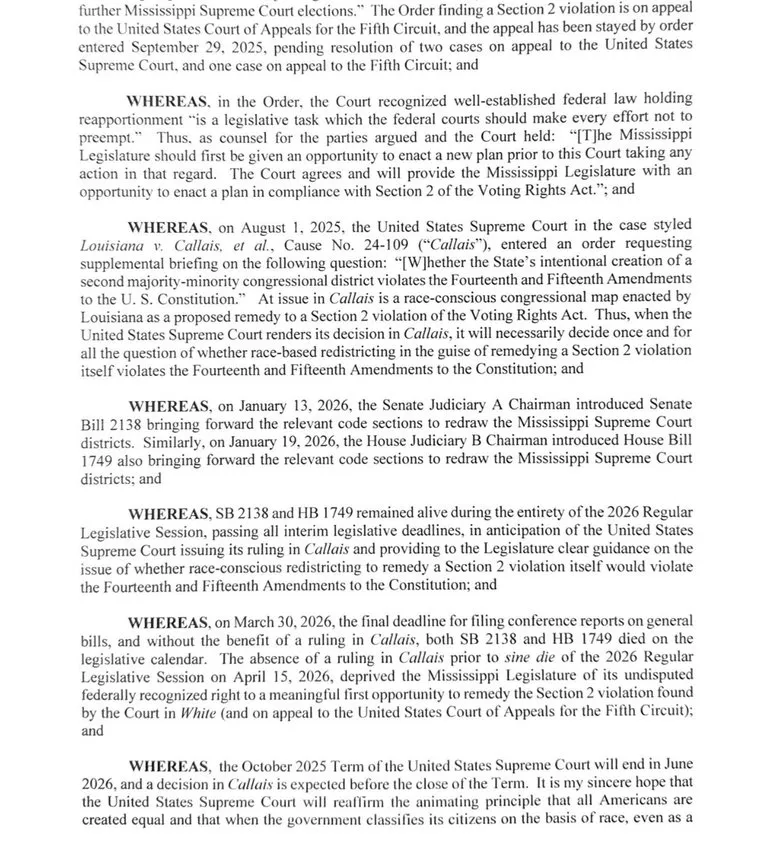
This redraw would be limited to state Supreme Court districts. A federal court found Mississippi’s state Supreme Court districts violated Section 2 of the Voting Rights Act and required the legislature to pass a remedial map. But it failed to do so during the regular session. A court hearing was scheduled for this week, and the court would have likely adopted its own map. So the Governor is calling this special session in hopes the court will hold off until the legislature has time to act.
In the election last November, voters ended the Republican supermajority in the legislature, but Republicans still hold a majority of the seats in both chambers and should be able to pass a map of their own devising. So the governor likely believes a map that comes out of the legislature will be superior to one created by the court.
And finally, the SAVE Act isn’t quite dead yet. We need to stay alert to any resurgence and be prepared to call our members of Congress to demand they resist its resuscitation. Trump is again demanding that his party end the filibuster and pass the Act, saying that not doing so will “lead to the worst results for a political party in the HISTORY of the United States Senate.” It reads as an acknowledgment that only voter suppression can save the Republican Party in the midterm elections.
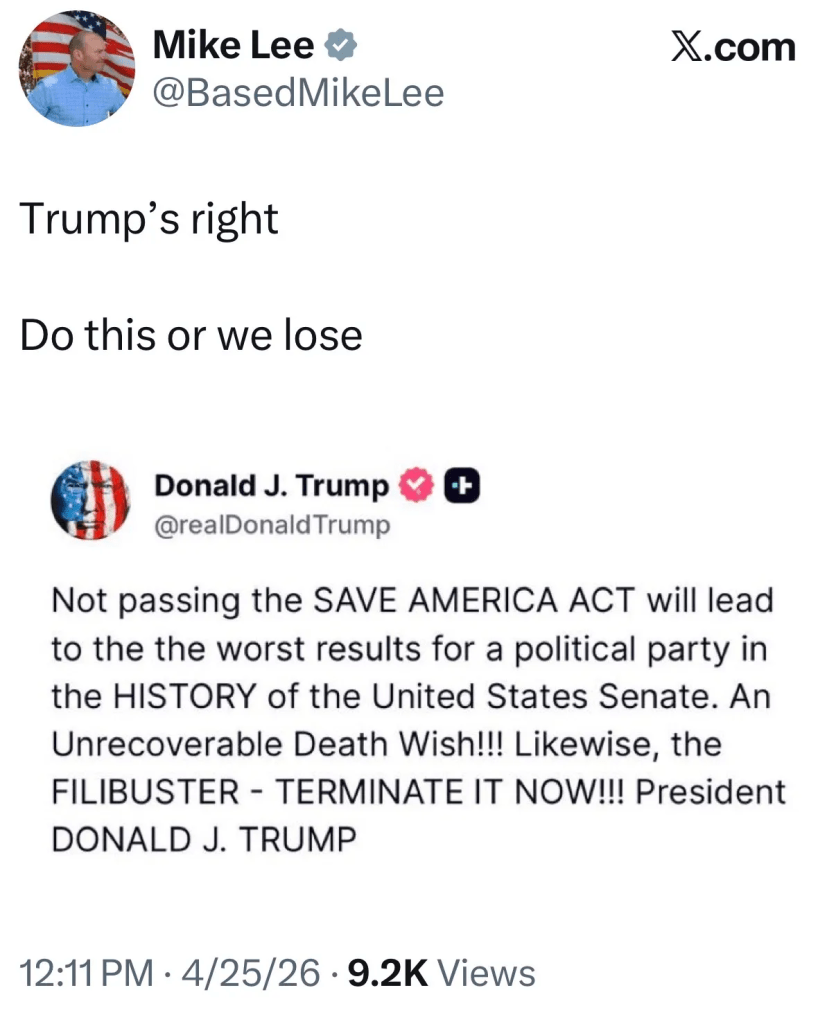
Utah Senator Mike Lee followed up on Trump’s command with this tweet. Lee is not up for reelection until 2028. But he, too, seems to sense that this will be a dangerous election for Republicans. The SAVE Act is one of the last-ditch efforts Republicans have to suppress the vote and hold onto power this year and again in 2028. There is no mention of crafting policies designed to win the hearts and minds of American voters. It’s just about keeping eligible American citizens from voting. We must do everything we can to resist that.
If you’ve found this useful, it’s exactly the work I do every week—reading the filings, tracking the arguments, and explaining what it means before it becomes obvious. The headlines will keep coming, but understanding them takes more than a glance. That’s what this space is for. My goal is to give you clear, careful analysis you can rely on. If that’s the kind of work you value, I hope you’ll choose to subscribe.
We’re in this together,
Joyce
Your Saturday Morning Birds Post
From Cornell Lab Bird Cams:
From American Bird Conservancy:
Three-wattled Bellbird
Procnias tricarunculatus
Also Known As
- Campanero Tricarunculado (Spanish)
- Pájaro Campana Centroamericano (Spanish)
About
The Three-wattled Bellbird, like other Central and South American bellbirds in the Cotinga family, is a natural history paradox. Breeding males perch on exposed branches and sing one of the loudest songs of any bird, impossible to ignore and audible from more than half a mile away. However, despite this extremely conspicuous breeding season behavior, females and nonbreeding males are notoriously difficult to observe, foraging in the higher levels of the canopy and remaining remarkably silent. As a result, this species has been subject to fascinating and in-depth studies of its song and courtship behavior, but some of the most basic aspects of its natural history are unknown. For instance, only two nests have been recorded, one in 1975 and one in 2012, and no eggs or young have been documented.
But biologists have learned a great deal from studying the Three-wattled Bellbird’s song. The bellbirds belong to a group of perching birds known as the suboscines, which also includes tyrant flycatchers like the Western Kingbird and antbirds, such as the Marsh Antwren. While the “true” songbirds (or oscines) are famous for their song-learning abilities, suboscine songs are classically considered to be completely innate, with no learning taking place. However, the Three-wattled Bellbird shares an important feature with birds that learn their songs: dialects. Birds from Nicaragua sound noticeably different from Costa Rican birds in the Cordillera de Talamanca and the Cordillera de Tilarán, which each host populations with distinct songs. (snip-MORE)

Today Is Arbor Day, 2026!
I was just telling Jill over on Filosofa’s that I’d totally missed that today is Arbor Day. I’m so sorry and a bit ashamed; DH was a tree planter, and we always did some sort of observation. This year it almost slipped by! Anyway, we can start with a couple of quotes; here are two of my favorites:
Trees are as close to immortality as the rest of us ever come.”
― Karen Joy Fowler
“You know me, I think there ought to be a big old tree right there. And let’s give him a friend. Everybody needs a friend.”
― Bob Ross
https://onetreeplanted.org/blogs/stories/inspirational-quotes-about-trees
Here at the Redford manse, we have two fine green ash trees, not young but not at all old. The Arbor Day Foundation sends (or used to) send little saplings out to elementary schools, and we took one two years in a row, then contributed the rest to the city. Anyway, those are some really nice trees! Here’s some info from the Foundation. In case Arbor Day about slipped past you, too, there could be a reason; some states observe on other days. On the page linked below, you can see that, along with when and how the rest of the world observes. Surf around the site, too; there are many resources to help us make good history with trees!
Arbor Day Dates Across America
National Arbor Day is always celebrated on the last Friday in April, but many states observe Arbor Day on different dates throughout the year based on best tree planting times in their area. (snip-see the chart on the page)
From The Farmers Almanac (a good source for so very much in life!)
Home » Holidays & Events » Minor Holidays Arbor Day 2026: What and When is Arbor Day?
Arbor Day 2026: What and When is Arbor Day?

What Is Arbor Day?
Arbor Day is a national holiday that recognizes the importance of trees. The most common way people celebrate Arbor Day is to get together in groups to plant trees. (snip)
How Did Arbor Day Start?
The day was the brainchild of Julius Sterling Morton, a Nebraskan journalist who later became the U.S. Agriculture Secretary under President Grover Cleveland. Morton was an enthusiastic promoter of tree planting, had long championed the idea of a day dedicated to planting trees.
When Was The First Arbor Day?
Arbor Day was first celebrated in Nebraska on April 10, 1874, following a proclamation by Gov. Robert W. Furnas. In less than a decade, the idea for the holiday caught on in other sates until, by 1882, its observance had become a national event. Nebraska made Arbor Day a legal holiday in 1885, moving it to April 22, Morton’s birthday. An estimated one million trees were planted during the first Arbor Day.
Many other countries around the world set aside one day each year to celebrate trees, though not all of them take place on the same day as Arbor Day. One of the oldest is Tu Bishvat, a minor Jewish holiday that usually falls in late January or early February. In ancient times, the people of Israel used this day to plant trees and celebrate their gifts by eating dried fruit and nuts, including figs, dates, raisins, carob, and almonds. (snip)
There is much more information on all of these pages. But most importantly, try to get out and hug a tree, and maybe facilitate the planting of another tree! Or draw a tree, or dream of trees…

I hope this is a fine day for all who read here!

